Tuesday, November 08, 2016

Some confusing specimen labels

kw: labels, natural history, natural science, museums, research, photographs, puzzles

This post has two parts. Firstly, of several reasons that research collections wish to have multiple—even many—specimens of a species from a particular collecting location and time, with this first set of labels I wish to explore one that is not often thought of: Lot splitting for sharing. Sometimes a collector or museum desires specimens of a particular species, and also possesses multi-shell lots of a species desirable to others. Each can extract several shells from a larger lot to trade with the other.

These labels show one interesting consequence of this. The species Planorbis duryii Wetherby, 1879, now known as Planorbella duryi (Wetherby, 1879), is a moderately desirable snail of the Rams' Horn shape. But today the shell is not the story, the labels are. I don't know the protagonists here, so I will call them Collector 1, 2 and 3 (Coll1, Coll2, and Coll3).

Coll1 collected a largeish lot of this species, numbered it #1193, and later split the lot to share portions with two other collectors, Coll2 and Coll3. One of them, let's say Coll2, received both lots and wrote labels for them, giving one to his (or her) friend, Coll3. These were numbered No. 23 and No. 24. Notice that Coll2 did not care about the county they were found in, just the town and state.

Over time, the original lot and both splits made their way into one collection, which was donated to the Delaware Museum of Natural History. Judging from the catalog number, 153565, this occurred in the late 1980's. An alert collections manager, sorting through the donated material, naturally sorted them by species (if they weren't already sorted) and noticed that they were all from one originally collected lot. So they were combined and cataloged as one lot.

What makes their labels of further interest is the location information, and this brings up the second subject of this post. The location seems to be an unknown place! Survey, Florida is not found in the GeoNames geographic name database, nor in GNIS from which it originates. But these paragraphs in an online history of Bonita Springs unlock the mystery:
(1st paragraph) Bonita Springs had its beginnings when, some time in the 1870's, government surveyors in a remote part of Southwest Florida pitched camp near a medicinal spring which the local Indians believed could heal the sick. After the crew left, the site became know as Survey and the stream running from it, Surveyor's Creek.
(4th paragraph) In 1912, a Tennesseean named Ragsdale purchased 2400 acres around Survey. He and his associate, Dan Farnsworth, surveyed the area and laid out a small town with streets and avenues named for potential buyers. There was no church, but, in 1915, a Naples minister held the community's first non-denominational service in the school house. The developers decided that the name, Survey, lacked sales appeal, so the town was renamed Bonita Springs; Indian Spring Branch became Oak River; and Surveyor's Creek was upgraded to Imperial River
Without the Internet, it could have taken weeks to write letters or phone around to find someone who knows what happened to Survey. Name changes such as this are more common than one might suppose, leading to all kinds of interesting puzzles for researchers, and for errant database cleanup specialists such as myself. This is particularly a focus now that I am cleaning up the geographical information for the current project.

Just a month ago I finished taking inventory of the freshwater snails in the collection of the Museum. Now I am working on pinning down the collecting locations, correcting as needed—such as putting in Bonita Springs as the new name for Survey, Florida—and attaching or correcting county, state, and sometimes country. For example, one database record was attributed to Papua New Guinea, and a locality name of "Lake (Cape?) Palousa". I went to the specimens, and was able to puzzle out that the collector's handwritten label actually read "Cape Palmas", not mentioning a country. The species is an African endemic, which made it easy after that to determine that the country was Liberia. Cape Palmas is a prominent point near the southernmost part of the country. Here are some other interesting labels that I saw today; not all could be pinned down:

Lot #17002 is from the initial donation by John du Pont, used to set up the mollusk collection when the museum was chartered before 1970 (it opened to the public in 1972). As this label indicates, Mr. du Pont was the collector. This label replaced whatever label there might originally have been. More likely, the information was taken from a notebook when the label was written. (Note to collectors of all kinds. Never throw away an original label! Keep old notebooks also.)

It is curious that this label names the collecting locality as "Java, Singapore". The closest points of southern Singapore and northwest Java island are more than 500 miles (800 km) apart. I have taken this to mean the species is found in both places, but I wonder if the lot is a combined lot. Nerita lineata Chemnitz is a marine snail in a family that has many freshwater species. That is why it was included in a "freshwater gastropod" inventory. Being marine it could easily be represented all along the Malay peninsula and throughout Indonesia. The actual collecting locality remains a puzzle.

This collector's label for lot #90224 says, "Little Sur River Bridge Hwy 1 nth of Monterey Santa Cruz Calif", with the date and collector's initials. We think "nth" means "north." The bridge indicated is 10 miles south of Monterey, and more than 60 miles south of Santa Cruz. We have a "Verbatim Location" field in our database, and that is where the quoted text was put, while the "Locality" field for publication now reads, "Little Sur River bridge, Hwy 1, near Monterey", with the county (Monterey County) entered in its own field. I've driven the Big Sur highway, and crossed that bridge. Most of the highway is slow and curvy, but I would not expect actual confusion as to which direction one is traveling.

Finally, this label with older catalog numbers from two collections, and written in 1924, originally read, "Rio Hondo at S.P. Trestle". Much later someone  wrote "San Pedro Calif", which was entered into the museum ledger in about 1980 as "San Pedro Coll.". Ever since then, this has been assumed to refer to a college, but there is no such college. A look at the label showed me the real situation. The Rio Hondo wash splits off the Los Angeles river going northward between Lynwood and Compton, 16 miles or more north of San Pedro. The Southern Pacific trestle is a mile or so north of that, so the Locality field now reads "Compton" and I added the coordinates of the center of the trestle to our "Coords" field.

Fortunately, most of the geographic data is much easier to determine, and frequently can be vetted by a quick glance. A lot of data cleansing is routine and can be boring, but there is enough "detective work" involved to keep the boring times to a minimum.

Tuesday, November 01, 2016

Weaponizing science writing

kw: book reviews, nonfiction, science, natural theology, philosophy, poetic naturalism, polemics

A few years ago it was fashionable to coin terms using the word "challenged" to euphemize various handicaps and other perceived drawbacks. For example, the words "moron", "idiot" and so forth were to be replaced by "mentally challenged" or "intellectually challenged", and criminals were to be described as "ethically challenged". Soon humorous neologisms arose such as "vertically challenged" for "short" and "financially challenged" for "underpaid" or even "poor". One day I said to someone, "Yeah, and Christians are Politically Challenged", by which I was referring to concerted efforts (that continue) to remove First Amendment rights from Bible believers.

About 3% of Americans claim to be Atheists. But the word has gained political overtones. A noisy contingent of American atheists are what I call "evangelical atheists", those who try to get all matters of faith driven underground. (Just as an aside: take a look at China and Russia, the two major nations to make atheism the official "religion".) But I have said, and continue to say, most "atheists" actually do believe in God, but they know that He disagrees with some major factor in their life, so they deny His existence to brush the conflict under the rug. I have met very few honest Nontheists, as I prefer to call them. These are the ones I actually respect.

Sean Carroll appears to be one such. A number of shriekingly polemical books have been written, if not to change the faith of the faithful, at least to keep most questioning folks from seeking for faith. Dr. Carroll (a physicist) is much more measured in his approach. I understand him as a gently evangelical nontheist. His recent book is The Big Picture: On the Origins of Life, Meaning, and the Universe Itself. I would call it the most effective gospel of nontheism I have yet to see. It is a big book, more than 440 pages, dense with meaning, and my slow and careful perusal is the primary reason I spent nearly a month reading it (Sorry for the long silence, followers of my blog!).

The fifty chapters make up six parts: Cosmos, Understanding, Essence, Complexity, Thinking, and Caring. Boiled down into a near-criminal over-simplification, the author promotes Poetic Naturalism as a philosophy that can accept multiple levels of description, from the quantum-mechanical to the chemical to biological to psychological and even to the cosmic level. As he makes clear numerous times, language that is appropriate to various emergent phenomena is meaningless when it is applied at a different level. Even though we do that all the time!

For example, when my cousin was teaching basic electronics to a class of raw privates in the Army, he'd begin discussing semiconductor electronics thus: "See, N-type material is full of extra electrons, and P-type is full of holes, and they've all been eating eggs, so they want each other." With a bunch of guys "just off the farm" it would jump start their understanding of electromagnetic forces between charged particles.

In The Big Picture, Dr. Carroll had the unenviable task of using language with exceeding precision. Generally speaking, each Part of the book explains things at a different level, and each succeeding level is emergent from the one(s) before. He starts with the Core Theory, which used to be called the Standard Model of Physics. It bases everything on a handful of fermions (particles of matter) and bosons (particles that convey forces). The Higgs Boson that was finally detected in action last year at the Large Hadron Collider is the last of the expected boson particles, and completes the theory.

In order to make the Core Theory of physics intelligible, the author has to work through the concepts slowly. There are several of them. They obey the "rules" of quantum mechanics and general relativity. Even though those two theories seem to us to be incompatible, the fermions and bosons just go along doing their thing without distress (there I go, anthropomorphizing quarks and neutrinos!).

I looked up the Core Theory and found that it is a pretty new term (2014), that is more satisfying than Standard Model, which has always sounded somehow temporary. Now, to a Theist, whatever you call the theory, it is temporary, because we believe God is able to operate outside of physics as we know it. The author does his best to show that such a belief is contradictory. As a scientist who is also a theist, indeed a Christian, and a Christian mystic at that, I recognize the argument as an effective filter. How real is the faith in which you claim to believe? If this book can shake your faith, then it ought to be shaken. Someone who has experienced divine things cannot be argued out of those experiences. Someone who has been "argued into faith" can just as easily be argued out of it.

At the most basic level, all known physical effects are particle interactions according to the Core Theory. For example, you can look at Chemistry as a complicated set of rules for the multitude of ways atoms react to form or unform molecules. Or you can peek under the covers to see the particle interactions that dictate why Sodium can easily either release or share an electron, but that no known chemical reactions have extracted a second electron. But each level of description must use appropriate language to convey what is going on, or what is theorized to go on in many cases. The terms "ionization" and "covalent sharing" just don't go together with the wave-statistical language of the Schrödinger Equation that describes what the electron can do when a Sodium atom and an Oxygen molecule come into proximity…or, rather, what the relevant electrons in outer orbitals of the various atoms can or might "do". Even the word "do" gets problematic at a Core Theory level!

Jumping to the human level: Are our thoughts simply a bunch of electrochemically-mediated, deterministic activities that would run in exactly the same way if all the relevant atoms could be re-assembled into the same starting positions? In the case of a random cubic millimeter (one milligram) of brain tissue, that comes to about 600 billion trillion nucleons (neutrons plus protons) and about half as many electrons; or at three quarks per nucleon, and who knows how many gluons, you can multiply that by a factor of about ten. I suspect the average "thought" or "memory" seldom takes up more than a cubic millimeter, so you'd be faced with putting that many "things" in just the right places, to see if the same thought would recur in exactly the same way.

"Wait a minute! Just a darn minute! What about quantum mechanics?" you might ask. Well, yeah. There is a bit of a paradox there. To what extent is there an element of randomness in our thoughts, and do they constitute an element of what we call "free will." Every "explanation" I have encountered about that has eventually sidestepped the matter. We just don't know, and it may be that we can't know. This is as good a place as any to remind my readers of the three limits of science: Heisenberg Uncertainty, Schrödinger Undecidability (is the cat dead?), and Gödel Incompleteness.

It is also a good place to bring up a related matter I've been thinking of for a few years. If you wanted to put those billions of trillions of atoms back into place, assuming that their subcomponents would not misbehave so this can work, just how accurately do they have to be placed? What are the acceptable errors of placement? This is analogous to the placement accuracy of the Transporter in Star Trek. Get too large a percentage of the atoms out of place by too large a distance, and as Scotty said on one occasion, "I canna guarantee brain function." Let's assume an Ångstrom unit (0.1 nm) is the maximum allowable displacement. That means the device used to nudge each atom back into place—and all of them have to get into place in the same billionth or possibly trillionth of a second—needs to have Ångstrom-level precision. Laser "tweezers" are typically used to move single atoms about, such as nudging one after another into a Bose condensate. Light that can place an atom with that accuracy has to have a wavelength of no more than 2Å, which is a pretty hard X-ray, one with an energy of 6,200 eV. Thus, the minimum energy expenditure to re-align those atoms is a few times 6,200 eV per particle. OK, folks, 6,200 (eV to place an atom)×(roughly)1020 (atoms)÷6.2×10¹⁸ (eV per Joule) comes to 100,000 Joules…and actual energy needed is several times that much. The 100kJ is 23,900 calories, and the total energy needed is probably much, much more. It would heat that milligram of brain tissue to tens of thousands of degrees, exploding the poor head in which that brain resided.

This is why, even if we had the help of Laplace's Demon (who is responsible to know where the atoms were) and Maxwell's Demon (who is responsible for putting them into place), there is no hope of trying such an experiment. No wonder Hell is hot, of those demons can wield such energies so freely! By the way, Laplace's Demon needs to exercise similar levels of energy just to know those atomic positions. Just sayin'.

Another side thought, based on Chapter 42, "Are Photons Conscious?" If they are, it is wasted on them. Remember time dilation? Photons always zip along at exactly the speed of light, and so they experience no time whatever. A photon formed by some electronic transition may travel billions of light years before being absorbed and triggering an electronic transition. To the photon, were it conscious, its awakening would be simultaneous with its annihilation. No time even to think, "Oh, crap, here comes an atom to …" To photons, there is no time, no space, no nothing. We are the conscious ones. They exist for us! And that is where Poetic Naturalism leads. We speak in experiential terms because we experience things. At the level of human experience, of caring and feeling, the Core Theory is as remote as some distant galaxy. With four or five emergent levels between, we paraphrase Descartes, "I think and feel and love and hate and care about meaning and purpose…and therefore, I am." And is God also, who named himself "I AM"? One day we all will know, if we know anything at all.

As trying as the book was to read, it was enjoyable. The author writes very well, explains things with great clarity, and makes quite the air-tight case. In the face of such powerful arguments, how can I resist the siren call of Nontheism? I think of Isaiah 45:15, "Surely you are a God who hides himself…" To date, God has not submitted himself for scientific analysis. Why should he? In the Bible that he inspired, we read of a soul and spirit within us, and that our spirit can interact with the Holy Spirit. That is how he chooses to interact with us…with me.

Monday, October 31, 2016

Is a new Spider gulping up our blogs?

kw: blogging, blogs, spider scanning

Dear fellow Bloggers, particularly on Blogger.com,

A few months ago I noticed a sudden surge in the number of views of my blog. My blog is pretty specialized, so I don't get a lot of traffic, usually 80-100 daily views. In past years, when I posted daily, there were more, but seldom more than 200. So I know I don't compare to bloggers with thousands to millions of daily views and many followers.

The present rate averages 240 per day. That is nice, but I wonder if it is really more readers, or a periodic partial dump via a Spider app? Take a look at the Stats for the past few days (the Week view):
That's a little unusual, wouldn't you say? Previously, the line would jigger along in the range of 2-5 per hour. That kind of traffic still exists, but is overwhelmed by a 30-view spike roughly every four hours, with lots of variability. That 99-view spike and the two in the 60 range indicate a possible third factor. But let's concentrate on the 30's. In the Month view, they rock along in the 200-300 range (boring, so I didn't snag it), and I see this with the All Time view:
This begins in 2010 because that is when Google began recording stats; I've been blogging since 2005. But except for the heavy period in 2011 and 2012, readership has seldom breached 3,000 views per month. Then in June of this year, the spiking began. At first, it wavered, but September and October seem pretty consistent. One more chart, the Now view:

This is minute-by-minute for a 2-hour period. Someone or something dumped 30 posts at 5:04 PM today. This is why it can't be ordinary readership. Those single views rocking along there are the folks who are actually reading. Sometimes I will see two or three in the same minute.

So I am interested to find out if other bloggers have looked at their stats and seen an extra spike about six times per day. Feel free to comment. If you want to send an e-mail address for further contact, put it in a comment, along with a note whether you are OK to publish the comment or not. I moderate comments, so nothing will be published until I've had a look at it. Thanks for having a look!

Wednesday, October 12, 2016

Writing the manual as you go

kw: book reviews, nonfiction, memoirs

Picture it: a girl, a woman, growing up in a home with at least three heritages: Jordanian Arab Christian, Catholic, Muslim…where nobody knows what they want to be when they grow up! Life Without a Recipe is not the first memoir by Diana Abu-Jaber, but the second. In the confusion of a house truly divided against itself, yet filled with love (and food!), young Diana wrote to escape, wrote to focus her heart, wrote to create worlds that were hers and hers alone, not somebody else's.

I really don't know how to review a book such as this. She writes in bits and pieces—and perhaps this is witting—and just sort of drops the reader into the confusion of the life she experienced, as she experienced it. At least, in the first portion of the book, the necessary background (Even if one has written an earlier memoir, one cannot assume a reader has any inkling of its existence). The vignettes turn to more rounded and more extended pictures once the author has presented "life before baby".

For this is the story of Diana making her way, or perhaps, muddling her way through, to a marriage that works (her third), adopting a child in her forties (one presumes her husband is somewhere close to the same age), and, by the time little Gracie is four, losing both her father-in-law and her father to cancers.

It is also a story of the various food traditions she learned, from rather demanding cooks. I was appalled at the story of nine-year-old Diana making a special dish for her beloved grandmother Grace: upon the first taste, Grace wept, saying it wasn't the same.  Well, of course it wasn't; how could it be when Grace herself never made it the same as the time before? Diana soon learned it wasn't worth trying to please them, not her parents, not her grandmother, nor a gaggle of aunts, though she never overcame the urge to try.

Near the end of the last chapter, on making knafeh late into the night, almost to sunrise, her aunt Aya sums it up: "You learn food by feel, not on a paper." That reminded me immediately of a very aged family friend, famous for her chicken-and-dumplings. The proper making of the dumplings, according to my mother, depended on her instinct with her particular kitchen faucet, under which she would hold a fistful of flour and baking soda mix, and "turn the water on and right off again" before kneading up a perfect dumpling to throw in the boiling pot. I infer a succession of less-than-perfect dumplings in her past as she calibrated her twisting wrist.

And so it is with good cooks everywhere. Is it so with good lives everywhere? I suspect so. As a favorite proverb has it, "Good judgement comes from experience, and experience comes from bad judgement." Diana the successful novelist and memoirist may have a closet full of imperfect "dumplings", but the ones that came out well are a joy to read, to feel, to experience, to taste.

Saturday, October 08, 2016

A peek into physics

kw: book reviews, nonfiction, physics, popular treatments

Physics is the intersection of mathematics with observations of nature. So a book that promised an entirely non-mathematical presentation of the deepest puzzles of physics was impossible for me to pass by. In Seven Brief Lessons on Physics, Carlo Rovelli aims not so much for non-physicists to understand the great theories of physics, but for them to become intrigued by them.

Optimistically enough, he begins with "The Most Beautiful of Theories", discussing Albert Einstein's two related theories of relativity, the Special Theory, which treats of the effects of relative motion on time and space, and the General Theory, which unifies space with gravity. He discusses the problems left unsolved by Newton's mechanics, and at least helps us get a glimpse of the way that these two theories resolve them, at least in part.

Many people think that Einstein's Nobel Prize was for one of this theories of relativity, but it was instead for his work on the Photoelectric Effect, with which he demonstrated that light is quantized, or made up of particles. Newton had thought this might be so, calling the particles "corpuscles", but had no way at the time to prove it one way or another. Albert Einstein did so, and then worked on quantum theory for many years. Today, many, at least many of those with some scientific training, are more or less comfortable with light's having both a wave nature and a particle nature. Not only that, but elementary particles such as protons are found to also have a wave nature, though it takes subtle apparatus to winkle out the evidence for it.

Eventually, Einstein was dissatisfied with quantum mechanics, not least because his theory of general relativity and the developing theory of quanta were in fundamental conflict. General relativity requires that space and time be continuous. All aspects of quantum theory require them to be "chunked". Is this just another duality we simply have to accept, like the particle-wave duality of light and even matter? Dr. Rovelli is clear: At the moment we don't know, and nobody is sure how to resolve the dilemma. I like that about him. He doesn't sweep the problems under the rug. They are just there, waiting for someone to hit upon the right approach to straighten them out.

Rather than discuss each of the following chapters, I think it best to leave folks with the following picture of the way light behaves as it enters our eyes and is perceived. Once light is on its way to us, either directly from a source such as the sun or an artificial lamp, or indirectly after bouncing off something, whether it travels as a wave or as a stream of particles is not important. But as it reaches the cornea of the eye, and before that the very thin film of tears on the cornea, it behaves as a wave and is refracted. There is no equation in quantum mechanics which can adequately describe refraction. This shows us that quantum theory is still not complete. During the tenth of a nanosecond that the light is traveling through the eyeball, it is refracted several times, as it passes from one thing to the next: the tear film, the cornea, and aqueous humor in the front of the eye, the crystalline lens behind the iris, the vitreous humor that fills the rest of the eye, and a very thin film of liquid between that and the retina. At the retina, all of a sudden, the light behaves like a stream of particles. The "color" of light depends on the kinetic energy of those particles, the photons, the quanta of light. The cone cells in our retina come in three varieties (for most of us). The cones that respond only to a range of higher energy photons stimulate the color "blue", those that respond best to lower-energy photons stimulate "red", and those with a medium energy preference stimulate the color "green". Thus the particular mix of variously-energetic photons in the beam of light striking a particular patch of cone cells stimulates a color response, which may differ quite a lot from the response of the next patch over, depending on the energy mix of photons that reach that spot.

An interesting side note is that the solution to a quantum mechanical event requires an "observer", and in a simple way, we humans are typically considered the observers. But if phenomena such as diffraction occur when none of us is watching, as we think is true, then the "observer" is actually the whole of the universe, which responds at some level (usually a very, very, very low level) to every quantum event. So we aren't really the "observers" of quantum theory, but those who have figured out that whatever happens in the universe seems to matter to all the universe. At that point physics begins to border on metaphysics. By definition, science gets left behind if we go further.

The other matters covered in the book, cosmology and the shape of space, the resolution of the "particle zoo" that first emerged from our early cyclotrons and synchrotrons, what black holes might really represent, and where we fit into all of this, are each treated succinctly. Dr. Rovelli revels in the beauties of natural science as studied by theorists. His little book is a "good college try" at helping some of the rest of us respond to that beauty.

Tuesday, October 04, 2016

Two semi-related snails

kw: species summaries, natural history, natural science, museums, research, photographs

At the current stage of my inventory of the freshwater snails in the collection of the Delaware Museum of Natural History, I came across two species that  stretch the limits of the genus in which they have been classified. Indeed, as I shall discuss, they stretched those limits to the breaking point.

The first is Melanoides pantherina (von dem Busch, 1859). The genus Melanoides was created when a very large genus Melania was divided into several genera, and the family Melanoidea was broken into Thiara (to which these belong), Pleuroceridae, and several smaller families of genera.

"Melanoides" means "like Melania", and "Melania" means "dark". Snails in this genus are colored dark brown to nearly black.

This species was named "pantherina" because juvenile specimens are spotted. Faint spots in the smaller whorls of the specimen shown at right are still visible. At first, I thought the spots caused by their habit of laying their eggs on themselves were the reason for the name, but that habit is found in several related species.

Also note on the older label from Richardson's collection, that English and American conchologists tended to spell the author's name "Bush" instead of Busch. This arose during about a century of German-English conflict that culminated in two world wars.

The second species is presently named Melanoides Scabra (Müller), at least at Delaware, but many experts have renamed it Thiara scabra (Müller), and we plan to follow suit. The genus Thiara was created to gather the "Thumb snails", many of which really are about the size and shape of someone's thumb.

This species is a little smaller, but its lower spire indicates its affinity with other Thiara species. These species are also lighter in color than the typical specimen of Melania or Melanoides.

Both these species, and indeed, a great many of their relatives also, are river snails. Their shell shape and presence or absence of spines are clues to the energy of the rivers they inhabit, and the kind of predators they face. Larger, thick-shelled ones, for example, live in faster water and have little to fear from snail-eating fish, but are more likely to fall prey to boring predators such as smaller predatory snails.

The family to which they all belong, Thiaridae, is found throughout east Asia and the islands in the western Pacific and the Indian Ocean. They are found mainly in rivers and a few are found in brackish estuaries.

Thursday, September 29, 2016

Presenting CWWN v08 - The Present Testimony (1)

kw: book summaries, watchman nee, christian ministry

Watchman Nee had published a few issues of a magazine entitled The Present Testimony from 1922 to 1925. It dealt with the deep things of God in the experience of His believers. Nee was then burdened to publish The Christian, which forms the content of volumes five through seven of The Collected Works of Watchman Nee. That magazine contained exposition on specific topics related to Revelation and related topics. By 1928 his burden in this regard was discharged, and he realized that God did not intend for him to devote his time to Bible exposition, but to encouragement of the children of God in their lives and living in and with Christ. Thus he resumed publishing The Present Testimony. Volumes eight through eleven contain the messages and letters he wrote for that magazine, and a few letters written on his behalf by Ruth Lee. This volume contains material from issues one through eighteen, and takes us up through November, 1931.

During the period 1928-1930, Watchman Nee suffered much with tuberculosis (private communication from co-workers of his that I knew), though the nature of his disease is not mentioned in the letters to his readers. Somehow, during such a time of intense suffering and weakness, he wrote at least one article for nearly every issue of The Present Testimony, and completed writing The Spiritual Man, to be found in the three volumes that follow these. In 1930 he experienced a sudden, divine healing of his disease, which he recounts in his own testimony of 1936. He had been given a terminal diagnosis by his doctor, but the doctor actually died first, in the 1930's. Nee lived until June of 1972.

The focus of The Present Testimony is to explain the things of the Life of Christ as experienced by the believer, particularly those that, Nee wrote, "ordinary believers cannot fully understand." He went on, "…the testimony of the Lord is so incomparably great that we cannot receive and teach it completely." His intention was to help believers in their spiritual life and warfare. Thus we find a great diversity of topics presented. A few of the articles' titles illustrate this:
What is Prayer
Knowing the Self
The Presenting of the Body
The War Between the New and the Old
The Overcoming Life (the longest in this volume, and a title for a later book)
God's Masterpiece
I am frequently amazed at his ability to wring every shred of meaning from a short passage or a few verses. For example, in "The War Between the New and the Old" he discusses, not the two testaments or covenants, but our experience of the conflict between our flesh and our spirit, spoken of in scripture as our "old man" and our "new man". One might think this matter could be dealt with very briefly. Paul wrote of putting off the old man and putting on the new man in four short passages, chiefly in Romans 6, and Jesus referred to the matter once, using a different metaphor, that of new wine in old wineskins. Although Jesus' words are typically considered to refer to the Christian faith bursting the "wineskin" of the Jewish religion, it refers equally to the struggle within a believer to overcome the habits of which the old religion is composed. Nee wrote six pages on the subject, pages of rather dense writing that must be read carefully, and calls it the briefest of treatments!

In "The Overcoming Life" he states that an "overcomer" is a "normal Christian". For this reason an early edition of a later book on the subject was published under the title, The Normal Christian Life. More recent editions are titled The Overcoming Life. The article runs sixteen pages. Nearly each page was expanded into a chapter of the later book.

Some might complain that Watchman Nee's view of the Christian life takes Olympic-level effort to pursue. For this reason, it is necessary to read again and again what he writes, that it is not in us—that is, in our natural life—to live this life. We have the life of Christ within. He lives His life in us, just as the thornbush that Moses saw, being full of flame, was not burned, because God did not use that bush for fuel for His testimony and work: God Himself supplied the "fuel". He intended for Moses to be the unburnt bush full of flame, and the Christian life is on the same principle. It is best to remember this matter as a proverb:
In our natural man, the things of the Christian life are impossible.
In our spirit, they are effortless.
Always read the writing of Watchman Nee with this in mind. We may be the "bush", but we are not the fuel for the consuming fire of God. We are just the visible "wick" holding the flame, and He supplies the fuel.

Monday, September 26, 2016

The human side of gravity science

kw: book reviews, nonfiction, science, gravity, general theory of relativity, LIGO, scientists

Because I pay attention to the news, I knew the end from the beginning. So we'll start with the climax:


This is a screen clip from this YouTube video of the detection, just over a year ago, of gravitational waves, by the two facilities of the Laser Interferometer Gravity-wave Observatory, or LIGO. The video lasts just 12 seconds, and plays the sound as heard in each detector several times. The sonic spectra show that, when detected, the gravitational waves (GW's) indicate two black holes that are already very close to one another, revolving around one another about 30 times per second, and spiraling inward, in about one or two tenths of a second, whirling up to about 400 times per second before colliding and merging into a single black hole. So the subtle chirp is very quick. That's why those who made the video repeated the chirps so many times (4 times for each signal, in pairs).

As of this writing, three such black hole collisions have been detected, most recently this past June. You can read more about it here. What you will not find on that page, or hardly anywhere, is a chronicle of the LIGO project and the projects and people that led to it and its successes. For that, we must read Black Hole Blues and Other Songs From Outer Space by Janna Levin. While I find the technical accomplishment quite fascinating, the people are enlightening in their own right.

The stereotype of the white-coated, impassive mega-brain does severe injustice to actual scientists. Just like the rest of us, they have their tastes, quirks, habits, obsessions, relationships, and loves and hates. The kind of brain power needed to detect such extremely faint signals, just a few days short of 100 years after Albert Einstein proposed their existence, practically guarantees a collection of very unusual people. It has been said that reasonable people don't make changes, because they are satisfied with the status quo. Thus all change, for better or for worse, is made by unreasonable people. Gravitational "astronomy" attracted some of the least reasonable people of the past generation or two, with the proviso that they are able to carry out useful work.

The singular characteristic of the most unreasonable people is that they are predisposed to be bad team members. They have to work really, really hard to work together. Some never learn the knack. In Dr. Levin's chronicle, chief among these are two exceptionally talented experimentalists, Joe Weber and Ron Drever. Joe Weber came along first, inventing the suspended-mass GW detector, consisting of a ton or more of aluminum in the form of a solid bar, that would ring in response to space distortions of a certain frequency. It was designed to ring out the "song" of an end-stage black hole collision. Dr. Weber claimed he detected all kinds of GW signals with his device. Nobody else ever could get one to work.

Kip Thorne, a cheerfully unconventional man, as unreasonable yet as personable as they come, somehow shepherded a herd of "cats" over a period of four decades, to achieve LIGO. Scientists came and went. Directors of the project came and went. One early "cat" was Ron Drever, famed for inducing almost any detector to have almost supernaturally low levels of noise, so as to winkle out the signal. He was equally famous for insisting on his own autonomy and total authority.

But what kind of signal are we talking about? If two black holes collided somewhere "nearby", say, within a couple of light years, the resulting gravity waves would hurt, and hurt bad. You'd hear them, feel them, and possibly suffer brain death as a result. Since no such event is known to have happened in historic times (I suppose a latter-day Velikovsky could re-interpret some Biblical event thusly), Dr. Thorne and others were able to set a probable lower limit on the likelihood of such collisions per cubic megaparsec. The reality was even more sparse. At LIGO's present level of sensitivity, based on three detections to date, it can detect about one event per 2-3 months within a volume of about 700 trillion trillion parsecs. Such a volume has a radius of 2 billion light years.

At that kind of distance, the gravity signal is very weak. The "arms" of the two LIGO instruments are 4 km long. Over that distance, the gravity signals that were detected caused a fluctuation in the scale of spacetime that measured about a twentieth the width of a proton. The laser beams in LIGO don't just go down to a mirror and return. They bounce back and forth thousands of times (I didn't learn the precise figure) to amplify the motion such that the phase shift in light of wavelength around 600 nm becomes detectable and even measurable in magnitude.

Kip Thorne, Rai Weiss and others had to convince the National Science Foundation to spend, initially about $200 million, and eventually around a billion dollars. The first director of the project, "Robbie" Vogt, shepherded just the right mix of congressmen and scientists to obtain the early funding and keep it flowing. But he, being one of the "unreasonables", got fired after a few years, and for a while, directors of LIGO came and went almost with the seasons.

It seems miraculous that a physics project of this scope could actually be brought to completion, given the anti-science bias among American politicians. It was canny to tout LIGO as a physics endeavor rather than astronomy (in spite of the word "Observatory" in the title); supercolliders such as LHC set a high expectation for physics funding, while astronomers typically get stubborn resistance to spending more than a few percent of such amounts (LHC's budget is about $1 billion yearly).

By the time the author had completed her manuscript of the book, LIGO was just barely running in test mode, and simultaneous runs of the two facilities had yet to be performed. Fortunately, she held off publication long enough to "enjoy" learning of the first detection in September, 2015. This story really needed a happy ending, and her Epilogue describes it. I found it interesting, and comforting, to get to peek under the covers of a science project of this magnitude.

Tuesday, September 20, 2016

As usual, the aliens is us

kw: book reviews, science fiction, space aliens, speculative fiction, short stories, collections, essays

I note upon looking back through my records that I have previously read only two books by David Brin. I reckon it is time to remedy that. His recent book Insistence of Vision gathers stories and a couple of excerpts from throughout his writing career, together with brief story notes and two essays on the craft of fiction writing and his views on its value (positive, naturally, but the key is why it is valuable). The first essay is titled "The Heresy of Science Fiction" and the second, "Waging War With Reality".

One core idea from the first essay is worth abstracting: The message underlying much speculative fiction is one of two moods, either "give up and give in" or "try harder and push forward". Brin is of the latter persuasion, concluding, "…we are the rebels. We who think change might (possibly) bring good." The following 21 stories (including a novelette) and the closing essay illustrate his optimism.

Even in a rather dark story such as the title one, "Insistence of Vision", in which the punishment for certain crimes is blinding (apparently reversible) of the natural eyes, and forcible reliance on virtual reality jacked right into the brain, which is not operative in certain "free zones"; in such a story the actual message is that sanctions more humane than those now practiced might be possible, and even effective.

Here is a basic formula: Discern a trend in society, technology, fashion, or whatever, and extrapolate it to a logical conclusion…or an illogical one! It seems simple enough, and one might think it would lead to one-dimensional fiction. Most certainly it can. But the dimensions available are as numerous as human personal variation allows, and the possibilities are endless. That is just one tool of speculative fiction. Consider a visit by Martians or some similar aliens who out-Spock Mr. Spock. Emotionless, logical to a severe extreme, and they have a grievance against certain persons here on Earth (One thinks of a space probes crash-landing and injuring someone powerful. Kind of like Dorothy and her Kansas house, dropped on the Wicked Witch of the East). How might those beings take vengeance? "Mars Opposition" provides one possible scenario. The plot twist upon the narrator is a "Brin Special", the kind of eye-opening surprise he is noted for.

What makes David Brin special is the believableness of his space aliens. That rests in the glimmer of familiarity. No matter how alien, you find yourself thinking, "I know someone like that" or "that's what I'd do!".

Looking the stories over, I find I must either summarize them all or stop here. I'd better leave more room for a reader's delight. Get this book, and do restrain yourself, so that it lasts more than a single sitting!

Friday, September 16, 2016

Tiphobia horei and photo testing

kw: species summaries, natural history, natural science, museums, research, photographs, photography

This post is only incidentally about Tiphobia horei E.A. Smith, 1880, and more about the process of getting good photographs and making images that are both attractive and useful. T. horei is a freshwater snail that is endemic to Lake Tanganyika, which forms a major portion of the boundary between the Democratic Republic of the Congo (called Zaire for a couple of decades) and Tanzania; it also extends to the DRC's boundaries with Zambia and Burundi. The Delaware Museum of Natural History has two lots of this species, both collected in the mid-Twentieth Century. The lot shown below consists of two shells; the other lot has but one.


This image shows six presentations, obtained thus:

  • The background for the column on the left is a black t-shirt I happen to have, though it has a giant Dupont company logo on the front.
  • The background for the column on the right is a piece of commercial black felt. Closely looking at all the original images, I decided the felt is the better choice.
  • The top pair of exposures is the normal exposure the camera's light meter indicated.
  • The second pair was taken with a -1EV setting, and the third pair with -2EV. This was to be sure I obtained exposures that didn't have washed-out highlights on the shell. I needn't have worried.

I use Gimp (GNU Image Manipulation Program; GNU is a freeware consortium), a free alternative to Photoshop. The first priority here is to stretch the contrast to get the most out of the subtle hues of the shells, and push the background to black and the white on the scale card to fully white.

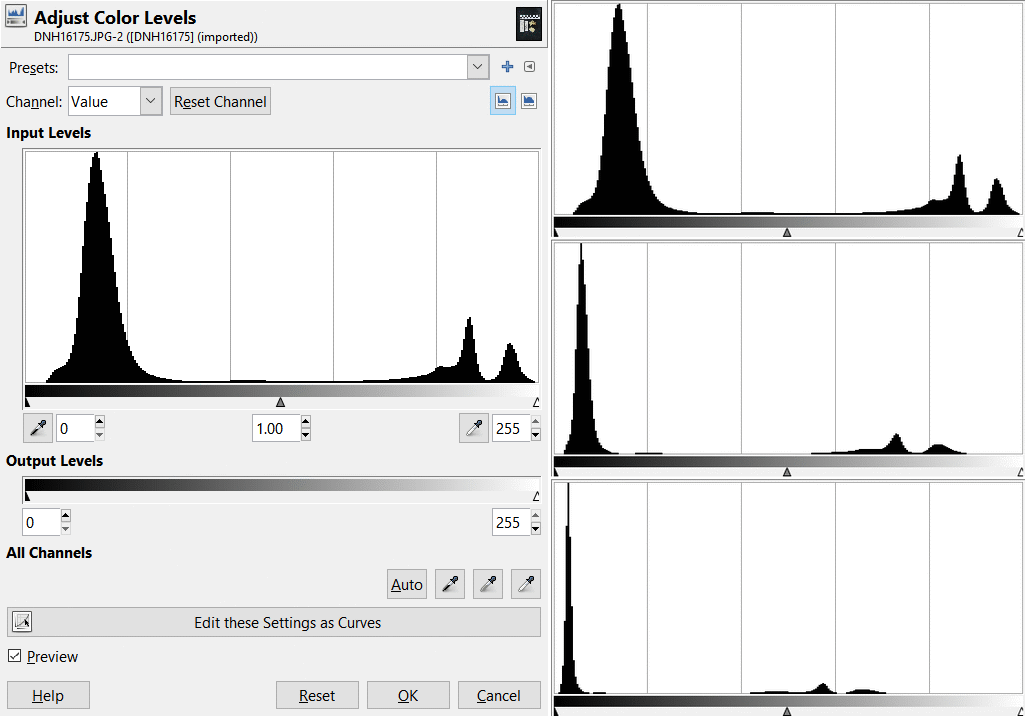
Here we have a lot of stuff in one image. On the left is the Adjust Color Levels dialog for one of the normal-exposure pictures. On the right is a crop of just its histogram, plus crops of histograms for the other two exposures. We can see how reducing the exposure just shifts all the tones toward black.

Three regions of interest appear in all three histograms. The peak on the left shows the range of dark grays from the background and the black part of the scale card. The peak at far right shows the near-white hues from the scale card. The bumpy peak near it shows the hues from the shells. The very low peak just left of center in the top histogram is from the penny. The clear separations make it easy to push the contrast as I desire. In the Levels dialog one just moves the little triangles at the bottom of the histogram to set the limits and adjust the gamma curve (which initially is 1.0). The following image is the upper right one from the montage above, just cropped to a tight square but otherwise unprocessed.


Here we can see, in addition to the shells and labels, the texture of the felt background. I used a stack of pennies to hold the tip of one shell up so the aperture is in the right orientation. By the way, the lower label indicates "40 m depth", but in the log book it says "40 mm depth". I suspect 40 meters is correct; this species is found anywhere from the surface to 100 m depth but is not common in shallow water. To obtain the next photo I set the contrast limits to 64 and 240 on the Adjust Color Levels dialog. I left the gamma at 1.0.


Now the entire background is solid black, the white of the ruler is at full brightness, and the color variations on the shells are much more distinct. Had I used a lower limit of 128 instead of 64, the pennies would also have become almost entirely black and the range of shell tones would be very strong, but it would look overdone. There is a lot to be said for working with the discriminatory powers of the human eye and brain, and not seeking to overwhelm them. For most purposes this image is a fine illustration of the shells and their labels. At times, such as for identifying shells that are more subtly similar to others, it is useful to increase the visible detail, thus I used one more processing step to emphasize the decorations and markings on the shells:


For this image I used a little bit of Unsharp Masking. It would usually not be a good idea to use this for a published illustration. The masking, a type of sharpening, emphasizes the fine details while lowering overall contrast. Unsharp Masking is one type of High Dynamic Range processing, and works even better when used with a Raw image. But a JPG image has 8 bits of color dynamic range, which comes to a 256:1 range, much greater than the typical 25:1 of a color print or magazine illustration or the 50:1 (at best) of a well made color slide. Thus we can often "pull out" details that would be lost if we just lowered the contrast overall.

Unsharp masking was developed decades ago for film processing, by astronomers who wanted to bring out details in photos of nebulas and galaxies, which have a very high contrast range. It consisted of making an out-of-focus copy of the negative, of the size you are going to make your print. That is the Mask. Then by printing through the mask, much of the large-scale dynamic range is suppressed, and the finer details are emphasized. It takes some experimentation to figure out how far out-of-focus you need to go to make the mask, and which level of contrast in the mask will appropriately render the image you want (when I was doing darkroom work I had five levels of contrast available in the printing and large-format negative films). It is time-consuming and expensive. The Unsharp Masking filter in Gimp and Photoshop and similar software emulates this process using computer code. One may tweak the controls on a dialog and see instant feedback.

As the label above also shows, these two shells were used to illustrate this species in the book "Best of Nautilus". It was a bit of an honor to handle them.

Wednesday, September 14, 2016

From lab girl to lab woman

kw: book reviews, nonfiction, science, scientists, botany, autobiographies, memoirs

The stereotype of a career scientist is of someone rather dour, square, dispassionate, and driven; one who cannot be deterred; someone who knew what he (rarely she) wanted in a career and thus majored in a chosen field, obtained degrees (at least two or three), excelled at research, obtained a university position, published (and published and published), obtained tenure, and eventually has come to rule a scientific domain as an éminence grise (best translation: "grizzled crag"). A straight line from birth to near-godhood.

Ha! Not in my experience!! The few grizzled crags I've known were either really harsh SOB's who attained eminence while leaving behind a trail of shattered foes, or (much better!) perpetual children who still aren't sure just what they want to be when they grow up, but have mightily enjoyed the ride along the way. The best scientists breathe curiosity, emit questions with every breath, and seldom take anything for granted. They know that great discoveries frequently began when someone said, "That's funny! What IS that?"

But the one adjective above that is accurate is "driven". Driven to know, driven to find out what and how and perhaps even why. Driven to learn endlessly and hoping, if not to find ultimate truth, to carve a new step or two along the path. Sometimes they know this for what it is. Sometimes not. Either way, a scientist worth knowing seems always to have a twinkle in his or her eye.

Getting to know Hope Jahren through her memoir/odyssey Lab Girl, it seemed at first that her dour Minnesota Scandanavian upbringing might have squashed all the twinkle out of her. She remembers her mother as unendingly stern and undemonstrative, and nearly always angry. But as we learn of her own nearly catastrophic level of bipolarity, and that she hints how it ran in her family, a more sympathetic picture emerges: that her mother kept herself under supremely strict control, not liking it but seeing no other way. The twinkle was suppressed in order to conform to the stultifying reserve inherent in the Minnesotans. Too bad they didn't run into Garrison Keillor very early on! He showed the fun under the stiff collar. Clearly, Dr. Jahren had twinkle enough left in her to have a stellar scientific career. But it came slowly, laboriously.

Lab Girl is half memoir and half an introduction to the botany of trees. At first, a chapter on herself and her life alternates with one on the growth of a seed, a sprout, a sapling. By the end of the book, the segments begin to mix. Dr. Jahren has become the tree she writes about, having survived stage by stage of growth, succeeding in spreading her canopy to take in enough sun to thrive.

We look on human life as though success were a right, a given; that "infant mortality" were an aberration; that poverty of body and soul ought to be rare. The mathematics of reproduction in a forest are grim: A tree produces millions of seeds yearly, and at the end of a life that may be no more than 25 years for a Mimosa or as long as hundreds to thousands of years for oaks and redwoods, if two of those seeds have sprouted, grown, and become mature trees, that counts as reproductive success. We count it unusual for a baby or child to die. But even in this most "enlightened" part of Western culture, we pay little attention when dreams die, when millions labor at nearly useless "work", when the bad (i.e. paranoid) kind of "grizzled crag" crushes the hopes of one perceived opponent after another, whether in science, business, art, governance, or industry.

For much of Dr. Jahren's career she was frequently, almost constantly, in danger of being crushed by more established fellow scientists. Like a sapling in a forest, frequently overshadowed and starved of sunlight, she had to struggle to make her way. But make it she did. And I don't think she is at the peak of her career. Perhaps writing this book indicates that she has a nagging suspicion that she has indeed peaked. Not likely. She has too much drive, too much spunk.

Her blog is hopejahrensurecanwrite.com, and I agree, she sure can write! She writes so well, it might actually be a negative in the eyes of some. My younger brother, now an established professor, was denied admission to a History department's PhD program largely because of jealousy: he was already a published author with a very readable writing style, and history professors are well known for writing either badly or abominably. His "judges" felt diminished in his presence. So he got into an Archaeology school instead and the rest is (giggle) history! However, as Hope Jahren tells us, early on she became proficient at writing "a language few read and nobody speaks", the dry, ultra-precise prose of the scientific article or monograph. Rather than let it stultify her popular writing, she learned to use the lessons of scientific writing to sharpen and brighten it. Thus, when she isn't trying to impress a granting agency, she writes sparkling, need I say, twinkling, prose. I think she has another book or few in her. I hope so.

Saturday, September 10, 2016

Real pirates don't hoard treasure

kw: book reviews, nonfiction, pirates, diving, salvage, discoveries

Prior to 2009 only one sunken pirate ship of the "Golden age of (Atlantic) Piracy" (1650-1720) had been found and positively identified, the Whydah, found in 1984 off Cape Cod. Barry Clifford and the others who found the Whydah had a map to go by, though it had been misinterpreted before his discovery. When John Chatterton and John Mattera, ably assisted by Heiko Kreschmer and Howard Ehrenberg, and partly bankrolled by Tracy Bowden, went out to find the Golden Fleece twenty years later, they didn't even have that. They had a smattering of resources including diary entries, old ships' logs, and letters between the Governors of Hispaniola and the English Crown.

They started with what they had, including a strong hunch by Bowden, based on some written speculations, that the wreck would be found near Cayo Levantado in Samana Bay on the north side of the Dominican Republic, which now occupies the eastern 2/3 of the island Hispaniola. "Levantado" means "raised up" or even "levered up", and refers to the island's suitability for careening a ship. Careening is partly beaching a ship and heeling it over so the sailors can scrape barnacles from the hull and do other maintenance a sailing ship periodically needs . Contemporary accounts of a battle between two British frigates and the pirates aboard the Golden Fleece, captained by Joseph Bannister, state that the frigates came while the ship was careened, and that she was partly re-floated but then sunk in 4 fathoms (24 feet) of water.

Chatterton and Mattera, extremely experienced divers and treasure hunters, were enticed and employed by Bowden to search for the Golden Fleece, and once it had been found, they told their story to Robert Kurson, author of Shadow Divers, about the salvage of a WW2 German submarine near New Jersey in 1991. His new book is Pirate Hunters: Treasure, Obsessions, and the Search for a Legendary Pirate Ship.

Chatterton's and Mattera's search has as many twists and turns as the life of any pirate of the Golden Age. Their quarry was not really the ship so much as her captain, Joseph Bannister, who began as a very successful merchant captain. But one day he sailed his ship off without lading cargo and went pirate. In the two years that followed, he and his crew robbed many ships and foiled attempts to corral him again and again. But it was the battle with the two frigates that made his name. He won. It appears that, knowing he had to careen the ship to reduce drag and keep her speed up, he careened in a place that he could defend adequately. He had the ship's cannons, including it seems quite a number taken from other ships and kept in the hold, brought ashore in two batteries, where he also stationed a large number of men with muskets. They held off the British until the frigates were out of shot and powder and had to retreat.

The book tells, not just the story of the search and salvage work, but the stories of Chatterton and Mattera, of Bannister as it was gradually unearthed by Mattera's research, and of the work of the deep divers who test the limits of endurance of humans and the equipment to which they entrust their lives. It tells of the relationships, by turns collegial and fractious, among the men who reach the top of their obsessive profession.

It has been said, "An expert is someone who has gotten away with risking his life a few more times than you have." This is most true of salvage diving. The work requires an unusual combination of intelligence and perseverance and patience. Those usually don't go together, and they very seldom go together well. The divers searched every possible area around Cayo Levantado, dived every magnetometer "hit" (and this magnetometer cost the same as a Cadillac, or more), and came up dry. They found lots of "modern trash". No lost ship. Library work, and learning to think more like Bannister, led both Chatterton and Mattera to believe that the island was not well suited to planning a battle against the British navy. They became sure it must have been a different island, and found one nearby that seemed ideal. They couldn't get their backer Bowden to agree, however, and to dive the new area could be considered a kind of mutiny.

Eventually, Mattera decided to look for evidence of the battle on land, and found it. About that time, they obtained a "map" of their own, a drawing of the battle by an eyewitness in 1686, in the "Taylor manuscript", republished in 2008. The layout shown in the drawing matched the new location, and the finding of British cannonballs of the right vintage, deep in the island's soil, clinched the deal. Bowden agreed to a spell of diving and the Golden Fleece was found.

I'll leave it to you to learn the aftermath in the Epilogue. Big egos seldom get the kind of happy ending they are looking for. But we also learn fascinating tidbits about the lives of the "pirates of the Caribbean". For one thing, they were amazingly democratic in their own "government". Ship after ship had drawn up articles of their polity, in which the captain could not have the kind of absolute mastery of a vessel that was the rule in the British Navy. These men had had enough of the evils absolute power can engender! The captain's word was law only during pitched battle. Otherwise, he had one vote like all the crew. It is likely that these democratic ideals, and the chance to make a famous name, attracted Bannister more than the prospect of riches; he was well-to-do already.

Also, the notion that pirates amassed great wealth and stashed it on lonely islands all over the place is a Hollywood myth. Knowing that their life expectancy was likely a matter of months (Bannister lasted about 30 months in the pirate life until he was caught and hanged), they spent their takings, almost to the last piece-of-eight, in carousing ashore between voyages of plunder. Only a captain with considerable foresight could keep back enough plunder to buy provisions for the next voyage. Many with less foresight went into debt to provision a ship, and had to pay the debt upon return, or forfeit the ship.

They were tolerated in Port Royal, Jamaica, a center of their operations, because they at first mainly plundered the Spanish, and the British liked that. They also enriched the merchants there with their carousing. But later they became more eclectic in their takings, so when merchant trade had increased a great deal, by 1680 or so they were discouraged, then forbidden, then outlawed and hunted by the navy. By 1720 the "Golden Age" was over. And now, a golden age for salvagers may be over. Maritime countries around the world are passing laws to reclaim their "heritage" from treasure finders and salvagers, and archaeology is being favored in place of the derring-do of men like Chatterton and Mattera.

Thursday, September 08, 2016

The Noble Hornsnail

kw: species summaries, natural history, natural science, museums, research, photographs


The image above shows all the specimens held by the Delaware Museum of Natural History for the species Pleurocera nobilis (I. Lea, 1845). From the lot-by-lot pictures below, you can see that two lots were originally identified as P. moniliferum (Lea, 1862). That species is now considered a synonym of P. nobilis. This species is found throughout the Tennessee River watershed, but particularly in and near that stretch of the Tennessee River running a hundred miles on both sides of the Tennessee-Alabama border, and into its tributaries.

When Isaac Lea named the species moniliferum, he was referring to a necklace, monile in Latin. With a length of at most 3 cm, this is hardly an impressive river snail. But compared to the rest of the genus Pleurocera it is larger and a little prettier.

Pleurocera means "ribbed horn", referring to the rib or ribs running along the whorls. In this species the rib is rather subtle. This lot of two shells was collected in or near the Holston River in Tennessee north of Knoxville, possibly quite far north, as that river is 160 miles long.

I took pictures for earlier posts on various backgrounds. Someone had said perhaps a standard gray would work, but I found that anything other than black or white tends to make the specimens harder to see. Today I used an enameled black surface, a background for one of the inspection microscopes. It worked pretty well but is rather reflective, so I guess it is time to spring for some black velveteen. I put paperclips under the specimens so I could orient them appropriately.
This lot and the next show how we occasionally run across misspellings and other errors on labels from collectors. "Bridgepark" actually refers to Bridgeport, a small Alabama city on the Tennessee River just south of the state border.

These were collected in 1877, as handwritten on the museum label, which was learned from Richardson's notes. He did not put collector or collecting information on his own labels, but fortunately had notes about many of the specimens he sold to the museum.

Being from a quieter part of the river system than the first lot, or the one that follows, these shells are a little larger and cleaner, not quite so banged up near the tip of the spire. If you'd spent a few weeks looking at other species in this genus, as I have, you would realize that when Isaac Lea named this species nobilis, he really meant it. Most of the pleurocerids are horn-shaped, but are usually rather small, and seldom undamaged. These seem "noble" by comparison.

This lot of three is also from the Holston River, though the original collector misspelled the river name. John D Parker, who gave these to the museum, didn't add his own label, so the volunteer on duty the day this was cataloged just used the spelling from the collector's label.


I included this fourth lot because when I saw it I thought, "It looks just like P. nobilis." These were found near Knoxville, probably at or near the confluence of the Holston and Tennessee rivers. Here is where habitat notes, so rarely made by a collector, might have helped us distinguish what species it really is.

Also, I could find no reference to a Pleurocera species named nodulatum, nor any variation such as nodatum, authored by Say or anyone else, and I don't know who identified it for Richardson or the person he might have obtained it from. There is nothing about that in Richardson's notes. But rather than re-classify it just now, I've put a note in the database that it may be P. nobilis, and to ask the next specialist in pleurocerids who visits to take a look at it.

Tuesday, September 06, 2016

Don't give up on your neighborhood library just yet

kw: book reviews, nonfiction, libraries, librarians, digital libraries

Clever geeks have been trying to replace people with mechanisms for a long, long time. "Artificial intelligence" didn't begin with Eniac in the 1940's. It didn't even begin with "The Turk", a chess playing automaton that was exhibited from about 1770 onwards, for more than 80 years. Even after it was revealed that a chess master hidden inside its cabinet was actually moving the hands, it remained a popular attraction. The earliest legend of a manufactured intelligent creature may be that of the Golem; the legends long predate the story of Rabbi Loew in the 1500's.

I have watched the hype intensify for the fifty years I have been involved with electronic computers. Marvin Minsky, in particular, made numerous predictions of things that computers would be able to do "in 20 years", "in 50 years", whatever. He was wildly optimistic. Eventually, though, humans have been bested at certain tasks we tend to associate with "intelligence," by computer systems: Chess, Go, Checkers and Jeopardy. That last, by the Watson system, required tens of thousands of hours of laborious work by more than a hundred computer scientists and database experts, and cost at least a couple of billion dollars (IBM has been coy about revealing the amount). Watson did indeed glean the highest score, but made a few silly mistakes.

During my last ten years working at Dupont, I worked with the Indexing group, spending part of my time reading technical reports—usually very quickly—and applying index labels to their metadata; and part of my time improving the computer interface used by the professional indexers. During those years, we were dogged by questions such as, "Why can't something like Google do this instead, for a lot less money?" Fifteen years earlier I had helped the Indexing group test and review software that was intended to produce the indexing labels automatically. There are a lot of "keyword generators" out there, but only one "Summarizer" seemed to produce any shadow of appropriate key terms lists. It was by far the best piece of software, but it seldom scored better than 50%, when compared to the lists of terms produced by the human indexers. I heard that, a year or so after I retired, most indexing was indeed handed over to software, and though the results are rather poor, they are indeed cost-effective, if one only thinks in the short term. Sigh.

Later, working as an indexer, I experimented with using the Summarizer: After I had gathered my own set of key terms, I would run it and it occasionally came up with a term or two that made me pause, and then add them to my own term list. With practice, and some improvements of the interface, I reckoned that an indexer might be able to save time by having the software display its list automatically after the human list was first created, because it takes no more than a few seconds to discern if any of the machine-derived terms make sense. We might have been able to save some time and also produced a little better results. But with software alone, there is no such hope, and there will not be for at least one or two (or three or more) generations.

This effort was part of the Library and Information Sciences division of the Research department. Librarians have long (thousands of years) been the keepers of the flame of knowledge. Now that "the Web" has become a ubiquitous choice for finding stuff, an index into a world-spanning online library, people are wondering, why keep our physical libraries around? Here is why. The PageRank algorithms used by Google, though they are being continually improved, actually leverage human intelligence! The largest factor in the PR ranking is still the number of pages that link to a page of interest, as a measure of how many people have found it useful.

I built a career in computer programming and information science spanning, so far, 48 years (I still work part time), based primarily on taking proper advantage of both human and machine abilities. I like to call it the Synergy of Mind and Mechanism. Some (benighted) people may think that "the internet" can replace all the functions of the 120,000 libraries across America, and the 350,000 or more worldwide. Actually, with the current flood of new information being generated, mostly by non-professionals and non-experts, the need for librarians is increasing.

All that being said, I find now a book that reaches a similar conclusion, from someone we might call a "partial insider." Though John Palfrey is not a degreed librarian, he was made head of the Harvard Law School Library, where he updated its workflows, reformed it mightily, and kept the best of its traditional "analog" character while adding great digital resources. His status as a "feral"—the librarians' derogatory term for "layman librarian"—has made many librarians look askance at his work, even though it is intended to save their jobs and even increase their numbers! His book is Biblio Tech: Why Libraries Matter More Than Ever in the Age of Google (for non-francophones, bibliothèque is French for "library").

The book is not nearly as polemical as I expected. The ten chapters outline nine areas in which this digital age we are entering (we've only just begun) is a complement to the "analog age", not a replacement for it. Just because something is "old" doesn't make it "obsolete" or outdated. We are surrounded by "old" things that continue to function well and may never be replaced.

So it is with libraries. Documents were collected, not because people just like to collect (as indeed they do), but because there was value in having a place where every authorized academic or student could find the key documents needed to do his work. The primary innovation in libraries was not one or another technical improvement, but the opening of formerly closed collections to the public, which began no more than 150 years ago! Libraries and the networked communications of librarians were fundamental to the development of democracy.

I believe it is still true that most of us have a liking for the local library (some 16,700 branch libraries in towns and cities in the U.S. and nearly 100,000 in our schools). But Dr. Palfrey warns that nostalgia can only go so far. To date, nostalgia has not prevented the budgets for public and school libraries, in particular, from being reduced to half of what they were a generation ago, in real terms.

Call me a Luddite: I visit the local branch library at least monthly, and usually more frequently. I still prefer reading books printed on paper. I find that I can read from a computer screen, even the most "retina"-sharp, even the latest paper-white Kindle, no more than 10-15 minutes at a stretch. I can read a paper book for a practically unlimited amount of time. Sure, the under-30 crowd can focus on their screen the whole day long, but I suspect that nearly none of them spends long stretches of time reading an e-book. They scatter their attention, "multitasking". The "eye-unfriendly" nature of every kind of screen so far invented probably has something to do with that!

Libraries and librarians do their best work in a network. This has always been so, although there is a strong tendency toward hoarding within any "collecting" profession, including museum collections as well as libraries. I would never have finished graduate school without free InterLibrary Loan (ILL) facilities. Any book I could learn the title and author for, a reference librarian could find somewhere, and have it shipped to the library or even to me, within a week. The spread of digital technologies makes networking easier than ever. For those who like e-books, ILL can now take no more than a few minutes to find and deliver a document or book…for those items that are still lendable. Chapter 9 on Law warns that digital works are frequently hard or impossible for a library to loan out. The licensing contracts called "Digital Rights Management" trump copyright law, with its specific "second sale" provisions that favor library lending. Lending a hardcopy book is practically free. Lending an e-book often costs some small licensing fee for each loan, and those can add up in a hurry. So while  a $25 hardbound book may seem costly compared to the $12 license fee for an e-book (you never BUY an e-book, you license it), the residual lending-licensing fees can make an e-book much, much more costly than the hardback.

Though this book has less of a "go do this" character than I expected, it does provide great resources for librarians and those who love libraries, and great ammunition to use at those public meetings where town and county budgets are discussed. The librarians are our friends, and they need our help. Has a library near you closed recently, or is one under threat? Get two copies of this book, one for yourself and one for your friendly local librarian, and then go together to budget discussions and enter into the fray of democracy, not just as a voter but as a participant. Perhaps a future generation will look back and thank us for keeping "physical libraries" from going the way of the Dodo.

Sunday, September 04, 2016

Presenting CWWN v48 - Messages for Building Up New Believers (1)

kw: book summaries, watchman nee, christian ministry

Several months ago the small group meeting in our home began using Watchman Nee's "Messages for Building Up New Believers", which comprise volumes 48, 49 and 50 of The Collected Works of Watchman Nee. Now that we have used the first seventeen lessons, I thought it good to present volume 48 now, out of the sequence I have been following, because these things are fresh in my mind.

The first of these three volumes contains the first seventeen lessons, with the following titles:

  • Baptism
  • Terminating the Past
  • Consecration
  • Confession With the Mouth
  • Separation From the World
  • Joining the Church
  • The Laying on of Hands
  • Abolishing All Distinctions
  • Reading the Bible
  • Prayer
  • Early Rising
  • Meeting
  • Various Kinds of Meetings
  • The Lord's Day
  • Hymn Singing
  • Praising
  • Bread-Breaking

These are preceded by the transcript of Nee's sharing to his co-workers in July, 1950, regarding the meetings for new believers. He strongly believed the churches need to provide thorough instruction to new believers, based on what Jesus said in Matthew 18:3, "Unless you turn and become like little children, you shall by no means enter into the kingdom of the heavens." It is best for a new Christian to assume that everything he or she has done for the past twenty, thirty, forty years or more is totally contrary to God's ways. Thus, all old ways must be dropped and new ways learned. We cannot simply add Jesus to our bag of tricks, as though all we need is a little reformation. When Jesus comes in, the whole bag must be discarded.

In my experience, the lack of specific instruction for new believers will, in a generation, lead to a church composed almost entirely of soulish and fleshly persons, who believe the occasional flash of actual spiritual joy or insight to be a special blessing from God. This was my condition before I came this way. I was soon disabused of that notion, when I realized that, as I said to myself, "Living in spirit is what these people do all day!" My former "golden moments" were spiritual pocket change, analogous to the silver that was despised in the days of Solomon because all the vessels were gold.

I can testify that these lessons are quite challenging. Firstly, they average fourteen pages in length. There is too much material to cover thoroughly in a one-hour meeting. Beginning with Lesson 18 in the second volume (v49 of CWWN), we plan to spend two meetings on each lesson. As one brother remarked in a footnote to an earlier, somewhat abridged translation published by CFP in 1972, "There are quite a number of 'first things' that Brother Nee wished new believers to learn!". In churches that faithfully follow the pattern he laid out, new believers who miss one of the lessons can expect a visit from an elder or two who are prepared to present the lesson personally.

Watchman Nee's particular approach is evident throughout: Our techniques and abilities hardly matter at all; what matters is the source of the work, that is the Holy Spirit of God. Brother Nee sometimes also comes at you from the side, as in "Joining the Church", in which he soon tells us that the true church is one you cannot join. A believer is BORN into the house of God, and we can no more "join" God's house than we "joined" the household of our parents! I remember my joy upon reading, with newly-opened eyes, in 1 Peter 1:3, that God has "begotten us again". My understanding that Jesus is the "only begotten of the Father" was outdated! It referred only to the human life of Jesus, from his birth until he was resurrected. In that same resurrection, we also have become begotten sons and daughters of God. The lesson continues by showing that our life in God is a corporate life. We need fellow believers and even companions in the pursuit of Christ to make adequate headway against the opposition of Satan and the world. We are warned in the letter to the Hebrews, "…not abandoning our own assembling together…" (10:25).

Watchman Nee stresses that it is this life of God in us that must grow and become the source of all that we do. Thus these lessons are guidelines for what to expect from the divine life within us, rather than lists of rules to follow.

Tuesday, August 30, 2016

Shells ready for data entry

kw: natural history, natural science, museums, research, photographs

One volunteer has been working with the Collection Manager of Mollusks at the Delaware Museum of Natural History to get some recently-acquired shells ready to be cataloged and put away. "Recently acquired" in a museum collection typically means "in the lifetime of the current curator". The shells in the tray shown below were donated to the museum in 2014, so that is "really recent"!


The details below show that each lot has been identified, and one label has the location, date and donor information, which is the same for them all; all were collected on San Salvador Island in The Bahamas. The first detail image shows a slightly unusual item, a shell attached to a sea pen. The shell is the bivalve Chama radians (Lamarck, 1819), one of the Jewel Box Clams. They are called that because of the detailed decoration of their shells. Other items nearby include some chitins (little known 8-shelled mollusks), mussels, ark shells, various clams and some turban snails.

I took these pictures about 9:00 AM today. The volunteers arrive at 9:30, so "someone" spent this morning entering the data for these boxes of shells into the database. The blue tag in with the location and collecting information gives the Accession Number: 2014.MOL.009. This decodes to "the ninth accession of mollusks in 2014". A thank-you letter was duly sent shortly after the shells were delivered to the museum. A lot goes on between "stuff" arriving on a museum's doorstep, and its full incorporation into a research or display collection.

A reminder for potential donors to a museum: Museum research thrives on data. The donor of these shells gave us pretty good information, but it would be even more helpful to have the actual location on San Salvador Island. It is small, only 15 miles long, but has several micro-ecologies that would interest a researcher. Also, the actual date is best. These are dated "Nov 1978". In the Bahamas, not much changes during a month, but in other locations, it could make quite a difference for some species. Gee, aren't we picky!