Showing posts with label natural science. Show all posts

Friday, January 19, 2024

He brought the lions back

 kw: book reviews, nonfiction, science, natural science, cougars, mountain lions, memoirs

It takes a real optimist to wait fifty years to write a memoir. The kind of optimism that motivates a young naturalist to stake the success of his PhD research on his determination to work in the tough Idaho wilderness surrounding the River of No Return, to track, capture, and study the most elusive apex predator that North America has to offer: the cougar. Furthermore, when he began the study he had a family. That's exactly what Maurice Hornocker did, and thus his recently-released memoir relates events that occurred in the period 1964 to 1973. He was 91 when he began to write…

Cougars on the Cliff: One Man's Pioneering Quest to Understand the Mythical Mountain Lion—a Memoir kept me up late several nights. It is the kind of page-turning book one would not expect from a scientist. Dr. Hornocker has a co-author, "roving reporter" David Johnson, who must have had something to do with the compelling prose. But artful prose needs something to work with, and boy, was there a lot to work with!

Possibly more dangerous than the big cats were the hunters, the ranchers, and others with a vested interest in destroying as many cougars as possible, and in keeping them classified as "vermin", so that there would be no "hunting season" or other restrictions on the slaughter. In the face of disparagement and occasional threats, and even attempted sabotage of the research project, Maurice (not Dr. Hornocker yet), with immense help from Wilber Wiles, caught the cats he needed to catch, re-caught them repeatedly, tracked them through several winter seasons (there was no radiotelemetry before the 1970's, so tracking in snow was a must), and gathered priceless data on their habits. Slowly, the data itself, and his passionate advocacy, made itself felt. At first, a temporary moratorium on hunting the cats (after a few collared cats were killed) was put in place, allowing the study to be completed, and eventually, a new law was passed giving the Idaho Fish and Game Commission the power to declare the Cougar a game animal, and thus to regulate it, including barring hunting the cats in specific areas. Eventually the largest contiguous wilderness area was created in central Idaho, where no persisting human presence is allowed: visit but leave only footprints, and gather only photos.

Cougars manage their territories well, and they practice "mutual avoidance", a term Maurice stressed and possibly coined. They manage their own reproduction. Rather than being rapacious monsters that kill for the fun of it, cougars kill to live, and their natural tendency to take down the weak and the old, primarily elk and mule deer, actually manages the prey herd to encourage strength and to ensure a thriving population. The "demon cats" of superstitious lore would soon wipe out the entire herd, and descend into starvation. Big cats can do cost/benefit analyses. Once this was understood, the wind went out of the sails of the "cougars as vermin" viewpoint.

How would one describe a typical day during the winter cougar-study season? It seems impossible, mainly because what Maurice and Wilber did are impossible to most of us. They began by preparing (sometimes building) and stocking ten camps throughout the study area. In each season, they both, and the 3-4 dogs they had with them, traveled on foot more than 1,000 miles. Not flat miles, but up hill and down dale, often in knee-deep or hip-deep snow. The average mileage required to track, tree, tranquilize and tag & measure one cat was about 100. In the initial three (exhausting!) seasons, somewhat more than 30 cougars were tagged, and multiple observations of previously-caught cats, plus re-catches to replace missing tags or collars: all added up to a ton of data about them. In addition, the men took samples from prey animals, to assess age and condition, so as to compile a picture of the ecology of cougar country.

The picture above shows a lioness with two half-grown "kittens". The book doesn't use the word "cubs". An interesting fact learned from the population studies, and from the author's family raising two orphaned kittens that weighed ten pounds at the start, is that the ears stay about the same distance from the chin as a lion's head grows, so that the mother cat, on the left, had her ears set lower compared to her young. Females have smaller heads than males, so mature males have ears set even lower. Once this relationship was understood, it was possible to determine the sex of a cat from a distance, and also estimate its age during its first few years. The heaviest females seldom exceeded 100 pounds, but most grown males were heavier; the heaviest was 182 pounds, though the average was more in the 120-140 pound range.

I worked at DuPont in Wilmington, Delaware for many years. For a few of those years a cougar resided in northern Delaware and southeastern Pennsylvania. One snowy day, a laboratory building at a DuPont facility was ringed with cougar tracks. The animal could smell the lab rats inside the building, and circled it a few times trying to find a way in. Later it bedded down at an outdoor YMCA facility a few miles away. For about a week, the Y Camp was its home base. Then it seemed to vanish, until reports in Maryland indicated it had moved on. Many white-tail deer live in this area, and it probably reduced the herd to the point that leaving was necessary. By the deer being "reduced" I mean partly eaten, and partly scared into moving on themselves. The big cat followed its food supply. Curiously, I don't know a single person who every actually saw the cat as more than the end of a tail as it vanished into the woods. They are secretive and very hard to spot!

When I say in my title above that Dr. Hornocker "brought the lions back", I refer to bringing back the concept of the cougar as an integral and necessary part of the natural world, throughout North America. Before his work, they'd become almost extinct outside a few wilderness areas such as the Bitterroot Mts of Idaho, because of their "vermin" image. That has changed. A change for the better. Just as the local family of foxes keeps the squirrels in our neighborhood on the alert, and limits the population of mice and voles, so a resident cougar or two keeps the deer from becoming vermin themselves. P.S. This juvenile fox had just awakened from a nap in our back yard. I took the picture from the family room window.

I don't mind that this memoir looks back half a century. The adventures are as fresh as yesterday's snowfall. Dr. Hornocker is one of the great benefactors of wide-scale ecology studies.

Wednesday, September 22, 2021

Wilson and his wonderful ants

 kw: book reviews, nonfiction, science, natural science, naturalists, memoirs, ants, myrmecology


This is the most troublesome ant in the world. The 47 known species of leaf-cutter ants can form immense nests with millions of members, move tons of earth doing so, and strip entire trees of leaves overnight. In Tales From the Ant World, Edward O. Wilson, my favorite naturalist and nature writer, saves these ants for his last chapter. I don't have his patience.

Of all the social insects, leaf-cutter ants best deserve the moniker "superorganism". There are several distinct castes, and this photo (cropped from a much larger image) shows two of them. The workers that cuts the leaves and carry them are accompanied by smaller "minors", which ride along when the leaf bits are carried to the nest. They aren't freeloading. They keep away parasitic flies that would otherwise lay eggs on the workers. They are bodyguards.

Dr. Wilson, who studied at Harvard, taught there for 41 years, and is still affiliated as a Professor Emeritus, has been there for more than seventy years. From his many books we find that he didn't always spend much time there. Collecting and studying ants has taken him almost everywhere on Earth where ants live; effectively, everywhere except the polar ice caps and a few islands (ants are poor at crossing oceans).

When asked, "What do I do about ants in my kitchen?", he will typically reply,

"Watch your step, be careful of little lives, consider becoming an amateur myrmecologist, and contribute to scientific study. … They carry no disease, and may help eliminate other insects that do carry disease." —from the Introduction, p. 10.

If we all followed that advice, a lot more would be learned about ants in short order, and some pesticide companies would go broke.

The short chapters of Dr. Wilson's book are like adventure tales. We read of ants that sting worse than any wasp, ants that farm insects such as aphids for their honeydew, some that are ranchers (keeping "domesticated" insects to eat), and the many ants that enslave other ant species. Slavery has been around for 100 million years or more; humans didn't invent it.

This image, from a pest control company, shows some common ants to be found in temperate areas, such as most of the US. On my screen they are shown about 3x natural size. That would make the smallest, the "Crazy Ant", about 3mm (1/8") long, which is about right. Taken together, the ants in a typical yard weigh as much as one of the occupants of the house, perhaps more. Worldwide, the ants weigh more than all the billions of humans.

One chapter describes a few species of trap-jawed ants, such as the one shown here. They pull back their jaws past a cocking point. When they release the jaws they slam shut in a couple of milliseconds.

Such ants prey on insects such as springtails, which are much too fast to chase down or can jump (springtails also have a cocking mechanism and a lever to launch themselves). These ants move very slowly, to maneuver close enough to snap the jaws on their prey.

There are more than 15,000 species of ants so far described. Some are well known, but for others a physical description is all that is known besides where they were found. Sometimes, even knowing where a species was first found isn't much help if you don't take account of when. The author writes about searching in vain for some rare ants, only to learn later that they are only active in cold weather, and he'd had the misfortune to try to find them in the summertime.

Live and learn. He has a few chapters on his own path to becoming a naturalist, bolstered by a childhood in neighborhoods with a lot of natural places nearby, and parents who didn't mind him raising sundry critters or nests of insects in his bedroom. Yet after a working life that spans seven decades, he is still learning, and loving the learning. His books have the same goal, to share that love of learning from nature that has been his delight. His writing is happy writing because he is happy. Reading him makes me happy.

Tuesday, March 12, 2019

The other kind of land snail

kw: species summaries, natural history, natural science, museums, research, photographs

I spent more than two years, in my work at the Delaware Museum of Natural History, cleaning up/correcting and loading data for their collections of terrestrial gastropods, informally known as land snails. Correction: the past 2+ years I worked with the pulmonate terrestrial snails. They are called "pulmonate" because they have lungs, though really they are modified gills in an internal cavity where they can be kept moist, and muscular contractions pump air in and out, like real lungs.

That is not the only kind of land snail. The other great division is the operculate terrestrial snails. They are called "operculate" because they have an operculum, a kind of door that they can use to seal the shell shut, to keep water in, because they have gills inside the shell, and also to keep predators out. Many marine snail species also have an operculum, used to avoid desiccation when they get stranded above the tide line for a while, and even more to keep predators out.

The pulmonate lifestyle is apparently the easier, because there are many more species of pulmonates than operculates. In the DMNH collection, 95% of the land snail collection is pulmonates, more than 40,000 lots versus about 2,000 lots or operculate land snails.

Thus, my last project is to clean up, and load, all the data for the operculates. The first major family that I encountered is the Annulariidae. Many of these have a flared aperture, as shown in these two images:
This image is roughly life size (the museum label is 3" long). The species Chondropoma bairense Torre & Bartsch 1938 is a little prettier than most of its kin, and larger. Here, "Chondro-" relates to "grain", and many species in this genus are little larger than grains of corn. The flared aperture is characteristic of species in many genera of the Annulariidae.

This one is called "bairense" because it was first found at Baire, Cuba, which is in the south, in the state of Santiago de Cuba, west of Guantanamo. Hoyo de la Reyes can mean "king's pit" or "-hole", but here it probably refers to a steep valley.

From the differences between the older label and the one that C.L. Richardson typed up we can see why it is helpful to have all the labels possible with a specimen. Richardson simply left out the name of the town on his own label!


Here is a closeup of the shells. Sadly, both have their tips knocked off. This is the only lot of this species in the DMNH collection, so we must make do with what we have. I find it fascinating that there is ribbing along the outside of the whorls, but the shell on the right also reveals longitudinal ridges in the omphalos (a synonym of "navel" or belly-button; it refers to the central hole where the whorls come together. Not all snail species have one, including the next one shown).

I picked one other species to show, because of its bristly appearance and because one shell still has the operculum:

In spite of the way the name is spelled on both labels, this species is Blaesospira echinus (Wright, 1864). The parentheses indicate that the genus name has been changed, but I don't know the history. I don't know what the genus name means, but I suspect it means something like "open spiral" because the whorls of the shell are not in contact.

The species name is easier: "echinus" means "spiny", and this little critter is truly spiny. The mogote (isolated hill) named "El Queque" is a well known snail collecting locality in the Viñales area of the state of Pinar del Rio, Cuba. 

This image is about 40% larger than life size; the shells seldom exceed a centimeter in length or diameter. These spiky little critters are even more impressive when magnified:


Here you can see that one of the shells still has an operculum in its aperture. Opercula frequently have a spiral structure like this one. The wavy rim of the apertures hint at the way the spikes are formed. They are hollow with open tips. These lovely little shells are very popular with collectors, which makes me wonder if they are still to be found there. Few specimens from Cuba have found their way into American collections since the Castro regime began in 1959.

I should also mention that some taxonomists place this genus in the family Pomatiidae (once called Pomatiasidae). What with DNA sequencing and other tools of molecular biology, the taxonomy of mollusks in general is being reviewed and revised more than ever. 

Tuesday, April 17, 2018

The waxy snails

kw: species summaries, natural history, natural science, museums, research, photographs

In the course of time I have come to a cabinet-and-a-half containing a couple of thousand lots of a family of snails (gastropods) named Cerionidae. Though there are four genera in the family, the Delaware Museum of Natural History holds members only of the type genus Cerion. The family was split out from a large family, Urocoptidae, by Henry A. Pilsbry in 1901. "Harry" Pilsbry spent much of his career at the Academy of Natural Sciences in Philadelphia, where he described hundreds (thousands?) of new species.


This first photo is of the type species (of the type genus of the family Urocoptidae), Urocoptis cylindrus (Dillwyn, 1817). Lewis Dillwyn originally named this species Turbo cylindrus, using a genus name created by Carl Linnaeus in 1758, when he single-handedly invented biologic nomenclature. At the time these specimens were collected the species was considered of the genus Cylindrella, then was shifted again to the genus Urocoptis when the family Urocoptidae was set up. The family Urocoptidae contains many genera, and while many of the species are similar to this one, being cigar-shaped with a flaring aperture, they vary a lot around this gestalt.

The genus Cerion, pronounced "kerion" or "Syrian", from the Latin word cerea, meaning "waxy", was named by Peter Röding in 1798, based on his renaming of Turbo uva as Cerion uva (Linnaeus, 1758). The genus has just a handful of fully accepted species, but the DMNH collection contains representatives of more than 200 species, which have varying levels of acceptance among workers carrying on a decades-long reworking of land snail families. This photo shows two characteristics of many Cerion species: the off-white waxy color and the ribbing along the entire shell. The flared aperture is less pronounced than it is in most of the Urocoptidae. The following photos showcase three more Cerion species, chosen to illustrate the range of variation in the genus.


The photo below shows Cerion weinlandi (von Martens, 1860); Edward von Martens originally placed it in the genus Pupa. It does look like a pupa! I chose this species to illustrate the extreme of nearly absent ribbing. Also, while the background color tends to be waxy off-white, this species is one of many with color banding and mottling also.


Though this lot is labeled Ceriod dalli Maynard—publication date is probably 1889—it was renamed and included in the species Cerion rubicundum (Menke, 1829). I don't know what name Karl Menke originally gave it. The species name means "ruddy", and when the shells are fresh and moist, the brown markings are reddish-brown. I chose this species for its narrow ribbing.


Finally, Cerion marielinum Pilsbry, 1927 (the museum curator attributed the species to Carlos de la Torre, who had edited the journal in which Pilsbry published the description) is so named for its occurrence mainly near Mariel, Cuba. This species shows wider, more robust ribbing, and also has a ruddy background with the waxy white being confined to the tops of the ribs.


I chose the scale for these photos so that they would show the shells close to life-size on a 17-inch monitor. On my 22-inch monitor they are about 25% larger than life. Comparing the four Cerion species with Urocoptis cylindrus, there is certainly a resemblance. It is easy to see why the genus was originally put in the same family. However, details of their morphology, including not only the more pronounced ribbing, but also the smaller aperture and the small teeth inside the aperture, distinguish Cerionidae from Urocoptidae…at least for now! Biological naming is always a tug-of-war between "splitters" and "lumpers". In some mollusk families, large numbers of species have in recent years been combined into a relative handful of species, and this may soon result in the few hundred species of Cerion being lumped into a smaller number of species that are recognized as being rather variable.

Genetic studies and breeding studies are going on in parallel, and revealing more and more about the species and inter-species relationships of many animals, not just snails. But, you know, I just like opening a drawer full of shells once in a while to simply admire them.

Tuesday, February 06, 2018

Some random members of family Orthalicidae

kw: natural history, natural science, museums, research, photographs

I have been in the midst of inventory of terrestrial snails of a large family that is popular with shell collectors, the Orthalicidae. The family is named for the genus Orthalicus, but the family contains numerous species in many genera. In recent years taxonomy professionals have split certain genera out into new families. But we tend to call all these species "Orthalicids". Today I just present a few that I ran across recently, showing some of the breadth of attractive shell forms in these families. Each image is followed by a caption.
These are two species in the genus Placostylus, P. scarabus (Albers, 1854) and P. seemani (Dohrn, 1861). They are found on the islands of the south Pacific: the former in New Caledonia and the latter in Fiji. These island nations are about 850 miles apart (~1,350 km), so there is little natural opportunity for these species to encounter one another. The Fijian shells are visibly narrower than the Caledonian.
These are two more species of Placostylus, P. strangei (Pfeiffer, 1858) and P. stutchburyi (Pfeiffer, 1860). Both are found on the Solomon Islands. The third row consists of five lots of shells that have been identified as Placostylus, but no species is yet assigned. I am particularly intrigued by the one shell with aperture showing, that is bright orange inside.

This closeup shows one lot of P. scarabus. I purposely turned one shell to show the aperture, which shows a pale orange inside, less prominent than the one in the former picture. This also shows the variety of coloration to be seen in a single species, from quite mottled and brownish to smoothly creamy.

I turned two of these shells, of the more distantly related species Auris melastoma (Swainson, 1820), to show the nearly black interior. "Melastoma" means "black mouth". These inhabit Brazil.

Finally, this is a closeup into the plastic box containing one lot of Berendtia taylori (Pfeiffer, 1861). These are from a little closer to home, for us Americans at least: on the Baja peninsula of Mexico. I wanted a closeup of these, to show the fine ridges that cover the shells. You can also see a relic of museum practice in three of the shells: Munroe Walton had written his own number inside the apertures, and these have been crossed out and the DMNH catalog number written there.

Friday, December 08, 2017

The most popular snails

kw: species summaries, natural history, natural science, museums, research, photographs

For the current series of projects at the Delaware Museum of Natural History, I have worked through several families of terrestrial gastropods (land snails and tree snails). Many of these are quite inconspicuous, being small and not colorful, though they are in general a little more various than the little brown "mud snails" (freshwater gastropods) I worked with for most of 2016.

You know, in any group of creatures, most are rather inconspicuous and poorly known. The "typical" mammal is a "little brown furry thing" such as a mouse, vole, shrew or lemming. The "typical" bird is a "little brown feathered thing" such as a wren or sparrow. The "typical" insect is a "little dark beetle" about the size of a grain of rice. The world is full of little brown things and we hardly notice them.

But we really like the colorful "charismatic" ones. Among the land snails, that would be the tree snails of Florida and the Caribbean, of the genus Liguus.


This is part of a drawer of "unidentified" lots of Liguus fasciatus, the poster child for pretty tree snails. Though these have been identified as to species, L. fasciatus has many "forms" or "varieties", which we provisionally catalog as subspecies, but they probably aren't really subspecies. We usually call them color forms.They hybridize freely, but a particular color form is usually physically separated from most others, being endemic to a few "hammocks", as small patches of raised and heavily vegetated ground are known in the area.

These are mostly from an area of the Everglades called Pinecrest, named for a ghost town tucked away in the middle of a couple of hundred hammocks. You can clearly see that most of these lots are in need of splitting into their color forms. Any particular hammock may be inhabited by a few color forms. A collector in a hurry will gather a couple of dozen shells, put them in a box or bag with a label (date, provisional ID, and location, at the least, to be a useful specimen lot), and move on to the next hammock a few minutes' walk away in the dry season, or a short airboat ride away the rest of the year.

Here is the prettiest of the color forms, in my opinion:

On your computer screen this may be a bit larger than life size. The paper label is 3 inches long, so these shells are about 2 inches long, a little bigger than the average for the species. Liguus fasciatus splendidus Frampton, 1932, must have been Henry Frampton's favorite also. These are indeed splendid! This lot was collected by Erwin Winte a few years after Frampton described them, and in the 1980's it wound up at DMNH.

These shells are so sought after that, though they are prolific and widespread, many color forms are getting hard to find. In the southeast U.S. and the Caribbean, a whole subset of shell collectors are called "Liguus collectors". We are loving them to death!

This only serves to introduce these lovely shells. I hope soon to gather pictures of several color forms, and also to compare L. fasciatus with its sister species in the genus.

Monday, September 25, 2017

The referential Clausiliid

kw: species summaries, natural history, natural science, museums, research, photographs

The gathering of biological species into genera (plural of genus), and of genera into families, can be a difficult matter. This is particularly true of animals that are variable in their expression, including mollusks, and gastropods (snails) in particular. The history of discovery proceeds to-and-fro: Species after species will be collected and described, and at first, many similar creatures will all be described under a certain genus. A later researcher may then distinguish a common set of features for certain of those species, and a different set of features for others, leading to setting them aside as a new genus. A similar but more arduous process is needed to discern family membership…usually.

In the case of a unique family of terrestrial snails, the Clausiliidae, one and only one distinguishing feature is needed to determine whether a newly discovered species belongs: the presence of a clausilium. This requires a little explanation.

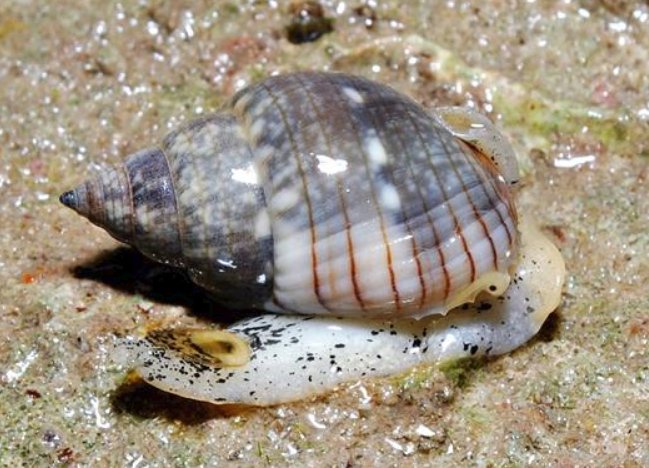
You may know that many marine snails have a kind of "door" that they can shut behind them when they retreat into their shells. It protects them from many predators and also keeps them from drying out when they are exposed to the air for too long. These two pictures show different species of whelk; the operculum for each is visible. First we see a Lightning Whelk all pulled inside after a wave threw it up onto the beach. Its operculum is the brown oval thing in the aperture.

The second photo shows a different species of whelk crawling on the sand. The animal's foot, at the lower left, is white with dark spots, and the operculum is also brownish, attached atop the end of the foot. Many, many families of marine gastropods have opercula (the plural of operculum). Twenty families of freshwater gastropods also have opercula, as do a small number of non-pulmonate (that is, gilled) land snails. Only one prominent family and two very minor, though related, families of pulmonate land snails have opercula. A pulmonate snail has a lung rather than gills, or in addition to gills, and can thus spend prolonged amounts of time out of the water.

A clausilium is not an operculum. This structure is not kept external to the shell, as an operculum is, but is internal, as seen in these semi-transparent shells. Rather than being attached to the animal's foot, it is attached by a muscular structure to the columella, the central column around which the whorls of the shell are wrapped. When a Clausiliid snail retreats into its shell it pulls its body inside, then deploys the clausilium to block the aperture. So the clausilium's purpose is the same as that of the operculum, but is a distinct evolutionary development.

In addition, whereas an operculum is sometimes thin and even translucent, it is usually robust and may be a thick shell in its own right with a spiral structure. By contrast, a clausilium, although always calcareous, is thin and rather fragile. Apparently, members of the Clausiliidae, being small and having a small aperture, do not encounter the determined predators that attack many marine snails.

Today in my work on the current project at the Delaware Museum of Natural History I began to take inventory of a little more than 1,000 lots of the family Clausiliidae. The type genus of the family is Clausilia, described by Jacques P.R. Draparnaud in 1805. He based his description of the genus on the species Clausilia dubia, but a later evaluation by physician and malacologist Louis C.G. Pfeiffer led to a re-description of the genus as referred to Clausilia scalaris Pfeiffer, 1850. Ironically, this species has been renamed and then made synonymous with another species, and is now called Muticaria macrostoma (Cantraine, 1835; Cantraine originally called the species Clausilia macrostoma).

I found that DMNH has just one lot containing shells of this species, which is endemic to the island of Malta. The collector, whose material was obtained by Ralph Jackson in the 1950's and later donated to the museum, notes that this species is "very rare". Yet he somehow obtained six shells.

This photo shows the shells close to natural size. It is hard to see in this image that the shells are well-decorated with ridges or striations. Clicking on the image to see it larger is a little better, so I also took a closeup through a low power microscope.

The species name "macrostoma" means "large mouth". Clausiliids all have small apertures, and the aperture of this species is only "large" by contrast to many other species in the family, and that primarily because of the wide lip around the "mouth".

All the shells in this lot have the first one or two or three whorls broken off. That fact and the ridges indicate that these little animals live in a rather high-energy environment. I became curious about the locality so I looked it up, and found that Mistra is on a protected bay. Malta is not very large, being 17 miles long and 8 miles wide (27x13 km), but it has room for at least five places named "It-Torri", which means "red tower". The nearest to Mistra is about three miles to its northwest. This is a much windier locale than Mistra, so perhaps such environmental stresses shaped the species.

Few clausiliids are so heavily decorated, and, indeed, most are smooth or nearly smooth. So it is ironic for this to be, in effect, the "poster child of the Clausiliidae."

Tuesday, June 06, 2017

The yellow-tipped little agate snail

kw: species summaries, natural history, natural science, museums, research, photographs

Earlier this year I completed two major projects to prepare about 17,000 data records at the Delaware Museum of Natural History for all the freshwater species of bivalves (clams and mussels) and gastropods, and load them to a new database system from which they can be served up via the internet. The principal portal is iDigBio. A secondary portal, from which it is easier to dig into the records on a museum-by-museum basis, is InvertEBase. Each project took about a year.

That done, I have begun working through the museum's data for terrestrial gastropods (land and tree snails), which total about 38,000 records. We decided to take these a cabinet or two at a time, for the most part. I am basically tackling between 1,500 and 2,000 records per mini-project. A first project took about a month, so I expect the sum of about 20 projects to take a couple more years, maybe three or more.

I am in the midst of inventory for three related families, and the first is Achatinellidae. These snails were so-named because they resemble the large tree snails of the family Achatinidae. The prefix "achat-" means "agate" in Greek, and refers to the striped appearance of the most familiar species, the giant African tree snail, Achatina achatina (Linné, 1758), also called the tiger snail.

The one shown in this image may have a shell as long as 8" (20cm). The suffix "-ell" means "small"; the snails of family Achatinellidae are much smaller than the Achatinidae, but many have a similar striped look.

The type genus (the one the family's description is based upon) is Achatinella, and the type species is Achatinella apexfulva (Dixon, 1789). As I was taking inventory of the specimen lots of this species, I noticed that some had been collected by a major donor to the museum, Munroe L. Walton, when he was quite young, not more than eleven years old. In the three photos below, you can see they were collected in Hawaii in 1901; Walton was born in 1890. First, the photos, which mostly speak for themselves. Commentary continues following.


Around the year 1900 it was common to distinguish the many color variations of variable species by assigning subspecies names. The original labels for the first two lots reflect this. The third lot was originally attributed to a different species because many of the shells in certain parts of Oahu are left-handed, such as the one on the right in the third picture. These are now recognized as part of the species apexfulva. The suffix "-fulva" means "yellow", and shells of this species have a yellow tip. Specimens of this species grow to 1.5-1.9 cm (0.6-0.75 inch).

The second lot shown has an added label, written by Edward W. Thwing, who may have been the actual collector of that lot or part of it. He was 22 years older than Walton. The designations "New." and "Newc." on some of the labels refer to Wesley Newcomb, a physician who became a curator of mollusks at Cornell in the 1870's and until 1888. He described the first specimens of many species in the family Achatinellidae.

Although Achatinella apexfulva does not have a common name, I call it the "yellow-tipped little agate snail" as a direct translation of its scientific name. The Achatinellidae in general are colorful and attractive. Sadly, most, including A. apexfulva, are now extinct.

Tuesday, May 09, 2017

A snail family and a photo experiment

kw: species summaries, natural history, natural science, museums, research, photographs, digital darkroom

A few weeks ago I finished a project to clean up the data for all of the specimen lots of freshwater snails at the Delaware Museum of Natural History. We loaded almost 10,000 data records to the new database product, and linked them to the InvertEBase site (the link opens the Collections page; we are #3). Then I began working my way through the land snails (called terrestrial gastropods in most literature, and they include tree snails). The Curator and I decided to work taxonomic family by family, or in groups of related families, working with about 1,000-2,000 records at a time.

The two great groups of terrestrial gastropods are the Pulmonates (infraclass Pulmonata of class Gastropoda) and the Operculates (in class Caenogastropoda along with many freshwater and marine species). "Pulmonate" means they have a lung; "Operculate" means they have a small, separate shell with which they can block the aperture of their main shell when they pull inside, and this allows them to survive periods of dryness and also blocks most predators.

The majority of land snail families are Pulmonates, so we began with the family Ellobiidae and two related families, Carychiidae and Amphibolidae. Digging into current taxonomic research, I found that the family Carychiidae is now a subfamily of Ellobiidae, and is now named Carychiinae. I also found that, while a few species in family Amphibolidae are terrestrial, most are marine, and our collection contained only marine species. Nonetheless, having extracted the records, I proceeded with both families, dealing with 75 lots of Amphibolidae and 1,236 lots of Ellobiidae.

It is instructive to survey the family Ellobiidae, which tend to have a certain appearance no matter what environment they inhabit. Some genera are all terrestrial, some are all marine, a few genera are estuarine (adapted to brackish water), and others contain species found in various habitats.

We'll first look at Ellobium chinense (Pfeiffer, 1856). Lawrence Pfeiffer originally described the species under the name Auricula chinense, thus the parentheses around his citation, indicating the reclassification of the genus.


These are medium-sized, up to 3 cm long and 1.4 cm wide, and rather ovate or cigar-shaped. In the closeup below notice the small lump on the inner lip of the aperture. The apertures of nearly all species in this family are variously decorated, probably depending on the kinds of predators these snails encounter.


The genus Ellobium is primarily Asian, and this species occurs in Japan.

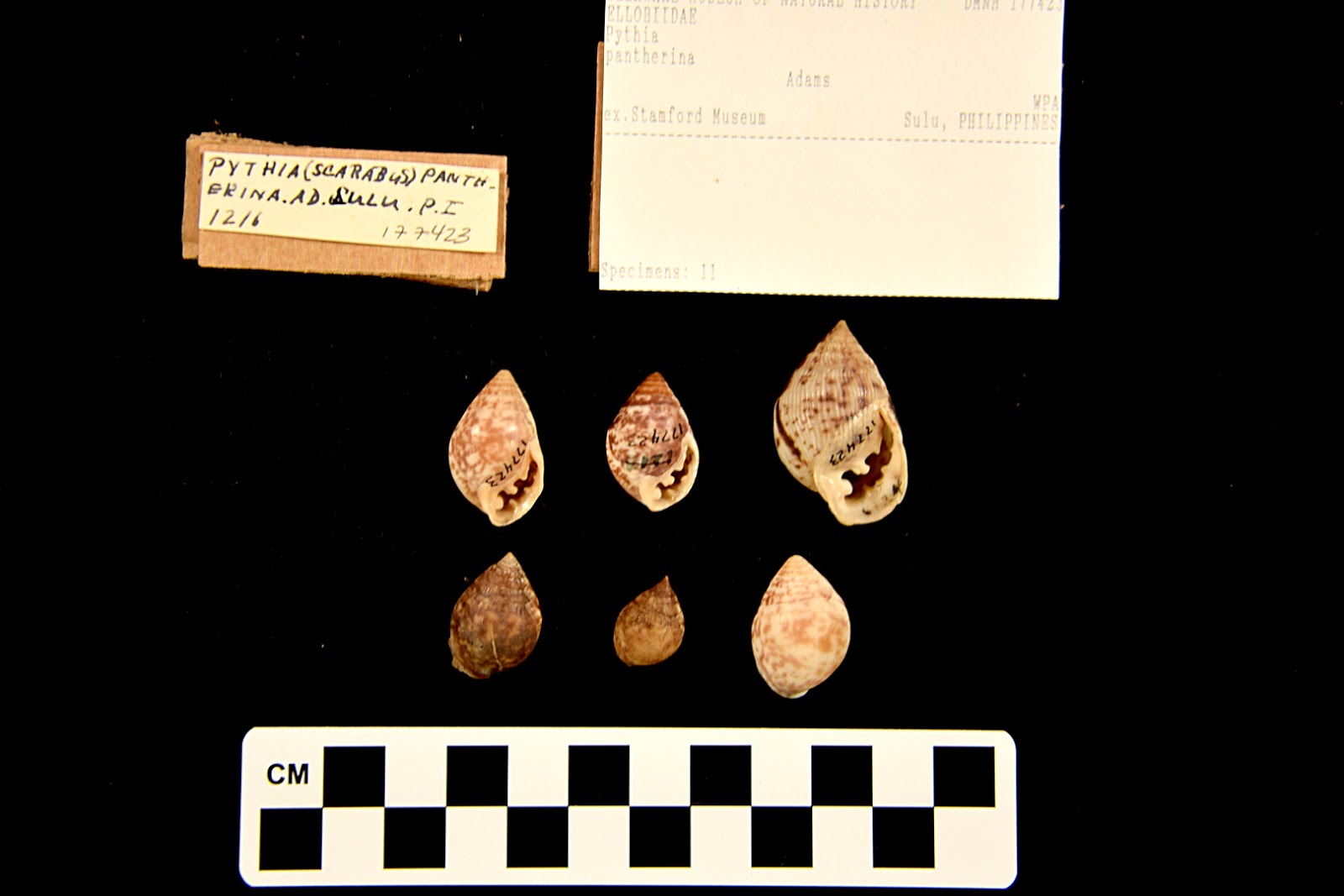
Here we have another strictly terrestrial species, Pythia pantherina (A. Adams, 1851). Though the genus of this species has been changed to Pythia, I don't have information what its earlier name was. (Scarabus) on the older label indicates a subgenus, now no longer used.


Shells of this genus have the most elaborate dentition in the aperture, which indicates they have more severe predation at the aperture, probably by birds. Such a wiggly aperture allows the soft-bodied snail to emerge and crawl about, but prohibits entry to all but the slenderest of bird beaks. Other predators have other ways in: see the shell at lower left in the closeup, with two tiny pinholes in its lower left area (I didn't notice them until I looked at the closeup). They are from a predatory drilling snail, which uses its abrasive radula (sort of like a tongue with tiny teeth) to scrape a hole through the shell. It then injects a nerve poison. The animal inside relaxes, and enough of it extrudes through the wiggly aperture that the predator can either dismember it in place or pull it out to be consumed.


The genus Pythia is found throughout the Indo-Pacific region, typically on mangrove roots above the high tide line, and a little further inland. These specimens, six of the eleven in this lot, are from the Sulu Archipelago of the Philippines.

The third species of interest is Auriculastra subula (Quoy & Gaimard, 1832); the genus was formerly Auricula. These are quite small, seldom exceeding 1 cm in length.


The closeup below shows a single tooth in the aperture on the inner lip, simlar to the Ellobium specimens above. This is an estuarine species, found on mangroves in tidal marshes. It is not fully marine and cannot tolerate ocean water for any length of time.


The genus Auriculastra occurs throughout the Indo-Pacific and South Pacific. These are from Fiji. They show more wear than the prior two species, indicating that they get roughed up in the sandy lagoons, probably during the frequent storms.

The fourth and final species is Ovatella algerica (Bourguignat, 1864), originally called Alexia algerica. These are very small, just a bit bigger than those called "minute", seldom exceeding 0.6 cm in length. Note, however that like the others they have the ovate/cigar shape characteristic of the family.


The closeup shows that they also have small teeth, in this case two of them, partially blocking the aperture. These are 8 of the 20 in this lot. The original label also shows a better example for future shell collectors than the other three: the town, the beach ("Quarry Beach" in Las Palmas), and the country, plus the month and year of collecting. Is lacks only the collector's name. I am not sure why an earlier version of the database placed these in Argentina, but I am glad it has been corrected ("Argentina" on the oldest label is in someone else's handwriting. The handwritten correction on the older DMNH label is from the 1990's.)


These species are found near-shore Europe and north Africa. Their habitats are fully marine to salt marsh. The Canary Islands are offshore from north-western Africa.

The photographic experiment I mention in the title is a matter of spacing for the sake of good focus. The typical way to photograph museum mollusk specimens is to arrange the specimens on black velvet, velveteen, or (as in 3 of the 4 cases above) on black felt, and then to arrange the labels and the scale indicator around them. But even the small shells of these Ovatella specimens have a significant thickness when being photographed close-up. One may either focus on the upper surface of one of the shells, or on the labels, with the consequence that the other will be a little out of focus. One way around that is to use a lens aperture of f/8 or f/11 for greater depth of field. I tried something different.

I cut a number of small pieces of corrugated cardboard, either 3/4" x 2" (2x5 cm) or 1/2" x 1.5" (1.3x3.5 cm). I put these under the labels to bring them up to a plane close to the tops of the shells. In the case of the Ellobium specimens above, it took three thicknesses of cardboard, and you can see the spacers under the smallest label in that photo and the first photo of the Pythia specimens. It worked very well! Everything I want to see is in good focus, using f/4 to f/5. I was also using a +2 closeup lens on my camera's 18-105 mm zoom lens.

With the camera back fixed at 24" (60 cm) above the table top, I used focal lengths of 36 mm and 105 mm. I used a spot focus just below the top of a central shell in each group for the autofocus to work with, and I am pleased with the results.

Each of the original images was cropped, and the color levels clipped to remove the grayness the camera allowed in the black background, and the gamma and saturation were adjusted so the colors in the image matched the colors of the shells. The images above are all re-sized to 1620x1080 pixels, so you can click on them to get images that fill most screens. I also used just a little bit of Unsharp Masking to emphasize the shell decorations, also to make the images look more "eyeball true". My Nikon camera under-sharpens its images, which I like. I usually prefer its usual, softer look, but when I want to sharpen back to "normal", UM is the most versatile way of doing so.

Finally, although felt is cheaper than velvet, the clean, smooth blackness of genuine velvet makes for much better final images, as can be seen by comparing the first two images with the other six.

Thursday, December 22, 2016

The Great Pond Snail

kw: species summaries, natural history, natural science, museums, research, photographs


This tray contains all but four of the lots of Lymnaea stagnalis (Linnaeus, 1758) that are currently in the collection of the Delaware Museum of Natural History. It is called the Great Pond Snail because it is the largest freshwater snail found in Great Britain ("Great" in this case meaning "large"). L. stagnalis is the type species of the genus Lymnaea, which is the type genus of the family Lymnaeidae. You'll notice one box contains only a pink label. That indicates the lot is a Topotype; it was collected in the location where Linnaeus's first-described specimen (the Holotype) was collected. The museum keeps types in a special cabinet. I'll get into more about types on another occasion.

The Latin prefix lymn- is equivalent to limn-, which refers to a lake. As a matter of fact, I am a bit puzzled that the family is not named Limnaeidae and the genus Limnaeus (but see below). The species was first named by Linnaeus as Helix stagnalis. He placed nearly all the spiral-shaped gastropods he knew of in the genus Helix, for obvious reasons. Later workers broke up the genus into quite a number of new genera so as to group the species more appropriately. For a time, subgenera had been created to group the species, and in fact, Lamarck renamed this species Lymnaea (Lymnaea) stagnalis in 1799, while placing several other former Helix species into that subgenus; the subgenus name is in parentheses. Later genus-splitters removed the subgenus designation. In 1875, Sandberg tried to rename the genus Limneus, considering it a justified spelling correction. Nearly everyone else disagreed because of priority rules, and so Lymnaea it remains.

Members of the family Lymnaeidae are lake snails almost exclusively, and some are also found in slow-moving streams, such as in deltas. This species in particular favors very quiet, shallow waters, even stagnant waters if the oxygen content is not too low. Thus the species name stagnalis.

I chose to photograph two of the lots. This first, catalog #60565, was collected in a shallow part of the Niagara River, on the New York side. These are the largest specimens of this species at DMNH. I neglected to put the scale in, but the museum label is 1" x 3", so the largest specimen's height is about 2.3" or 57 mm. The largest recorded specimen just exceeded 60 mm.

These shells, being nearly translucent and very light in weight, practically broadcast their environment: very quiet water and an absence of shell-crunching predators. However, they are hosts to several parasites, and intermediate hosts to at least six different flukes, including one that can severely affect humans. Thus, these are well studied because of their medical and economic impact.

They are "ubiquitously holarctic", meaning they are found throughout the Northern Hemisphere, particularly at higher latitudes, though south of the permafrost line. They apparently hunker into the mud to over-winter in England, Scotland, across northern Europe including Russia, and across the northern U.S. and Canada.

The second lot shown, #119635, contains some of the smallest adult specimens in this collection. The longest is just over 0.8", or 21 mm. Although these were collected in 1926, this indicates that the river where they were found, in or near Detroit, Michigan, must have already been heavily polluted.

Note that both of these lots have subspecies designations on the collectors' labels; one was jugularis and the other, expensa. These are now deprecated; so far as I have determined, no subspecies of L. stagnalis are recognized at present.

The labels of the second lot also show its history, or most of it. Originally collected by L. F. Merrill, it came into the hands of Grace M. Seymour, and then G. M. MacCoy, who donated it to DMNH. Sometimes, collections are accompanied by letters and other documents that tell more of the story. I haven't dug into the library records for the MacCoy collection to see if there is more to the tale.

Shell collectors who are dedicated enough to identify and index and label their specimens are dubbed Shellers. By contrast, the designation Conchologist is reserved for those who also devote time to studying shells, and perhaps living mollusks, and professional Conchologists are called Malacologists. Mollusk enthusiasts and dealers Guido and Philippe Poppe have gathered information about more than 41,000 Shellers in their site Conchology Inc., from which they sell and trade shells, and curate a kind of online museum. It is one of a handful of online resources that I have found very useful to determine the full name of someone. Interestingly, however, none of these three Shellers is included. Neither is Esley Doremus, the donor of the lot from New York.

At least we have the initials for two of them and full names for the other two. In many cases I find a label that says nothing more than a species name, a location, and a surname followed by "leg." or "legit.", the usual Latin designations for a collector. The abbreviation "col." is also sometimes used, but "coll." usually means "from the collection of"; Shellers trade and buy shells so much that for many large collections, only a small percentage of the holdings were actually self-collected by the owner.

The 78 lots of this species held at DMNH allow researchers to study areal extent, presence through time at locations or in areas that were visited more than once, and changes in animal health. I occasionally find a note among the labels that specimens were collected from the bed of a dried-up pond, indicating at least local extinction. Rather poignant, that.

Monday, November 28, 2016

An apple-size apple snail

kw: species summaries, natural history, natural science, museums, research, photographs

I am presently checking and correcting geographic information for the freshwater snails in the research collection of the Delaware Museum of Natural History. Though I am not constantly using the lots in the cabinets, it sometimes happens that something I find in the database doesn't make sense, so I go to the lot in question to see what the collector, and perhaps later owners, have recorded. Today I happened to look up some "Apple Snails" of the genus Pila, and they are such nice-looking shells, and so much larger than many of those I've seen of late, that I just had to share a few of them here.

Firstly, here are two views of the largest specimen of Pila in the collection, and it ought to display at about 80% of actual size if your screen resolution is 100 dpi. The shell length, with the spire eroded, is about 5 inches, or 125 mm. The smaller item next to the scale is the operculum. Many snails have these; they are armored "doors" they can use to shut themselves into a shell when a predator threatens, or to avoid drying out during a dry season.

For the second view I turned over both shell and operculum. On this side of the operculum it is a little easier to see that it grew in a spiral pattern as the shell grew.

The original designation of this species was Ampullaria leopoldvillensis Putzeys, 1898. Sylvère Putzeys was a Belgian who collected in the Belgian Congo, as it was then called, and named this species for its type locality, which is now called Kinshasa, the capital of the Democratic Republic of the Congo (which was also called Zaire from 1971-1997).

I tracked down this specimen to be sure of the spelling of Coquilhatville. Then I was able to determine that the town is now named Mbandaka. It is about 550 km upriver from Kinshasa, and while I haven't looked it up, I suspect that snails of this species are found throughout the Congo river system. I understand that just one of these makes a good meal for a child, and two or three are sufficient for a teen or adult.

While I was in that cabinet, from the same tray I picked out two other lots to photograph, to show specimens of a more "average" size for this genus. This next species seldom exceeds 2 inches, or 50 mm, but is of a very similar shape and has a lighter color:

Pila globosa Swainson, 1822 is primarily Asian, and these were collected from the Mekong River system. The abbreviation of Swainson's surname is quite common. The better-known, more prolific naturalists were all abbreviated in field notes and earlier museum labels. L. means Linnaeus (or Linné), Lam. means Lamarck, Pfr. means Pfeiffer, and so forth.

As the name implies, this species is very globular, almost spherical. It is a contender for being the original "Apple Snail", but there are several others. All members of the family Ampullariidae are called Apple Snails, though not all are quite so globular. For example, this final species has a more pronounced spire:

The scratching-out and overwriting on the museum label, printed in about 1990, shows that the species now called Pila polita (Deshayes, 1830) was originally placed (by some authorities) in the genus Ritena, of the family Neritidae. The Nerites are mostly marine snails, but many species in that family inhabit brackish estuaries and quite a number are fully fresh water-dwellers. Sometime since 1990 this species was re-examined and re-named to be among the Apple Snails, to which it bears an even better resemblance when the spire is eroded, as in the third specimen in the top row. It is a pity we don't know just where in Thailand these were found. The Apple Snail website records these from Thailand all across south Asia to the southern part of China.

It is interesting that the original collector identified these shells as Pila, while the curator or collections manager who accessioned them into the collection used a different reference work to identify them as Ritena. Later someone else changed it back. So it goes. When all we have to go on are physical characteristics of a dry shell, convergent evolution can make two species look very similar when they are actually only distantly related, and in other cases a species will look quite different from its closest cousins because of rapid adaptation to changing environments.

Now that DNA sequences are getting almost cheap, museums are beginning to go through their collections to figure out just what species certain specimens belong to. There is usually enough DNA within the shell material to use with modern techniques, though at present one must destroy one or more shells in the process. This will change. Even more exciting times are on the way!

Tuesday, November 15, 2016

Mussels and mother of pearl buttons

kw: natural history, natural science, museums, outreach, photographs

The Collections and Research Department of the Delaware Museum of Natural History recently hosted a class of conservators-in-training from nearby Winterthur Museum, for special instruction in conserving natural materials that might form part of a piece of clothing or artwork.

Some items that were brought out for display and discussion related to the mother-of-pearl button industry that flourished in Arkansas and other southern states from the 1880's to the 1940's. America's rivers are full of freshwater clams and mussels, and many species of the mussels in particular have thick shells composed mainly of mother of pearl. Mainly in the south, some species get quite large millions of shells were harvested for button manufacture.

The upper shell in this picture has been drilled for buttons. The lower shell is an undrilled one, so the students could compare. A shell drilled like this can still be a valid natural history research object, as long as its collecting locality and a date of collection—or harvest—are known. Even in this condition it provides a data point for the existence of this species at a certain time and place.

The conservators in training were quite surprised that the museum doesn't seem to care much about the appearance of specimens. They are taught to exercise extreme care with objects in their charge. A culture museum such as Winterthur has goals quite different from a research collection. They aim to stave off damage and decay as much as possible, frequently with the aim of showing beautiful objects to the visiting public. Natural history specimens don't need to be pretty, although we also work to minimize damage or decay. The data that accompanies the specimens is of equal value.

These two photos show other items that were on display. One is a sample card used by salesmen to show distributor-customers the range of button types a factory could produce. The other is a box of random unfinished buttons. Some have holes cut already, others not. Many have pink or black dopping wax still attached. The wax was used to affix a piece to a post in a polishing jig to flatten the opposite side and cut any pattern, such as a circular groove.

The study of natural history is not just about natural objects themselves, but also about what humans do with them. Though I spend my time in the mollusk ("sea" shell) side, the bird collection takes an equal amount of space. Think of the millions of feathers that were once used to decorate clothing. A Natural History museum collects and preserves specimens, and the field data about them, to support the study of their biology (or geology) through space and time. A cultural museum collects and preserves specimens primarily of human artifacts—which in the years before plastics manufacture, were made of natural materials including shells and feathers—to support the study of cultural trends through time and around the world. It is nice that we work together, each having knowledge to offer the other.

Tuesday, November 08, 2016

Some confusing specimen labels

kw: labels, natural history, natural science, museums, research, photographs, puzzles

This post has two parts. Firstly, of several reasons that research collections wish to have multiple—even many—specimens of a species from a particular collecting location and time, with this first set of labels I wish to explore one that is not often thought of: Lot splitting for sharing. Sometimes a collector or museum desires specimens of a particular species, and also possesses multi-shell lots of a species desirable to others. Each can extract several shells from a larger lot to trade with the other.

These labels show one interesting consequence of this. The species Planorbis duryii Wetherby, 1879, now known as Planorbella duryi (Wetherby, 1879), is a moderately desirable snail of the Rams' Horn shape. But today the shell is not the story, the labels are. I don't know the protagonists here, so I will call them Collector 1, 2 and 3 (Coll1, Coll2, and Coll3).

Coll1 collected a largeish lot of this species, numbered it #1193, and later split the lot to share portions with two other collectors, Coll2 and Coll3. One of them, let's say Coll2, received both lots and wrote labels for them, giving one to his (or her) friend, Coll3. These were numbered No. 23 and No. 24. Notice that Coll2 did not care about the county they were found in, just the town and state.

Over time, the original lot and both splits made their way into one collection, which was donated to the Delaware Museum of Natural History. Judging from the catalog number, 153565, this occurred in the late 1980's. An alert collections manager, sorting through the donated material, naturally sorted them by species (if they weren't already sorted) and noticed that they were all from one originally collected lot. So they were combined and cataloged as one lot.

What makes their labels of further interest is the location information, and this brings up the second subject of this post. The location seems to be an unknown place! Survey, Florida is not found in the GeoNames geographic name database, nor in GNIS from which it originates. But these paragraphs in an online history of Bonita Springs unlock the mystery:
(1st paragraph) Bonita Springs had its beginnings when, some time in the 1870's, government surveyors in a remote part of Southwest Florida pitched camp near a medicinal spring which the local Indians believed could heal the sick. After the crew left, the site became know as Survey and the stream running from it, Surveyor's Creek.
(4th paragraph) In 1912, a Tennesseean named Ragsdale purchased 2400 acres around Survey. He and his associate, Dan Farnsworth, surveyed the area and laid out a small town with streets and avenues named for potential buyers. There was no church, but, in 1915, a Naples minister held the community's first non-denominational service in the school house. The developers decided that the name, Survey, lacked sales appeal, so the town was renamed Bonita Springs; Indian Spring Branch became Oak River; and Surveyor's Creek was upgraded to Imperial River
Without the Internet, it could have taken weeks to write letters or phone around to find someone who knows what happened to Survey. Name changes such as this are more common than one might suppose, leading to all kinds of interesting puzzles for researchers, and for errant database cleanup specialists such as myself. This is particularly a focus now that I am cleaning up the geographical information for the current project.

Just a month ago I finished taking inventory of the freshwater snails in the collection of the Museum. Now I am working on pinning down the collecting locations, correcting as needed—such as putting in Bonita Springs as the new name for Survey, Florida—and attaching or correcting county, state, and sometimes country. For example, one database record was attributed to Papua New Guinea, and a locality name of "Lake (Cape?) Palousa". I went to the specimens, and was able to puzzle out that the collector's handwritten label actually read "Cape Palmas", not mentioning a country. The species is an African endemic, which made it easy after that to determine that the country was Liberia. Cape Palmas is a prominent point near the southernmost part of the country. Here are some other interesting labels that I saw today; not all could be pinned down:

Lot #17002 is from the initial donation by John du Pont, used to set up the mollusk collection when the museum was chartered before 1970 (it opened to the public in 1972). As this label indicates, Mr. du Pont was the collector. This label replaced whatever label there might originally have been. More likely, the information was taken from a notebook when the label was written. (Note to collectors of all kinds. Never throw away an original label! Keep old notebooks also.)

It is curious that this label names the collecting locality as "Java, Singapore". The closest points of southern Singapore and northwest Java island are more than 500 miles (800 km) apart. I have taken this to mean the species is found in both places, but I wonder if the lot is a combined lot. Nerita lineata Chemnitz is a marine snail in a family that has many freshwater species. That is why it was included in a "freshwater gastropod" inventory. Being marine it could easily be represented all along the Malay peninsula and throughout Indonesia. The actual collecting locality remains a puzzle.

This collector's label for lot #90224 says, "Little Sur River Bridge Hwy 1 nth of Monterey Santa Cruz Calif", with the date and collector's initials. We think "nth" means "north." The bridge indicated is 10 miles south of Monterey, and more than 60 miles south of Santa Cruz. We have a "Verbatim Location" field in our database, and that is where the quoted text was put, while the "Locality" field for publication now reads, "Little Sur River bridge, Hwy 1, near Monterey", with the county (Monterey County) entered in its own field. I've driven the Big Sur highway, and crossed that bridge. Most of the highway is slow and curvy, but I would not expect actual confusion as to which direction one is traveling.

Finally, this label with older catalog numbers from two collections, and written in 1924, originally read, "Rio Hondo at S.P. Trestle". Much later someone  wrote "San Pedro Calif", which was entered into the museum ledger in about 1980 as "San Pedro Coll.". Ever since then, this has been assumed to refer to a college, but there is no such college. A look at the label showed me the real situation. The Rio Hondo wash splits off the Los Angeles river going northward between Lynwood and Compton, 16 miles or more north of San Pedro. The Southern Pacific trestle is a mile or so north of that, so the Locality field now reads "Compton" and I added the coordinates of the center of the trestle to our "Coords" field.

Fortunately, most of the geographic data is much easier to determine, and frequently can be vetted by a quick glance. A lot of data cleansing is routine and can be boring, but there is enough "detective work" involved to keep the boring times to a minimum.