Showing posts with label photographs. Show all posts

Wednesday, January 25, 2023

Neighborhood birds – not so ordinary

 kw: book reviews, nonfiction, ornithology, birds, bird watching, photographs

This is how baby robins look the day they hatch. On most monitors this image will be just a little smaller than actual size.

We had the good fortune that a pair of robins built a nest on the kitchen window ledge. They anchored it to the thermometer support. Four blue eggs were followed by four pink nestlings, covered with sparse white fuzz. We kept the window shade down, except when taking pictures, to keep from spooking the parent birds, and later, the fledglings.

I am not much of a bird watcher, but I pay attention to them, particularly the ones in my yard and neighborhood. In Jack Gedney's book The Private Lives of Public Birds: Learning to Listen to the Birds Where We Live, the author wants, most of all, that we all pay attention. Birds are all around us.

When we step outside in the morning (or if we have an open window at sunrise), do we notice the birdsong? When we turn a corner at the end of the house and hear a flutter from a nearby bush, do we bother to look for the rapidly-exiting bird we just spooked? When a catbird is crying nearby, do we crane about, hoping to see it? Do we thrill to see a cardinal in the birdbath?

The book has the stories of 15 common birds of California, where the author lives. A few, the towhee and two species of native sparrow, were new to me. The rest were familiar. Hmm: Chapter 10, on the White-crowned sparrow and golden-crowned sparrow, is two-for-one, so that's 16 bird species.

Although I've lived in California three times, for a total of eleven years, I never learned of the California towhee. Gedney calls it "the brown bird", which reflects its principal characteristic. However, the average songbird is a "little brown thing"—think of common (English) sparrow and wrens—which makes sense. For prey birds, being inconspicuous is a life strategy. So I was probably in the presence of towhees daily and never noticed.

I love the way he writes: lyrically, without being maudlin. In Chapter 6, about the House Finch, he invites us to "reenchant our lives": "You can choose to peel away the concealing layer of quotidian gray and rediscover the brilliant core that's been present all along." From any distance farther than halfway across your yard, it's hard to tell this is a red bird. Particularly in fall and winter, its winter coat is more of a stately pink than this blazing red.

Writing of owls, he remarks on the way they add their own sounds to the night (the stereotypical "Hoo-hoo Hoooo!" is generally a great horned owl; hard to spot in spite of its size). Yet with the spread of artificial light, the monthly cycle of the moon's phases is lost on us, and the changes in owl song that were once so familiar: "[We] lose the evening, erase the quiet time between activity and sleep. Moonlit groves grow lonely in an age of off-and-on." He turns to a poet, Pablo Neruda, to limn the Anna's hummingbird: "You are / a seed in the sun / a fire / dressed in feathers." Although mourning doves have the fastest level flight of any bird, Anna's hummingbirds fly faster relative to their size than any other bird. Put another way, the hummingbird is a bit slower than the dove, but is 1/3rd the length and 1/30th the weight.

I suspect if almost anyone put their mind to it, they could recall at least a dozen birds with which they are at least a little familiar.

I live some 10 km west of the Delaware River, near the PA-DE state line. This is the northern end of the Mid-Atlantic region. The ranges of many populations of northeastern and mid-southern birds overlap, so folks that keep life lists have a rich harvest without going far.

The larger birds we see are typically turkey vultures, such as these two (photographed by my wife), after chopping up some small carcass in our yard, peering in the neighbor's window. I've seen bald eagles in nearby areas, but never from our neighborhood. Even from far away, it's easy to distinguish eagle from vulture. The eagle's wings are held flat and its flight is very steady. The vulture's wings are held in a shallow "V", and it tends to teeter in flight, catching every tiny shift in the updrafts that keep it aloft. The turkey vulture, if close enough, sports long, white triangles on the rear of its wings. Half the tail is also white.

We also have black vultures, with black skin on the head rather than red. Turkey vultures have the best sense of smell of any bird, and black vultures keep an eye on them because they can smell what no vulture can see.

Slightly smaller raptors in the area include this Cooper's hawk, that was sitting our our fence, and both red-tailed hawks and red-shouldered hawks. Cooper's hawks are bird hawks, but one day a friend and I were in the driveway talking, and heard a thump. We turned just in time to see the Cooper's hawk flying off with a squirrel. That's a lot of load for this hawk, for they are smaller than red-tailed hawks.

Middle sized birds are dominated by robins. In certain seasons, it's interesting to see a nearby schoolyard hosting 20 or more feeding robins, which keep 10-20 feet apart, while not far away, a flock of 100 blackbirds, with much closer spacing, could fit in the area of a garage. We also have cardinals—this picture is of two cardinal eggs in a nest in our privet hedge. There are also catbirds, starlings, mourning doves, tree swallows, blue jays, and occasional goldfinches.

Smaller birds include several "little brown things": English sparrows, Carolina wrens, and another wren species I haven't identified. We also have chickadees. Neighbors have reported seeing bluebirds, but I haven't.

That's nineteen. Not much of a life list compared to many folks I know. But for me, it's enough. I can't identify them all by sound, but with observation that ought to improve. I hope Mr. Gedney would approve.

Friday, November 13, 2020

An anchor of my life has been removed

kw: memorials, photo essays, photographs

Those of us lucky enough to grow up with an active, extended have wonderful "home-grown friends," our cousins and their parents. The boy cousin on my father's side, whom I called Gordon, was the only son of my father's sister Martha and her husband Jim Noyes. They were a stalwart Christian family, and I learned I could rely on "Uncle Jim and Aunt Martha" for counsel and valuable advice, which I sorely needed a few times.

Martha was born October 17, 1919. She passed away earlier today, November 13, 2020, age 101. After my father died 2½ years ago, preceded by my mother in 2004, Martha was my last connection to her generation.

This kind of infant photo was very popular at the time, and for a generation or two earlier. I have a photo like this of her mother, my grandmother.

In this photo Martha and her brother Buddy or Bud, my father Jim, are about six and four years old, respectively. They were close all their lives. Cute kids!

About fifteen years later she had grown into a beauty. She and a Navy man, Jim Noyes, were married October 22, 1940. They were married 58 years.


Here, Martha and Jim's son Gordon is the small boy on the lap of our great-grandfather J.G. Nye. His daughter Inez, our grandmother, is at the far right and her husband Earl, our grandfather, is in back, near center, next to Jim Noyes. 

My mother and father are at far left, and I am in my father's arms. Martha is next to her father, peeking between my dad's cousin Paul and his wife.

This picture was taken about 1950 in Alhambra, California.

This is how I remember Jim and Martha, once their son and I were young adults, and I was still living in California and could see them frequently. Later when I was there on a business trip I would see them.

I remember going to church with them a couple of times, years earlier, when I would stay over for a visit. My family was Methodist, and in that near-Episcopal tradition, "God's frozen chosen", church services were quiet, and sermons were more like lectures.

The Noyes family went to a Baptist church, the congregation was more vocal, and the preacher could do Fire-n-Brimstone with the best of them. I was impressed, and perhaps a little apprehensive.

I don't know when it was; a few years earlier when I was still in high school, the family spent a year in India. Although it was business-related for Jim, they took advantage of the opportunity to work with missionaries on Gospel work. Later they also spent a few months in Israel using Christian films to proclaim the Gospel.


These two pictures, taken in 1990 and 1996, show Martha and Jim and my parents together, first as new retirees, and then at my parents' Fiftieth Anniversary party. The other couple at their table are my mom's sister and her husband.

After my father passed away early in 2018 my brothers and I and other relatives went to Fremont, California, where Martha lived after her husband died in 1998.

This picture was taken in her assisted living facility in Fremont, where we held a memorial for my father. Here she is talking to my wife and a few others, wearing an expression I like, her "I'm messing with your mind" look. I don't recall what she had just said.

We promised to return the following year for her birthday.

Many of us went to Fremont the following year for her hundredth birthday. A party for her was held in the recreation hall of the church she attended.

Here she is, wearing a little crown. She has two grandsons. One is at the second "0" in "100", and the other at the far left, behind a family friend holding a guinea pig. The others are some of the 100 or more people who came to the party. Martha was a kind of mother hen and spiritual adviser to many, many people.

Finally, back at her living facility, we got this photo of Martha with my brothers and I, plus her grandsons and other relatives and friends including our son (in purple).

Monday this week she called me to tell me "Happy Birthday". One of her grandsons had been keeping us up to date on her failing condition. She sounded a little weak, but still quite clear. I am so glad for that phone call.

May God richly reward her for something like ninety years of faithful and loving service to Him.

Tuesday, March 12, 2019

The other kind of land snail

kw: species summaries, natural history, natural science, museums, research, photographs

I spent more than two years, in my work at the Delaware Museum of Natural History, cleaning up/correcting and loading data for their collections of terrestrial gastropods, informally known as land snails. Correction: the past 2+ years I worked with the pulmonate terrestrial snails. They are called "pulmonate" because they have lungs, though really they are modified gills in an internal cavity where they can be kept moist, and muscular contractions pump air in and out, like real lungs.

That is not the only kind of land snail. The other great division is the operculate terrestrial snails. They are called "operculate" because they have an operculum, a kind of door that they can use to seal the shell shut, to keep water in, because they have gills inside the shell, and also to keep predators out. Many marine snail species also have an operculum, used to avoid desiccation when they get stranded above the tide line for a while, and even more to keep predators out.

The pulmonate lifestyle is apparently the easier, because there are many more species of pulmonates than operculates. In the DMNH collection, 95% of the land snail collection is pulmonates, more than 40,000 lots versus about 2,000 lots or operculate land snails.

Thus, my last project is to clean up, and load, all the data for the operculates. The first major family that I encountered is the Annulariidae. Many of these have a flared aperture, as shown in these two images:
This image is roughly life size (the museum label is 3" long). The species Chondropoma bairense Torre & Bartsch 1938 is a little prettier than most of its kin, and larger. Here, "Chondro-" relates to "grain", and many species in this genus are little larger than grains of corn. The flared aperture is characteristic of species in many genera of the Annulariidae.

This one is called "bairense" because it was first found at Baire, Cuba, which is in the south, in the state of Santiago de Cuba, west of Guantanamo. Hoyo de la Reyes can mean "king's pit" or "-hole", but here it probably refers to a steep valley.

From the differences between the older label and the one that C.L. Richardson typed up we can see why it is helpful to have all the labels possible with a specimen. Richardson simply left out the name of the town on his own label!


Here is a closeup of the shells. Sadly, both have their tips knocked off. This is the only lot of this species in the DMNH collection, so we must make do with what we have. I find it fascinating that there is ribbing along the outside of the whorls, but the shell on the right also reveals longitudinal ridges in the omphalos (a synonym of "navel" or belly-button; it refers to the central hole where the whorls come together. Not all snail species have one, including the next one shown).

I picked one other species to show, because of its bristly appearance and because one shell still has the operculum:

In spite of the way the name is spelled on both labels, this species is Blaesospira echinus (Wright, 1864). The parentheses indicate that the genus name has been changed, but I don't know the history. I don't know what the genus name means, but I suspect it means something like "open spiral" because the whorls of the shell are not in contact.

The species name is easier: "echinus" means "spiny", and this little critter is truly spiny. The mogote (isolated hill) named "El Queque" is a well known snail collecting locality in the ViƱales area of the state of Pinar del Rio, Cuba. 

This image is about 40% larger than life size; the shells seldom exceed a centimeter in length or diameter. These spiky little critters are even more impressive when magnified:


Here you can see that one of the shells still has an operculum in its aperture. Opercula frequently have a spiral structure like this one. The wavy rim of the apertures hint at the way the spikes are formed. They are hollow with open tips. These lovely little shells are very popular with collectors, which makes me wonder if they are still to be found there. Few specimens from Cuba have found their way into American collections since the Castro regime began in 1959.

I should also mention that some taxonomists place this genus in the family Pomatiidae (once called Pomatiasidae). What with DNA sequencing and other tools of molecular biology, the taxonomy of mollusks in general is being reviewed and revised more than ever. 

Thursday, April 26, 2018

Scoping out lamp spectra

kw: analytical projects, spectroscopy, photographs

Technical photography of biological subjects has its tricky aspects. An important one is the quality of the lights. This picture shows one setup I have used to avoid the use of the compact fluorescent lamps (CFL's) that were brought in to replace the incandescent flood lamps they had been using, but which burn out on a regular basis…and they are hot. CFL's have serious drawbacks for color photography, which we'll see later on.

The little blue lamps, wrapped in tissues, are "work lights" from Harbor Freight, with 18 small LED bulbs each. They have a pretty good spectrum (I'll point out a similar one below).

We have been considering a more quantitative approach, particular for photos of birds. Few mollusks have "interesting" colors, but nearly all birds do. Birds have an extra color sensor in their eyes and can see ultraviolet light, so it is also of interest to be able to photograph birds in UV light.

I decided to explore the various lamps available, not only for these reasons but a few extra ones. In recent years I used pieces cut from a page-size sample of diffraction grating, obtained from Edmund Scientific many years ago, to make two spectroscopes. One, about a foot long, is for handheld use, and another, about twice the size, is for use with a camera.

I originally made them to investigate which yellow lamp would be the best "bug light". Night-flying insects see UV even better than birds do, and many of them cannot see yellow or red light, and have low sensitivity even to green. The ideal bug light would have a cutoff in the yellow-green range, and would be rather orange. In order to keep people on your doorstep from looking too weird, all commercial bug lights include some green and look distinctly yellow.

This shows a test setup with the large spectroscope on my workbench, using a black light as the source. Not only does the camera "see" UV, it is also being overloaded by the bright blue and violet lines of mercury (Hg). That black light bulb is not nearly this bright to my eyes. The camera at the left is set back a little farther than usual; I usually use it with the front of the zoom lens about two inches from the grating, which is at the end of the white bell-shaped "front" of the spectroscope. The "slit" is currently a thin slot sawn into a PVC cap at the end where the lamp is.

Initial tests verified that the camera's sensor can record UV and that the lens passes it, and also that none of the lens elements is fluorescent (a problem with the lens of another camera I have!). I also learned that the "UV filter" I was sold with the camera does not block UV-A (longwave, or near-UV). It does block short-wave UV, that is UV-B and UV-C, pretty well. So I bought a better filter, a UV(0) filter from Hoya. Now to the recent batch of tests, summarized in this image, a screen shot from PowerPoint:


Depending on your monitor, this might be hard to read. To summarize, the top shows the spectrum of a "black light" CFL (a "party light"), at two exposures; the next 11 sets are at three exposures each. From the top, then, we have

  • two sets for different hues of fluorescent tube, 
  • two sets for incandescent bulbs, 
  • two sets for different hues of CFL, 
  • a yellow CFL "party light", 
  • two commercial "bug light" bulbs, and 
  • two sets for LED bulbs from different manufacturers; the spectrum of the work lights from Harbor Freight is a little bluer than the bottommost set.

Only the black light has a spectrum that includes a strong UV line at 365 nm. Most of the lamps have a cutoff near 420 nm, though a couple of the CFL's let through a little deeper blue and the UV line. The spectra of the CFL's show very strong lines with darkness in between, which is why these lamps have poor "color rendering", as it is called. LED's, as shown at the bottom, come the closest to mimicking the spectra of incandescent lamps.

My preliminary conclusions are (1) that for ordinary color photography, LED lamps are the best choice among the "non-incandescent" ones, and (2) to get good UV images we'll need to use black light CFL's, probably with a visible-blocking filter. It may also work to use UV LED flashlights like the ones used by TSA at airports, though they are a bit costly, because they don't produce any visible light.

Tuesday, April 17, 2018

The waxy snails

kw: species summaries, natural history, natural science, museums, research, photographs

In the course of time I have come to a cabinet-and-a-half containing a couple of thousand lots of a family of snails (gastropods) named Cerionidae. Though there are four genera in the family, the Delaware Museum of Natural History holds members only of the type genus Cerion. The family was split out from a large family, Urocoptidae, by Henry A. Pilsbry in 1901. "Harry" Pilsbry spent much of his career at the Academy of Natural Sciences in Philadelphia, where he described hundreds (thousands?) of new species.


This first photo is of the type species (of the type genus of the family Urocoptidae), Urocoptis cylindrus (Dillwyn, 1817). Lewis Dillwyn originally named this species Turbo cylindrus, using a genus name created by Carl Linnaeus in 1758, when he single-handedly invented biologic nomenclature. At the time these specimens were collected the species was considered of the genus Cylindrella, then was shifted again to the genus Urocoptis when the family Urocoptidae was set up. The family Urocoptidae contains many genera, and while many of the species are similar to this one, being cigar-shaped with a flaring aperture, they vary a lot around this gestalt.

The genus Cerion, pronounced "kerion" or "Syrian", from the Latin word cerea, meaning "waxy", was named by Peter Rƶding in 1798, based on his renaming of Turbo uva as Cerion uva (Linnaeus, 1758). The genus has just a handful of fully accepted species, but the DMNH collection contains representatives of more than 200 species, which have varying levels of acceptance among workers carrying on a decades-long reworking of land snail families. This photo shows two characteristics of many Cerion species: the off-white waxy color and the ribbing along the entire shell. The flared aperture is less pronounced than it is in most of the Urocoptidae. The following photos showcase three more Cerion species, chosen to illustrate the range of variation in the genus.


The photo below shows Cerion weinlandi (von Martens, 1860); Edward von Martens originally placed it in the genus Pupa. It does look like a pupa! I chose this species to illustrate the extreme of nearly absent ribbing. Also, while the background color tends to be waxy off-white, this species is one of many with color banding and mottling also.


Though this lot is labeled Ceriod dalli Maynard—publication date is probably 1889—it was renamed and included in the species Cerion rubicundum (Menke, 1829). I don't know what name Karl Menke originally gave it. The species name means "ruddy", and when the shells are fresh and moist, the brown markings are reddish-brown. I chose this species for its narrow ribbing.


Finally, Cerion marielinum Pilsbry, 1927 (the museum curator attributed the species to Carlos de la Torre, who had edited the journal in which Pilsbry published the description) is so named for its occurrence mainly near Mariel, Cuba. This species shows wider, more robust ribbing, and also has a ruddy background with the waxy white being confined to the tops of the ribs.


I chose the scale for these photos so that they would show the shells close to life-size on a 17-inch monitor. On my 22-inch monitor they are about 25% larger than life. Comparing the four Cerion species with Urocoptis cylindrus, there is certainly a resemblance. It is easy to see why the genus was originally put in the same family. However, details of their morphology, including not only the more pronounced ribbing, but also the smaller aperture and the small teeth inside the aperture, distinguish Cerionidae from Urocoptidae…at least for now! Biological naming is always a tug-of-war between "splitters" and "lumpers". In some mollusk families, large numbers of species have in recent years been combined into a relative handful of species, and this may soon result in the few hundred species of Cerion being lumped into a smaller number of species that are recognized as being rather variable.

Genetic studies and breeding studies are going on in parallel, and revealing more and more about the species and inter-species relationships of many animals, not just snails. But, you know, I just like opening a drawer full of shells once in a while to simply admire them.

Tuesday, February 06, 2018

Some random members of family Orthalicidae

kw: natural history, natural science, museums, research, photographs

I have been in the midst of inventory of terrestrial snails of a large family that is popular with shell collectors, the Orthalicidae. The family is named for the genus Orthalicus, but the family contains numerous species in many genera. In recent years taxonomy professionals have split certain genera out into new families. But we tend to call all these species "Orthalicids". Today I just present a few that I ran across recently, showing some of the breadth of attractive shell forms in these families. Each image is followed by a caption.
These are two species in the genus Placostylus, P. scarabus (Albers, 1854) and P. seemani (Dohrn, 1861). They are found on the islands of the south Pacific: the former in New Caledonia and the latter in Fiji. These island nations are about 850 miles apart (~1,350 km), so there is little natural opportunity for these species to encounter one another. The Fijian shells are visibly narrower than the Caledonian.
These are two more species of Placostylus, P. strangei (Pfeiffer, 1858) and P. stutchburyi (Pfeiffer, 1860). Both are found on the Solomon Islands. The third row consists of five lots of shells that have been identified as Placostylus, but no species is yet assigned. I am particularly intrigued by the one shell with aperture showing, that is bright orange inside.

This closeup shows one lot of P. scarabus. I purposely turned one shell to show the aperture, which shows a pale orange inside, less prominent than the one in the former picture. This also shows the variety of coloration to be seen in a single species, from quite mottled and brownish to smoothly creamy.

I turned two of these shells, of the more distantly related species Auris melastoma (Swainson, 1820), to show the nearly black interior. "Melastoma" means "black mouth". These inhabit Brazil.

Finally, this is a closeup into the plastic box containing one lot of Berendtia taylori (Pfeiffer, 1861). These are from a little closer to home, for us Americans at least: on the Baja peninsula of Mexico. I wanted a closeup of these, to show the fine ridges that cover the shells. You can also see a relic of museum practice in three of the shells: Munroe Walton had written his own number inside the apertures, and these have been crossed out and the DMNH catalog number written there.

Friday, December 08, 2017

The most popular snails

kw: species summaries, natural history, natural science, museums, research, photographs

For the current series of projects at the Delaware Museum of Natural History, I have worked through several families of terrestrial gastropods (land snails and tree snails). Many of these are quite inconspicuous, being small and not colorful, though they are in general a little more various than the little brown "mud snails" (freshwater gastropods) I worked with for most of 2016.

You know, in any group of creatures, most are rather inconspicuous and poorly known. The "typical" mammal is a "little brown furry thing" such as a mouse, vole, shrew or lemming. The "typical" bird is a "little brown feathered thing" such as a wren or sparrow. The "typical" insect is a "little dark beetle" about the size of a grain of rice. The world is full of little brown things and we hardly notice them.

But we really like the colorful "charismatic" ones. Among the land snails, that would be the tree snails of Florida and the Caribbean, of the genus Liguus.


This is part of a drawer of "unidentified" lots of Liguus fasciatus, the poster child for pretty tree snails. Though these have been identified as to species, L. fasciatus has many "forms" or "varieties", which we provisionally catalog as subspecies, but they probably aren't really subspecies. We usually call them color forms.They hybridize freely, but a particular color form is usually physically separated from most others, being endemic to a few "hammocks", as small patches of raised and heavily vegetated ground are known in the area.

These are mostly from an area of the Everglades called Pinecrest, named for a ghost town tucked away in the middle of a couple of hundred hammocks. You can clearly see that most of these lots are in need of splitting into their color forms. Any particular hammock may be inhabited by a few color forms. A collector in a hurry will gather a couple of dozen shells, put them in a box or bag with a label (date, provisional ID, and location, at the least, to be a useful specimen lot), and move on to the next hammock a few minutes' walk away in the dry season, or a short airboat ride away the rest of the year.

Here is the prettiest of the color forms, in my opinion:

On your computer screen this may be a bit larger than life size. The paper label is 3 inches long, so these shells are about 2 inches long, a little bigger than the average for the species. Liguus fasciatus splendidus Frampton, 1932, must have been Henry Frampton's favorite also. These are indeed splendid! This lot was collected by Erwin Winte a few years after Frampton described them, and in the 1980's it wound up at DMNH.

These shells are so sought after that, though they are prolific and widespread, many color forms are getting hard to find. In the southeast U.S. and the Caribbean, a whole subset of shell collectors are called "Liguus collectors". We are loving them to death!

This only serves to introduce these lovely shells. I hope soon to gather pictures of several color forms, and also to compare L. fasciatus with its sister species in the genus.

Monday, September 25, 2017

The referential Clausiliid

kw: species summaries, natural history, natural science, museums, research, photographs

The gathering of biological species into genera (plural of genus), and of genera into families, can be a difficult matter. This is particularly true of animals that are variable in their expression, including mollusks, and gastropods (snails) in particular. The history of discovery proceeds to-and-fro: Species after species will be collected and described, and at first, many similar creatures will all be described under a certain genus. A later researcher may then distinguish a common set of features for certain of those species, and a different set of features for others, leading to setting them aside as a new genus. A similar but more arduous process is needed to discern family membership…usually.

In the case of a unique family of terrestrial snails, the Clausiliidae, one and only one distinguishing feature is needed to determine whether a newly discovered species belongs: the presence of a clausilium. This requires a little explanation.

You may know that many marine snails have a kind of "door" that they can shut behind them when they retreat into their shells. It protects them from many predators and also keeps them from drying out when they are exposed to the air for too long. These two pictures show different species of whelk; the operculum for each is visible. First we see a Lightning Whelk all pulled inside after a wave threw it up onto the beach. Its operculum is the brown oval thing in the aperture.

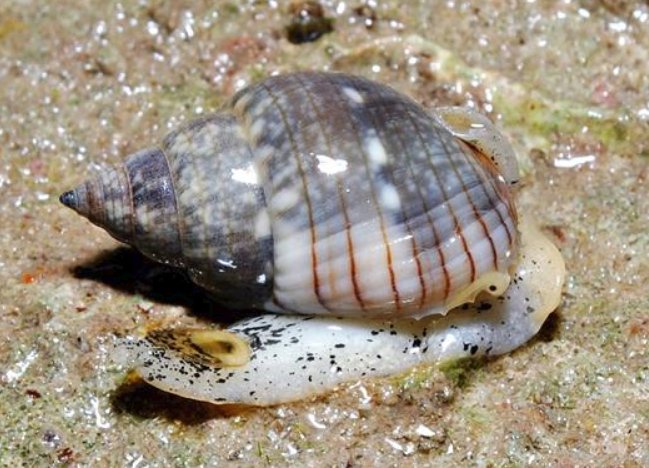
The second photo shows a different species of whelk crawling on the sand. The animal's foot, at the lower left, is white with dark spots, and the operculum is also brownish, attached atop the end of the foot. Many, many families of marine gastropods have opercula (the plural of operculum). Twenty families of freshwater gastropods also have opercula, as do a small number of non-pulmonate (that is, gilled) land snails. Only one prominent family and two very minor, though related, families of pulmonate land snails have opercula. A pulmonate snail has a lung rather than gills, or in addition to gills, and can thus spend prolonged amounts of time out of the water.

A clausilium is not an operculum. This structure is not kept external to the shell, as an operculum is, but is internal, as seen in these semi-transparent shells. Rather than being attached to the animal's foot, it is attached by a muscular structure to the columella, the central column around which the whorls of the shell are wrapped. When a Clausiliid snail retreats into its shell it pulls its body inside, then deploys the clausilium to block the aperture. So the clausilium's purpose is the same as that of the operculum, but is a distinct evolutionary development.

In addition, whereas an operculum is sometimes thin and even translucent, it is usually robust and may be a thick shell in its own right with a spiral structure. By contrast, a clausilium, although always calcareous, is thin and rather fragile. Apparently, members of the Clausiliidae, being small and having a small aperture, do not encounter the determined predators that attack many marine snails.

Today in my work on the current project at the Delaware Museum of Natural History I began to take inventory of a little more than 1,000 lots of the family Clausiliidae. The type genus of the family is Clausilia, described by Jacques P.R. Draparnaud in 1805. He based his description of the genus on the species Clausilia dubia, but a later evaluation by physician and malacologist Louis C.G. Pfeiffer led to a re-description of the genus as referred to Clausilia scalaris Pfeiffer, 1850. Ironically, this species has been renamed and then made synonymous with another species, and is now called Muticaria macrostoma (Cantraine, 1835; Cantraine originally called the species Clausilia macrostoma).

I found that DMNH has just one lot containing shells of this species, which is endemic to the island of Malta. The collector, whose material was obtained by Ralph Jackson in the 1950's and later donated to the museum, notes that this species is "very rare". Yet he somehow obtained six shells.

This photo shows the shells close to natural size. It is hard to see in this image that the shells are well-decorated with ridges or striations. Clicking on the image to see it larger is a little better, so I also took a closeup through a low power microscope.

The species name "macrostoma" means "large mouth". Clausiliids all have small apertures, and the aperture of this species is only "large" by contrast to many other species in the family, and that primarily because of the wide lip around the "mouth".

All the shells in this lot have the first one or two or three whorls broken off. That fact and the ridges indicate that these little animals live in a rather high-energy environment. I became curious about the locality so I looked it up, and found that Mistra is on a protected bay. Malta is not very large, being 17 miles long and 8 miles wide (27x13 km), but it has room for at least five places named "It-Torri", which means "red tower". The nearest to Mistra is about three miles to its northwest. This is a much windier locale than Mistra, so perhaps such environmental stresses shaped the species.

Few clausiliids are so heavily decorated, and, indeed, most are smooth or nearly smooth. So it is ironic for this to be, in effect, the "poster child of the Clausiliidae."

Tuesday, June 06, 2017

The yellow-tipped little agate snail

kw: species summaries, natural history, natural science, museums, research, photographs

Earlier this year I completed two major projects to prepare about 17,000 data records at the Delaware Museum of Natural History for all the freshwater species of bivalves (clams and mussels) and gastropods, and load them to a new database system from which they can be served up via the internet. The principal portal is iDigBio. A secondary portal, from which it is easier to dig into the records on a museum-by-museum basis, is InvertEBase. Each project took about a year.

That done, I have begun working through the museum's data for terrestrial gastropods (land and tree snails), which total about 38,000 records. We decided to take these a cabinet or two at a time, for the most part. I am basically tackling between 1,500 and 2,000 records per mini-project. A first project took about a month, so I expect the sum of about 20 projects to take a couple more years, maybe three or more.

I am in the midst of inventory for three related families, and the first is Achatinellidae. These snails were so-named because they resemble the large tree snails of the family Achatinidae. The prefix "achat-" means "agate" in Greek, and refers to the striped appearance of the most familiar species, the giant African tree snail, Achatina achatina (LinnƩ, 1758), also called the tiger snail.

The one shown in this image may have a shell as long as 8" (20cm). The suffix "-ell" means "small"; the snails of family Achatinellidae are much smaller than the Achatinidae, but many have a similar striped look.

The type genus (the one the family's description is based upon) is Achatinella, and the type species is Achatinella apexfulva (Dixon, 1789). As I was taking inventory of the specimen lots of this species, I noticed that some had been collected by a major donor to the museum, Munroe L. Walton, when he was quite young, not more than eleven years old. In the three photos below, you can see they were collected in Hawaii in 1901; Walton was born in 1890. First, the photos, which mostly speak for themselves. Commentary continues following.


Around the year 1900 it was common to distinguish the many color variations of variable species by assigning subspecies names. The original labels for the first two lots reflect this. The third lot was originally attributed to a different species because many of the shells in certain parts of Oahu are left-handed, such as the one on the right in the third picture. These are now recognized as part of the species apexfulva. The suffix "-fulva" means "yellow", and shells of this species have a yellow tip. Specimens of this species grow to 1.5-1.9 cm (0.6-0.75 inch).

The second lot shown has an added label, written by Edward W. Thwing, who may have been the actual collector of that lot or part of it. He was 22 years older than Walton. The designations "New." and "Newc." on some of the labels refer to Wesley Newcomb, a physician who became a curator of mollusks at Cornell in the 1870's and until 1888. He described the first specimens of many species in the family Achatinellidae.

Although Achatinella apexfulva does not have a common name, I call it the "yellow-tipped little agate snail" as a direct translation of its scientific name. The Achatinellidae in general are colorful and attractive. Sadly, most, including A. apexfulva, are now extinct.

Tuesday, May 09, 2017

A snail family and a photo experiment

kw: species summaries, natural history, natural science, museums, research, photographs, digital darkroom

A few weeks ago I finished a project to clean up the data for all of the specimen lots of freshwater snails at the Delaware Museum of Natural History. We loaded almost 10,000 data records to the new database product, and linked them to the InvertEBase site (the link opens the Collections page; we are #3). Then I began working my way through the land snails (called terrestrial gastropods in most literature, and they include tree snails). The Curator and I decided to work taxonomic family by family, or in groups of related families, working with about 1,000-2,000 records at a time.

The two great groups of terrestrial gastropods are the Pulmonates (infraclass Pulmonata of class Gastropoda) and the Operculates (in class Caenogastropoda along with many freshwater and marine species). "Pulmonate" means they have a lung; "Operculate" means they have a small, separate shell with which they can block the aperture of their main shell when they pull inside, and this allows them to survive periods of dryness and also blocks most predators.

The majority of land snail families are Pulmonates, so we began with the family Ellobiidae and two related families, Carychiidae and Amphibolidae. Digging into current taxonomic research, I found that the family Carychiidae is now a subfamily of Ellobiidae, and is now named Carychiinae. I also found that, while a few species in family Amphibolidae are terrestrial, most are marine, and our collection contained only marine species. Nonetheless, having extracted the records, I proceeded with both families, dealing with 75 lots of Amphibolidae and 1,236 lots of Ellobiidae.

It is instructive to survey the family Ellobiidae, which tend to have a certain appearance no matter what environment they inhabit. Some genera are all terrestrial, some are all marine, a few genera are estuarine (adapted to brackish water), and others contain species found in various habitats.

We'll first look at Ellobium chinense (Pfeiffer, 1856). Lawrence Pfeiffer originally described the species under the name Auricula chinense, thus the parentheses around his citation, indicating the reclassification of the genus.


These are medium-sized, up to 3 cm long and 1.4 cm wide, and rather ovate or cigar-shaped. In the closeup below notice the small lump on the inner lip of the aperture. The apertures of nearly all species in this family are variously decorated, probably depending on the kinds of predators these snails encounter.


The genus Ellobium is primarily Asian, and this species occurs in Japan.

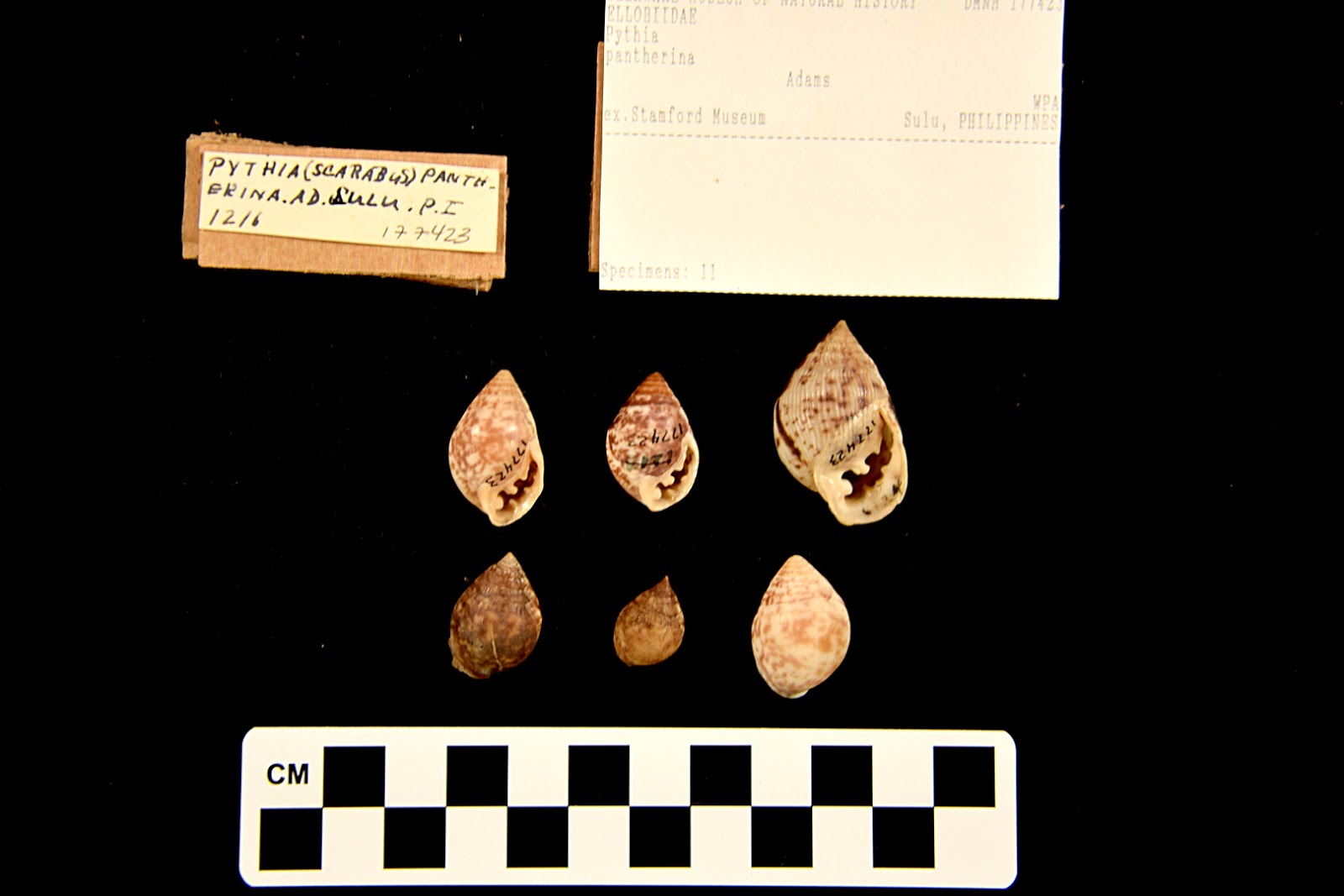
Here we have another strictly terrestrial species, Pythia pantherina (A. Adams, 1851). Though the genus of this species has been changed to Pythia, I don't have information what its earlier name was. (Scarabus) on the older label indicates a subgenus, now no longer used.


Shells of this genus have the most elaborate dentition in the aperture, which indicates they have more severe predation at the aperture, probably by birds. Such a wiggly aperture allows the soft-bodied snail to emerge and crawl about, but prohibits entry to all but the slenderest of bird beaks. Other predators have other ways in: see the shell at lower left in the closeup, with two tiny pinholes in its lower left area (I didn't notice them until I looked at the closeup). They are from a predatory drilling snail, which uses its abrasive radula (sort of like a tongue with tiny teeth) to scrape a hole through the shell. It then injects a nerve poison. The animal inside relaxes, and enough of it extrudes through the wiggly aperture that the predator can either dismember it in place or pull it out to be consumed.


The genus Pythia is found throughout the Indo-Pacific region, typically on mangrove roots above the high tide line, and a little further inland. These specimens, six of the eleven in this lot, are from the Sulu Archipelago of the Philippines.

The third species of interest is Auriculastra subula (Quoy & Gaimard, 1832); the genus was formerly Auricula. These are quite small, seldom exceeding 1 cm in length.


The closeup below shows a single tooth in the aperture on the inner lip, simlar to the Ellobium specimens above. This is an estuarine species, found on mangroves in tidal marshes. It is not fully marine and cannot tolerate ocean water for any length of time.


The genus Auriculastra occurs throughout the Indo-Pacific and South Pacific. These are from Fiji. They show more wear than the prior two species, indicating that they get roughed up in the sandy lagoons, probably during the frequent storms.

The fourth and final species is Ovatella algerica (Bourguignat, 1864), originally called Alexia algerica. These are very small, just a bit bigger than those called "minute", seldom exceeding 0.6 cm in length. Note, however that like the others they have the ovate/cigar shape characteristic of the family.


The closeup shows that they also have small teeth, in this case two of them, partially blocking the aperture. These are 8 of the 20 in this lot. The original label also shows a better example for future shell collectors than the other three: the town, the beach ("Quarry Beach" in Las Palmas), and the country, plus the month and year of collecting. Is lacks only the collector's name. I am not sure why an earlier version of the database placed these in Argentina, but I am glad it has been corrected ("Argentina" on the oldest label is in someone else's handwriting. The handwritten correction on the older DMNH label is from the 1990's.)


These species are found near-shore Europe and north Africa. Their habitats are fully marine to salt marsh. The Canary Islands are offshore from north-western Africa.

The photographic experiment I mention in the title is a matter of spacing for the sake of good focus. The typical way to photograph museum mollusk specimens is to arrange the specimens on black velvet, velveteen, or (as in 3 of the 4 cases above) on black felt, and then to arrange the labels and the scale indicator around them. But even the small shells of these Ovatella specimens have a significant thickness when being photographed close-up. One may either focus on the upper surface of one of the shells, or on the labels, with the consequence that the other will be a little out of focus. One way around that is to use a lens aperture of f/8 or f/11 for greater depth of field. I tried something different.

I cut a number of small pieces of corrugated cardboard, either 3/4" x 2" (2x5 cm) or 1/2" x 1.5" (1.3x3.5 cm). I put these under the labels to bring them up to a plane close to the tops of the shells. In the case of the Ellobium specimens above, it took three thicknesses of cardboard, and you can see the spacers under the smallest label in that photo and the first photo of the Pythia specimens. It worked very well! Everything I want to see is in good focus, using f/4 to f/5. I was also using a +2 closeup lens on my camera's 18-105 mm zoom lens.

With the camera back fixed at 24" (60 cm) above the table top, I used focal lengths of 36 mm and 105 mm. I used a spot focus just below the top of a central shell in each group for the autofocus to work with, and I am pleased with the results.

Each of the original images was cropped, and the color levels clipped to remove the grayness the camera allowed in the black background, and the gamma and saturation were adjusted so the colors in the image matched the colors of the shells. The images above are all re-sized to 1620x1080 pixels, so you can click on them to get images that fill most screens. I also used just a little bit of Unsharp Masking to emphasize the shell decorations, also to make the images look more "eyeball true". My Nikon camera under-sharpens its images, which I like. I usually prefer its usual, softer look, but when I want to sharpen back to "normal", UM is the most versatile way of doing so.

Finally, although felt is cheaper than velvet, the clean, smooth blackness of genuine velvet makes for much better final images, as can be seen by comparing the first two images with the other six.