Showing posts with label puzzles. Show all posts

Tuesday, November 08, 2016

Some confusing specimen labels

kw: labels, natural history, natural science, museums, research, photographs, puzzles

This post has two parts. Firstly, of several reasons that research collections wish to have multiple—even many—specimens of a species from a particular collecting location and time, with this first set of labels I wish to explore one that is not often thought of: Lot splitting for sharing. Sometimes a collector or museum desires specimens of a particular species, and also possesses multi-shell lots of a species desirable to others. Each can extract several shells from a larger lot to trade with the other.

These labels show one interesting consequence of this. The species Planorbis duryii Wetherby, 1879, now known as Planorbella duryi (Wetherby, 1879), is a moderately desirable snail of the Rams' Horn shape. But today the shell is not the story, the labels are. I don't know the protagonists here, so I will call them Collector 1, 2 and 3 (Coll1, Coll2, and Coll3).

Coll1 collected a largeish lot of this species, numbered it #1193, and later split the lot to share portions with two other collectors, Coll2 and Coll3. One of them, let's say Coll2, received both lots and wrote labels for them, giving one to his (or her) friend, Coll3. These were numbered No. 23 and No. 24. Notice that Coll2 did not care about the county they were found in, just the town and state.

Over time, the original lot and both splits made their way into one collection, which was donated to the Delaware Museum of Natural History. Judging from the catalog number, 153565, this occurred in the late 1980's. An alert collections manager, sorting through the donated material, naturally sorted them by species (if they weren't already sorted) and noticed that they were all from one originally collected lot. So they were combined and cataloged as one lot.

What makes their labels of further interest is the location information, and this brings up the second subject of this post. The location seems to be an unknown place! Survey, Florida is not found in the GeoNames geographic name database, nor in GNIS from which it originates. But these paragraphs in an online history of Bonita Springs unlock the mystery:
(1st paragraph) Bonita Springs had its beginnings when, some time in the 1870's, government surveyors in a remote part of Southwest Florida pitched camp near a medicinal spring which the local Indians believed could heal the sick. After the crew left, the site became know as Survey and the stream running from it, Surveyor's Creek.
(4th paragraph) In 1912, a Tennesseean named Ragsdale purchased 2400 acres around Survey. He and his associate, Dan Farnsworth, surveyed the area and laid out a small town with streets and avenues named for potential buyers. There was no church, but, in 1915, a Naples minister held the community's first non-denominational service in the school house. The developers decided that the name, Survey, lacked sales appeal, so the town was renamed Bonita Springs; Indian Spring Branch became Oak River; and Surveyor's Creek was upgraded to Imperial River
Without the Internet, it could have taken weeks to write letters or phone around to find someone who knows what happened to Survey. Name changes such as this are more common than one might suppose, leading to all kinds of interesting puzzles for researchers, and for errant database cleanup specialists such as myself. This is particularly a focus now that I am cleaning up the geographical information for the current project.

Just a month ago I finished taking inventory of the freshwater snails in the collection of the Museum. Now I am working on pinning down the collecting locations, correcting as needed—such as putting in Bonita Springs as the new name for Survey, Florida—and attaching or correcting county, state, and sometimes country. For example, one database record was attributed to Papua New Guinea, and a locality name of "Lake (Cape?) Palousa". I went to the specimens, and was able to puzzle out that the collector's handwritten label actually read "Cape Palmas", not mentioning a country. The species is an African endemic, which made it easy after that to determine that the country was Liberia. Cape Palmas is a prominent point near the southernmost part of the country. Here are some other interesting labels that I saw today; not all could be pinned down:

Lot #17002 is from the initial donation by John du Pont, used to set up the mollusk collection when the museum was chartered before 1970 (it opened to the public in 1972). As this label indicates, Mr. du Pont was the collector. This label replaced whatever label there might originally have been. More likely, the information was taken from a notebook when the label was written. (Note to collectors of all kinds. Never throw away an original label! Keep old notebooks also.)

It is curious that this label names the collecting locality as "Java, Singapore". The closest points of southern Singapore and northwest Java island are more than 500 miles (800 km) apart. I have taken this to mean the species is found in both places, but I wonder if the lot is a combined lot. Nerita lineata Chemnitz is a marine snail in a family that has many freshwater species. That is why it was included in a "freshwater gastropod" inventory. Being marine it could easily be represented all along the Malay peninsula and throughout Indonesia. The actual collecting locality remains a puzzle.

This collector's label for lot #90224 says, "Little Sur River Bridge Hwy 1 nth of Monterey Santa Cruz Calif", with the date and collector's initials. We think "nth" means "north." The bridge indicated is 10 miles south of Monterey, and more than 60 miles south of Santa Cruz. We have a "Verbatim Location" field in our database, and that is where the quoted text was put, while the "Locality" field for publication now reads, "Little Sur River bridge, Hwy 1, near Monterey", with the county (Monterey County) entered in its own field. I've driven the Big Sur highway, and crossed that bridge. Most of the highway is slow and curvy, but I would not expect actual confusion as to which direction one is traveling.

Finally, this label with older catalog numbers from two collections, and written in 1924, originally read, "Rio Hondo at S.P. Trestle". Much later someone  wrote "San Pedro Calif", which was entered into the museum ledger in about 1980 as "San Pedro Coll.". Ever since then, this has been assumed to refer to a college, but there is no such college. A look at the label showed me the real situation. The Rio Hondo wash splits off the Los Angeles river going northward between Lynwood and Compton, 16 miles or more north of San Pedro. The Southern Pacific trestle is a mile or so north of that, so the Locality field now reads "Compton" and I added the coordinates of the center of the trestle to our "Coords" field.

Fortunately, most of the geographic data is much easier to determine, and frequently can be vetted by a quick glance. A lot of data cleansing is routine and can be boring, but there is enough "detective work" involved to keep the boring times to a minimum.

Saturday, December 08, 2012

Setting up a general Sudoku solution

kw: puzzles, analysis

I have been addicted to solving the daily Sudoku puzzle since I first saw them a few years ago. I've gradually learned a number of strategies, so that I can usually "do" the ones with up to three stars of "difficulty" with minimal writing. Sometimes I can solve a 4-star puzzle without writing much, but today I saw that there were no easy hits, so I set up the General Solution method that I can use to solve almost any Sudoku.

As you can see in this first image, it involves writing in each empty square all the numbers that it could possibly contain, in a pattern that makes recognition easy. In this puzzle with 24 clues, there are actually three "low hanging fruit" that the setup reveals, which the three arrows point out. I cannot yet "see" such solution squares without writing the setup. Now look in particular at the top center block. The arrow points inside to a lone 6. Once I erase the little 6 and write it in full size, I erase all the 6's in that block, row and column. Now you can see that the 5 at the top is by itself, so it is the next square solved. Then the one below that will have only an 8, and that one is also solved.

The other two arrows point to 1's. "Doing" them and erasing all 1's that they eliminate, we'll find some more singletons. At the very least, to the right of the 5 at the center of the third row up, the 7 will be next.

Here is the puzzle about half done. Getting this far was easy. We are still in a realm of one-solution-leads-to-another. The two arrows show a 3 and a 9 that are next, and it is easy to see that a 4 will be found next to the 3, and a 1 just below the 9. In addition, the squares in that same row are both solved: a 5 on the left and a 2 in the middle. The 5 is also a case of only-one-in-the-row. You need to be on the lookout for such items.

We are starting to see "completion groups" show up, such as the two squares with only 3 and 7, at the lower left. I notice that I haven't yet erased a 1 below a 4 and 3 at top center; that leaves a 9...nor a 3 in the bottom square (that I should not have written in the first place!), so that block is solved already.

Then look at the top center block. The three unsolved squares contain 1 2, 2 9 and 1 9. This is a "completion group" of three squares. If any square is "picked off" by a solution elsewhere, all three are solved immediately.

Here we are near end stage, and the going gets a little harder. No more lone numbers appear, but with a little checking, we can see that the two circled 1's are next (they are both next to the central block). Firstly, the 1 at the left is the only one in that block. Then, the 1 on the right will be the only one in its block.

The upper row with a circled 1 will then have a 7 near the right end to solve next. Also the block to left center has an 8 only in its center square, so that is solved. And so forth.
Here is the solved puzzle. Although I made a couple mistakes during setup, they were easily caught. That is not always so, and I sometimes find I've misled myself. Once I catch a contradiction, I just mark the puzzle "not solved" and wait for the next day's version. I am not going to go back and erase everything and start over!

Something I see in some 5-star puzzles is the pathological situation where you wind up with five or six (or maybe more) completion groups, and none appears solvable. What I do in such a case is study the puzzle to find where I can make a fruitful guess. I'll lightly draw a square around my guess, then circle (lightly) the solutions to which it leads. Sometimes this solves the whole rest of the puzzle. Half the time, it won't, and will lead to a contradiction. But I have a record of my chain of logic. One thing I know is, my initial guess was wrong. I erase that number, carefully erase the light circles, and make a different guess. Because I nearly always make my first guess as one of two, that other "guess" is actually a certain solution of that square, and the solutions to which it leads will usually solve the rest of the puzzle. I have only seen one case in which a chain of logic "dried up", and I had to make a second guess.

If you've never tried such a general solution, and just tend to space off tougher puzzles, give this method a try.

Thursday, April 29, 2010

A cousin and a half

kw: genealogy, puzzles

This interesting linkage showed up as I deciphered the relationship between my grandmother Liz and her favorite cousin "Billie". I have letters between them, and Will-Ella usually signed herself "Bill", sometimes "Billie", and only once by her given name, in a formal condolence letter when Liz'z father died.

With the help of a relative who has better records than I for this branch of the family, I found that these two cousins are doubly related. It hinges on the relationship between JGK's two wives. Mary was Jane's aunt, through her sister Marg.

That means that, while Ella and Kate were half-sisters, they were a little closer than that, but I haven't figured out how; perhaps they are also half-cousins.

But for sure, Liz and Billie are half cousins via their grandfather, but half cousins once removed via their grandmothers. I don't know if they ever thought about it. They didn't write about it. They were best of friends and frequent correspondents. That's what mattered to them.

Saturday, April 10, 2010

Cheating at crosswords

kw: observations, games, puzzles

Most days of the week, I work the puzzles in the newspaper. The main three, Sudoku, a Cryptogram, and a Crossword, increase in difficulty through the week. I can usually do the Cryptogram and the Sudoku any day of the week, though the techniques differ as the week progresses. I can usually do all the Crosswords except Saturday (I don't even try on Sunday, when they use an oversize NY Times puzzle), though in recent weeks I have often been able to complete a Saturday Crossword also.

Today I got halfway done with the Crossword and got stuck. All the key clues to the remaining sections were societal references that meant nothing to me. I guess I don't get out enough! This movie star, that 1965 Nobel prize winner, some composer. Well! I had the computer handy, so I looked a couple things up. Pretty soon, I'd gathered enough of the social clues to finish the puzzle. But, it just isn't as satisfying as finishing a puzzle by memory and wit alone.

Friday, August 07, 2009

A partial analysis?

kw: analysis, puzzles

I have played Sudoku for years without really considering just how many such puzzles can be formed. I did a quick search and found quite a variety of "answers" to the question, "how many Sudoku puzzles?". They range from a few trillion to about 1050, all confidently asserted. So here is my 2¢ worth. I don't have all the analytical tools to do a complete statistical analysis, but I'll do what I can.

There are three constraints:
  1. All the digits from 1-9 must appear in each row. This implies that no digit can be repeated in any row.
  2. The same goes for any column.
  3. All the digits from 1-9 must appear in each of nine blocks formed by breaking up the 9x9 grid into a tic-tac-toe board. This also implies that no digit may be repeated in a block.
The following block of digits is the trivial Sudoku solution:

1 2 3 4 5 6 7 8 9
4 5 6 7 8 9 1 2 3
7 8 9 1 2 3 4 5 6
2 3 4 5 6 7 8 9 1
5 6 7 8 9 1 2 3 4
8 9 1 2 3 4 5 6 7
3 4 5 6 7 8 9 1 2
6 7 8 9 1 2 3 4 5
9 1 2 3 4 5 6 7 8

Now let us constrain the solution. First, there are 9! ways, or 362,880, to make a single row of nine digits. If we were totally free to make the rows, without constraints 2 and 3, the total number of arrangements would be (9!)9 or 1.09x1050.

We are not so totally free, however. Given any particular top row, the second row is constrained, so that the number of possibilities is 8x7x6x5x4x3x2x1x1 = 8!. Looking at the other end of the problem, we find that once eight rows are completed, the ninth has a unique solution, so the number of its possibilities is 1 or 1!. If there are two rows left, they can come in either order, but are otherwise completely constrained, so the number of possibilities for the seventh row is 2 or 2!. Thus I infer that the number of row-column solutions, not constrained by the blocks, is 9!x8!x7!...1! = 1.84x10²¹.

The block constraint will further limit the total number. My stab at it is to reason thus: The solution given above is a rearrangement of:

1 2 3 4 5 6 7 8 9
2 3 4 5 6 7 8 9 1
3 4 5 6 7 8 9 1 2
4 5 6 7 8 9 1 2 3
5 6 7 8 9 1 2 3 4
6 7 8 9 1 2 3 4 5
7 8 9 1 2 3 4 5 6
8 9 1 2 3 4 5 6 7
9 1 2 3 4 5 6 7 8

This is a row-column solution, but not a block solution. This particular collection of rows can be rearranged 9! ways, but not all of them are block solutions. The true solution given previously can be considered as three sets of three rows. Each such set can be rearranged 3! or 6 ways, and the three sets can be rearranged 3! or 6 ways, giving (3!)4 ways in total, or 1,296. Thus we take the number of row-column solutions, divide by 9! and multiply by 1,296, which yields:

6.55x10¹⁸

I do believe that is the total number of Sudoku puzzles. If I have left something out, I am sure I will hear from someone…

Monday, August 07, 2006

Invertebrate geometer - Mystery Solved

kw: puzzles, geometry, flowers, solutions

In a post on August 2, 2006, I showed a picture of a Phlox flower that looked like a propellor, each petal was chewed on one side only. This image is the clue to solving why a critter (probably a caterpillar) would favor only the left side of each petal.

The opened flower is chewed in the same propellor pattern. The bud next to it, about a quarter opened, lets us see what happened. When a bud gets partway open, and it is still mostly dark, the caterpillar eats the exposed part of each petal quickly, then flees as the sun rises.

The geometric "knowledge" thus resides in the flower bud's DNA, not in the eater.

Thursday, August 03, 2006

Invertebrate geometer?

kw: puzzles, curiosity, geometry, flowers


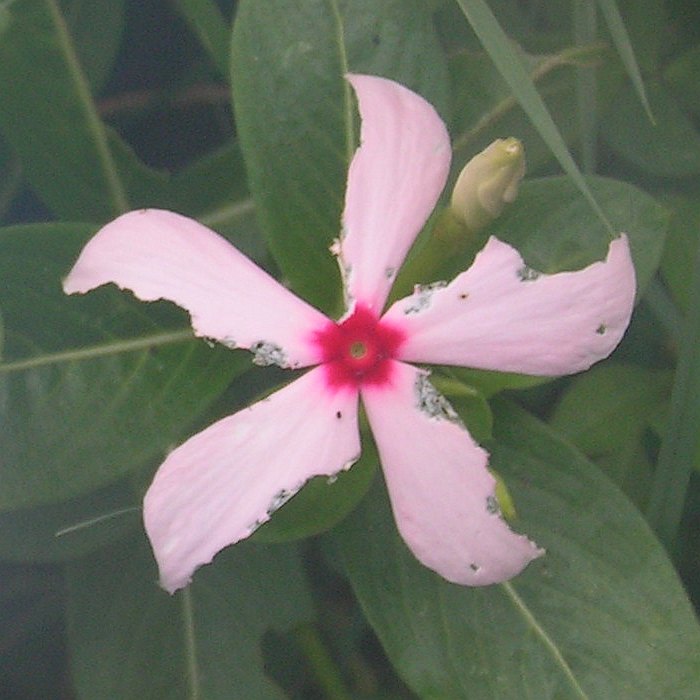
I took this picture the morning of August 1, 2006. Our little Fall Phlox plant produces a flower or two daily; a bud is visible behind this chewed flower. Each afternoon, I see the new flower(s) in pristine beauty. The next morning, they are variously chewed.

This particular morning some fastidious creature—probably some kind of caterpillar—has eaten only the left half of each petal. The other flower, on the other side of the plant, was chewed in a similar pattern.

In the past, I've seen the ends of the petals removed, or two of the five completely eaten. A curious circumstance, this one!