Tuesday, July 17, 2018

The little things that keep us going

kw: book reviews, nonfiction, medicine, cellular biology, mitochondria

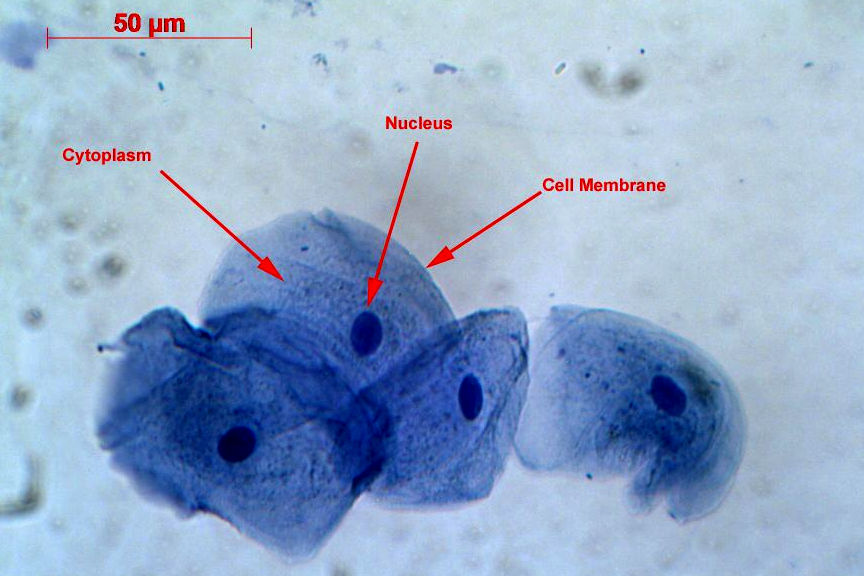
Did you ever hear of a buccal smear? If you take a teaspoon and gently scrape the inside of your cheek, and put some of the stuff on a microscope slide, that's a buccal smear. The four cells in this photo are cheek epithelial cells, stained with Methylene Blue, from just such a smear.

From the scale bar you can see that the cells are around 50 microns across. They are a little compressed. A typical cell of this sort is a roundish thing about 40 microns in diameter. Methylene Blue stains DNA very well, so each cell's nucleus is seen as an oval blob about 10 microns long.

Today we are interested in something that doesn't show in this photo, the mitochondria, the powerhouses of the cell. Each of the cells above contains around 1,000 mitochondria. Mitochondria vary in size, but here they would be about the size of E. coli bacteria, a micron in diameter and 2-4 microns in length. As it happens, there are a few small bacteria in this photo, the little dots such as the one near the arrowhead labeled "Cytoplasm". Imagine about a thousand of these in each of these cells.

Let's scale this up to a size we can better imagine, and magnify one of these cells by 100,000. Some museums have made models of cells on this scale. Then the cell would appear as a lumpish thing about 4x4x4 meters in size, the size of a big bedroom with a high (12-13 ft) ceiling. The cell's nucleus would be a meter across, not quite spherical. Consider it like a bean bag chair floating somewhere near the middle. The cell isn't just a bag of fluid. "Cytoplasm" is a very complex mix of fluids and organelles. About half of the cell volume is the fluid, called cytosol; "sol" indicates it is a semifluid colloid, not just watery stuff. Just under half of the "solid" material is the mitochondria, and a similar amount of space, or a little less, is taken up by the endoplasmic reticulum (ER to its friends), a highly folded array of membranes that handle protein synthesis. There are other organelles that we won't go into here. Some can be seen in the electron microscope view on the left in the image below.


(This image is © Pearson Education.) The mitochondria scale up to be about the size of a fat sausage, such as a salami, around 10cm in diameter and under half a meter long (say, 4" diameter and a foot long or so). So now you have a bedroom with a bean bag chair suspended in the middle surrounded by salamis, and we'll have to forego describing the "shape" of the ER, except to say that it is a lot like masses of folded blankets. Mitochondria vary in shape also, from nearly spherical to long and even branched. But the sausage shape is common.

So what is this all about? Earlier this year I noticed a rather dramatic shift in my energy level. It wasn't a one-day thing, but I could think back over a few months to "how things were." My usual temperature has been 97.8-98.0°F for many years. It went to 97.6 or less, where it still is. I thought it might be one of several side effects of a diuretic blood pressure pill I had been taking for a few months. If it was, it has been a permanent side effect! I've changed to three different blood pressure medications since then, and the current one seems to have no troubling side effects. But back to energy.

Mitochondria are the powerhouses of the Eukaryotic cell. That's the kind of biological cell that makes up all multicellular life, plus protozoans and fungi, including yeast. "Eukaryotic" is Greek for "Good kernel", referring to the distinct nucleus that contains the DNA. Bacterial cells don't have a nucleus; their DNA is a long, tangled loop attached to one point on the inner cell membrane.

Knowing this, I specifically looked for a book on the subject of mitochondria and their disorders. There was really only one choice in the popular press: Mitochondria and the Future of Medicine: The Key to Understanding Disease, Chronic Illness, Aging, and Life Itself, by Lee Know, ND. Doctor Know is a naturopath, so I was a little leery, but I was cheered by the even tone and lack of hysteria in his writing. He did a great deal of research to prepare the book, which he admits is little more than an outline of many subjects related to mitochondria.

From time to time in the book the author uses a metaphor from popular culture, the Midi-Chlorians of Star Wars. They are actually modeled on mitochondria, but have the added function (in that galaxy far, far away) of tuning certain people in to The Force, so that the Jedi and the Sith have rather magical powers.

The little mitochondria in our cells have almost magical powers themselves. The first part of the book discusses their structure, activities and origins. They almost certainly began as small bacteria that were incorporated into a larger bacterium as a symbiont, on the way to the development of the first Eukaryotic cell. It may be that all cell organelles began as bacterial symbionts, including the nucleus!

Now most of the genes that produce the components of the mitochondria are held in the cell's nucleus, and turned into appropriate proteins in the cell's ER. But a small number of critical bits of DNA are kept within each mitochondrion (5-10 copies per organelle), so that crucial operations can be performed as fast as possible, in seconds or minutes rather than hours or days.

In such a complex arrangement, a lot of things can go wrong. It is amazing that most of the world's people, and plants and animals, live out their lives with little to trouble them except predation. The main reason a wild wolf seldom lives more than seven years, while a pet dog frequently lives twice that long, is that once a wolf reaches middle age, something is going to come along and kill it, frequently a rival wolf. We usually prevent our dogs from killing one another.

But why should a middle-aged wolf slow down? And…why do we slow down? On my Dad's sixtieth birthday, I asked him, "What is it like?" He said, "It is a lot like being 25, except everything takes longer." Now that I am over 70, I agree. Particularly since the beginning of this year. So the second part of the book (of three parts) describes a whole host of things that can go bad as the mitochondria wear out. The section has the cute title, "The Dark Side of The Force".

Section three, equal in size to the other two, around 60pp, describes what we can do about it. The two biggest factors for mitochondrial health? More exercise and less eating, particularly for Americans! The author really believes in Severe Caloric Restriction (though his photos show little sign that he practices it himself). Most things that go wrong with mitochondria trace back to imbalances that lead to excess oxidative free radicals such as superoxide. While there are many products that promote "antioxidants" to mop up such stray molecules, both exercise and a sparse diet (rich in nutrients, but with minimum calories to deliver them) prevent most of the free radicals from forming in the first place. They keep the "electron chain" that mitochondria use to turn ADP into ATP tuned up and running in balance.

One item that is not exactly an antioxidant, but that operates that way among several other things, and that I've heard a lot about recently, is Coenzyme Q10, or CoQ10. It is made in our bodies. But production drops off as we age, after age 30. Some medications, such as statins for cholesterol reduction, hinder its formation, further reducing it, and slowing down our mitochondria. Also, its lack possibly permits them to suffer more rapid decay. The author admits that it is hard to make this stuff into a pill that will work. It is a medium-sized molecule, and is hard to get into solution. So that's something I'll look into. It is only one of a dozen or more nutritive materials he discusses, and among them one more stands out. Magnesium. I am very thankful that this essential mineral (not known to be so essential just a decade or so ago) is added to many supplements including the calcium supplement I use. As usual with a complex machine like the mitochondrion, magnesium does several good things. Without it, several bad things can happen. For example, we think of ATP (Adenosine trophosphate) as a "thing", but this "thing" needs a magnesium ion to shepherd it around. Less magnesium, less energy.

Fortunately, magnesium is easy to get and being a "salty" element it is easily absorbed. A magnesium atom sits at the center of the heme complex in chlorophyll the same way an iron atom sits in the heme complex of hemoglobin, which makes our blood red. The magnesium makes the heme green in plants. The greener the plant, the more magnesium. So eat yer darn greens! (By the way, hemocyanin, the heme complex with a copper atom inside, makes the blood of crabs blue. The "cyanin" part of the word refers to the blue color, not to cyanide).

There you have it. I'll keep a lookout for newer books on the subject. At present, this book stands out, and while it contains a lot of technical language, it is well explained, so the book is easy to read.

Tuesday, July 10, 2018

Even kidneys are political

kw: book reviews, nonfiction, medicine, kidneys, organ transplants, race

A good friend of mine was already on hemodialysis when I first got to know him. We are church friends. His life was quite restricted, not only by the need to visit the dialysis center 3-4 times weekly, but by the severe fatigue that is a side effect of the treatment. When your kidneys are not producing any urine, fluid accumulates. After a couple of days, you've gained a few extra pounds. Those pounds are extracted by the dialysis machine, along with urea and other toxins. But the best of the machines is a poor substitute for a real kidney. It will keep someone alive, but not very healthy. Just the rapid removal of fluid causes severe cramping and headaches.

Fortunately, my friend was able to receive a transplanted kidney a few years later. It made a huge difference in his life! He told me right after the transplant operation that the typical "cadaver kidney" lasts between 10 and 20 years, and then the body begins to reject it, in spite of the best anti-rejection medicines. He was a bit luckier than average; it lasted 19 years. Then he was back on dialysis.

This time, one of his daughters insisted that she be tested to see if she was a "good match", histologically speaking. And she was, a very good match indeed. She donated one of her kidneys, and he is back in comparative good health. Because the match is even better than before, and because of further advances in medical treatment, this kidney is more likely to last him the rest of a good life (he isn't as old as I, but old enough to make plans no more than a few years into the future).

My friend is Asian. I wonder what the outcome would have been if he were Black. After reading Hundreds of Interlaced Fingers: A Kidney Doctor's Search for the Perfect Match, by Vanessa Grubbs, M.D., it seems likely he'd have died by now. The book is partly memoir, partly a medical travelogue, and partly an exposure of a medical system that has not yet become free of racism.

Vanessa and her husband, Robert Phillips, are Black. As a Black woman in medical school, and as a Black, female M.D., she had trouble enough getting the residencies and fellowships she needed for her chosen specialty. Now, part of that may have been that her choices didn't solidify until she had nearly finished medical school. The "solidifier" was Robert. He was already in advanced renal disease when she met him, and being kept alive with hemodialysis.

Love is really blind, it seems. Knowing what she knew (not enough, it seems), she still fell in love with him. She offered him one of her kidneys. After a lot of discussion, and testing that showed how good the match was, he accepted. She had already found out that Blacks on dialysis typically wait an extra 2-4 years, compared to a White or Asian, for a transplant to become available. It is not just a numbers issue. Blacks are seldom put on the transplant list as early as Whites or Asians, and until recently priority on the list was according to time on the list, not time since dialysis became necessary. That has since been changed, but it is not the only inequity in the system.

You'd think, once the transplant was performed, everything would be copacetic. The transplant doctor made a minor error or two, errors of, as Dr. Grubbs puts it, "laziness." Another surgeon, a more diligent one, had to re-install the new kidney so its outlet would not clog! There is much more about issues that a White doctor would probably never notice, but that she did notice.

Along the way, there is a lot of information about kidneys and kidney disease. Dialysis patients seldom talk about their troubles outside their family; I know my friend was pretty quiet about it. But the plain fact is, a dryer-sized machine is, even as we approach the year 2020, a poor substitute for a quarter-pound organ. And it all comes down to glomeruli.

The title of the book describes an image like this one, a highly magnified portion of a glomerulus. The glomeruli (plural of glomerulus) are tiny, highly-structured tangles of blood capillaries situated each in its own capsule. The capillaries have some special features that make them efficient filters, to remove the right amount of fluid and toxins from the body. The toxin-laden fluid collects in the capsules. Tubes from all the capsules are gathered together to feed the ureters that send urine to the bladder.

A glomerulus is small. There are about four of them in each cubic millimeter (a pinhead) of inner kidney tissue; about 4,000 per cc. This comes to 2/3 of a million per kidney. And they aren't just passive filters. They contain enzymes and other active "machinery" that cooperate in blood filtration. It has been said that the kidney is second only to the brain in complexity.

Because of this complexity, it will probably be a good, long while before researchers figure out how to grow someone a new kidney from their own stem cells, making auto-transplanting a reality and eventually closing down most dialysis centers. It is one thing to grow someone a new ear or fingertip (we're nearly there right now); but even growing a liver would be easier.

I hope, long before auto-transplantation is developed, that the remaining racial disparities are dealt with. In addition to race, there is money. I'll let a quote from the book suffice:
"We get paid much more to keep someone on dialysis than to keep them off it…It's profitable to build another dialysis center, but we haven't figured out how to build comprehensive palliative care services."
The fact is, not everyone in end-stage renal disease should have dialysis. Until the kidneys totally fail, certain palliative care and other measures can afford a person a better quality of life. And even at the very end, some people have the fortitude to decide, "I've had enough of this. Uremia isn't the worst way to die; better than most. It's time to go." Very few doctors, who got into the business to "help people", usually internalized as "help people not die", are willing to offer a terminal patient every option, rather than just the options of "fighting the disease."

I am not sure how effective an activist Dr. Grubbs is, but the presence of this amazing book is a great first step to exposing some issues that have been swept under the rug.

Saturday, July 07, 2018

The ChRIstMas sEason

kw: book reviews, crime fiction, short stories, anthologies, christmas

It seems there is a book series for everything. For those who like to read a lot of crime fiction, I find the Soho Crime Series. The volume that caught my eye is titled The Usual Santas (no editor[s] named), and the title is that of a story within by Mick Herron.

The title story is perhaps the most memorable. Eight mall Santas have finished their service for the night, and gather together as is their wont for a bit of complimentary grub before going home. Also, as is their habit, they do not change out of their Santa costumes, preferring to not know who their compatriots are, though they have met this way, season after season, for many years. But they find a ninth Santa among them. They discuss how to determine who the "newcomer" might be. You didn't think I would tell you more than that, did you?

The eighteen stories are in three sets, lighthearted, dark, and warmhearted (each in its own twisted way). They are set all over the world, in all imaginable cultures among those that have adopted, at least in a mercantile way, the Christmas season. A Hindu street urchin with a flair for drawing ponders how to depict her close friend. POW's in North Korea (set in 1953) try to cobble together some kind of seasonal cheer. Jane Austen ponders the loss of a dowager's diamond necklace. As one might imagine, one fellow's mischief is another's mayhem.

Fun stories to read. I seldom read crime, but a collection of this quality, I'll make an exception for.

Monday, July 02, 2018

A searcher's story

kw: book reviews, nonfiction, spirituality, faith, memoirs

I was tempted to title this post, "Looking for God in all the wrong places," but it seems a bit too cheeky, don't you think? Alan Lightman has been a prominent physicist, and is that rare breed, a scientist who is also a qualified professor of the Humanities. It may in part stem from an experience he had in his younger years, as related in Searching for Stars on an Island in Maine: lying back in a small boat near his favorite island, looking into the starry sky, he had a transcendent experience. You can't un-experience such an experience.

Make no mistake, Dr. Lightman is a committed scientist. He is thus most comfortable with a Materialist philosophy, which posits that the physical world is all there is. As one of many paraphrases puts it, "If you can't measure it, it doesn't exist." And we must admit that scientific materialism has gotten us pretty far. But, while he is "most comfortable" in Materialism, he isn't entirely comfortable with it or within it. There is that pesky experience—and there have been others—that is just as real to him as the shoes on his feet.

Science and Religion represent the stereotypes of Relativism versus Absolutism. Although there are certain absolutes in the scientific realm, and some relatives in the religious or spiritual realm, the dichotomy is pretty clear for most instances. As a committed Materialist who nonetheless finds in himself a yearning for something Absolute, Dr. Lightman dwells in a boundary land.

It is sometimes said that scientific evidence must include reproducibility. If I mix chemicals A and B and chemical C is always produced, I can try to publish the results of my experiments. But the journals (major ones, at least) will send the article to other scientists to review, to pass judgment, whether it is worth publishing. If the experiment can be replicated, of course, at least one reviewer is likely to do just that, to make certain that chemical C does indeed result, and not chemical D or E…or nothing at all. Of course, all the experiments that are that easy have been done and published long ago, so now a reviewer will instead determine if the experiment is at least repeatable in principle. Only in the most controversial cases will someone attempt to replicate the experiment.

I like to pose the following to my scientific friends:
Non-repeatable phenomena: Many people engage in a certain activity that is known to usually evoke certain emotional responses in other people. This activity can be carried out by one person alone, or several persons carrying it out together. A large number of standard "recipes" exist (though we are not talking about cooking here). Frequently, following a specific recipe yields a known result. But not always. Some people try, but get a different result, sometimes even a response opposite to that expected. The outcome is not at all consistent!
Can you think what this activity may be?

Singing. And before you think, "Oh, some people just don't have a good voice," I am sure you know of people with a fine, melodious voice who nonetheless cannot convey the expected emotional impact of a specific song. Even: not all expert, operatic tenors can sing "Nessun Dorma" and get the same response that Luciano Pavarotti could. And I suspect that nobody with a "good" voice can effectively convey the power of a Bob Dylan song.

But what about simple systems? One of the simplest systems of all is a single electron moving through a hole and hitting a detector that can tell you where it hit (a sensitive CCD can do that). It may not be simple to set up, but once operating, suppose that roughly one electron per second is released to zoom through that hole. You are in a room with many others, and a screen is set up to record the results of each electron's impact on the CCD. You are given the chance to place a bet on where the next electron will hit. Do you place a bet?

If you know the initial speed and trajectory of the electron, and the diameter of the hole, you can calculate with absolute certainty, using the law of diffraction, what is the probability that it will fall on any particular segment of the CCD. But nobody can predict on which segment the next electron will land. So here in one experiment you have an Absolute matter and a Relative matter.

The book's chapters do not dwell on electrons, but are instead titled things like "Hummingbird", "Truth", "Transcendence", "Monk" and "Death". The second chapter is titled, "Longing for Absolutes in a Relative World," and introduces the rest. I kept hoping to read that this seeker after faith had found faith in God. At least in this book, he has not done so. An absolute God is apparently a step too far for him, an Absolute just too, well, absolute. But when you have experienced transcendence, you can never forget that there are things our relativistic science can never account for, and perhaps, the things that it can account for are in the minority.

Tuesday, June 26, 2018

A wilder look at wildlife

kw: book reviews, nonfiction, animals

The book title is The Truth About Animals: Stones Sloths, Lovelorn Hippos, and Other Tales from the Wild Side of Wildlife. It is by Lucy Cooke, who does know a thing or two about animals. But if the title were anything close to accurate, the book would amount to millions of pages. Nonetheless, it is a fun romp.

The thirteen chapters spin out stories of thirteen animals, misconceptions about them—and how those were debunked—, and a strong dollop of "down and dirty", usually about their sex lives. For example, sex seems to be the only thing a sloth does quickly...over and over again (The author, a real sloth fanatic, is the first person to film sloth sex). Even their bathroom habits are quite a bit slower than a snail's pace: roughly one defecation weekly, for which the poor beast must make its way down the tree to drop the evidence of its existence on the ground and cover it with detritus.

The "lovelorn hippos" of the title refer to male hippos in Colombia, offspring of a small pack of them imported by Pablo Escobar in his heyday. Since the patriarch drives out all his sons once they reach puberty, they disperse around the countryside, looking in vain for mates among other packs of hippos.

The chapter on frogs dwells quite a bit on Xenopus, the African Clawed Frog, which used to be used for pregnancy testing. Only many years after the method was developed, and after it had become obsolete (replaced by the blue strip of monoclonal antibodies now in use), did it become clear that the frogs, millions of them, had brought with them "chytrid", a fungus parasite that is gradually destroying most other frog and toad species around the world. Xenopus is immune to chytrid; not so for most other amphibian species.

Oh, by the way, should you ever get close enough to a vulture to try to catch it, you ought to know that they keep cool on hot days by defecating on their legs and feet. Who knows, maybe the smell of fresh poop is also a real turn-on to the opposite sex! (Hmm, is this in any way related to a phrase from a love letter from Napoleon to Josephine, when he planned to return early from a battle, "I'll be home tomorrow – don't bathe!")

I really can't think of how to describe more without giving too much away. All the animals in the book, a fish, 8 mammals, 3 birds, and an amphibian, are vertebrates. There are 40,000 species of them in thousands of categories, so there's lots of room for sequels if the author is so inclined. And then, should she decide to tell us about some invertebrates, there are, so far, at least a couple of million species, though most are insects. But, hey, some are "bigger than a bedbug", such as squids, giant African tree snails, and six-foot Australian earthworms. A fun book.

Monday, June 18, 2018

Seeing half the birds — and more

kw: book reviews, nonfiction, science, bird watching, birding, obsessions, travelogues

Everybody collects something…or several somethings. Collections of small things are most popular because the collections don't take much space. A collection of 50,000 postage stamps takes up a few cubic feet; 10,000 worldwide coins would be of a similar size. These days, if one foregoes printing photos and putting them in albums, a collection of tens of thousands of high-resolution photos will fit on a single 64- or 128-Gbyte SD Card.

At the other end of the spectrum, H. F. du Pont, defining what it means to be filthy rich, collected salons. Not just "rooms", but the very large rooms used for large scale entertaining, complete with all furnishings, from 175 American mansions at his "home" in Greenville, Delaware, now known as the Winterthur Museum. A typical tour at Winterthur takes up to two hours to show just five of the rooms. I wonder whether many of the rooms have ever been toured; I don't think they have nearly enough unique tours.

Bird watching, bird listing, and other facets of "birding" can take up very little space, if one collects mainly memories. Just seeing and getting to know the habits of a few or a few dozen—or a few hundred—species of bird is very rewarding to many people. Lists can be made of the birds that visit your yard or neighborhood, or a certain town, county, state or country. Or the whole world.

Noah Strycker decided to take a whack at the all-time one-year record list of world birds by planning to see at least one-half of all species of bird in one year. 365 days. There is more than one "official" list of all species (biologists differ on a few percent of species, whether they are truly one species or more than one). Anyway, the number of known bird species in 2014 was roughly 10,500, so Noah set out to see at least 5,025 if possible, and possibly more. He traveled upwards of 40,000 miles, spent time in 41 countries in all seven continents, at a cost of about $60,000.

Just to get ready, he had to collect as many bird handbooks as possible. This photo shows the stack. Its volume is greater tha most stamp or coin collections…and that's just his prep work. How did he carry it with him? He scanned every page and stored them in his phone. It must have taken months! My guess is that the stack represents about 20,000 pages. I hope he had several backup copies, including one "in the cloud" in case his phone was lost, stolen, smashed by a Cassowary or whatever.

As chronicled in his book Birding Without Borders, An Obsession, a Quest, and the Biggest Year in the World, he eventually saw, including verification by other bird enthusiasts that were with him, 6,042 species of birds. The prior record for a year's quest had been about 2/3 of that.

Creating such a world record is amazing in itself. To Noah, it was secondary to the memories of the birds, the stories about many of them as told by local birders who helped him along the way, and the relationships he built with literally hundreds of bird enthusiasts in every one of the 41 countries.

I had a vague thought of putting a lot of photos in this post. But I took Noah's example; he didn't put many photos in the book. Just 22. So I'll confine myself to just one more picture, of the world's most famous bird, a Giant Antpitta in Ecuador, that one of his new-found friends, Angel Pax, had half-tamed so visiting birders would actually get a chance to see one of the shyest bird species.

Birding Without Borders is astonishing. For one thing, Noah had much less trouble overall than he or anyone else would have any right to expect. When you share an obsessive fascination with people around the world, and you call on them for help, stand back! you're going to get help. Many of the local birders who accompanied Noah went out of their way to show him the rarest species they knew how to find, while keeping in mind the pace he had to maintain.

Just to see 6,000+ birds in 365 days requires a pace of 16-17 new species every single day. Since there are bound to be a few unfavorable days, and Noah even had a couple of "zero" days, seeing 30-40 birds on some days is practically a requirement. This is hyper-endurance marathon stuff.

The reading is much more enjoyable than running a marathon (at least for me, with my poor joints!). I consider portions of this book to be micro-biographies of a few dozen of the wonderful people Noah met all around the world. There's a lot of good stuff packed into this book.

Thursday, June 14, 2018

Sing for your supper - er - survival

kw: book reviews, science fiction, space aliens, first contact, singing, competitions

Well, after a few serious books in a row, I was ready for some mindless escapism. Boy, did I find that! Space Opera, by Catherynne M. Valente is about the silliest bit of SF I've come across, yet based on an idea worth thinking about.

Scenario: When the aliens arrive, they arrive to everyone at once. By some kind of projection, a bizarre-looking alien being visits every single human on Earth, wherever they happen to be at the time, and converses with everyone individually (only much later in the book is there just a hint about translation technology). After various amounts of time for the human involved to get over the shock, the discussion gets serious (as serious as anything gets in this book): One human person or group is to be entered into a Galactic singing contest, to determine if humans are sentient. It turns out that "sentience" is not so self-evident as we'd like to think.

According to the Esca, the species chosen to "recruit" a human singing group, all entrants in the song festival are ranked, including any newcomers (in this case, humans). If a newcomer winds up ranked dead last, the species is indeed "Dead Last": the entire species is to be exterminated and the planetary biosphere will be given another few million years to evolve a new, purportedly sentient, species. Rinse, Dry, Repeat as necessary. The Esca were the most recent species to "enter" the contest, and are quite proud that they came in Eighth, rather than something like Seventy-Fourth, or whatever Dead Last would be. The proven sentient beings of the Galaxy have decided that the extinction of an occasional species is the price to be paid for the peace-promoting songfest. It succeeded "Galactic War X", after all.

To give you an idea of the hyper-enthusiasm of language Ms Valente, here is the description of the leading member of the Absolute Zeroes, the group that is taken a few thousand light-years to the competition venue, a certain Mr. Decibel Jones (né Danesh Jalo):
…a leggy psychedelic ambidextrous omnisexual gendersplat glitterpunk financially punch-drunk ethnically ambiguous glamrock messiah…
The prose reminds me of teachers of the art of composition, who advised us, "Use more adjectives!" This book is about 2/3 adjectives, frequently in sentences that run 100-200 words. Sentences full of immense enthusiasm. Also full of neologisms. Amazingly, newly coined words seem to fit into the text around them and practically define themselves. Other than the occasional jarring bit of potty-mouth, prose like that just washes over me like perfumed olive oil.

The concept is actually based on a real bit of history, though "last place" in a certain global competition does not result in anyone's being exterminated.

I don't know if I could call this escapism at its best, but it is certainly escapism of a most compelling sort.

Saturday, June 09, 2018

Geology on the habitable edge

kw: book reviews, nonfiction, geology, plate tectonics

A formative experience of mine took place in a wilderness area north of Twenty Lake Basin in the Sierra Nevada mountains. The second session of Summer Field Camp was held there, for six weeks. What could we accomplish there that could not be done in the suburbs? To do geology you have to go where the rocks are…that is, where it is easy to get to the rocks. Where I live, near the Pennsylvania-Delaware border, you'd typically have to dig or drill 50-100 feet to find anything approaching "rock" as we know it: The Columbia Formation consists of loose to poorly consolidated (that is, cemented) sand with sparse fossils of Cretaceous dinosaur bone. You need to go a lot deeper to get to actual "bedrock".

Thus, a dozen other Geology students and I spent half a summer in high mountains, among lovely scenery, because the bedrock, mostly granite and limestone, was right there at the surface. We could walk up to it and hammer off chunks to take back to the "library" tent and study. We were interested in the intersection between the limestone and the granite, studying "cooked" rocks called skarn.

To study bigger problems you need to go to places even more remote. In A Wilder Time: Notes From a Geologist at the Edge of the Greenland Ice, William E. Glassley weaves a narrative of discovery around four field seasons, each about a month long, along the Arfersiorfik Fjord in western Greenland. The camp area is at or near the little white arrow I placed at the middle of this image. The map pin is on Tunertooq Island, where significant evidence was discovered by the author and his colleagues.

He and two colleagues were working to gather evidence that the area had been a continental suture in the deep past, around two billion years ago. The deformed rocks in the area look very similar to other areas of mountain-building, but are so much older that some geologists wonder if it is possible. The short answer is, "hard rocks", what we call igneous and metamorphic rocks, form primarily when continents collide and thrust softer materials ("soft rocks" such as sandstone and limestone) deep into the crust and mantle. They are later brought to the surface by various mechanisms of plate tectonics, where erosion eventually exposes them.

Plate tectonics describes the movements of the crust of the Earth over time. The "plates" are large portions of crust, including thicker continental crust and thinner oceanic crust; there are 8 major plates and about 20 smaller ones. They are in constant motion, but the rates are slow and imperceptible without instruments: 10cm/year or less, averaging 4-5 cm/year. That is just slightly faster than the rate fingernails grow. But give it time: If the Earth had only two continents, and they had separated some time in the past and were moving first away from one another, at a rate of 5cm/yr each, but later toward another as they each circled halfway 'round, how long would it take until they collided? This is equivalent to asking how long it would take one continent to circle the Earth at a rate of 10 cm/yr. The circumference of Earth, 40,000 km, is 4 billion cm, so the time would be 400 million years. That implies that the crust beneath the oceans is formed and then consumed on a time span of a few hundred million years. Indeed, the oldest sections of oceanic crust are no more than 200 million years old (except for a small portion of older crust, ~300 million years of age, that was preserved in the Mediterranean basin).

New material is added to the oceanic crust of tectonic plates at divergent margins, AKA mid-ocean ridges. Iceland rides atop one of these ridges, which is why it is so volcanic. Where plates move toward one another, one or the other will be pushed downward and (mostly) consumed into the mantle beneath. Such convergent margins are also volcanic, such as the "ring of fire" around the Pacific Ocean. The volcanic activity is evidence of the energies involved in the convergence. Where the convergence brings together two major continents, you get mountain uplift. The Himalayas are still growing as India presses into the Eurasian plate. In the roots of mountain belts, remnants of the collided plates, including bits of oceanic crust, remain to mark the suture zone.

Greenland, where you can get to the rocks (most of it is under a mile or more of ice), has large areas of strongly folded rock, similar to that seen in the Alps, the Himalayas, and the Rockies. These are understood to mark the continental collisions that produce each mountain chain. The Appalachian mountains, including the area shown here in central Pennsylvania, are understood to be the roots of a mountain chain that stood tall 300 million years ago, but is now eroded to these remnants. By comparison, the Rocky Mountains were formed during the Laramide orogeny, between 80 and about 40 million years ago; the Alps began forming about 65 million years ago, and the process is presently winding down; and the Himilayas began forming about 40 million years ago. Each such mountain range has buried beneath it a suture zone where two continents collided.

The folded rocks in western Greenland are about 2,000 million (2 billion) years old. There is still some controversy among geologists about whether plate tectonics operated that early, or if it did, whether it worked the same way as it has in the past half billion years or so.

When I was a graduate student of Geology in the early 1980's, in one class we were asked how we would determine whether plate tectonics had operated in the early Precambrian, prior to about 1.2 billion years ago. I didn't do well on the assignment, and received my only C grade. Dr. Grassley and his Danish colleagues would have received an A+. They not only figured out how to do so, they went and did it, though it took a couple of decades. I think it no spoiler to report that the field seasons described in A Wilder Time led to a much better understanding that the Arfersiorfik Fjord area does indeed include a continental suture zone.

The book is in three parts, describing first the breaking down of old concepts, then accepting ignorance and becoming open to new ideas, and finally the beginnings of integration as a broader understanding emerges. The author stresses several times that our biology constrains us to awareness of only a tiny fraction of what the Universe has to offer. We "see" within one octave of a span of nearly infinite radiative wavelengths; we hear a wider range of sound frequencies, but most animals can hear sounds we cannot; we can bear only a narrow range of temperatures without severe damage; and so forth.

I was doubly compelled and fascinated by the book. I thoroughly enjoyed the geological material, of course. Even more, the author writes with a rare lyric intensity. He sparsely limns the emotions and impressions evoked by the harsh landscape. And sometimes it is not so harsh. One day he knelt and lay flat, to see the outline of a ptarmigan and her chicks hiding in plain sight atop the tundra:
I was suddenly awash in layers of sweet flower scents. As I rested lightly on the surface, the smell of dozens of blossoms I hadn't noticed engulfed me. Arctic poppy and white Arctic bell-heather were interspersed among mountain sorrel, hairy lousewort, purple saxifrage, and mountain avens. I was awash in a botanical sea, carried into an unexpected world.
Upon arising, he found none of the scents could be discerned more than a few inches above. He realized that the bird and her young would live among these scents:
A world of perfumes would cloak the hatchlings and saturate their feathers, becoming a sensory background to the birds' accumulating experience of living…
If "poets" who like to write free verse could write it like Dr. Glassley, I'd read more free verse.

Tuesday, June 05, 2018

The short life of the most famous wolf

kw: book reviews, nonfiction, natural history, wolves, yellowstone

A wolf in the wild seldom lives more than nine years. The wolf called O-Six, so named because she was born in 2006, lived less than seven years, though she was very healthy, with several good years left in her, when a hunter killed her late in 2012.

American Wolf: The True Store of Survival and Obsession in the West, by Nate Blakeslee, outlines the life of O-Six, the wolves in her pack, and other wolves and wildlife that filled the landscape of the Lamar Valley in Yellowstone Park where she lived. Partly because she was big, bigger even than most male wolves; partly because she was such a skilled hunter she could fell an elk all by herself; partly because she was wilfully ignorant of the humans that dotted the road and ridge tops around her; and mainly because she was a consummate survivor in a species that is known for toughness and surviving: she became the most famous wolf in America, perhaps in the world. Her fame brought more tourists to Yellowstone, just to see the wolves, and particularly to see O-Six, which wasn't really that hard, with Rick McIntyre helping out (the book is partly a biography of Rick).

Many people love wolves. Many people hate them. Neither stance is entirely rational. But the obsession that puzzles me most is that of the "sport hunter", whether the game sought is a deer, an elk, a wolf, or a bear (or a fish or a duck or goose). If you are using a rifle that can kill any creature on earth from a distance of 100-500 yards, there is no sport in it at all. As I have said before, the word "sport" implies a certain fairness or equity. If there is no chance that your target can retaliate, perhaps by taking your life before you take his or hers, that is not a sport. If you hunt for food, well and good. Hunt for your needs. If you hunt for fun, I pity you.

Y'wanna be a real sport? Go after a deer with a knife and a loincloth. You're allowed to carry a bottle of water. Going for wolf or bear, or perhaps an elk? OK, I'll permit you to carry two knives, one to distract the animal while you try to extract its life with the other. Even the Masai way of going after a lion with a knife and spear is heavily weighted against the lion. But, hunters, I don't hate you. I just don't understand why you are obsessed with killing.

I slowed down my normal hectic reading pace and savored the book. The author writes compelling prose, and has stories to tell that are worth taking in with care. O-Six was an amazing animal. She outwitted rival wolves and rival packs when it seemed she had no chance to survive. She and her mate guided a growing pack through numerous dangers, to thrive. And for the wolf-haters out there, the final bit of storytelling by the man who killed O-Six is an eye-opener. After he shot her, her mate ran off. The man went to collect her body, because he was required to bring the carcass to the wildlife office to register his kill against his license. As he stood over her body, her mate returned and howled, then one by one, her whole pack came. All eleven of them. They ignored the man. They sat in a loose arc around the body and began to howl. They went on for some time. The hunter backed away, safely returned to his truck, and drove off. The next morning, he returned to take the body to the wildlife office. Other than humans, the only other animals I know of that communally mourn their dead are elephants.

The book is bittersweet. The return of wolves to Yellowstone Park has re-balanced the ecosystem there. The Park is no longer overrun with elk. The kinds of plants that grow have changed. More beavers dam the streams, making habitat for a host of species. The drawbacks? Hunters may not always get an easy shot at an elk; they have to do more work to "fill their license." (Boo hoo!) Some domestic animals get taken by wolves, though the Park Service compensates them. The news storm that followed the shooting of O-Six resulted in laws changing; in my opinion, for the better. Why does someone or something famous usually have to die before the public does what is right?

Wednesday, May 30, 2018

Taxonomy is alive but not well

kw: book reviews, nonfiction, naturalists, taxonomy, systematics, natural history, africa, african setting

Environmental stewardship is one of this generation's signature issues, but nearly nobody, from the Boomers (my generation) and the X-generation to the Millennials, knows what is needed to make it work. From a few sources I compiled this list of environmental concerns, in order of importance:

  1. Climate Change
  2. Species Conservation
  3. Mining
  4. Nuclear
  5. Pesticides
  6. Pollution
  7. Population
  8. Waste

These overlap quite a bit, of course, but it is rather tragic that, while Species Conservation is the second-most important issue, support for the fundamental, naturalistic studies needed has been drying up, year after year, decade after decade.

Questions: (1) How can we care for the species on this planet if we don't know what they are? (2) Do we already know enough so we can set public policies to mitigate (dare I say eliminate) extinctions that we are causing?

Answers: (1) We can't, even a little bit; and (2) No, not even close: we don't even know what most of them are.

Dr. Eli Greenbaum is a front-line soldier of species knowledge, one of a totally insufficient cadre of naturalists and taxonomists who actually gather the specimens held in museums and describe them for publication and further study. He and others like him gather and communicate the knowledge needed to actually perform Species Conservation. You need to know what you have if you expect to keep it or care for it!

An old fable, much abbreviated:
Two brothers inherited their parents' farm. The older brother did most of the work while the younger brother preferred to party. But soon there was a war and the older brother was called to serve as a soldier. He left the care of the farm to his younger brother, with the demand that the farm continue to prosper until his return, "Or I will demand an accounting of you!" The younger brother said nice things to his older brother, but continued to party and ignore the care of the farm. After a few months, he got a letter from his brother, stating that he hoped to return after another month, and repeating his warning and threat. The young man went to the bank to check on the finances, and was shocked to discover that very little money remained. He went to the barns and found that hardly anything was stored against the coming winter. In a panic, he took a gold doubloon to the village witch to ask for help. "My brother will kill me if he returns and the farm is in such a mess!" he told her. She went to a back room and returned with a small wooden chest, saying, "This and my advice are worth only half a doubloon." She gave him some silver pieces in change, and then said, "See the hole in the top of the chest? It contains enchanted dust. You must go to each corner of the farm, and to the middle of each building, and shake out a few grains of this dust, every day. Then your farm will begin to prosper. But do not open the chest." The young man returned to the farm and set out on his task. In a back corner of the land he found a farm hand napping next to a broken portion of fence he was supposed to be mending. The young man kicked him awake and demanded that he finish his work. In another spot, two men were playing cards. He set them to their tasks and took the cards away. In the barn he noticed the messy stalls, so he called another hand and together they cleaned them and put in fresh hay against the animals' return. And so his day went. Day after day he continued, and the farm began to prosper. The promised month came and went, as did more months. His brother never returned. After a few years, the farm was prospering indeed, and he took a wife. When he was very old and dying, he asked his wife to bring him the magic chest. He said, "I was told not to open this, but after I die, that will not matter. Please help me open it. I want to see what is inside." They forced the lock and opened the chest. Inside they found just a remaining ounce or two of desert sand.
I think you can draw the appropriate conclusion.

In his book Emerald Labyrinth: A Scientist's Adventures in the Jungles of the Congo, Eli Greenbaum chronicles two of his early field seasons (2008, 2009) in the eastern part of the Democratic Republic of The Congo, once called Belgian Congo, and later, Zaire. Dr. Greenbaum is a herpetologist, one who studies snakes, lizards, turtles, frogs, salamanders and toads. He describes his experiences in the Congo, where he photographed and collected a broad range of "herps", as such animals are colloquially called. His studies expanded knowledge of the geographic range of many species, particularly of frogs, and resulted in the discovery of several new species. He worked with a Congolese herpetologist, Chifundera Kusamba (AKA "Chif"), several other colleagues, and a variable crew of porters and guides, visiting some of the remotest areas of eastern Congo.

The chapters contain alternating sections of the author's experiences and historical narrative. Congo does not have a pretty history. Yet, because of the sheer difficulty of travel, large sections are still, well, not exactly pristine, but in better shape than much of Africa, environmentally. But it is not exactly a paradise.

Being a naturalist is difficult. In past generations, a naturalist had to be an artist, drawing from life the things being collected, because once a specimen makes it back to the laboratory, even a local lab in the same country, it has changed a lot, usually from being preserved in alcohol or formalin. Formalin is not used any more; it destroys DNA and is dangerous to handle. Even drying an insect changes it; many beautifully-colored beetles turn black soon after death, for example. While artistic skill is still very useful, now we have digital photography and memory cards that can hold thousands of images, even in larger formats (In the 35mm days, even up to the late 1990's, a day of serious shooting could consume about ten rolls of film).

Secondly, a naturalist must be a scholar in a chosen discipline (and pretty good in several others). What is the difference between an expert and a scholar? An expert has a wealth of useful knowledge of a subject. A scholar knows everything that is known about that subject. This is what is needed to be able to recognize if that yellow-spotted, blue-bellied frog in your hand is a new species, or a familiar species in a habitat from which it was not recorded before.

Thirdly, a naturalist must have the strength and energy of a triathlete and a superior immune system. In places like the Congo, you will get sick and clinics are scarce. Dr. Greenbaum suffered two rounds of malaria and one of typhoid fever, in addition to stings by venomous ants (of a variety that can kill) and a number of other diseases and afflictions. His colleagues in Africa would kid him about coming from America in a rather pudgy condition (in contrast to their whip-thin physiques). That would soon change. But he records unflinchingly that he was frequently the slowest climber and needed others to wait for him.

Fourthly, a naturalist needs sponsorship. Traveling to places that are hard to reach is costly. Not just in gasoline, repair parts for vehicles, and food and lodging: Keeping good will with the locals frequently requires giving small gifts, treating a village to a beer party, and other social expenses. It appears that actual bribery was hardly ever needed.

There was the added complication of the civil war among at least four rebel groups and the tatters of a national government. It takes more than documents with official-looking stamps and signatures on them to allay the suspicion of a militia commander. The crew were lucky as often as they were politically skillful, just to stay alive.

With all that, I want to return to the question of taxonomy and systematics. These two words are formally synonyms, and both refer to the classification of items and hierarchical structure of the classification system. But they differ in usage. Taxonomy describes determining how a specimen is classified; in biology this means assigning a binomial species designation such as Tyrannosaurus rex, Homo sapiens, or Turdus migratorius (the American Robin). When describing a new species, it means not only assigning it to the right Genus (the first word of the binomial), but possibly deciding that a new Genus is to be described, and into which Family it is to be placed. The original binomials were Latin words and compounds, but the language had too few words for the millions of species, so "Latinized" words of many languages are pressed into service, as are names of people one might wish to honor. For example, the author and his colleagues named a new species of lizard Congolacerta asukului: "Lacerta" is Latin for "lizard", and Asukulu was a helper on the expeditions who was murdered by a militia group later on. Tacking an "i" to Asukulu's name "Latinized" it.

Systematics describes the maintenance of the taxonomic structure, and is typically concerned with "everything from Family on up". Thus, the complete "branch" to which we humans belong is
  • Kingdom: Animalia
  • Phylum: Chordata
  • Class: Mammalia
  • Order: Primates
  • Suborder: Haplorhini
  • Infraorder: Simiiformes
  • Family: Hominidae
  • Subfamily: Homininae
  • Tribe: Hominini
  • Genus: Homo
  • Species: H. sapiens
  • Binomial: Homo sapiens
The six classification levels in bold are those originally set up in 1758. Other sub-classifications have been set up since, and this continues, particularly as DNA studies allow ever-finer relationships to be discerned. In my work at the Delaware Museum of Natural History, the Collections Manager and I are continually confronted with changes such as splitting a Family into several (and assigning which Genus goes in which Family), or re-assigning a species to a different Genus. At least, in the realm of land and tree snails in which I am presently working: these critters have been the subject of intensive work at many museums for 10-20 years.

There are at present about 1.4 million species that have been described. Estimates of the number of species still unknown, just of "animals and plants big enough to see", range from 10 million to 100 million. There may be even more species of microscopic protozoa, algae and fungi; and then bacteria and archaea ("germs" to most folks) are still very little known in comparison to what is likely "out there".

By one estimate the author quotes, it will take more than 600 years of work by half a million naturalists to fully describe all life on Earth. But Species Conservation has to be carried out now, or there will be a whole lot fewer species to describe. There are thousands of naturalists, but we need tens or hundreds of thousands...and the funding to support them. That is what it takes to put "magic dust" on every corner of the farm we call Earth.

Tuesday, May 22, 2018

A Doctor tells it like it is

kw: book reviews, nonfiction, medicine, alternative medicine, hype, advice

As much as I appreciate doctors and nurses, I am rather skeptical of over-confident physicians. However, I am even more skeptical about medical claims, veiled or otherwise, for "alternative" and "non-traditional" remedies and treatments. It is ironic that, in the earlier times when physicians had few useful techniques and fewer genuine remedies, phony doctors seem to have been rather scarce. Since the modern era of "miracle drugs" and effective vaccination, starting around 1800, the "snake oil salesman" became a fixture of Western culture; ironically, genuine Chinese oil of water snake is a pretty good liniment for sore muscles and joints. But the "patent medicines" of the American West…you'd be better off drinking some clean water! . . . and rubbing fish oil or olive oil into sore joints.

Hype, medical and otherwise, got a huge boost with the invention of the World Wide Web, as a service offered over the Internet, after 1993 ushered in the first browser, Mosaic. That is 25 years of rampant self-publishing of everything imaginable. According to an old proverb, the Devil will tell you the truth seven times to prepare you to believe one lie. Many Web pundits don't bother with the seven truths; it is just lie, lie, lie, preying on the gullible. Caveat emptor was never needed more than now!

Hype: A Doctor's Guide to Medical Myths, Exaggerated Claims, and Bad Advice—How to Tell What's Real and What's Not, by Nina Shapiro, M.D. and Kristin Loberg, takes a series of bold swipes at the whole enterprise of online medical quackery, misinformation, and tomfoolery. I had high hopes when I began the book, and those hopes were largely met. Dr. Shapiro knows her stuff, and it is told well.

Do you fear Ebola more than bees? The number of people in the U.S. who die of bee stings ranges from 75 to 85 yearly. Worldwide, it is hard to determine, but it is perhaps twenty times that, maybe 1,500 or so. In the U.S., there have been 11 cases of Ebola, with 2 deaths. Total. Of course, in central Africa, there have been thousands who died of Ebola, 11,000 by one measure. Both bee stings and Ebola pale in the face of the most dangerous thing most of us do every day: ride or drive a car. Safety technology has cut the number of auto-related deaths in half during my lifetime, but in the U.S., the number is still about 40,000 each year, and worldwide, it exceeds 1.2 million. For comparison, the most dangerous insect, the Anopheles mosquito, spreads malaria, which kills nearly half a million yearly (though very few in the U.S.). So worldwide, autos are almost three times as dangerous as malaria!

Another fun subject. Juicing. It is enjoying a resurgence. About 40 years ago, some folks put all kinds of stuff in juicers, and a friend of mine broke his juicer trying to extract the juice from wheat grass. So, you cut up carrots, fruits, and other stuff and extract the juice. What do you get? Tasty (maybe!) water with some vitamins and whatever phytochemicals survive the juicer. What don't you get? Any of the fiber, which is the main benefit of the fruits and vegetables!

Turn your juicer into a museum piece, and just eat an apple, including the skin. If you peel the skin you are throwing away most of the pectin, which is a major ingredient in Kaopectate, a diarrhea medicine. The pectin is behind the proverb, "An apple a day keeps the doctor away". Eat an apple without skin and you are more likely to have a runny B.M. Eat it with the skin, and you probably won't.

More fears: Formaldehyde and Mercury in vaccines. Guess what? If, during your first 18 years you received the usual schedule of 25-30 vaccinations, you received about half the formaldehyde you would consume by eating a single pear! Also, your body makes formaldehyde all the time. In some of those vaccinations, there was also a little bit of mercury in the preservative. How much? About the amount in two tuna sandwiches, if you use Albacore tuna, or four sandwiches made from "light chunk" tuna. There's even less mercury in salmon, so if you want to avoid mercury, eat salmon instead of tuna! And there is even less than that in Tilapia!! My wife and I happen to like fish, so even though we usually go for low-mercury varieties, we probably consume more mercury each year than we received from all our vaccinations (and those we still get, such as the Flu vaccine).

There is advice about detecting hype, though it will be hard for most of us to carry it out. When we are looking for medical information, we are usually worried about something, and thus more prone to believe almost anything that sounds plausible and is presented with an air of authority. At a time that we most need our critical facilities, they are weakest. Every day we read or hear or view ads about medications, some legitimate and some that are really just nostrums. (Def: nostrum. A medicine with unrevealed components, prepared by a private party or non-professional, that is claimed to "cure" ailments that "ordinary" medicines cannot treat.) Some, such as a recent rash of "T-boosters" ("T" is the current euphemism for testosterone), can actually deliver some of the results promised, but they also deliver results that are not mentioned.

To speak of "side effects" is too mild. Boosting testosterone in a man will indeed allow him to grow bigger muscles through exercise, it will indeed make him more "passionate" (that is, lustful), and it will also greatly increase his risk for heart disease and cancer. The ads don't mention that last item or two, do they? Nor do they mention the shorter fuse of any testosterone-addled male at any age. Why are teens so impulsive? Because they have twice the "T" level that they'll have just 10-20 years later. Guess what? The reduction of hormone levels in most men is not only normal, but beneficial, helping them live longer. In fact, one big drawback of too much "T" is the tendency to be accident prone because of increased impulsiveness. And trust me, most women don't want a man who is as randy as a bull elk in rut; things get a lot better when a man learns to slow down.

Here is my take-away as the #1 hype detector: If the beginning of the pitch is selling fear or dread, stop right there. Salesmanship comes in two varieties. One variety is to say, "If you have this need, here is a solution." The other says, "You have a big problem; in fact you could have several big, big problems, but this stuff will make them all go away." And here is my personal rule of thumb: If a company can afford frequent TV ads about their product, its price is much too high. On principle, I keep track of TV-advertised medicines and avoid them. So far, I think I've only had to violate that principle once.

Doctors can come across as stodgy and not so fun. Dr. Shapiro, with the help of her co-author, keeps a smile on your face as you learn a thing or two about keeping your health and your finances intact.

Friday, May 18, 2018

Science Fiction gets up to speed

kw: book reviews, science fiction, anthologies, victorian era, collections

I grew up reading Victorian-era science fiction and semi-fantastic fiction. Tales by Jules Verne, Arthur Conan Doyle, Edgar Rice Burroughs, Edgar Allan Poe, H.G. Wells, Rudyard Kipling and others of the era filled my imagination. Upon reading Frankenstein Dreams: A Connoisseur's Collection of Victorian Science Fiction, edited by Michael Sims, I find myself amused at my reaction to language that now seems stilted and wordy. Such writing was the magic carpet of my imagination in my pre-teens and teens.

This nGram chart shows a trend that explains much of it:

From Project Gutenberg I downloaded the text to Twenty Thousand Leagues Under the Sea, by Jules Verne. About 0.73% of the words are "which" (~770/106,000). His style of writing (or the English translation thereof) was entirely typical of the first half of the 1800's.

In the early 1900's Ernest Hemingway went on a "which hunt" in his writing, practically eliminated coordinating clauses, and transformed English language style. The Old Man and the Sea, ¼ as long as 20,000 Leagues, contains just 13 instances of "which", or 0.05%. As the chart shows, most writers of the late Twentieth Century, though their writing is briefer than Victorian-era writing, still use "which" about five times as much as Hemingway did.

Syntax and style aside, when the ideas are compelling, I am still drawn along, and thoroughly enjoy the story. The book introduced me to a dozen writers of the era that I hadn't heard of before. I find a few just too boring, but Grant Allen ("The Thames Valley Catastrophe") and E. Nesbit ("The Five Senses"), in particular, produced compelling writing to clothe their unique ideas.

The collection shows the roots of the several sub-genres of science fiction. Mary Shelley's Frankenstein, or the Modern Prometheus was not the first tale of scientific hubris and its penalty, but it is easily the keystone of the genre. By the way, I suspect nearly everyone has seen the Hollywood version of Frankenstein, with a nearly mute, grunting "monster", but how many know that most of the book is written as the narrative of the creature to its creator, Victor Frankenstein? Similarly, while early movies about Tarzan have Johnny Weismuller saying little more than "Me Tarzan, you Jane", the Tarzan of the book (Lord Greystoke) was a very literate, multi-lingual sophisticate. But that's the trouble with early fiction. The narrators and characters are wordy and even erudite, and if scriptwriters put in all the authors' dialogue, a typical Tarzan flick would last 4-5 hours.

Sunday, May 13, 2018

First contact - with AI

kw: book reviews, science fiction, space travel, space aliens, artificial intelligence

Considering recent titles by Ben Bova, I figure that his new novel Survival is one of a series, probably the second or third. Very generally, humans have been contacted by a starfaring machine culture that they call the Predecessors, an altruistic one that is attempting to contact as many planet-bound cultures as they can, to help them prepare to survive a "Death Wave" that is spreading from the galactic core. Periodic cataclysms there emit enormous waves of gamma radiation that scour all the planets in a galaxy of organic life, and also any "machine life" that is insufficiently hardened against the radiation.

Much of the dramatic tension in the book, aside from a couple of love stories, concerns the contrast between the Predecessors and another machine culture on a planet about 2,000 light-years toward the galactic center from Earth, dubbed the Survivors. The Survivors are not altruistic. They are motivated only by a drive to survive that was built into them by the organic beings that first created them and then perished in an earlier death wave. A human ship sent to warn the Survivors is held captive by them. They do not wish to receive such help, having survived prior death waves, and they are supremely indifferent to the fate of the organic life on their planet, even though they had a hand in preserving remnants of earlier biospheres, and re-instating them.

It would give away too much to describe more of the plot. Of course, this would not be a Ben Bova novel if the humans didn't find a way to influence the Survivors.

I am interested in decision making, by men and machines. A number of psychological and sociological studies in the past couple of decades have demonstrated that an emotionless, Spock-like hyper-logical being would actually be crippled when it came to deciding between competing alternatives. People who have suffered injuries that disconnect their intellect from their emotions, or that destroy their emotional centers, are incapable of making decisions. It seems that we need the ability to like or even love one thing more than another. Emotion is not contrary to logic, but in some way amplifies it.

We were, or at least my generation was, taught that our brains evolved in layers, with an entirely reactive "reptile brain" or even "fish brain" overlain by an emotional "rat brain", all wrapped in a cerebral cortex, the "higher brain" in which free will, creativity and intelligence resides. Further, if we learned a smidgen of endocrinology, we find that emotion is a largely bodily function, mediated by hormones and other small molecules that motivate us, or its opposite, in response to many kinds of stimuli. The reality is not all that simple. Disconnect the cortex from the inner layers, and reasoning spins along without having any "hooks" to pick one alternative over another.

The "modern" (50-70 years) efforts to create Artificial Intelligence (AI) comprise two branches. The engineering branch includes various attempts to replicate human reason by finding all the rules we follow. The "poster child" for this branch is the Expert System, much touted 20-30 years ago. Its best-known example was the Caduceus System for medical diagnosis. It was supposed to be able to ask a doctor or patient a series of questions and then produce a differential diagnosis of any condition. It could eventually diagnose about 1,000 conditions, a small fraction of the total. As is typical of the field of AI in general, it had a few dramatic successes amidst a great number of equivocal results and a large mass of failures.

The heuristic branch of AI includes neural nets and machine learning systems. A neural net is a framework that is thought to (very roughly) represent natural networks of neurons, and while it can be implemented in hardware, it is most often emulated by software running on a multi-core processor. A machine learning system can be based on a neural net, or on other technologies that are being tried on a rather empirical basis, almost trial-and-error. The Watson system, which won a round of Jeopardy against two very talented men, is the current exemplar. I doesn't make the news much these days. It cost billions to develop, and a number of applications (besides winning game shows) are still being developed. It has been 7 years since the Jeopardy event. So far as I can find out, its main strength is parsing and answering questions posed in natural language, presumably orally, and it is mainly being used for decision support in the treatment of lung cancer.

Many of us now encounter AI in the form of Siri, Alexa, Cortana or a few other voice avatars of our smart phones and "thing in the den" systems. They can indeed parse our vocalizations into text, and then the "big computer in the cloud" can come up with an answer for us. A few years ago a short article in the endpapers of Scientific American touted a machine system that supposedly exceeded the human brain in processing speed and memory capacity. Just a bit of miniaturization is needed before such a "machine brain" can be installed in Robby the Robot, however: the system requires a 9 megawatt power plant to support the electronics and the cooling systems, and fills a warehouse. Can we expect technology to advance until such a system is lunch-pail size and runs of a lithium battery? Can Moore's Law (very roughly: capacity tends to double about every 2 years) deal with this?

Wouldn't you know it, Moore's Law ended about 15 years ago with the development of CPU cores (because more than one CPU is now put on a chip) that run in the 3-4 GHz range. That has been the limit. I built the PC I am using about 8 years ago, to be a middle-of-the-road desktop system. It is still a middle-of-the-road system. In the 1980's a machine with this level of compute power was called a supercomputer. Today's supercomputers are enormous arrays of 4 GHz multicore processors running special software so they can effectively communicate and thus break up a complex process into numerous subprocesses. Had Moore's Law continued from 2005 until today, a single-core processor running at a clock speed close to 1 THz would be the basis of most systems (and phones, etc.), and a large chip holding up to 1,024 cores would form the basis of supercomputers that would fit in a filing cabinet-size unit, consuming no more than a few hundred watts.

Will quantum computing re-start Moore's Law where it left off? So far, it is a great deal harder to take advantage of quantum coherence and decoherence than anybody predicted in the 1990's when "quantum computing" was coined. Without that, however, we have little hope of developing a "machine brain" to rival the mammalian brain for its combination of size and capacity.

And we still have no clue how to even define consciousness, let alone reproduce it. Every SciFi story about artificial consciousness either finesses it with "it just happened when we put together enough circuits", or doesn't try to describe its workings at all. Based on the studies mentioned earlier, a big component of consciousness is our emotional response system(s). We really don't understand that, and until we do, it may be impossible to develop a Watson-like "decision support system" into an effective "decision system".

Still, a well-told tale of how we might interact with any machine civilizations out there is a welcome diversion from the "organic" aliens we usually encounter. It gets the brain cells working in a new direction or two...a good thing.

Friday, May 11, 2018

How soon would you like your future to arrive?

kw: book reviews, nonfiction, futuristics, forecasting

OK, so where are the flying cars? Well, junior airmen everywhere, the first commercial one recently went on sale! For a mere $400,000 or so, you can own a brand-new Aeromobile. More upscale models range up to $1.6 million. Oh, you said, an air car for all of us? That could take some time. In the meantime, you just need two licenses, drivers' and pilots', and the financing, and an air car can be yours. I wonder where you'll be permitted to use it, with anything like the same freedom you use an automobile?

I remember a brief fad of building one's own ground-effects machine ("hovercraft"). I wanted to do so, though I was about 15, and I was doing all kinds of design and planning. But I wasn't planning on earning the money required…funny how the teen brain works. I mean, I had a spare lawnmower engine, with maybe 3 hp. A typical design found in, for example, Popular Mechanics, needed 10 hp, and used a chain saw engine. I talked to my dad about it. He had a practical point: "Why use all that energy keeping yourself off the ground, when four wheels will do it without burning any gas at all?" First nail in that coffin. More would follow.

Fast-forward half a century or so. Everything has a cost-benefit analysis associated with it. What is the benefit of a flying car? Usually, not much. If there is no road between the Point A where you are, and the Point B you want to get to, then maybe it can get you there, as long as the place has a pretty good landing strip (the Aeromobile and its kin cannot land straight down). But you can get a helicopter ride to the same place for a lot less than 400 grand, and you don't need your own pilot license. So, besides the cachet of having a really fancy toy, there isn't much benefit to the flying car. Not even if it cost a "mere" $100,000.

I just had a lot of fun reading Soonish: Ten Emerging Technologies That'll Improve and/or Ruin Everything, by Kelly and Zach Weinersmith. Zach is the cartoonist of Saturday Morning Breakfast Cereal; Kelly is a faculty member at Rice University. They discuss ten "emerging technologies" in various states of emergence (and just a few others in an added chapter). Of the ten, the first two have to do with space, "Cheap Access to Space" and "Asteroid Mining". The cheapest way to get things off the Earth, like, a few thousand miles off the earth, is with a "space elevator", if you ignore sunk cost. The price to lift a kilo of stuff to orbit is presently around $10,000. Incremental cost could go as low as a few dollars. However, add the amortized price of the elevator, it would be a lot higher. How high? I haven't seen a credible projection, and neither have the Weinersmiths. Because (1) we don't yet have materials strong enough to build it, and (2) whenever we do have them, the construction cost will be greater than the total budget of all the nations of Earth for a century or so. That is a lot to amortize!

Hmmm. OK, suppose the cost is, in today's US dollars, 100 Trillion. If we gave everyone on Earth a joyride to geostationary orbit and back for, say, $1,000, and the population was 10 billion, that would only pay of the first 10% of it. Charge $10,000, and now you have it. Of course, 90% of the people on Earth can't afford even a $1,000 joy ride that would likely take about a week. And how many people could you run up-and-down the space elevator each week? How long would those 10 billion joy rides take? I'll leave further speculation and calculation to you. Trust me, people are being born faster than you can send them up and down any practically-sized space elevator.

The Weinersmiths take a great combination of lots of information and a stiff dose of humor to deal with their ten subjects. Augmented Reality, for example. A really good system would allow you to live in a single room some 20 feet on a side, that could appear as any room you want to be in, in the eyes of your AR system. That, and some Programmable Matter (a different chapter) to be instant furniture and various implements, and you could live almost any kind of life you like. Though it seems to me a lot like prison, just with better views and a bunch of cool "instant toys". Then there's the "outside" kind of Augmented Reality, where you can know everything about whatever you see using the heads-up displays in your contact lens or whatever: I foresee people at first being totally enamored at knowing everything there is to know about every random tree or building or animal or person they see, for, say, an hour or two. Or maybe ten minutes. Then overload kicks in, and they'd quit making whatever "hey, look this up" gesture or command they've been using and get on with life.

Precision Medicine seems a good thing. I hope it works out. You get your DNA tested and find out which things will cause what side effect, and if you are lucky, treatment Zed will have no noticeable side effects, for you. Maybe. I wonder, though, at the cost of medicine so utterly focused that a new drug has to be developed just for you, for anything that happens to you. How many people will find out they aren't really well-suited to using almost any actual treatment on the market? Of course, you probably knew that already. After all, that's why everything you try has side effects; if you can live with them, fine, you get cured or whatever, but you're scared to go through that again.

What will happen, and what won't? Who's to say? Nobody predicted that the first men to visit the Moon would do so on a color TV broadcast, watched all over the Earth. So at least some of the various ideas explored in Soonish are likely to come to pass. Whether we can afford any of them is another thing. And I had a kind of global realization: nearly none of this applies to the majority of the world outside the Euro-American sphere.

Monday, May 07, 2018

Spycraft for us all

kw: book reviews, nonfiction, do it yourself, spies, survival

Espionage is quite exciting to many people. My mother loved spy stories, the more sensational, the better. She had paperback copies of everything by John le Carré, Ian Fleming, and others. She did have sufficient self-control to wait for a book to be released in paperback; beyond that, she was rather compulsive about it!

This "hobby" of hers proved useful in an interesting, and sad, way a few years before she died. After the age of 60 she was afflicted with Alzheimer's Dementia, and it progressed steadily for the following 20 years until she died. She was in the hospital, having had a cancer operation. My brother went to see her, and before he got to her room he found her, in her hospital gown, sneaking out of the hospital. She had pulled out her IV and other tubes. If you don't already know, now is the time to learn it: Anyone with a tendency toward dementia gets delusional for a few days (or longer) after being anesthetized.

My brother asked Mom what was going on. She said, "I'm a prisoner here. They are trying to get me to tell secrets. So many questions!" He wisely jumped right into her world and said, "No, you are here to gather information. Your case worker cannot be seen in this facility, so I am the go-between." He led her back to her room and took the little note pad hospitals often supply like hotels do, saying, "Observe their comings and goings, and the things they ask you, and write it all down." I'll check with you daily and take your notes so you don't get caught with them. She was happy as a clam! She enjoyed her spy role for the next several days until she could be discharged and return home.

This is a good principle when we have delusional relatives. Constantly correcting them just annoys them, and is a significant reason that many become uncommunicative or stop speaking entirely. They don't live in the same world you do any more. Learn what makes them happy in their world, and foster that. Keep them happy, and keep them talking about things they like.

But we are here to talk about spycraft that can be applied to us all. Former CIA officer Jason Hanson has gathered many genuine spy stories (totally different from Hollywood or Fleming!), and uses them as the backdrop for very useful advice, in Survive Like a Spy. This is not his first book on the subject; a few years ago he produced Spy Secrets that can Save Your Life.

Do you think of a spy as a secretive, paranoid person, flitting through the shadows and occasionally fighting some enemy to the death? It is the job of spymasters the world over to minimize or eliminate such scenarios! I think of three lessons that I find important:

  1. A spy is very social. He or she makes friends everywhere. Spies tip well, but not ostentatiously, at hotels, restaurants, taxicabs. They cultivate every relationship, gaining credit with as many people as possible, because you never know who can help you out at a critical time. In one of the stories, an operative was at a social function where he was friendly with the host. He was tasked with protecting a brilliant scientist who could be subject to kidnap. Sure enough, he soon saw a few men there who were keeping very close watch over the scientist, obviously looking for a chance to apprehend him. The operative asked the host if he knew where those men's cars were parked; it wasn't hard to find out. Then he partly revealed his role and asked the host to order the cars to be towed away! Realizing the gravity of the situation, the host readily agreed. Soon an announcement was made that cars with such-and-such license numbers were being towed away, and the baddies abruptly left the party.
  2. Situational awareness is critical. You never know when a problem may erupt, anything from an argument to a fight to a bombing or gunfire. We hope we never see such things, but we sometimes have a sense that something is afoot. It is best to be observant, and if things seem "off", we shouldn't be shy about gently removing ourselves and those with us from the situation. I know it seems like a wet blanket to be always on alert when all you want to do is relax and have fun. But many times, getting a "spidey sense" that trouble is likely has led not only spies, but folks of all kinds, to "be elsewhere" when the trouble erupted. Also, and this ties into the former point, one story is of an officer who had just finished dinner, and the waiter nervously asked him if he wanted dessert. He began to demur, but the waiter urged him. So he ordered dessert, and then asked the waiter if there was a reason for his jitteriness. The waiter leaned close and told him that another waiter had gone out to tell local muggers that there was a well-to-do American who might soon leave the restaurant. He was kept from being mugged by being observant of the waiter's "spidey sense".
  3. Learn if you are being followed by planning a surveillance detection route (SDR). It is good to know several ways to get home (or anywhere else you go frequently), and to vary them, as randomly as you can. It is equally good to be aware of who might be following you. This is harder on foot than when driving, because your car has rear-view mirrors. If any car seems to follow you through more than two turns, make the next turn away from your destination, particularly if it is an illogical direction. If the car follows, then you need to know the location of the nearest police facility and go there. That is safer than trying to "shake the tail", which is harder than you think. My parents went to a good restaurant in a sketchy part of Los Angeles; they were in their seventies. They drove straight home and parked in the driveway. Mom got out to get the mail and Dad was getting his keys ready to open the door of the house. A car pulled up and a young man with a gun jumped out and told them, "Stick it up!" They both began screaming and Mom threw the mail at him. He got flustered and left. That won't always work! Had they taken a more "scenic" drive home, the situation may not have happened at all. When walking, it is good to know the area, and to purposely stop in to this or that boutique or café, particularly because turning to go in a door gives you a chance to look behind you without seeming obvious. There are a lot of added tips in the book, including knowing a safe "hunker down" site where you can wait out a tail. This can take hours.

Many of us lead remarkably safe lives…but not all. And we don't all stay in the safest areas all the time. It is not paranoia to understand that there are people out there who really might have it in for us. We do well to remember the Scout Motto, "Be Prepared." We may never need to use spy skills to survive, but learning them is interesting and can save us trouble, and perhaps save our life.

By the way, I learned a little more: A CIA officer is called an "operative", not an "agent. An agent is the foreign national that an operative cultivates into a source of information that is needed by the U.S. government. In official communications, an agent is also usually called an "asset", but is not the only kind of (human) asset.

Also, while we are on the subject, human intelligence (HUMINT) is usually the most reliable, but there are many others. The internet opens up several new ones. One symptom of that is this kind of statistical page that Google supplies, which I check from time to time to see if the Russians are watching. Hi, Russkies! I see you seeing me. I hope you are having fun! I wonder if they show up in the CNN or Huff Post blog statistics…or if those folks even care.

Saturday, May 05, 2018

Half ÄŒapek, half Rabbi Leow, part Shelley, and a smidgen of Stoker

kw: book reviews, science fiction, fantasy, robots, golems, automata

Since history began people have dreamed of creating beings like ourselves but from inanimate materials. Equally, myths such as Atlantis, drawn upon by Plato among others, belong to a genre of "The First Men", godlike beings that preceded humanity, or were perhaps our ancestors. Putting all these strains together in one well-written narrative is no mean feat, but in The Clockwork Dynasty, Daniel H. Wilson has pulled it off. The slipcover of the book indicates a Steampunk fantasy, but this is much more.

Peter, or Pyotr, is not a man; his sister Elena is no woman. They are Avtomat, automatons, built long ago and restored by a Russian mechanician. Much of the book follows them in chapters alternating between the 1900's and the 1700's, when they were (re)activated. Later in the book, the flashback chapters land us in about 3,000 BC, when an Avtomat was sheathed in articulated porcelain, much like a golem. Also like a golem, their motivating core, called an anima, embodies a Word; Peter's is pravda (justice), though it eventually turns out to be a much older word of the same meaning. Since that early period, they have taken advantage of improved technology to house their machinery in better "shells".

An Avtomat is faster and stronger than a human—otherwise, what's the use of their production?—and roughly equally intelligent, though perhaps not any wiser. The word "anima" is Latin for "soul", also "breath" or "breeze", and "animal" is derived from Latin for "that which breathes". In The Clockwork Dynasty, though, the anima is much more. It contains the Word and is also the power source of the entire mechanism.

So I'll leave the plot of the story—including wars between rival Avtomat factions over a 5,000-year time span—for the reader to enjoy. In fact, I suggest you read the book first, before reading further in this, because the rest isn't really about the book at all. It's a wonderful book, but it prompted a riff on my part about the energy that is needed by a self-contained robot or Avtomat.

The power needed to run a human body

The "standard" dietary requirement found on most food packaging refers to a 2,000 calorie-per-day diet. Digging around in various resources about basal metabolism, we find that people in the ordinary range of weights need from 1,700 to 2,400 cal/day. At any weight, men need a little more than women. These "calories" are, to a physicist, kilocalories (kCal). The key conversion factor needed is that 1 watt = 860 cal/hr = 0.86 kCal/hr. Over a day this comes to 20,640 cal or 20.64 kCal. Thus 2,000 kCal/day = 97 watts. The day's energy expenditure is thus above 2,300 watt-hours.

This is the standby energy we use because we are warm-blooded. This heat is generated by subtle twitching of all our skeletal muscles all the time, something termed "muscle tone". Animals that aren't warm-blooded, such as reptiles, have much lower energy needs, about 1/5 of what a mammal of similar size might need. And still, much of that is respiration of the living cells in the animal's body. What of a creature that doesn't respire, one that doesn't need to consume oxygen at all?

We may consider an Avtomat is akin to a laptop computer housed in a strong body, and lacking the energy-gobbling screen. Such a being, at rest, may consume no more than a watt or even a fraction of a watt. Of course, that is assuming the memory circuits use similar refreshing technology to that in a cell phone. Perhaps the "First Men" who devised these prehistoric robots had something better.

The energy of work

But when an Avtomat needs to walk, run, work, or fight, it will consume a great deal of energy. A mile walk consumes more than 80 kCal or almost 95 watt-hours. Running the same mile takes about 40% more energy. I remember the fad of the 50-mile hike of the 1960's. Such a hike takes roughly 4,000 kCal, tripling your dietary need that day. If you want to lose weight and be fit, that is a good beginning!

A friend who is a retired lumberjack told me that he and the men he worked with had to eat 8,000 calories daily (8,000 kCal). Subtract resting metabolism, and you find the work consumed about 6,000 kCal, or roughly 7,000 watt-hours. I don't know how much of that energy is consumed regenerating worn tissues, but we can figure that a robot lumberjack that operates similarly to a man will need about a one-horsepower power plant running during working hours.

That may not seem like much, until you consider holding such energy in a battery. Some of the most efficient electrical batteries currently in use are those in laptops and cell phones. A laptop battery weighing a few ounces can deliver about 65 watt-hours. You'd need more than 100 of them to run your robot lumberjack! And they would need recharging every day.

OK, now posit an Avtomat that began with a full charge in about 1700 AD and is still running today, over 300 years later. The anima is described as a device smaller than your hand. Even assuming such a robot isn't hard at work all the day, we're still looking at something over 100,000 days, at a few thousand watt-hours daily. "Only" one kWh/day means the anima has a capacity of at least 100 megawatt-hours. Let's move to physics momentarily: that comes to about a third of a trillion joules (0.36 trillion). Total annihilation of one gram of mass, according to Einstein's equation releases 90 trillion joules. So perhaps the anima begins as a container holding several milligrams of antimatter, plus machinery to meter it out in very tiny doses, and conversion of that energy to mechanical work at great efficiency so that poor Peter and Elena don't burn up during a hard run.

In case you'd rather consider chemical energy release, burning 1 liter of gasoline releases about 7,600 kCal, but only 1/3 of that is usable by the best "heat engines" we have been able to devise. So a liter of gasoline would be needed to run an Avtomat for a day or two, more if it was a lumberjack.

I think that has taken us far enough for now. I hope you read the book before reading this. Such thoughts might ruin the enjoyment of a well-written, page-turner of a narrative about ancient robots.