Showing posts with label naturalists. Show all posts

Sunday, June 22, 2025

Another naturalist, more yards

 kw: book reviews, nonfiction, science, biology, naturalists, natural history, citizen science, cities

When you think of Picnic Guests, what do you imagine? This image probably doesn't come to mind. Ants are the more likely thought. The third chapter of Secret Life of the City: How Nature Thrives in the Urban Wild, by Hanna Bjørgaas (or the fourth if you count a long "Introduction") considers ants. Ants that invade the author's city apartment, ants that drive her to consider chemical warfare. Discussions with a couple of scientists dissuade her, and she simply pays more attention to keeping things clean and outwaits them.

In the meantime, she uses a magnifier to get a closer look at one. At 20X, it looks quite fearsome. Ants are well fitted for living in a great many environments. They may be the primary ubiquitous animals. They live on six of the seven continents; none are native to Antarctica (the only insects that live there, in a few coastal areas, are a couple of species of midges that can survive being frozen for half the year). They abound everywhere else, and probably outweigh the sum of all mammals, humans included.

Ms Bjørgaas lives in Oslo, Norway. Her book was translated from Norwegian by Matt Bagguley. The nine titled chapters touch on living things she paid attention to during nine months of the year. She begins the year with crows, the most intelligent birds most of us are likely to encounter. Crows in the city, like many types of city birds, are less skittish around humans than their more rural cousins. They may not be as human-adapted as pigeons—sometimes you almost have to step on a pigeon before it flutters away—but they seem to have a keen sense of how far you can reach, should you be so inclined.

In the Introduction, though, which takes place in Antarctica where she worked briefly as a tour guide, her focus is not so much on penguins as on a particular species of lichen that caught her eye. Both crows and lichens appear later in the book also. The November chapter focuses on lichens, and is titled, "The Written Language of the City." This is because, among the great variety of lichen species, some are more sensitive, and others more tolerant of the polluted air of cities, particular when it includes sulfurous (stinky) gases. 

This picture shows at least three species of lichen on an old branch, in an area with rather clean air. Using citizen scientists to help collect observations, researchers have developed a "lichen scale" to measure the level of air pollution in and around cities. One may then map concentric rings that surround sources of more egregious stenches such as paper plants (Sixty years ago I remember the smell of paper plants near Newark NJ, which my cousin called "the armpit of New Jersey". It's been cleaned up a bit since then).

The author did an experiment in soil fertility. She bought nine pieces of cotton underwear and selected three locations, one in a desiccated city lot, one in a park, and one well outside the city in the forest. In each, she dug three holes and buried a garment a spade-length deep in each hole. Months later, there was nearly nothing left of her "offerings" in the forest, and the parkland holes yielded semi-composted cloth bits. The third location had been paved over since, which demolished that part of the experiment. I expect that the cloth may have been darkened a bit, but would have been otherwise almost unchanged, and I suspect she would agree. That's what others have found.

If you find the spectacle of a woman digging holes in a city park amusing, consider coming across her prone upon the ground, examining the contents of a shallow scrape with a strong magnifier. She did a little of this, as she tells in "August: Stories from Underground". With a bit more discretion, she visited a soil scientist, who showed her the life beneath our feet with a video microscope. A tiny springtail (the size of a comma) was a hideous monster compared to protozoa and other small denizens of the soil. And, of course, it must be said that the number of bacteria in a teaspoonful of soil will typically exceed the entire human population of the earth, perhaps ten times over. Even the dry, sandy soil of a trampled path in a city may contain a billion bacteria per gram.

This book is a delightful contrast to nature books that tend to concentrate on, for example, birds, or beetles, or some other focus. There is room in the concept of "naturalist" for anything living. I wish the book had an index. Still, it is fascinating and it opens one up to some of the variety to be found in any environment, if we will simply slow down and look, and listen, and observe.

Monday, June 16, 2025

The naturalist in the yard

 kw: book reviews, nonfiction, science, biology, naturalists, natural history, citizen science

I took this picture in 2010, the first year I participated in the Great Sunflower Project. It is a sweat bee of a species common in the mid-Atlantic area, gathering pollen from a Lemon Queen Sunflower, the flower designated in the Project for attracting pollinators, primarily native bees. For those who like to be involved with natural history in their own surroundings, GSP is one program that Thor Hanson recommends in Close to Home: The Wonders of Nature Just Outside Your Door.

According to directions, I planted sunflower seeds in early spring, and once the flowers began to bloom, I stood nearby for 15-30 minutes a few times weekly to record what I saw. The project organizers don't expect us backyard naturalists to identify the species of every bee. They supply a simple field guide to several broad types of common bees, and participants report how many of each type appears during each session of watching.

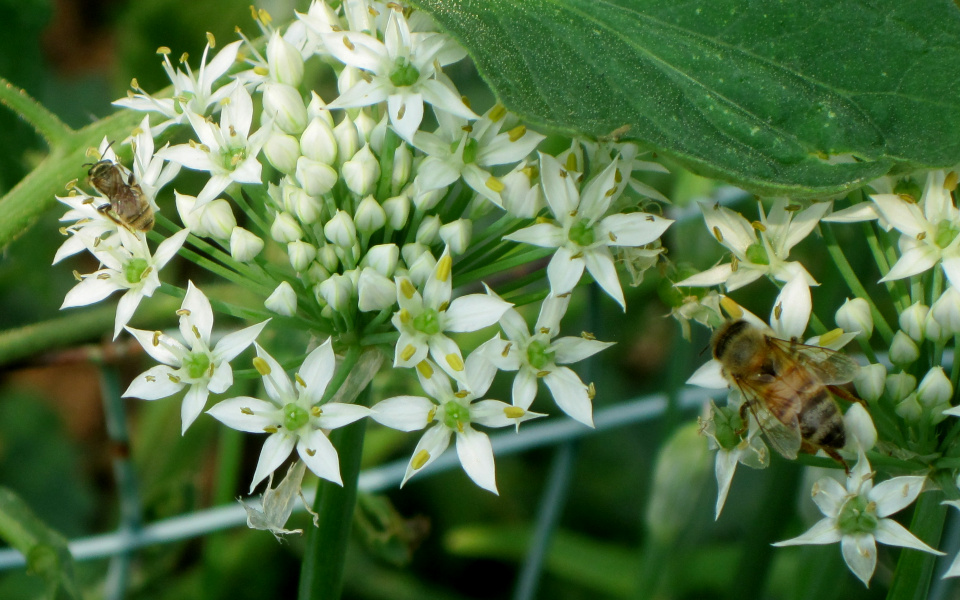
That year I saw very few honeybees, at least in the late summer when the sunflowers were blooming. But as summer cooled toward autumn, I saw a few more, not just on the sunflowers, including this one on a flower of garlic chive, near a smaller bee that I don't recognize (it is near upper left).

I participated in the project for several years, then stopped. Standing around on a hot August day is rather hard on me. But we have plenty of fare for pollinators in all seasons, as seen in the pair of pictures below:


On the left, three tiny bees (about 8mm) are picking over Sedum flowers that bloom in the spring next to our front walk. Oh the right is a flower bed with flowers for all seasons. A Hellebore is almost hidden beneath late-spring-blooming evening primroses. The Hellebore blooms from February until June. We have a few in other parts of the yard, to keep pollinators supplied while they await other kinds of flowers. In mid-June the Echinacea begin to bloom, and carry on for a month. Lavender and heather flower later, and several other flowering plants push the season almost to first snow. This garden is next to a crabapple tree, that flowers in mid-spring, and across the yard, an apple tree flowers in early spring.

One more creature we recently began to try to attract is the Monarch butterfly, with these milkweed plants. There is a schoolyard nearby that has a big patch of milkweed, but this is just the third year for us. We started with a single plant we grew from seeds we collected in the schoolyard. So far we haven't seen any butterflies, but these plants attract many more honeybees than I've seen in ten years or more. They also become infested with milkweed bugs. When they are very small, the little red nymphs must have honeydew like aphids do, because ants tend them.

Early in the book, Thor Hanson uses the term "backyard biology." Later he says it might be better to speak of "yard biology," though it is less euphonious, because nature doesn't just hide out behind our houses. It is all around us. The ten chapters (plus an Introduction and Conclusion) reveal the manifold riches of his own yard. Of course, he does live on an island in Washington state, with a yard that's bigger than average…multiple yards, from the sound of it. However, any of us, if we're willing to slow down and observe, can see a lot.

Thinking it over, we can gather quite a list of the variables that lead to quite a variety of creatures making themselves at home in any yard: variations of light and shade; warmth on cooler days and shelter on hotter days; foods that appeal to this or that sort of creature; shelter for the shy ones (such as little songbirds) and open spaces for the bold (rabbits, squirrels, and foxes; even deer when apples are falling).

I tend to favor insects because many of them ignore humans if we move gently and don't breathe on them. They're easier to photograph than birds. One acquaintance of the author uses a lighted sheet at night to attract moths, which he photographs obsessively. He has catalogued hundreds of species in his yard. One can do the same for beetles; many will also come to a lighted sheet. The beauty of a light trap is you don't have to catch and kill to identify most species (sometimes it's necessary, though).

Dr. Hanson speaks much of birds, and advises getting not just "a birdhouse" but a dozen or more, of various sizes, because there are many varieties of bird that prefer to nest in cavities. There just aren't enough abandoned woodpecker holes to go around. During my last few years at my company I was on a team that monitored birdhouses scattered around the property. All were sized for bluebirds, which also made them ideal for swallows (2 species), wrens (3 species) and chickadees. On occasion we would find a birdhouse in a more sheltered location that had been taken over by a pair of starlings, which are rather large; they had pecked the hole a lot bigger. At the end of the season we would take that birdhouse to the company shop to be fitted with a new door, this time with a metal collar in the hole! On another part of the property there were much larger boxes designed for wood ducks. My wife and I have talked it over a little. We may get (or make) a few birdhouses.

Another project recommended in the book is iNaturalist. It is a phone app, with an accompanying website, where I find it helpful when I want to edit an entry. TIP: The GPS on my phone is not as accurate as I'd like, so I go into the website later and edit the location if it is too far off. The minimum "native" accuracy of an iNaturalist geolocation is four meters. That's usually sufficient; for us Yanks, that comes to a radius of 13 feet. On the website, if you remember accurately where you were (it shows you a detailed aerial photo), you can enter a value as small as one meter.

Here I have focused on the "what we can do" suggestions. The book is also chock full of stories about various animals of all sizes found in the author's yard, or discussed by his friends and colleagues. Getting closer to what goes on outdoors is good for us. We need to slow down and, typically, just look and listen. It is good to recognize that we are part of nature.

Friday, April 11, 2025

Wolves making it against all odds

 kw: book reviews, nonfiction, science, wildlife, wildlife management, wolves, biologists, naturalists, memoirs

About two decades before wolves were trucked into Yellowstone National Park, a lone female wolf made her way from Canada into the area around Glacier National Park. She was named Kishinena, Later a male wolf joined her, and the pair raised at least three litters of pups. By the time "re-introduction" was officially carried out, the Glacier NP area was host to a few packs of self-introduced wolves.

One woman witnessed it all, and continued to study wolves in and near Montana for forty years. Dr. Diane K. Boyd became the most skilled wolf trapper in America, although she never caught Kishinena. We can be generous and say that she was still learning in those early years.

At first when I was reading Dr. Boyd's memoir A Woman Among Wolves: My Journey Through Forty Years of Wolf Recovery, my mental image of a wolf trap was the cruel leg-crushing snap trap employed by fur trappers. Eventually I learned that recovery trappers use a cable trap that doesn't break any bones and seldom breaks the skin. A wolf (or mis-caught bear or other animal) that struggles for hours against such a trap can still cut off circulation to the trapped foot to cause permanent injury; this is why a biologist runs the trapline at least twice daily. 

The author tells one story of herself and an assistant, also female, tranquilizing a wolf that had become so exhausted from fighting the trap that it was practically frozen to death, and the foot was solid as a rock. The two women took the sleeping wolf into the truck, laid it across their laps, ran the engine fast and the heater all the way up. Then they took off their shirts and body-warmed the wolf, whose body temperature was about eight degrees below normal by then. Once the animal began to warm, Diane realized it was waking, but for a while it stayed still to enjoy the warmth. She carefully reached to open the door, holding the radio collar they'd put on earlier to keep that mouthful of teeth away from her face, and let the wolf bolt away. Quite a sight they must have made, two half-naked women covered in sweat and black-and-gray fur! Happy to see the wolf on the run. A visit to the area the next day to follow its tracks for a ways confirmed that the wolf didn't just run a quarter mile and drop dead; it was apparently well enough to run long and far. Radio tracking in the following days showed that it covered a lot of territory, and made kills as usual.

During her forty years with the wolves, the author saw their situation come nearly full circle. Wolves were once so universally hated they were destroyed from every square mile of the U.S. "lower 48" except the extreme north of Minnesota and Isle Royale on Lake Superior. By the mid 1990's they were much beloved by many Americans, federal legislation protected them, and they multiplied all across the northern states, from the Great Lakes to Washington state. Over the next decade or so the mood shifted again, and the fear and hatred of wolves was on the rebound. Even today, the pendulum is a bit to the side of "protect livestock" rather than "protect wolves". Nonetheless, the gray wolf has been restored as a major predator in the northern US.

Consider this list: Grizzly Bear, Wolf, Coyote, Fox, Wolverine, Mountain Lion, Bobcat. Five of these seven can easily kill a human. Only wolves are hated in a special way. This came out especially strongly at a public meeting in 2018 in Trout Creek, Montana. For more than two hours a couple hundred wolf-hating folk berated Forest Service members and supporting scientists, including Dr. Boyd. Earlier in the book she calls her treatment among wildlife biologists and forest rangers, as a young, slender blonde woman among "mountain men", a baptism of fire. But this was another thing entirely. When she had opportunity, she spoke reason, but when the crowd is unreasonable—and half are drunk—that's like tossing a snowball into a hot wind.

I don't know what the national mood is today. Where has the pendulum swung in the past seven years? I was once told by a policeman that there's a threshold of 15%: if more than 15% of the population habitually speeds, for example (and the level is more like 75%), speed laws cannot be effectively enforced. I don't know what the present level of wolf-hatred is, but if it's more than about a quarter of us, a lot of wolves are at risk. Poaching has existed all through the past 4-5 decades, but it reached an all-time high within the past decade, and I just don't know if the trend is still upward, or if it is abating.

Duck-Duck-Go's AI Assist tells me this:

As of 2024, the estimated gray wolf population in the contiguous United States is between 14,000 and 18,000, with Alaska having an additional 7,000 to 11,000 wolves. Most of the populations are concentrated in the northern half of the country.

That's a big difference from the near-zero population of the period from 1940-1970. And Dr. Boyd witnessed all of that recovery. She is an admirable naturalist/biologist, and a great storyteller.

Saturday, July 01, 2023

The fruits of loneliness

 kw: book reviews, nonfiction, oceanography, naturalists, memoirs, isolation, bereavement

Everyone reacted to the pandemic and the various governmental restrictions surrounding it in different ways. Introverts like me could just hide out and read or carry on private studies; I had the freedom to take a few months off work. My very social aunt suffered greatly: isolated in her Independent Living suite, with meals delivered to the door and nobody allowed to visit for several months (thanks to Gov. Newsom, solidly in the running for worst in the nation), within a year she died, not of illness but of loneliness.

Dr. Maddalena Bearzi, a very active oceanographer, suffered as one might who'd lost all one's best friends at once. Being of an active mind and character, she found things to do, carrying on "homespun naturalist" activities in spite of the nagging depression. Stranded: Finding Nature in Uncertain Times is her memoir of those times.

The first and last chapters limn her last foray into the ocean to observe porpoises and whales, before the lockdown, and her first after the lockdown was lifted, more than a year later. In between, rather than spend all her time on the inside looking out, she took walks with her dog, she gardened mightily, and she made the acquaintance of the animals all around her that she had earlier mostly ignored.

It seems her dog Genghis is a real goofball. Fortunately he is a lovable goofball, in spite of his penchant for endangering the integrity of her shoulder socket whenever he spies a lizard or squirrel. She tells of several lizard species she encountered during those months, primarily at times that Genghis didn't see them yet. She watched a paper wasp land on her sandwich just before she took a bite, getting itself spotted with a bit of avocado; that enabled her to keep an eye on that particular wasp as it took up guard duties at the entrance to a nest in one of her patio lounges. She tells us of the gradual replacement of the native gray squirrels by invaders from the east, Eastern Fox Squirrels brought to California by well-meaning folks. She also encountered an opossum or two, and tried to spot coyotes that she sometimes heard, but never saw.

She has a chapter, really a well-deserved diatribe, about captive animals, particularly free-roaming ones such as orcas. Under certain circumstances, caging an animal may be needed, and urban kids do get some good from seeing zoo animals, at least in modern zoos with larger enclosures. But putting large animals in small aquariums for the sake of entertainment is quite troubling.

Her writing is lyrical, deep and evocative of many good emotions. I'm glad she's back to her beloved cetaceans, continuing a more-than-25-year study of their surface habits, now with new eyes for them after the months she spent observing a variety of (to her) less familiar species.

Tuesday, October 19, 2021

Dual purpose memoir

kw: book reviews, nonfiction, naturalists, natural history, autism, memoirs

I scour the Science shelves at libraries and bookstores. Naturally, once I saw Diary of a Young Naturalist, by Dara McAnulty, I anticipated a good read. I was not disappointed.

The author has been a naturalist as long as he's been able to get out and into nature. The book is taken from his diary starting in Spring 2018, through Winter 2019, just before his 15th birthday. He writes to re-process a day and its experiences. It is a triumph for him to share all that with us.

This is a memoir with two tracks, as his diary has two tracks. He shows us nature as he sees it, and he shows himself to us, as he experiences himself and the world around. This takes some doing because he is autistic, at least according to the modern definition (It wasn't that long ago that "high-functioning" autistic persons were described as having Asperger's Syndrome, but that term has been swallowed up into "the spectrum", which covers a huge range from classical autism—which depicts those who cannot communicate nor even recognize the difference between people and furniture that inexplicably moves about—, to the highest-functioning end of Asperger's, which grades into the hyper-focus of ADHD).

Both Dara and his brother Lorcan are "on the spectrum," though they experience it differently and behave differently. I'm not certain that his sister Bláthnaid is also autistic, but once or twice he writes of her as though she might be so. Whatever their status, all three children are very, very lucky in having a mother who knows how to nurture them and provides a safe haven for them, and a father who is equally accepting and nurturing. This family picture is from Irish News. Dara is wearing blue.

Dara, in particular, is easily overwhelmed by business/busyness in the human world. It is time-consuming and difficult for him to recover from attending a public function or giving a speech, something he is called on to do more and more often, particularly as his blog has gained popularity and he's become better known among naturalists and environmentalists. Just attending school takes its toll, all the more when he is bullied, as autistic youngsters frequently are. However, the school in their new neighborhood is quite different, he's bullied far less often, and he writes of gathering a number of students to form a club for environmental activism.

In spite of all the troubles he's had, Dara writes with open-hearted charm. There's a freshness akin to what I've enjoyed during conversations with young friends "on the spectrum." Describing his family's last leave-taking of Rathlin Island, which he describes as shaped like a mermaid's tail—they were soon to move farther away from the northern coast—, he says, "There's a Rathlin space inside me, mermaid-shaped, and it needs to be filled again." In this picture, perhaps you can almost see the mermaid, off the picture to the upper right, taking her leave. (Picture from Wikimedia).

Later on, writing of a walk in late September: "The beach is invigorating today. I haven't stretched my legs properly in a few days, and the comfort of walking unloads a little more weight. With every passing day, a little more joy sneaks in – is there a peak, a maximum amount of joy that we're allowed to feel?"

I see I have dwelt mostly on autism. The book is filled with bits of knowledge about birds and other animals. I don't know if I can easily recognize more than a handful of bird species. Dara seems to know dozens, perhaps hundreds, by sight, sound, or even from a single fallen feather. He's much more than a bird watcher, however. He writes of insects, particularly those that inhabit streams and ponds, toads and frogs, and numerous other creatures whose habitats we have, quite frankly, invaded and often ruined.

He has a visceral reaction to things. He feels with his whole body. This can cause surprise at times: he writes of finding a jay feather and handing it to a girl standing nearby. Her mother snatched it away, saying, "Dirty!", at which point Dara screamed. He screamed loud and long, and it took much of his mother's care to calm him down. This was probably when he was younger than ten. He also writes of a later incident: seeing a boy pick up a chestnut, followed by a similar reaction from that boy's mother. But Dara held back and waited. When the mother was distracted, he found a bigger chestnut, sidled up to the boy, told him a bit about chestnut trees, and let the boy whisk the nut into his pocket before the mother could see. That's one-on-one activism, and I hope the youngster keeps his love of nature.

At about 200 pages, the book is just right. Not every day is detailed, perhaps a quarter of them or less. What we do have produces a comforting feeling that at least some young people are "getting it", that they realize we cannot continue to devour the earth, heedless of those with whom we share it.

Wednesday, September 22, 2021

Wilson and his wonderful ants

 kw: book reviews, nonfiction, science, natural science, naturalists, memoirs, ants, myrmecology


This is the most troublesome ant in the world. The 47 known species of leaf-cutter ants can form immense nests with millions of members, move tons of earth doing so, and strip entire trees of leaves overnight. In Tales From the Ant World, Edward O. Wilson, my favorite naturalist and nature writer, saves these ants for his last chapter. I don't have his patience.

Of all the social insects, leaf-cutter ants best deserve the moniker "superorganism". There are several distinct castes, and this photo (cropped from a much larger image) shows two of them. The workers that cuts the leaves and carry them are accompanied by smaller "minors", which ride along when the leaf bits are carried to the nest. They aren't freeloading. They keep away parasitic flies that would otherwise lay eggs on the workers. They are bodyguards.

Dr. Wilson, who studied at Harvard, taught there for 41 years, and is still affiliated as a Professor Emeritus, has been there for more than seventy years. From his many books we find that he didn't always spend much time there. Collecting and studying ants has taken him almost everywhere on Earth where ants live; effectively, everywhere except the polar ice caps and a few islands (ants are poor at crossing oceans).

When asked, "What do I do about ants in my kitchen?", he will typically reply,

"Watch your step, be careful of little lives, consider becoming an amateur myrmecologist, and contribute to scientific study. … They carry no disease, and may help eliminate other insects that do carry disease." —from the Introduction, p. 10.

If we all followed that advice, a lot more would be learned about ants in short order, and some pesticide companies would go broke.

The short chapters of Dr. Wilson's book are like adventure tales. We read of ants that sting worse than any wasp, ants that farm insects such as aphids for their honeydew, some that are ranchers (keeping "domesticated" insects to eat), and the many ants that enslave other ant species. Slavery has been around for 100 million years or more; humans didn't invent it.

This image, from a pest control company, shows some common ants to be found in temperate areas, such as most of the US. On my screen they are shown about 3x natural size. That would make the smallest, the "Crazy Ant", about 3mm (1/8") long, which is about right. Taken together, the ants in a typical yard weigh as much as one of the occupants of the house, perhaps more. Worldwide, the ants weigh more than all the billions of humans.

One chapter describes a few species of trap-jawed ants, such as the one shown here. They pull back their jaws past a cocking point. When they release the jaws they slam shut in a couple of milliseconds.

Such ants prey on insects such as springtails, which are much too fast to chase down or can jump (springtails also have a cocking mechanism and a lever to launch themselves). These ants move very slowly, to maneuver close enough to snap the jaws on their prey.

There are more than 15,000 species of ants so far described. Some are well known, but for others a physical description is all that is known besides where they were found. Sometimes, even knowing where a species was first found isn't much help if you don't take account of when. The author writes about searching in vain for some rare ants, only to learn later that they are only active in cold weather, and he'd had the misfortune to try to find them in the summertime.

Live and learn. He has a few chapters on his own path to becoming a naturalist, bolstered by a childhood in neighborhoods with a lot of natural places nearby, and parents who didn't mind him raising sundry critters or nests of insects in his bedroom. Yet after a working life that spans seven decades, he is still learning, and loving the learning. His books have the same goal, to share that love of learning from nature that has been his delight. His writing is happy writing because he is happy. Reading him makes me happy.

Wednesday, May 30, 2018

Taxonomy is alive but not well

kw: book reviews, nonfiction, naturalists, taxonomy, systematics, natural history, africa, african setting

Environmental stewardship is one of this generation's signature issues, but nearly nobody, from the Boomers (my generation) and the X-generation to the Millennials, knows what is needed to make it work. From a few sources I compiled this list of environmental concerns, in order of importance:

  1. Climate Change
  2. Species Conservation
  3. Mining
  4. Nuclear
  5. Pesticides
  6. Pollution
  7. Population
  8. Waste

These overlap quite a bit, of course, but it is rather tragic that, while Species Conservation is the second-most important issue, support for the fundamental, naturalistic studies needed has been drying up, year after year, decade after decade.

Questions: (1) How can we care for the species on this planet if we don't know what they are? (2) Do we already know enough so we can set public policies to mitigate (dare I say eliminate) extinctions that we are causing?

Answers: (1) We can't, even a little bit; and (2) No, not even close: we don't even know what most of them are.

Dr. Eli Greenbaum is a front-line soldier of species knowledge, one of a totally insufficient cadre of naturalists and taxonomists who actually gather the specimens held in museums and describe them for publication and further study. He and others like him gather and communicate the knowledge needed to actually perform Species Conservation. You need to know what you have if you expect to keep it or care for it!

An old fable, much abbreviated:
Two brothers inherited their parents' farm. The older brother did most of the work while the younger brother preferred to party. But soon there was a war and the older brother was called to serve as a soldier. He left the care of the farm to his younger brother, with the demand that the farm continue to prosper until his return, "Or I will demand an accounting of you!" The younger brother said nice things to his older brother, but continued to party and ignore the care of the farm. After a few months, he got a letter from his brother, stating that he hoped to return after another month, and repeating his warning and threat. The young man went to the bank to check on the finances, and was shocked to discover that very little money remained. He went to the barns and found that hardly anything was stored against the coming winter. In a panic, he took a gold doubloon to the village witch to ask for help. "My brother will kill me if he returns and the farm is in such a mess!" he told her. She went to a back room and returned with a small wooden chest, saying, "This and my advice are worth only half a doubloon." She gave him some silver pieces in change, and then said, "See the hole in the top of the chest? It contains enchanted dust. You must go to each corner of the farm, and to the middle of each building, and shake out a few grains of this dust, every day. Then your farm will begin to prosper. But do not open the chest." The young man returned to the farm and set out on his task. In a back corner of the land he found a farm hand napping next to a broken portion of fence he was supposed to be mending. The young man kicked him awake and demanded that he finish his work. In another spot, two men were playing cards. He set them to their tasks and took the cards away. In the barn he noticed the messy stalls, so he called another hand and together they cleaned them and put in fresh hay against the animals' return. And so his day went. Day after day he continued, and the farm began to prosper. The promised month came and went, as did more months. His brother never returned. After a few years, the farm was prospering indeed, and he took a wife. When he was very old and dying, he asked his wife to bring him the magic chest. He said, "I was told not to open this, but after I die, that will not matter. Please help me open it. I want to see what is inside." They forced the lock and opened the chest. Inside they found just a remaining ounce or two of desert sand.
I think you can draw the appropriate conclusion.

In his book Emerald Labyrinth: A Scientist's Adventures in the Jungles of the Congo, Eli Greenbaum chronicles two of his early field seasons (2008, 2009) in the eastern part of the Democratic Republic of The Congo, once called Belgian Congo, and later, Zaire. Dr. Greenbaum is a herpetologist, one who studies snakes, lizards, turtles, frogs, salamanders and toads. He describes his experiences in the Congo, where he photographed and collected a broad range of "herps", as such animals are colloquially called. His studies expanded knowledge of the geographic range of many species, particularly of frogs, and resulted in the discovery of several new species. He worked with a Congolese herpetologist, Chifundera Kusamba (AKA "Chif"), several other colleagues, and a variable crew of porters and guides, visiting some of the remotest areas of eastern Congo.

The chapters contain alternating sections of the author's experiences and historical narrative. Congo does not have a pretty history. Yet, because of the sheer difficulty of travel, large sections are still, well, not exactly pristine, but in better shape than much of Africa, environmentally. But it is not exactly a paradise.

Being a naturalist is difficult. In past generations, a naturalist had to be an artist, drawing from life the things being collected, because once a specimen makes it back to the laboratory, even a local lab in the same country, it has changed a lot, usually from being preserved in alcohol or formalin. Formalin is not used any more; it destroys DNA and is dangerous to handle. Even drying an insect changes it; many beautifully-colored beetles turn black soon after death, for example. While artistic skill is still very useful, now we have digital photography and memory cards that can hold thousands of images, even in larger formats (In the 35mm days, even up to the late 1990's, a day of serious shooting could consume about ten rolls of film).

Secondly, a naturalist must be a scholar in a chosen discipline (and pretty good in several others). What is the difference between an expert and a scholar? An expert has a wealth of useful knowledge of a subject. A scholar knows everything that is known about that subject. This is what is needed to be able to recognize if that yellow-spotted, blue-bellied frog in your hand is a new species, or a familiar species in a habitat from which it was not recorded before.

Thirdly, a naturalist must have the strength and energy of a triathlete and a superior immune system. In places like the Congo, you will get sick and clinics are scarce. Dr. Greenbaum suffered two rounds of malaria and one of typhoid fever, in addition to stings by venomous ants (of a variety that can kill) and a number of other diseases and afflictions. His colleagues in Africa would kid him about coming from America in a rather pudgy condition (in contrast to their whip-thin physiques). That would soon change. But he records unflinchingly that he was frequently the slowest climber and needed others to wait for him.

Fourthly, a naturalist needs sponsorship. Traveling to places that are hard to reach is costly. Not just in gasoline, repair parts for vehicles, and food and lodging: Keeping good will with the locals frequently requires giving small gifts, treating a village to a beer party, and other social expenses. It appears that actual bribery was hardly ever needed.

There was the added complication of the civil war among at least four rebel groups and the tatters of a national government. It takes more than documents with official-looking stamps and signatures on them to allay the suspicion of a militia commander. The crew were lucky as often as they were politically skillful, just to stay alive.

With all that, I want to return to the question of taxonomy and systematics. These two words are formally synonyms, and both refer to the classification of items and hierarchical structure of the classification system. But they differ in usage. Taxonomy describes determining how a specimen is classified; in biology this means assigning a binomial species designation such as Tyrannosaurus rex, Homo sapiens, or Turdus migratorius (the American Robin). When describing a new species, it means not only assigning it to the right Genus (the first word of the binomial), but possibly deciding that a new Genus is to be described, and into which Family it is to be placed. The original binomials were Latin words and compounds, but the language had too few words for the millions of species, so "Latinized" words of many languages are pressed into service, as are names of people one might wish to honor. For example, the author and his colleagues named a new species of lizard Congolacerta asukului: "Lacerta" is Latin for "lizard", and Asukulu was a helper on the expeditions who was murdered by a militia group later on. Tacking an "i" to Asukulu's name "Latinized" it.

Systematics describes the maintenance of the taxonomic structure, and is typically concerned with "everything from Family on up". Thus, the complete "branch" to which we humans belong is
  • Kingdom: Animalia
  • Phylum: Chordata
  • Class: Mammalia
  • Order: Primates
  • Suborder: Haplorhini
  • Infraorder: Simiiformes
  • Family: Hominidae
  • Subfamily: Homininae
  • Tribe: Hominini
  • Genus: Homo
  • Species: H. sapiens
  • Binomial: Homo sapiens
The six classification levels in bold are those originally set up in 1758. Other sub-classifications have been set up since, and this continues, particularly as DNA studies allow ever-finer relationships to be discerned. In my work at the Delaware Museum of Natural History, the Collections Manager and I are continually confronted with changes such as splitting a Family into several (and assigning which Genus goes in which Family), or re-assigning a species to a different Genus. At least, in the realm of land and tree snails in which I am presently working: these critters have been the subject of intensive work at many museums for 10-20 years.

There are at present about 1.4 million species that have been described. Estimates of the number of species still unknown, just of "animals and plants big enough to see", range from 10 million to 100 million. There may be even more species of microscopic protozoa, algae and fungi; and then bacteria and archaea ("germs" to most folks) are still very little known in comparison to what is likely "out there".

By one estimate the author quotes, it will take more than 600 years of work by half a million naturalists to fully describe all life on Earth. But Species Conservation has to be carried out now, or there will be a whole lot fewer species to describe. There are thousands of naturalists, but we need tens or hundreds of thousands...and the funding to support them. That is what it takes to put "magic dust" on every corner of the farm we call Earth.

Tuesday, April 29, 2014

Three for a reason

kw: omnibus review, book reviews, nonfiction, science fiction, space fiction, naturalists, apes, politics, polemics

Even reviewing three books I'll have to keep it short. The injury in my fingertip is slow to fully recover. In order to type I put a pressure bandage over it; that reduces edema.

These are three quite disparate books! First, interstellar fiction at its best:

A lovely bit of space opera: Shipstar by Gregory Benford and Larry Niven. Niven has made his name with epic stories of immense space mysteries, in settings where starships are a bit like clipper ships: costly but in frequent use; and alien constructions of incredible size are discovered and explored.

Several years ago in Bowl of Heaven these authors introduced something even more huge than the Ringworld of Niven's "Known Space" books. The Bowl is somewhat wider than Earth's orbit, and its technology uses a captive K-class star for illumination and propulsion. Having a surface area a few million times that of a typical planet, all in perpetual daylight, such a world can support trillions or quadrillions of beings.

The story is a drama of interactions between the humans who have arrived at the Bowl and the various species they encounter there, particularly the elephantine, birdlike "Astronomers" who are nominally in charge. As the story reached its climax I remembered a 1967 episode of Star Trek, "The Squire of Gothos", in which an all-powerful being turns out to be a misbehaving child once his parents intervene at the end. As always in work by both Niven and Benford (and collaborations), we find a bracing panoply of alien minds and cultures.

The Bowl itself is of more interest to me. Several times the characters discuss its dynamic equilibrium. Rather tricky that, holding a star with the Bowl's gravity while inducing it to form a jet—similar in principle to the nucleus of an active galaxy, just star-sized—to propel both Bowl and star across the galaxy. The jet's forces counteract the gravity that would draw star and Bowl together. What I didn't see discussed is how they make it turn around to slow down. The stability of the system turns out to depend on plasma-beings called the Diaphanous. One one hand, I first thought this a copout, but it also emphasizes Niven's determination to imagine some kind of intelligent life for every possible environment. The centers of stars and the surfaces of neutron stars await…but not the interiors of black holes; that's been done.

Second, encounters of a quite different sort underlie Kindred Beings: What Seventy-Three Chimpanzees Taught Me About Life, Love, and Connection by Sheri Speede. This remarkable woman first became a veterinarian, but yearned for something more worthwhile than spaying pets and treating heartworm. An opportunity to visit Cameroon opened up a new world to her, and at the age of forty, she jumped in with both feet.

There are several threads in the book, including lots of autobiography. I'll leave it to her to describe the twists and turns of her own life. She had been blessed with an upbringing and early experiences that helped her cope with the very difficult lifestyle in rural Cameroon. Her passion has been to set up and maintain a sanctuary for orphaned and rescued chimps. Now you can learn of the Sanaga-Yong Chimpanzee Rescue Center here.

The book opens with, and later develops the background story leading to, the death of Dorothy, among the first of the rescued apes. Dorothy became a kind of tribal matriarch to the sanctuary chimpanzees. When she died, Dr. Speede had to perform an autopsy, but afterward, wheeled her covered body by the compound for the other apes to view her. The clear grief on their faces was captured in a photograph that has done more to crack open the anthropological community, and the world at large, to the understanding that chimpanzees have emotions very much like ours. No longer can anyone get away with claiming that "they don't feel in ways we can relate to" or "they don't really feel pain" and so forth.

Creating and running a nonprofit of any kind, particularly an ape rescue enterprise in Africa, takes an incredible amount of fundraising and much time-consuming political effort. The author was favored with a network of support that built up quickly, and the time was ripe for a logging company and numerous regional and tribal chiefs to encourage and support the work. Still, there was a level of effort and commitment that would have deterred her had she had any idea what she was getting into. Those who do great things are often blessed by this kind of holy ignorance. They do the impossible simply because they don't yet know it is impossible.

I wept often while reading, sometimes in joy, sometimes in pain. I suspect, so will you.  I would hope better of my fellow humans, some of whom are degraded to the extent we see in rampant animal cruelty. I am also encouraged by those who express the best of humanity by, in any way, helping what they can help. I recall telling someone of a similar, small effort, and he responded, "That is just a drop in the bucket." I replied, "Yes, so where is your drop?"

Third, something to rile the blood, whether your political slant is left or right or neither: a set of Lou Dobbs chalk talks in book form, Upheaval. Lou Dobbs is unabashedly conservative. We need more like him. These days, the public face of conservatism is, at best, shamefaced. Conservative "leaders" are embarrassed to be conservative, except for a few who claim they are conservative but are actually somewhat left-leaning moderates…they are conservative only by comparison to the rampant collectivists who run this administration and the Senate.

Lou Dobbs wants to do something about that. His weapon is facts, well-researched and well-presented facts. In that, he is more effective than Ross Perot was around 20 years ago, with his flip chart campaign ads. The trouble is, most Americans either don't care enough to realize that the scandal of the month really will affect them, or they are all, "Don't confuse me with facts. My mind is made up." American politics is "American Idol" set on a larger stage. The one who can sing best and get the audience whooping gets the most votes. Nobody even listens to the words of the song.

For me, an unabashed science nerd, I find the following a most telling symptom of our malaise (my bullet points, not his):

  • American astronauts have to rely on getting a ride with Russian cosmonauts to get to and from the International Space Station. I'll bet that ends if we do more than weakly, squeakily protest the current Russian "adventure" in Ukraine.
  • The next visit to the Moon will be by the Chinese. They have said so. They began orbital flights in April of 1970 and intend to send Chinese astronauts to the Moon by about 2020. The next six years ought to be interesting. I wonder if they will bring back the American flag from Tranquility Basin as a souvenir.
  • The latest three countries to launch orbital rockets were Iran, North Korea and South Korea, all since 2009.
Hell, if North Korea, "the dark spot on the map of the Earth at night" can afford a space program, anybody can! We spend more on dog food than on NASA.

Quite frankly, the most fundamental of fundamental problems in this country is risk aversion. America was not started by the risk averse, but now it has been taken over by them.

Do you know why I do not get more politically involved? Too imaginative, too emotional, and I don't want to die of apoplexy. I had to read the book in spurts and starts. A steady diet of polemic, even polemic I agree with and as well presented as this, makes me too upset to sleep well. Lou Dobbs is right much more than he's wrong. I hope someone is listening.

Saturday, December 14, 2013

A classic that will never go out of date

kw: book reviews, nonfiction, ecology, naturalists, advocacy

(For the record, I read most of a book on investing, and it was so poor I decided not to review it. Thus the delay for this book, which is shorter than most.)

I just finished reading A Sand County Almanac by Aldo Leopold. In case anyone doesn't know, the volume includes Sketches Here and There plus The Upshot. I suppose it is a bit odd that I had not read it before, as I have read Thoreau's Walden and a couple of writings by John Muir. This book outclasses Walden by a large margin.

I suppose Sand County has been reviewed hundreds of times in the 66 years since it was published, so I feel little need to plow worn-out ground. But a few things struck me with sufficient force that they require comment.

In the essay "Prairie Birthday" he writes of the annual blooming of Silphium, seen here, in mid-July. In the
1940s he could find it only in one small abandoned graveyard, and at the end of the essay he notes that the graveyard has been "developed" and the plant is now probably extinct in Wisconsin. This image shows a low-growing planting; this perennial can reach two meters. From the comments at Rob's Plants, it is apparently still found in Vermont and environs. I was particularly struck by the plainness with which Leopold reported the demise of the plant and the yard in which it grew. His is not to castigate, but to unflinchingly report.

Later in the same essay he writes, "…it comes to pass that farms are good in proportion to the poverty of their floras." Having kept a record of the species he has seen blooming in two areas—one his farm and the other the campus where he taught—he noted that the former hosted 226 flowering species, the latter, but 120.

In the essay "Marshland Elegy" his penultimate paragraph reads, "Thus always does history, whether of marsh or market place, end in paradox. The ultimate value of these marshes is wildness, and the crane is wildness incarnate. But all conservation of wildness is self-defeating, for to cherish we must see and fondls, and when enough have seen and fondled, there is no wilderness left to cherish." This may be the truest and saddest ecological statement in print.

In the essay "Green Lagoons", one of the Sketches, he writes in a similar vein, more tersely, "Man always kills the things he loves, and so we pioneers have killed our wilderness. Some say we had to. Be that as it may, I am glad I shall never be young without wild country to be young in. Of what avail are forty freedoms without a blank spot on the map?"

I find it strange that land is being developed at a clip greater than the increase in population. Here are before-and-after satellite images (clipped from Google Earth), one just about 20 years ago, the other earlier this year:

The two neighborhoods thus constructed, not more than a few miles from where I live, quite overloaded the school seen at upper right in both images, so a couple of miles away a new one was built. I know, continued construction is good for the jobs market, but the number of unused homes in the US has reached more than 14 million (11% of the total), quite an incredible number! Having lived most of my life in rural areas, I consider it tantamount to a capital crime to put houses on land that can grow crops, or even worse, shelter wild things. It is even more criminal to do so when there are a few million acres of land under millions of homes that nobody lives in. Hey out there! Remodeling is construction work also.

A final note. I am so poor at both fishing and hunting that I never enjoyed either activity. Leopold excelled at both, and writes of them with lyrical fervor. It touched my heart. He deeply understood all the motives that a person could have toward the land and its denizens. I wonder if any of today's "environmentalists" either hunt or fish. Yet I am distrustful of most "sport" hunters and fishermen. I favor both activities only if you eat everything you kill. But I think it is not true "sport" unless you do all your sport hunting naked with only a knife in hand, and all your sport fishing with your bare hands. I suspect Leopold would be at least mildly supportive of such a view.

Sunday, January 18, 2009

The quintessential city Park at its most quintessential

kw: book reviews, nonfiction, natural science, naturalists, parks, animals

This book could not have been written twenty or thirty years ago. Oh, many of the same stories might be told, and most of the animal dramas have gone on for many years. But it would be worth your life to be there to observe them. I recall a family friend who attended a family wedding in Cleveland, Ohio in the 1970s. A bunch of us were walking from the restaurant back to the hotel, and someone suggested a shortcut through a park. This friend, who now lived in Manhattan, declined, saying, "I'm from New York. There's no way I'm going through a park after dark!" And in New York, in the 1970s, she was right. Even by day, Central Park could be a death trap.

Things have changed. By 1995 it was quite a bit safer to visit Central Park, even at night. Marie Winn and others have been watching the wildlife in Central Park for a number of years, and by 1995 they began to hazard evening and night visits, particularly to see moths, bats and owls. She records some of these adventures in Central Park in the Dark: More Mysteries of Urban Wildlife. The "more" in the subtitle follows her prior book, Red-Tails in Love, which chronicled the first pair of red-tailed hawks to successfully nest and raise young atop a building near the Park.

When the author began birdwatching in Central Park, more than twenty years ago, she little thought it would lead to midnight moth-watching expeditions, pre-dawn "fly-out" vigils, voyeurism of slug sex, or being bitten by the "rescue fantasy" bug while watching owlets take their lumps as they fledged. Central is a big park. At 843 acres, or about 1.3 square miles, it is big enough to hide the City from you when you are almost anywhere in its midst.

It is also big enough to host quite a variety of wildlife. According to the Central Park Conservancy, more than 240 bird species have been seen here, and about half of these can be found nesting here. There are also several species of bat, quite a few other mammals (not just rats), and perhaps 10,000 species of moth.

It's the moths that brought about the Central Park Mothers (rhymes with Authors), a moth-watching group that, of necessity, had to carry out their activities after dark. There are very few day-flying moths. They began with a sheet and a battery-powered black light, but soon found that bait works best. The Moth Tree, an elm with a mild fungus disease, seeped sweet sap, which attracted moths by the hundreds. Their favorites were the large underwing moths, species with colorful hind wings, usually having big eye spots. These moths flash the eyespots when disturbed, which will startle a predator and give the moth a running head start to escape. Moth stories take up a third of the book.

But the author doesn't just tell animal stories. She has learned a lot of science and lore over the years, and imparts it with relish, using writing that is to be relished. For example, about ring-necked pheasants:
There may have been pheasants in Central Park in the earliest years: an 1878 article in Harper's Monthly mentions a pheasant 'scurrying through the shrubbery' of the Ramble. But an 1886 survey of Central Park bird life did not include pheasants among the 121 species it listed. Perhaps during that period of eight years they all ended up on dinner tables…the pheasant was absent from Central Park until April 30, 1972, when a number of birdwatchers ran into one in the Ramble.
The author has also, at various times, been a member of the Woodlands Advisory Board, a consortium of members of the Conservancy and of the community. After an ill-advised move to remove the hawk nest from atop the nearby building, there was quite an outcry. Since that time, the hawks have been allowed to rebuild their nest, and quite a number of other red-tailed hawks have adopted city skyscraper life. (In a story the author doesn't tell, Peregrine falcons are also to be found nesting atop skyscrapers)

The book's closing chapters chronicle the introduction of screech owls to the Park, ending with a few sightings that indicate their successful integration. The members of the Woodlands Advisory Board originally opposed the project, noting that the owls had been absent from the park since about 1950. A later project by the author indicated, indeed established, that a combination of owl habits and human drivers' habits made screech owls' long-term habitation of the park very unlikely.

Screech owls eat insects, and most of the tastiest ones fly 2-4 feet above ground (very roughly, a meter). The owls begin hunting by dropping from a tree to this level, flattening out their flight path, and swooping along just at the "ideal" altitude to get smacked by cars on one of Central Park's drives. The timing of their earlier disappearance coincides clearly with the era in which cars were first allowed to go faster than 25 mph on Park roads.

But the introduced screech owls, in spite of a high level of auto mortality, have so far reproduced and spread throughout the Park. Maybe they are learning to fly a little higher! In time, this may lead to a new subspecies of screech owl. What it most certainly lead to is a great motivation for subsequent generations to continue watching the birds and beasts of Central Park, by day or by night.

Saturday, August 18, 2007

Flawed heroes of Twentieth Century entymology

kw: book reviews, nonfiction, natural history, insects, collecting, naturalists, biographies, autobiographies

Two memories from my childhood hint at the range, just of size, found in the family Ichneumonidae, the largest family of parasitic wasps.

This poor hornworm, such as I find on my tomato plants, is the victim of a tiny wasp no more than 3mm long (about 1/8 inch). She inserted one egg into the caterpillar's body. In a feat of self-cloning that puts to shame our practice of "embryo splitting" to produce eight calves from one egg, as many as 700 larvae resulted, eating first the hornworm's fat reserves, then emitting a hormone that causes it to crawl high on the plant, then finishing off its insides before burrowing out to form pupae in the little cocoons seen in this image.

This painting, which shows the "giant ichneumon" better than any photo I could find. The artist, Caroline Bochud, has copies of the painting for sale here.

I saw many of these on the Box elder trees during the years we lived in Utah. They are huge, about 7cm long (almost 3 inches), with a "stinger" (ovipositor) longer yet. I usually saw one in the midst of "drilling" into the tree. If I watched patiently, it would drill deeper and deeper, perhaps using more than half the ovipositor, pause, then gradually pull free. It all took half an hour or so. I learned later that this scary little lady had located a grub eating in the wood, perhaps 5cm (2") deep. She has excellent hearing. She then drilled and deposited one egg into the tunnel nearby. The larva hatches almost immediately and burrows into the grub. Sometime the following Spring, the young wasp would burrow out of the tree. Fascinating and yucky!

Ichneumoninae is the second largest subfamily of ichneumons, and includes the tiny parasite of the hornworm, but not the giant. All subfamily members parasitize caterpillars of the moths and butterflies. Most are small, around one or two centimeters long. As it turns out, very many of the known species of this subfamily, primarily those of Europe and Asia, were described by one unusual man, Gerd Heinrich, who labored forty years to get his life's work into print. Altogether, he described more than 1,500 species and subspecies, and the Zoologische Staatssammlung München has produced an on-line index to his work.

The Snoring Bird: My Family's Journey Through a Century of Biology by Bernd Heinrich—Emeritus Professor of Biology at the University of Vermont—is a biography of Gerd, the father, and the autobiography of the author, the son.

In every family where a stong-willed, obsessively focused father raises an equally powerful son, the dynamic relationship results in a son fighting, seemingly for his life, to outstrip the trap of his father's character. This is particularly true where there is much to deplore. Yet it is equally true that the son repeats most of the father's history, both successes and mistakes, though there are glaring areas of oppositeness. This comes out in spades in Snoring Bird

Oppositeness first: Gerd fought in two world wars, on the German side, and was proud of his military heritage (though his WW2 service was a matter of self-preservation, not loyalty); Bernd began as a loyalist, volunteering to enlist during the Vietnam War, but was 4-F, "unfit for service" due to a bad back, and later became a pacifist.

A milder contrast: Gerd worked with academics, but was not one himself, and could not have been one by temperament. Bernd is an academic with a distinguished scientific career only now approaching a close after forty years.

Similarities: Both did their life's work with insects, specifically Hymenoptera, Gerd with parasitic wasps, and Bernd mainly with bees. Both collected throughout the world. Both were primarily naturalists, though the son is more of an experimenter. Both became very attached to rural homesteads, Gerd to Borowke (now in Poland) and Bernd to a farmstead in Maine. Both are exceptionally stubborn and brook no argument. Both were singularly focused on their scientific passion, to the neglect of their families.

This last point is particularly painful to read. Both men had no trouble attracting women, and both seemingly without remorse discarded relationships, or forced one woman to accept another, almost on a whim. They tended to fall in lust (they only thought it love) on sight. Neither ever learned that love is a decision...but few men really do.

And what is the "snoring bird"? In 1931 Gerd was sent by investors to Celebes (a large Indonesian island) collect a specific bird of which only one specimen was known. After more than a year, during which he also collected new specimens of Wallace's Rail, nearly as rare, he heard a new sound, like a large man snoring. Creeping up, he saw it was the target bird, so he shot it. While there, he collected hundreds of insects, mostly Ichneumons, and also many, many other birds and small mammals. He had his wife along, and her sister (his preferred bedmate). His wife had become an excellent taxonomist. The skins were sold for added finances.

Many of his expeditions were like this. He was usually sent to find birds or shrews or whatever, but collected wasps as he went. He also took one, two, or three women along. Once only he took Bernd, who spent a year in Africa in between his first and second years at UCLA. (You must read for yourself who Bernd's mother is. She is now the surviving "Mrs. Heinrich"). Once many of the holotype specimens he collected and described were ensconced in various institutions, and his work in print, his fame gradually was made. He's be gratified to see the ZSM web site.

Bernd's fame was made by being the man to show how bumblebees can fly. He first found that hawk moths (like the one which hatches from the hornworm that escapes wasply attention) have warm flight muscles, as warm as 42ºC (108ºF), and that they keep a constant temperature during flight by shunting more or less blood through the abdomen, their "radiator". Bumblebees were found to "shiver" to warm their flight muscles before flying, and to use similar blood shunting depending on air and sunlight temperatures. This work was presented to a public audience in Scientific American in 1988, an issue I remember reading.

Two men, more similar than different, who made their mark on 20th Century biology. This book portrays them, warts and all. Not exactly heroes to emulate, not all cautionary tale: two men who did science the best they knew how.

Saturday, June 09, 2007

Mistress of Metamorphosis

kw: book reviews, nonfiction, biographies, naturalists, artists

In Chrysalis: Maria Sibylla Merian and the Secrets of Metamorphosis, Kim Todd revives a nearly-forgotten hero of the Renaissance, someone whose amazing work did much to dispel the old notion of spontaneous generation. I obtained this illustration of a butterfly whose larva feeds only on Amaryllis from the Hippeastrum page of a French horticulture website. They obviously have more interest in the flower than the insect, as it isn't mentioned.
But generations of printers have reprinted, revised, edited, and frequently nearly destroyed, the work of Maria Merian, who published six lavishly illustrated books of the natural history of caterpillars in the late 1600s and early 1700s. Three books are based on her work in Surinam in 1699-1701. The earlier three were of European species.

The biography chronicles her life as a gifted artist and printer's daughter, who grew up illustrating flower books and others of a genre we'd call "coffee table" today. But from age 13, when she first watched a moth emerge from its cocoon, her lifelong love was caterpillars, the eggs they hatched from, the pupae they formed—cocooned or not—, the butterflies or moths that they produced, and the plants both larva and adult fed on.

She, more than any other of her generation, patiently gathered the evidence to show that a particular caterpillar always produced a particular adult, even though certain caterpillars have several color phases and certain adult insects have color variations of their own. She struggled with the red-herring depredations of parasitoids that confused the evidence by causing many pupae to emit clouds of flies or wasps rather than the expected insect.

Author Todd traces her life, and the career of her work over the three centuries following her death. Merian was an extraordinary woman in an extraordinary time, a great among greats. Simply being able to work in her chosen field at a time that Galileo was forced to recant that "the Earth moves", and that Newton felt compelled to write more of alchemy and theology then of science, is a marvel in itself. We are all richer for her vision, diligence, and passion.

Sunday, October 02, 2005

A Thoroughly Victorian Naturalist

kw: book reviews, nonfiction, biographies, naturalists, evolution

Imagine, if you will, that after nearly sixteen years of research and study, after groping for a synthesis of his studies of earthworms and domestic fowl, after ruminating over his observations of the ecology of the pampas and the finches of the Galapagos Islands, after beginning to prepare a final outline of a great, multi-volume survey of his theory of evolutionary biology, Charles Darwin had one day been presented with a monograph describing natural selection, newly printed, describing every facet of the mechanism that drives evolutionary change, a mechanism he had elaborated on in detail in his outline.

This nearly happened! Though scientists in the Victorian era were generally no more or less venial and credit-hungry than those of today, there were two, at least, who behaved with nobility and commendable restraint, when it happened that they both deduced the same hypothesis. While Alfred Russel Wallace could have published his monograph—he was already a much-published and celebrated naturalist—he decided to send a copy of the manuscript to Darwin for review. Darwin was in a quandary!

The story of his handling of this delicate situation, with the help of some wiser, or at least bolder, friends, is told in numerous books, including the recent biography of Wallace, The Heretic in Darwin’s Court: The Life of Alfred Russel Wallace, by Ross A. Slotten. A mainly friendly relationship between Wallace and Darwin ensued, which lasted until Darwin’s death, and which was recalled by Wallace with much fondness near the end of his own life in 1909.

The publication of Darwin’s and Wallace’s first papers on the theory of natural selection, presented simultaneously to the Linnean Society, marked a turning point in the lives of both men. But, while it was the beginning of ever-increasing celebrity for Darwin, it led to a rougher road for Wallace. He rode the crest for a time, but when he later began to investigate Spiritualism, becoming quite an apostle for the “new religion,” he lost favor and influence, and fell into a couple decades of eclipse. His passionate embrace of the anti-vaccination cause, and later of many “thoroughly unpopular” movements, made him far from a favorite of the drawing room. Only in his eighties did he become a “national treasure,” and gain the recognition for his earlier work on an appropriate scale.

Today he is remembered less for supplying the prod to Darwin to publish “a sketch” of his theory in The Origin of Species (short title), and more for Wallacea. This region in Indonesia began as Wallace’s Line, an apparent biological boundary between Asian faunas to the west and Australian faunas to the east. It originally ran from the strait between Bali and Lombok, north between Borneo and Celebes. Later investigations showed that there is a region of gradual decline in one fauna as another takes over, rather than the sharp line that Wallace posited. Today Wallace’s Line delineates the first appearance of a great number of Australian species and the last appearance of several important Asian ones, while to the east, Weber’s and Lyddeker’s Lines mark the last appearance of all key Asian avian and mammalian species.

The amount of material is massive. It is undoubtedly less so than Wallace’s own autobiography My Life, but it took me a good while to read. I employed a stratagem I use when I find a book to be, however interesting, quite a long slog: I read this at work during breaks while reading other books at home, mainly bedtime. Thus the prior two posts are for books I completed while making my way through Heretic. Slotten is a good writer, or I’d have not finished. Wallace’s life is a fascinating window into the Victorian world at the height of its colonial power. Regardless of the privations Wallace, Bates (of Batesian mimicry fame), Spruce and others endured, they were greatly lessened by the pervasive influence of British civilization to all but the most remote corners of the world. Author Slotten’s masterwork is a fascinating window into the lives of Wallace, Darwin, and other naturalists of the time.

Thursday, July 14, 2005

Birdsong at Audubon

kw: book reviews, birds, bird song, birdsong, natural history, naturalists

Is there anything more fresh than walking through the cool morning air at, or just before, sunrise, hearing the morning chorus of birdsong? I confess it has been too many years since I have done so. This evening, though, taking a walk near dusk, I was treated to an evening chorus no less sweet or varied. There is a patch of woods near home, between one neighborhood and the next, as is the fashion in Eastern suburbs. It has been pretty well left alone since this development was built up some fifty years ago. This patch partly abuts a schoolyard, so we have our choice of a grassy sward or a running track to walk on.


I've noticed the birds and their singing in the past, but tonight I had different ears, all from reading Birdsong: A Natural History, by Don Stap. Perhaps half of the book is composed of information about singing birds and some history of the study of songbirds and birdsong. The structure of the book, though, is a picaresque history of the career of Don Kroodsma. The author has been privileged to accompany Dr. Kroodsma on a number of expeditions and excursions to record birdsong and study singing birds.

The recording itself is one thing. Making something useful of it is quite another. For that, one uses a sonograph, or sonic spectograph. Here is an example of the resulting sonogram.


The vertical dimension is frequency, with higher notes at the top. The scale ranges from 2,000 to 9,000 Hertz (1 Hertz = 1 cycle per second), for few bird sounds are outside this range. 9,000 Hz is an octave or two higher than most people can whistle. That's why it is hard to reproduce a bird's song. This song begins with a high chirp, a short beat of silence, then a lower whistle, followed by four chirps in the medium frequency range. To hear the sound and see & hear a few other examples, check out this Audubon Society site, which promotes Don Kroodsma's recent book The Singing Life of Birds. I've bought the book and will review it soon.

The song shown is called "Song A" because there are several dialects of the Eastern Towhee. Much work over the past twenty to thirty years has been done to record birds that have, and those that don't have, dialects, and to attempt to understand the differences.

Dr. Stap's writing recalled to me my early love of hearing birds sing. As a preteen with a new tape recorder, one of the first things I did was put the microphone outside my second-storey bedroom window and record a half hour or so of the birds waking up at daybreak. Now, 42 years later, if I can ever find that tape, it will be a valuable record. Birdsong begins with a description of the Macaulay Library of Natural Sounds. Many, many of the sounds record birdsong, including many dialects and variations.

It takes a great many recordings to produce a comprehensive collection of birdsong. Not only are there many singing birds—nearly all the passerines (perching birds), more than 5,500 species out of 10,000 or more total bird species—but some birds sing numerous different songs. Most (maybe, maybe less than most) have two calls, a territorial song and an alarm call. Many have a few or a few dozen songs, and there are some birds that sing hundreds or thousands of different songs. Some, such as the chipping sparrow, occasionally engage in repertoire contests, with a number of tiny birds, "dueling banjos" style, singing song after song to one another, very rapidly, often in a fixed order, in which the duelers either match one another note for note, or each jumps ahead to the next song, then the next...on through as many as four thousand songs.

Rather than grow this post to an hour's reading, I'll leave the rest for those who are interested, to check out or purchase Don Stap's quite enjoyable book.

Sunday, July 10, 2005

Beebe

kw: book reviews, naturalists, bathymetry

I had the good fortune not long ago to check out two books about William Beebe from the local library.

The first, The Remarkable Life of William Beebe: Explorer and Naturalist, by Carol Grant Gould chronicles Beebe's life. It is a good beginner's biography, and is the first biography one could call "authorized," because Ms Gould was persuaded to write it by Jocelyn Crane, Beebe's companion the last ten years of his life, and the holder of his journals and letters.

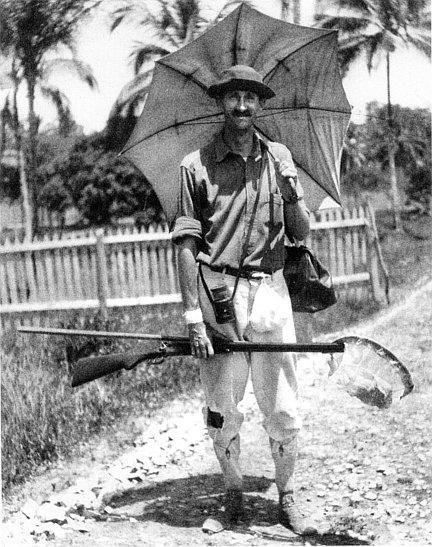
Beebe is of course best known to my generation for his book Half Mile Down, about the use of the Bathysphere to study creatures in midocean near Bermuda in the early 1930s. He was already one of the best-known scientists of his generation, and was famous for his writing and lectures by the time this picture was taken in 1917. In his early career, he was known primarily as an ornithologist.

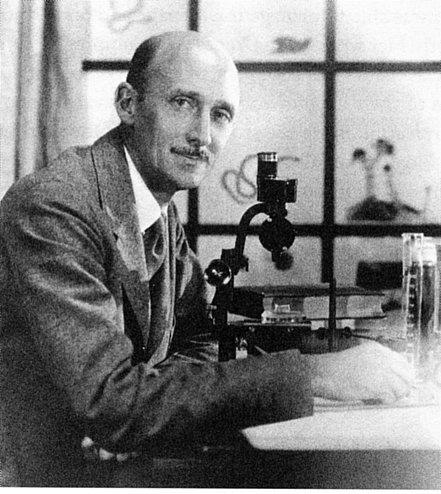
A few years after the Bathysphere adventures, he was continuing oceanic studies, but moving more and more in the direction of focused tropical studies. He loved the tropics, and spent increasing amounts of time in tropical laboratories. By 1940 or so, his appearances in his office at the Bronx Zoo, shown in the second image, were becoming rather rare.


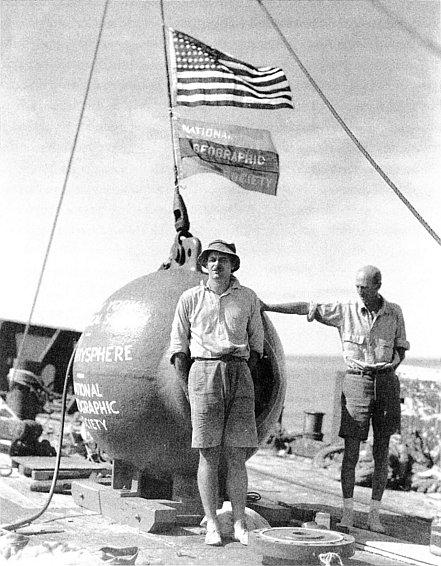
Beebe, usually called Will by all and sundry, was associated with the Bronx Zoo and the New York Zoological Society his entire professional life. He was occasionally sponsored by the National Geographic Society, particularly in the 1930s. He wrote articles for them and others, and monographs throughout his career, that are still classics in several fields.

Gould's book is comprehensive, very readable, and unblinking. We have her, and Miss Crane, to thank for presenting to us a fascinating study of a great generalist in a time of increasing specialization.


While his studies of birds, tropical ecologies, and netted sea life gained him great fame, what captured the imagination most—and still does—was the subject of Descent: The Heroic Discovery of the Abyss by Brad Matsen.


Beebe had been fascinated with undersea life since some youthful experiments with diving bells and helmets. In his fifties, frustrated with the difficulty of studying abyssal creatures brought up in nets and dredges—they were all too often pulped or exploded by pressure changes—he began to design a deep diving apparatus. His engineering skills were, in this regard, woefully inadequate.

Otis Barton was an engineer who knew his stuff. Scion of a well-to-do family, beneficiary of a generous trust fund, he was Harvard-educated in engineering and mathematics. He also had experimented with undersea apparatus, and planned to create a deep-diving submersible.

Beebe was his idol. When Barton read of Beebe's plans, he was at first depressed, thinking he would be scooped. Then he realized his design was likely to save Beebe's life. He gained audience with Beebe (through much trouble; Beebe had a crackpot a day come by with one scheme or another), and they became partners.

Matsen outlines in exciting detail the development of the initial, too-heavy Bathysphere, its redesign, and the studies Beebe and Barton carried out with it. For this section of Beebe's life, it greatly expands the story told more briefly by Gould. And it brings Barton to light, where he has been rather a cipher previously.

These two ambitious, complex, driven men, who each found the other hard to tolerate, managed to capture the world's attention with great skill and daring. I know, when I read Half Mile Down, more than forty years ago, Beebe's descriptions of the deep they observed were thrilling beyond measure. Beebe had a bit to say about Barton, but it took this book by Matsen to bring both men into a clear light, that I find a much more satisfying understanding of the risks they took and privations they suffered, to begin to open to us the depths of the sea.