Saturday, March 09, 2024

Guidance Parameter in Playground AI

 kw: experiments, ai art, generated art, artificial intelligence, simulated intelligence, comparisons, photo essays

Another parameter to explore in Playground AI is Guidance. This influences how closely the generated image conforms to the prompt, so they say. I decided to find out. In earlier experiments I had kept a few images I particularly liked. One had the seed 260650348, and I decided to use that for this experimental project, and to use only the Euler a Sampler.

The three Models have very different sets of Guidance parameters:

  • Stable Diffusion XL (SDXL) has levels from 0 to 30, and Guidance above 30 is available to subscribing (paying) users. The default is 7 and in FAQ's they recommend primarily using between 7 & 10. After some pre-work I decided to use 2, 4, 7, 11, 16, 24, and 30.
  • Playground v2 (PGv2) has levels from 0 to 5. The default is 3. I determined that levels 0, 1, and 2 produce identical results, so I decided to use levels 2, 3, 4, and 5.
  • Playground v2.5 (PG25) doesn't use a Guidance parameter. It also doesn't have multiple Samplers. It's a "point and shoot" generator.

I've learned from others' reviews and some "help" YouTube videos that longer prompts give the software more to work with. It stands to reason that there could be a greater difference among Guidance levels with a long prompt, compared to a short one. I decided to test four prompts of a wide range of lengths; the word counts below are "meaningful" words, ignoring articles:

  1. 1 word: Cosmology
  2. 5 words: Quaint village near a mountain stream
  3. 13 words: A rocky beach grading into a sandy beach below sea cliffs beneath a partly cloudy sky
  4. 28 words: Fantastical clock with a big dial for the time using roman numerals, the second hand on a small dial of its own, and indicators for month and day and phases of the moon

I'll present the resulting images half size (512x512) in pairs or groups of 4, beginning with PGv2 and Prompt 1.


A number of trends are seen as Guidance (G from now on) goes from 2 to 5:

  • The sky arch begins with a look like a multiverse, and goes to more of a dynamic universe look.
  • The observer is bigger at G4 and 5, while the child seen at G2 turns to a rock which progressively shrinks.
  • Trees appear at G3 and move around.
  • The nebula of G2 gradually turns into a galaxy.
  • Sundry planets come and go.

However, there is no dramatic change in the overall look of the image.

Next, 7 images from SDXL, plus one by PG25.


The SDXL images all have a Medieval look to them. The two that look best are the third and fourth, with G07 and G11. Above G16 they kind of go off the rails. At G30 in particular the frame is quite detailed, but the rest of the image has lower quality, as the FAQ warned. The PG25 image is quite fetching, similar to the central portion of the PGv2 images, with a kind of swirly surround. This one could be fun to run a bunch of with random Seed turned on.

Now for Prompt 2, the village by a stream. PGv2 first:


As before, these are all very similar, with added details at each increased G level. Next, SDXL and PG25.


The frame seen in the earlier series is still with us. Here, the overall look gets a dramatic overhaul after G11. The image for G16 has a bookplate look, while G24 and G30 seem to emanate from confusion, perhaps due to conflicting requirements.

The PG25 image is very pleasing, similar to any of the four PGv2 images, but more detailed and dramatic. Next, the beach scene, PGv2 first.


The differences between these are a matter of increasing detail. I note that the main cliff attains an overhang in the fourth image, and while it looks like the sun is higher, it's just that the second headland is lower, with a notch in it. Now for SDXL and PG25.


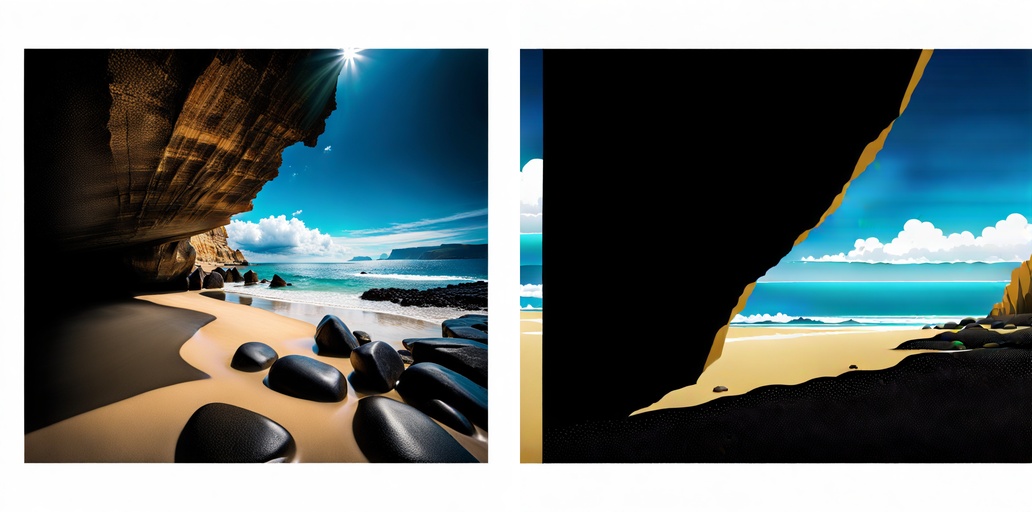


I see that these retain the frame. The first two images, at G02 and G04, are from a high perspective; it would have taken more words to specify where eye level is. The next one, G07, is about what I had in mind. The fourth image, at G11, is very good and G16 is almost as good, if a little exaggerated. After that things go downhill, and the frame is even breached.

PG25 has a very good look, with more diverse scenery than the PGv2 images. Now for the final series, the clock, beginning with PGv2.


I had something in mind when I wrote Prompt 4, which I'll get into below. Only the fourth image, with G5, appears as if it could be a real clock. All four of these have the "smaller dial for the second hand" concentric with the main dial. That's not what I had in mind, but I didn't specify "next to" or "below" the main dial. Now for SDXL and PG25.


It's pretty clear by now that, however many words one uses, the best range is usually from G07 to G16. The first two images are rather primitive, and the last two go wonky. I suppose the best is at G07.

PG25 has produced an entire clock, not just a dial in a frame. It still doesn't meet all the criteria. 

Here is what I had in mind, a clock with a moon dial and a separate second hand dial above the center. The day indicator is in the square window; numerous variations on showing days have been produced. This is a modern dial, in a style going back 150 years.


Had I specified "many dials" I might have expected something more like this, a French clock from the Louis XIV era. The "dial" at the top signals a speed control, typically adjusted for the seasons as temperature affected the length of the pendulum.

This last image is from a clock tower in Belgium. Clearly, the AI interpretation of "fantastical clock" is still somewhat limited.


Monday, March 04, 2024

The new artist on the block

 kw: ai art, generated art, artificial intelligence, simulated intelligence, comparisons, photo essays

A year and a half ago I began to use Dall-E2 as my "hired painter". A favorite pastime has been generating landscapes, particularly for use as Zoom backgrounds. This image is one I have used a lot:


The prompt for this was "A calming forest scene with wildflowers in a meadow, a stream, and a small pond, landscape painting." I don't recall how many times I ran the prompt, probably no more than twice, before I saw a 1024x1024 pixel square I liked, shown here. Then I outpainted (extended) it. The images Dall-E2 produces are PNG files, which are 5-7 times as large as a JPG saved with a 95% quality factor.

The result is 2624x1472 px, including the color bar used by Dall-E to identify its products. I cropped out a 2572x1447 portion, which is very close to the 16:9 aspect ratio needed for HD wallpaper. (As with any Blogger image, you can click on these to see them full size. The first image was reduced by about half from the original.)

Just a few days ago I got a notice from Bard, Google's version of ChatGPT, that its name was being changed to Gemini, and that it could now generate images. In the past few months I got access to a free version of Dall-E3 through Bing, and discovered another AI image program called Playground, that I've written about recently.

When I started to use Dall-E2 in 2022 I also tested the other two "legacy" AI art generators, MidJourney and Stable Diffusion. I found them more limited than DE2, and they are more expensive to use, so I ignored them since then. I recently took another look at MidJourney, but it runs as a Discord service, and I find Discord hard to use; it's also still too expensive. I'll mention more about Stable Diffusion in a moment.

I decided to test the products that I do use on the same prompt. Later I added another prompt, and we'll come to that.

First, I ran the "calming forest scene" prompt with Dall-E3 a few times, and picked the square shown here as the one most pleasing to me. DE3 doesn't yet do outpainting (at least not in the free version). Where the free version of Dall-E2 allows 15 free "Generate" steps per month, the free Bing version of Dall-E3 allows 15 per day. Running a prompt in Dall-E3 yields four square JPG images.

It is immediately clear that this image is more detailed, while retaining the look of a painting. Also, there is no color block or other "signature".

Both versions of Dall-E adhere pretty well to the prompt. Shorter prompts result in more variety. Prompt construction and editing become tools to negotiate with the product to get an image you want.

Secondly, I ran that prompt with Gemini. Since Gemini is also a chatbot, one must say, "Create a calming forest scene…", for example. You can ask Gemini for more suggestions, and get its help producing a prompt. Gemini also can produce four results per prompt, but sometimes it gives only two or three. At the moment, you cannot ask for human figures to be included; Google got in trouble when its early release of Gemini images yielded nearly all "minority" (non-Caucasian) faces.

The default size of Gemini images is 1536x1536, and they are JPG files. I reduced this one to 1024x1024 to compare with the other programs.

The level of detail is between that seen for Dall-E2 and Dall-E3. There is also a painterly look. I haven't tried asking for photographic detail.

Gemini claims that you can ask it to produce images of other sizes, between 256x256 to 1536x1536, and other ratios, such as 1024x576 (an HD ratio), but when I included size instructions in the prompt, I still always received 1536x1536 squares. Queried about this, Gemini said the capability was not yet there. I'd love to be able to produce 1920x1080 images from the get-go, but that has to wait.

Now, with Playground there are complications. Playground has a "side version" called Playground.AI that can produce images that are 1920x1080 and a wide variety of other sizes, but after doing about 20 prompts, a countdown reaches zero and you need to subscribe. I haven't seen whether more images become available after a month or whatever; I had other issues so I stopped using it. The "big version" at playgroundai.com has so many controls and options that it is hard to pick a single "default". For example, there are presently three Models, Stable Diffusion XL (they once included Stable Diffusion 1.5, but have dropped it), Playground v2, and Playground v2.5; there are also Samplers, which are mathematical methods used for the Diffusion operation, as many as 12 in the paid version and 8 in the free version; and there are dozens of Filters that affect the look of an image in ways ranging from subtle to dramatic; you can also turn on or off the random number generator used to produce a different Seed for each image. 

To simplify things for this experiment I let the Seed be random, I didn't use any Filters, and I used the following setups to produce five images, selected from groups of four under these conditions:

  1. SDXL (Stable Diffusion XL) with DPM2 Sampler
  2. SDXL with Euler a Sampler (Euler a is the default when you start to use Playground)
  3. PGv2 (Playground v2) with DPM2 Sampler
  4. PGv2 with Euler a Sampler
  5. PG25 (Playground v2.5), which doesn't use an explicit Sampler (of course there is a Sampler buried inside somewhere)

SDXL with DPM2. This and the following four images have quality and detail equal to DE3. This has a brighter look overall, including a little drama in the sky. I'll compare its siblings below with it.
SDXL with Euler a. Euler a in general has a softer look than DPM2.
PGv2 with DPM2. This is even brighter than SDXL, even a bit edgy, though the sky is more bland. I like the misty aspect of the background for all these, but this one is more pronounced.
PGv2 with Euler a. A little softer, as before, but this one also has a better sky.
PG25. This is even brighter than the others, almost too bright. All these five have a greater aesthetic quality than DE2 and Gemini, while matching DE3 in aesthetics though having a rather different feel.


They are all beautiful. But we are only half done here. All these art generators have the characteristic that they produce more widely diverse images when given very short prompts. Diverse not only from one product to the next, but from one image to the next in any product.

I happened to be reading a book about simulations in cosmology, so I decided to use a one word prompt: "Cosmology". This time I ran the prompt twice with each product. Here, for each product and variation I'll show all four responses to each issuance of the prompt. Dall-E2 is first:


These are screen shots of the image sets Dall-E2 produced. There's lots of variety from image to image, not just of subject matter but of style. Most of these have a focus, planets, galaxies, etc. The last image, at lower right, seems to have a wider scope, and most closely evokes "cosmology".

The next two sets of four are from Dall-E3, which displays its results in a block rather than a line, and with a black background:


Here, each set of four has a common theme, but the theme varies, as does the style, from one set to the next. Both sets have a galactic focus, but in the first set, two appear to host quasars.

Next is Gemini.


The first set is similar in concept to Dall-E2, with greater diversity. Its first image seems to best encapsulate "cosmology", having great scope. For the second set, Gemini produced only three images, all similar. One may click "Generate more", which I did, and it came up with two more images, one of which is shown here. The one not shown is different from all the others.

Now we turn to Playground, which produces groups up to four in a line. First, SDXL with DPM2 Sampler:


Six of these echo historical, pre-Enlightenment era, concepts of the Universe, in sundry ways. I'd say that the first image in the first set best illustrates the prompt. It seems to segue from Earth to infinity. Only the second image in the second set includes something vaguely like a galaxy.

Switching to the Euler a Sampler produced these:


Five of these bear some resemblance to the six "historical" images above, but the allover feel of these is different. None of these really fit the scope of the prompt.

Next we'll see PGv2 with the DPM2 Sampler:


These have less overall variety. The last image of the eight seems to go the farthest "out there". It's curious that PGv2 put people in nearly every image.

Now for the switch to the Euler a Sampler:


Wow! The first of the images would make a great bookplate. The rest are similar to the sets with the DPM2 Sampler, with the same tendency to include a person, if not persons. The third image in the second set is the closest of these eight to the "cosmology" concept, as I envision it.

Finally, let's see what PG25 does:


I still see a person or two, but all of these better approach the prompt in concept, with the eighth perhaps being the best. It is interesting that, with the one exception noted above, the images produced by Playground don't show things that look like galaxies. 

I see this collections of images as a catalog of "looks" I can refer to when choosing the way I want a generated image to appear. It is evident that Playground has the greatest variety of ways it can respond to a prompt, but that each of the other three art engines has something unique to offer.

Thursday, February 29, 2024

Yes, she is funny

 kw: book reviews, nonfiction, humor, comedians, sociology

At my grandmother's funeral, many years ago, I was with my then-fiancée, in the second row behind my parents. At some point, someone coming in had a minor mishap—nearly tripping—and my fiancée laughed. She laughed rather loudly, and then stifled it. And turned very red. I just held her hand and we waited it out. I was glad for her laughter, really. It calmed me somehow.

Fast-forward nearly thirty years. I had a very major cancer operation and came home looking like a corpse. Being able to do nearly nothing, I alternated between reading, watching inane TV, eating and sleeping. That Sunday evening I happened to turn on ABC to watch, for the first time ever, America's Funniest Home Videos. Tom Bergeron was the host. I laughed my fool head off! I felt great for the first time in a long time. I watched that show faithfully for the next decade or so. I don't credit the show for my amazing survival (nobody lives 20+ years after having what I had, but I did). But it sure helped. I called it my Laugh Therapy. It has been a few years since I had time to watch AFV, or anything else, for that matter. I lead an active life. But from what I hear, a lot of popular themes from the show in the early 2000's aren't used any more. Too many "professional offended people" complained.

One would think that the country (and most of the West) is overrun by the always-offended folk who are bigger buzz kills than the dourest of Puritans in Colonial America. They don't like it when anyone laughs at anything...unless it is them doing the laughing, mostly as Schadenfreude against conservatives' embarrassment. However, consider that, less than a quarter of Americans use X/Twitter, and the noisy, vocal trolls are just a percent of that. That is what drives Cancel Culture, 1/4% of the country. Talk about the tail wagging the dog! But we should expect the tail to be in a bad mood, it's right next to the s**thole!

The best defense against humorless idiots (most especially the Woke, in my view) is to laugh them out of town. Kat Timpf, for one, is doing just that. Her new book, You Can't Joke About That: Why Everything is Funny, and We're All in This Together, is a big breath of fresh air to me and to anyone who just wishes folks would loosen up a little. So what does she think is funny? It's better to ask, what doesn't she joke about? The list is very, very short. Maybe nonexistent. Start with the most taboo subjects: disease and death. Go on from there.

Kat Timpf is a comedian. Her current gig is Gutfeld on FOX. She doesn't just do comedy. She writes (writing lots of columns is good practice for writing a book) just as much, often her own soufflé of libertarianism and satire. Particularly in the political arena, she's an equal-opportunity abuser.

How's this for dark humor. Riffing on "the Quarantine" of 2020, upon hearing "Anne Frank had to hide in an attic…" a few too many times: "Pioneers probably didn't have time to notice the little annoying things about their pioneer family, because they had that exhausting, dangerous cross-country journey to distract them. Plus, if you were a chick, you were just constantly getting pregnant and giving birth, and then some of the kids you had already given birth to would sometimes die along the way before you reached your horse-driven destination. So no, they probably were not noticing how much their husbands' whistling bothered them because the were too busy discussing whether or not they should, I don't know, eat the body of the kid that just died in order to have the strength to pop out the next one." (pp39-40). That is from the chapter "No one wants to hear you whine (unless it's funny)". 

This is a serious book, under the satire. She is making a plea for allowing humor to work its magic as a universal releaser-of-really-bad-feelings. As it happens, comedians are the second-biggest target of the humorless Wokemeisters, right after Christians. As a lapsed Catholic, perhaps Kat ought to be glad she doesn't have Christian faith just now. Christian comedians are doubly Cancelled these days.

Bottom line: She is in favor of the freest of free-speech environments possible. Then, her final chapter consists of instructions on when not to speak: when the police want you to. It is three pages of instruction on handling several scenarios. Not a joke in the chapter, because police, by the nature of their job, need to be entirely humorless. Of course, when you're with a cop friend off duty, joke around all you like. But not whenever there's a chance you are under suspicion.

Kat is, as generations X and later are, pretty free with her use of expletives. It seems that, for all the generations subsequent to mine, various derivatives of the F word are the general adjectives of choice, and the S word is the generalized noun of choice. I watched a few of her routines that are on YouTube; she rarely dropped either bomb, but she did occasionally do so. I am an old-school entertainer (think of Red Skelton or Roy Rogers): in the public arena we have a choice, to ennoble our audience or to debase them. Blue humor causes snickers, not honest laughter. Go watch an old video of Red Skelton doing a Clem Kadiddlehopper routine, or Gertrude and Heathcliff the seagulls. You'll laugh with tears until you get a smile-ache. Not a cuss word from end to end. Are you an entertainer? Leave your audience feeling better about themselves because they were with you. (But if there is a Woke heckler in the crowd, that fool you want to drive out in pelting shame! It can be done without cussing. The rest of the audience will be thankful.)

Tuesday, February 27, 2024

Learning Playground Samplers

 kw: artificial intelligence, automatic art, evaluations, instructions, photo essays

The learning curve for the Playground AI art generator is a bit steeper than it is for Dall-E. But the level of control is amazing. A couple of weeks ago I wrote about testing Playground's Filters. Here I introduce what are called Samplers. They seem to work by emphasizing different aspects of the prompt. The web site has a video available that explains Samplers, but the examples are all based on the description of a suit of armor. I don't try to illustrate video games; I like landscapes, both semi-real and sci-fi imaginary, and also domestic scenes. The prompt for all the images shown here is:

Several customers in various places within a very well-stocked music and musical instrument store

I also used the same Seed value for all: 618732496. This was chosen after generating several images using random Seeds; I picked one that made an image I liked, using the Playground v2 Model and the default Sampler, Euler a, which means "Euler ancestral". I don't know how the Sampler names arise, but I do know that Euler was a pioneer of linear algebra, which is used very much by AI software.

Eight Samplers are available to free users of Playground. The learning video has a table of certain characteristics, which I clipped:

The video was made a couple of years ago, so the list of Samplers has changed. The present list of free Samplers is, in the order I used them:

  1. Euler a (a="ancestral") 
  2. DPM++ 2M Karras (I abbreviated it in the file names) 
  3. DDIM
  4. PNDM (which I entered as PDNM in the file names)
  5. Euler
  6. DMP2
  7. DMP2 a (a="ancestral") 
  8. LMS 
The Heun Sampler is now among those in the paid-only version.

The ones marked "Varied Output" in the diagram tend to hew more closely to the prompt, but can diverge from it widely. The others, "Similar Output" are similar to one another. I just used one prompt to make all 16 images, so I'll have a different impression, as we'll see.

I don't have a good handle on the difference between "fast" and "slow" for these. Free users' generation times range from half a minute to several minutes to "we can't do that now, too busy".

I used each Sampler with both the SDXL and PGv2 Models. The image sets are screen shots from Explorer windows, so they show the file names I used to keep track of everything. I present four images, two pairs, in each portion below. These were generated with a different aspect ratio: 1024x576, or 16:9 like HDTV. Forthwith:


My first impression is that the PGv2 Model is closer to what I had in mind than SDXL. With both Models DPM-Karras provides more "stuff" in the music store than Euler a.


With both Models, DDIM and PNDM are very similar to one another, only differing in small details. These are quite different from the first two Samplers.


These two Samplers are most similar to DPM-Karras. In the two images on the left, DMP2 has produced some funky mini-guitars (they look almost like bent violins) above the guy on the right, and with Euler the customer on the left is female.


Now we see that DPM2 a is like Euler a in being "more different" than the others, while LMS is very similar to Euler and a few others.

Conclusions at this point:

  • Euler leads a cluster that includes DPM++ 2M Karras (abbreviated in file names) , DMP2, and LMS in having a certain "look" to the image, with either Model.
  • DPM2 a emptied the room of occupants with SDXL, but lined up four of them with PGv2. DPM2 a also added a grand piano. This earns it a "Varied Output" designation from me.
  • DDIM and PNDM form another cluster, with either Model, that is distinct from all the other Samplers' output.
  • Euler a produced a unique look, with some similarities to the Euler cluster.

In the future I hope to repeat this series using a landscape-generating prompt, perhaps one with an "alien city" in the scene. The reason I changed the aspect ratio from the default square (1024x1024) is that, using an upscaler such as Upscayl I can double the size of an image, which also doubles the detail density, to make a 2048x1152 image, which works well as wallpaper on HD (1920x1080) screens. No outpainting needed: I just need to "negotiate" with Playground until I get an image I like all at once.

Friday, February 23, 2024

Final Fourteen

 kw: story reviews, anthologies, literature, fiction, poetry

In the past couple of days, I've finished the last fourteen pieces in 2024 Pushcart Prize XLVIII: Best of the Small Presses, edited by Bill Henderson and others. There were two (of six) bits of verse I'm sorry I read, and four others that were "OK". One was clearly well-written prose broken into a "poem" in lines of nearly equal visible length; otherwise unremarkable. Another is worth a short remark:

"Blue" by Erin Wilson is short, and very sad (gut-punch sad), and I dare not say more because it's too easy to spoil.

Three of the prose pieces are worth mentioning:

  • "Dear Damage" by Ashley Marie Farmer – Apparently a true story, of an attempted (and failed) murder-suicide brought on by unimaginable pain. Where's a Kevorkian when you need one? Though I am a Christian, I understand, and sympathize with, the need to determinedly end one's own life in certain circumstances.
  • "Dreaming of Water With Tiger Salamanders" – This is also nonfiction. Most of it is an essay compounded of equal parts pandemic panic and climate panic, in a setting of "development" of land that ought not be developed. The author (or narrator) is the token biologist who must accompany a development crew, by California law. The two panics are overhyped. On the other hand, I am in favor of strong laws forbidding "development" of arable land (with a Capital penalty) and forbidding destruction of habitat for vulnerable species (slightly-less-than-Capital).
  • "Black Land Matters: Climate Solutions in Black Agrarianism" by Leah Penniman – An excellent essay on the efficacy of traditional soil enrichment. The historical flow as I have observed it is sadly almost predictable: in recent years it has been determined that the Amazon rainforest is not a "jungle" but a now-neglected (and much abused) garden, which includes huge areas enriched by biochar and river-bottom muck to make it more fertile. It is only now becoming clear that significant parts of the African continent have a similar history of cultivation. I learned of the impressive usefulness of biochar when I edited a PhD dissertation for a friend who did research with biochar. This essay focuses on many traditional practices, and on their continuation by American Blacks, where they have been permitted to own land. A formative experience in my own young life was a visit to Malabar Farm in Ohio, where conservation tillage was "rediscovered" a millennium after the fact, as it happens.

There were several other stories that were good reading, but rather thin on ideas. The four noted above have strong ideas, and I am an idea guy. I read, not just for escape, but to see what people are thinking, to glean good ideas.

I've finished the Pushcart volume. At 462 pages, it took me a while. Mostly, it was well worth it.


Monday, February 19, 2024

Four out of five — Not so bad

 kw: story reviews, anthologies, literature, fiction, poetry

In the past day or so I've had time to read only five pieces in 2024 Pushcart Prize XLVIII: Best of the Small Presses, edited by Bill Henderson and others. I'll ignore one of the five. The others:

  • "A Most Generous Offer" by Joy Guo – It took a while to see where this story was going. Superficially, it's about an inherited apartment. Really, lack of communication risks loss of everything.
  • "The Blob" by Molly Gallentine – Flashing forward and back, with the old film The Blob as a metaphor for climate anxiety, while the protagonists attempts artistic climate activism. The image is the beginning of the movie theater scene from the 1958 film.
  • "Marmalade" by Fred D'Aguiar – In the aftermath of a breakup, the kids are hurt the most. Of many treatments on this old theme, this is one of the best.
  • "Toward a Unified Theory" by Wayne Miller – It's hard to say if it is intended to be one poem: very short bits of free verse with a strong TITLE every 4-8 lines, and lots of white space. No relationship to the overall title that I can discern.

Sometimes, being puzzled is as valuable as being gratified.


Saturday, February 17, 2024

Spiders from Hong Kong outrun those from Singapore

kw: blogging, spiders, spider scanning


Just when I'd got used to seeing another extra 400-600 views per day, just from Singapore, today I saw this, for the past 24 hours:


Here, the usual "Singapore plus everyone else" is the low terrain on either side of the "mountain". Naturally, I had to see if this is also Singapore. As it happens:


No! Views from Singapore are indeed many, at 555 for the day, but Hong Kong, in an eight-hour spree, racked up 5,225 views, or about 650 per hour. Considering that the total number of posts in this blog is about 2,500, I suspect that my blog is one of perhaps millions of blogs that are being gulped down wholesale to train AI text models such as ChatGPT and, where images and text occur together, diffusion models such as DALL•E or Playground. I checked into the top posts for the past day:


Everything below the first ten posts has been viewed no more than twice in the past 24 hours. The "text vacuuming" going on is unfocused. At this point, I don't what more to conclude. It would be interesting to learn if other bloggers are experiencing new and unusual numbers of hits, most likely from automated text vacuums.

Friday, February 16, 2024

Leaning into the Apocalypse

 kw: story reviews, anthologies, literature, fiction, poetry, essays

The eight items I read today in 2024 Pushcart Prize XLVIII: Best of the Small Presses, edited by Bill Henderson and others, are evenly matched, four in verse and four stories/essays (sometimes it's hard to tell the difference). I'll touch on most of them.

"Memorials" by Tyler Sones – Remembering the localized apocalypses in the author's memory, one near Waco, Texas and the other at Ruby Ridge, in Idaho. The word "apocalypse" just means "taking off the cover", and by extension "revelation". It is, by itself, the title of the last book of the Bible. The content of the apostle John's visions has colored our understanding of the term. The author describes a fiercely Bible-centered culture in which the two attacked homesteads were embedded.

The image was produced using Playground AI; a milder view than what is warranted by the text, but a more appropriate prompt would have been rejected.

The verse "Dawn 2040" by Jorie Graham is intended to evoke a post-apocalyptic scene, set just sixteen years in the future (perhaps 17-18 when the piece was written). Overblown, in my view.

"Fight Week" by Laura Van Den Berg – A young woman, a prize fighter, is drawn into a drama and inadvertently does a good deed. It leads to a step change in her fighting skills.

    I'll limn three other pieces with the two words that came to mind as I finished each:

    • "Nomad Palindrome" – Extended palindrome. [At 87 words, one of the longest I've encountered]
    • "Jorie, Jr" by Michael Czyzniejewski – Superman metaphor. [there's no relationship with the author of "Dawn 2040"...I think]
    • "The Emperor Concerto" by Julie Hecht – Musical rumination.


    Thursday, February 15, 2024

    Four hits in a row!

     kw: story reviews, anthologies, literature, fiction, poetry

    In the past 24 hours I read just four pieces in 2024 Pushcart Prize XLVIII: Best of the Small Presses, edited by Bill Henderson and others. Surprise, I liked all four, so I'll give all four "the treatment".


    "Two Breaths" by Christina Rivera Cogswell – A wife and husband scuba dive at night to observe Manta rays off Kailua-Kona in Hawaii. The Hawaiian word for the Manta, hahalua, means "two breaths". The woman cannot get her mind off her two children, asleep at home. Much of the story is her stream of consciousness as she copes with near-panic, something she didn't experience before becoming a mother (mothers reading the story will sympathize). The image was created using Playground AI.


    "It is Once Again the Season of Corn" by Onyekachi Hoh – Thirteen couplets of free verse, full of observations and wishes. One of these, "let all the rifles become violins…" evoked the image. The final wish is for an orchestra. The image was created using Dall-E3, which threw a horse into the image I liked most.


    "The Magician's Assistant" by Kelsey Bryan-Zwick – Four quatrains of free verse: after the act is over and the magician has sawn her in half, the assistant sews herself back together. Her thought near the end is poignant: "the applause is for his miracle and not hers". I also used Dall-E3 to produce this image. Dall-E3 didn't like the first prompt I tried, "too violent", so a more innocuous one produced this image.


    "Tomorrows" by Lakiesha Carr – A slot machine addict, coping as best she can. It's no surprise that her familial feeling for fellow slots players exceeds all others. At least she has an income. This image was created using Playground AI. Note that we can control the aspect ratio of PG-AI images.

    At this point I am just past halfway done with the volume.