Monday, August 14, 2006

More variety than a field of snowflakes

kw: book reviews, nonfiction, psychology, sociology, human personality

I've heard debates over Nature versus Nurture all my life. Everyone has, though mostly we tune them out. Even if we're interested, the interest seldom lasts long. I long ago concluded "it's both," not as a copout, but from observation. However, I didn't think much about what "Nurture" means.

Almost a decade ago, I wrote a song that contains these lines in a chorus: "Is it nature, is it nurture?/Why should anybody care?/We are dealt the cards, but our own hand we play..." Yet in the song, I celebrated Nature (genetic endowment) more than Nurture, and assumed that Nurture was also mainly a family affair. I wrote it in my fifties, after thinking long and hard about the way I'd "become my Father" in many ways, but quite a different person in others, and not just because in those ways I had instead become my Mother. Some of "what is Me" seems to be due to neither of them, nor any ancestor. Where and how did I come by some of these things? It was a mystery to me.

Judith Rich Harris may have the key that unlocks such a mystery. She studied psychology, including at Harvard, from which she was eventually expelled as being too much the synthesist...they like specialization there. She became an independent investigator, which makes her right after my own heart. She has studied much more than psychology over the years, which I believe gives her unique insight into humanness. Her recent book No Two Alike: Human Nature and Human Individuality presents her key, or rather, three synergistic keys.

Having at present a teenage son, I've been forced to the conclusion that most of who he is, that is, his personality, was built not my my wife and me but by the world around him and his reaction to it. I don't mean just his peer group—naturally, I think him peerless, and in many ways, he is so capable that true peers are hard to find. No, I mean everyone: schoolmates, church friends, teachers, coaches, and family members (definitely in the minority). His case is not like mine; my father's oldest friends, as they get senile, mistake me for a younger him. Such will never happen with my son. My wife and I are so very different, and he is such a smooth blend of the two—in those things he does have from us—that he cannot resemble either of us very closely.

I'll cut to the chase, but you shouldn't think this will "spoil it" for you. Nobody could do that; Ms Harris writes too well, bringing too much detail, for a mere thousand-word review to steal her thunder!

Author Harris first explains and then disposes of the common list of "suspects," commonly thought to produce human personality. The vast majority of studies have focused on degrees of similarity: between identical twins, ordinary siblings, cousins, and non-relatives, including step-siblings raised together. Few have focused on differences, and nearly none have focused on Harris's key question: Why are identical twins so different?

Think about it. Everyone knows a few pairs of identical twins. Some pairs go to great lengths to seem similar, others to great lengths to be different. Yet, once you get to know them, you can always tell them apart, though you may occasionally forget which name goes with which.

A certain sub-genre of science fiction literature abounds with clones. (Definition: a clone is the collection of individual entities that share the identical geotype. Thus a pair of identical twins is one clone. The four or eight calves produced by splitting a single embryo are one clone. The sheep Dolly and the mature sheep from whose cell she was developed are one clone, though in this case, the two were of different ages; both have died). Anyway, these sci-fi clones typically have almost magical qualities, frequently of the telepathic sort. In reality, there is at least one known human four-member clone, a set of identical quadruplets...there is nothing magical about them. They are four kids who happen to look a lot alike and have many similar tastes and habits, and a very robust collection of tastes and habits that are not shared!

Judy Harris has discerned three more likely suspects, that she calls systems. Each appears to be a mental organ with a specific function. This is similar to our language organ and our face-recognition organ. People whose face-recognition organ is damaged (it is in a particular part of the brain) cannot learn to recognize faces any quicker than they learn to recognize a car key or the house they live in. If you show them a picture of a familiar face, either right-side up or upside-down, they take the same time to state who it is. For most of us, however, recognition of an upside-down picture of someone's face takes much longer. The "face" organ is tuned to people in "ordinary" orientation, not hanging by their heels.

Each System has a set of skills, and each provides its own motivation so that a person willingly does the work to develop accordingly. We are self-motivated to produce a personality that we feel will best serve our interests. The three systems observe differing things, so they sometimes work at cross-purposes. We have plenty of reasons for the inner conflict we often feel!

The first of the three is the Relationship System. It makes use of the Recognition organ, and builds up a body of knowledge about every person we've taken note of, even via hearsay. It strives to build a predictive model of a person, so we'll know how they react, and how we ought to act with them. It uses what it has, which is why first impressions are so important. It tries mightily to determine what distinguishes each indivitual from the mass of "others" yet unknown; thus it homes in on the small differences we notice, even between identical twins. Yet it also looks for patterns in each individual's behavior, so as to be better at its predictions. So, it becomes very skillful at determining a certain kind of sameness (for one person) and another kind of distinctiveness (between any person and all others).

The second of the three is the Socialization System. We seek to belong. When we have few options, we do our best to belong to the group in which we find ourselves. The desire to conform is strong. Yet, once we venture outside the home and have a group of playmates and later schoolmates, we automatically belong to at least two groups, and probably several. Our family is but one of those groups, and we are definitely socialized to certain behavior with our family members. But it turns out that our in-home socialization has almost nothing to do with the other groups to which we belong.

The very active teens (high schoolers) with whom my son spends most of his time belong to several groups: as many as three sports teams; two, three, four or more musical ensembles (stage band, marching band, jazz band, city or county performing band, rock group, private jazz ensemble...); several academic organizations (Math League, Science Olympiad, Drama club...); a church; a church youth group; plus the AP and IB students, a quarter of the student body, form a loose-knit group with specific academic and societal goals. For my son, the number of his "friends" in this gaggle of groups numbers about two hundred. Each group has different "bylaws" or "running rules", and thus a child is differently socialized by each group. My kid is like ten different people, depending on whom he's with!

Dwell on that a moment: other than a few basic habits, the effect of parental training is completely overwhelmed by the socialization requirements of such a life. My conclusion, which I think mirror's Harris's: kids only turn out like their parents if all the groups to which they belong are a lot like their parents. Only this can explain the relative success of the Amish and similar groups, in raising kids who "stick with the program." No other choices are offered. Thus also the impulse of strongly religious parents to put their children into religious schools, of the appropriate stripe, of course! Parents can strongly influence their children's personalities, but only by controlling the entire environment. If home and school are much different, the parents will learn how little influence they truly have.

Actually, there is more to it than this. We have one system to go: the Status System. This system uses information from the other two, over a longer period, to gain status or advantage within the groups we choose to stick with (or that we can't escape). This system is the strongest discriminator; it makes our differences more different, in an effort to carve out a niche of greater value. The Relationship System collects all the information about differences between all the people we know, and many people we've heard about. The Socialization System averages the information for those in a group, so we tend to conform to group norms. But the Status System uses the distinctions between ourselves and others to find areas in which we alone excel, so as to dominate, or gain status, or at least earn some measure of respect, in each group.

No matter how similar one twin is to her twin, there must be some differences, just from the effects of random events. Everyone who knows those twins will put them on distinct "pages" of their Relationship memory, and will thus treat one a little different from the other. Each twin, reacting to others' reaction to them, will emphasize any difference that seems to confer an advantage. Thus, though both are likely socialize to the same group, each will specialize within it, so both are individually respected for unique characteristics.

As it turns out, by the time a pair of twins has reached adulthood, they are about equally balanced between similarities and differences. They may share many things (tastes, habits, attitudes...), but they will differ in about the same number of things. They are more similar than nontwin siblings, who typically share only about a quarter of their tastes or attitudes.

Our desire to be "loved for myself" drives much of our personality development, particularly in Western cultures in which individuality is more valued. Yet significant events can have great effects also. I don't know what I'd be like if I'd never experienced receiving Jesus. I might have many characteristics I now have, but I'd probably be very ignorant of biblical and theological subjects, and would not have gained anything from certain spiritual people I've spent much time with. I know that in many ways I am no different than I was six years ago, when I was dying of cancer. But some things are quite different. People who've known me all along can see the difference. Some folks like it, and most don't care. A few liked me better before, and I've lost one formerly close friend as a result.

Nobody who specialized in any one psychological or sociological discipline could have produced such a synthesis. Judy Harris is just the right sort of person to bring it all together, so we can see some of the "why" and "how" of the puzzles we all face.

Wednesday, August 09, 2006

Kiddie Kommander

kw: book reviews, science fiction, political fiction, child prodigies, gifted children, morality plays

I just re-read Orson Scott Card's 1985 classic Ender's Game, based on a 1977 novelette by the same name. This must be the third time. The book has sufficient depth that I find much I forgot I'd read before with each re-reading.

While Ender's Game wasn't the first, it has become the prototype "Young gaming expert defeats alien foe—unknowingly" story. It is also a morality play. (If you haven't read it, I'm about to spoil it for you. Skip a paragraph to avoid pollution!) When Ender (Andrew Wiggin) meets the last surviving "bugger" Queen, who communicates telepathically, he finds the alien species he destroyed, planet and all, hadn't realized they were at war until the end of the "Second Bugger War," upon which they retreated to their home system, hoping to be left alone. Thus, Ender has become the first to commit Xenocide, and in the sequels he attempts to atone by finding a planet for the Queen to colonize.

Ender is a moral child: though capable of ruthless violence he feels neurotically guilty over it. He is thus the combination of his brilliant siblings, the ruthless, amoral Peter and the loving, empathetic-but-practical Valentine. In this he is like Shedemai in Card's Homecoming series. The original protagonist of the early books, Nafai, is the most overly-good person in literature that I've read. He becomes a partial Christ figure in the fourth Homecoming book, altruistic to a near-fatal fault, even though he wears the mystical Cloak of the Starmaster, that confers invincibility. He is convinced by the Oversoul (a computer that watches over humanity) to yield the Cloak to Shedemai, who is nearly as well-intentioned as Nafai, but just ruthless enough not to he overborne by the evil older brother Elemak. Shedemai becomes the heroine of the last book.

In a sense, if the story had a happier ending, it would make great Disney fare: abused but talented child escapes family, but suffers even greater abuses (horrendous ones, actually) at the hands of his rescuers, finally triumphs. This is a story of manipulation taken to as great an exteme as one can, and still keep a reader in sufficient "suspense of disbelief" to continue reading.

Everything I've read by Card (he's prolific: Orson Scott Card Bibliography) is an exploration of the limits of morality in a tragic universe. Card is a Mormon...I was going to say "serious Mormon" but that's redundancy. Mormonism is a vigorous and rigorous faith, as mine is, so few adult Mormons are lukewarm. You're either active or absent. He once stated that the Homecoming series is a recasting of the migration stories in the Book of Mormon. Thus, he explores nobility and altruism, and their opposites, in all his fiction. It is what is in him.

In that, I like him very much. I care not about the difference in beliefs. I find all too few writers care a whit about appealing to their readers' nobility, and the majority seem entirely the opposite, making sales by appealing to people's taste for vice. Writers like Card that explore nobility, sacrifice, and empathy tend more to ennoble us.

Tuesday, August 08, 2006

Was Humpty really a cannon?

kw: book reviews, nonfiction, children's verse, history

Almost from birth, we hear rhymes and ditties of all sorts. Many are so-called "nursery rhymes". Later on, we may hear or read that many of these have a hidden meaning: how "Ring around the rosy" describes the effects of plague, or that "Contrary Mary" was good old "bloody Mary", perhaps that Humpty Dumpty was really a cannon that blew up. Or not...later still, everything we thought we knew about hidden meanings seems to get more hidden and more ambiguous. Most folks quit paying attention, even when they recite the rhymes for their own grandkids.

Many popular rhymes of past generations were riddles. Some were explicitly so:

When I was walking to St. Ives
I met a man with seven wives.
Each wife had seven sacks.
Each sack had seven cats.
Each cat had seven kits.
Kits, cats, sacks, wives,
How many were walking to St. Ives?

The answer is either one (myself) or nine (me + man + wives), assuming in the latter case this large family was walking! If you respond with a number greater than 2,400, you've counted a lot of creatures not walking!!

Here's a more typical example:

Little Nanny Etticoat,
In a white petticoat,
And a red nose;
The longer she stands,
The shorter she grows.

Answer: a Candle. Now, for the MOST familiar rhyming riddle of my childhood:

Humpty Dumpty sat on a wall.
Humpty Dumpty had a great fall.
All the king's horses and all the king's men
Couldn't put Humpty together again.

Answer: an Egg...that is, until I was told there was a great cannon in Colchester that blew up about 1645. However, as Chris Roberts reports in Heavy Words Lightly Thrown: The Reason Behind the Rhyme, the egg version predates the cannon story by centuries. A humpty-dumpty was an ale-and-brandy drink, and was also used to refer a clumsy oaf (of either sex), presumably under its influence. For children, the many falls of the drunk (and subsequent cracked skulls) were sanitized as the dreaded fall of an egg.

Roberts, a librarian, has put together forty nursery rhymes that are almost universally known among English speakers everywhere. Though one of the most "very British" of Brits, he has included a few items of American descent, including Yankee Doodle.

Yankee Doodle's is a lovely story of a slur being turned to a taunt by those slurred, a simpler version of the conversion of "God Save our Queen" into "Let Freedom Ring (America)".

It ought to be no surprise that many childhood ditties are, often openly, steeped in cruelty and sex. Prior to the 20th Century, few children escaped exposure to the full range of human experience. Kids slept in the same beds as their parents (regardless of what the parents were up to), went to the taverns and dogfights with them (and drank the ale and placed bets), and on occasion observed public hangings and the rotting corpses of those left up after the more heinous crimes. In much of the world, little has changed. Less than 1/10th of humanity is "civilized" to the extent that "certain things" are hidden from youngsters.

That last makes me wonder: in cultures where kids aren't kept so "innocent", do they create as many nursery rhymes? Probably, even more so. They need SOME way to express the overpowering things going on around them. But for our at-least-partly sanitized culture, we need a Chris Roberts to tell us what we were talking about, singing Baa Baa Black Sheep or Jack and Jill.

Monday, August 07, 2006

Invertebrate geometer - Mystery Solved

kw: puzzles, geometry, flowers, solutions

In a post on August 2, 2006, I showed a picture of a Phlox flower that looked like a propellor, each petal was chewed on one side only. This image is the clue to solving why a critter (probably a caterpillar) would favor only the left side of each petal.

The opened flower is chewed in the same propellor pattern. The bud next to it, about a quarter opened, lets us see what happened. When a bud gets partway open, and it is still mostly dark, the caterpillar eats the exposed part of each petal quickly, then flees as the sun rises.

The geometric "knowledge" thus resides in the flower bud's DNA, not in the eater.

The most beautiful tree: Sakura

kw: book reviews, nonfiction, photography, sakura, flowering cherry

In Cherry Blossoms Jake Rajs presents about 150 images of flowering cherry trees in the U.S., primarily in Washington, D.C. and New York City, which has several major botanical gardens and arboreta. To minimize copyright concerns, I've excerpted only four images from the book, and supplemented with three of my own from Japan. To me, the Sakura is the loveliest of trees.

I took my family to Japan to visit relatives several times, and in 1992, we went at Sakura time, thei first week of April. This image was taken at Odawara castle, across the moat with its arched bridge, deep in shadow and varely visible below the profusely blossoming trees.

Later that week we were in Gifu, an agricultural area. Though I saw a few Sakura bonsai, none were close enough to photograph. This little Momo (flowering peach) was right on the doorstep. This is one of my favorite photos from that trip.

I should say as an aside that I've seen more bonsai in the U.S. than in Japan. Where a Japanese family may have one or two, both Japanese and non-Japahese bonsai fanciers in the U.S. tend to have many. My brother-in-law had perhaps two hundred.

I suppose it relates to the American (and British) passion for making collections. Older cultures live among antiquities. Americans make collections of other folks' old stuff.

We also visited an art center at Narikawa. This image is scanned from a post card I bought there. The artist makes huge canvases, six to eight feet high by as long as the wall you plan to use. He uses a stenciling technique to put the thousands of flowers on the tree. Indeed, his paintings are produced in a multilayered way, and have fractal characteristics.

Sakura blossoms may be single or double. To my eye, the "double" ones seem to be at least quadruple. The single blossom is usually faintly pink, though an individual tree may be nearly white, or more richly pink. This is the traditional Sakura.

(This image and those that follow are from Rajs's book.)

Double blossoms are darker in color. A tree with white double blossoms is more likely to be a peach, and one with a richer purplish pink than shown here, it is probably a plum. Japan has quite a variety of very lovely early Spring flowering trees.

This is one of several photos from the book that shows the color contrast between various Sakura varieties. The Brooklyn Botanic Gardens staff tend to juxtapose contrasting varieties, while the Japanese habit is to plant masses of the same variety.

The afternoon light makes the Washington Monument and the Sakura trees nearby take on a golden hue.

If I have any quibble with the book, it is that the pages are only 5"x7" in size (13x18cm). A coffee-table book would be excessive, but a nice octavo volume would be quite stunning.

Friday, August 04, 2006

AI versus AI

kw: book reviews, mysteries, science fiction, artificial intelligence

Delete All Suspects by Donna Andrews is classified as a Mystery novel. The author's use of AIPs, or Artificially Intelligent Personalities, puts the book also in the Sci Fi realm.

Let me begin with a quibble. The principal AIP involved here, named Turing Hopper (AKA Alan Grace...could you guess?), is just a bit too human. There is a bit of soliloquy in Turing's thoughts (italic text in the narrative) about AIP limitations and inability to understand many human concerns. However, Turing comes across as a rather nerdy young woman. I don't recall if the human characters in the story attribute a gender to Turing, but this AIP has a woman's voice and sensibilities. Of course, the author can most convincingly speak in her own gender space...and I get the idea that Ms Andrews would like to be reincarnated as Turing Hopper (This is analogous to Isaac Asimov's clear sympathy and wishful identification with his deified R. Daneel Olivaw).

Be that as it may, I've sometimes wondered how a person would function if the bodily component of mind, the endocrine system, were absent. Perhaps one day someone will experience a corporectomy (the subjective side of a beheading) and be attached to sufficient life support for the head to live on. Without the body and its mind-bending glands attached, could the mind even work? Would you get the detached head seen in some Sci Fi stories, continuing with little change, or would you get the rapid development of extreme psychosis, or simply "mind death" (catatonic coma)? I vote for the latter. The body has too much to do with the mind. In particular, most emotions require chemical support from various bodily organs located far from the head—though you'd have to cut pretty high to leave out the thyroid and parathyroids. Turing experiences guilt, sadness, elation, foreboding, and dread. Unlikely, in my view.

OK, putting that aside, we have a very engaging tale of digital skullduggery and non-digital murder. There is the fear of digital murder (deletion...), and a modified, handicapped copy of Turing, whom she thinks of as her sister T2, figures largely in a parallel plot. This could lay the ground for a series of sequels, and I hope this is what the author intends (Note: her title list hints that this book is already a sequel).

Turing in this book, and her AIP friend KingFischer, serve as the perfect investigator's aides: lightning-fast with any kind of computer work, including "white hat" hacking and digital surveillance. They can do many things at once. Much dramatic tension revolves around them doing very many things at once.

There are at least two, or probably three, murders, done to keep the covers on some shady and illegal enterprises being performed using computers managed by a young basement computer wizard named Eddie. Sad to say, his only appearance opens the book, and he does not play any part in the plot thereafter, except as the missing hub of a collapsing wheel. But that's often the way life is. You don't get to rescue everyone. And the private detective Tim and his colleagues are shown much more realistically than in most PI stories: secure in what they do well, insecure when they don't understand, very human and likeable. Not for this author is the patient, infinitely competent Hercule Poirot, or a hard-boiled bulldozer like Sam Spade.

The side thread of the story, including hints of other AIPs besides Turing and KingFischer and the theft and attempted suborning of T2, opens up the interesting question: if genuine AIPs come into being at some time, will we let them exist?

Thursday, August 03, 2006

Invertebrate geometer?

kw: puzzles, curiosity, geometry, flowers


I took this picture the morning of August 1, 2006. Our little Fall Phlox plant produces a flower or two daily; a bud is visible behind this chewed flower. Each afternoon, I see the new flower(s) in pristine beauty. The next morning, they are variously chewed.

This particular morning some fastidious creature—probably some kind of caterpillar—has eaten only the left half of each petal. The other flower, on the other side of the plant, was chewed in a similar pattern.

In the past, I've seen the ends of the petals removed, or two of the five completely eaten. A curious circumstance, this one!

Wednesday, August 02, 2006

Rediscovering why I didn't read all the "Dune" books

kw: book reviews, science fiction, political fiction, fantasy

I've read just four chapters, of 86, in Timeweb, the first of a new series by Brian Herbert. I've decided to go no further. Reading the last page confirmed my decision. I read Dune by his father Frank Herbert, and a small part of Dune Messiah. The inter- and intra-family conflict, the incessant intrigues, the overblown political and social enmities, were more than I could stomach.

Brian Herbert and collaborator Kevin J. Anderson wrote eight Dune novels (Frank Herbert had written six) and a few stories and collections. More are apparently on the way. From time to time I considered reading one or the other, but never did. The other day a the library, I saw Timeweb, and decided to see how Herbert the younger writes. He is, if anything more than more of the same. The few "setup" chapters I read indicate that the crux of the story is an undying, obsessive enmity between a planetary ecology of shapeshifters and that of earthlings. There are, as well, alliances and intrigues enough among the humans to keep the undertakers very, very busy.

It all just makes me very, very tired. I have enough tiring me without inflicting it upon my leisure time.

Franklin's Maxim at work...with a little help

kw: book reviews, science fiction, fantasy, picaresque tales

After reading a book and collection by Matthew Hughes, set in his Archonate milieu, I just had to pick up the Fool books: Fools Errant and Fool Me Twice. The Fool in question is young Filidor Vesh, nephew and heir of the Archon. Franklin's Maxim, fyi, is "Nature keeps a hard school, but a fool will learn in no other, and scarce in that." Filidor's uncle, having long since given up on more traditional forms of tutelage, brings him, over and again, into intimate contact with Nature and culture of as many forms as possible. It's a kill or cure method, and of course (for the author is the master of the narrative) it works. I just takes a few iterations.

Reading Hughes in the past, I'd been struck by his literary style. I just put my finger on it: it reads very much like 19th Century translations of Jules Verne. Yes, I know modern scholars very much impugn these old translations, and are hurrying to retranslate all of Verne. But those translations were produced with a particular English audience in mind, and serve well in that context.

So, in this two-volume coming-of-age tale, well stocked with exaggerated societies—human and not—of a variety much beyond anything Jonathan Swift might have devised, young Filidor must contend with around a dozen kinds of culture shock, far-future creatures such as enormous beavers and mastiff-size ants, several sorts of enigmatic "ultramondane" (i.e. space alien) folk, and assorted brigands, wizards, and thieves. While one or two last-minute rescues stretch one's credulity, in the main the narrative carries one along into a realm where all seems quite sensible, though it is far from coherent to poor Filidor.

The title of the second book comes from the aphorism "Fool me once, shame on you; fool me twice, shame on me." Filidor expresses this at one point in the story, but finds he is only half right: a very rough "half", but just the right one.

Monday, July 31, 2006

The "Big Eye" has bigger offspring

kw: book reviews, nonfiction, science, astronomy

I am a science junkie. I haunt the 500 section of the local library, and the corresponding section of bookstores. While a few scientists write their own books, a larger number work with more literary collaborators. By far the largest number of books in the section are by popularizers, those who studied enough science at some point to write about it intelligently, and can communicate for scientists who can't write (frequently because they're too busy!). But there is nothing like the writing of an involved scientist who can also write very well, and is willing to take/make the time to write for the public.

J. B. Zirker is one of these gems. As the former director of the National Solar Observatory, with a forty-year career as a solar researcher, he has written three books about the sun and solar research. In An Acre of Glass: a History and Forecast of the Telescope he writes about telescopes in general, their development over the past three centuries, and his expectations of the near future in telescope development.

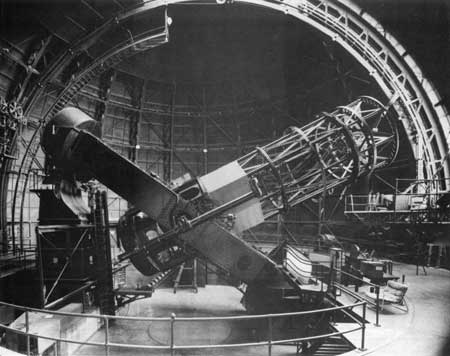
For much of the 20th Century, the two largest telescopes in the world were the 200 inch (5 meter) Hale telescope at Palomar, and the 100 inch (2.5 meter) Hooker telescope at Mt. Wilson. I used to live in the foothill area of Pasadena, CA, and more than once I hiked up the trail over which the 100-inch mirror—and many tons of associated equipment—was borne to the summit. On occasion, I hiked over to the Hooker instrument's dome and peeked inside. In the 1970s, when this picture was taken (not by me), there was a short viewer's platform and viewing window. I was awed by a telescope the size of a Greyhound bus. I haven't seen Hale at Palomar, but I'd love to.

Now, since the late 1970s, new technologies have allowed the production of telescopes as large as 400 inches (the 10 meter Keck telescopes). Larger instruments are being planned, right up to one called OWL, for OverWhelmingly Large telescope: 4,000 inches, or 100 meters (328 feet). Think of a mirror the size of ten suburban lots (2 acres), polished to an accuracy of 15-20 nanometers (less than a millionth of an inch), held in a mounting that won't let it sag by more than this amount, that can be pointed at any part of the sky.

Dr. Zirker brings us the background story behind many large instruments astromers have crafted, and those to come. He dwells on the incredible scientific discoveries each new instrument enables, and those that'll have to await the next big mirror.

Some may ask, "Why do you only mention mirrors? I thought telescopes had a big lens in front." Many do. The most common small telescope actually comes in a set of two: a pair of binoculars. Also, many folks have a stovepipe-size bargain telescope with a lens two or three inches across, and have had a look at the Moon or Saturn through it. But there is a problem with lenses. They don't focus all colors to the same point. Binoculars and other lens-type telescopes have two or three lenses bonded together at the front, each of a different kind of glass. They compensate for each other's deficiencies, so you can see a clear image without too much "secondary color." Also, the pieces of glass you need for a big lens, let's say four feet across, are very thick and heavy. The biggest practical refractor (lens-type) telescope is 44 inches in diameter and weighs a couple of tons.

Mirrors focus all colors to the same point. There are other issues that need to be addressed, but basically you just need to find a way to hold a few micrograms of aluminum or silver in place on a curved surface. A typical "first mirror" for an amateur telescope maker is six or eight inches across (15-20 cm), and weighs a few pounds. However, if you were to scale down the Palomar mirror from 200 inches to eight, it would be eggshell-thin, with an egg-crate hollow back, weighing about two pounds. This construction couples the great rigidity needed, with lighter weight (the 200-inch mirror weighs almost 20 tons; a 20-ton lens would be only 80-90 inches across). Larger telescopes use even more innovative techniques to reduce weight still further, but keep that thin metal surface in just the right configuration.

Even with modern detectors that can record nearly every photon, you need a lot of glass to record very distant objects with reasonable exposure times. The orbiting Hubble telescope, with its 2.4 meter mirror (just a little smaller than the Hooker telescope...an orbiting Greyhound bus), spent twelve days collecting the Ultra Deep Field image that shows galaxies and proto-galaxies that were among those earliest formed in the universe. If OWL gets built, and advanced optical correction gives it sufficient acuity, it could collect the same image in about ten minutes.

I can't do much astronomy, but I love reading about it, and I love this book.

Tuesday, July 25, 2006

Grasped by the essence of things

kw: book reviews, science fiction, fantasy, anthologies

In a post on July 14, I reviewed Matthew Hughes's book Black Brillion. The human "collective unconscious" or Commons plays a large part in the book. Three of the stories in Hughes's 2005 collection The Gist Hunter & Other Stories develop the background of Guth Bandar, who helps Baro Harkness use the Commons to unravel a mystery and foil an ancient plot. In the novel, Bandar is rather timid and fussy, though he exhibits surprising pluck in a crisis. These stories explore his younger days, when it seems he had considerably more pluck, or perhaps dumb luck.

Henghis Hapthorn, discriminator extraordinaire (that means he's a lot like a far-future Sherlock Holmes), is featured in six other stories, also set in the Archonate milieu of Guth Bandar and Baro Harkness. This is one of the farthest-future settings one can have, the Sun being quite close to bloating into a red giant and engulfing Old Earth. Fortunately, humans have spread to a number of other star systems, and star travel is within the means of at least the well-to-do. Hapthorne wrestles with the implications of a cusp in the cycles of essential laws, with logic soon to give way to magic; indeed, it is doing so—in fits and starts—as these stories progress.

Four final stories give the author a chance to kick up his heels in a few other arenas. My favorite is "Go Tell the Phoenicians," set in a more repressive version of the Archonate, perhaps pre-Archonate...and explores the turn of the worm that will end the repression.

I rejoiced in the focus of Black Brillion on things less violent or sexual than is the norm today. In a couple of the Guth Bandar stories, Hughes shows he's as prone to adolescent fantasy as any, and has an arena in which to take it to extremes few others might dream of. He manages to make one tale hilarious rather than scurrilous, in which our hero returns from misadventures in the Commons with elephantine ears and nose...and "other nose". Oh, well, it'll take a while to get some of that out of my memory!

I've scared up copies of another couple of the author's books. Stay tuned.

Saturday, July 22, 2006

Big Brother has a Bigger Brother

kw: book reviews, science fiction, political fiction, rfid

In a previous post (Big Brother in Your Pocket... ), I reviewed a book warning about the risks of proliferating RFID devices, such as toolroad pass tokens, smart cards, and trackable clothing tags. Now I find that, just about a year ago, a novel that illustrates the same premise appeared: The Traveler by John Twelve Hawks. After a bit of searching, I read that the book is the first of a planned trilogy. Will the final denouement be tragic, as is 1984? We'll have to wait and see.

The author claims to live "off the Grid." The Grid is the web of technology that tracks us: financial transactions such as our use of personal checks and ATMs; use of electronic convenience tokens such as EZ-Pass and Speedpass; purchases with credit cards. Recently I showed my wife how to look through the traffic system's surveillance cameras. I use them sometimes to look ahead on a planned trip, where congestion is likely. As we watched an intersection near our home, the camera's view suddenly slewed around, and it zoomed in on one car waiting for the light. The angle didn't allow reading the plate, but it would have been possible. However, the make and color of the car were evident. I told her, "The police just took control of that camera to look for something or someone. We're along for the ride."

Project the trends forward a few years, maybe ten at most. What will life be like? John Twelve Hawks shows us one possibility. While there is a mystical element to the story—it is a fantasy about Travelers who can roam free of their bodies—the dystopian background is all to possible.

There are dozens of Web pages with speculation about who Mr. Twelve Hawks really is. If his novel has the appropriate effect, we'll never find out. If instead the violent reaction of the public to recent attempts to spread RFID tracking becomes complacency, we'll know who the author is in just a few years, at the point it has become both physically impossible and a criminal offense to live off the Grid.

A few points to ponder:

  • Most electronically operated doors use a fail-safe mechanism: they open when power is removed. The ones where I work use a strong electromagnet. Others use a latch held in place by a solenoid that drops out when the current is cut off. All such doors can be opened by a HERF device, a High-Energy Radio Frequency pulse generator that burns out electronics from a distance. You don't harm the electromagnet or solenoid, just the tiny transister that controls it. At present, public safety laws don't allow the sale of door latches that would lock someone inside a building if they fail. That just means Big Brother paranoids will have to make their own...
  • A Traveler who is one personality of a Dissociator or Multiple Personality won't have to leave his/her body unattended.
  • Any RFID device cannot communicate from inside a metal shield, a foil wrapping, metal-mesh lining of a glove on the hand for an implantable type, or a conductive plastic bag such as the gray or black bags delicate electronic parts are sold in.
  • A smaller version of the HERF device should disable any tag, particularly if you know the RFID tag's resonant frequency. It wouldn't do the damage a microwave oven does to smart cards and clothing tags.
  • Finally, do keep up-to-date by bookmarking Caspian and check in from time to time.

Thursday, July 20, 2006

Suffering Lebanon

kw: opinion, world affairs, mideast, lebanon, hezbollah, hizbollah

World War 3 is heating up. The news continues full of the growing war between Israel and Syria/Iran, through their proxy Hezbollah. Syria provides money and logistical support, and Iran most of the weapons. These two countries and one organization lead, by far, those who are devoted to eliminate Israel.

Let's be clear. They don't want to "beat" Israel, or subjugate it, but to destroy it. They would, if they could, kill every Jew.

Suppose Israel is defeated, and destroyed. These folks know that there are more Jews living in New York City than in the nation of Israel. That there are millions more Jews, mainly concentrated in major cities worldwide. They won't stop with Israel. And now they have, or soon will have, nuclear weapons.

A military man I know once defined peace thus: "Peace means you have no living enemies."

As an organization, I believe Hezbollah will cease to exist in my lifetime. Sooner or later the present leaders of Iran and Syria will also pass away, but probably not before they lose a war or two. Just as the present Iranian leaders are more moderate than the Ayatollah Khomeini, the next generation might also be more moderate yet. If not, WW3 will continue.

A lot depends on continued American support for Israel.

Wednesday, July 19, 2006

Sharing a body

kw: book reviews, nonfiction, psychology, mpd, dissociative identity disorder

In 1972, about the time my first wife divorced me, my uncle divorced my aunt. This aunt, my mother's sister, came to talk with me. She talked about the deep emotional connection she and her husband had had, almost like telepathy in the early years; and about his extreme volatility, particularly later on. She said something that amazed me. When he was upset with himself, he would beat himself to unconsciousness with his own fists. I couldn't understand how it was possible. I recalled a verse from the book of Ephesians: "No man ever yet hated his own flesh, but nourishes and cherishes it..."

Reading A Fractured Mind: My Life with Multiple Personality Disorder by Robert B. Oxnam, someone who also beat himself, but apparently not to the point of concussion, I understand that my uncle was probably a multiple, someone whose mind housed several personalities, including at least one who was a hateful abuser of my uncle's body.

As understood by many psychiatrists, MPD—now more frequently called DID, for dissociative identity disorder—results from child abuse on a truly horrific scale. One or more personalities are split off that carry the original innocence, having no memory of the abuse. Yet there is usually at least one personality created that assumes the attitude and behavior of the abuser(s), and one that takes all the abuse, whether or not it manifests in self-beating. The dissociation is the disconnect between the memories of the various internal persons; some may have access to all memories, but at least one is usually walled off from the rest, and can carry on daily activities with seeming aplomb...except that at least some of the others occasionally "get out" and control the body at various times. The dominant personality is typically in denial that there are blank spots in his/her memory.

Dr. Oxnam, a very successful specialist on Asia, became an alcoholic and was burning out. About six months into psychiatric analysis, one of the "others" took over and spoke with (mostly cursed at) the psychiatrist. Dr. Jeffrey Smith, who wrote a fascinating epilogue to the book, realized that Dr. Oxnam suffered from MPD/DID, and set about helping him recover. As of the writing of the book, eight of eleven "alters" have been integrated into three, who at present cooperate, and may not further integrate.

One point brought out several times is that integration of one personality with another is not like death for one of them. The memories, skills, and attitudes of both are joined into a more rounded whole. The hard part is to get the two to agree on a set of values and beliefs. If I understand correctly, the three current alters in Dr. Oxnam, Robert, Bobby, and Wanda, have widely differing beliefs that lead them to remain separate at present. Of course, I am oversimplifying!

The narrative in A Fractured Mind is told in at least eight voices, as each alter that can, is allowed to speak for him/herself. I found this fascinating. The only other author I've observed who can write in divergent voices, convincingly, is Theodore Sturgeon (I wonder...?).

Dr. Oxnam and Dr. Smith consider MPD to be entirely a product of experience, with no genetic basis. I wonder, though, if some folks are more disposed to dissociate than others; perhaps much more so (see the last URL below). They particularly point out that Bipolar Disorder (manic-depression) is genetic again, I wonder. In the Introduction, the phrase is used, "...my experience may be an extreme exaggeration of what is normal human behavior."

This statement mirrors almost exactly my own statement, as a Bipolar individual. Everyone has higher and lower moods that seem to occur on a schedule that does not always relate to external events that might cause happiness or sadness. With Bipolar 2, as I have, the highest and lowest moods can become disruptive of one's life, and with Bipolar 1, they require medication for any semblance of "ordinary" life to be possible.

And, I've had experiences that may be closer to dissociation than usual. Primarily, in my teenage years I purposely constructed a personality to handle human interaction. I realized I was a hopeless nerd, more at home with machines than with people. I couldn't read body language with anything like the facility of my younger brothers. I purposely gave away a handful of IQ points to develop processing habits to make up some of the lack. Many years later, taking a 2-week leadership training course at a nice ranch, I had to take a personality assessment. This was one of those big deals, where you answer hundreds of questions about yourself and your work, with instructions to answer quickly, with little thought. Three customer plus three colleagues answer the same questions about you. You also answer the same set of questions, answering as you imagine a perfect employee fitting your job description would answer them.

The result was a huge shock. My colleagues, my customers, and my "ideal employee" all lined up very, very well, but my personal reaction results were almost perfectly opposite. As I said to a trusted friend later, "I have them all fooled. But 'the machine' was revealed, unchanged after all these decades!" I call my original self, that doesn't know how to relate to people, "the machine." I was not the only person who was shaken by their results. Our group called that day "suicide Tuesday."

I guess I have tremendous will power. I came up with a new slogan a few days later: "You cannot build a tree." On my own, over the next five months, I sought within myself any traces of "normal" human abilities, and gradually discarded my home-brew personality. I found I was able to assume the skills I'd constructed, melded with decades of human experience, to make myself a more balanced person. Now, nearing 60 years of age, I suppose, in 60s terminology, I "have it together."

Well, not completely. A couple years after "suicide Tuesday" I found I am Bipolar. To this day, I am almost like two different people. However, there is no dissociation. Reading Dr. Oxnam's book has greatly helped my own journey of self-discovery. One thing in particular, I know I am not MPD/DID. I have continuous memories back to age 2, and my brothers' stories to cross-check. What I do have is a lot more sympathy for multiples, and a bit of curiosity, whether there are any multiples who didn't get abused into the condition.

Useful URLs:

Tuesday, July 18, 2006

This may be Kansas, Toto, but it isn't the SAME Kansas

kw: book reviews, science fiction, fantasy, anthologies

Landscapes is Kevin J. Anderson's show-off collection. A writer of great range, he stretches his muscles here (sometimes, quite literally) to present stories from all over the map...a big map, megaparsecs across. Actually, few of the SciFi stories here are space opera. He likes to mess with time even more, and other stories are sideways "what-if" that could happen anywhere, or straight, hard-SF near-future extrapolations.

Fourteen stories are billed as Science Fiction, seven as fantasy, and his "The Great Outdoors" section consists of two essays and a "backpacking on a new planet" mini-epic. Two of the fantasy pieces are really horror. "Santa Claus is Coming to Get You" shows how to leave just enough to the reader's imagination...including the ending.

I'll skip my traditional ideas list, and let two examples suffice (too many of the core ideas also give away the point).

"The Bistro of Alternate Realities" is the cream of the time travel stories. A researcher who travels to "nearby" parallel worlds has learned to hook up with a number of her alternate selves. But the truism that we often give ourselves the worst advice is even truer when there are a handful of "ourselves".

"TechnoMagic" takes Clarke's dictum—"Any sufficiently advanced technology is indistinguishable from magic"—to make an end run around the Alien Among Us theme.

I've just added Anderson to the list of authors whose books I look for.

Monday, July 17, 2006

Is NYC your cup of tea?

kw: book reviews, nonfiction, essays

When I read in the publisher's blurb that Colson Whitehead had "won critical acclaim for his literary novels" I counted it a big negative. The more "literary" a novel is, the less substance it typically has. However, this was a book of essays, and it was quite short, even in the Large Print edition.

Whitehead's The Colossus of New York: a City in Thirteen Parts does consist of essays, but they're my first exposure to "essays" in stream-of-consciousness mode. Took a little getting used to. Another word I don't like to see in a blurb is "evocative." In this case, however, the essays do evoke the New York City experience, quite well.

It isn't quite true that every sentence has a different person's viewpoint, but it is close. I suppose it is one way to get across that there are eight million New Yorkers, and as the author says, each has a personal NYC inside. This seems to be the theme of the book. Your NYC is not my NYC, even if "you" and "I" live on the same block, or next door.

A history teacher I once had said most of us live a "dumbbell life": there is a cluster of places near our home, a cluster of places near our job, and the road between them. We seldom get outside that dumbbell. Most of the time that is our world. Author Whitehead's NYC is bigger than that, because he expresses quite a tendency to get around the city. Perhaps a better simile for his inner map of NYC is a still shot of one of Calder's mobiles: a cluster of amorphous shapes with paths between.

I've visited Queens a lot, because of church connections. I've been to Manhattan twice, and I don't care for it, any of it. I am not an anthill kind of guy. I left Los Angeles (and I lived inside LA city limits for about a year) because it is an anthill. I like small cities and towns better. The nearest city to where I live now has 70,000 residents, and I hate to go downtown.

Thanks to Colson Whitehead, I get a taste of New York experience without having to go there.

Friday, July 14, 2006

That which answers all answers none...fortunately

kw: book reviews, science fiction, fantasy, crime fiction

At last! An author capable of writing a book with an engaging style, compelling plot, interesting characters, and exciting new ideas, who doesn't bother cluttering up the story with oversexed or wantonly vicious characters or scenes.

Matthew Hughes is relatively new to the Science Fiction/Fantasy scene, but is an established writer and journalist and speechwriter. He writes crime/suspense fiction as Matt Hughes. His new book Black Brillion combines both. I am glad he refers to this work as Fantasy, for it is set in a time so far future—the Sun is close to going Red Giant—that one could not hope to imagine the technology.

This is a story of transformation, on many levels. The protagonist, one Baro Harkness, a policeman or "scroot" (the police enterprise is named "The Bureau of Scrutiny"), forced to work alongside a criminal he recently arrested, learns a few things about himself, humanity, and existence. A most welcome lesson: any unique tool or skill can be used as a weapon.

The plot revolves about a particularly dreadful alien species, apparently extinguished millennia earlier. Yet the viewpoint is not unitary, and one comes to realize that the common practices of one culture may seem irredemably evil to another...and vice versa. Hughes does not give us much from the Dree viewpoint, just enough to elicit the tiniest twinge of pity that they had to be expunged, though the book ends with a bit of doubt, whether they really are extinct.

The concept of "the commons," an ancient, corporate store of archetypical memories, drags one along, hoping for more. We'd all like to gain control of our dreams (as someone who begins dreaming whenever my eyes close, even when awake, I've been trying to learn such control for decades). The vivid descriptions of the waking dreamscape doubled my desire.

The title material, a type of Philosopher's Stone, along with its blue, red, and other-colored siblings, is supposedly a distillation of ancient industrial waste from our time. This I find the least plausible of the ideas...I am too much the Geologist and Chemist!

I'll be looking for more of this author's titles, scouring out existing ones, and awaiting future offerings.

Wednesday, July 12, 2006

A stable of stable staples

kw: book reviews, science fiction, anthologies

Writer after editor after fan bemoans the modest quantity of Eileen Gunn's fiction. As one editor put it, her normal pace is two or three stories per decade. For Gunn, quality trumps quantity. We might wish for more...what we have is what we get.

The 2004 collection of her short stories, Stable Strategies and others, shows just how diverse her mind is. Their publication dates ranging over thirty years, these twelve gems range from a very, very generic and adaptable recipe, to the barely fictional, to as far out as you care to go. As a bonus, in the introduction, she offers "the secret of writing" which is a friend's advice: "You must learn to overcom your...revulsion for your own work." Perhaps she took it, and increased her output to three, rather than two, stories per decade.

The stories, ideas and my comments:

  • Stable Strategies for Middle Management - take Kafka's "Metamorphosis" and put it in a business setting where people gradually morph (she really shouldn't use the word mutate) into insects that reflect their characteristics.
  • Fellow Americans - Dick Nixon got out of politics and went into television; the Presidency took a different turn in his absence. Make it wildly hilarious...
  • Computer Friendly - Revolutions restore the diversity of society that bureaucracy seeks to eliminate. The genesis of a revolutionary or two.
  • The Sock Story - Surreal sock steals soul!
  • Coming to Terms - Packing up the belongings of one's dead searches the soul. A deft story of such a search, with touch of the fantastic.
  • Lichen and Rock - As we grow, we realize that the world changes us. What if we could change—i.e. switch—worlds?
  • Contact - A beautiful rendering of an old idea: the (literal) meeting of minds with an alien. So many stories, this included, rely on telepathy, I wonder if most SciFi writers are wise enough to despair that we'll ever learn to communicate with aliens once we find some. After all, we are no smarter than dolphins, and haven't got very far in generations of trying.
  • What Are Friends For? - The destruction of Earth and most of humanity, and the forced removal of a very few, awaits only the cultural recording of an alien ethologist. How do you slow it down?
  • Ideologically Labile Fruit Crisp - Philosophically deconstructed, generic recipe.
  • Spring Conditions - A piece of amorphous horror that won praise from Stephen King.
  • Nirvana High (with Leslie What) - Telepaths and others with "special talents" are likely to pose a discipline problem in public schools. Is putting them all in one school system likely to make things any better? By the way, in my opinion, if there is a mechanism of telepathy, it'll work only between two brains of exquisitely similar construction. Two telepaths could read each others' minds, but nobody else's.
  • Green Fire (with Andy Duncan, Pat Murphy, & Michael Swanwick) - This was a round-robin story, so wrenching twists are the norm. Mix a Tesla coil with other experimental circuitry, all mounted in a battleship...could it affect the structure or properties of matter...or of spacetime? (not really, but it's a fun read)

Tuesday, July 11, 2006

What price Utopia?

kw: book reviews, science fiction, utopias, dystopias

Should you inherit a half billion, or win it in a State lottery, what would you do with it? The two folks I know who won millions in the lottery say they are heartily sorry they every bought the Lotto ticket...but I don't notice them giving it back. The one near-billionaire I know, who happens to have earned it, building a huge fortune from a merely large family fortune, is a modest fellow, having no utopian pretensions.

In his 1879 classic Les Cinq cents millions de la Bégum Jules Verne contrives to endow two men, both scientists but one French, the other German, with equal shares in a half-billion-franc fortune. Each decides to build a city. So far, so good.

The French doctor Sarrasin, a student of hygiene, obtains a large tract of land in Oregon and establishes France-Ville as a healthful, industrious place, and example to the world. The German chemist Schultze, seemingly in a piece of me-too-ism, obtains a similar plot ten leagues (about 30 English miles) distant, where he establishes Stahlstadt (Steel City), where his workers make superior cannons; he jump-starts the international weapons trade, mid-Victorian style. His passion is to first show up the French city, then to destroy it, with an enormous new weapon of his invention. To give away a portion of the ending: a laboratory accident results in Dr. Schultze being flash-frozen, bringing Stahlstadt to a halt. I guess Verne found this a simpler solution than having the French rapidly invent a counter-weapon.

The English title is The Begum's Millions. This 2005 re-translation by Stanford L. Luce is published by Wesleyan University Press, in their "early classics of science fiction" series. Reading the apparatus (Arthur B. Evans, ed.), the value of a more accurate translation is clear. The earlier English edition by Kingston is more of an overly-colloquial paraphrase.

The editor makes much of the actual oppressiveness of both cities. Though France-Ville is intended as a happy, healthful place, the hygienic environment is attained at the expense of numerous rules most folks would find intrusive. However, this aspect doesn't really come out in the text. There is but one chapter that describes France-Ville, in the form of a newspaper article told from a German viewpoint. Most of the book is taken up with the story of a young Frenchman (an Alsatian) who infiltrates Stahlstadt to learn of the secret weapons and plans. He poses as a Swiss engineer (to explain his accent), and gains Schultze's confidence. As Verne states in his correspondence, Schulteze's city is "more interesting" than Sarrasin's.

With this novel, Jules Verne began to express his political fears. His first, unpublished novel Paris in the Twentieth Century was very negative, and he had to publish a number of more cheerful books to attain the stature that allowed him to present cautionary material later in his career. From his correspondence, he also grew more pessimistic with age. I find his career similar to Mark Twain's, in the growing pessimism and black humor of his later days (and I find even the relatively early work "A Conneticut Yankee in King Arthur's Court" quite appalling, in the "hero's" annihilation of some 30,000 armored knights).

Verne was as prescient in his fears as he was in his science. The German-French antipathy filled the world with war for fifty years. Though a side effect was to effectively force the U.S. to become a superpower, it also did so for the Russia of Lenin and Stalin. I find the juxtaposition of the US and USSR too uncomfortably close to that of France-Ville with Stahlstadt! And the end of the "Cold War" and destruction of the Iron Curtain and Berlin Wall came about as a denouement nearly as fanciful as the sudden freezing of Schultze.

I have to say it: the Berlin Wall came down on my birthday...I was on my way to work, driving alone instead of in the pool van. When the announcement came over the radio, I pulled off the road and cried a long time. I could still taste the sense of immense betrayal I'd felt at age 14 when the Wall was built. The tremendous relief I felt that day still makes me teary.

Makes me wonder if Verne got hold of Wells's time machine...

Sunday, July 09, 2006

Implausible Deniability

kw: book reviews, nonfiction, politics, terrorism, statecraft

I lived about a year in East Los Angeles in the 1970s, in the Barrio...don't ask me why! I got to know a kid named Tony who was the leader of a gang of youngsters all under 16 years old. All the older kids were already in jail or prison, so these kids pretty much ran the place. I lived with nine others. We were college students, renting two houses. We suffered a little petty trespassing and thievery, then one day a more major theft from our premises. We went looking for Tony.

Tony usually ran with a couple guys, bodyguards I suppose, but that day there were eight of us. Tony of course denied any of "his guys" were responsible. But we simply told him, we didn't care who did it, we knew all the kids for a half mile around were under him. Anything more happened, we were coming after him. We made it clear we could "take" any number of "his guys" he cared to throw at us, but that we would be sure he, personally, suffered, very much. End of story.

Would that it were so easy to deal with a nation like Syria that trains, supports, and offers sanctuary to several groups of terrorists, perhaps numbering a thousand or so. After the Twin Towers attack of 9/11/01, we couldn't just make the Taliban leaders suffer. They seemed to welcome that. We had to annihilate their military capability. I'd say we did just that, about 95%. A small number of Taliban fighters are still waging a guerilla war against us.

In Deadly Connections: States that Sponsor Terrorism, Daniel Byman analyzes for the general reader (i.e., political innocents like me) the connections between several of today's more important sponsors of terrorism, including the rather unique case of the Taliban with Al Q'aida (there are so many ways to spell this, I just picked one). Here is what I take away from the book.

  • Terrorism is the warfare of the weak.
  • Sponsoring terrorist groups is typically (not always) the foreign policy of a state too weak to affect events directly.
  • "Passive sponsorship," usually turning a blind eye, is a result either of being too weak to drive the group out, or of political naivety, thinking they pose little threat.
  • States that sponsor terrorists often claim they are not responsible for their depredations. Nobody is fooled.

States that sponsor terrorism for ideological reasons (Syria, Iran, and the Taliban are the sharpest modern examples) are the least likely to change their ways, because they think they are doing God's work (I discuss the question "Does the Devil know he is evil?" in a post of about ten days ago). The only state to seemingly about-face on the issue, that formerly was an ideological sponsor, was Libya, just in the past couple of years. It took Qaddafi some thirty years to come to such a point, and even the minor changes in stance we have seen in Iran since the mid-1980s took thirty years and the passing on of the earlier, more radical leaders.

Modern religious terrorism is not a simple problem, and in my opinion, the current crop of terrorist organizations will be defeated only over one to two centuries of effort...if at all! But they most likely will die away over that time, even if they are not militarily eliminated, just because later generations have less fire than their forefathers, and later zealots don't join old groups, they start new ones.

Tuesday, June 27, 2006

This preacher comes at you from another angle

kw: book reviews, nonfiction, celebrities, religion, values

The kind of spiritual leaders I like best didn't go to any seminary, and usually haven't been ordained by any organization. God's way as seen in the Bible is for a prophet to appear from the wilderness, make a huge impression on his generation, and pass on. Though a "school of the prophets" will often rise up, none of its graduates exhibits the gift or power of its namesake. Moses is the prototype: well educated, though in the Egyptian way, at the age of forty, he suffered a terrible failure, and spend the following forty years watching sheep eat "in the back side of the wilderness," somewhere in Midian. Once God decided he'd learned his lesson, and was ready to be a more effective shepherd, he called Moses from the burning bush.

Often the best preachers are the secret ones, those who can put God's lessons into you without seeming to touch on religion at all. St. Francis strove to be one of these; he said, "Preach the Gospel at all times. When absolutely necessary, use words." Fred Rogers, TV's Mister Rogers, is my favorite of this genre.

Marcia Z. Nelson, who writes about religion in a number of venues, has found such a "secret preacher" in Oprah Winfrey. She has influenced people worldwide for twenty years through her TV talk show and the publishing empire that has grown up around it...and I mean publishing of all kinds, for it is her Web site, www.oprah.com, that has the greatest impact.

Though Oprah Winfrey was raised a Christian, she has been accused of being "New Age" because of her nonjudgmental approach and emphasis on self esteem. While I prefer to emphasize self respect over self esteem, I understand her approach, and appreciate it. I am a Christian teacher, and I find nothing to offend me in her method.

Ms Nelson's new book, The Gospel according to Oprah, shows a double handful of ways that Oprah gets her message across without being preachy. Two are of interest to me, the 5th and 10th of ten chapters: "Oprah teaches gratitude" and "Oprah is a reminder service."

We are frequently exhorted in the Bible to exercise thanksgiving. The Psalms are primarily expressions of praise and thanksgiving to God, and the rest of the Bible contains many "secret psalms" such as Isaiah chapter 12. Gratitude in our attitude makes everything go better, as Oprah reminds her audience frequently.

Also in the book of Isaiah, God's people are called "God's remembrancers," even called to remind God (and themselves in the process) what His plans are. Jesus said that the Holy Spirit's major task would be to "bring to remembrance" the things He had said, and what His disciples had read. This is why we need to read the Bible; it gives the Spirit something to work with. For those who have never read the Bible, and perhaps wouldn't be caught dead with one in hand, Oprah reminds us what values and virtues really are, and why we're happiest when we're best.

Dale Evans once said, "The way we behave may be the only Gospel some people ever see." I don't know if Oprah knows that aphorism, but it is clear she is living it, and asking us also so to do.

Monday, June 26, 2006

Isn't Weather part of Nature, too?

kw: opinion, environmentalism, ecology

The other day, on a PBS broadcast, I heard the phrase, "...a fragile ecology at the mercy of the world's weather..." I immediately thought, "What balderdash! The weather is part of the ecology."

When I was a graduate student of Geological Engineering in Rapid City, SD, I often went with fellow students to see their project areas, as many of them came to mine. One area was an alluvial fan below a steep canyon south of Sturgis, SD (an alluvial fan is a sloping plain formed of the debris of a river's erosion of young mountains. The Black Hills are part of the Rocky Mountains, a relatively young mountain chain).

The fan had a great scattering of large boulders, some as large as a minivan. My friend had mapped the locations of all the boulders, from three feet in diameter up, and measured the size of the lichen spots on them. From the known growth rates of lichens, he was able to determine that there had been more than ten flooding events in the past 5,000 years, or about one per 500 years, with sufficient force to move stones weighing many tons as far as two miles from the canyon mouth. Some older stones showed signs of having been uprooted and moved by later floods, from where an earlier flood had left them.

The current climate that we call an Ice Age Interglacial period has been relatively stable for about 11,500 years. But by "relatively stable," we must include times much colder than today, even colder than the "little ice age" of the 1400s-1800s, and periods of warming quite a bit beyond our expectations of the next hundred years of "global warming." Yes, I do believe the current warming is in large part caused by our burning of fossil fuels, but it is certainly not unusual compared to the excursions of the past ten millenia or so.

The various ecological zones of each continent contain assemblages of plants and animals that have existed over that span of time. When things were cooler, those that could, moved south or downhill, and when warmer, north or uphill. The rest adapted without migration, or went extinct. Those today existing are those that adapted, with or without migration.

The idea that a 100-year flood, a 100-year drought, or a 100-year "disaster" of any kind is unprecedented is a truly blind viewpoint. My friend noted that he couldn't tell yet which of the floods whose debris he had mapped had been the worst. Whichever it was, it was the 10,000-year flood, and didn't make great numbers of things go extinct.

We still have a lot to learn about the resilience of ecological systems. Our lifetime is too short to provide a useful baseline. Even all of written history encompasses only half the current Interglacial. Until environmentalists become astute students of history, we'll go from panic to panic, for no good reason. A pity...

Sunday, June 25, 2006

The Clueless Professor

kw: book reviews, fiction, humor

A favorite character of my childhood, first in stories, then in film, was the absent-minded professor. The inventor of Flubber is but one of a number of these archetypical bumblers.

In At the Villa of Reduced Circumstances, Alexander McCall Smith has gone the genre one better with Professor Dr. von Igelfeld, a truly blinkered, clueless academic, famous among a handful of philologists for his 1,200-page tome, Portuguese Irregular Verbs (the title of the first von Igelfeld "entertainment" by Smith).

Author Smith wrote in the voice of his native Botswana to bring us Precious Ramotswe and the No. 1 Ladies' Detective Agency series. With the good German Professor, the voice is a combination of erudite wit among mutually suspicious academics, and an exaggerated ivory-tower species of tunnel vision.

Dr. von Igelfeld, suffering the intrigues of his fellows, finds the intrigue even deeper at Cambridge on a visit there. Intrigue hardly begins to describe the thunderously funny convolutions of the plot in Bogotá, Colombia, where he is tricked into becoming President, and needs all his cleverness to abdicate before being shot by the next Government, due "any week now."

Ya want escape? None better than right here!

Saturday, June 24, 2006

The Rich and Famous get Nowhere

kw: book reviews, fiction, short stories, high society

In The Young Apollo and Other Stories Louis Auchincloss recalls New York "high society" of a century ago, evoking that unreality for a generation that thrives on "virtual anything." From the mistakenly noble motives of rich young men who find that bleeding blue blood kills you as quick as any other kind, to their wives or widows exercising their thwarted intelligence in rounds of house parties; from the robber barons to the noveau riche; all are presented in their own pretentious late-Victorian language.

Perhaps an older, more credulous generation finds such stories gratifying; I find them sad. Is that what the author intended? Perhaps. I cannot presume to read the heart of one who began publishing about the time I was born. Suffice it that I read of person after person who may have accomplished much...or may not have: All are at best grimly satisfied, but most are simply lost within a formerly familiar environment. How credible are the images thus presented? I don't have an easy way to determine.

Two stories in particular open a door rather than close any: Pandora's Box and Her Better Half. In the former, a man learns how he must play the game, and determines to play it much better than his fellow suppose. In the latter, a woman learns the same lesson. With a modicum of thought, both stories have a post-text: Watch Out World, Here I COME! I am a junkie for stories of transformation.

Thursday, June 22, 2006

A religion struggling to grow up

kw: book reviews, nonfiction, politics, religion, terrorism, islamic extremists

Of the world's great faiths, only two are territorial:

  • Biblical Israel is required to worship in Jerusalem and to live under a theocracy in “the good land.”
  • The Koran requires an Islamic theocracy, which is to be actively spread to all the world.

Point 2 is the source of World War Three, which has been going on for twelve years, at least. Islam is the youngest of the global faiths, 1,400 years, with a following of 1.3 billion. Considering that religions last millennia, Islam is in its adolescence! Until it grows up, it will be a source of global instability. Religions become more tolerant with age.

The largest faith (2.1 billion) is presently Christianity, and though it is not inherently territorial ("My kingdom is not of this world"), medieval Romanist Christianity certainly was (e.g. the Crusades), and the Protestant Reformation period (14th-17th Centuries) was marked by warfare that led to the current division of the world into three regions dominated by Roman Catholic, Orthodox, and Protestant practice.

Although Hinduism, the world's oldest active faith (4,000 years or older), is mainly esoteric, and Buddhism (aged 2,500 years) even more so, both experienced sustained periods of conflict during their "spiritual adolescence", the teen centuries (~1,500 y of age). Together, 1.3 billion follow one or both of these esoteric faiths.

Judaism, though not a great faith in numbers, only 15 million, has had a great, continuing effect on the world. It is the third-oldest faith, at 3,400 years. It underwent several upheavals, but its most warlike period was very early in its history, as the "children of Israel" wrested Canaan from its inhabitants. The spiritual teens for Judaism and a long struggle for national survival began in the Maccabean period, lasting from two centuries prior to the birth of Jesus, until 70AD. From then until 1948, Judaism was a territorial faith without territory, but matured as the jingoistic language of the old Hebrew prophets was reinterpreted in a more spiritual way.

If these faiths are any guide, religions tend to be very unstable as they pass through an adolescent stage after the first millennium or so. They are bad citizens of the world for a while, like self-centered, spiteful "young adults".

Thus it seems almost inevitable for Islam to be in a period of sustained upheaval. 'Tis a pity it occurred in a generation that has access to nuclear weapons! But few of us in the West have observed that Islam's internal struggle is more intense, and its outcome more crucial, than the external struggle we call Islamic Terrorism. As a point of plain fact, the struggle within Islam will determine whether "the war on terror" lasts one generation or ten.

Mary Habeck, formerly a popular lecturer at Yale, now an Associate Professor at Johns Hopkins, teaches and studies military history. She asks a wonderful question, "What do the Islamic extremists say about why they are at war with the West?" She brings us the answer in her new book, Knowing the Enemy: Jihadist Ideology and the War on Terror. To me, this book is required reading for every human on the planet. The outcome of Islam's internal conflicts will have some impact on the lives of us all, every one of us.

Hitler didn't invent the Big Lie, he is just the first to embrace it publicly. Today the jihadists are its most ardent practitioners. They know if they say it often, say it loud, and stifle all other voices (make them feel guilty for their virtues), they will win hearts. Professor Habeck outlines their motives and their reasoning, from their own writings. In a world where perception is everything, it doesn't matter that they are twisting the Qur'an (Koran) and their other semi-sacred writings. The studies of millions of Islamic scholars don't matter; such scholars are vilified as false Muslims. To some extent, the hope of the world rests in the laziness of the majority of Muslims.

Ms Habeck has a brilliant suggestion. We must rename the "war on terror" as the "war on the khawarij." To quote her, "They khawarij were heterodox Muslims who appeared soon after the death of Muhammad to claim that they alone were true believers...", precisely the position the jihadis take today.

As I have written elsewhere, should the majority of Muslims embrace the Jihadist view, a generations-long conflict will result in extermination, either of jihadism, or of the rest of us.

Forget what the Western commentators are saying, forget both liberal and conservative viewpoints. The jihadists themselves make it clear that their purpose is entirely religious. They really, really believe that God requires them to bring the entire planet and every person on it into subjection to Allah, or to the grave.

Think on this: Does the Devil know he is Evil?

Think on it some more.

I think, No. He thinks he is Good, even the Best. The Devil thinks he got a raw deal from God, that he is the victim of bad press, that he ought to be running things. The Devil thinks the problem of sin in people is because they are too free; he'd love set up really strong law with superior—even supernatural—enforcement, to take away all causes of straying, until nobody has the opportunity to disobey. That's how he'd run things: nobody can steal from his neighbor, because neither party has anything worth stealing; nobody can commit mayhem, murder, or adultery, because everyone works too hard and is too tired; nobody can lie because the demons can read minds and they'd be everywhere (they outnumber us...); and coveting? a level of mind control that would make Mao blush would take care of that. Then, he thinks, everyone would love him.

Absent mind-reading minions, the above is a fair description of Shari'a, at least as defined by the Jihadists. The religious heart is the power of the movement.

Get Knowing the Enemy. Read it, learn its lessons, keep it handy and read it again. And again. Until jihadism is eliminated.

Friday, June 16, 2006

Phobos Galaxy 1 anthology

kw: book reviews, science fiction, anthologies

From an introductory note: "Phobos Books has stakes its reputation on new, rather than established, voices in science fiction, because, as Orson Scott Card wrote in his introduction to our very first anthology, Empire of Dreams and Miracles, 'Science Fiction, of all genres of storytelling, is the one that hungers most for new writers.'"

This sentence makes it clear why Sandra Shulberg is a publisher, not a writer. It is also an example of the sloganeering that seems to characterize American culture since the 1970s. From time to time it is well to remember, like those late night bull sessions, the guys who have the most to say about their 'conquests' are the insecure ones. Those who talk don't do, and those who do, aren't talking.

D'ya wanna make a difference in the world? Don't say it, do it.

As it happens, the 2004 Phobos offering, Absolutely Brilliant in Chrome (edited by Keith Olexa), contains some gems among its "new voices." My idea and comment list for this volume, ten stories by six writers and a collaboration (Gordon Gross is a couple's pseudonym):

"Letters to a Sister by Rebecca Carmi. A truly touching series of letters from an Earthbound woman to her sister, who is on an 800-year starflight in suspended animation. Collapse of the global economy and Chinese takeover.

"Guess Who's Coming to Dinner" by Daniel Conover. A sickly hilarious sendup of the G.W. Bush administration. One of the aliens recovered in Roswell, NM in 1947 has been living underneath the White House ever since. More aliens show up, philistine interstellar tourists, and fireworks ensue.

"The Ants of Imhotep" by Carl Frederick. An Egyptian fantasy. The son of a pharaoh, "amberized" rather than embalmed, has a strange affinity for the young son of an archaeologist. Ants crawling on a stone slab reveal a map to a hidden chamber hiding his remains.

"Absolutely Brilliant in Chrome" by James Maxey. A cheap treatment of an interesting idea: What will we do when synthetic skin, initially created for burn victims, becomes better than the original ... Kevlar(R) plus Teflon(R) ...!

"Ascension" by Matthew S. Rotundo. A new redaction of the 'mountain makes the man' archtype. This mountain is the hardest climb on the known worlds (of course).

"A Meeting of Minds" by Gordon Gross. People have been getting frozen at death for some decades now (background fact), in hopes of being thawed and healed later. When the technology is perfected to create a digital version of one's personality, to take care of the assets of the 'frozen asset,' how do you know you are you, and not a better digital version?

"Promise" by James Maxey. I guess the editor really liked the Title story, because he gave the author another whack. I wasn't surprised that a sexual coming-of-aged figured strongly. The writer takes a whack at religious extremism, but his straw man is a pitiful caricature.

"A Debt Unpaid" by Justin Stanchfield. The planets are up for grabs, in an Oklahoma-style land run (ten days to stake your claim). Can a former Government agent become a trusted homesteader? The ending is a cop-out.

"Perfect" for Each Other by Daniel Conover. Hometown hicks make good, courtesy of a government that needs a better "Charly" to fight terror, and which is willing to "enhance" his wife to match. Ends on a note of hope, but rather weakly.

"Deep Flows the River of Time" by Carl Frederick. Fun premise: Physics post-doc lets his mentor maneuver him into testing a new time machine by going back 20 years in time; he rescues his mother and young self from his own miserable youth, and gets rescued in turn by the mentor.

Wednesday, June 14, 2006

Is Autism an Evolved Adaptation?

kw: speculation, autism, asperger, ASD

I recently read an article in one of the May 2006 issues of Time about autism. Seems the current term is "autistic spectrum disorders" or ASD. I wonder if these are really disorders? I also recently read that some number of folks (10% or so?) are sensitive to very low frequencies, such as those used by elephants, rhinos, and big cats for long-distance communication. These ideas milled around in my head...

I have three friends who are autistic. One is a 4th grader, one of my music students. He is intense, focused, disciplined, very frank, and more sociable than I'd expect of an autistic person. He does tend to live in his head, and not listen well unless you can get him to look at you. He is diagnosed with a mild form of Asperger.

Another, a 10th grader, is a family friend. His particular interest—obsession, really—is weather. He and I have spent some happy times talking about weather and climate. He knows he has Asperger. I have noticed his hands are always chapped, so he probably has a washing obsession also.

The third, in his 20s, is right on the edge of full-blown autism. He is hard to talk to, and usually unwilling to interact. Whatever he is interested in, he does 100%. Whenever he gets bored, he's gone.

I have seen other people who are, I supposed, placed variously along the autistic spectrum. I am told an autistic person who has a job of interest to him (80%+ are male) is a very devoted, often overly loyal, worker.

The various "bad habits" usually reported for autistic persons, such as screaming and head-banging, seem to be exaggerations of responses we all feel to overwhelming stimuli. To me they manifest less-than-ordinary impulse control.

As far as I can tell, autistic characteristics and behaviors are exaggerations of "normal" stuff. If a person mainfests the intense focus of an autistic savant, but is otherwise ordinary, we don't call it a disorder. I am myself sometimes very averse to human contact, and I've been known to indulge in "autistic rocking" when overwhelmed. Some, perhaps many, autistic persons have keener or more sensitive hearing or light sensitivity than usual.

If a person has four or five of these "fringe" characteristics, being "3-sigma" or more from the norm in them, we label it, but what is really going on? In quiet times, people with keener senses, who overreact to sounds or bright light, or who are extra-focused, are considered a nuisance. But what of more chaotic times? Keen senses detect enemies or impending catastrophes sooner. Great focus is needed for rapid problem-solving in the face of emergency.

I think the human species keeps a certain number of these people around, because there are times when we need them. They deserve our appreciation.

The double burden of the obese

kw: book reviews, nonfiction, autobiographies, overweight, obesity

Michael S. Berman is a bit of a big shot. He's a lobbyist and political activist who has worked on campaigns since 1964, including Bill Clinton's, and was V.P. Walter Mondale's Deputy Chief of Staff. He is also a big man. How big? It varies, from 220 to 330 pounds. With the help of Laurence Shames, he chronicles the divided life and many burdens of being fat in Living Large: A Big Man's Ideas on Weight, Success, and Acceptance.

Mike Berman repeatedly states that fatness is a disease, one with compelling power, that has no cure, but can be managed. In a way, it is similar to the AA view of alcoholism, except that 12-step programs for the fat are scarce, and there is as yet very little professional support. As I see it, American society views obesity the way it viewed alcoholism in the 1950s or earlier, as a problem of self-control and depravity. As a borderline fatso myself (currently 220 pounds, but it is a struggle to stay there), I know from the inside the power of addictive compulsion.

A story. In early 2001, undergoing chemotherapy, I was warned by my doctor to keep my weight up, because of the chemo's effect on appetite. I did weigh about 180 at the time, because before my operation, I hadn't eaten for two months due to a blocked colon. I replied, "Doc, I long ago learned to dissociate enjoyment of food from hunger. That's why I was fat."

You can be addicted to alcohol, sex, cocaine, cough medicine, amphetamines, and sometimes even heroin, and manage to hide your addiction nearly all the time. How do you hide a silhouette the width of a piano? How do you hide getting stuck in armchairs? You can hide Bipolar disorder, as I do, with judicious planning; our son's band director hides his Obsessive streak most of the time, but always carries a bottle of Purell®. How do you hide the ability to eat three racks of ribs at a sitting, or to spend two or three hours at a buffet, eating nonstop?

Berman unflinchingly relates his lifelong struggle to be thinner, and his tortuous, and torturous, path to acceptance of himself. Behind the successful lawyer and lobbyist, he has been an insecure supplicant of every weight loss scheme that didn't involve surgery or overly-"instant" claims. With maturity, and nine years of therapy, he attained a balance of insight and self-control, so he can manage his life, including his health. He can't be a 170-pound athlete, but he can be as healthy as a 230-pound man can be.

His life is not over by any means. He's only 66 (maybe 67 by now). He still yo-yos some of the time. He's been very successful, and found that his family, wife, and friends don't look on him as being quite as morbidly fat as he often views himself. By his own report, he's happy more than not, now. I hope he writes a sequel, perhaps in another ten years or so. I think he, and we, will be gratified at the equilibrium even a lifelong fat man can achieve.

Monday, June 12, 2006

Looking for God in all the wrong places

kw: book reviews, nonfiction, afterlife

I really like Mary Roach. I have read her columns in a couple of venues, most recently in the Reader's Digest. She has her own, refreshing take on almost anything. It is no surprise to me that she would straightforwardly dive right in where angels (or at least, most of the rest of us) fear to tread: is there any overlap between science and faith? In particular, she asks, can science have anything to say about "what happens after we die?" Her book Spook: Science Tackles the Afterlife is the fruit of her year-long trek through the back roads of a "search for the soul".

Scientists and Religionists are today about a deeply polarized as ever, and proponents from both sides tend to say that religious things are a priori untenable subjects for science. I was taught at one time that things of faith offered "subjective proof" only to the faithful; we could know within ourselves, but no spectrograph or microscope would detect anything. Ms Roach is not the first to say, "Is that really true?", but she is probably the most thorough.

She investigated reincarnation in India, focusing on the work of a few who collect reports by children about past lives they remember. She dug out the records of those who tried to weigh the soul, by putting moribund persons on sensitive scales, and recording sudden changes in weight that might occur at the time of death. She brings out fascinating material—quite literally—presented by Spiritualists of the 19th Century who were quite compulsive in their attempts to objectively prove that the souls of the "dearly departed" were available and eager to communicate. She attended a school for Mediums, tinkered with various gadgets that have been used to record or measure spirit voices or influences.

She came close to hitting pay dirt when she encountered some folks who record and study infrasound. No ghosts, but a possible explanation for the ghostly feelings people get in "haunted" locales. Among land animals, elephants and rhinos have recently been reported to communicate over long distance using frequencies below 20Hz (20 cycles per second), sounds humans can't hear, but which we can feel if they are strong enough, like the bass beat at a rock concert. It is less well known that lions and tigers also use infrasound, and that the after-rumble of a tiger roar is quite strong. Some people, but not all, get fearful or tearful when they hear tigers roaring, or similar strong sounds. This makes sense; it is useful to know tigers are in the vicinity!

Finally, the author reports on medical people who are doing their best to follow up on Ray Moody's 1975 book, Life After Life, about near-death experiences, or NDEs. They keep a computer screen, pointed upward, near the ceiling of their operating room, with a timed sequence of images shown. When someone reports they "floated to the ceiling," the researchers can ask what was on the screen, and learn if out-of-body consciousness has genuine senses.

Death is our biggest question, and Faith our most coherent response. Is any faith true? Can any claims made by any body of Scripture be subject to experiment? My own faith has this to say, based on the Christian Bible:

  • A person has a body, a soul, and a spirit.
  • The body deals with physical (somatic) things, the soul with psychological things (feelings, decisions, thoughts), and the spirit with spiritual things (fellowship, conscience, prophetic knowledge).
  • The Holy Spirit deals only with the human spirit, except in rare instances we call miracles.

From this we draw certain conclusions:

  • The things of the spirit are interpreted by the soul.
  • The soul controls the body, in part.
  • The only known "instrument" of spiritual things is the human soul, acting through the human body.

I suppose some kind of EEG might detect the soul's activity in changing brain waves. But it isn't certain, to a Christian at least, whether there is more to the soul than brain activity. In fact, the Body-Mind theories of some psychologists claim that the mind's activity includes endocrine and other glands throughout the body, so that the soul requires all the body. There is so much we still don't know!

But the Bible also has this to say:

  • We die but once, then await judgment.
  • After death, the spirit+soul, the disembodied person, is held in Sheol (Hebrew) or Hades (Greek) awaiting resurrection.
  • The saved and the lost are held separately, but have not yet received final judgment; that will occur after resurrection.
  • The saved can enter heaven after resurrection, when they receive a "spiritual body."

There is a lot more, but the scope of Mary Roach's study was a lot closer in than any promise of resurrection or judgment, it was just, what's happening now. I tend to think that God, being as Isaiah said of Him, "a God who hides himself," does not submit the Spirit to instrumentation.

Friday, June 09, 2006

Cultures don't clash, people do

kw: book reviews, science fiction, posthumanism, terrorism

It would not surprise me to find out that James Patrick Kelly began life among the Amish or a similar "simple life" people. Then again, maybe he took all his inspiration from Thoreau, whose quotes adorn each chapter of Burn.

An aside about Thoreau. Two of the quotes Kelly uses are, "I have lived some thirty-odd years on this planet, and I have het to hear the first syllable of valuable or even earnest advice from my seniors" (Journal, 1852), and "I find it wholesome to be alone the greater part of the time. To be in company, even with the best, is soon wearisome and dissipating" (Walden). I have read Walden and these quotes reinforce the impression I had, even thirty years ago, that Thoreau was a morose 15-year-old who never grew up. Remember the joke: "When I was 15, I thought my Dad was the dumbest guy ever born. Within five years, it's amazing how much he'd learned." Henry David, you just never listened; too self-absorbed to realize your own depression was fed by your solitary habits, you inflicted sorry lifetimes of low self-image on generations of young Americans.

Oh, my, I feel better already! Kelly is a better writer than Thoreau. I hope he outgrows his impressionable youth soon. Burn has a very telling counterplay among three cultures, two of which are at war, though a bit unconventionally.

On one planet among a thousand, named Walden, colonists are striving to retain their original soil-bound humanness, in the face of a hugely dominant humanity, called "upsiders." The upsiders use technology that allows them to transmit themselves across light-years in some quantum way. They have, to a degree, transcended death, for their psyche can be "saved," retained in a form that can live on in (unexplained) machinery. The upsiders have contracted not to mess with Walden.

The planet was bought on the cheap from some folks that expoited it to ecological ruin. They are called pukpuks (if there's a reason for the term, I didn't find it). With all the ores mined out, it is good only for farming...but that's all Walden's residents want to do. For some reason, some of the former residents have stayed on, in remote parts of the planet, and now they object to the re-forestation going on. They fight back using a mid-60s method, self-immolation to start forest fires.

At the cultural triple point between Waldenites, pukpuks, and upsiders, the story plays out. This book is more hopeful than many recent SF offerings.