Thursday, June 08, 2006

Literature as Labyrinth

kw: book reviews, fiction, rejections

Two books I didn't finish: Babylon Babies by Maurice G. Dantec (translated by Noura Wedell) and Titan by Ben Bova.

I am intrigued by some of the ideas in Babylon Babies, but was put off by the ugliness of the narrative. There is a way to handle war, even war and its atrocities, that doesn't drag the reader into a state of degradation. Most writers of the 1970s and earlier knew it, and few writers since have bothered to learn how. Dantec seems to revel in degradation for its own sake.

As I have written before, I take the Proverb seriously, "Guard your heart above all that you guard, for from it are the fountains of life." I guard my heart from trash as seriously as any wise person guards the stomach from damaging foods.

Thus, I hopped here and there, checking out the story line and the ideas; there is one of interest to me: that schizophrenics (at least some of them) are a stage in human evolution to a more comprehensive consciousness. However, the idea that a major, major evolutionary advance can take place in one or two generations simply exposes one's ignorance of natural selection, even of facilitated selection. The "punctuations" in Punctuated Equilibrium as proposed by Gould and Eldredge (see Punctuated Equilibrium Comes of Age ) encompass hundreds of generations, rather than the thousands to tens of thousands of generations of more traditional evolutionary theory.

Now, Titan, quite simply, I found very frustrating. Ben Bova has been one of my favorite writers since I got my first library card and discovered the Science Fiction section at the library. Titan is the latest of his Grand Tour series, and I suppose he plans to write an adventure about every planet and moon large enough to hold you down against a hard jump.

Bova has followed many of his fellow writers into the heads of his characters, particularly the villains and the merely venal. Mr. Bova, listen up: I don't care a rip about the though patterns of your creations. Leave that crap out!

Further, it seems no story can get published that isn't full of political machination. Titan is a middlin-big book, but in its timeline of half a year, compresses all the political and social twists of the French Revolution and the Terror.

I read the first third, then skipped to the end to see how it all wraps up. Getting the main villain a post-political job in the media was an interesting touch, and probably more like reality than the usual dénoument! But the final line turns this book into a clone of Sentinel (Clarke's story that was reworked into the movie 2001).

Having read—or declined to read—so many overly-plotted books these past few years, I got to thinking: I bet the writers are taking greater pains to hide their formula, either by cluttering them up with side branches or by making the formula much more complex. I realized these are the Maze and Labyrinth strategies.

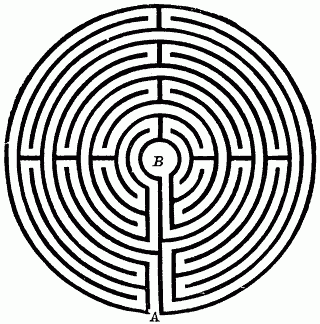
Did you ever consider, what is the difference between a Maze and a Labyrinth? Take a look at these two items:



Forget that one is rounded, the other square. Some folks call both of these Mazes, some call them both Labyrinths. But there is a significant difference. Whatever the shape, a Labyrinth has a single path, sometimes from end to end, but usually from a "mouth" to the center. Whatever the shape, a Maze has branches off the main path, dead ends, whether the goal is the center or an exit. Ergo, you cannot get lost in a Labyrinth!

Suffice it to say, the long-standing principle that all narrative must serve the purpose of pressing toward the goal, a well-written tale is a Labyrinth. Look again at the rounded Labyrinth above. To go from A to B, you'd go halfway there, wind around a bit, find yourself right next to A (if you could see it), then make much more rapid progress. You'd be certain to get there. A good story has twists and turns, and seeming setbacks, but gets to a goal in the end.

In the little maze, on the other hand, if you enter at the botton, taking the right branch takes you on a long, fruitless journey, while the left branch leads you past five shorter side branches, some of which you can discern with a peek around the corner. Now let's look at the smallest possible labyrinth.

This is a 3-circuit labyrinth. Although you must make four turns on the way to the center, there is no backtracking. This and the 7-circuit labyrinth above are of ancient design, and are easily drawn, if you care to try. I put the "starting cross" in dark blue. You draw the cross and four dots, then connect them with loops. The following diagram from The Labyrinth Society shows how to draw a 7-circuit labyrinth.

By the way, the choice of making a left- or right-sided labyrinth is up to you. Mystics who make big hedge or path labyrinths in which to walk and meditate make much of the difference, but you'll find them both ways in all sorts of historical documents.

From a literary point of view, the 3-circuit labyrinth is a fine structure for a straightforward short story; each turn makes further progress with no setbacks. (A typical story by O. Henry is even simpler: a long, straight shot with a quick, neck-wrenching turn at the end)

Many, many novels have a 7-circuit structure. The first path takes you halfway to the goal, then you circle back and forth, getting farther away, to find yourself near "square 1". Another path to the halfway point, loop around, almost make it, take three more loops that lead you farther away, until you are again at the halfway point, a third time, then it's a straight shot to the goal.

The next step in the sequence of "classical" labyrinths is 15-circuit. In Medieval times, other designs arose, and the 11-circuit variety shown here was popular.
These are quite a bit harder to draw. You can find advice galore with a little searching. The Labyrinth Society is a good starting point. While this labyrinth has eleven circuits, they are not complete circuits, but combinations of half-and quarter-circuits that make the path quite complex. There are, as with the 7-circuit labyrinth, four major thrusts toward the goal, but there are many more minor advances and setbacks (31 turns in all). I didn't read enough of Titan to determine its structure, but I suspect it is of this order of complexity.

And this labyrinth, in quadrants, is actually four 9-circuit labyrinths based on a Greek Key. I found it on Joe Edkin's Maze Page. If you take out one quadrant, and "circularize" the rest, you'd have the structure of a large trilogy.

Is life really like this? Can "labyrinthine" formula really match reality? Truly, it is a simplification. Real life is often more like a maze. I daren't consider how many blind alleys I've gone down, and had to backtrack.

What is "real life" anyway? To a person of faith, life has a goal, but we seldom know what it is...of course, heaven is considered a goal, but what is the goal of the life before we pass on? If we learn that at all, we learn it only in retrospect.

Monday, June 05, 2006

Poison Ivy's Past

kw: speculation, global warming, plant growth

The recent reports of the effect of higher levels of CO2 on the growth or poison ivy got me thinking. In short, the present CO2 level in the atmosphere is 370 ppm or so. In 2050 it is expected to be about 570 ppm. At an experimental forest in North Carolina, researchers found that poison ivy grew 150% faster, produced urushiol (the toxic oil) at a 150% greater concentration, and that the urushiol was a more toxic variety.

When I was a child, I frequently got small poison ivy rashes. This was the 1950s. There was no cortisone treatment. We could only use calomel or potassium permanganate poultices. The rash typically could be cleared up in about two weeks. At that time, CO2 in the atmosphere was about 300 or 310 ppm.

So, let's figure. 570/370 = 1.55. (100%+150%)/(100%) = 2.5. There are two likely mathematical models. One is exponential: log(2.5)/log(1.55) = 2.1. This is the model exponent. For simplity's sake, we'll say this model predicts foliage growth and urushiol concentration both increase as the square of the CO2 level.

The other is a linear relationship with a threshold. Plot points at (570, 2.5) and (370, 1), and you find that the slope is 1.5/200 = .0075. Then, 1/.0075 = 133.33, the level of CO2 at which growth and urushiol production cease. The proportionality constant is 0.0075 per ppm.

What do these two models predict for a CO2 level of 310 (when I was a pre-teen)?

First model: The square of 310/370 = 0.70, which is 30% less than 1.

Second model: Decrement of 0.0075*60 = 0.45, or 45% less.

My conclusion: It seems likely that the growth rate of poison ivy was 30% to 45% less than today, during the 1950s and 1960s, and that the concentration of urushiol was also lower by a similar amount. It is also likely that the urushiol then produced was less toxic.

I do know that my reaction to poison ivy has gotten much more severe over the past fifty years. Every case I've had since the mid-1980s required a three-to-four-week regimen with prednisone to clear up. And poison ivy looks bigger than it did then. Since I am much bigger now than when I was 12, it must be really bigger! Bigger and badder...

Thursday, June 01, 2006

Math, around every corner, beneath every façade

kw: book reviews, nonfiction, mathematics

I remember realizing that Geometry and Algebra are the same thing, just using different (very different!) notations. The feeling was one of deep beauty. My lifelong interest in languages, which turned mainly toward formal languages as I matured, was kicked into high gear. Geometry and Algebra are formal languages that happen to have a great overlap of vocabulary; you just need to learn the translations.

But this isn't like English vs French; it is more like written Chinese vs written Spanish. One is entirely pictorial, with nearly no phonetics, and the other is the most phonetic of Western languages...and we won't get into their very different grammatical rules!

As in any pair of languages, Geometry and Algebra have their unique strengths. For example, the geometric proof that one cannot (truly, impossibly can not) trisect an angle using only a compass and unmarked straight edge is rather involved. Recasting it in Algebraic notation, we find that all the operations that are possible with those tools are solutions to linear or quadratic equations...that all means every single one! So geometrically, taking a square root is easy, nearly trivial. But no higher roots can be extracted using an unmarked straight edge. Algebraically, we find that trisecting an angle requires the extraction of a cube root. QED: no geometric trisection is possible.

Later, much later, once I'd (mostly) mastered "college calculus" and (finally) passed the required course in Differential Equations, I realized that I was conversant in four notations for Differential Calculus. These are very consonant, like dialects rather than distinct languages. But each has its strengths also. I prefer "prime" notation to perform implicit differentiation, for example, although I know how to do so in all four.

Fortunately, along the way, I got fully decompressed from high school and college freshman levels of calculus, and realized that the real power of calculus, and of all mathematics, is in learning how to pose a question. A properly posed question literally drags you towards its appropriate solution.

In Letters to a Young Mathematician, Ian Stewart, FRS and a professor of mathematics, drops all of the above bombshells and a great many more, in a most engaging way. His stated intention is "to give an inside view of the mathematical enterprise, and to explain what it is really like to be a mathematician." The work I do requires me to be a working mathematician, sort of a mathematical journeyman. Author Stewart hits every nail square on the head. I kept saying as I read, "Exactly!"

The scope of the book is really remarkable. The author doesn't go over the mathematical landscape in the ordered way we learned as kids: numbers, fractions, ...algebra ... calculus ... and on to things whose name we can never remember. He likens it instead to an inverted pyramid, a 3-dimensional structure, then pops all over the place, including several of those disciplines whose name I forget before the end of the sentence.

Fortunately, he doesn't mentions such things just to impress or awe, but to show connectedness; and he always has a bit of explanation so we at least find out what it's about.

This isn't just a book for mathematicians. I think it especially useful for young people of the "I HATE Math!" variety, to open for them a window onto the breadth and beauty of mathematics. Math (Maths if you're from the UK) is (are) all about patterns, and the fundamental mathematical activity is to operate on some entity to transform it into an item that is more useful or easier to understand. In other words, mathematical operators are Verbs, and the Nouns they consume and produce are numbers, functions and formulas. Thus, learning and performing music are mathematical activities, as is learning the grammar of a new language or following a cooking recipe.

Mathematics takes place in the background, but it underlies everything. Math is how the universe works. Just as we aren't all auto mechanics, but most of us drive cars, so few of us use math in an explicit way, but we do mathematical things all the time without realizing it. Professor Stewart, great mentor that he is, shows us just how much that really is.

Wednesday, May 31, 2006

That old Climate may be pretty nimble...

kw: book reviews, climatology, history, anthropology

One of my brothers, a Mayan archaeologist, was interviewed for the Discovery Channel a couple years ago. He told of the destruction of the forest around Palenque because the Mayans used huge quantities of charcoal to make stucco. All their buildings are plastered with several inches of stucco, perhaps as insulation.

Among more than a hundred theories about the destruction of the Mayan civilization some 1100 years ago, regional drying and crop failures are a prominent part of many. Regional or global climate shifts have been proposed only recently.

Among the many factors one may list, we must take account of a major dry period in all of Mesoamerica from about 750 AD to about 950 AD. Civilizations are defined by their mass effort to mitigate the effects of bad periods. They stave off droughts and other disasters, even ones that may last a few years, as the U.S. survived—though with much suffering—the dust bowl years of the 1930s, and as Joseph's Egypt was able to survive a 7-year famine around 1900 BC (with divine forewarning).

No civilization has survived a 200-year drought, though the Mayans came close: the Mayan collapse occurred in three phases beginning in 760 (about ten years into the drought) and ending about 910. Had they hung in there for another generation or two, they'd be a major civilization today.

The details needed to pin down such stories are found in abundance in The Winds of Change: Climate, Weather, and the Destruction of Civilizations by Eugene Linden. Note carefully, the word "Civilizations". This book does not forecast "the destruction of civilization", but reports on the destruction of a number of civilizations in the past, and points out the environmental and climatological influences that coincide with them. While one coincidence does not imply causality, many coincidences of the same type make a strong case.

Author Linden presents his material as a case, with opening arguments, presentation of evidence, cross-examination and rebuttal, and closing arguments. This format leads to some rather dry reading. Fortunately, much of the book is well and stirringly written, and he makes a good case.

It is a puzzle that, as an increasing majority of scientists agree that climate can change rapidly and violently, has done so in the past, and appears to be on the verge of doing so in our lifetimes, public and media complacency—even denial—are at an all-time high. To most people, "long term planning" means at most five years. Most retirement advisers work with a horizon of thirty to forty years. Futurists, even my favorite, Bruce Sterling, write about the next fifty years with great frequency, scarcely about longer periods. Few folks can think in terms of something global in scope and multi-generation in effect. We need stories with more immediacy.

So, I really like these articles about poison ivy: Global warming may aid poison ivy and CBC News: Poison ivy itchier when carbon dioxide levels increase. Even if we freeze CO2 production at current levels, the atmospheric content will rise from the current level of about 370 ppm (0.037%) to 570 ppm (0.057%) by 2050. At that level, poison ivy in an experimental forest with extra CO2 gas in the air was found to grow 150% faster each year, compared to plants grown without the extra CO2, and they contained 150% more urushiol, of a more toxic variety.

Let's work this out: 150% faster means for each pound of poison ivy in Forest A, Forest B produces 2.5 pounds; 150% more urushiol means each pound of leaves contains 2.5 times as much of the stuff. Put it together, and Forest B has 2.5x2.5 = 6.25 times as much urushiol production per acre! And the icing on the cake? Urushiol is a mix of oils of varying toxicity. Forest B urushiol has a larger proportion of the worst oils.

In Japan, this might be considered a good thing, because they use urushiol to make the lacquer for lacquerware (the lacquer isn't toxic), and to paint all those lovely temples and palaces. For the rest of us, forest burning anywhere will create six times as much toxic smoke. My wife has caught bad rashes from dried leaf bits blowing around. More CO2 means an itchier future. That hits home with me more than an extra meter of ocean water.

"The Winds of Change" sounds an alert. The author is not being alarmist. He is frustrated at our case of galloping apathy. Perhaps, to paraphrase Ronald Reagan, to keep a car that is getting bogged down off one side of the road from falling further, it is necessary to plant oneself firmly on the other side with a tow truck, and pull HARD.

It is now known to everyone who cares to look, that past climate changes have been abrupt and violent. The "Little Ice Age" of the 14th-18th Centuries was less violent than most, yet it caused widespread misery, appalling death rates, indirectly fostered staggering epidemics, and changed Western society permanently...another century and the Renaissance would have died aborning. Dare we neglect signs that the climate is about to make a major switch?

Tuesday, May 30, 2006

Kneeling a Mortal Sin?

kw: opinion, faith, spiritual practices

I heard this morning that the Pope recently left it to Bishops whether to continue the practice of kneeling during mass. This is apparently a result of questioning the practice as being due to feudal influences in the medieval church.

It is a bit older than that... In Isaiah, God says, "every knee shall bow to me...", which Paul quotes in Romans. Paul also wrote to the Ephesians, "...I bow my knees unto the Father...".

If kneeling to pray is a mortal sin, it has always been so, and if it was not a mortal sin in the past, it is not one now, nor ever shall be. The real influence is some folks being influenced by The DaVinci Code, which we must remember is a work of fiction (and pretty poorly researched fiction, at that).

Saturday, May 27, 2006

Big Brother in your pocket, your shoes, your car's tires, your shirt's designer label...

kw: book reviews, nonfiction, technology, surveillance, smart tags

In the keywords, I almost wrote "nonfiction...sadly". There is no fiction in the book. There is a bit of extrapolation, very close-in, sure-thing extrapolation: car going 100, already missed a turn, ten feet from impact with a fire hydrant...conclusion, we're going to get wet and somebody's headed for a major ER visit.

Catherine Albrecht, founder of CASPIAN, and Liz McIntyre, CASPIAN's communications director, sound alarmist in their new book SPYCHIPS. Full title of the book: SPYCHIPS: How major corporations and government plan to track your every move with RFID, and CASPIAN stands for "Consumers Against Supermarket Privacy Invasion and Numbering". Only, it ain't just supermarkets, folks.

They only sound alarmist. Compared with the magnitude—and current reality—of the threat, they are mild-mannered, harmless kittens. Fortunately, they aren't that harmless, and have forced major corporations to back down from plans to implement spy-chipping endeavors...for the present.

What is the threat? Let's take it a step at a time.

What is a spychip? There are two kinds. The cheap variety are little passive transponders: when a radio signal of the right frequency, and strong enough, is present, they take power from it and broadcast on a very close frequency their ID code, and perhaps other information...perhaps lots of other information. The more expensive variety are active transponders. They contain a battery. The most familiar are highway toll transponders, such as EZ-Pass in the Northeast US. They can respond to a weaker signal; they broadcast a stronger signal with their ID code, and probably other information as well.

Passive chips, depending on frequency and efficiency, can be "read" at distances from a few inches to two or three feet. Active chips can be read much farther, from ten feet or so to a mile or more.

Such chips can be little. The chips themselves are the size of a sand grain or smaller. Their antenna makes them larger. The low-frequency ones, like my company badge that opens the door to my office building, are the size of a credit card. The ones that work in the UHF band (off the end of the TV channels) can me half an inch long, and no wider than the wire to your IPod earphone.

Scenario one: Are you a Texan? Got a TranStar toll transponder? Like those discounts? Houston gets a lot for the discount it offers you. Ever notice, on the highways around Houston, there is a sign bridge every four or five miles...even where you'd think none is needed? Every car passing under those signs is recorded, using its TranStar. That explains why the TranStar needs replacement every year or two; the battery is getting a lot more use than you bargained for! This isn't fiction; it is happening now.

Scenario two: Since mid-2005, did you buy any Levi's in Mexico? So far, it is just one store, but you just might find a chip inside one of the labels...drop this search string into Google for more details: +frontline +levi +mexico +rfid .
Chips that can hide behind the alligator label on your designer shirt can be read from a foot away or so, just far enough that every store in the mall _could_ have a reader in the doorway, and thus be alerted to the presence of that shirt. Point-of-sale information, which the stores can all buy cheaply, will attach your name (or the name of whoever gave you the shirt for your birthday!).

I have "loyalty" cards for several local grocery stores. At the moment, they are all bar-coded, and contain no chips (I've checked). But whenever I use one during a purchase, the receipt is very diligent to print how much I've saved in the current year by using the card. It's dollars and cents, folks! My stores know everything my family has eaten, for years already. All they have to do is collate their datebases. As an expert in that field, I know how easy this is.

Within a couple years I expect these grocers to issue replacement cards, that offer "added benefits." They won't mention that the benefits are all on their own side! They'll have chips. At that point, my family and I will be faced with a decision: How badly do we value the privacy of our eating habits? Are we ready to return to paying cash for everything? Are we willing to go to the trouble to create a false identity with which to set up the "loyalty" account? (child's play, by the way)

How long will it be before we come under pressure to have chips implanted in our bodies? The story will be about public safety, but the real reason will be surveillance. Big Brother in your armpit, or up your butt, or somewhere...

Most of us are descended from patriots who threw a few thousand dollars' worth of tea into Boston harbor over a tax raise. How many of us are willing to revolt over a technology that will with total certainty lead to 24/7, minute-by-minute recording of our lives? Oh, it will be gradual, but it will be relentless.

You know, I've only touched on a few points from the book, and I'm already boiling again. I have a story from history we would all do well to heed.

John Bunyan, author of Pilgrim's Progress, wrote of a dream in which he conversed with the Devil. Satan said, "I'll get you, you know." John stalwartly replied, "You can't. I'll fight you at every turn." The Devil said, "Oh, I don't need to fight. I'll be very gentle, and gain you very gradually, like a mother lulling her infant to sleep."

Let us remember that governments and corporations live longer than we do. They can afford enormous patience. Freedom can't be retained on autopilot. The battles must be fought again and again.

See these web sites for more information, and some ideas you can put into practice: http://www.nocards.org/ (CASPIAN) and http://www.spychips.com/ .

Wednesday, May 24, 2006

Is the universe big enough for more than one god?

kw: book reviews, science fiction, deification, super powers

In the Mormon doctrine of deification (theosis or exaltation), as commonly understood, some of the really, really good folks become gods in their own right, and are given (or make for themselves) private universes in which to rule. I don't know whether Robert Reed is a Mormon, but deification is the premise of Sister Alice. Though such divinity is achieved by technology—a technology a few million years more advanced than our own—it results in beings that can, and do, destroy stars and galaxies.

Something I have yet to see in an SF novel is a clear indication of the huge energies involved in relativistic travel. Say you are satisfied to poke along at half the speed of light. To accelerate a ton of material to 0.5c requires at least the total annihilation of about a quarter-ton of mass. If you can't do total annihilation, by using antimatter for example, then, considering that hydrogen fusion uses up 4% of the mass, you need the output of a fusion generator burning five tons of hydrogen to helium...as long as you don't carry the generator with you! Want speedier? Going 0.99c requires 7 tons of total annihilation, or the conversion of 140 tons of hydrogen. You can get pretty close to light speed if you can manage to gather the total output of the Sun for a year or two, with perfect efficiency of propulsion.

OK, you endow a bunch of people (a thousand families, in Reed's novel) with technologies that allow them to manipulate power on such a scale. Now what? You get a bunch of demigods, and a handful of genuine gods. What do they do? They realize the universe isn't big enough; any one of them can boil the galaxy away on a whim. Thus far, they've exercized sufficient self control (for the past several million years, anyway) and the galaxy is intact. So, they set about making another universe. They become creators. Some of them, at least, will be able to have a private universe to play around with.

Reed's writing is called "high concept" by some reviewers, and I guess they mean it for praise. As I understand it, high concept means you can summarize the story in a sentence, and the execution relies on dressing it up with sufficient twists of plot to make the result less than obvious. High concept stories usually sacrifice character development for literate agility. Fortunately, Reed is better than that, and the five novellas that string the story together have sufficient scope for his characters to breathe a little.

The novel is galactic in scope, even intergalactic (there is no good adjective for a scope that includes a couple of galaxies of the Local Group). The term I prefer for the genre is Universal Saga, and its best early purveyor was Olaf Stapleton.

I plan to read more of Robert Reed's books (he has ten to date).

Monday, May 22, 2006

People as they oughta be...perhaps

kw: book reviews, fantasy, paranormal powers, otherness

Few are the tales I re-read. Fewer still the ones I re-enjoy time and time again. Zenna Henderson's "People" stories are among those elite few. Many think them too sentimental, even mawkish. They suit me perfectly, perhaps because I'm a very sentimental bloke myself. Others decry the open piety of the People, which is often contrasted to narrow, bitter fundamentalism...but not always: where the People encounter "earthlings" of genuine piety, they are welcomed as people of faith.

Considering that most "christian" religion consists of wholly unbiblical sentimentality (who hasn't heard, "Oh, a loving God would never do that!"?), and that fundamentalism is typically insecurity in disguise, it is no surprise that publishers prefer writers who never mention religion. It is almost true that "rational Christian" is an oxymoron...almost.

Zenna Henderson's People seem to me like Mormons without the polygamy, but with super powers, which they wisely keep in check. They are unfailingly reserved, unwilling to inflict their difference on an unknowing populace, and even less willing to become subject to curious (tending to hostile) scrutiny. As she came from a Mormon background (see the Wikipedia biography), this makes sense.

The 2005 printing of Ingathering: The Complete People Stories returns these classic tales to print after a generation. Paranormal powers—telepathy, clairvoyance, telekinesis, levitation—are the most common fantasy element of otherwise "science fiction" stories.

The growing field of universal saga SF, which deals in epic, mythic-scale story lines and ultra-technological (though largely undescribed) toolkits, commonly "explains" superpowers via the high-tech kit. Ms Henderson's People have powers that aren't explained at any level, they just are.

To use an analogy, most fish sense sound and vibration, and a very few create sounds they use for echolocation, like bats; only toothed whales also use sound as a powerful weapon. To a fish, the sonic stun beam of a dolphin must seem like a super power. To the dolphin, it's a useful hunting weapon, normal as can be.

The root of all of Henderson's stories, of the People and otherwise, is coping with being different, whether as an individual or as a social minority. Her last People story, "Katie-Mary's Trip," faces People differences with the Hippie counterculture (which she consistently misspells "hippy"); two "different" groups are thus contrasted. To me, the effort fails in this case. She couldn't get inside the hippie mind, as she could both the People mind and that of their persecutors (These last bear a singular resemblance to those who persecuted the Mormons in the 1840s).

The rest of her stories succeed, often wildly. They take the "aliens among us" theme from the angle of the alien, trying to live unnoticed in a very different world. There are more ways to tackle this notion than you might at first imagine. Setting aside "bridging material," there are seventeen stories in this collection. Sixteen at least are gems.

Thursday, May 18, 2006

De-Disneyfying the "King of the Wild Frontier"

kw: book reviews, nonfiction, biographies, history

How many legends circle around to meet their model in his lifetime? He never figured out how to spend within his means, partly because he so seldom had any; he had way too many kids (9) on little or no income; he was elected three times to Congress, but wholly ineffectual as a legislator. Yet he was an enormously popular public speaker; a spectacular marksman and hunter (nearly no 21st Century person will ever see in their lifetimes as many deer, bears, and wild turkeys as he killed in a single year); he published three books, two of embarrassingly poor quality and one that is still a classic; and it is accurately said that David Crockett was the first genuine American Celebrity, the most popular man of his generation. It is also pertinent to observe that, had he lived through the Alamo slaughter, he'd likely be mostly forgotten today. Like Samson, he became greater in death than in life.

To me and my schoolmates and siblings, Fess Parker was "Davy Crockett, King of the Wild Frontier." We all had "coonskin" (dyed rabbit skin) hats. We sang the song. We went to Disney's Frontierland in Anaheim.

Buddy Levy has slogged through a huge mass of material, in particular cross-checking and corroborating the things Crocket wrote about himself, and has produced a powerful biography, American Legend: The Real-Life Adventures of David Crockett. Crockett was not only a champion woodsman, hunter, and orator, he was a champion spinner of tall tales. More than a few are found in his "autobiography."

How to encompass a character whose fame barely fits the continent?
Historians have tried! Tens of thousands of pages in hundreds of books and thousands of learned articles...with the total growing daily. Fortunately, Author Levy has boiled it down for us. The portrait that emerges is a man of nearly incurable optimism, who suffered frequent reverses of fortune, a series of spectacular rises followed by equally stupendous descents.

He was a sore loser, but not the kind to hold long grudges; given to pushing ahead even harder than before. He embodied his motto: "Always be sure you are right, then Go Ahead!" Trouble is, he seldom had a good take on what was right, or perhaps among the various "rights" he had to choose from, he typically chose the most contrary.

I've read some pretty hefty chunks of Crockett's prose (and of course I know it was edited by his friend Thos. Chilton), and no historian can match the style. I nonetheless find Levy's writing quite readable anyway, quite a bit better than most histories. Good research, well presented.

Monday, May 15, 2006

Just how many people really need "high-def" music?

kw: opinion, music, digital music

In the recent CNET News.com article
Syncing high-def music with digital generation, Staff writer Greg Sandoval reports on efforts to distribute lossless music, challenging the "terrible sound" of mp3 files at 128 Kbps.

My experience with mp3 files isn't that clear. Yes, there's a lot of junk out there, whether purchased, ripped, or pirated. But I know few people who can hear the difference between an mp3 at 128K and the CD from which it came. I am a musician, and only in the most exacting situation, in a room with superior acoustics and using exceptional equipment, can I hear the "details" that certain audiophiles make so much of.

The difference in enjoyment is too small to warrant the trouble, for me. I suspect this is so for all but a few people that I consider overly picky.

I grew up with vinyl, and a CD track played on almost any player is superior to vinyl on equipment costing a BMW or two. An mp3 file played with my computer or an iPod is still better than the best vinyl.

Sunday, May 14, 2006

Living the Kingdom of God in the 21st Century

kw: book reviews, nonfiction, christian faith, spirituality

About a hundred years ago, God began moving among young Chinese, many with a British or American missionary upbringing. Some, like Henry Nee (later Watchman Nee), were from third or fourth-generation Christian families. Once they began to follow Christ as teenagers and young adults, they asked, as young Christians do everywhere, "Why are there so many competing 'churches'?" and "Why are God's people so inert?"

Nee and his coworkers, primarily Witness Lee by the late 1930s, were used of God to recover a church life and practice that was nearly unknown among Western Christians, and remains very little known today. The local church life, based on oneness in any locality, on the indwelling Spirit of Christ, and on the vital actions of every member, produce a revolution among Christians in China and throughout the Far East since the 1920s, and in America and Western Europe since the 1950s.

Historically, the difficulty with retaining the freshness of any move of God centers on the lukewarmness that enters with the third or fourth generation. The first generation can often gain their children in large numbers, but the generations following gradually lose the first love, and the sad history of Ephesus is repeated: God warned them in "Second Ephesians", found in Revelation 2, that they were at risk of losing the lampstand, the testimony. God's testimony requires love. Ephesus did lose their testimony, and the city exists no longer.

I entered the local church life in 1972, and have since participated in the second, third, and fourth generations of its expression in the United States. That fourth generation is embodied in the grandchildren of my generation, and their condition is very sad. Fresh love for the Lord is very scarce. They find "church" boring. We are at risk of becoming just another denomination.

We once thought we would be the generation that saw the Lord's return. Now we are not so sure. I have sometimes asked myself and others, "If the Lord sets us aside and turns to others, what will it look like, and how will we know?" Privately (and now publicly, since you are reading this), I believe that from our side it looks like what we see around us in the local churches I know. There are wonderful things happening in a few localities, and there is much joy among us who have known one another for so many years, but we see the darkness falling.

From others' side, what it looks like just may be the experiences presented by Shane Claiborne in The Irresistible Revolution: living as an ordinary radical. These people are at a stage similar to the young Chinese brothers in the 1920s, and the church life I experienced in the 1970s in California. At that same time, however, there was a lot of activity called at the time "The Jesus Movement," which came to nothing. I hope these folks do better than that.

When I got the book, I didn't notice the Zondervan imprint. I wasn't actually expecting a Christian testimony, it was just strange enough to be my "wild card" book this time around. What I got was a breath of fresh air. People of God everywhere are casting deadness aside and trying out the dangerous freshess of living what they see in Acts and the Epistles. God likes that.

Oh, I could quibble with some of the author's interpretations. I'll just mention one, because this understanding and the vision that accompanied it were largely responsible for the turn I made in 1972. Most believers think the parables in Matthew about the mustard tree and about the leaven in the dough are positive, something to do with the growth of the faith. The saints in L.A. helped me see, by showing me the mustard on the hillsides, and its use as a salad herb, that the great tree grows contrary to its nature. The "fowls" nesting in it represent evil things coming in as a result. Thus, this parable and the one following, of the leaven, predict the damage the so-called Church will do as it grows in power rather than life. The evil birds and the sinful rebellion and pride (leaven) contaminate the testimony of Christ (the gentle herb and the fine flour). This is important to me, but God can use someone regardless how they interpret these particular parables.

Author Claiborne and his companions in Christ are, as my companions and I did thirty years ago, "being the church" and "doing the church". Read the book, then read more at the simple way. If you dare, visit the Kensington area of Philadelphia and see for yourself.

Thursday, May 11, 2006

Psychic kitty strikes again (Cat Who #28)

kw: book reviews, mysteries, cats

I haven't kept track, but I've read nearly all the Cat Who mysteries by Lilian Jackson Braun. The latest is The Cat Who Dropped a Bombshell. When I got this book I did a little digging, and found that Ms Braun wrote the first one just forty years ago. It seems she published three in quick succession, made quite a name for herself, then spent almost thirty years as a newspaper columnist and editor ("Good Living" section for Detroit Free Press) before writing another. The lastest is the 28th!

For anyone who hasn't yet enjoyed Koko and his rich owner, start with "The Cat Who Could Read Backwards", then go to a website such as The Unofficial Lilian Jackson Braun Fan Club so you can read them in sequence. The early ones, in particular, hang together better when read in order.

Premise: a discouraged journalist in middle age, a man of striking appearance and sympathetic mien, gets a couple of Siamese cats, quite reluctantly. His rich aunt dies and leaves it all to him, if he will live five years (generously provided for in the trust fund) in the little town of Pickax, county seat of Moose County, "four hundred miles north of everywhere." Each book contains a murder or two that he solves, or helps to solve, aided more-or-less subtly by the male Siamese, Koko. Koko does catlike things, things like pushing books onto the floor, tearing up photos, or just looking at someone fixedly, that put ideas into his "owner's" head.

With a murder or two to be solved per book (three in this one), one might imagine a small place like Pickaxe would soon be depopulated. The author must share the concern, for she imports many of the victims from nearby towns or from among tourists. Since the books cover a span in Koko's life of about eight years (so far), the rate of about four murders per year would make it less popular as a tourist haven, I would think.

No matter. Pickaxe, Moose County, Lockmaster, Brrr, and the surrounding locales are charming, most of the books' characters are gracious—or at least have a heart of gold under their eccentricities—, so that there is plenty to enjoy. These are not blood-and-gore mysteries. The murders are verly lightly drawn. The focus is instead on their solution via cat-ESP or whatever, and upon the details of small town life that produce the books' lovely ambience.

Tuesday, May 09, 2006

Ancient and old gods and heroes

kw: book reviews, fiction, fantasy, contemporary mythology, poetry

"Whom the gods would destroy, they first make mad" —Euripides.

I think we're all a little mad. Why else the intoxicating pull of tales of gods, demons and heroes; of titans and mad tyrants; of deals made with—or without—the Devil? It makes me think of Mao's aphorism on the Dragon: "You pray for the True Dragon to come/When the True Dragon comes, you don't like it" (my own translation of his overly-stylized Chinese).

Sonya Taaffe writes in Singing Innocence and Experience of modern lives colliding with the mythology of Greek and Jew. Orpheus, dismembered now a trilennium, sings still of Euridike; the Devil keeps a hard school (moreso than Franklin's "nature") and still takes the hindmost; a golem, Pinocchio-like, wonders about being human; a unicorn must still submit to an Innocent...but what if the hunters don't accompany her, and he moves in?

I'm reminded of a song by Terri Gibbs:

"Somebody's knockin', should I let him in?
Lord, it's the Devil, would you look at him!
I've heard about him, but I never dreamed
He'd have blue eyes and blue jeans..."

Ms Taaffe's summers on the dissected Maine coast, so like the island-studded Aegean, engendered a unique voice for the seacoast setting of most of her stories. I used to wonder why Greece and Rome had such similar mythologies (I once learned quite a long table of name correspondences: Zeus=Jove, Hera=Juno, Hermes=Mercury...). How the Greek island and seacoast culture could spawn myths so similar to those of the malarial, miasmal swamps that surrounded the "seven hills." Certainly the Norse myths suited their landscape, as the Hebrew myths and Kabbalah did theirs.

Then I learned that their old stories descended, through the Etruscans, from family legends of the exploits of Nimrod, his mother/consort Semiramis, and their offspring. The more I learn of mythologies in any culture, the themes are the same, and devolve to a single principle: Ask yourself, "If I had the power of a god, what would I do?" Answer: you'd behave very childishly, as do the gods of every myth system, and godlike emperors and dictators everywhere. Responsible behavior is found in myths only among mortals, and is darn rare even there.

So it is with the author's immortals the the mortals who encounter them. Capricious, amoral (or better, nonmoral), unheeding, planless. If you have forever, can deadlines (and how apt the term is!) matter? The mortals in such stories are young, young enough to think they'll live forever, which attitude I recognize in every teen (and all too many alleged adults) I know.

The themes are ageless, nothing new under the sun, as Solomon was not the first to note. The modern twist is often arresting, but what makes these stories and poems compelling is the style, the use of language, of a classicist learning to breathe new life into old themes. She succeeds.

Battle of the Sexes: males 1, females 0, children 0

kw: opinion, sociology, parental responsibility

Yesterday (Monday, 5/8/2006), on the Michael Smerconish show on WPHT 1210 in Philadelphia, some new laws were debated. Recently Florida, following 16 other States, introduced a law absolving men from child support for children who are not their biological offspring.

Michael debated in favor of the law and his guest, a woman whose name I can't recall, debated in favor of current law, that a man is responsible for a child he has been raising, regardless who is the biological father.

I won't get into the debate. Rather, I noted that the debate was a perfect sociological vignette: for women, the welfare of a child trumps everything, while for a man, personal interest is paramount.

If people were lions, there would be no stepfathers: the female's new mate would eat, kill, or drive off her existing offspring. When a new lion cub is born, the male can tell by smelling if it is his, and if it isn't he eats it. Other species exhibit similar behavior.

Humans are social animals. Thus, it is (usually) safe for a new mother to hand her infant around in a group, to be cooed and admired by each in turn. It is also (usually) safe for a single mother to marry.

Why the "usually"? Some men are more like lions than others...so are some women. The "fairy tales" of evil stepparents are based on grim reality. Grim but, fortunately, rather rare.

Saturday, May 06, 2006

What are we doing to some of the Best among us?

kw: book reviews, nonfiction, police work, detectives, sociology

In rare cases, I will overlook ugliness and vulgarity. The fact is, street people are frequently ugly and vulgar, particularly criminals; detectives work mainly with street criminals; to learn something of their lives, I must look (peek) unflinching into the world they inhabit. Street Stories: The World of Police Detectives by Robert Jackall makes police detectives the subject of sociological scrutiny. "The Professor" spent several years in their world: in the "houses" of several New York City precincts, alongside them in their work, studying the files and archives, and probably making a bit of a nuisance of himself, as sociologists must do.

The bottom line for me (as it seems to be for Jackall): the bosses and their political machinations are frequently a bigger danger to society than the "criminals". Sure, some cops go bad, some whole departments go bad. At times, policital machines have suborned entire police systems. But most police and most police detectives are dedicated though jaded, honest but cynical, and incorruptible in the midst of vast corruption and venality.

As I read of their work, I found myself asking, "How can we do this to them? What are we turning these good men and women into?" Consider this list, from Chapter 5, "Squad Work", of the events in a typical four-day duty tour by a Transit policeman during the early 1990s:

  • One armed robbery by a single suspect seeking cash
  • Two or three robberies by groups of suspects taking sneakers, earrings, and other accessories
  • Three token booth robberies

And in a typical four-day tour "aboveground" by a Midtown North squad detective during the same years:

  • Two assaults on homosexual "johns"
  • A handful of tourists conned by flim-flam artists
  • Extortion for "protection" in a local bar by huge men with gravelly voices
  • A corpse in a flophouse
  • A knife slashing outside a trendy nightclub

Further uptown in Manhattan, a detective in the 34th precinct might encounter, in a four-day duty tour:

  • Two aggravated gun assaults
  • One armed extortion
  • A knife-wielding derelict
  • A bookie, "shaken down" of his receipts
  • Someone jumping from the Geo. Washington Bridge, who may have driven over from Kentucky to do so
  • One drug-related killing

For each of these three examples, multiply by the sixty tours in a year...is it any wonder police detectives are tired, jaded, cynical about human nature? How many of us witness a single armed robbery in a lifetime? See a corpse anywhere but the open casket at a funeral? Meet up with any of the darker denizens of the streets, of any size or voice quality? When my parents were in their early seventies, they were followed home from a restaurant and confronted by a young man with a gun as they opened the garage and got their mail. Mom threw the mail at him and they both screamed and shouted at him. They are lucky he panicked and fled... The only such event in two long lives.

The later chapters of the book open another window on the political and "legal" wrangling and ambiguities that detectives confront once they have "solved" a crime (and 50% is a very good record). I didn't get a good idea how many cases are solved on the street only to be lost in the office or courtroom, but it seems to be substantial. I don't have any trace of an idea what to do about it, either. People say "The justice system is broken." Well, sort of, except there really isn't enough of a system to break. If we could apply systems thinking to justice and criminality...worth a thought (by people capable of thinking; getting elected removes all though from the brain).

Author Jackall, "the Professor" to the detectives he followed, has done us all a service, if we will heed it.

Wednesday, May 03, 2006

Sandblasting your Senses

kw: book reviews, nonfiction, essays, poetry, illustrations

The book jacket blurb from the Seattle Times reads, "When Margaret Atwood is good, she's very good. And when she's barbed, she's better." So I can't say I wasn't warned.

Atwood's little book The Tent is touted as an essay collection, and it mostly is. A few chapters are poems in free verse. I read these little pieces at odd moments while reading other books. Whether she's rebuking photographers of all ilk as papparazzi, looking at orphans from a round half-dozen viewpoints (except their own...), or recasting old fairy tales to comment on society and politics, she has her stompin' boots on.

Perhaps she's working at filling the shoes of Dorothy Parker—though reading between the lines, Atwood's done better at love. Or perhaps, instead, those of Alice (Roosevelt) Longwood, of the famed pillow reading, "If you don't have anything nice to say about anybody, come sit be me." Her illustrations are an odd cross between Egyptian temple art and Dr. Seuss.

Her voluminous prior writing, both fiction and nonfiction, covers quite a spectrum, and can be warm or dry, bitter or humorous, so this little volume may simply be, as the last line in the book reads, "...the right thing to do on the darkest day of the year."

The man who would be prophet dare not miss.

kw: book reviews, nonfiction, economics, demographics, forecasting

This book took a week to read, and a couple days to think over. In The Next Great Bubble Boom: How to Profit from the Greatest Boom in History: 2005-2009, written in 2002, Harry S. Dent, Jr. forecasts a boom in the last half of the decade, followed by a significant recession, or even a depression, of about 14 years' duration. He rides on his credentials as the one who forecast the economic ride we had in the 1990s.

So is he right this time? Or is it as Churchill said, "Even a fool is right sometimes." Author Dent's main thrust is the demographic changes that America and much of the world will go through as the Baby Boom generation finishes its climb to the peak of economic power, then goes into retirement, followed by the smaller, and thus less powerful, echo boom, the X generation.

I am certain there will be a significant impact. Whether the reduction in the need for goods and services will be greater or less than the reduction of workers available is another question. In other words, we know demand is going to reduce, probably from 2010 until the early 2020s. Will the job market shrink more than the working population, leading to rampant unemployment? Will the working population instead contract the more rapidly, leading to a surplus of job and business opportunity?

The demographics are pretty clear. There are many studies of the expected population trajectory for most countries, and of the economic rise and decline of typical individuals as they age into the work force, buy houses, raise families, retire, and "fade away." The use we make of such data requires a more rigorous mathematical basis than it receives at the hands of economic forecasters.

For example, the author shows that for the average American, spending is the greatest around age 42. Then he takes the birth curve of the 1940s to 1960s, projects forward 42 years, and shows it as an economic projection. However, that curve has a rather broad peak, and is skewed: rapid rise, slower fall with aging.

To properly combine a spending curve with a changing population curve, the proper mathematical tool is convolution, AKA cross-correlation. Only a convolution of spending with age, and the numbers at each age over time, will properly predict an economic trajectory.


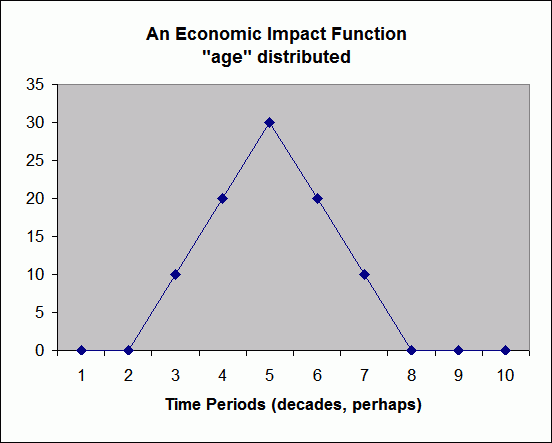
An extremely simplified model shows the principle. This chart shows a population bubble: an otherwise steady birthrate of 10 (thousands, millions, whatever) per time period (years, decades...), rises to 25, then drops again to 10. We'll call this the Birth Function.


This second chart shows economic effectiveness (on whatever scale you'd prefer to measure it) as it rises then falls with age. Supposing these time periods are decades: earning "enough to care about" begins in the 20s, rises to a peak in the 50s, then falls to "too little to care about" in the 80s...on average. We can call this the Spend Function.

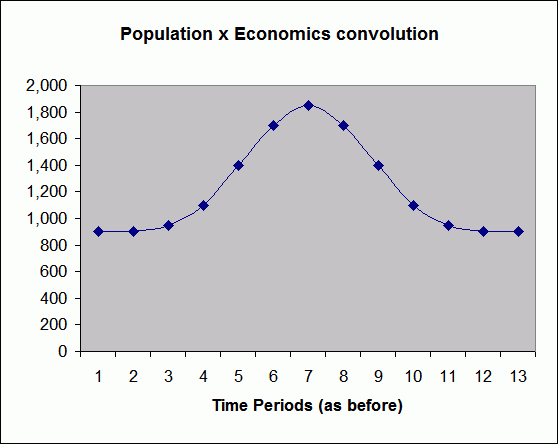
You may of course get more complicated schemes, with differing trajectories (and impact levels!) for rich, middle, and poor "classes." Regardless, the homogeneous economics-with-age Spend Function function is convolved with the Birth Function to produce our result:


This chart shows that the convolution is not as sharply peaked as the two functions that produced it. The time scale is different also; this Economic Impact Function covers about an amount of time equal to the width of the Birth Function and the width of the Spend Function.

The Birth function and Spend Function both fall from a peak to the baseline (10 in the first case, zero in the second) in three time periods. Their total width is the same, six periods.

The total width of the Economic Impact Function, the convolution, is twelve time periods. However, because it is more 'curvy', it really has a significant difference only over about eight time periods, so the fall from the peak to the effective end covers about four periods.

Now, given the many other factors that affect a national market over various periods of time, there is a lot of noise masking any signal we'd like to discern. Specifically, if the month-to-month variation in a market signal is a few percent (10% is common for the DJIA, for example, from any month to the next), it can take a long time to pick out a long-term trend.

Thus, we may expect the US economy to turn downward around the end of 2009, and it very well may. However, it may have market peaks and valleys that make it hard to determine the fall has really begun for several months. Major market slides take a couple years to work out. Only in retrospect can we say, "The downturn was such-and-such a date."

Harry Dent's book is interesting, informative, and gave me a lot to think about. I like his ideas, though I think the analyses view some noise as though it were a signal. That's where I'd put Elliott Waves, on which Dent spends a chapter. Bottom line: the Boomers and the Echo Boom can be expected to make the world economy ring like a bell for about a century to come. When you expect a downturn, how do you prepare? Best way known: start a business that caters to those you expect to have money anyway.

My grandfather, once a salesman, later a piano tuner, began renting and leasing used and repaired pianos in the 1930s. He figured almost anyone would go for having a piano if it only cost them a dollar or two a month. Everyone needs entertainment, and radios then cost a lot. He was right, and continuing piano rental receipts provided my grandparents a very comfortable retirement, including two vacation homes.

Harry Dent makes me think. I like that.

Thursday, April 27, 2006

A Fresh Breeze and Spring in Your Step

kw: book reviews, poetry, aging, humor

Perhaps best known for the children's book, Alexander and the Terrible, Horrible, No Good, Very Bad Day, Judith Viorst is at her most delightful best as a poet. A few years back, her Suddenly Sixty (and Other Shocks of Later Life) provided fuel to the cry, "Sixty is the new Thirty."

Her latest, I'm Too young to be Seventy (and Other Delusions), continues the tradition. I think as a children's author, she has remained better connected with the RIGHT NOW mind of a child, and clearly sees how the luckiest of us recover such a mindset once we're old enough to be free again.

Her poems are short, which suits me. They smack of Ogden Nash: the lines usually vary in length, but tend to rhyme sooner or later. A favorite of mine, "The Secret of Staying Married" exemplifies:

Still married after all these years?
No Mystery
We are each other's habit,
And each other's history.

Whether wise or wicked, languid or lascivious, these lovely little poems hit the reluctantly gray right where they live.

Sunday, April 23, 2006

Some stories don't belong in print.

kw: book reviews, fiction, anthologies, rejects

The title story in The Human Fly and Other Stories by T. C. Moore is edgy, but at least entertaining. The second and third are edgier, and go nowhere. By the fourth story, the author has crossed the bounds of decency, and a quick peek of later ones indicates he never makes it back.

One of the few books I'm sorry I ever cracked open.

Saturday, April 22, 2006

Genius is as genius does.

kw: book reviews, science fiction, juvenile literature, humor

My favorite comics character, Calvin of Calvin & Hobbes, lives in his imagination. A bundle of close second places, for the same reason, includes Snoopy and Garfield. Here is a delightful book for grade schoolers that really blurs the border between imagination and reality. I guess Frank Asch, author of Star Jumper: Journal of a Cardboard Genius, remembers his childhood better than most!

Alex, bugged by his (evil) little brother Jonathan, devises a plan to escape to the other end of the universe. Getting boxes and building his Star Jumper isn't much problem: with his plastic bins of useful stuff, and a bit of rummaging in the attic, he finishes by midafternoon. He'd be done even quicker, without Jonathan's 'help'.

But he needs a space suit, which takes a bit more time, and an Atom Shifter so he can get Star Jumper outside without opening a window. Halfway to the moon, he realizes he'll need a defense system, so he returns, and the fun just gets more fun.

The author does his own illustrating, and I must say the journal pages beat my own all hollow!

Friday, April 21, 2006

Killer Armadillos

kw: book reviews, science fiction, cloning, genetic creation

A cover blurb from Alternative Words boasts, "Better than Jurassic Park!" Better how? More guts and gore! Stronger soldiers! More cussing! Bigger weapons! Stupider politicians!! Fiercer monsters! Even less likely plot twists! More dastardly betrayals! Prettier scientists in peril!

As a cliffhanger yarn, The Genesis Protocol by Dayton Ward is hard to beat. While Michael Crichton's novels have thrills aplenty, Dayton Ward's books are like the X-Games compared to the Olympics. (By the way, with me that isn't a plus)

The premise: It all began with an innocent idea, "Let's make a jungle in an isolated Utah desert area, where plants and animals that can metabolize pollutants can be developed"—by direct DNA creation, apparently. Of course, nothing funded by Washington can get away without the military getting a horn in. And of course, as the techniques are perfected, the generals get more and better, and more scary, ideas of how to use them.

Thus, the book begins with this secret jungle, full of all kinds of lab-created plants and animals, that has become quite risky to even enter, because of the toxins there the creatures are adapted to ingest, and their own toxic by-products from such ingestion. At that point, I find myself asking, "OK, I thought the idea was to turn poison into water, air, and salt. What's the idea of making bad poisons into worse ones?!?"

The culmination is a set of animals termed "harbingers", supposedly so named for a Victor Harbin, the main military meddler in the background. Of course, for once, you can see the author's machination here, naming a character such that he can name his chief monsters a word meaning "one going before" and "omen". Opens the door to a dandy sequel, no doubt, as does the final chapter, even more.

As science, of course, it is infinitely less plausible than anything in "Jurassic Park", which is already on the bleeding edge of infeasible (see The Science of Jurassic Park and the Lost World by Rob Desalle & David Lindley). As an escapist adventure story, however, it's quite a romp for the rough at heart.

Thursday, April 20, 2006

Niche-marketing religion...the third-oldest profession.

kw: book reviews, nonfiction, religion, alternate christianities, history

Beliefnet's eclectic approach to spirituality is reflected in their "Beliefnet Guide to..." series. To date they've tackled Islam, the Kabbalah, and Evangelical Christianity. Their forté is a kind of hit-and-run survey of a religion or religious phenomenon.

The current volume, Gnosticism and Other Vanished Christianities by Richard Valantasis, surveys a significant assemblage of religious competitors to "orthodox" Christianity during its first several centuries. Dr. Valantasis, an Episcopal priest and professor of Theology, has summarized a wealth of primary source material that opens a little window into the beliefs and lives of vanished Christian (and semi-Christian) traditions.

So, who were Gnostics? What did they believe? It is a little like asking, who are the Baptists, or the Pentecostals. Gnostic groups ranged from near-orthodox elites to wholly non-Christian mystery cults that occasionally mentioned Christ. They shared two characteristics: Dualism, the struggle between good and evil, meaning for them, between spirit and matter; and Elitism, the belief that some people were by nature "pneumatic" and could thus learn the esoteric knowledge (gnosis) needed for salvation, while the rest could not and never would.

Gnostics aren't so extinct as one might think. I've witnessed one definite incursion of elitism-plus-dualism into a congregation of which I was a part. It's a seductive mix. People get to feel special, and they get a simple explanation of "how things work," even though that explanation is made to seem mysterious and esoteric, secret knowledge. In the end, however, any esoteric movement turns out to be the propagation of the pecularity of one person and a number of followers who share that peculiarity in some measure.

In biblical terms, this kind of "rampant peculiarity" is like all the eyes, for example, getting together in a club that excludes all non-eyes, saying to the rest of the body of Christ, "I have no need of thee." Too late, the eyes find out that without feet, they can't go anywhere to see anything, and without hands, they can't do anything about what they might genuinely see.

What is peculiarity? It is any soulish counterfeit of seemingly spiritual virtues; something one person may naturally be good at that looks spiritual but is actually natural. James the brother of Jesus was famed for wearing holes into the floorboards near his bed with his knees, by long praying. So, should we all pray until our knees are wooden and the floor wears out? Perhaps James really had a spiritual gift of prayer, or perhaps he was simply good at mindless kneeling. But God doesn't need millions of people who can kneel for hours, so there's no use everyone trying to be like James (downright boring, in any case).

I happen to have a good memory, and I notice details. In a discussion once about an article for a Christian newspaper, someone asked how to quote a certain saying of Jesus. Someone else replied that it was found in Matthew and Mark both, but the words were the same, "so take your pick." I responded, "They are differently punctuated; check with the Greek for both." Another burst out, "You Pharisee! I can barely recall the words; how d'you remember the punctuation?" I didn't answer. I've learned not to say too much about details; they usually aren't as important as all that, not worth getting bogged down with. (And for those thinking this is an instance of inconsistency in Scripture, the real detail to learn is that Jesus said things more than once to different audiences; Mark was recording one incident, and Matthew a different one, in which Jesus used a saying he probably used frequently.)

OK, so, who were the Gnostics? They were special-interest groups. Just one vaguely related group of Christian spin-offs among many. Don't think denominationalism is a modern phenomenon. Selling faith to narrow markets has gone on long before the Gnostics and various heretics (notice I didn't say "other heretics"; most Gnostics weren't heretics) brought it into the Christian realm.

They were mostly rather unpleasant people. They despised the "non-pneumatic," and were often more rigid in their own practice than the "orthodox" against whom they rebelled. I guess they needed a reason to feel special, because without that, few of them would get any respect.

Monday, April 17, 2006

A happy trip

kw: random comments, church conferences

Sunday evening my son and I got back from New York, where we'd attended a conference for church Young People. About 300 attended the whole three days, and another couple hundred came for a day here or there, mainly Sunday morning.

The subject was "The Lord's Coming," but the main thrust was getting ready not by becoming privately spiritual (what one might expect), but by caring for others, shepherding others, and being willing to receive care and shepherding. This is a good word for today's independent-minded teenagers.

One good item: If you don't want to fall in an open well, don't walk around it. Teens who say, "I know my limits," and "I can handle it" are always either lying or self-ignorant. If you stay too far from the well to see it, only then are you safe. This is how to treat sin and the world.

So, they've had some amount of vision on the mountaintop. We'll see how they work it out in the next few months, in their daily lives, before the longer Summer conferences in July and August.

Wednesday, April 12, 2006

Year's Best SF 2004.

kw: science fiction, collections, anthologies

I look for The Year's Best Science Fiction most years. The 2004 collection (the 22d) is edited by Garner Dozois. SciFi to me is about ideas. This collection has more ideas and less existential musing than I have seen in a long time. There's hope for SF! As John Campbell advised more than one struggling author, "Pose a problem, then fix it." Best formula ever devised.

The Stories, the Authors, and the Ideas:

Inappropriate Behavior by Pat Murphy. Autistic people can be gainfully employed in very goal-directed jobs...if you can find an appropriate supervisor. The placement of this story on some planet somewhere is irrelevant.

Start the Clock by Benjamin Rosenbaum. A virus has halted everyone's growth and aging; how will society respond? Decades later, a cure is found; how will the new society respond? One ugly, overly sexual scene could have been handled with more discretion, but I don't think subtlety is Rosenbaum's forté.

The Third Party by David Moles. When engaging in conflict over someone's fate, remember to count all the players.

The Voluntary State by Christopher Rowe. Just how much control of a populace is possible; and can that control be removed? Also, vehicles are as sentient as pets, things are grown rather than built.

Shiva in Shadow by Nancy Kress. How real is "dark matter" anyway? If you hit some, will you know? Plus an interesting take on "If I could do this over, could I do it better?"

The People of Sand and Slag by Paolo Bacigalupi. Human life once only humans remain...almost.

The Clapping Hands of God by Michael F. Flynn. How long does it take to get to know a person, or alien species, well enough to extend trust, or even sympathy?

Tourism by M. John Harrison. Post-apocalyptic dystopia has been done so much, another is boring. This one, in particular, begins in the middle, goes nowhere, and seems to be chapter one of a bad novel about bad people. Nearest thing to an idea: a professional fighter regularly spills his guts (unless he spills the other guy's), gets reconstructed overnight, at the tailor shop, to go lose again. Curious take on Tailor.

Scout's Honor by Terry Bisson. A better take than usual on Neandertal / Cro-magnon contact, with time travel thrown in...probably. The protagonist is, if not autistic, at least very, very self-absorbed.

Men are Trouble by James Patrick Kelly. Thirty years ago, aliens came and all males disappeared. Long enough for a new society to begin to arise, not long enough for the old to be forgotten.

Mother Aegypt by Kage Baker. Consummate con man meets ageless fortune teller. A new take on the Irresistible Force vs the Immovable Object.

Synthetic Serendipity by Vernor Vinge. I can't give this one away; it only looks like Cyberpunk... I wonder if we'll someday communicate with our external intelligence using shrugs and other gestures.

Skin Deep by Mary Rosenblum. What begins as a seeming paean to stem cell research has a turn that exposes its ethical ambiguity.

Delhi by Vandana Singh. A hindi-gothic fantasy of communication into the past and future.

The Tribes of Bela by Albert E. Cowdrey. 1) Can an ecosystem be built on a single genome? 2) Will the real alien please stand up?

Sitka by William Sanders. Alternative-history fantasy: Is "The Sea Wolf" autobiographical?

Leviathan Wept by Daniel Abraham. A possible future for Islamo-terrorism...network wars? [My own prediction: within 3-5 generations either everyone will be Muslim, or nobody will be, not one].

The Defenders by Colin P. Davies. A distant prequel, perhaps, to Saberhagen's Berserkers: if the perfect defender is allowed to evolve, whom (or what) will it defend?

Mayflower II by Stephen Baxter. You can't run away forever, and considering the implications, should you want to?

Riding the White Bull by Caitlin R. Kiernan. Yes, there's life on Europa, and boy, are we sorry!

Falling Star by Grendan DuBois. A little post-apocalyptic gem, based on someone writing a computer virus that does in the hardware.

The Dragons of Summer Gulch by Robert Reed. Alternative-history; dinosaurs on steroids.

The Ocean of the Blind by James L. Cambias. Studying an ocean planet, whose sentient residents live too deep for light to penetrate; and what happens when everyone gets what they've all (but one) wanted...

The Garden: A Hwarhath Science Fictional Romance by Eleanor Amason. Space wars and their effect on an alien species, told as fiction by one of the aliens—if that doesn't fry your brains, little could.

Footvote by Peter F. Hamilton. Put a gateway to a paradisical planet somewhere on Salisbury Plain, big enough for lorry after lorry, caravan after caravan to drive through. Who should go...and who actually will?

Sisyphus and the Stranger by Paul Di Filippo. Camus survives to middle age, France is the lone superpower...now what?!?

Ten Sigmas by Paul Melko. What if the many-worlds interpretation of quantum strangeness were correct, and there were someone who could know himself in all 'nearby' world lines? By the way, "ten sigmas" refers to something that occurs about 7.6 times in a trillion trillion attempts, such as flipping a coin 77 times and coming up heads every time.

Investments by Walter Jon Williams. Not all good decisions have good outcomes. Not even when the investment you own is a whole solar system.

Wednesday, April 05, 2006

Mr. Stanley, it's time to find Dr. Livingston again

kw: book reviews, nonfiction, relationships

The chapters have snappy titles, and in themselves, provide most of the content. A few of my favorites: "The statute of limitations has expired on most of our childhood traumas," "Only bad things happen quickly," and "Not all who wander are lost."

The book is Too Soon Old, Too Late Smart: Thirty True Things You Need to Know Now by Gordon Livingston, M.D. Even in large print, it's a small book. A lot of folks really love Dr. Livingston. I found the book disappointing. Reminded me of Gertrude Stein's aphorism, "There is no there there."

Dr. Livingston, a psychiatrist and decorated Vietnam veteran, has lived through enough hell to earn his agnosticism. But it is the source of the emptiness of his discursions. I think if I lost my son, I'd also question God...but I reckon I'd recover. A life without faith is lonely indeed.

An aphorism of my own: All authors reveal themselves; good authors help us know others around us; the best authors reveal us to ourselves. I'd put this author on the border between the first and second categories.

Monday, April 03, 2006

Living in the mouth of a loaded cannon

kw: book reviews, nonfiction, safety, Alaska, avalanches

I've lived in California three times. I did my undergraduate studies at Cal State Los Angeles. When I did my graduate studies in South Dakota, one of my professors once said, "Visiting California is like walking in front of a loaded crossbow. Living there is like being tied to a chair in front of it." He was referring to earthquakes. I've been through a few, including one that rolled me out of bed at 6 am precisely (The "Sylmar Quake" that devastated areas of the San Fernando Valley). I've since moved out of earthquake country...relatively speaking, because there is nowhere on Earth that has absolutely no earthquakes.

I've also lived in tornado country, several parts of it, including the Buckle of the Tornado Belt, Stillwater, OK. I've seen a few, and once came close to being caught up in one. Tornadoes can be more destructive than any earthquake, over a much smaller area, but they give more warning of their imminent arrival. If you have a well-made storm cellar, you can ride out even the strongest tornado; though an F5 with 300+ mph winds leaves little but plowed land behind, it won't pull a good cellar out of the ground!

When I moved to Rapid City, SD, I was shown by a colleague how to recognize a flood-prone area. This was just a few years after the big flood of 1972 pretty much razed a downtown area. It wasn't hard to learn to recognize signs such as scraped bark and debris caught in forks, ten to twenty feet above ground. Early settlers only lived on the terraces above the floodplain, but later folks obliviously put houses anywhere they could afford a flat spot. Floods usually give some warning beforehand, and many arrive slowly enough to be escaped from...but not all.

An avalanche, more like an earthquake, arrives suddenly and is over in moments. Experienced observers can learn to predict that a certain place is likely to release an avalance soon, but too few people are experienced enough to see the signs of imminent danger. Each year, about 25 people die in avalanches in the Western U.S., and a similar number in Alaska, though the latter has a much smaller population.

Avalanches, like floods, earthquakes, and tornadoes, occur in certain places. One can learn to recognize an avalanche path. Mainly, it doesn't have many old trees at its bottom. There are even more signs of imminent risk, signs that "If you go there, you'll die." Jill Fredston and her husband Doug Fesler have taught avalanche awareness and avalanche safety courses for many years in Anchorage, Alaska. They codirect the Alaska Mountain Safety Center. They have no web site I can find, but www.avalanche.org/ has a list of courses, including theirs. Together they also consult with businesses and governments, when workers must go into a risky area. And, of course, they are called to many rescue efforts, and have helped dig out many victims...all too few were survivors.

Ms Fredston's new book, "Snowstruck: In the Grip of Avalanches," tells the story of her avalanche education and the growth of the center. She shows us the power of avalanches through the stories of people who've experienced them. Sadly, many of these died. Considering their immense power, and the suddenness with which they occur, the surprise is that anyone survives.

Having trained people in the vicinity, wearing a radio beacon, and having knowledge of how to anticipate (and thus avoid) an avalanche-prone area, plus knowing what to do if caught in one, can give you a chance at living. But only a chance. Few people live more than a few minutes once buried in snow that immediately refreezes to concrete-like consistency. It takes a quarter to half an hour to dig someone out of a four-foot burial, and such shallow burials are the exception, not the rule.

The book's amazing and sobering stories make it a very readable companion volume to the more authoritative Snow Sense that she and her husband co-authored. Where that volume is matter-of-fact, factual, this one is for the heart as much as the head. I felt the fear and despair of many of the victims, the anguish of their families, and finally the frustration of Jill and Doug with the apparent determination of the majority of fellow-humans to live in denial, as a terminal condition. There is no doubt, where avalanches are concerned, denial is fatal.

Thursday, March 30, 2006

Pets and their people solving mysteries, Berenson style

kw: book reviews, mystery, animal fiction

The Cat Who series by L.J. Braun leads the pack when it comes to animals that solve mysteris for their humans. The various series by Agatha Christie set the standard for mental thrillers that a sharp reader can figure out just ahead of the estimable H. Poirot or Miss Marple.

Laurien Berenson's Melanie Travis mysteries are replete with animals, mostly show dogs, that lend color but few clues. They are instead meant to provide cover, as the swirling silks of a magician, that help her hide the clues in plain sight. Without very diligent mental discipline, the reader gets the point just behind Ms. Travis—or whatever her married name is, in the lastest. And, where would Melanie be without her Aunt Peg?

That latest, Raining Cats & Dogs, is an enjoyable romp. Melanie is doing her best to compete in any arena where her aunt hasn't already dominated the field. So she begins training recently retired Faith (her champion Standard Poodle) in an Obedience class. This is not your ordinary "heel, roll over, play dead & shake hands" class. Many class members are seriously into getting their dog certified at various levels of competitive Obedience.

As a side project, many of Melanie & Faith's new classmates go to a retirement home to provide a couple of hours of companion dog service to the residents there. Of course, not all is well, neither in the class nor at the retirement home. These people have been together 'way too long, and it shows.

A tone I notice in the book, is that the scattered action—looking for a bigger house for a blended family that includes five full-size Poodles, getting used to a very new marriage, sharing a kid with an ex-spouse (fortunately, very amicably)—is justly suited to the Boomer and X generations. While my life has been on the quiet, conservative side, very many of my age-mates and their grown children seem to live in a maelstrom. I suspect that they won't just die when their time comes, they'll be pulled apart by the social whirl.

The thread I was able to unravel, was Melanie contriving to have a cat visit the woman who doesn't like the dogs. A satisfying touch. Otherwise, I was simply led down the garden path as the story unfolded. Matches my life...

Monday, March 27, 2006

Bridges are old hat...I have a continent for sale...

kw: book reviews, nonfiction, fraud, deceit, history

Michael Farquhar loves a wicked tale. Just look at his former titles: A Treasury of Great American Scandals: Tantalizing True Tales of Historic Misbehavior by the Founding Fathers and Others Who Let Freedom Swing and A Treasury of Royal Scandals: The Shocking True Stories History's Wickedest, Weirdest, Most Wanton Kings, Queens, Tsars, Popes, and Emperors. With his new book, A Treasury of Deception: Liars, Misleaders, Hoodwinkers, and the Extraordinary True Stories of History's Greatest, Hoaxes, Fakes, and Frauds, he takes in new territory. While many scandals of the past involved widespread deception, the new book focuses on the deception itself, in a run of events where the scandal element was less prominent, and the cleverness, or heinousness, of the deciver(s) was primary.

In the seventy chapters and four appendices, we find P.T. Barnum, the unabashed "Prince of the Humbugs"; Ben Franklin and Edgar Allan Poe's delightful hoaxes (though Poe was chagrined that a near-unknown at the New York Sun out-hoaxed him); wartime tricks—some that probably saved freedom—and great excapes; and the most evil lies of recorded history. It was a relief to come off that last category with lighter fare: royal wannabe imposters and practical jokers (though on a scale few of us could pull off).

Reminds me of a prank my brother (among many, many others no doubt) and used to pull with a friend or two, in the early 70s when jewelry for guys became widespread. They'd agreed on some basic signals, and so would dress like slumming royalty, walk around in a place like Venice (Calif), stall near a likely group, and "discuss" things in a phony language. Then one would turn to someone nearby and ask the time, in a bad accent. Usually, they could, with hints and plenty of "translation" with a member or two who feigned no English, convince some folks they were a prince or two from "Lower Slobbovia" or somewhere, with a couple body guards.

On a different note, at the beach we'd sometimes play catch with an invisible ball. Each had a paper lunch bag, to be used as a mitt. Holding it right, you could snap your fingers and make it hop noisily, as though a ball had dropped in. We made great catches, and put on quite a show. Exhausting in short order, so we never did it for long.

Such pranks are fun and pretty are innocent. Many of the lies in the book either cost lives or saved them. We're not talking "little white" variety here. It'll take quite a different book to determine if, when Martha asked, "Does this skirt make me look fat?", George Washington lied. More incentive than hiding a dead tree, d'ye think?

So...how do you like your vice? There's plenty in Farquhar's book to go around.

Friday, March 24, 2006

The greatest invention ever (at least for 50,000 years or so)

kw: book reviews, nonfiction, english language, words, logophilia

I can't report such a book without some paraphrases & quotes:
  • Each year about 5,000 new words enter or are coined in the English language. (p40)
  • From H.D. Thoreau: "Read the best books first, or you may not have a chance to read them at all." (p151, in the chapter Bookmobility)
  • From John Cheever: "I have always imagined that Paradise will be a kind of library!" (p156, in A Celebration of Libraries)
  • From V. Alexandrov: "Language is the greatest achievement of culture; poetry is the greatest achievement of language." (p163, in What is Poetry?)
  • Of writing poetry yourself, "The place to begin is with yourself. If your poems are to be sincere, they should be fashioned from the raw material of your experience..." (p167)
  • From A. Quiller-Couch: "If your language is confused, your intellect, if not your whole character, will almost certainly correspond. (p 211)

Richard Lederer loves language. His new book The Miracle of Language invites us to read his love-letters to words and language.

This is fond to my heart, as I do also. The earliest memories of my next-youngest brother and myself are of finding a "Table of Alphabets" in our family encyclopedia and spending hours copying letters of the Sumerian, Greek, Amharic and other scripts.

Our careers sprang from this, as he became a calligrapher then a student of language—now a Mayan archaeologist—, while I work with the meanings of words and the relationships among them: in a hierarchy of concepts, "rust" is a species of "corrosion", but does "corrosion" come under "chemical attack" or vice versa...or are they siblings under something greater, as corrosion can involve biochemistry? At a lecture my brother gave on the artwork in the Book of Kells, a wag who knew of my Bible expertise cracked, "M-- and L-- both study the Bible: one the form, the other its content."

Lederer had a choice when he planned his book. He has the expertise to write a lengthy, comprehensive, scholarly tome. He made the happier choice to seek clarity in brevity, and has produced a book of just the right size: broad in scope, enough so to be called comprehensive, yet concise and to the point. Meaty without being overwhelming.

(I am thus reminded of my decades of reading Stephen Jay Gould's books. Very readable, and as a group covering all aspects of natural science. Then, I got a copy of his mammoth The Structure of Evolutionary Theory. 1400 pages! I am capable of reading half a hundred pages a year, with any understanding. So it'll sit on my nightstand until I am at least 80. Should Lederer produce a monster tome, I'd likely give it a go...but so glad this book isn't.)

Lederer is an essayist, a columnist. Many of the chapters in Miracle are from his columns. I love essays. They are polished gems, where a novel is more of an inlaid or mosaicked mural. In them, we hover with him over scenes in which language is used and misused—shown with particular beauty in an essay on George Orwell—, crafted, created, and variously made to pull its weight or pull us down.

He likes to quote others, which made it rather hard for me to find good bites of his own text to present. There is but one in the list of quotes above (it's next to last). His last chapter "Words about words" consists of an introductory page followed by thirty pages of quotes. He calls it "A Gallimaufry for Word Lovers". How can one not love words? Whether spoken or in print, they are indeed, not only "mightier than the sword," but the source of sword and plowshare alike.

Monday, March 20, 2006

You only think you've been cold...

kw: book reviews, nonfiction, natural science

To those who have ever overwintered in Antarctica or Kamchatka, the title above is not directed!

(prescript: I prepared this the 20th, so I am dating it then. I was ready to post it, but went on a trip before I'd copied it into here. Oh, well.)

I note that twelve days have passed without a posting. Blame a combination of my obsessiveness and the writing of Mariana Gosnell. Her book Ice, the Nature, the History, and the Uses of an Astonishing Substance is 500 pages of small text. I briefly contemplated posting about halfway through, but a day or two later was far enough long on the second half, that I just forged ahead.

Now, I can usually polish off a quarter million words in six to eight hours of reading time. Not here. The author's prose is not difficult, though it is quite straightforward and less lyrical than that of many nature writers. She writes well, but the book is so packed with ideas and information that I could read but a few pages at a time, then had to think a while.

The halfway point in the book was a seductive point to pause—if I had done so—because of a shift in the narrative. Of the 36 chapters, the first 16 present ice where it is found: capping seas, lakes, and streams; glaciating continents (at the moment, two) and high mountains; and in permafrost. The next seven chapters show how plants and animals, including humans, are impacted by ice. Five more focus more on ice in our work and play, then seven on more places ice is found: the air and space. Finally, a chapter on ice ages and a closing one on life at the north end of Lake of the Woods.

I've had a love-hate relationship with the stuff. Born in California, I saw snow only after a family move to Utah. There I learned to ski, and found I am no good at it. I did better at lunch-tray tobogganing, which I learned at college in Ohio. I also learned to ice skate, and love that, though I rarely do so any more. Now that I live on the edge of the ice belt, outdoor skating places are typically far away, and "rinks" are too costly. The eight years I lived in South Dakota were quite fun. Snow was not plowed; when it is -20°, snow is like sand. You pack it down and drive on it. Further south, snow is too close to its melting point to be safe to drive on. Thus, the ubiquitous sand-n-salt trucks, and the prevalence of body shops to repair the rust on your car.

The uniqueness of ice on Earth is that, of all the common solid materials, it alone exists close to its melting point. I imagine if Venus were a little hotter, granite would behave a little more like ice does on earth...with a big exception. Ice is the only common solid that is less dense than its liquid.

Aside: the next-most common solid that expands on freezing is the semimetal Antimony. Where ice expands 9% in volume Antimony expands about 1%, which makes it a perfect alloying element for type metal in hot-type machines such as the old Linotype™. That little expansion makes the metal squeeze into every cranny of a type slug so the letter is very clear.

I imagine if the temperature were near 1000°C (1800°F), granite mountains would creep and flow the way glaciers do. What they would creep upon is another matter. Basalt, I suppose, which melts another 600° or so higher.

To me, the most beautiful form of ice is windowpane frost. In Utah, we didn't have storm windows for our bedroom windows, so there was often a swirl of frost catching the rays of the rising sun of a winter morning. Second most beautiful, snowflakes. During the South Dakota years, I was a Geology student, and carried a hand lens all the time. I kept it on a lanyard so it would stay cold, and during November or April snows (December to mid-March, the little snow that fell was powder), I'd look at the flakes that fell on my dark blue parka. Exquisite!!

In Ice, Gosnell explains how these beauties form by direct freezing from vapor. No liquid phase occurs. Conversely, ice in stiff clothing on the clothesline in winter evaporates directly to the chill winds, and you know the clothes are dry when they become supple. While we often dry clothes that way, a quick tumble in the clothes dryer with some Bounce, or a touch of a warm iron, makes them so much nicer to put on!

We also find animals that can survive freezing, mainly because ice tends to form between cells rather than within (saltier there), so the cells evaporate much water to the growing ice while they shrink and stiffen. A frozen insect or frog is not in much danger from the freezing, but from dehydration if too much water is withdrawn from the cells. Those that must live in the coldest climes have efficient antifreezes, some that allow them to survive nearly 100 degrees of frost.
Will we soon get more intimately acquainted with Ice? Are we at the end of an Interglacial episode? Most science indicates that is the case, but the author mentions a few studies that argue it will be another 10,000 or 20,000 years until the US, northern Europe, and southern Africa are glaciated again. The more we learn, the more there is to learn. This is particularly true about Ice.

Monday, March 06, 2006

The Law of Unintended Consequences at work

kw: book reviews, nonfiction, ecology, natural history

Many years ago, when I lived in Anaheim, I got up extra early, before first light. Just before beginning my morning shower I opened the window above the tub. The night was very dark and very clear. I could see a few stars. I got the hot water going, and when I next looked out a minute or two later, I saw steam forming in the air outside the window. In seconds, the whole area was socked in with a coastal fog.

I recalled this as I read of a tern flying through the boundary between moist, rising tropical air and colder air above, suddenly initiating cloud formation, which grows into a storm front. This is the opening sequence in the chapter "Set in Motion," of Threads from the Web of Life: Stories in Natural History by Stephen Daubert; the book is illustrated by the author's brother, Chris Daubert. Threads contains sixteen such vignettes and lifeline narratives for some of the creatures involved. To each chapter is appended technical notes on the science behind the stories and a list of references.

The stories span sizes and times, from protozoa to whales, from subsecond twitches to geological eras. Of the latter, the chapter "Sea Green" presents the Ascension Island population of green sea turtles, that migrate thousands of miles farther than their species-mates; they seem to be following a genetic program that developed millions of years ago, when the Atlantic could be swum across in a matter of hours. Ascension has remained an above-surface portion of the mid-Atlantic ridge, while the coast of Brazil was pushed a couple thousand miles to the west by sea-floor spreading. The chapter ends on a Rachel Carsonesque note, when a turtle, having survived migration from Ascension to Brazil to feed, eats some plastic flotsam that will likely kill it.

The author's avowed purpose is to present dramatized narratives that demonstrate some surprising results of ecological study. This he does in fine style. His inner agenda also becomes clear; nearly every story shows the adverse effect of the hand of man, from whaling as the likely cause of the near-extinction of condors to the replacement of most of America's "little brown sparrow-type birds" (my expression) with chestnut-sided warblers, a result of agriculture first, then of the destruction of American Chestnut trees by an introduced fungus—warblers thrive in disturbed forest and will not live in intact forest.

This other agenda does not bother me, it encourages me; we need to be saying these things. We need to be bold enough to say that we are saying these things. No subterfuge is needed.

The stories themselves are enchanting. I knew squid sometimes jump to arc over the water; I didn't know that some can jump thirty feet high and 75 feet long, that they do so by using their water jet mainly in air! Or that they are such artists with light. I knew about the cenotés of Mexico; I had college friends who went "potholing" in some of them over 1,000 feet deep. I didn't know they form a ring centered on the Chicxulub crater.

These stories benefit from the "fictionalizing" approach Daubert uses. They are too good to leave to dry fact.

Sunday, March 05, 2006

Making things fit together, for a century.

kw: musings, evolution, development

I've been thinking more about The Plausibility of Life by Kirschner and Gerhart. Vertebrate limb development amazes me. There are bones, muscles, tendons, blood vessels, nerves, lymph vessels, and skin. At least these seven systems, maybe more. Whatever size you are, they all fit together (nearly always).

Consider two alternatives (there are likely more). Firstly, that there is some collection of genes that control the development of each of these seven systems separately, seven sets of "this is how big to get" genes. Secondly, that one of the seven has its "how big to get" genes, and the other six each have a set of "how to fit yourself in" genes.

In the first case, suppose a mutation happens, and a child is born with the instructions, "make the forearm muscles 10% longer"? That arm would be just useless. Suppose instead, it were, "make the humerus bone 20% longer"? All the other tissues would either fall short or tear apart during growth of the larger bone.

The second case clearly is better, but which is the master? The experience of some teens provides a folklore clue: growing pains. Many youngsters get pains in their legs during a growth spurt. They are muscle pains, and the muscles are stretched and sore for a number of days until they catch up.

As a matter of fact, the bones are the master. Only they have a set of "how long to get" genes, while other tissues may have "how wide" genes, but otherwise are programmed (genetically) to respond to chemical signals that inform the cells they need to grow faster or to slow down.

Stretch a muscle many times, and it will get longer. Longer muscles need more blood and lymph flow. Lack of Oxygen causes blood vessels to sprout more capillaries, and increased flow in small vessels causes them to enlarge. Similarly, Oxygen saturation beyond a certain point causes some capillaries to degenerate and be re-absorbed. This is the reason you can condition yourself with exercise, but lose condition rapidly when you slack off. Similar signals promote growth of nerves, lymphatics, and so on.

Amazing. Fewer control mechanisms means fewer genes are needed to produce the limb, and mutations that affect limb size affect it in a way that the limb will still be proportional. Not only so, specialized cells are constantly remodeling bones, responding to any persistent changes in the stresses they endure, and all tissues are renewed and remodeled constantly...and they continue to fit.