Showing posts with label cats. Show all posts

Wednesday, December 18, 2024

SI struggling to get cats right

 kw: generative art, experiments, cats, simulated intelligence

I spent an interesting hour several days ago "persuading" a few generative art programs to make an illustration for a story I planned to review. In the story, a ship cat (on a spaceship) in patrolling, as cats do, and sees someone (a saboteur, but the cat doesn't know that) release many tiny spiderlike robots from a bag. They are intended to disable the ship. The cat hunts them down and destroys every one (there's other things that happen to the saboteur). I tested various prompts, and settled on this one:

A white-and-black cat fiercely pouncing on small mechanical spiders in a spaceship cargo bay

My first tests were with Dall-E3 in Bing ("Bing Image Creator"). This image, the best of twenty or more images, was the closest to what I was looking for, up to this point.

There is just a one significant problem: The cat appears to be allied with the spiderbots, not attacking them.

Other than that, it's a very good image.

I usually find that Dall-E3 adheres most closely to the prompt. I wasn't satisfied, so I went on to Gemini, which uses Imagen 3 when you ask for an image. 

Imagen 3 produces only a single image, and that image is always square. If you ask Gemini how to ask for a wide format image, it gives instructions, but they don't work. If you just ask, "Please create the same image in a wider format," it will respond, "Sure, here you are," but it will produce another square image, usually very similar. Oh, well.

Here is the image Gemini offered. It was square, but with enough freeboard above and below that I could crop it to a 4:3 aspect ratio. It is the one I ended up using. There are a couple of anomalies, however. Take a close look at the paws. The left paw, that is the one raised, has the dewclaw much too far forward, like a thumb, and there is a sixth digit. Also, one of the digits on that paw, and the corresponding digit on the right paw, have double claws.

An image of a barefoot man that Dall-E2 produced for me a couple of years ago has six toes on one foot and seven on the other. These sorts of errors show that the programs aren't just modifying images of real cats or cartoon humans, but doing something deeper. However, they demonstrate that there is no understanding of the actual nature of cats or humans…or anything else, for that matter.

I went on to ImageFX, part of Google Labs, which I understand uses Imagen 3 also, but it seems to have more flexibility, including settings for aspect ratios. A slip of the mouse set the aspect ratio to Portrait for this one. I kind of like the tiny screens on the spiderbots. As with the Dall-E3 image, it isn't clear whose side the cat is on.

I tried again with a wide aspect ratio setting. This one came out 10:7. This is the only image of the entire set that has the cat in mid-pounce. But is it pouncing on the spiders?

If you look carefully you can see a number of flying spiders.

Hoping to get the cat attacking spiders without ambiguity (though the Gemini image is quite good), I turned to Leonardo AI. Bingo!

This image used the Leonardo Phoenix preset and the Moody style. The cat is not exactly pouncing, but at least it is looking at its prey. I almost used this image, but there is distortion in the hip area, and the even moodier tone of the Gemini image led me to choose that one.

In all, I generated about 100 images to get one I could happily use, and these few others that are "almost there," and interesting in their own right.

Wednesday, March 18, 2015

Rescue Cat

kw: book reviews, nonfiction, cats, homelessness, street life

There are dog people and cat people (and small numbers of a few other kinds). I am a cat people. Raised with them. Raised many. Not quite raised by a cat, but then, I didn't have a cat like Bob. I suspect he could have managed it.

Bob is the star of two books by James Bowen. I haven't seen the first one yet (A Street Cat Named Bob), but I'll get to it anon. I just finished reading The World According to Bob. Quite an amazing book. I wondered how someone like Mr. Bowen could write a book, but since a third of the second volume is about how the first volume came to be, I didn't have to wonder long.

James Bowen was a troubled young man who fell into drugs as a teen and was a heroin addict for about a decade. I presume his ascent from the depths of addiction is mainly covered in the first book. This one begins with him being on the mend for a further decade, and being weaned from Methadone treatment, and finally the follow-on remedy, Subutex. But he remains desperately poor, though he is eking out a bit of a life in a flat, the kind that you have to "top up" the heat and electricity meter almost daily. He has spent some years selling a street publication, then has to return to busking (he's a guitarist and singer), which he'd done so many years earlier.

Bob, a ginger tabby, has been his constant companion since 2007. People are suckers for a nice animal, so having Bob on hand helped James sell more of the magazines, more than offsetting the vet bills. But Bob has not been a passive cat, for viewing only. He plays to whatever audience comes by, and even does a "high 5" at times with James or someone else. It tends to stop people long enough to induce them to buy a magazine, or later on, to toss a quid or two into the hat.

One of the aims James has in both books is a frank portrayal of street life. People's habitual disgust at someone disheveled and dirty, and probably smelly, pushes them farther and farther into the margins of society. And many folk wish they could be pushed right out of all possible view.

Both James and Bob had to navigate a significant transition once the first book was published. Anywhere you may be, some folks are going to envy any break you might get. On the street, people tend to be less reserved about expressing an opinion, particularly when it is contrary. Fortunately, the publishing company folks have done more than just assign and interviewer to gather the stories and knock them into a narrative in James's voice, and market the book. He had help of many kinds along the way.

When a cat adopts you, perhaps in many cases it is just trying to secure a steady meal plan. But once in a while a cat is more like Bob, and becomes a partner in your life, even defending you and yours. One would-be mugger has a few rather large scars that prove that. The chapter titled "Doctor Bob" further shows this; our pets are keen to our welfare, and Bob sometimes seemed to know what had to be done about it. We don't often think that the life of a homeless or poor person is fraught with more illness and pain than is usual among "middle class" people. James benefited an amazing amount from Bob's presence and ministrations.

I am glad that one man at least has been helped to rise from the street, and is likewise helping others. He owes a lot of that to the cat named Bob. See where they are not at their blog.

Saturday, January 12, 2013

Owned by cats

kw: book reviews, nonfiction, animals, pets, cats, humor

They are so appealing when they are little. We had a cat for 18 years, but she'd been dead 10 years when our son insisted we get another. He brought home a 2-month-old calico he'd named Dora (for the TV character). Here she is at age 3 months.

Contrary to my childhood, when we typically had 3-15 cats (depending on recent litters born), my wife has insisted on no more than one cat at a time. One cat can be more than enough!

Humorist Bob Torte chronicles how his household cat population grew from two to six in Kitty Cornered: How Frannie and Five Other Incorrigible Cats Seized Control of our House and Made it Their Home. I suspect in his mind, the word "their" is in the boldest font imaginable. In another book (Enslaved by Ducks), we find that the cats are the least of it: fifty or so birds are to be found inside Torte Manor and outside in the yard, barn or coop. So how do you keep a passel of cats from eating your avian stock?

Just luck, in most cases. Bob and wife Linda adopted cats that are either intimidated by parrots, ducks and chickens, or is too lazy to give pursuit. When the star of the book, Frannie, a tiny stray, gradually and ever-so-reluctantly consents to being fed, and even petted (particularly during feeding), she ignores the birds of yard and house as beneath contempt. She's been living off rodents and songbirds, and only little flitty birds are worth the chase and the consuming.

But the book is not just about Frannie. Agnes, Moobie, Tina, Lucy and Mabel round out the group. Their personalities are more than simply different: They could be from different galaxies. One is a cuddler, one meows very loudly the entire time he's not being petted, and one bites every petting hand and often gives a scratch for good measure. Frannie is the most outdoorsy, and Lucy will go outside, but lean against the house while looking around (or sleeping), as though reluctant to part ways with it.

For a chapter or so some of the cats have to get treated for dietary problems and need special food. When it is just one, it is possible to feed the special food to all. But when two cats need different special food, and the whole houseful is accustomed to stealing food from everyone else's bowls, the mere humans on the scene are run ragged.

Midway through the book Frannie is run over or otherwise crushed, and gets a fractured pelvis and leg. She and Bob bond more deeply during her recovery, which is surprisingly fast and complete. We learn that a pelvis doesn't really heal; cats are light and their muscles form a "false joint", getting along without the real one.

I can't pass up the humor. This isn't just a chronicle. The author uses a combination of self-deprecation and studied exaggeration. It took me a little while to get used to it. An example, from the time the lower yard flooded and mice began moving inside: "Ponds filled the low spots in our woods, and I could hear the slam of tiny suitcases as grumbling mice abandoned their holes and headed for our basement." Another, while he is trying to set up an answer phone: "As I squinted at a folded slip of tissue paper that masqueraded as the user's manual…" Cute, and it makes the book more enjoyable. I wasn't ready for it to end. A good author leaves you wanting more.

Kittens don't stay kittens. Here is Dora just a month ago, being fed a treat by my wife. Dora is atop a climbing stand. She's now an 11-pounder, and insists on clawing the carpet. It's getting pretty ragged.

Dora is less affectionate than our former cat, a 5-pound silver tabby that liked laps. Dora has sat on my wife's lap half a dozen times in 2½ years, and never on mine. She usually tolerates petting well as long as she is standing on something. She doesn't like being picked up, but will now lie still in my arms for at least ten seconds before going berserk.

If anything, different cats are more different than different people. They keep you guessing.

Friday, April 15, 2011

Superkitties, round two

kw: book reviews, science fiction, space fiction, cats, cat lovers

I reviewed Catalyst last September, the first novel of backstory by Anne McCaffrey and Elizabeth Ann Scarborough about the telepathic Barque Cats, which kill vermin, provide companionship and in general guard spaceships everywhere. The second book in the current series is Catacombs.

At the end of Catalyst a space-faring Egyptian cat named Pshaw-Ra has enabled dozens of ship cats to escape a galactic destroy order that is based on a mistaken understanding of the remnants of scarab beetles in their feces. The scarabs came from the super-Egypt located on planet Mau, to which the cats are taken as Catacombs begins.

The focus of this yarn is the culture clash between the ship cats, some of which are becoming telepathic with their chosen "cat persons" due to ingesting the special scarabs, and the cats on Mau, which are regarded as deities. Much of the plot is driven by the machinations of Pshaw-Ra, who is the Grand Vizier to the Queen of Mau. The former queen, Pshaw-Ra's mate, has died while he was gone, and their daughter (of course the vain, evil one) has taken her place. In the middle third of the book, the action takes place in the catacombs attached to an underground city (Mau is quite hot, topside).

A huge, magical serpent that inhabits the underground tunnels has to be driven back a couple of times, and is finally, it seems, killed, but Phoenix-like, seeming death is part of its cyclical life. It becomes space-faring as a cloud of energy-hungry mini-serpents that threatens to extinguish some of the stars in the settled Galaxy.

Wouldn't you know it, the next generation of cats, crosses between the ship cats and the Mau cats, are just the right warriors to eliminate this horde of mini-serpents and save the threatened stars. The book ends with the end of the first battle, successful for the cats, but boding more to come.

With quite a bit of willing suspension of disbelief, the book makes a fun yarn. In the interest of continuing the series, I offer these possible title words:
  • Cataract: More goings-on beneath Mau with its underground river.
  • Cataclysm: Terrible danger for the nascent race of Barque Cats, ending with a hairbreadth escape.
  • Catamarans: An interlude on a more watery world, perhaps with a swimming version of the big serpent.
  • Catatonia: The Cats are threatened by a paralytic syndrome.
  • Catapult: I can't think of a plot line, but I had to include the word.
  • Catenary: Super Cats design suspension bridges (A catenary is also a type of geodesic in a uniform field, which might make more sense with space-faring felines).
  • Categories: The librarian duties of the more literate Cats.
  • Catalogue: A companion volume listing the names and special abilities of the varieties of Barque Cat; sort of like Pokemon catalogue lists.

Sunday, September 05, 2010

Telepathic kitties

kw: book reviews, science fiction, cats, space fiction

Noted cat lover Anne McCaffrey and introduced the Barque Cats, spaceship cats that hunt vermin and detect leaks and other dangers, in a the novels of her Tower and Hive series. Now she has teamed up with fellow cat lover Elizabeth Ann Scarborough to produce a few books of backstory, the first being Catalyst.

As the book begins, Barque Cats are already established as a special breed of angora coated cat, bred for intelligence and spaceworthiness. During the course of the novel, a few cats develop a telepathic bond with humans, a one-to-one bond between one cat and one caretaking person. The kidnapping (catnapping) of a prominent breeding cat first triggers an adventure story as her Cat Person sets out to find her, then morphs into a second story of interstellar intrigue involving an ancient Egyptian space vessel and its feline captain. Mysterious glittery scarab-like beetles round out the cast.

In the book's setting, shared with the Tower and Hive series, the Earth is long abandoned and people have been in space for millennia. One can hop aboard a shuttle and drive out to meet an orbital mother ship, to be taken to another solar system, with the same nonchalance we go to the station to catch a train to New York. Absent the space elements, the story could have taken place on Earth, limited to, say, the Kentucky-Tennessee-Ohio area of the US…or even all within Ohio. Just substitute cities for planets.

The Barque Cats are truly extraordinary. The authors posit cats that can speak amongst themselves almost from birth, and a few chapters relate cat-to-cat dialog (catalog?). They quickly learn Standard (AKA English) also, at least to hear. The telepathic ones communicate ideas that their link-fellows interpret in words. For an animal with a two-ounce brain, this is a stretch, and requires a great deal of willing suspension of disbelief.

It is an entertaining yarn nonetheless. A cat person like myself will enjoy cat fiction, no matter how far-fetched. But I suspect if I had a telepathic link to my cat, its "utterances" would be no more complex than "Food!", "Open door!", "Play!" and "Stop that!", which I understand in Cat already.

Thursday, March 08, 2007

Psychic kitty in the background

kw: book reviews, fiction, mysteries, cats

Sometimes I've ruminated on the kind of female characters found in male-written stories, particularly if the woman is the lead. It seems to me that women write of men better than the converse. There are now 28 books in Lillian Jackson Braun's Cat Who series, with a male lead. How does he stack up? I'd say he's less realistic than most; he is more of a woman's mind in a male body, or perhaps a man who suits Ms Braun's idea of what a man should be.

In the earlier Cat Who books, mustachioed James Qwilleran was portrayed better; he began as a journalist down on his luck, swept by events into a new kind of life. Each novel has had a murder or two for him and his cat Koko to solve. The other cat, Yum Yum, has pretty much been along for the ride, at most providing symmetry. But the books had drama enough to keep one going, providing Mr. Q. with adventures and scrapes enough to give us our occasional guilty thrill.

The Cat Who Had 60 Whiskers continues a trend found in the most recent four or five books towards a more hands-off approach. About the only contact Qwill now has with the crimes is hearing Koko's "death howl", by which he knows the death that occurred just then was a murder. The narratives are so much more concerned with six or seven sub-plots, in which Qwill and his "K Fund" solve this or that problem, that the murder mystery in each has been pushed into the background, and serves nearly no dramatic purpose.

Time to re-name the series, perhaps A Mustache and his Money.

Thursday, May 11, 2006

Psychic kitty strikes again (Cat Who #28)

kw: book reviews, mysteries, cats

I haven't kept track, but I've read nearly all the Cat Who mysteries by Lilian Jackson Braun. The latest is The Cat Who Dropped a Bombshell. When I got this book I did a little digging, and found that Ms Braun wrote the first one just forty years ago. It seems she published three in quick succession, made quite a name for herself, then spent almost thirty years as a newspaper columnist and editor ("Good Living" section for Detroit Free Press) before writing another. The lastest is the 28th!

For anyone who hasn't yet enjoyed Koko and his rich owner, start with "The Cat Who Could Read Backwards", then go to a website such as The Unofficial Lilian Jackson Braun Fan Club so you can read them in sequence. The early ones, in particular, hang together better when read in order.

Premise: a discouraged journalist in middle age, a man of striking appearance and sympathetic mien, gets a couple of Siamese cats, quite reluctantly. His rich aunt dies and leaves it all to him, if he will live five years (generously provided for in the trust fund) in the little town of Pickax, county seat of Moose County, "four hundred miles north of everywhere." Each book contains a murder or two that he solves, or helps to solve, aided more-or-less subtly by the male Siamese, Koko. Koko does catlike things, things like pushing books onto the floor, tearing up photos, or just looking at someone fixedly, that put ideas into his "owner's" head.

With a murder or two to be solved per book (three in this one), one might imagine a small place like Pickaxe would soon be depopulated. The author must share the concern, for she imports many of the victims from nearby towns or from among tourists. Since the books cover a span in Koko's life of about eight years (so far), the rate of about four murders per year would make it less popular as a tourist haven, I would think.

No matter. Pickaxe, Moose County, Lockmaster, Brrr, and the surrounding locales are charming, most of the books' characters are gracious—or at least have a heart of gold under their eccentricities—, so that there is plenty to enjoy. These are not blood-and-gore mysteries. The murders are verly lightly drawn. The focus is instead on their solution via cat-ESP or whatever, and upon the details of small town life that produce the books' lovely ambience.

Friday, January 06, 2006

Cats Rule

kw: book reviews, nonfiction, illustrated, cats, cat lovers

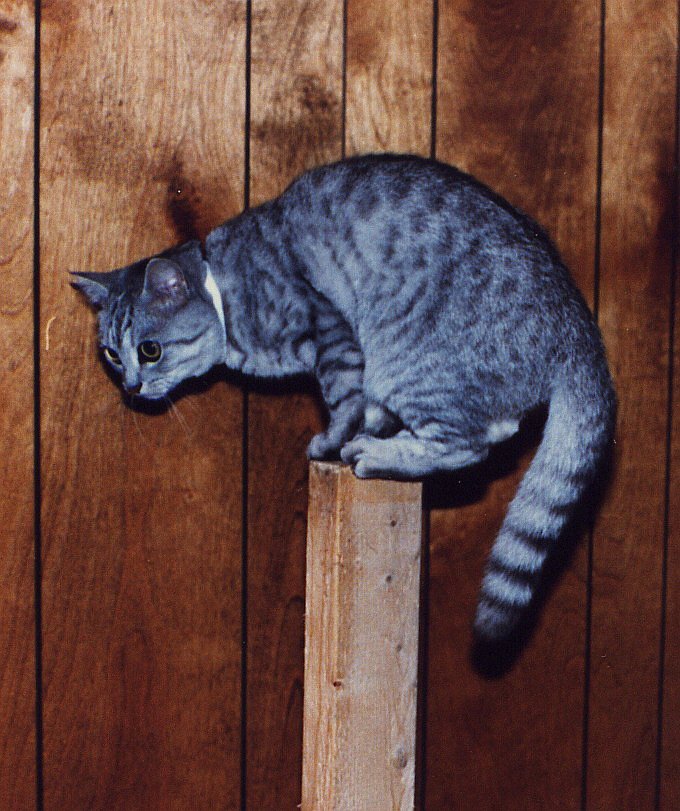
This picture, taken in 1987, is my most recent cat on top of her scratching pole. We had her from 1982 to 2000, when she died of cancer.

We haven't replaced her, but we will, once our son is on his own. Keeping a cat (one never owns a cat) is a commitment that is incompatible with the time consumed by a high schooler.

I grew up with cats, and my wife grew up with dogs. But when we lived in the countryside near Rapid City, SD, and had frequent invasions by mice, we agreed a cat was the critter to have.

She was a small silver tabby—never weighed more than 2 kilos (4½ pounds). She was a great mouser, though the festivities sometimes got noisy in the middle of the night as she raced about after her latest prey. Once the house was saturated with cat scent, we had no more murine visitors. Then she took to prowling the neighborhood, including the cattle yard across the street, and soon cleared out all the small mammals. She never took after birds, as some cats do.

Well, 18 years is a long time to have a cat, and we miss her.

As I said, I grew up with cats. I have an old picture of my mother at age five with a cat in her arms. During the years I was between 7 and 12, I had several litters of cats born in my bed or sleeping bag. Our cats trusted me.

So, it was with great pleasure that I found Cats 24/7 by Rick Smolan and David Elliot Cohen. They have previously produced America 24/7 and Dogs 24/7, the companion volume to this one. It is full of pictures. The 200 or so bigger ones are captioned, and many pages also have a row of thumbnail images along the top edge, numbering 420. It is a coffee-table-sized book, 24x29.5 cm.

Though there are three short story-length pieces, this isn't a book to read, but a feast of eye-candy for cat lovers. I went through it several times.