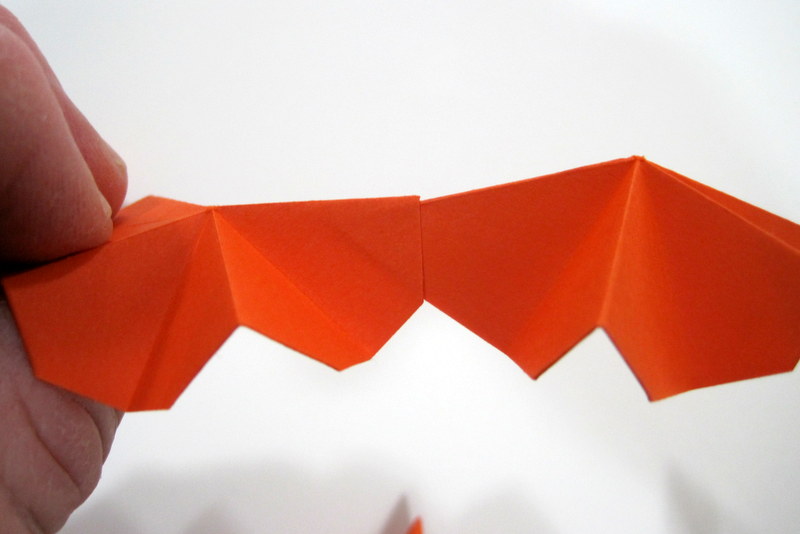
kw: crafts, origami, solid geometry, polyhedra, mobiles, photographs
This long post has many pictures, showing a technique I learned for making attractive shapes based on Platonic and Archimedean solids. The shape chosen here is the Icosahedron, but I call it "skeletal" for reasons you'll see once it is complete.
For this technique, we use folded paper shapes as the vertices of the chosen polyhedron's skeleton. All the shapes of interest have either 3, 4, or 5 edges radiating from a vertex. Most have vertices of the same type, as does the Icosahedron, but some shapes have more than one type of vertex. I find the Icosahedron interesting because its vertices have 5 edges. I earlier made one using cut-out, 5-pointed stars, which will be seen at the end of this post. This time I did an experiment using a "puckered star" made by adding a corner to a square. Such a "square" will not lie flat; it becomes a 5-pointed star with extra paper in it.
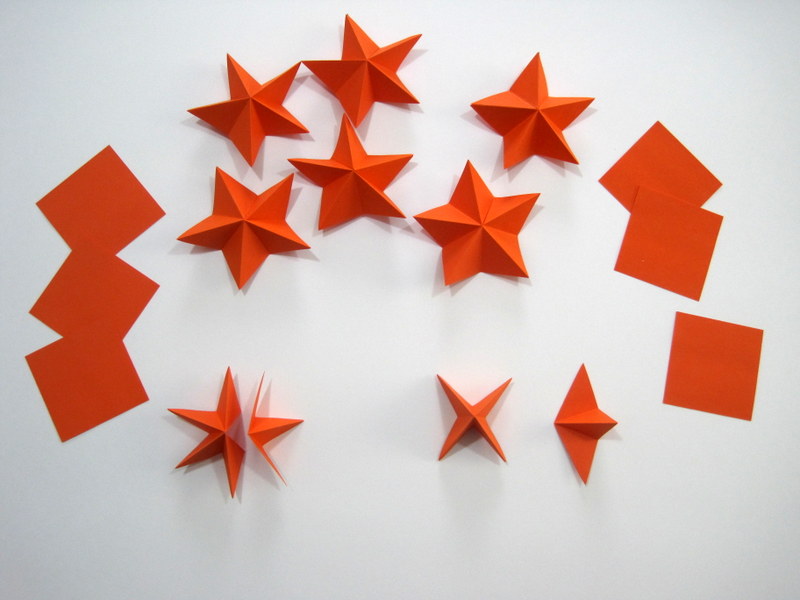
Six such stars are at top center in this image. It takes twelve to make the Icosahedron.
Three squares are needed to make two stars, so the project starts by cutting 18 squares. At bottom, two squares have been folded into the Origami base fold: corner to corner both ways folded from one side and then edge to edge folded from the other side, to make a 4-pointed star. One of these stars is cut along the diagonal to make the extra material to be inserted in the other two.
At lower right, one 4-pointed star is shown next to the extra point with its "wings" which are used for gluing. At lower left, the other star is shown with its side cut open so the point can be inserted. The next image shows these in closeup.
I use a glue stick. You could use any adhesive you like, so long as it is long-lasting. I think you can see how the extra point will go in the cut-open star on the left. I put the "wings" inside the shape. That makes it easier to line things up when gluing and holding.
OK. It would be possible to simply glue these with a little corner overlap on the points, but the original technique, for another shape, used a pocket fold to fit one point inside the other. The next pair of images shows how I prefer to set up the pocket.
On the left, one pocket was formed by folding the tip 1/3 of the way to the center. This is easier than you think, because when it is folded, the tip is halfway to the center from the fold. On the right, the first puckered 5-pointed star has had pockets folded on all 5 points. We are looking at the "bottom" of these stars, the side that will be inside the finished shape.
Let's think about this a minute. A point that has not been folded into a pocket will be inserted and glued into a point that has. Five points each on 12 stars means there are 60 points, so we need 30 to be folded and 30 to be left unfolded. We will have to take care not to fold too many or too few as we go. For starters, I made the one on the right to have all five points folded in, and five more stars with just two adjacent points folded in.
Here are the first six stars ready to glue. The 5 pockets on the central star plus 2 on each of the others totals 15, or just half of our total need for pockets. They are arranged in a way that you can see how each one will fit into its neighbor.
This is how one of the non-folded points on a star fits into the pocket in the central star.
This is how I hold them; I put some adhesive on the unfolded point, hold it in line inside the pocket, and give it a squeeze.
It takes a little care to put each star on the central one in the right orientation. We want them to each fit into its neighbor.
On the left, the five have been glued just to the central star. In the middle, they have been joined together, as seen from above; on the right as seen from below (inside). The shape is already half joined. Once this was done I did some more thinking about how to distribute the remaining 15 pockets.
On the left, the pockets on the glued shape are pointing clockwise, and the unfolded points are pointing counter-clockwise. I realized that the five surrounding stars (all but one of those that remain) could be "pocketed" as shown, with three points each folded into pockets. The last star will have no pockets. It will fit into five pockets that will wind up pointed toward its location.
So now the five 3-pocket stars have been added to the shape in the right orientation. They need to be joined together. You can already see that there will be five pockets pointed at the last star's location.
Look carefully. This is ready for the last star to be added. This one is the hardest. The shape has been rather flexible, but by this point is rather stiff. As each point of the last star is glued in, the next gets just a bit harder to put into place. Fortunately, even with the last point, there is enough flexibility so it can be coaxed into position and held tight so the glue will stick.
This is the final shape, shown looking right down on a vertex. This is a stereo pair for crossed eyes. You need to look at the left side with your right eye, and the right side with your left eye.
This stereo pair is looking more equatorially at the shape. This is the way the Icosahedron is usually pictured.
The actual Icosahedron is formed of 20 triangles, which fill the space between the edges that go from vertex to vertex. Here, we have made a more complex figure based on the geometry of the Icosahedron.
The reason I tried out using puckered stars was to make a shape with more "meat" inside the edges. This green one was made from flat 5-pointed stars. Even though I had a program to print the star shapes on the green paper, it was a tedious matter to cut them out. Their slender shape made a more skeletal look to the final piece.
I folded each star five times, from a point to an inside corner, then back-folded the shorter limb of each fold to get the 3D star shape that is so familiar.
I also didn't use the same method to fold the pockets. I wanted a little angle to the "edge" (which is now a dihedral), so I folded each point almost to the center of the inner fold, then turned it inside. Thus, when the unfolded point is inserted into the pocket, it doesn't line up the same way but has about a 10° angle. I think it makes the final shape prettier.
As I said, the vertexes of other shapes can have 4 or 3 edges. The square is easiest to use to make a shape. The yellow item on the left, based on an IcosaDodecahedron, is the first shape I learned to make, and uses square pieces. It is quicker to make, though it uses 30 squares.
The blue one on the right was made using triangles, and is based on Buckyball geometry. It uses 60 triangles. There is an Archimedean solid with 90 vertexes, but I haven't mustered the ambition to try to make one!
Shapes like these can be displayed by themselves, but I like to make mobiles, and these are light so they make ideal mobile danglers.
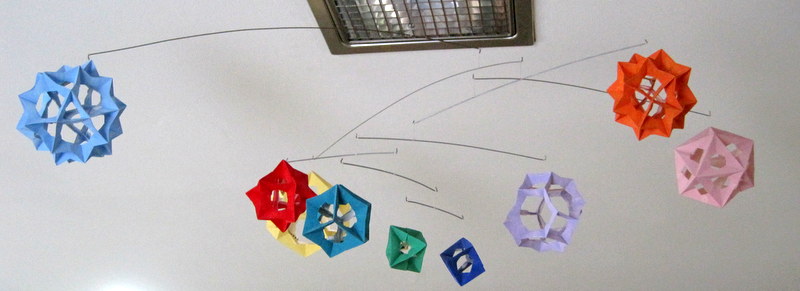
I made this mobile a couple of years ago. The pic is looking up at it. I made it so all the shapes are nearly in the same plane. Sorry, one is hiding behind. The blue one on the left is the IcosaDodecahedron. The Icosahedron on the right (pink) was made differently than either of the two I have shown above, using fatter stars, but still flat. A couple of the shapes mix vertices with 3 and 4 corners. That is a bit tricky to put together!
Showing posts with label polyhedra. Show all posts
Thursday, February 28, 2013
Saturday, March 29, 2008
Mobile Polyhedra
kw: mobiles, polyhedra, geometry
Some months ago a young friend showed me how to make the origami modules for a novel kind of dodecahedron. It has a slightly stellated look, but is not a stellated solid. After some thought, I figured out how to make a number of other polyhedra. The original module has the appropriate angles for the dodecahedron and other shapes that use about thirty modules, but I had to modify it for other shapes with different numbers of modules.
After several months of fooling around I had nine polyhedra of various kinds, some a solid color and some multicolor. I decided to construct a mobile. The backdrop for this image was several black plastic bags. I'll have to get some dark cloth if I want to do any more pics like this. The mobile consists of two smaller mobiles connected by a three-foot rod. Since this image was taken I have replaced the long rod with one of larger diameter that doesn't sag as much. That keeps the whole thing within a foot of the ceiling, making it suitable for hanging in my office (this is my basement workshop).
The larger sub-mobile consists of the original green dodecahedron (30 modules), a lavendar icosahedron (also 30), a pink rhombic dodecahedron (24), a light blue icosadodecahedron (60) and a dark blue rhombic triacontahedron (60).
The smaller sub-mobile consists of a yellow icosahedron (30, smaller modules), a cuboctahedron (24), a shape I think is a snub cube (48) and a darker-hued icosadodecahedron (60). The latter took the most planning, to get each planar section a single color. Purists put these together with friction only. These are glued for durability.
Once I make the appropriate drawings I'll submit a post with directions for the modules and information about making some of the shapes.
Some months ago a young friend showed me how to make the origami modules for a novel kind of dodecahedron. It has a slightly stellated look, but is not a stellated solid. After some thought, I figured out how to make a number of other polyhedra. The original module has the appropriate angles for the dodecahedron and other shapes that use about thirty modules, but I had to modify it for other shapes with different numbers of modules.
After several months of fooling around I had nine polyhedra of various kinds, some a solid color and some multicolor. I decided to construct a mobile. The backdrop for this image was several black plastic bags. I'll have to get some dark cloth if I want to do any more pics like this. The mobile consists of two smaller mobiles connected by a three-foot rod. Since this image was taken I have replaced the long rod with one of larger diameter that doesn't sag as much. That keeps the whole thing within a foot of the ceiling, making it suitable for hanging in my office (this is my basement workshop).
The larger sub-mobile consists of the original green dodecahedron (30 modules), a lavendar icosahedron (also 30), a pink rhombic dodecahedron (24), a light blue icosadodecahedron (60) and a dark blue rhombic triacontahedron (60).
The smaller sub-mobile consists of a yellow icosahedron (30, smaller modules), a cuboctahedron (24), a shape I think is a snub cube (48) and a darker-hued icosadodecahedron (60). The latter took the most planning, to get each planar section a single color. Purists put these together with friction only. These are glued for durability.Once I make the appropriate drawings I'll submit a post with directions for the modules and information about making some of the shapes.
Monday, May 07, 2007
He could make anyone love geometry
kw: book reviews, nonfiction, biographies, geometry, polyhedra
One of these times, I'll post a picture gallery of some of my mobiles. Although Calder is a favorite artist of mine, I don't make mobiles in the abstract way he made famous. As a lover of geometry, I make them very regular. I even have a spreadsheet with formulas for working out the length ratios for various kinds. For example, sometimes I use Fibonacci ratios for the lengthening support wires, sometimes a more pure geometric sequence. They also represent fractals, with a dimension in the range 1.4-1.7.
My favorite, which hangs in my office, is made with skeletal polyhedra. All the 5 "regular solids", of course, plus four other mixed-face shapes. Now, I find myself wondering why I never learned before of the king of polyhedra, Donald Coxeter. The recent biography, "King of Infinite Space: Donald Coxeter, the Man Who Saved Geometry" by Siobhan Roberts, is shelved as a math book, but clearly belongs in the BIOG section of the library.
HSM Coxeter ("Donald" is from his third name, MacDonald) lived nearly the entire 20th Century, and three years into the 21st. By the time he was seventy, people that met him were astonished that this legend still lived. By the time he was 95, their children or grandchildren shared the experience. He lived 96 years, and just two days before he died, he put the finishing touches on his last monograph, titled "An Absolute Property of Four Mutually Tangent Circles," a breakthrough paper published in 2005.
Not for him, the usual "burn out young" mathematical career. He was productive for some eighty years...phenomenally productive. A classical geometer in an age of "new math" and "down with triangles", he is solely responsible for the resurgence of geometry that has revivified math, cosmology and physics since the 1970s. It is to "Coxeter groups" that we owe the efficiency of modems, and his masterwork "Regular Polytopes", published in 1948, underlies recent theories of the "shape" of the Universe.
What is a polytope? It is a generalization of a polyhedron into more than three dimensions. This image shows Coxeter with George W. Hart at a conference at which many polyhedral models, most inspired by his work, were displayed. A plane figure is a polygon (gon = side); a 3-D shape made of several or many polygons is a polyhedron (hedron = face). The suffix tope means place.
The five "regular solids" are the Tetrahedron, composed of four equilateral triangles, the Cube or Hexahedron, composed of six squares, the Octahedron, composed of eight equilateral triangles, the Dodecahedron, composed of twelve pentagons, and the Icosahedron, composed of twenty equilateral triangles.
This figure shows one way to represent a 4-D polytope called the 11-cell. It is a regular polytope whose eleven topes or cells are icosahedra. The colored square next to each of the eleven shapes shows which face it attaches to on the other ten, and the numbering is used to indicate orientation. You gotta think in four dimensions to figure it out, which I can't do. Click for a large view.
Somehow, Coxeter and others can think in almost any number of dimensions, and get useful results. His "Coxeter graphs" are a compact notation of the symmetry of a kaleidoscope in any number of dimensions, that would show some regular polytope (I'm really getting to the limit of my understanding here...).
The one called "The Coxeter Graph", however, as shown here in four different arrangements, has a use I really don't comprehend, but was a discovery that tickled him so much that he wrote of it under the title "My Graph".
Though I have mentioned a few uses of his work, he didn't care much for its usefulness. He was the epitome of a pure mathematician, and sometimes retorted rather sharply when a practical application of his work was described.
Although he was typically cordial, even affable, he bore fools not at all, and reading between the lines of the text, one finds that he could be a bit of a jerk. Or perhaps that term is too harsh. Perhaps he is more like a colleague of mine, who tends to roam the halls when thinking hard. He'll run right over you if you don't step quickly; he simply doesn't see you. Coxeter's geometric vision was vastly wide, but in the rest of life, his tunnel vision was legendary.
These scattered reflections sadly belie the quite comprehensive narrative that Ms Roberts has produced. A biography of Coxeter has been long overdue, and I am grateful to make his posthumous acquaintance.
One of these times, I'll post a picture gallery of some of my mobiles. Although Calder is a favorite artist of mine, I don't make mobiles in the abstract way he made famous. As a lover of geometry, I make them very regular. I even have a spreadsheet with formulas for working out the length ratios for various kinds. For example, sometimes I use Fibonacci ratios for the lengthening support wires, sometimes a more pure geometric sequence. They also represent fractals, with a dimension in the range 1.4-1.7.
My favorite, which hangs in my office, is made with skeletal polyhedra. All the 5 "regular solids", of course, plus four other mixed-face shapes. Now, I find myself wondering why I never learned before of the king of polyhedra, Donald Coxeter. The recent biography, "King of Infinite Space: Donald Coxeter, the Man Who Saved Geometry" by Siobhan Roberts, is shelved as a math book, but clearly belongs in the BIOG section of the library.
HSM Coxeter ("Donald" is from his third name, MacDonald) lived nearly the entire 20th Century, and three years into the 21st. By the time he was seventy, people that met him were astonished that this legend still lived. By the time he was 95, their children or grandchildren shared the experience. He lived 96 years, and just two days before he died, he put the finishing touches on his last monograph, titled "An Absolute Property of Four Mutually Tangent Circles," a breakthrough paper published in 2005.
Not for him, the usual "burn out young" mathematical career. He was productive for some eighty years...phenomenally productive. A classical geometer in an age of "new math" and "down with triangles", he is solely responsible for the resurgence of geometry that has revivified math, cosmology and physics since the 1970s. It is to "Coxeter groups" that we owe the efficiency of modems, and his masterwork "Regular Polytopes", published in 1948, underlies recent theories of the "shape" of the Universe.
What is a polytope? It is a generalization of a polyhedron into more than three dimensions. This image shows Coxeter with George W. Hart at a conference at which many polyhedral models, most inspired by his work, were displayed. A plane figure is a polygon (gon = side); a 3-D shape made of several or many polygons is a polyhedron (hedron = face). The suffix tope means place.The five "regular solids" are the Tetrahedron, composed of four equilateral triangles, the Cube or Hexahedron, composed of six squares, the Octahedron, composed of eight equilateral triangles, the Dodecahedron, composed of twelve pentagons, and the Icosahedron, composed of twenty equilateral triangles.
This figure shows one way to represent a 4-D polytope called the 11-cell. It is a regular polytope whose eleven topes or cells are icosahedra. The colored square next to each of the eleven shapes shows which face it attaches to on the other ten, and the numbering is used to indicate orientation. You gotta think in four dimensions to figure it out, which I can't do. Click for a large view.Somehow, Coxeter and others can think in almost any number of dimensions, and get useful results. His "Coxeter graphs" are a compact notation of the symmetry of a kaleidoscope in any number of dimensions, that would show some regular polytope (I'm really getting to the limit of my understanding here...).
The one called "The Coxeter Graph", however, as shown here in four different arrangements, has a use I really don't comprehend, but was a discovery that tickled him so much that he wrote of it under the title "My Graph".Though I have mentioned a few uses of his work, he didn't care much for its usefulness. He was the epitome of a pure mathematician, and sometimes retorted rather sharply when a practical application of his work was described.
Although he was typically cordial, even affable, he bore fools not at all, and reading between the lines of the text, one finds that he could be a bit of a jerk. Or perhaps that term is too harsh. Perhaps he is more like a colleague of mine, who tends to roam the halls when thinking hard. He'll run right over you if you don't step quickly; he simply doesn't see you. Coxeter's geometric vision was vastly wide, but in the rest of life, his tunnel vision was legendary.
These scattered reflections sadly belie the quite comprehensive narrative that Ms Roberts has produced. A biography of Coxeter has been long overdue, and I am grateful to make his posthumous acquaintance.
Subscribe to:
Posts (Atom)