kw: book reviews, nonfiction, over-the-road driving, trucking
Phillip Wilson doesn't drive bigtrucks because he has to, to make a living. He does so because he wants to. His author's blurb states, that he "served in the U.S. Navy, and has worked in management positions in the construction, utility, and nuclear industries."
Apparently an early retiree, Wilson decided to see the country and get someone else to pay for it. So he took driving school for 18-wheelers, then entered the necessary internship, a five-to-six week stint driving with a trainer.
His new book—and my wildcard choice this time—Driver: Six Weeks in an Eighteen-Wheeler chronicles that training period. During training the new driver is on salary, but the trainer is still being paid by the mile, so the experience gets the newbie used to the contant push, push to roll down the road, to run right up against the legal limit for miles-per-week a professional driver experiences.
Trainers are a special breed. The author confesses freely he'd never do it. They have to endure a lot of boneheadedness from the trainee, to help overcome the fragile rigidity of book learning in favor of rubber-on-the-road experience. But they aren't motivated by altruism. A trainer gets credit for all miles the rig travels, and by driving as a team, the pair can drive about twice as far per day as a lone driver.
Lingo time: We call 'em "truckers," but to one another, they are "drivers." A limited-access highway is a "bigroad," and what we call a "semi" they call a "bigtruck." Who are we? We are four-wheelers. An irritation often enough, usually blissfully unaware of the almost unlimited damage that 80,000 pounds of 65-mph bigtruck will do if you get in its way.
Driving among autos is a frequent worry to a driver who knows he, or she, has much less control of where he is going and how quickly the rig can be stopped if needed, than a four-wheeler. Basically, if you can see a bigtruck behind you, at most any visible distance, chances are if you stop suddenly, just jam on the brakes, someone is likely to die.
Wilson ruminates frequently on such things. He is a conscientious fellow. He is amazed at the appalling obliviousness of many people on the road, and writes, "...I find it difficult to believe that some car drivers drive as much as they do and get no better at it than they are. It seems to me they would get at least fairly good just by virtue of association after a decade or two. But they don't." (p. 151)
The book is written in a picaresque style: Part narration, part stream-of-consciousness, and part soliloquy. The author enjoys changes of season, changes of scenery, and meeting various folks along the way. He ruminates about the dry Southwest, "Like most beautiful things, the desert is dangerous. Beauty is almost always Nature's warning to stay away." (p. 97) A statement at once profound and bitter.
Wilson spent most of the 6-week period in the cab, either driving, riding, or sleeping in the "condo" (double bunk behind the seats). It is a more intimate association than most marriages. He and Trainer are a near-ideal combination of sameness and polar opposite, that makes for a solid working relationship. He came through the experience with a great deal of admiration and fondness for Trainer, but when they parted afterwards, there was no further contact, nor news. A clean break.
Near the end of the training period, Wilson spoke with a retiring driver, about to take his last run. He realized this guy was a library, and asked him, did he have any advice. When the man replied he'd never rolled a rig, never had an accident, never even dinged a fender, Wilson was (silently) amazed. Drive two or three million miles...with such perfection? How? he asked. A pause, "You just have to care," to which Wilson responds, aside to us, it is "the key to a lot of things." (p. 294)
Finally, in the school of "don't do anything you can't undo," he recalls for us the wisdom of one of his instructors: "...a driver can go down a hill too slow many times, but too fast only once." (p. 333) Put that together with "You just have to care," and you can pretty well manage your life.
Saturday, March 04, 2006


Monday, February 27, 2006
What can happen depends on what has happened before
kw: book reviews, nonfiction, evolution, theory of facilitated variation
Imagine a large, snowy mountain. One so large you'll never get off it. This ski run will last forever. At the summit, which direction will you go? Ridges and canyons stretch in all directions; gentle slopes, steeper slopes, crags and cliffs. It's not downhill everywhere. There are pockets and swales to be had, and the occasional deep, blind pocket. Some look inviting, perhaps places to rest, but there is a catch: you depend on gravity and inertia alone. If you come to rest in a low spot, that is the end of the run, forever.
You pick a direction and go. Soon you are schussing at a good clip, and it runs here and there, sometimes branching; you choose this branch, then that, reacting, barely thinking. At one point, a steep section levels off to a plain. Choices abound, here. You can creep along, almost at a standstill, pick a direction, and go off again.
Some runs are steep and rough, but single. There are no choices for a stretch, then choices abound. At some point, you think, "What if I had taken a different branch back there?" You are more likely to think that if a run levels out onto a pocket plain, surrounded by upslopes on all sides. There's no getting out of this one, no escape, no further progress. You're stuck. Eons pass, with no change. Perhaps you're lucky...slowly, the mountain slopes shift and change. Rare, sudden changes shift the landscape a little more. One day, there is an ever-so-narrow path that leads downward.
The inertia of being stuck so long is hard to overcome, but you do so. You glide slowly through the new gap that leads onward, then drop into a steep run, and you're off! Where to next?
Where indeed. We see around us the results of trillions of choices, made throughout the eons that life has existed here. The choices were not made by a brainy skier, but by happenstance. Once living things came into being—by what means we don't yet know—they multiplied, perhaps rather slowly at first. They could afford some slowness; "at first" there was probably little competition. But any pocket of living cells, perhaps remotely similar to bacteria, became the first few billion skiers dropped on the top of that mountain. When you are the first life on a planet, every direction represents progress.
It may be that RNA/DNA comprised the first and only genetic storage system that came about. Maybe not; it may be the sole winner of the oldest contest. But at some time, a genetic storage system gained a way to exist in a capsule and carry on metabolic activities (i.e. energy consumption). This probably happened nearly four billion years ago. We may imagine that these first living cells, however primitive, didn't stay that way very long. Light capture, by rhodopsin and chlorophyll, arose almost at once.
Many kinds of metabolism arose, specialized for different chemical regimes, gaining energy by reducing sulfates, or iron oxides, or (with light's help) carbon oxides. Some kinds got bigger, some stayed small or got smaller.
What took a long, long time, it seems, was for a bigger cell to engulf a number of smaller ones and enslave them. Little, single-purpose bacteria and photo-bacteria are very efficient at energy production and conversion. Somebody big was able to take advantage of their efficiency, to turn a single cell into a community, a "bacterial village" consisting of specialists in food gathering, energy production, DNA decoding, and many other tasks. As a result, that "somebody big" got bigger. Today's protozoa are the highly-advanced descendants of "somebody big". We'll give it a name, "Fat Albert." Or, just Albert. Albert isn't a single cell, but the presonification of the first Eukaryotic species. Eukaryotic cell fossils aged two billion years are known, and the innovation probably occurred within half a billion years before that.
Think of the mountain. Once Albert arose, he found himself on the slopes, in a broad, steep valley of his own. Stretching away to the sides were other ridges and valleys, covered with the little skiers, cousins of Albert's internal specialists. All were headed down the mountain, finding their way into this rille or that crack, past ridgeline and rock, all making what progress they could. Albert had his own valley. Nobody would enter it again, and he would never pass into any of the runs to either side. There was nowhere to go but down. Fortunately, because of the greater efficiency of the Albert-village, there were lots of ways down. Albert became Bertha, Carrie, Daniel, and many others, and took them all. A species can do that. Not all led to continued progress. Many got stuck, but many didn't.
At some point, a collection of Albert-villages—or maybe Valerie-villages—took a slope that led to numbers of them sticking together. A group became a whole. A lot of Valeries took a new name, Dallas, and became a small city composed of several villages. There were plenty of downhill directions Dallas could go. Of course, she took them all. This was probably 1.5 billion years ago.
As it turned out, there were so many, many ways Dallas and her siblings could go that for a time it seemed there was one member of each species on Earth. Various levels of efficiency, in the various environments in which Dallas-cities could live, resulted in quite a sorting-out, until just a few hundred varieties remained.
At some point, probably not long after the first Dallas was assembled, the development program in the DNA for some little wormy thing became well-enough organized that it could direct the staged development of a bilateral body, with certain intercellular messages used in a variety of ways in a segmented, or at least compartmentalized, body. Most of the naked-eye-visible animals we encounter today arose from little XingXing*.
Today we recognize at least these five major stages in the evolution of bilateral animals: Prokaryotic cells arose from whatever went before (we have little clue so far), Eukaryotes came a billion years later, Metazoans another half-billion or less, and Bilateral animals that today comprise about thirty phyla a billion years or more ago. All "bilaterians" share a group of genes called the Homeobox, or just Hox, that regulate the development of a fertilized egg cell into an organized body. Non-bilaterians such as jellyfish have a very distant relative of Hox comprising two or four genes, half the minimum size of the Hox cluster.
The key feature of the mountain metaphor is, you can't go up, only ski down. Once you've entered one run, you'll never ski the run to its right or its left. Critics of evolution used to say things like, "You don't see rabbits evolving into cats or monkeys, do you?" Now, most of them know how abysmally stupid that question is. I think we understand the principle, that what we can do today depends on what we did in the past. If you were educated or trained for business, and you excel at marketing, you are unlikely to become an engineer, and vice versa. If you first begin a little recreational fencing at age thirty, you may become pretty good on the mat, but you'll never win Olympic gold for fencing; there, you'd face kids half your age who've fenced since they were four.
All this rumination was triggered by reading The Plausibility of Life: Resolving Darwin's Dilemma by Marc W. Kirschner and John C. Gerhart. I have read millions of words by and about evolutionary biologists (I know nearly all biologists are evolutionists, but some specialize in evolution itself). S.J. Gould was, to me, the best. He and Niles Eldredge developed "punctuated evolution" to explain why species seem to persist unchanged for periods of a few million to tens of millions of years, then either vanish or (rarely seen in the fossil record) change rapidly into a different species or radiate into several related species. This idea is typically discussed in anatomical or palaeontological terms. There has been much discussion of possible underlying mechanisms, including much by Gould in his columns (collected in a great series of books, the most memorable to me being "The Panda's Thumb"). Kirschner and Gerhart have provided a very plausible mechanism.
After noting the title and reading the introductory blurb, I was prepared to dispute the idea. They call their idea "facilitated variation". I immediately thought, "Facilitated by whom?" I am a facilitator of process modeling as part of my work. So I bring my history to the word. Having read the book, I understand, the denotation they are using is not my kind. Facilitation of the evolutionary process is active, but not conscious, nor purpose-directed.
Here was my epiphany: Evolvability is also subject to evolution. Variation of the genetics in a population is the source of the bodily variety among which natural selection makes its selections, and the ability to both vary and to tolerate greater degrees of genetic variation is also something that natural selection can work on. I saw this about halfway through, and found that the authors discussed it in their last two chapters. Oh, well. I had the brief illusion of a new idea...
Just seeing this was a result of some history. I have for a decade or so been considering the phenomenon of gene regulation. I did some work in the 1990s with chemical kinetics in interlocked networks of reactions, particularly the feedback loops that result. Then I connected the ideas to gene regulation. Here is the overview chapter in Wikipedia's article Gene regulatory network:
"A gene regulatory network (also called a GRN or genetic regulatory network) is a collection of DNA segments in a cell which interact with each other and with other substances in the cell, thereby governing the rates at which genes in the network are transcribed into mRNA."
I thought, are regulatory networks freestanding, or more deeply regulated? Regulating a gene depends on a tag near the "start" signal, that is recognized by a regulatory protein. A gene can have several of these. They are in what once was called "junk DNA." I can think of lots of uses for that "junk", but that's another rant!
After a lot of reading, I've concluded that there are at least three, and perhaps five or six, levels of gene regulation. Also, the machinery for exon/intron splicing, plus other protein or RNA splicing that combines smaller segments into larger proteins, explains how the human complement of about 23,000 "genes" can produce millions of proteins.
Thus, about fourteen human Hox genes suffice to regulate the development of our entire body. Mechanisms that are capable of development under the direction of relatively few regulatory signals can be trusted to grow bodies that are at least roughly proportionate, so that people have quite a range of variation (which keeps ergonomics folk in business), but not an infinite range (no 30-foot people, or 4-footers with 8-foot arms).
Kirschner and Gerhart have a compelling message. I think they have it right. Time will tell. They compiled and sorted a great mass of material to deliver a book that, while I had to read it slowly, kept me captive with clear examples and forceful logic. They go as deep "in the weeds" as they need to, to show how powerful and robust the evolution of the ability to evolve safely has rendered the living species with which we share the Earth today.
*Xing-Xing is Chinese for the Gemini.
Imagine a large, snowy mountain. One so large you'll never get off it. This ski run will last forever. At the summit, which direction will you go? Ridges and canyons stretch in all directions; gentle slopes, steeper slopes, crags and cliffs. It's not downhill everywhere. There are pockets and swales to be had, and the occasional deep, blind pocket. Some look inviting, perhaps places to rest, but there is a catch: you depend on gravity and inertia alone. If you come to rest in a low spot, that is the end of the run, forever.
You pick a direction and go. Soon you are schussing at a good clip, and it runs here and there, sometimes branching; you choose this branch, then that, reacting, barely thinking. At one point, a steep section levels off to a plain. Choices abound, here. You can creep along, almost at a standstill, pick a direction, and go off again.
Some runs are steep and rough, but single. There are no choices for a stretch, then choices abound. At some point, you think, "What if I had taken a different branch back there?" You are more likely to think that if a run levels out onto a pocket plain, surrounded by upslopes on all sides. There's no getting out of this one, no escape, no further progress. You're stuck. Eons pass, with no change. Perhaps you're lucky...slowly, the mountain slopes shift and change. Rare, sudden changes shift the landscape a little more. One day, there is an ever-so-narrow path that leads downward.
The inertia of being stuck so long is hard to overcome, but you do so. You glide slowly through the new gap that leads onward, then drop into a steep run, and you're off! Where to next?
Where indeed. We see around us the results of trillions of choices, made throughout the eons that life has existed here. The choices were not made by a brainy skier, but by happenstance. Once living things came into being—by what means we don't yet know—they multiplied, perhaps rather slowly at first. They could afford some slowness; "at first" there was probably little competition. But any pocket of living cells, perhaps remotely similar to bacteria, became the first few billion skiers dropped on the top of that mountain. When you are the first life on a planet, every direction represents progress.
It may be that RNA/DNA comprised the first and only genetic storage system that came about. Maybe not; it may be the sole winner of the oldest contest. But at some time, a genetic storage system gained a way to exist in a capsule and carry on metabolic activities (i.e. energy consumption). This probably happened nearly four billion years ago. We may imagine that these first living cells, however primitive, didn't stay that way very long. Light capture, by rhodopsin and chlorophyll, arose almost at once.
Many kinds of metabolism arose, specialized for different chemical regimes, gaining energy by reducing sulfates, or iron oxides, or (with light's help) carbon oxides. Some kinds got bigger, some stayed small or got smaller.
What took a long, long time, it seems, was for a bigger cell to engulf a number of smaller ones and enslave them. Little, single-purpose bacteria and photo-bacteria are very efficient at energy production and conversion. Somebody big was able to take advantage of their efficiency, to turn a single cell into a community, a "bacterial village" consisting of specialists in food gathering, energy production, DNA decoding, and many other tasks. As a result, that "somebody big" got bigger. Today's protozoa are the highly-advanced descendants of "somebody big". We'll give it a name, "Fat Albert." Or, just Albert. Albert isn't a single cell, but the presonification of the first Eukaryotic species. Eukaryotic cell fossils aged two billion years are known, and the innovation probably occurred within half a billion years before that.
Think of the mountain. Once Albert arose, he found himself on the slopes, in a broad, steep valley of his own. Stretching away to the sides were other ridges and valleys, covered with the little skiers, cousins of Albert's internal specialists. All were headed down the mountain, finding their way into this rille or that crack, past ridgeline and rock, all making what progress they could. Albert had his own valley. Nobody would enter it again, and he would never pass into any of the runs to either side. There was nowhere to go but down. Fortunately, because of the greater efficiency of the Albert-village, there were lots of ways down. Albert became Bertha, Carrie, Daniel, and many others, and took them all. A species can do that. Not all led to continued progress. Many got stuck, but many didn't.
At some point, a collection of Albert-villages—or maybe Valerie-villages—took a slope that led to numbers of them sticking together. A group became a whole. A lot of Valeries took a new name, Dallas, and became a small city composed of several villages. There were plenty of downhill directions Dallas could go. Of course, she took them all. This was probably 1.5 billion years ago.
As it turned out, there were so many, many ways Dallas and her siblings could go that for a time it seemed there was one member of each species on Earth. Various levels of efficiency, in the various environments in which Dallas-cities could live, resulted in quite a sorting-out, until just a few hundred varieties remained.
At some point, probably not long after the first Dallas was assembled, the development program in the DNA for some little wormy thing became well-enough organized that it could direct the staged development of a bilateral body, with certain intercellular messages used in a variety of ways in a segmented, or at least compartmentalized, body. Most of the naked-eye-visible animals we encounter today arose from little XingXing*.
Today we recognize at least these five major stages in the evolution of bilateral animals: Prokaryotic cells arose from whatever went before (we have little clue so far), Eukaryotes came a billion years later, Metazoans another half-billion or less, and Bilateral animals that today comprise about thirty phyla a billion years or more ago. All "bilaterians" share a group of genes called the Homeobox, or just Hox, that regulate the development of a fertilized egg cell into an organized body. Non-bilaterians such as jellyfish have a very distant relative of Hox comprising two or four genes, half the minimum size of the Hox cluster.
The key feature of the mountain metaphor is, you can't go up, only ski down. Once you've entered one run, you'll never ski the run to its right or its left. Critics of evolution used to say things like, "You don't see rabbits evolving into cats or monkeys, do you?" Now, most of them know how abysmally stupid that question is. I think we understand the principle, that what we can do today depends on what we did in the past. If you were educated or trained for business, and you excel at marketing, you are unlikely to become an engineer, and vice versa. If you first begin a little recreational fencing at age thirty, you may become pretty good on the mat, but you'll never win Olympic gold for fencing; there, you'd face kids half your age who've fenced since they were four.
All this rumination was triggered by reading The Plausibility of Life: Resolving Darwin's Dilemma by Marc W. Kirschner and John C. Gerhart. I have read millions of words by and about evolutionary biologists (I know nearly all biologists are evolutionists, but some specialize in evolution itself). S.J. Gould was, to me, the best. He and Niles Eldredge developed "punctuated evolution" to explain why species seem to persist unchanged for periods of a few million to tens of millions of years, then either vanish or (rarely seen in the fossil record) change rapidly into a different species or radiate into several related species. This idea is typically discussed in anatomical or palaeontological terms. There has been much discussion of possible underlying mechanisms, including much by Gould in his columns (collected in a great series of books, the most memorable to me being "The Panda's Thumb"). Kirschner and Gerhart have provided a very plausible mechanism.
After noting the title and reading the introductory blurb, I was prepared to dispute the idea. They call their idea "facilitated variation". I immediately thought, "Facilitated by whom?" I am a facilitator of process modeling as part of my work. So I bring my history to the word. Having read the book, I understand, the denotation they are using is not my kind. Facilitation of the evolutionary process is active, but not conscious, nor purpose-directed.
Here was my epiphany: Evolvability is also subject to evolution. Variation of the genetics in a population is the source of the bodily variety among which natural selection makes its selections, and the ability to both vary and to tolerate greater degrees of genetic variation is also something that natural selection can work on. I saw this about halfway through, and found that the authors discussed it in their last two chapters. Oh, well. I had the brief illusion of a new idea...
Just seeing this was a result of some history. I have for a decade or so been considering the phenomenon of gene regulation. I did some work in the 1990s with chemical kinetics in interlocked networks of reactions, particularly the feedback loops that result. Then I connected the ideas to gene regulation. Here is the overview chapter in Wikipedia's article Gene regulatory network:
"A gene regulatory network (also called a GRN or genetic regulatory network) is a collection of DNA segments in a cell which interact with each other and with other substances in the cell, thereby governing the rates at which genes in the network are transcribed into mRNA."
I thought, are regulatory networks freestanding, or more deeply regulated? Regulating a gene depends on a tag near the "start" signal, that is recognized by a regulatory protein. A gene can have several of these. They are in what once was called "junk DNA." I can think of lots of uses for that "junk", but that's another rant!
After a lot of reading, I've concluded that there are at least three, and perhaps five or six, levels of gene regulation. Also, the machinery for exon/intron splicing, plus other protein or RNA splicing that combines smaller segments into larger proteins, explains how the human complement of about 23,000 "genes" can produce millions of proteins.
Thus, about fourteen human Hox genes suffice to regulate the development of our entire body. Mechanisms that are capable of development under the direction of relatively few regulatory signals can be trusted to grow bodies that are at least roughly proportionate, so that people have quite a range of variation (which keeps ergonomics folk in business), but not an infinite range (no 30-foot people, or 4-footers with 8-foot arms).
Kirschner and Gerhart have a compelling message. I think they have it right. Time will tell. They compiled and sorted a great mass of material to deliver a book that, while I had to read it slowly, kept me captive with clear examples and forceful logic. They go as deep "in the weeds" as they need to, to show how powerful and robust the evolution of the ability to evolve safely has rendered the living species with which we share the Earth today.
*Xing-Xing is Chinese for the Gemini.
Tuesday, February 14, 2006
Aliens everywhere? Pack your microscope...
kw: book reviews, nonfiction, science, astrobiology, space science
Peter Ward and his colleague Don Brownlee made a host of constituencies mad when they published Rare Earth four years ago. Their conclusion is that, while life in the form of microbes may be rather common throughout the Universe, complex animal life, however constituted, the kind of life that makes cities and spaceships and radio signals, is probably exceedingly rare. Read Rare Earth for a thorough, and thorougly entertaining, study of the requirements of complex life.
Agree or disagree, you'll find they raise questions that need to be discussed even as we imagine a universe like that of Star Wars or Star Trek. My own conclusion is that this portion of the Galaxy has only recently begun to produce civilizations: Stars formed (in this region of the Galaxy) prior to our Sun have too few heavier materials with which to form rocky planets such as Earth, large enough to hold an ocean for five or ten billion years.
Also, stars formed only 1-2 billion years ago have larger amounts of rocky material, but even a larger proportion of heavy metals and radioactive materials; they are likely to form super-earths that hold too much water (no continents), and stay hotter longer. So there is a window of opportunity, which may be rather narrow, maybe not. I think we are on its leading edge.
OK, with that out of the way, I say, "Who better than Peter Ward to discuss the various kinds of life that may arise, both here and elsewhere?" Complex life of any kind may be rare...or not. But life analogous to bacteria and viruses is likely to be found nearly everywhere. In his new book, Life As We Do Not Know It, Dr. Ward warns that it may be hard to recognize as life.
His opening example is telling. When subsea hydrothermal vents were first found, there was a lot of thin, snotlike material floating around. It got in the way of observations of the big clams, crabs, and tube worms. The scientists often had to move around or wait for the water to clear so they could get nice looking photos. It was quite a while before anybody thought to capture some of the slime and look at it. It turned out to be bacterial life, in a profusion that probably outweighs the nice clams and worms. It happens to be their food, too!
It seems ludicrous. Any grazing or browsing animal weighs less than the biomass of forage needed to sustain its life. So what did they think the clams and tube worms were eating? But this is just the problem. We don't really know the limits of earthly life, in terms of temperature, pressure, or chemistry.
If you take a pinch of soil from your yard, and spread bits of it onto petri dishes containing the ten or so common nutrient mixes you can get from places like Cuisenaire or Cole-Parmer or Ward, you'll get dozens or hundreds of bacterial colonies, and if you're lucky, perhaps twenty or thirty different species. If instead, you shake that same soil sample with water, then screen for the portion smaller than two microns. Pulverize and use genetic probes, you'll find evidence that there were tens of thousands (or even millions) of different species present.
Here, this'll blow your mind: Ordinary ocean water, whether sampled shallow or deep, contains three or four parts per billion of viruses. Doesn't sound like much...it comes to 20 to 50 million virus particles per cc! Not only that, but almost every living thing on the planet contains a ppb or so of viruses, including you our me. I we had a kind of light that "saw" only viruses, the entire biosphere and all bodies of water would be outlined in a ghostly filigree of viruses, down to its last detail.
To jump to the chase, the author presents his reasons for considering viruses as living beings. Though they require living cells to reproduce, there are many species of animal parasites whose biochemistry is defective such that they cannot live outside their host.
Just to make you feel secure: the vast majority of animal species are parasites. Even though some, such as the follicle mites that live in the forehead hair follicles of at least 95% of us, are called "commensal" because they don't seem to do harm (How they might benefit us is totally unknown. Any benefit is strictly one-way, so I call them parasites).
What is life? We need enough of a definition that we'll recognize it...we just can't fall back on "I'll know it when I see it." My own formulation: "Life is a process that results when aperiodic crystals grow in an environment strongly out of equilibrium". Dr. Ward proposes, "Life metabolizes, life replicates, life evolves." Simple and functional, and more testable. It doesn't depend on a particular kind of genetic mechanism or "bio"chemistry.
What kinds of non-Earth life might we find, somewhere (even on Earth)? The author proposes Terroan to designate "life as we know it", so we can then distinguish as alien, "life as we do not know it." Terroan life is composed of cells with a lipid cell membrane, is based on Carbon, Hydrogen, Oxygen, and Nitrogen (CHON), employs water as the main solvent, and uses DNA to encode and RNA to translate genetic codes to proteins via the Universal Genetic Code (UGC). In order of increasing "alienness", we might list
- Certain bacteria that slightly violate the UGC. For example, some mycoplasmas use one of the "stop" codes (the U-G-A sequence) to encode for tryptophan.
- The parent organism of our Mitochondria; these organelles have their own, somewhat different, genetic code and reproduce independently.
- Organisms using one of the approximately 1075 other UGCs that might be devised, though only about 1050 of them keep redundant codes in groups. The mycoplasmas mentioned above could be included here also.
- Viruses, which are non-cellular.
- Organisms that use a solvent other than water, such as methane or a strong ammonia/water solution at very low temperatures, or hydrogen sulfate (sulfuric acid if excess water is present) at high temperatures.
- Organisms that use a polymer other than DNA to encode its genetics. (Note that silicate rocks consist of Si-O and Si-Al-O polymers. Feldspar life?)
I can think of one attribute that might make really alien life hard to recognize. Velocity. Let's look at plants. How do you tell the difference between a living and freshly-dead slice of Oak leaf? Oak trees are proverbially slow growing, though they grow leaves quickly enough each Spring. Within the cells of the leaf, though, under the microscope you can see cytoplasmic streaming going on. The insides of a cell seem to revolve complete every two or three seconds, in spite of the fact that it is encased in a porous cellulose box. Loose cells from the inside of your cheek also show streaming as long as Oxygen is present, though it is slower.
Both animals and plants of Terroan life exhibit at some scale, motions that can be observed directly by our 20-frames-per-second visual systems. That is anything from a speed just faster than the minute hand on a wall clock to velocities that blur like a spinning figure skater. But suppose we find objects in an environment whose kinematics disallow motions of such rapidity, or that are composed of much stiffer material?
A science fiction story I read was about an odd rock in an astronaut's collection, kept in a terrarium with other rock specimens from the apparently desert planet he'd visited. Every week or so, it seemed this rock had moved a little. Finally, after setting up a time-lapse camera, he was able to see that, over a few months, the odd rock moved away from the more lighted part of the terrarium, then moved to the glass side and began slowly (very slowly) grinding at it, seemingly in an attempt to escape. Perhaps it "lived" on a time scale that to it, seemed like running to a barrier and grinding through in the space of a few moments. I wonder what the astronaut seemed like from its viewpoint?
We know, kinematically, living creatures that live ten or a hundred times faster are implausible. But there is no limit to how slow one may go.
There is a point to the book. We need to expand the "tree of life" to include viruses and RNA life, at the very least, so as to include all Earth-originated and/or -developed life. We think RNA life is extinct, if it originated at all. But it may be created soon in the laboratory. Bacteria with added DNA codes have been created in the laboratory, so they are aliens. Mars probably once hosted living creatures, at least bacteria or something similar; and it may do so today, some distance below ground. Europa might have life, though the energetics are forbidding. Titan seems to have a "just right" mix of energetics and complex chemistry, that life of some kind is likely.
Thus, Dr. Ward proposes that we send people to Mars and to Titan, to look for it. Because of the differing probable history, and the known differences today, a Paleontologist needs to go to Mars and a Biochemist to Titan (better, more than one of each!). Mars is likely to have fossils, and a Paleontologist by definition is good at finding fossils. Titan doesn't seem to have anywhere on its surface that could contain fossils, but is likely to have a strong chemical signature of life processes in many places. Just what a Biochemist is prepared to determine.
You know, that's a pair of really good ideas. I hope we do it. The biggest hurdle? We have to get used to the idea that a Saturn/Titan mission is definitely one-way. Radiation there is less than near Jupiter, but still deadly over the span of a few months at most (Jupiter orbit is a DOA environment at any arrival speed less than 0.1c). Mars is probably one-way also. Can we afford to send heavy digging equipment to Mars, so astronauts can get dug in before they die of radiation poisoning? Just getting there, the DNA in 1/3 of the body cells gets damaged per year of exposure to the interplanetary environment. You gotta get a hole dug first (10m deep at least), then go there fast. Then, there is a chance to return. Send a backhoe to Mars first!
Though I was a bit put off by Rare Earth, I understand the reasoning. I find Life As We Do Not Know It much more optimistic.
Monday, February 13, 2006
1491, Post 4 of 4: People are people
kw: book reviews, nonfiction, history, western hemisphere
Who were the Indians in 1491, and before?
- They were a Stone Age people, living by hunting and gathering.
- They were a highly cultured people, living a complex political and religious life.
- They were sophisticated agriculturalists.
- They were noble and wise, living lightly on a vast land.
- They lived in the most primitive of conditions.
- They built great cities.
- They managed their environment to make life easier.
- They overran their resources and destroyed their environment.
- They were a people without history, unchanged for millennia.
- They were illiterate savages.
- Their written languages were complex and expressive.
All these statements are true. All are false. All were true at some times, for some groups. None was true of all.
In the prior three posts, I discussed things I found interesing in 1491: New Revelations of the Americas Before Columbus by Charles C. Mann. The history of the Indians of the Western Hemisphere has been hard to discover and harder to publish. The first two hundred years of Indian-European contact resulted in near-destruction of Indian populations by disease, the subjugation of many to unequal trade practices, and the collapse of many of their cultures. The next two hundred years of "Indian wars" resulted in near-depopulation of North America and less intense, but quite devastating reduction in the populations of Central and South America.
By about 1900 AD, most U.S. and Canadian Indians lived on reservations or had been forcibly "assimilated" into white society. Mexican and Central American Indians had been chased into "waste places" the neo-Spanish society didn't care about. The Indians of South America, at least the northern half, were marginalized and mainly ignored by a larger Spanish- and Portuguese-speaking majority.
Once the film industry in the U.S. really got going, about the 1920s, huge numbers of popular films had a "Western" theme, mainly about noble whites prevailing over wily savages. When I was growing up in the 1950s, the only non-negative Indian on a popular TV series was Tonto, who regularly got beat up whenever he went into town. Bill Cosby had it right, "You go to Hell, Lone Ranger!"
If you were to take an Egyptian of the 15th Century BC and drop him near Cahokia, Illinois, he'd be on familiar ground. "These guys are building a big pyramid, like my ancestors did...only bigger!"
Take a village farmer from 13th Century AD England or France, and drop him in coastal Peru. He'd quickly learn a few things, and soon be itching to go home and get better yields from his own field.
Take a courtier from the court of Louis IX of France, say in 1215 AD, and drop him among the New York Mohawks, of the Haudenosaunee (Iroquois) confederacy. Their "Great law of peace" was but seven decades old, but he would find the intrigues and power by-play quite familiar and invigorating. A number of the "founding fathers" of the U.S. and its constitution claim inspiration from the egalitarian principles of the Haudenosaunee.
Which had the greater population in 1200 A.D., Paris or Tikal (in the Yucutan)? Where were the better-managed forest lands, Spain or pre-Bolivia? Was there, anywhere in Europe, a culture that developed a "long count" to rival that of the Mayas: a cycle that contains 1,872,000 days, or more than 5,000 years? (Considering that their "day zero" was in 3114 BC, the cycle will end in 2112 AD, which is of great interest to all kinds of cultists.)
Of all the statements at the beginning of this post, I consider the following to me "most true, most of the time":
- They were a highly cultured people, living a complex political and religious life.
- They were sophisticated agriculturalists.
- They managed their environment to make life easier.
In other words, they were people, like people everywhere.
1491, Post 3 of 4: Primeval Woodland or Managed Garden?
kw: book reviews, nonfiction, history, western hemisphere
When I was twelve or so, I was walking in a forested area in late Summer. I began to notice apples on the ground, then cherries. I looked up, and there was fruit everywhere. Not on every tree, but on many, particularly a number of old, gnarly trees. It didn't take long to figure out that this piece of now-public land was once a farmer's informal orchard: half a dozen apple trees, some cherry trees, and I found a stand of small plums.
Visitors from temperate areas (mainly Europe and North America) who visit the tropics often remark that life must be easy, you can pick fruits and other foods almost anywhere. Contrary to my childhood experience, though, very few consider that they might be in ancient orchards. As it happens, writes Charles C. Mann in 1491, the poster child of tropical forests, the Amazon "jungle," is actually at least one-ninth "'anthropogenic'—directly or indirectly created by humans."
The tropics are rich, no doubt. In "unmanaged" forest, about 20 percent of the plants bear edible fruit. But over large, widespread areas, fully half the plants are sources of food. It is likely that many of the "20-percenter" forests were once managed, but have been fallow since the epidemics of 500 years ago.
And what of the great American grasslands, the Western steppes and Mideastern tall grass prairies? Or the large open areas in the "impenetrable" forests of the East? Early reports tell of the Indians' use of fire, to prepare agricultural land, to create charcoal for enriching fields, for managing the species that would grow, and for keeping the forest open for travel. The open, cathedral-like forests once seen from Pennsylvania (Penn's Woods...except they weren't his) to Minnesota and south to Kentucky were burned yearly by their earlier inhabitants. By the late 1500s, the cathedral-like aspect had pretty much vanished, and white homesteaders cut down and burned off the now-impenetrable forest for farmland.
If a forest burns every year, the grasses, forbs, and shrubs of the understory burn and char, and the trees are little affected. It is only when the understory gets overgrown that fire can endanger trees. If you want to turn a meadow in Pennsylvania into forest, as quickly as possible, first let it burn over in Autumn. In the Spring, scatter acorns and seeds of elm, ash, maple, and other trees. Then wait a few years until you have a few hundred 15- to 25-foot hardwood trees per acre and burn it, again in Autumn. If a lightning strike starts a fire before that, let it burn. Either way, many of the trees will survive. Thereafter, burn the underbrush yearly. You'll have a nice, open forest with dense shade within a decade or so. Thereafter, the "ceiling" will rise by a few feet per decade until it tops out at 50-60 feet.
Further west, the central North American grasslands are a product of fire. The Corn Belt was once covered with "buffalo grass," that fed browsing prey. Prior to 1492, there were comparatively few bison; their population explosion in the 1700s was a symptom of environmental collapse once the "burners" died off and the plants changed. The resulting Sioux and other bison-hunting cultures were no more than a century old when Custer was lured to his death in Montana. Rather, the older culture mixed grain growing with the hunting of pronghorn and deer, and perhaps were taking steps to domesticate the larger Whitetail deer, much as the Lapps domesticated Caribou to create Reindeer. We'll never know.
I live in Delaware. In some of the State parks, there are hardwood trees 18 to 24 inches in diameter and forty feet tall, and in wetter areas, 40-inch sycamores sixty feet tall. A little inquiry determines that none of these trees is a century old. An oak that died in a bit of forest near my home, which was two feet in diameter (at breast height, where trees are properly measured), died of root fungus and was felled. Its stump has sixty growth rings. My house is 62 years old, so that tree was planted or first sprouted two years after my development was built. In my yard I have two oaks and a maple, all about 18 inches in diameter, that are 44 years old, which I know because my neighbor told me the year she saw them planted.
Some of the former farms in northern Delaware were farmed, abandoned, farmed again...four cycles since the 1600s. Today large trees grow on those lands, but you can see old walls running through. The upshot is, not having visited the Pacific northwest, I've never seen "virgin" forest...but what I have seen looks pretty good to me.
The author concludes in one section, "Until Columbus, Indians were a keystone species in most of the hemisphere. Annually burning undergrowth, clearing and replanting forests, building canals and raising fields, hunting bison and netting salmon, growing maize, manioc, and the Eastern Agricultural Complex, Native Americans have been managing their environment for thousands of years."
When I was twelve or so, I was walking in a forested area in late Summer. I began to notice apples on the ground, then cherries. I looked up, and there was fruit everywhere. Not on every tree, but on many, particularly a number of old, gnarly trees. It didn't take long to figure out that this piece of now-public land was once a farmer's informal orchard: half a dozen apple trees, some cherry trees, and I found a stand of small plums.
Visitors from temperate areas (mainly Europe and North America) who visit the tropics often remark that life must be easy, you can pick fruits and other foods almost anywhere. Contrary to my childhood experience, though, very few consider that they might be in ancient orchards. As it happens, writes Charles C. Mann in 1491, the poster child of tropical forests, the Amazon "jungle," is actually at least one-ninth "'anthropogenic'—directly or indirectly created by humans."
The tropics are rich, no doubt. In "unmanaged" forest, about 20 percent of the plants bear edible fruit. But over large, widespread areas, fully half the plants are sources of food. It is likely that many of the "20-percenter" forests were once managed, but have been fallow since the epidemics of 500 years ago.
And what of the great American grasslands, the Western steppes and Mideastern tall grass prairies? Or the large open areas in the "impenetrable" forests of the East? Early reports tell of the Indians' use of fire, to prepare agricultural land, to create charcoal for enriching fields, for managing the species that would grow, and for keeping the forest open for travel. The open, cathedral-like forests once seen from Pennsylvania (Penn's Woods...except they weren't his) to Minnesota and south to Kentucky were burned yearly by their earlier inhabitants. By the late 1500s, the cathedral-like aspect had pretty much vanished, and white homesteaders cut down and burned off the now-impenetrable forest for farmland.
If a forest burns every year, the grasses, forbs, and shrubs of the understory burn and char, and the trees are little affected. It is only when the understory gets overgrown that fire can endanger trees. If you want to turn a meadow in Pennsylvania into forest, as quickly as possible, first let it burn over in Autumn. In the Spring, scatter acorns and seeds of elm, ash, maple, and other trees. Then wait a few years until you have a few hundred 15- to 25-foot hardwood trees per acre and burn it, again in Autumn. If a lightning strike starts a fire before that, let it burn. Either way, many of the trees will survive. Thereafter, burn the underbrush yearly. You'll have a nice, open forest with dense shade within a decade or so. Thereafter, the "ceiling" will rise by a few feet per decade until it tops out at 50-60 feet.
Further west, the central North American grasslands are a product of fire. The Corn Belt was once covered with "buffalo grass," that fed browsing prey. Prior to 1492, there were comparatively few bison; their population explosion in the 1700s was a symptom of environmental collapse once the "burners" died off and the plants changed. The resulting Sioux and other bison-hunting cultures were no more than a century old when Custer was lured to his death in Montana. Rather, the older culture mixed grain growing with the hunting of pronghorn and deer, and perhaps were taking steps to domesticate the larger Whitetail deer, much as the Lapps domesticated Caribou to create Reindeer. We'll never know.
I live in Delaware. In some of the State parks, there are hardwood trees 18 to 24 inches in diameter and forty feet tall, and in wetter areas, 40-inch sycamores sixty feet tall. A little inquiry determines that none of these trees is a century old. An oak that died in a bit of forest near my home, which was two feet in diameter (at breast height, where trees are properly measured), died of root fungus and was felled. Its stump has sixty growth rings. My house is 62 years old, so that tree was planted or first sprouted two years after my development was built. In my yard I have two oaks and a maple, all about 18 inches in diameter, that are 44 years old, which I know because my neighbor told me the year she saw them planted.
Some of the former farms in northern Delaware were farmed, abandoned, farmed again...four cycles since the 1600s. Today large trees grow on those lands, but you can see old walls running through. The upshot is, not having visited the Pacific northwest, I've never seen "virgin" forest...but what I have seen looks pretty good to me.
The author concludes in one section, "Until Columbus, Indians were a keystone species in most of the hemisphere. Annually burning undergrowth, clearing and replanting forests, building canals and raising fields, hunting bison and netting salmon, growing maize, manioc, and the Eastern Agricultural Complex, Native Americans have been managing their environment for thousands of years."
1491, Post 2 of 4: Where'd all these hills come from?
kw: book reviews, nonfiction, history, western hemisphere
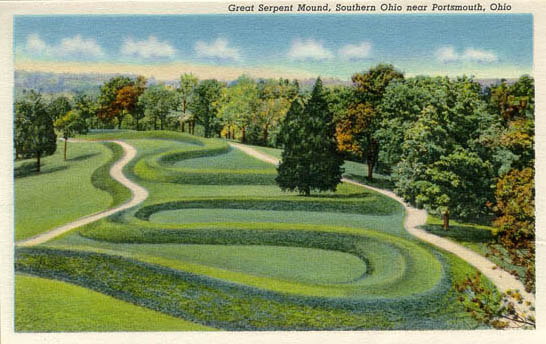
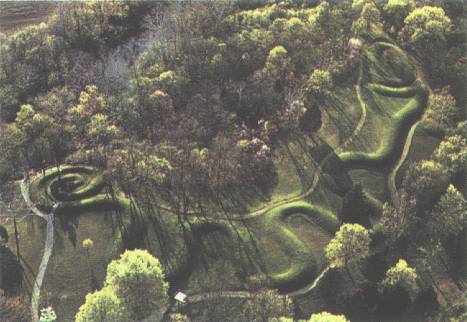 I lived in Ohio in my high school years. On a family trip to the southern part of the state, we visited Serpent Mound, near Peebles. I was sixteen, and six feet tall already, and it seemed quite a bit taller. Of course, it is on the top of a ridge. It takes about five minutes to walk along its length; about a quarter mile. Its serpentine shape would make a walk along the spine of the Serpent quite a bit longer.
The first image here shows Serpent Mound from above. The second is a post card from about the time I visited, around 1960.
 Continuing my review of 1491 by Charles C. Mann, I find it amazing that there is so much archeological richness in America, more than 99% overlooked or unrecognized. I recall visiting a relative in North Carolina, who took me digging for arrowheads. It isn't hard: Any road cut shows hundreds of yellowish flint chips along the older soil horizon a few inches below "modern" soil. We went into a field where we dug and sifted a couple cubic feet of dirt. There were hundreds of chips, a few dozen flake tools, and four arrow points. The site was a hunting camp, and has been dated to 8,000 years ago. It was used seasonally between that time and about 1200 AD. Even allowing for 7,000 years of use, there are huge numbers of artifacts. Agricultural areas nearby have few of the sought after "points", but much larger accumulations of various chips and flakes, made on the spot for various household uses, then discarded when dulled.
 Monk's Mound is shown here, with its companion mound, from above. That is a farmstead to the right!
At one time Serpent Mound was one of more than 10,000 mounds built by various peoples all over the Midwest and South. Most of them have been destroyed, plowed over or carted off for fill. While many were burial mounds, some such as Serpent Mound were "high places" or meeting centers, and some, such as Monk's Mound near Cahokia, Illinois, were for ceremonial use. The volume of Monk's Mound is substantially bigger than that of the Great Pyramid at Giza. It is often said of Giza that millions of slaves must have been employed for centuries. I wonder how many people it took to build Monk's Mound and its nearby, somewhat smaller (only by comparison!) companion mound?
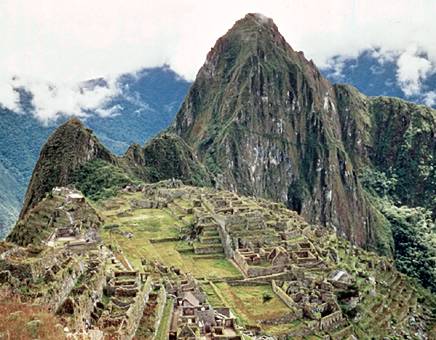 Looking further south, the spread of maize after its development before 1000 BC can be followed in proxy by mapping the successive high-population cultures that followed, the Olmec followed by the Maya and Aztec in Mesoamerica, and the Wari followed by the Aztecs in and near the Peruvian Andes. They built impressive cities. Machu Picchu, shown here, is the most famous in Peru...though the hardest to get to!
Severe climate shifts after about 1250 AD seem to have greatly reduced the population the land would support. The century of famines in Europe (1304-1390) is probably a related phenomenon.
 Yet great cities such as this one, Chan Chan in Peru, continued nearly until the Spanish conquest. Chan Chan itself was conquered by the Inca in about 1450, and declined rapidly. The Inca fell, first to smallpox, then to genocide, two generations later. Few stone cities are to be found in North America, though Tuzigoot (shown below) and the "Anasazi" cliff dwellings of the American southwest are awe-inspiring today. "Anasazi" is Navajo for "enemy ancestors"; they had a different name for themselves, now unknown.
Finally, the presence of trade goods throughout all areas testifies to numerous vibrant, sophisticated, interlocking cultures. Kentucky Flint is found throughout the Hopewell areas from Minnesota to Pennsylvania and Louisiana, Arizona pottery was traded into Utah and Idaho to the north and Mexico to the south, and copper was traded up and down the East coast of the (pre-)U.S. by Mandoag middlemen from North Carolina.
 All of this speaks to a much greater cultural attainment than many care to think of. Lacking only iron tools, the Indians of North, Central and South America had all other accoutrements of a culture as complex and sophisticated as any European culture of the day.
See the following posts.
1491, Post 1 of 4: "War of the Worlds," in reverse
kw: book reviews, nonfiction, history, western hemisphere
At the climax of H. G. Wells's War of the Worlds, just as the Martians are poised to take over the earth, they are extinguished by a fatal disease against which they have no resistance. I guess we're lucky that Earthlings weren't similarly prone to catching a Martian cold.
Something like the wildfire spread of a "Martian cold" seems to have raged through the Americas in the 16th Century. Only it was worse than a cold: Prior to 1570 AD, five epidemics of smallpox roared through mid-South America, where we have the best documentation (1524, 1533, 1535, 1558, and 1565). The area was also ravaged by Typhus (or a similar disease) in 1546, influenza in 1558—which killed many that survived smallpox—, diphtheria in 1614, and measles in 1618. Nine epidemics, each killing from 20% to 50% of the population then existing...estimates of the proportion that remained range down from 20% to less than 5%, all within about two generations.
Contemporary records by Europeans show the trend. Prior to 1520, from Maine to Yucatan to Peru and Chile, described the land as well-settled, with a dense, active population of agriculturalists. Writings made after 1600 report an empty land covered with the ruins of abandoned villages, and small numbers of people subsisting by hunting and gathering in scattered, roaming bands.
Piecing together many accounts, and the best of recent scholarship, Charles C. Mann opens his new book 1491: New Revelations of the Americas Before Columbus with a study of the de-peopling of the Americas. While our children are taught an outdated view of a nearly empty continent just begging to be settled, scholars for the past generation have determined that the Americas of 1491 rivaled Europe in population, civilization, and sophistication. People are more similar than they are different.
White American culture has two opposed views of Indians, particularly the Indians prior to contact with Europeans (Mr. Mann presents his reasons for using the term "Indians," including the fact that the Indians seem to prefer it. I follow his
example. While it is not accurate, it appears to be the least inaccurate term). They are seen as "noble savages": people who made no cultural or technological progress since the glaciers melted some 12,000 years ago; people without history, mostly without agriculture, without cities or even settled homes, living by hunting and gathering on a land that was edenic and pristine. They are also seen as incurable vicious barbarians: wily, stealthy, warlike bands that kept white armies at bay for generations, only succumbing when nearly annihilated.
Thirty or forty years ago, the pre-1492 population of North America was confidently declared to be "about a million," a figure thought to be little changed for thousands of years. The forests of the East and Midwest and the grasslands of the West were considered nearly pristine. Today, the "low counters" struggle to maintain the plausibility of a pre-Columbus population estimate of around five million, while the "high counters," the majority, support figures in the ten- to fifty-million range, or higher.
Today, there are about 2.5 million Indians in the U.S., and another 1.6 million who are part Indian. I don't think of myself as part Indian, my best estimate of proportion being about 1/64th. The most inclusive tribe, the Cherokees, require 1/32d for membership, so they and I agree I am not "Indian enough to count." Most of those "counted" have one or two full-Indian grandparents.
U.S. census figures show 44,021 "American Indian, Eskimo, and Aleut" in 1860; before that year, they weren't counted. The Census of 1890 shows two figures: 58,806 "excluding Indian Territory and reservations", and 248,253 including them. So the total for 1860 was actually about 186,000. There were 31.44 million people in the U.S. in 1860, so Indians comprised 0.6% of the population. Today they total 0.9% (just the 2.5 million).
I favor a figure for North America of about twenty million in 1492, and fifty million in all of the Americas. The 17th Century estimates of a million or so Indians in North America, north of Mexico, represents a 5% survival after a century of European plagues. Then in the 19th Century we find less than a 20% survival after a century and a half of "Indian Wars," including further plagues caused by weapons such as "smallpox blankets".
Studies of immune system haplotypes indicate that the Indians derive from just four, three of which are found throughout Siberia today (along with many others). By contrast, there are dozens of European haplotypes. This is one indication that their ancestors began with a very small population and multiplied. They went through a "genetic bottleneck". However, it may be that much of the bottleneck occurred in the 1500s, as well. Two successive reductions of population by 90% would have eliminated many minor haplotypes.
The evidence for large populations in South America and Mesoamerica is much more abundant and compelling...to most. "Small counters" still argue against hemispheric populations larger than a few millions. It is hard to ignore the incredibly abundant Mesoamerican ruins. It isn't so easy to determine what happened in the Andes or Amazon areas, but archeologists now recognize very large-scale, widespread evidence for large populations.
Just in the Beni area of northeast Bolivia, the example with which Mann begins the book, there are thousands of raised areas with causeways between, raised areas composed of huge numbers of artifacts that indicate not only long-term occupation by large numbers of people, but deliberate manipulation of the soil to better support their agriculture. In areas with poor soil, broken pottery is a kind of "artifical gravel" that releases mineral nutrients into the soil much as the glacial gravels found in the northern U.S. and Canada do. Admixed charcoal, both fire leavings and charcoal deliberately produced and stirred in, further enrich the soil. Similar accumulations abound in the Amazon area.
Yet, Central and South America were ravaged by European plagues, then felled by Indian-European warfare, just as thoroughly as in the North. Introduced diseases, particularly smallpox, ran through the continents so rapidly that most Indian societies were demolished a generation or two before they saw their first white man.
Let's reconsider the stone-age, naked-savage view of early Indians. Except for a few Spaniards in ~1500, nobody saw Indians in anything like a normal condition or setting. By the early 1600s, Europeans newly arriving in America encountered indigenous peoples who were more like the survivors of a few generations in a concentration camp.
This sets the stage for further investigation of Indian society in 1491. See the successive posts.
At the climax of H. G. Wells's War of the Worlds, just as the Martians are poised to take over the earth, they are extinguished by a fatal disease against which they have no resistance. I guess we're lucky that Earthlings weren't similarly prone to catching a Martian cold.
Something like the wildfire spread of a "Martian cold" seems to have raged through the Americas in the 16th Century. Only it was worse than a cold: Prior to 1570 AD, five epidemics of smallpox roared through mid-South America, where we have the best documentation (1524, 1533, 1535, 1558, and 1565). The area was also ravaged by Typhus (or a similar disease) in 1546, influenza in 1558—which killed many that survived smallpox—, diphtheria in 1614, and measles in 1618. Nine epidemics, each killing from 20% to 50% of the population then existing...estimates of the proportion that remained range down from 20% to less than 5%, all within about two generations.
Contemporary records by Europeans show the trend. Prior to 1520, from Maine to Yucatan to Peru and Chile, described the land as well-settled, with a dense, active population of agriculturalists. Writings made after 1600 report an empty land covered with the ruins of abandoned villages, and small numbers of people subsisting by hunting and gathering in scattered, roaming bands.
Piecing together many accounts, and the best of recent scholarship, Charles C. Mann opens his new book 1491: New Revelations of the Americas Before Columbus with a study of the de-peopling of the Americas. While our children are taught an outdated view of a nearly empty continent just begging to be settled, scholars for the past generation have determined that the Americas of 1491 rivaled Europe in population, civilization, and sophistication. People are more similar than they are different.
White American culture has two opposed views of Indians, particularly the Indians prior to contact with Europeans (Mr. Mann presents his reasons for using the term "Indians," including the fact that the Indians seem to prefer it. I follow his
example. While it is not accurate, it appears to be the least inaccurate term). They are seen as "noble savages": people who made no cultural or technological progress since the glaciers melted some 12,000 years ago; people without history, mostly without agriculture, without cities or even settled homes, living by hunting and gathering on a land that was edenic and pristine. They are also seen as incurable vicious barbarians: wily, stealthy, warlike bands that kept white armies at bay for generations, only succumbing when nearly annihilated.
Thirty or forty years ago, the pre-1492 population of North America was confidently declared to be "about a million," a figure thought to be little changed for thousands of years. The forests of the East and Midwest and the grasslands of the West were considered nearly pristine. Today, the "low counters" struggle to maintain the plausibility of a pre-Columbus population estimate of around five million, while the "high counters," the majority, support figures in the ten- to fifty-million range, or higher.
Today, there are about 2.5 million Indians in the U.S., and another 1.6 million who are part Indian. I don't think of myself as part Indian, my best estimate of proportion being about 1/64th. The most inclusive tribe, the Cherokees, require 1/32d for membership, so they and I agree I am not "Indian enough to count." Most of those "counted" have one or two full-Indian grandparents.
U.S. census figures show 44,021 "American Indian, Eskimo, and Aleut" in 1860; before that year, they weren't counted. The Census of 1890 shows two figures: 58,806 "excluding Indian Territory and reservations", and 248,253 including them. So the total for 1860 was actually about 186,000. There were 31.44 million people in the U.S. in 1860, so Indians comprised 0.6% of the population. Today they total 0.9% (just the 2.5 million).
I favor a figure for North America of about twenty million in 1492, and fifty million in all of the Americas. The 17th Century estimates of a million or so Indians in North America, north of Mexico, represents a 5% survival after a century of European plagues. Then in the 19th Century we find less than a 20% survival after a century and a half of "Indian Wars," including further plagues caused by weapons such as "smallpox blankets".
Studies of immune system haplotypes indicate that the Indians derive from just four, three of which are found throughout Siberia today (along with many others). By contrast, there are dozens of European haplotypes. This is one indication that their ancestors began with a very small population and multiplied. They went through a "genetic bottleneck". However, it may be that much of the bottleneck occurred in the 1500s, as well. Two successive reductions of population by 90% would have eliminated many minor haplotypes.
The evidence for large populations in South America and Mesoamerica is much more abundant and compelling...to most. "Small counters" still argue against hemispheric populations larger than a few millions. It is hard to ignore the incredibly abundant Mesoamerican ruins. It isn't so easy to determine what happened in the Andes or Amazon areas, but archeologists now recognize very large-scale, widespread evidence for large populations.
Just in the Beni area of northeast Bolivia, the example with which Mann begins the book, there are thousands of raised areas with causeways between, raised areas composed of huge numbers of artifacts that indicate not only long-term occupation by large numbers of people, but deliberate manipulation of the soil to better support their agriculture. In areas with poor soil, broken pottery is a kind of "artifical gravel" that releases mineral nutrients into the soil much as the glacial gravels found in the northern U.S. and Canada do. Admixed charcoal, both fire leavings and charcoal deliberately produced and stirred in, further enrich the soil. Similar accumulations abound in the Amazon area.
Yet, Central and South America were ravaged by European plagues, then felled by Indian-European warfare, just as thoroughly as in the North. Introduced diseases, particularly smallpox, ran through the continents so rapidly that most Indian societies were demolished a generation or two before they saw their first white man.
Let's reconsider the stone-age, naked-savage view of early Indians. Except for a few Spaniards in ~1500, nobody saw Indians in anything like a normal condition or setting. By the early 1600s, Europeans newly arriving in America encountered indigenous peoples who were more like the survivors of a few generations in a concentration camp.
This sets the stage for further investigation of Indian society in 1491. See the successive posts.
Thursday, February 09, 2006
Flinx at his most passive
kw: book reviews, science fiction, pip and flinx series
While preparing a series of posts for a history book, I read Running from the Deity by Alan Dean Foster, one of his "Pip and Flink" series. A mix of space opera and cautionary tale, Deity has Philip Lynx becoming a god as an unanticipated side effect of avoiding boredom while his ship repairs itself on a "Class IVb" planet.
Philip, AKA Flinx, suffers from an excess of empathy, or rather telempathy. He can't turn it off—though it comes and goes capriciously—, so visiting populated areas is quite uncomfortable for him. Pip is a minidrag, a small (meter-length?) flying reptile that spits poison, but most importantly, is also a telempath that can link with Flinx (I had to!), and is a comforting companion.
Flinx is also a thief, so must keep one step ahead of the law. Fortunately, he did a big favor for members of an advanced species, and they built him a starship, one of the few that can land on a planet. Nice trillion (quadrillion?)-credit bonus, that! So, he bombs around the galaxy, in a loose league with a few sympathetic humans and thranx, who are trying to save the universe from an evil bigger than a galaxy cluster.
Foster writes like a house afire. This has the great benefit that his most suspenseful scenes don't drag on too long. On the other hand, I wonder to what extent he thinks things through. This novel has Flinx at his most blindlingly naïve ever. He seems compelled to spill his guts to every interviewer, trusting his ability to read emotions. Of course, he can't discern accompanying thoughts, so how is he to know the joy a creature feels is to his benefit? I'd be suspicious of Stalin's joy, for example.
Anyway, a fun book, with yet another nonhuman sentient species to show for it. The author is one of the better inventors of aliens.
While preparing a series of posts for a history book, I read Running from the Deity by Alan Dean Foster, one of his "Pip and Flink" series. A mix of space opera and cautionary tale, Deity has Philip Lynx becoming a god as an unanticipated side effect of avoiding boredom while his ship repairs itself on a "Class IVb" planet.
Philip, AKA Flinx, suffers from an excess of empathy, or rather telempathy. He can't turn it off—though it comes and goes capriciously—, so visiting populated areas is quite uncomfortable for him. Pip is a minidrag, a small (meter-length?) flying reptile that spits poison, but most importantly, is also a telempath that can link with Flinx (I had to!), and is a comforting companion.
Flinx is also a thief, so must keep one step ahead of the law. Fortunately, he did a big favor for members of an advanced species, and they built him a starship, one of the few that can land on a planet. Nice trillion (quadrillion?)-credit bonus, that! So, he bombs around the galaxy, in a loose league with a few sympathetic humans and thranx, who are trying to save the universe from an evil bigger than a galaxy cluster.
Foster writes like a house afire. This has the great benefit that his most suspenseful scenes don't drag on too long. On the other hand, I wonder to what extent he thinks things through. This novel has Flinx at his most blindlingly naïve ever. He seems compelled to spill his guts to every interviewer, trusting his ability to read emotions. Of course, he can't discern accompanying thoughts, so how is he to know the joy a creature feels is to his benefit? I'd be suspicious of Stalin's joy, for example.
Anyway, a fun book, with yet another nonhuman sentient species to show for it. The author is one of the better inventors of aliens.
Thursday, February 02, 2006
The brutality of need
kw: book reviews, science fiction, fantasy, prejudice
It is like Earth but not Earth; they are called human and may be human, maybe not; their society is like semiurban America...usually. In a story told from the nonhuman viewpoint, Michael Blumlein, MD, presents in The Healer a narrative of a society wholly dependent for the health of its citizens on rare, gifted individuals from a despised race.
They are usually called "tesques," short for Grotesque. And grotesque they are, having misshapen skulls and an extra organ system—attached to an extra orifice on the rib cage—by which one tesque in ten can extract nearly any disease from a human, compact it into a grisly "concretion," and excrete it for disposal. This is the setting for a tragic novel of rare beauty.
Payne, perhaps the most gifted healer of his generation, or of all generations, finds healing easy and pleasurable. Indeed, it replaces all other passions, whether he is working on the roughshod miners in an isolated camp, the (temporarily) high-society denizens of a mirror of Las Vegas, or the hardest cases, near-moribund victims of "sixth level" illnesses. He is, like Orson Scott Card's overly-moral heroes, an innocent in a rough-and-tumble world that he never does understand.
Healers don't heal healers. Payne tries, once, and condemns a friend to an agonizing living death. At the instigation of his brother's human paramour—his brother Wyn was also a gifted healer—he tries once more, and succeeds in healing his brother. But at that point, the book departs into a full-fledged fantasy, having Payne re-live one of his people's creation myths. I found this ending profoundly disappointing. The author's point is clearly to provide a means to change from the outside a society that cannot be changed from within. The book closes with this hope plainly implied.
But I'd have preferred a less-mystical means of getting there. Ending with Payne in pursuit of his brother's snake-like 6th-level concretion would have left Dr. Blumlein with the room needed to develop a more satisfying transition to a second society in a sequel.
That's the trouble with the triple-point boundary between Science Fiction, Speculative Fiction (where I place most of this novel), and Fantasy. Begin invoking magic, and it will run away with you.
It is like Earth but not Earth; they are called human and may be human, maybe not; their society is like semiurban America...usually. In a story told from the nonhuman viewpoint, Michael Blumlein, MD, presents in The Healer a narrative of a society wholly dependent for the health of its citizens on rare, gifted individuals from a despised race.
They are usually called "tesques," short for Grotesque. And grotesque they are, having misshapen skulls and an extra organ system—attached to an extra orifice on the rib cage—by which one tesque in ten can extract nearly any disease from a human, compact it into a grisly "concretion," and excrete it for disposal. This is the setting for a tragic novel of rare beauty.
Payne, perhaps the most gifted healer of his generation, or of all generations, finds healing easy and pleasurable. Indeed, it replaces all other passions, whether he is working on the roughshod miners in an isolated camp, the (temporarily) high-society denizens of a mirror of Las Vegas, or the hardest cases, near-moribund victims of "sixth level" illnesses. He is, like Orson Scott Card's overly-moral heroes, an innocent in a rough-and-tumble world that he never does understand.
Healers don't heal healers. Payne tries, once, and condemns a friend to an agonizing living death. At the instigation of his brother's human paramour—his brother Wyn was also a gifted healer—he tries once more, and succeeds in healing his brother. But at that point, the book departs into a full-fledged fantasy, having Payne re-live one of his people's creation myths. I found this ending profoundly disappointing. The author's point is clearly to provide a means to change from the outside a society that cannot be changed from within. The book closes with this hope plainly implied.
But I'd have preferred a less-mystical means of getting there. Ending with Payne in pursuit of his brother's snake-like 6th-level concretion would have left Dr. Blumlein with the room needed to develop a more satisfying transition to a second society in a sequel.
That's the trouble with the triple-point boundary between Science Fiction, Speculative Fiction (where I place most of this novel), and Fantasy. Begin invoking magic, and it will run away with you.
Wednesday, February 01, 2006
If you cross Star Trek with the Dirty Dozen...
kw: book reviews, science fiction, space opera
In the middle of reading a number of heavier works, both fiction and nonfiction, Starship: Mutiny by Mike Resnick was pure escapist space opera for me. Heavy on the dualism: military discipline vs subversive righteousness; "the Republic" (which seems to be anything but) I vs an ill-defined "Toroni Federation" enemy; white hats and black hats all around.
I like the protagonist/hero, Wilson Cole, a thinker and doer. The byplay between him and various "by the book" adversaries makes any of them the poster child for my maxim (viz. M. Twain), "Someone who is unwilling to think is no better than someone who cannot think" and its corollary, "...and is probably much worse." Cole doesn't bother to outgun an adversary, but out-thinks him or her (boneheads of both sexes, and several species, abound).
Cole is assigned as a mid-rank officer on an aging starship staffed by malcontents. Sort of a halfway house. It doesn't take him long to make a tidy collection of both friends and enemies, nor to find "the enemy" active in a corner of space that nobody expected. As his successes pile up and his popularity (with the brass) plummets, Cole is in his element.
As someone who has built a career—a rather good one—by doing for customers what I've been ordered not to do, I know right where Cole is coming from. Like him, I've been tempted to hoist the Jolly Roger a time or two. Considering that the second volume in the proposed quintology is Starship: Pirate, it'll spoil nothing to tell you that Cole finally does just that.
Mike Resnick is just a couple years older than I am. I expect the quintology to get into print at a rate of about a volume each year or two. It's gonna be a fun decade.
In the middle of reading a number of heavier works, both fiction and nonfiction, Starship: Mutiny by Mike Resnick was pure escapist space opera for me. Heavy on the dualism: military discipline vs subversive righteousness; "the Republic" (which seems to be anything but) I vs an ill-defined "Toroni Federation" enemy; white hats and black hats all around.
I like the protagonist/hero, Wilson Cole, a thinker and doer. The byplay between him and various "by the book" adversaries makes any of them the poster child for my maxim (viz. M. Twain), "Someone who is unwilling to think is no better than someone who cannot think" and its corollary, "...and is probably much worse." Cole doesn't bother to outgun an adversary, but out-thinks him or her (boneheads of both sexes, and several species, abound).
Cole is assigned as a mid-rank officer on an aging starship staffed by malcontents. Sort of a halfway house. It doesn't take him long to make a tidy collection of both friends and enemies, nor to find "the enemy" active in a corner of space that nobody expected. As his successes pile up and his popularity (with the brass) plummets, Cole is in his element.
As someone who has built a career—a rather good one—by doing for customers what I've been ordered not to do, I know right where Cole is coming from. Like him, I've been tempted to hoist the Jolly Roger a time or two. Considering that the second volume in the proposed quintology is Starship: Pirate, it'll spoil nothing to tell you that Cole finally does just that.
Mike Resnick is just a couple years older than I am. I expect the quintology to get into print at a rate of about a volume each year or two. It's gonna be a fun decade.
Tuesday, January 31, 2006
Zero has no reciprocal...that doesn't mean they won't stop trying
kw: book reviews, science fiction, futuristics
A couple of chapters into the book, I nearly set it aside. A sex scene was way too explicit. But I skipped ahead a little, and continued. Another scene followed, much less explicit, then smoother sailing for the rest of the book. I know why the author did it. It is quite predictable that by the mid 2010s, the continuing epidemic of AIDS and other drug-resistant STDs will make "ordinary" sex unpopular...you know, the kind that involves bodily contact, skin to skin. There must be a way to get that point across that doesn't leave me with such sleazy memes.
Accelerando by Charles Stross has more ideas per kilo-word than any other book I've seen. Basic premise: Moore's law continues, and accelerates once manufactured computing power exceeds the natural-born kind. Then a Singularity occurs, an acceleration that tilts up to infinite, or tries to. Hence the title.
The author likes Avogadro's Number (6.02x10²³), the number of nucleons in a gram of matter. An avabit is that number of bits, or nearly 1023 bytes. He also uses this as the number of MIPS of processing power present in six or eight billion human brains. He doesn't use the word (I wonder why not), but this could be called an avaMIP.
[Let's see: The highest-density "concept" memory chips using 45-nm technology have memory cells measuring 588 nm (0.346 square microns per cell). The minimum cell size for gamma-radiation stability is about 100 Si atoms, maybe 5x5x4 atoms, or a cell size of 1.36nm x 1.36nm (1.84 square nm), and 1.08nm thick. An avabit of such memory cells would weigh 2.8 kg. Further: a 2005 Pentium 4 at 3.3 Ghz runs about 1000 MIPS. There're 100 million of these in use right now, so their composite computing power is 1011 MIPS. About a trillionth of an avaMIP. If aggregate power doubles yearly, we are about forty years away from the first artificial avaMIP.]
Whether computation is carried out in silicon or some other material, if it isn't biological, the author calls it Computronium. Once computronium becomes independent (we're close), it grows without limit, eventually turning all the planets into a haze of heat-engine-powered processors that become a fuzzy Dyson sphere about the Sun. The lives and survival of "meat people", with this process as a backdrop, over a century or few, are the structure of Accelerando.
Stross's universe is one only an MBA could love. I have no mind for business, so I found all the talk of predatory business plans involving hundreds of interlocked, virtual corporations quite hard slogging. Seems to me, business is warfare with primarily economic and legal weapons. Seldom any need for actual blood to be shed (it isn't ruled out...).
The people and computronium grade into one another over time. People move more and more of themselves, first memories, then intelligence, outside their brains (the process began with books, and continues with PDAs). Then they load into computronium for various amounts of time, load back to flesh...death becomes optional. A robot cat that takes over its own upgrade process becomes a demigod. Eventually there is little room in the Galaxy for entities with less than an avaMIP of processing power...each.
Bleak? Certainly. Likely? No. Fun to consider alternatives, though.
A couple of chapters into the book, I nearly set it aside. A sex scene was way too explicit. But I skipped ahead a little, and continued. Another scene followed, much less explicit, then smoother sailing for the rest of the book. I know why the author did it. It is quite predictable that by the mid 2010s, the continuing epidemic of AIDS and other drug-resistant STDs will make "ordinary" sex unpopular...you know, the kind that involves bodily contact, skin to skin. There must be a way to get that point across that doesn't leave me with such sleazy memes.
Accelerando by Charles Stross has more ideas per kilo-word than any other book I've seen. Basic premise: Moore's law continues, and accelerates once manufactured computing power exceeds the natural-born kind. Then a Singularity occurs, an acceleration that tilts up to infinite, or tries to. Hence the title.
The author likes Avogadro's Number (6.02x10²³), the number of nucleons in a gram of matter. An avabit is that number of bits, or nearly 1023 bytes. He also uses this as the number of MIPS of processing power present in six or eight billion human brains. He doesn't use the word (I wonder why not), but this could be called an avaMIP.
[Let's see: The highest-density "concept" memory chips using 45-nm technology have memory cells measuring 588 nm (0.346 square microns per cell). The minimum cell size for gamma-radiation stability is about 100 Si atoms, maybe 5x5x4 atoms, or a cell size of 1.36nm x 1.36nm (1.84 square nm), and 1.08nm thick. An avabit of such memory cells would weigh 2.8 kg. Further: a 2005 Pentium 4 at 3.3 Ghz runs about 1000 MIPS. There're 100 million of these in use right now, so their composite computing power is 1011 MIPS. About a trillionth of an avaMIP. If aggregate power doubles yearly, we are about forty years away from the first artificial avaMIP.]
Whether computation is carried out in silicon or some other material, if it isn't biological, the author calls it Computronium. Once computronium becomes independent (we're close), it grows without limit, eventually turning all the planets into a haze of heat-engine-powered processors that become a fuzzy Dyson sphere about the Sun. The lives and survival of "meat people", with this process as a backdrop, over a century or few, are the structure of Accelerando.
Stross's universe is one only an MBA could love. I have no mind for business, so I found all the talk of predatory business plans involving hundreds of interlocked, virtual corporations quite hard slogging. Seems to me, business is warfare with primarily economic and legal weapons. Seldom any need for actual blood to be shed (it isn't ruled out...).
The people and computronium grade into one another over time. People move more and more of themselves, first memories, then intelligence, outside their brains (the process began with books, and continues with PDAs). Then they load into computronium for various amounts of time, load back to flesh...death becomes optional. A robot cat that takes over its own upgrade process becomes a demigod. Eventually there is little room in the Galaxy for entities with less than an avaMIP of processing power...each.
Bleak? Certainly. Likely? No. Fun to consider alternatives, though.
Monday, January 30, 2006
Beautiful Downtown Mudville
kw: opinion, new orleans, political blindness
The news about hurricane damage continues to sputter along, and will do so for months yet to come. Most of it is so inane, it is beyond belief. The "land" on which New Orleans formerly sat wants to be a lagoon. Some of it presently is. All of it will be a lagoon some day, whenever the current crop of idiots known as Louisiana politicians either wakes up and smells the coffee or, more likely, gets hammered by a further disaster a few years from now, when the ocean will be another few inches higher yet, to start with. Their idiocy is certain to cost more lives (Darwinism uses real bullets, folks. Still live in Old New O? Get out). It is time for tradition to be replaced by practicality.
The news about hurricane damage continues to sputter along, and will do so for months yet to come. Most of it is so inane, it is beyond belief. The "land" on which New Orleans formerly sat wants to be a lagoon. Some of it presently is. All of it will be a lagoon some day, whenever the current crop of idiots known as Louisiana politicians either wakes up and smells the coffee or, more likely, gets hammered by a further disaster a few years from now, when the ocean will be another few inches higher yet, to start with. Their idiocy is certain to cost more lives (Darwinism uses real bullets, folks. Still live in Old New O? Get out). It is time for tradition to be replaced by practicality.
Wednesday, January 25, 2006
Looking forward to the rest of their lives
kw: book reviews, nonfiction, interviews, centenarians
According to a table I once saw in a book on futuristics, I can expect to live about twenty years longer than my father, and his generation can expect to live ten to fifteen years longer than their parents. Both my grandfathers were old, old men by the age of 65. Both died at about 72. My father is 83 (for another month or so), keeping himself busy. He shows no signs of the 5-year decline that typically precedes a "natural" death. I've watched other aged family members as their world narrows toward the end... If I live to be 103, at that time I am likely to have a level of health and general well-being that he enjoys today.
About one American in 9,000 is 100 or older today. That comes to some 40,000; 34,000 women and 6,000 men. The oldest members of the baby boom generation are in their 50s (I am 58). Fifty years from now, there ought to be quite a number of them still living; in all, some three million boomers are expected to live more than 100 years.
Why is this happening? We hear of "life expectancy" being 40 in 1900, in the 20s in Classical times, and in the 70s today. This is the average life span at birth. The main factor is reduced infant mortality. Average (remaining) life expectancy for 20-year-olds hasn't changed nearly so much: from age 60 in classical times, to 75 in 1900, to the late 80s today. Maximum life expectancy (at least since the patriarch Jacob died at age 137) hasn't changed at all; it remains near 120 years.
Actual maximum life span hasn't changed at all in 4,000 years. Rather, the chances of living to older ages has increased, as more and more causes of early death are reduced and eliminated. At one time, smallpox killed one in a thousand; now the virus is effectively extinct. All kinds of infectious diseases have become minor irritants. Most people die of chronic diseases now: vascular disease or cancer. We are increasing health span and eliminating causes of early death. The "population triangle" is becoming a "population rectangle". It is conceivable that one day accidents will be nearly the only cause of premature death, and nearly everyone living to their 90s and beyond.
Is there any special insight to be gained from those who outlived the dangers of the early and middle 20th Century? Any wisdom, anything besides luck (including the luck of the genetic draw) to account for their greater survival?
Six years ago, Neenah Ellis embarked on a project for NPR, to interview people who had lived through the entire Twentieth Century, to get their stories, to present a picture of life as it changed from 1900 to 2000 or so. She got more than she bargained for, lots more.
Her memoir of her experiences with fourteen centenarians, If I Live to be 100: Lessons from the Centenarians, (almost) unflinchingly chronicles the change in her own thinking that resulted. At first, the people she interviewed reinforced a stereotype: feeble, senile, crotchety oldsters who hadn't had much to live for since they were about seventy. Then she met Anna Wilmot.
Here is a lady, widowed for about thirty years, who rows back and forth across a little lake any day it is warm enough—because it is fun, she says. Still able to do much of her own cooking, getting out and about, looking better than many 60-year-olds.
A few others are clearly right up against the limits of their life. Indeed, about half the people she interviewed died within two years of the interview. Yet there was a couple with eighty years of marriage to their credit, and others with seventy or more married years. A woman who married at 98, to a 78-year-old. A centenarian who married shortly after the interview. A professor still tutors students at 103. Tell him the page of the textbook that you are on, and he can just about quote it.
Ms Ellis didn't get nearly as many stories as she'd planned, about life throughout the Century. She got a lot of childhood memories, and a smattering of young married life anecdotes, but the centenarians were mostly forward-looking, living for today and planning the next good thing. Many of them seemed unmoved by the past. It had happened, it was over.
Somewhere along the line, the author experienced a connection she describes as "falling", a kind of flow between her and her new acqaintance. Later, with a 103-year-old evangelist, she experienced it again, and his exhortation to her to think seriously of the end times and the state of her soul made the hair stand up on her nape. She happened on a book about falling in love that spoke of "limbic resonance," and one chapter records her visit with the author.
It seems we all have a powerful means of connecting with another emotionally, getting a "vibe" of someone. Mostly we hide it; the experience is too overpowering for everyday use. Yet a number of these old folks just don't have time for slower means of getting to know you. In their way, they have short shrift for fools: connect now, or forget it. It is not a lack of caring, but a husbanding of resources.
Many of the people she met were generous and hospitable to a fault. Many were caring for people younger than they. A good number were living on their own, needing at most a little housekeeping help. They'd seen two world wars, been through the great depression, retired about the time the Boomers were busy dropping out and getting high, and now have grandkids getting ready to retire...or not.
Centenarians are different. There is a little hook in the actuarial curve. For most people, from the age of 65 onward, half will die between today and the day they'd reach age 85. But for those who live past 85, there is a big dip in death rates. There is another population that tends to live healthy for another 15-20 years, and some go on past 110. As one old gent put it on his 107th birthday (a different source, not this book), "See you all next year. Nobody dies between 107 and 108."
Today Neenah Ellis is different. She was changed by these few years of interviews. Reading her book has passed on some of that change to me.
According to a table I once saw in a book on futuristics, I can expect to live about twenty years longer than my father, and his generation can expect to live ten to fifteen years longer than their parents. Both my grandfathers were old, old men by the age of 65. Both died at about 72. My father is 83 (for another month or so), keeping himself busy. He shows no signs of the 5-year decline that typically precedes a "natural" death. I've watched other aged family members as their world narrows toward the end... If I live to be 103, at that time I am likely to have a level of health and general well-being that he enjoys today.
About one American in 9,000 is 100 or older today. That comes to some 40,000; 34,000 women and 6,000 men. The oldest members of the baby boom generation are in their 50s (I am 58). Fifty years from now, there ought to be quite a number of them still living; in all, some three million boomers are expected to live more than 100 years.
Why is this happening? We hear of "life expectancy" being 40 in 1900, in the 20s in Classical times, and in the 70s today. This is the average life span at birth. The main factor is reduced infant mortality. Average (remaining) life expectancy for 20-year-olds hasn't changed nearly so much: from age 60 in classical times, to 75 in 1900, to the late 80s today. Maximum life expectancy (at least since the patriarch Jacob died at age 137) hasn't changed at all; it remains near 120 years.
Actual maximum life span hasn't changed at all in 4,000 years. Rather, the chances of living to older ages has increased, as more and more causes of early death are reduced and eliminated. At one time, smallpox killed one in a thousand; now the virus is effectively extinct. All kinds of infectious diseases have become minor irritants. Most people die of chronic diseases now: vascular disease or cancer. We are increasing health span and eliminating causes of early death. The "population triangle" is becoming a "population rectangle". It is conceivable that one day accidents will be nearly the only cause of premature death, and nearly everyone living to their 90s and beyond.
Is there any special insight to be gained from those who outlived the dangers of the early and middle 20th Century? Any wisdom, anything besides luck (including the luck of the genetic draw) to account for their greater survival?
Six years ago, Neenah Ellis embarked on a project for NPR, to interview people who had lived through the entire Twentieth Century, to get their stories, to present a picture of life as it changed from 1900 to 2000 or so. She got more than she bargained for, lots more.
Her memoir of her experiences with fourteen centenarians, If I Live to be 100: Lessons from the Centenarians, (almost) unflinchingly chronicles the change in her own thinking that resulted. At first, the people she interviewed reinforced a stereotype: feeble, senile, crotchety oldsters who hadn't had much to live for since they were about seventy. Then she met Anna Wilmot.
Here is a lady, widowed for about thirty years, who rows back and forth across a little lake any day it is warm enough—because it is fun, she says. Still able to do much of her own cooking, getting out and about, looking better than many 60-year-olds.
A few others are clearly right up against the limits of their life. Indeed, about half the people she interviewed died within two years of the interview. Yet there was a couple with eighty years of marriage to their credit, and others with seventy or more married years. A woman who married at 98, to a 78-year-old. A centenarian who married shortly after the interview. A professor still tutors students at 103. Tell him the page of the textbook that you are on, and he can just about quote it.
Ms Ellis didn't get nearly as many stories as she'd planned, about life throughout the Century. She got a lot of childhood memories, and a smattering of young married life anecdotes, but the centenarians were mostly forward-looking, living for today and planning the next good thing. Many of them seemed unmoved by the past. It had happened, it was over.
Somewhere along the line, the author experienced a connection she describes as "falling", a kind of flow between her and her new acqaintance. Later, with a 103-year-old evangelist, she experienced it again, and his exhortation to her to think seriously of the end times and the state of her soul made the hair stand up on her nape. She happened on a book about falling in love that spoke of "limbic resonance," and one chapter records her visit with the author.
It seems we all have a powerful means of connecting with another emotionally, getting a "vibe" of someone. Mostly we hide it; the experience is too overpowering for everyday use. Yet a number of these old folks just don't have time for slower means of getting to know you. In their way, they have short shrift for fools: connect now, or forget it. It is not a lack of caring, but a husbanding of resources.
Many of the people she met were generous and hospitable to a fault. Many were caring for people younger than they. A good number were living on their own, needing at most a little housekeeping help. They'd seen two world wars, been through the great depression, retired about the time the Boomers were busy dropping out and getting high, and now have grandkids getting ready to retire...or not.
Centenarians are different. There is a little hook in the actuarial curve. For most people, from the age of 65 onward, half will die between today and the day they'd reach age 85. But for those who live past 85, there is a big dip in death rates. There is another population that tends to live healthy for another 15-20 years, and some go on past 110. As one old gent put it on his 107th birthday (a different source, not this book), "See you all next year. Nobody dies between 107 and 108."
Today Neenah Ellis is different. She was changed by these few years of interviews. Reading her book has passed on some of that change to me.
Living planet, Dying cultures.
kw: book reviews, science fiction, intertstellar intrigue, shape-shifters
In 1830 the Congress of the United States passed the "Indian Removal Act." It took a couple more rounds of lawsuits and a supreme court decision, then a forced treaty, but in 1838, the Cherokee were driven from their land along the "Trail of Tears" to "Indian Territory", which later became Oklahoma after a further land grab, the 1889 Land Rush. Thereafter the Cherokee were confined to reservations, where most of them languish today. Some "assimilated" to white culture; those not willing to give up their culture had to remain "on the Rez". As time passes, the culture is vanishing anyway...
What if Oklahoma had had its own opinion on the matter? Or if another place would take the Cherokee, but somehow nobody else could get in? A place so much like their original land in Appalachian North Carolina, they could live there, restoring the best of their culture, living as they want to live?
This will give you a flavor of the politics underlying the Petaybee series by Anne McCaffrey and Elizabeth Ann Scarborough. They wrote a trilogy on the discovery and settling of the sentient planet Petaybee: Powers That Be, Power Lines, and Power Play. This planet turns out to have a distinct opinion about the kind of people it will allow to immigrate and settle, and it can enforce it. Now, in Changelings, the authors begin another trilogy, about the next generation of Petaybean settlers.
The human planets are pretty much under the control of Intergal Company, which runs their part of the galaxy much like the 19th Century USA was run by the administrations of Jackson, Van Buren, Cleveland and Harrison, who oversaw the "Indian Removal" and "Land Rush" stages of national expansion. The various peoples displaced by Intergal, from planet to planet to asteroid to orbital habitat or wherever, are denoted "Inconvenient Peoples" or IPs.
The changelings in question are Sean Shongili and his twin offspring, who are selkies, shape-shifters, that change into seals when immersed, and back to human form when dried off. (Remember Daryl Hannah drying her tail so it'll turn into legs in Splash! ?) Their special abilities are one key to the resolution of the various crises the authors have devised.
McCaffrey and Scarborough bring a warmth to SF writing. I find here, as in most fiction, good folks that are overly good and bad ones that are overly bad. Ya gotta have a hero to cheer and a villain to hiss, and ya gotta know the difference, I guess. They don't overdo it as much as most, however, and they avoid the over-sexualization that is rampant in most modern fiction. The book is one of those, when I finished, I could say, "I'm glad I read that!"
In 1830 the Congress of the United States passed the "Indian Removal Act." It took a couple more rounds of lawsuits and a supreme court decision, then a forced treaty, but in 1838, the Cherokee were driven from their land along the "Trail of Tears" to "Indian Territory", which later became Oklahoma after a further land grab, the 1889 Land Rush. Thereafter the Cherokee were confined to reservations, where most of them languish today. Some "assimilated" to white culture; those not willing to give up their culture had to remain "on the Rez". As time passes, the culture is vanishing anyway...
What if Oklahoma had had its own opinion on the matter? Or if another place would take the Cherokee, but somehow nobody else could get in? A place so much like their original land in Appalachian North Carolina, they could live there, restoring the best of their culture, living as they want to live?
This will give you a flavor of the politics underlying the Petaybee series by Anne McCaffrey and Elizabeth Ann Scarborough. They wrote a trilogy on the discovery and settling of the sentient planet Petaybee: Powers That Be, Power Lines, and Power Play. This planet turns out to have a distinct opinion about the kind of people it will allow to immigrate and settle, and it can enforce it. Now, in Changelings, the authors begin another trilogy, about the next generation of Petaybean settlers.
The human planets are pretty much under the control of Intergal Company, which runs their part of the galaxy much like the 19th Century USA was run by the administrations of Jackson, Van Buren, Cleveland and Harrison, who oversaw the "Indian Removal" and "Land Rush" stages of national expansion. The various peoples displaced by Intergal, from planet to planet to asteroid to orbital habitat or wherever, are denoted "Inconvenient Peoples" or IPs.
The changelings in question are Sean Shongili and his twin offspring, who are selkies, shape-shifters, that change into seals when immersed, and back to human form when dried off. (Remember Daryl Hannah drying her tail so it'll turn into legs in Splash! ?) Their special abilities are one key to the resolution of the various crises the authors have devised.
McCaffrey and Scarborough bring a warmth to SF writing. I find here, as in most fiction, good folks that are overly good and bad ones that are overly bad. Ya gotta have a hero to cheer and a villain to hiss, and ya gotta know the difference, I guess. They don't overdo it as much as most, however, and they avoid the over-sexualization that is rampant in most modern fiction. The book is one of those, when I finished, I could say, "I'm glad I read that!"
Sunday, January 22, 2006
First, assume a spherical cow of uniform composition...
kw: book reviews, nonfiction, collections, science journalism
OK, I assume you know the joke about asking a physicist to help improve the yield of dairy cows. That's how most folks look at physics, isn't it? Physics is math on steroids, right? Here's another one:
Are you an engineer or a mathematician? You enter a room. A sign says, "Boil the Water." You see a mug of water on a table just to the left of a microwave oven. OK, no prob; just put the mug in the microwave, and heat for a couple minutes.
Another sign says, "Go through the next door." When you do, you see a sign, "Boil the Water." You see a mug of water on a table just to the right of a microwave oven.
What do you do? Would you put the mug in the microwave, and so forth? If so, you're an engineer. A mathematician would move the mug to the left of the microwave, and state, "I already solved the rest."
What is Physics, really? Jennifer Ouellette's book will give you a good beginning, of seeing how physics has progressed during its 500-year history. Of course, "physics" wasn't its name in the 1500s. Instead, it was the major element of "Natural Philosophy". The 38 re-edited columns in Black Bodies and Quantum Cats: Tales from the Annals of Physics present highlights of the past half-millenium from a very human view.
The author is editor of American Physical Society News (APS News), and her monthly columns have been used by physicists worldwide to help their "physics-phobic" friends understand a little of what they do. Physics is not just math and esoteric experiments. It is a most human endeavor, and the stories Ms Ouellette tells are very human. Her love of history and fascination with the way science really happens come through loud and strong.
I am going to take a long sidetrack here. Nobody can be an expert in everything, and the author's blind spot seems to be optics. In particular, when discussing the compound microscope, and then telescope optics, she gets something very crucial completely backwards. I'll explain.
Simple, single-lens microscopes worked better than compound microscopes until the invention of the achromatic lens, which uses two lenses of different types of glass to cancel out most of the color aberration that is present in any single lens.
A single lens is used as an adjunct to your eye's lens to let you look at something really close. Most younger people's eyes work best at distances of ten inches or greater. We use a ten-inch distance as a benchmark. A lens with a 1-inch focus allows you to look at something one inch from your eye, so it looks ten times larger. The smallest lenses made by Leeuwenhoek in the 1680s had a focus of 1/30th inch, so they "magnified" by 300x. But you had to hold the lens so it nearly touched your eye. That is why his microscopes are built the way they are.
The compound microscope uses a kind of image relay to achieve large magnifications without sticking something right into your eye. If you have a large magnifier, try this. Instead of holding it close to your eye, hold it farther away, at arm's length, but a few inches from something. If you hold it close to the object, you see the object a little magnified. As you move the lens farther, the image you see gets bigger, then starts to be really distorted. Farther yet, and you see an enlarged image again, but upside-down. It may be hard to focus on also, because it is closer to you than the lens is. That is called a "real image", because if you put a piece of paper there, the image will be visible on it.
A compound microscope works by making an enlarged real image, then magnifying that with an eyepiece lens. For example, an ordinary school microscope might have a 10x objective, and a 10x eyepiece. The objective is made so that when it is 16mm (0.63 inch) from an object (the "slide" on the microscope stage), it produces a real image 160mm (6.3 inches) farther up the tube. Another 25mm (1 inch) farther up, the eyepiece, with a focal length of 25mm, works with the lens of your eye to focus the image on your retina, and it is magnified 100 times, compared to the slide.
While you can make a rudimentary compound microscope with two simple lenses, there will be strong rainbow effects, because the color aberrations of the second lens will multiply those of the first. So, special glasses are used to make lenses that don't have much color aberration, so you can see a clear image.
Now, in Chapter 3, Ms Ouellette states that the lenses in a compound microscope are "complementary", "one convex, the other concave." She states elsewhere that the concave lens (which spreads light, doesn't focus it) is the objective, while the convex lens (which does focus light) is the eyepiece. I have seen one of these historical microscopes, and I can assure you, both lenses are convex. What is going on here? Where did she get this idea?
It may be from an imperfect understanding of achromatic lenses. These do have a complementary pair of convex and concave, but the convex is the stronger. We want these lenses to focus, after all. But I think it might have been from partial knowledge of Galieo's telescope, and of common nautical "spyglasses" of the 19th century and earlier. These do use a convex and concave lens, one at each end of the tube. However, the convex lens is the objective, and the concave lens is the eyepiece. How this works is subtle.
The long-focus convex lens at the "business end" of a telescope has the job of producing an real image near the observer's eye. The eyepiece then has the job of relaying this image into the eye. Galileo and others of his time used a concave lens, which is easy to use. Concave lenses don't focus light by themselves. However, when light is coming to a focus because of a nearby convex lens, a concave lens can shift the focus, or even reverse it, so to speak.
A concave lens has a "negative focal length". If you produce a real image using a convex lens, then put a concave lens at just the right distance from that image, but intercepting the light before it gets there, it will just counteract the focusing effect, so the light seems to be coming from an object much farther away, but of a different size than the original object being imaged. They, when you place your eye near the concave lens, this nearly-parallel light will be focused by your eye's lens onto the retina and you'll see a magnified image. If you move the concave lens a little closer to the convex one, the size of the image will decrease a little, and you'll need to focus your eye as though the object were closer, but it is like a zoom lens.
This makes spyglasses easy to use. There is one setting where you get maximum magnification, and your eye's lens is relaxed. There are other settings with a little less magnification, as long as you can accommodate to viewing an image that seems to be closer. Of course, if you push the eyepiece in too far, you can't focus at all.
If this is so easy to use, what is the drawback? The geometry of the arrangement means you have a very narrow field of view. Looking through a spyglass, you see a small circle with a magnified image in it. But when you look through most modern telescopes, you see a much larger circle. Sometimes, you even have to look around to see the edges of the view. Why?
This is because they use convex lenses as eyepieces. A "positive" eyepiece stands farther from the real image produced by the objective, and relays it to your eye. Because a convex lens is a focuser, it can gather light over a larger angle and put it into your eye, so the view is much wider. There is a further, really big difference. A spyglass has its view right-side up, while a modern telescope has its view upside-down. There are simple ways to turn the image back over if you need to (binoculars use internal mirrors or reflecting prisms). Finally, though, the focusing range is more narrow, compared to a spyglass eyepiece. That is why most spyglasses just have a slide tube holding the eyepiece, but most telescopes use a mechanical focuser.
So, whether it is a microscope or telescope, an objective lens produces a real image of an object, and an eyepiece accommodates that image to your eye, further magnifying it in the process.
OK, back to the book. I really like the author's approach. She uses everyday analogies and popular culture (Addams Family Values, or Back to the Future...) to associate physics concepts to more familiar things. So, let's think about this. What do you do when you get curious about something?
Did you ever see the rainbow in the spray of a sprinkler on a sunny day? If you look closely, you can see that as a droplet of water moves, the color it sends to you changes. Perhaps close to the sprinkler head, it is silvery, but not very bright. Then as the drop moves up, it'll brighten to blue, green, yellow, red, then back to a dimmer, silvery color. Perhaps you'll see it fall back through the colors in reverse order before it hits the grass. If you want to, you can hold a drop of water in a tiny wire loop indoors, and shine a flashlight on it, to see what angles give you what colors. You're doing physics!
The big, theoretical formulations by Einstein, Dirac, and others, are one thing. Yes, there can be some really heavy math involved. But the foundations of physics rest in simple things like rolling a ball on a tilted table with a stopwatch in your hand. Ms Ouellette is to be thanked for bringing physics a bit closer to the everyday world.
OK, I assume you know the joke about asking a physicist to help improve the yield of dairy cows. That's how most folks look at physics, isn't it? Physics is math on steroids, right? Here's another one:
Are you an engineer or a mathematician? You enter a room. A sign says, "Boil the Water." You see a mug of water on a table just to the left of a microwave oven. OK, no prob; just put the mug in the microwave, and heat for a couple minutes.
Another sign says, "Go through the next door." When you do, you see a sign, "Boil the Water." You see a mug of water on a table just to the right of a microwave oven.
What do you do? Would you put the mug in the microwave, and so forth? If so, you're an engineer. A mathematician would move the mug to the left of the microwave, and state, "I already solved the rest."
What is Physics, really? Jennifer Ouellette's book will give you a good beginning, of seeing how physics has progressed during its 500-year history. Of course, "physics" wasn't its name in the 1500s. Instead, it was the major element of "Natural Philosophy". The 38 re-edited columns in Black Bodies and Quantum Cats: Tales from the Annals of Physics present highlights of the past half-millenium from a very human view.
The author is editor of American Physical Society News (APS News), and her monthly columns have been used by physicists worldwide to help their "physics-phobic" friends understand a little of what they do. Physics is not just math and esoteric experiments. It is a most human endeavor, and the stories Ms Ouellette tells are very human. Her love of history and fascination with the way science really happens come through loud and strong.
I am going to take a long sidetrack here. Nobody can be an expert in everything, and the author's blind spot seems to be optics. In particular, when discussing the compound microscope, and then telescope optics, she gets something very crucial completely backwards. I'll explain.
Simple, single-lens microscopes worked better than compound microscopes until the invention of the achromatic lens, which uses two lenses of different types of glass to cancel out most of the color aberration that is present in any single lens.
A single lens is used as an adjunct to your eye's lens to let you look at something really close. Most younger people's eyes work best at distances of ten inches or greater. We use a ten-inch distance as a benchmark. A lens with a 1-inch focus allows you to look at something one inch from your eye, so it looks ten times larger. The smallest lenses made by Leeuwenhoek in the 1680s had a focus of 1/30th inch, so they "magnified" by 300x. But you had to hold the lens so it nearly touched your eye. That is why his microscopes are built the way they are.
The compound microscope uses a kind of image relay to achieve large magnifications without sticking something right into your eye. If you have a large magnifier, try this. Instead of holding it close to your eye, hold it farther away, at arm's length, but a few inches from something. If you hold it close to the object, you see the object a little magnified. As you move the lens farther, the image you see gets bigger, then starts to be really distorted. Farther yet, and you see an enlarged image again, but upside-down. It may be hard to focus on also, because it is closer to you than the lens is. That is called a "real image", because if you put a piece of paper there, the image will be visible on it.
A compound microscope works by making an enlarged real image, then magnifying that with an eyepiece lens. For example, an ordinary school microscope might have a 10x objective, and a 10x eyepiece. The objective is made so that when it is 16mm (0.63 inch) from an object (the "slide" on the microscope stage), it produces a real image 160mm (6.3 inches) farther up the tube. Another 25mm (1 inch) farther up, the eyepiece, with a focal length of 25mm, works with the lens of your eye to focus the image on your retina, and it is magnified 100 times, compared to the slide.
While you can make a rudimentary compound microscope with two simple lenses, there will be strong rainbow effects, because the color aberrations of the second lens will multiply those of the first. So, special glasses are used to make lenses that don't have much color aberration, so you can see a clear image.
Now, in Chapter 3, Ms Ouellette states that the lenses in a compound microscope are "complementary", "one convex, the other concave." She states elsewhere that the concave lens (which spreads light, doesn't focus it) is the objective, while the convex lens (which does focus light) is the eyepiece. I have seen one of these historical microscopes, and I can assure you, both lenses are convex. What is going on here? Where did she get this idea?
It may be from an imperfect understanding of achromatic lenses. These do have a complementary pair of convex and concave, but the convex is the stronger. We want these lenses to focus, after all. But I think it might have been from partial knowledge of Galieo's telescope, and of common nautical "spyglasses" of the 19th century and earlier. These do use a convex and concave lens, one at each end of the tube. However, the convex lens is the objective, and the concave lens is the eyepiece. How this works is subtle.
The long-focus convex lens at the "business end" of a telescope has the job of producing an real image near the observer's eye. The eyepiece then has the job of relaying this image into the eye. Galileo and others of his time used a concave lens, which is easy to use. Concave lenses don't focus light by themselves. However, when light is coming to a focus because of a nearby convex lens, a concave lens can shift the focus, or even reverse it, so to speak.
A concave lens has a "negative focal length". If you produce a real image using a convex lens, then put a concave lens at just the right distance from that image, but intercepting the light before it gets there, it will just counteract the focusing effect, so the light seems to be coming from an object much farther away, but of a different size than the original object being imaged. They, when you place your eye near the concave lens, this nearly-parallel light will be focused by your eye's lens onto the retina and you'll see a magnified image. If you move the concave lens a little closer to the convex one, the size of the image will decrease a little, and you'll need to focus your eye as though the object were closer, but it is like a zoom lens.
This makes spyglasses easy to use. There is one setting where you get maximum magnification, and your eye's lens is relaxed. There are other settings with a little less magnification, as long as you can accommodate to viewing an image that seems to be closer. Of course, if you push the eyepiece in too far, you can't focus at all.
If this is so easy to use, what is the drawback? The geometry of the arrangement means you have a very narrow field of view. Looking through a spyglass, you see a small circle with a magnified image in it. But when you look through most modern telescopes, you see a much larger circle. Sometimes, you even have to look around to see the edges of the view. Why?
This is because they use convex lenses as eyepieces. A "positive" eyepiece stands farther from the real image produced by the objective, and relays it to your eye. Because a convex lens is a focuser, it can gather light over a larger angle and put it into your eye, so the view is much wider. There is a further, really big difference. A spyglass has its view right-side up, while a modern telescope has its view upside-down. There are simple ways to turn the image back over if you need to (binoculars use internal mirrors or reflecting prisms). Finally, though, the focusing range is more narrow, compared to a spyglass eyepiece. That is why most spyglasses just have a slide tube holding the eyepiece, but most telescopes use a mechanical focuser.
So, whether it is a microscope or telescope, an objective lens produces a real image of an object, and an eyepiece accommodates that image to your eye, further magnifying it in the process.
OK, back to the book. I really like the author's approach. She uses everyday analogies and popular culture (Addams Family Values, or Back to the Future...) to associate physics concepts to more familiar things. So, let's think about this. What do you do when you get curious about something?
Did you ever see the rainbow in the spray of a sprinkler on a sunny day? If you look closely, you can see that as a droplet of water moves, the color it sends to you changes. Perhaps close to the sprinkler head, it is silvery, but not very bright. Then as the drop moves up, it'll brighten to blue, green, yellow, red, then back to a dimmer, silvery color. Perhaps you'll see it fall back through the colors in reverse order before it hits the grass. If you want to, you can hold a drop of water in a tiny wire loop indoors, and shine a flashlight on it, to see what angles give you what colors. You're doing physics!
The big, theoretical formulations by Einstein, Dirac, and others, are one thing. Yes, there can be some really heavy math involved. But the foundations of physics rest in simple things like rolling a ball on a tilted table with a stopwatch in your hand. Ms Ouellette is to be thanked for bringing physics a bit closer to the everyday world.
Thursday, January 19, 2006
We coevolved with What??
kw: book reviews, nonfiction, ornithology, cultural evolution, coevolution
The great irony of ornithology: corvids are songbirds. Yeah, I'm talking about crows, ravens, jays, magpies, rooks...all those mainly black birds (that aren't blackbirds), with awful-sounding voices. To an ornithologist, "song" has a broader meaning, than to the average Ipod addict. So, it makes scientific sense, but the idea still makes me giggle.
Professor John M. Marzluff and illustrator Tony Angell have teamed up to produce In the Company of Crows and Ravens, half zoology and half enviro-polemic (as all naturalist writing must be these days, to get published). That means, out of 300 pages, plus apparatus, about 150 pages tell us about corvid natural history. Actually, a good chunk of that is a discussion of six threads that illustrate Prof. Marzluff's hypothesis that crows and humans co-evolved, or perhaps that the human-plus-wolf versus crow-or-raven creative tension has affected what all these species are today.
I many ways, corvids are more like primates than they are like other birds. They recognize themselves in reflections (dogs usually don't), they play, they gossip, and many species make tools.
Humans and corvids are social, inquisitive, problem-solving, and highly communicative. The peak of corvid evolution seems to be the American Crow. Crows do best in human-disturbed habitat. They don't favor untouched forest the way ravens do. Crows like the crops we grow, but even more, they thrive on the bugs that eat our crops and on our garbage.
People have a love-hate relationship with crows. It may be quaint—even beneficial—to have a few crows frequent your yard to pull up earthworms or decimate the lawn grubs. But if your house is near a spot they choose for a night roost, say 10,000 or so, every evening, in a shrieking, milling gabble, you're likely to become a card- and rifle-carrying member of NRA in short order!
I have to remark on the illustrations. Tony Angell has a deft hand, rendering a bird on scratchboard (I think that's the original medium). But I had a bit of nostalgia. I used to draw, a few birds and animals but mainly plants, mushrooms, and scenery. Whenever I tried to draw a person, somehow I couldn't get a human look. I wanted to be able to draw anything, but the human figure was my bugaboo, and by my twenties I gave up drawing altogether. I am glad Mr. Angell didn't give up drawing. His human figures are nearly as bad as mine were. In fact, he has a real problem drawing mammals in general. But his bird figures are sublime.
I'll have to think a while about the coevolution ideas. Meanwhile, I've a bit better appreciation for the noisy critters.
The great irony of ornithology: corvids are songbirds. Yeah, I'm talking about crows, ravens, jays, magpies, rooks...all those mainly black birds (that aren't blackbirds), with awful-sounding voices. To an ornithologist, "song" has a broader meaning, than to the average Ipod addict. So, it makes scientific sense, but the idea still makes me giggle.
Professor John M. Marzluff and illustrator Tony Angell have teamed up to produce In the Company of Crows and Ravens, half zoology and half enviro-polemic (as all naturalist writing must be these days, to get published). That means, out of 300 pages, plus apparatus, about 150 pages tell us about corvid natural history. Actually, a good chunk of that is a discussion of six threads that illustrate Prof. Marzluff's hypothesis that crows and humans co-evolved, or perhaps that the human-plus-wolf versus crow-or-raven creative tension has affected what all these species are today.
I many ways, corvids are more like primates than they are like other birds. They recognize themselves in reflections (dogs usually don't), they play, they gossip, and many species make tools.
Humans and corvids are social, inquisitive, problem-solving, and highly communicative. The peak of corvid evolution seems to be the American Crow. Crows do best in human-disturbed habitat. They don't favor untouched forest the way ravens do. Crows like the crops we grow, but even more, they thrive on the bugs that eat our crops and on our garbage.
People have a love-hate relationship with crows. It may be quaint—even beneficial—to have a few crows frequent your yard to pull up earthworms or decimate the lawn grubs. But if your house is near a spot they choose for a night roost, say 10,000 or so, every evening, in a shrieking, milling gabble, you're likely to become a card- and rifle-carrying member of NRA in short order!
I have to remark on the illustrations. Tony Angell has a deft hand, rendering a bird on scratchboard (I think that's the original medium). But I had a bit of nostalgia. I used to draw, a few birds and animals but mainly plants, mushrooms, and scenery. Whenever I tried to draw a person, somehow I couldn't get a human look. I wanted to be able to draw anything, but the human figure was my bugaboo, and by my twenties I gave up drawing altogether. I am glad Mr. Angell didn't give up drawing. His human figures are nearly as bad as mine were. In fact, he has a real problem drawing mammals in general. But his bird figures are sublime.
I'll have to think a while about the coevolution ideas. Meanwhile, I've a bit better appreciation for the noisy critters.
Monday, January 16, 2006
Exposing our most devastating affliction
kw: book reviews, nonfiction, depression, bipolar, mental health
I think of it as having lost seven years. Not at the end of life. I don't know when that might be. Rather, two major periods that total seven years were spent unfeeling, in sadness beyond weeping, vascillating between paralyzing lassitude and desperate attempts to feel good, or feel anything.
I underwent psychoanalysis as a pre-teen because I was considered "withdrawn." That was before. As a youngster, I didn't feel so numb; I felt a lot, just most of it was bad, or mixed at best. Yet, there were times of great energy, when I was just the opposite. This became important later. As a young adult, and into middle age, I simply thought I was depressive.
When a third very low period arose in my 50s, I realized I was thinking about suicide quite a bit, so I talked to my doctor. He prescribed Zoloft. That made me rather sluggish, then set me off. On my next visit, I was a full-blown maniac. He suggested I was really cyclothymic, a diagnosis also called Bipolar 3. Bipolar 1 is the worst, the well-known Manic-Depression, and 2 is in between. A couple of other medicines were tried, but had very distressing side effects.
I went to a Psychiatrist. She determined Bipolar 2, with some Social Anxiety thrown in. The more common medications hadn't worked, so I saw one of her colleagues for cognitive therapy and learned to cope, to observe any trend in mood and compensate for it. However, I am now considering that further trials with medication may be in order.
A large part of my change in thinking came through reading Against Depression by Peter D. Kramer. His earlier, better-known book was Listening to Prozac. Let us hope that this new book becomes at least as well-known and -read.
Dr. Kramer's book clearly shows two things, which run parallel courses through the volume. He performs a very valuable service by demolishing the various myths of depression as somehow noble or enlightening. Many people have asked him, "What if Van Gogh (or pick your favorite agonized artist) had used Prozac?" He can clearly state, "We would have a much larger body of even better artwork."
He performs an even more valuable service by showing that depression is, as he states early in Chapter 12, "the most devastating disease known to humankind."
Have you heard or read about the view by AA leaders that Alcoholism is a progressive, terminal illness, that cannot be cured or reversed, but can be treated. That holds in spades for depression. Contrary to a number of other chronic diseases, depression is found to be one thing, a progressive decrease in resiliency of the central nervous system; a brain disease that progressively reduces the size of those portions of the brain that retain memories, enable higher thinking, and feel our most precious emotions.
Dr. Kramer dares to hope that we can eradicate depression, without eliminating ourselves. Someone may have a melancholy or introverted personality. That doesn't guarantee depression, though it is a pretty likely result. Someone properly medicated for depression can still feel sadness at sad events, without the consuming, obsessive anhedonia that many experience.
All told, about 16% of people experience major depression; and twice as many women as men. As mentioned, it is progressive and terminal. These 16% not only have a high risk of suicide, they have more heart disease, diabetes, and tendency to strokes. Their lives are measurably shortened. Using MRI, doctors now can observe the progressive destruction of brain tissue as the disease progresses.
The 18th chapter parallels depression with bipolar disorders. The chapter title is "Art," because of the common belief that depressive and bipolar artists produce more profound and creative art. Here is where the rubber hit the road for me. One writer stated, "When I am manic I write; when I am depressive, I edit." I have known for years that I get most of my creative work done in a few days each month or so, and the rest of the time, I am better doing stuff where I can sit alone and plod away at less demanding work.
However, the author made it clear that bipolar disorder is also progressive and terminal. Some of the brain areas affected are different than in depression, but there is progressive damage in either case. While brutal medications such as Lithium definitely dull the creative edge—and working artists will purposely go off Lithium when they need to make a buck—others of more recent vintage do not.
It may take another generation or longer for society to view depression in a clear light, as a disease with no nobility about it whatever, and set about making life better for one-sixth of the population (and the much greater number of those who love them). A smaller number are bipolar, but need similar levels of help. Until then, if I can get one doctor to take bipolarity as seriously as Dr. Kramer takes depression, I may be able to make life better for at least myself and those who love me best.
I think of it as having lost seven years. Not at the end of life. I don't know when that might be. Rather, two major periods that total seven years were spent unfeeling, in sadness beyond weeping, vascillating between paralyzing lassitude and desperate attempts to feel good, or feel anything.
I underwent psychoanalysis as a pre-teen because I was considered "withdrawn." That was before. As a youngster, I didn't feel so numb; I felt a lot, just most of it was bad, or mixed at best. Yet, there were times of great energy, when I was just the opposite. This became important later. As a young adult, and into middle age, I simply thought I was depressive.
When a third very low period arose in my 50s, I realized I was thinking about suicide quite a bit, so I talked to my doctor. He prescribed Zoloft. That made me rather sluggish, then set me off. On my next visit, I was a full-blown maniac. He suggested I was really cyclothymic, a diagnosis also called Bipolar 3. Bipolar 1 is the worst, the well-known Manic-Depression, and 2 is in between. A couple of other medicines were tried, but had very distressing side effects.
I went to a Psychiatrist. She determined Bipolar 2, with some Social Anxiety thrown in. The more common medications hadn't worked, so I saw one of her colleagues for cognitive therapy and learned to cope, to observe any trend in mood and compensate for it. However, I am now considering that further trials with medication may be in order.
A large part of my change in thinking came through reading Against Depression by Peter D. Kramer. His earlier, better-known book was Listening to Prozac. Let us hope that this new book becomes at least as well-known and -read.
Dr. Kramer's book clearly shows two things, which run parallel courses through the volume. He performs a very valuable service by demolishing the various myths of depression as somehow noble or enlightening. Many people have asked him, "What if Van Gogh (or pick your favorite agonized artist) had used Prozac?" He can clearly state, "We would have a much larger body of even better artwork."
He performs an even more valuable service by showing that depression is, as he states early in Chapter 12, "the most devastating disease known to humankind."
Have you heard or read about the view by AA leaders that Alcoholism is a progressive, terminal illness, that cannot be cured or reversed, but can be treated. That holds in spades for depression. Contrary to a number of other chronic diseases, depression is found to be one thing, a progressive decrease in resiliency of the central nervous system; a brain disease that progressively reduces the size of those portions of the brain that retain memories, enable higher thinking, and feel our most precious emotions.
Dr. Kramer dares to hope that we can eradicate depression, without eliminating ourselves. Someone may have a melancholy or introverted personality. That doesn't guarantee depression, though it is a pretty likely result. Someone properly medicated for depression can still feel sadness at sad events, without the consuming, obsessive anhedonia that many experience.
All told, about 16% of people experience major depression; and twice as many women as men. As mentioned, it is progressive and terminal. These 16% not only have a high risk of suicide, they have more heart disease, diabetes, and tendency to strokes. Their lives are measurably shortened. Using MRI, doctors now can observe the progressive destruction of brain tissue as the disease progresses.
The 18th chapter parallels depression with bipolar disorders. The chapter title is "Art," because of the common belief that depressive and bipolar artists produce more profound and creative art. Here is where the rubber hit the road for me. One writer stated, "When I am manic I write; when I am depressive, I edit." I have known for years that I get most of my creative work done in a few days each month or so, and the rest of the time, I am better doing stuff where I can sit alone and plod away at less demanding work.
However, the author made it clear that bipolar disorder is also progressive and terminal. Some of the brain areas affected are different than in depression, but there is progressive damage in either case. While brutal medications such as Lithium definitely dull the creative edge—and working artists will purposely go off Lithium when they need to make a buck—others of more recent vintage do not.
It may take another generation or longer for society to view depression in a clear light, as a disease with no nobility about it whatever, and set about making life better for one-sixth of the population (and the much greater number of those who love them). A smaller number are bipolar, but need similar levels of help. Until then, if I can get one doctor to take bipolarity as seriously as Dr. Kramer takes depression, I may be able to make life better for at least myself and those who love me best.
Wednesday, January 11, 2006
Who you are depends on what World you've learned.
kw: book reviews, science fiction, interstellar colonization, first contact, posthumanism
About five years ago, walking in the park with my wife, I saw two little girls—third grade age or younger—running and skipping along, while talking on cell phones. I said to my wife, "In ten years or so, we won't buy cell phones. They'll be installed just behind the ear from birth. You'll tell them who to call." It will probably be quite a bit more than another five years, but I believe people will have built-in communications available in my lifetime. We just need to get speech recognition into a chip the size of a fingernail, powered by body heat (the 5° difference between core and skin).
My father's pacemaker, just a bit bigger than a man's wristwatch case, has some of the enabling technologies. It communicates by low-power radio with the doctor's computer (only within the office at present), can be reprogrammed easily, and has a five-year battery life. Newer models' batteries can be recharged by an induction loop (you need to do slow, overnight charging, to avoid excessive heating).
Fast-forward fourteen thousand years, at least. The humans of Earthly origin in Learning the World by Ken MacLeod, have Virtualities and other services, delivered by a synergy between circuits in their heads and public carrier services. The cell phone has morphed into an experience as immersive as you'd like. That is but one good idea from this book.
Another is fully translating the words and lives of two mutually alien species. Consider this: How would you translate, «Cette phrase est écrite en français», from French to English? There are valid arguments for translating it either "This sentence is written in French" or "This sentence is written in English." A certain novel, with dramatic tension based on the historic animosity between French and German people, and written in French, has been translated into several languages (sorry, I don't recall the title, just the story). The action takes place years into one of the occupations of France by Germany. It contains a number of short German phrases, and some phonetic dialog in French with a German accent. One wise translator, rendering the book into Polish, substituted Russians and Russian for the Germans and their language, and used phonetic dialog of Polish spoken with a Russian accent! It is by all accounts the most effective of the translations, because a Polish person reading it feels the same feelings a French person feels when reading the original French novel.
I have read many science fiction novels written from the viewpoint of interstellar aliens. Even in those most sympathetic to the nonhuman protagonists, there is a tendency to have them call themselves something like "Gvorch", and speak sentimentally about "gvorchkind". Often, the English language is distorted, and maintains thus a consciousness in the reader that the "alien" is really alien.
Ken MacLeod will have none of that. Both species' words and thoughts are presented in clear, straightforward English (except when the person is being deceptive). Both call themselves "human", "man", "woman". From the first transmission of images and sound until the two kinds of people meet, each thinks of the other in quite a xenophobic way, mixing fascination with disgust.
Actually, the batlike residents of the planet Ground are more cohesive and uniform than the interstellar travelers from the vicinity of Earth. The ship has three populations: Founders, parents of the Ship generation, which is the second, and Crew. The founders have been aboard for four centuries, as have the crew. But the crew live in free-fall, in a section of the habitat having an ecology adapted to microgravity, while the founders live in the rotating section of the ship. The ship generation is trained to colonize and settle an asteroid belt, and perhaps the occasional planet, though they are more comfortable in enclosed spaces. Once a system is colonized, the ship will go onward, with some of each population switching allegiance so that some ship generation become founders to the next colony trip, a few founders and crew remain behind, and so forth. There are more details, of course, but this gives a bit of a flavor.
Another good idea: the stock market. The ship is full of futures traders, and their fortunes wax and wane based on perceptions of which colony segments will do better or worse.
And another: that the spread of a planetary race into its home system gradually changes the color of its star, perceived from afar. Freeman Dyson posited that a really advanced society would gradually englobe its star with solar-powered orbiting habitats, changing it to an infrared-emitting body. MacLeod instead expects the plant life of largely transparent orbiting habitats will make the star greener. This has implications in the progress of the story.
A word on morals: While the story is a morality play, the characters are amoral as regards sex. This is the most consistent characteristic of science fiction since the 1960s, so is unremarkable, but must be borne in mind.
I read because of ideas. Ideas are our most powerful tools and weapons. This novel is packed with both new ideas older ideas further developed. Hands down, it is the best-thought-out story of interstellar colonization I've read.
About five years ago, walking in the park with my wife, I saw two little girls—third grade age or younger—running and skipping along, while talking on cell phones. I said to my wife, "In ten years or so, we won't buy cell phones. They'll be installed just behind the ear from birth. You'll tell them who to call." It will probably be quite a bit more than another five years, but I believe people will have built-in communications available in my lifetime. We just need to get speech recognition into a chip the size of a fingernail, powered by body heat (the 5° difference between core and skin).
My father's pacemaker, just a bit bigger than a man's wristwatch case, has some of the enabling technologies. It communicates by low-power radio with the doctor's computer (only within the office at present), can be reprogrammed easily, and has a five-year battery life. Newer models' batteries can be recharged by an induction loop (you need to do slow, overnight charging, to avoid excessive heating).
Fast-forward fourteen thousand years, at least. The humans of Earthly origin in Learning the World by Ken MacLeod, have Virtualities and other services, delivered by a synergy between circuits in their heads and public carrier services. The cell phone has morphed into an experience as immersive as you'd like. That is but one good idea from this book.
Another is fully translating the words and lives of two mutually alien species. Consider this: How would you translate, «Cette phrase est écrite en français», from French to English? There are valid arguments for translating it either "This sentence is written in French" or "This sentence is written in English." A certain novel, with dramatic tension based on the historic animosity between French and German people, and written in French, has been translated into several languages (sorry, I don't recall the title, just the story). The action takes place years into one of the occupations of France by Germany. It contains a number of short German phrases, and some phonetic dialog in French with a German accent. One wise translator, rendering the book into Polish, substituted Russians and Russian for the Germans and their language, and used phonetic dialog of Polish spoken with a Russian accent! It is by all accounts the most effective of the translations, because a Polish person reading it feels the same feelings a French person feels when reading the original French novel.
I have read many science fiction novels written from the viewpoint of interstellar aliens. Even in those most sympathetic to the nonhuman protagonists, there is a tendency to have them call themselves something like "Gvorch", and speak sentimentally about "gvorchkind". Often, the English language is distorted, and maintains thus a consciousness in the reader that the "alien" is really alien.
Ken MacLeod will have none of that. Both species' words and thoughts are presented in clear, straightforward English (except when the person is being deceptive). Both call themselves "human", "man", "woman". From the first transmission of images and sound until the two kinds of people meet, each thinks of the other in quite a xenophobic way, mixing fascination with disgust.
Actually, the batlike residents of the planet Ground are more cohesive and uniform than the interstellar travelers from the vicinity of Earth. The ship has three populations: Founders, parents of the Ship generation, which is the second, and Crew. The founders have been aboard for four centuries, as have the crew. But the crew live in free-fall, in a section of the habitat having an ecology adapted to microgravity, while the founders live in the rotating section of the ship. The ship generation is trained to colonize and settle an asteroid belt, and perhaps the occasional planet, though they are more comfortable in enclosed spaces. Once a system is colonized, the ship will go onward, with some of each population switching allegiance so that some ship generation become founders to the next colony trip, a few founders and crew remain behind, and so forth. There are more details, of course, but this gives a bit of a flavor.
Another good idea: the stock market. The ship is full of futures traders, and their fortunes wax and wane based on perceptions of which colony segments will do better or worse.
And another: that the spread of a planetary race into its home system gradually changes the color of its star, perceived from afar. Freeman Dyson posited that a really advanced society would gradually englobe its star with solar-powered orbiting habitats, changing it to an infrared-emitting body. MacLeod instead expects the plant life of largely transparent orbiting habitats will make the star greener. This has implications in the progress of the story.
A word on morals: While the story is a morality play, the characters are amoral as regards sex. This is the most consistent characteristic of science fiction since the 1960s, so is unremarkable, but must be borne in mind.
I read because of ideas. Ideas are our most powerful tools and weapons. This novel is packed with both new ideas older ideas further developed. Hands down, it is the best-thought-out story of interstellar colonization I've read.
Monday, January 09, 2006
...and a side of local culture
kw: book reviews, nonfiction, regional foods, hamburgers, burgers, fries, french fried potatoes
I remember when the plain McDonald's burger cost 15¢, they'd just sold their first million nationwide, and hamburgers most anywhere else cost at least a quarter. A decade later, my first year of college, the big Hardee's burger was almost seven inches across, and when the first Arby's opened (the first widely successful loose meat burger place), their Super was as big. Today, go to an Arby's for a Big Montana, and it is almost as big as the old Super; there isn't a seven-inch burger available from Hardee's or any other fast food place, and there are about ten kinds of burger variety at any of them.
The Boomer generation is about nothing so much as about variety. The 60s kids didn't invent cultural diversity, but act like they did. At least, they had a hand in making it a positive, rather than a stigma.
There are about four things you can do to make a burger different: add various things to the patty, put different things on top, use various breads to hold it, and cook it different ways. Just a fun bit of combinatorics:
John T. Edge, who seems bent on eating his way across America once for each kind of food with regional variations, has followed his earlier books Fried Chicken and Apple Pie with his newest, Hamburgers & Fries. He opens with a bit of research, and we are not surprised to find that hamburgers, at least of a kind we'd recognize as such, began in poverty, with many additives and toppings initially chosen to make the poor fare palatable. Some bread-loaded burgers are more like meat loaf sandwiches, for example. (As much as I like meat loaf, it is really an exercise in feeding four hungry people with a half-pound of ground beef...or a quarter pound in a pinch.)
At the outset, the dozen or so recipes in the book make it worth the getting. From the Onion-loaded burgers of Oklahoma, born of depression-era cheap onions and costly meat; to the "Deconstructed" (loose-meat) burgers of Iowa; to the Hawaiian "local burgers", sugary, like a few other varieties; all attest to the creativity of legions of cooks doing what they can to feed their folks, and perhaps make a buck or two in the meantime.
There is just a bit too much "looking for the perfect burger" going on in the book. Otherwise, it's a great window into the many, many things people have done to ground or chopped beef, to produce one of America's favorite foods. By the way, he tips his hat to fries, but we don't do nearly so much with them, so a couple short chapters exhaust the author's enthusiasm for them.
Answers to the quiz above: 1,080 (single item from each list) and 109,200 (any mix&match). That's just with my short lists above. Put together all the variations that Edge remarks, and there are easily millions of varieties of the humble burger.
I remember when the plain McDonald's burger cost 15¢, they'd just sold their first million nationwide, and hamburgers most anywhere else cost at least a quarter. A decade later, my first year of college, the big Hardee's burger was almost seven inches across, and when the first Arby's opened (the first widely successful loose meat burger place), their Super was as big. Today, go to an Arby's for a Big Montana, and it is almost as big as the old Super; there isn't a seven-inch burger available from Hardee's or any other fast food place, and there are about ten kinds of burger variety at any of them.
The Boomer generation is about nothing so much as about variety. The 60s kids didn't invent cultural diversity, but act like they did. At least, they had a hand in making it a positive, rather than a stigma.
There are about four things you can do to make a burger different: add various things to the patty, put different things on top, use various breads to hold it, and cook it different ways. Just a fun bit of combinatorics:
- Patty additives: cheese (inside the meat), chorizo, peppers, onions, sugar (5 items).
- Toppings: mayo, tomato-y mayo, mustard, lettuce, tomato, bacon, cheese, peppers (8 items).
- Buns: Kaiser roll, soft "burger" bun, potato roll, French bread (4 items).
- Cooking: Grilled on wire, grilled on flattop, deep fried, broasted, steamed (5 ways).
John T. Edge, who seems bent on eating his way across America once for each kind of food with regional variations, has followed his earlier books Fried Chicken and Apple Pie with his newest, Hamburgers & Fries. He opens with a bit of research, and we are not surprised to find that hamburgers, at least of a kind we'd recognize as such, began in poverty, with many additives and toppings initially chosen to make the poor fare palatable. Some bread-loaded burgers are more like meat loaf sandwiches, for example. (As much as I like meat loaf, it is really an exercise in feeding four hungry people with a half-pound of ground beef...or a quarter pound in a pinch.)
At the outset, the dozen or so recipes in the book make it worth the getting. From the Onion-loaded burgers of Oklahoma, born of depression-era cheap onions and costly meat; to the "Deconstructed" (loose-meat) burgers of Iowa; to the Hawaiian "local burgers", sugary, like a few other varieties; all attest to the creativity of legions of cooks doing what they can to feed their folks, and perhaps make a buck or two in the meantime.
There is just a bit too much "looking for the perfect burger" going on in the book. Otherwise, it's a great window into the many, many things people have done to ground or chopped beef, to produce one of America's favorite foods. By the way, he tips his hat to fries, but we don't do nearly so much with them, so a couple short chapters exhaust the author's enthusiasm for them.
Answers to the quiz above: 1,080 (single item from each list) and 109,200 (any mix&match). That's just with my short lists above. Put together all the variations that Edge remarks, and there are easily millions of varieties of the humble burger.
Sunday, January 08, 2006
Whales Sing Because They Like It
kw: book reviews, science fiction, whales
Remember Pinocchio, and his brief sojourn in Monstro? What if (at least some) whales were like that, a vessel to voyage the sea? This is the great new idea presented by Christopher Moore in Fluke, or, I Know Why the Winged Whale Sings.
About midway through the book, Dr. Nate Quinn discovers that some whales are actually living submarines. Sabotage done to his work and data about whale song had the purpose of keeping him from finding out how digital messages are being transmitted, hidden in the songs.
There is a pivotal moment, where Quinn's coworkers have transcribed binary bits that seem to be found in the subsonics of whale song, and someone accidentally saves the file of 0 and 1 entries as text. Upon re-opening the file, which the computer now treats as an ASCII text file, some of the material is readable, and is clearly a message from one humpback submarine to another "occupied whale".
At that point, I thought, "OK, this is not just a time-is-now story, but perhaps one with a time frame prior to 1990." My reason? After 1990 data encryption and text compression became cheap and simple enough that the binary bits would not have been sent "in the clear," as ASCII text. The story states that they are getting 50-60 bit-per-second transmission rates using subsonics. Quite a trick, given that subsonics have a maximum frequency of 20 hz. Of course, they must use several different frequencies. However, when you are constrained to such a narrow band, text compression, which often gains a 3:1 or 4:1 advantage, is a great boon.
I know, the reality is the story wouldn't work without ASCII transcription. It would strain credulity too much if a cetologist somehow could de-compress the text and then read it.
(I'll just mention as an aside, a story I read in which the SETI project has finally found a transmission in space that indicates aliens are there and communicating. However, the transmission is similar to a modem signal, with encrypted text. The scientists there get scared, thinking, "Must be military. Who is really out there?" My response was, "Bankers." Bankers and businesses use encryption more than anyone.)
Fluke is a great yarn, with good ideas.
Remember Pinocchio, and his brief sojourn in Monstro? What if (at least some) whales were like that, a vessel to voyage the sea? This is the great new idea presented by Christopher Moore in Fluke, or, I Know Why the Winged Whale Sings.
About midway through the book, Dr. Nate Quinn discovers that some whales are actually living submarines. Sabotage done to his work and data about whale song had the purpose of keeping him from finding out how digital messages are being transmitted, hidden in the songs.
There is a pivotal moment, where Quinn's coworkers have transcribed binary bits that seem to be found in the subsonics of whale song, and someone accidentally saves the file of 0 and 1 entries as text. Upon re-opening the file, which the computer now treats as an ASCII text file, some of the material is readable, and is clearly a message from one humpback submarine to another "occupied whale".
At that point, I thought, "OK, this is not just a time-is-now story, but perhaps one with a time frame prior to 1990." My reason? After 1990 data encryption and text compression became cheap and simple enough that the binary bits would not have been sent "in the clear," as ASCII text. The story states that they are getting 50-60 bit-per-second transmission rates using subsonics. Quite a trick, given that subsonics have a maximum frequency of 20 hz. Of course, they must use several different frequencies. However, when you are constrained to such a narrow band, text compression, which often gains a 3:1 or 4:1 advantage, is a great boon.
I know, the reality is the story wouldn't work without ASCII transcription. It would strain credulity too much if a cetologist somehow could de-compress the text and then read it.
(I'll just mention as an aside, a story I read in which the SETI project has finally found a transmission in space that indicates aliens are there and communicating. However, the transmission is similar to a modem signal, with encrypted text. The scientists there get scared, thinking, "Must be military. Who is really out there?" My response was, "Bankers." Bankers and businesses use encryption more than anyone.)
Fluke is a great yarn, with good ideas.
Everything Nobody Else Will Tell You About College
kw: book reviews, nonfiction, tips, advice, college, college experience
The cover boldly proclaims, The Naked Roommate: and 107 Other Issues You Might Run Into in College. The author, Harlan Cohen, writes the syndicated column Help Me, Harlan, for teens, particularly those in college. After interviewing many students on about 200 campuses, he has collected the 106 tips in this book, grouped into 14 chapters. The tips and the story behind each are the product of the students interviewed. Harlan follows with his own comment and further, related resources. Here is an example, a tip of my own, showing the format:
TIP # 108
Frosh Week Follies
The Tip
If your school has an orientation week for Freshmen, go...you never know what you'll learn.
The Story
I began my college experience living in a dorm. Freshmen started a week early, "Frosh Week." There were plenty of planned activities aimed at helping us learn our way around—it is a big campus—and to get acquainted as a frosh class, with no older students present.
The last day, there was a meeting for the administration, the faculty, and many parents in an auditorium on the edge of the campus. There was no planned activity for us. In midafternoon one guy climbed onto the roof of an atrium of my dorm and began playing bagpipe. He was good. Pretty soon the whole dorm was on the yard below, clapping and yelling. He was presuaded to come down, and proceeded to lead us in a spontaneous march. We marched across campus, circled the auditorium where the big meeting was going on, then returned to the dorm, with our piper skirling the whole way.
I don't think there is another way on the planet to have such an experience. By the way, I made one good friend, in my first roommate. Frosh week was definitely worth it.
At this point, Harlan adds his piece. There are many mini-tips from other students peppered throughout also. The sum of many voices makes this a valuable reference.
The author deals frankly with the issues faced by a young person who is probably on his or her own for the first time. The temptation to push every boundary, felt by every teen, can be indulged to the max. Mr. Cohen not only advises the wisest way to keep out of a dozen or so kinds of trouble, he often has sections that say, in effect, "OK, if you are determined to do this anyway, here is how to keep from dying in the process".
A squeamish parent is sure to find something that causes hesitation about giving such a book to a 17- or 18-year-old. I confess to being rattled a time or two. But kinds can't afford not to know how to deal with even the sleaziest of situations. I do plan to get a copy for my son before he begins college...and a copy for me to have here.
The cover boldly proclaims, The Naked Roommate: and 107 Other Issues You Might Run Into in College. The author, Harlan Cohen, writes the syndicated column Help Me, Harlan, for teens, particularly those in college. After interviewing many students on about 200 campuses, he has collected the 106 tips in this book, grouped into 14 chapters. The tips and the story behind each are the product of the students interviewed. Harlan follows with his own comment and further, related resources. Here is an example, a tip of my own, showing the format:
TIP # 108
Frosh Week Follies
The Tip
If your school has an orientation week for Freshmen, go...you never know what you'll learn.
The Story
I began my college experience living in a dorm. Freshmen started a week early, "Frosh Week." There were plenty of planned activities aimed at helping us learn our way around—it is a big campus—and to get acquainted as a frosh class, with no older students present.
The last day, there was a meeting for the administration, the faculty, and many parents in an auditorium on the edge of the campus. There was no planned activity for us. In midafternoon one guy climbed onto the roof of an atrium of my dorm and began playing bagpipe. He was good. Pretty soon the whole dorm was on the yard below, clapping and yelling. He was presuaded to come down, and proceeded to lead us in a spontaneous march. We marched across campus, circled the auditorium where the big meeting was going on, then returned to the dorm, with our piper skirling the whole way.
I don't think there is another way on the planet to have such an experience. By the way, I made one good friend, in my first roommate. Frosh week was definitely worth it.
At this point, Harlan adds his piece. There are many mini-tips from other students peppered throughout also. The sum of many voices makes this a valuable reference.
The author deals frankly with the issues faced by a young person who is probably on his or her own for the first time. The temptation to push every boundary, felt by every teen, can be indulged to the max. Mr. Cohen not only advises the wisest way to keep out of a dozen or so kinds of trouble, he often has sections that say, in effect, "OK, if you are determined to do this anyway, here is how to keep from dying in the process".
A squeamish parent is sure to find something that causes hesitation about giving such a book to a 17- or 18-year-old. I confess to being rattled a time or two. But kinds can't afford not to know how to deal with even the sleaziest of situations. I do plan to get a copy for my son before he begins college...and a copy for me to have here.
Friday, January 06, 2006
Cats Rule
kw: book reviews, nonfiction, illustrated, cats, cat lovers
 This picture, taken in 1987, is my most recent cat on top of her scratching pole. We had her from 1982 to 2000, when she died of cancer.
We haven't replaced her, but we will, once our son is on his own. Keeping a cat (one never owns a cat) is a commitment that is incompatible with the time consumed by a high schooler.
I grew up with cats, and my wife grew up with dogs. But when we lived in the countryside near Rapid City, SD, and had frequent invasions by mice, we agreed a cat was the critter to have.
She was a small silver tabby—never weighed more than 2 kilos (4½ pounds). She was a great mouser, though the festivities sometimes got noisy in the middle of the night as she raced about after her latest prey. Once the house was saturated with cat scent, we had no more murine visitors. Then she took to prowling the neighborhood, including the cattle yard across the street, and soon cleared out all the small mammals. She never took after birds, as some cats do.
Well, 18 years is a long time to have a cat, and we miss her.
As I said, I grew up with cats. I have an old picture of my mother at age five with a cat in her arms. During the years I was between 7 and 12, I had several litters of cats born in my bed or sleeping bag. Our cats trusted me.
So, it was with great pleasure that I found Cats 24/7 by Rick Smolan and David Elliot Cohen. They have previously produced America 24/7 and Dogs 24/7, the companion volume to this one. It is full of pictures. The 200 or so bigger ones are captioned, and many pages also have a row of thumbnail images along the top edge, numbering 420. It is a coffee-table-sized book, 24x29.5 cm.
Though there are three short story-length pieces, this isn't a book to read, but a feast of eye-candy for cat lovers. I went through it several times.
Wednesday, January 04, 2006
OK, who is this...REALLY?
kw: book reviews, science fiction, automata, artificial intelligence
It takes a real master of the craft to write a large novel (380+ pages of 11pt type), containing large swathes of dialog and internal soliloquy, that keeps me interested. In her first novel "Silver Screen", Justina Robson proves to be such a master.
Furthermore, she has interesting ideas. Ms Robson is but one of many who explore the boundaries around life, consciousness, and what it means to be human. What's it like for a copy of a human mind to exist in a computer network? What's it like for a real artificial intelligence to live in a human world? Would you believe none of our categories matter?
If I write more than a little on this, I'll spoil it. Instead, I'll touch a side point I noticed. A number of male writers have written in a female voice. With few exceptions, their female protagonists are men with boobs, women as many men would like them to be. And with only one exception I can remember, these male-created females are drop-dead gorgeous. The main woman in "Silver Screen" is probably attractive enough, but thinks of herself, and describes herself, as unattractive. For the female characters in general, looks are secondary to attitudes. I think this reflects the general female attitude...but what do I know, I am a man!
I'll keep an eye out for future work by this author.
It takes a real master of the craft to write a large novel (380+ pages of 11pt type), containing large swathes of dialog and internal soliloquy, that keeps me interested. In her first novel "Silver Screen", Justina Robson proves to be such a master.
Furthermore, she has interesting ideas. Ms Robson is but one of many who explore the boundaries around life, consciousness, and what it means to be human. What's it like for a copy of a human mind to exist in a computer network? What's it like for a real artificial intelligence to live in a human world? Would you believe none of our categories matter?
If I write more than a little on this, I'll spoil it. Instead, I'll touch a side point I noticed. A number of male writers have written in a female voice. With few exceptions, their female protagonists are men with boobs, women as many men would like them to be. And with only one exception I can remember, these male-created females are drop-dead gorgeous. The main woman in "Silver Screen" is probably attractive enough, but thinks of herself, and describes herself, as unattractive. For the female characters in general, looks are secondary to attitudes. I think this reflects the general female attitude...but what do I know, I am a man!
I'll keep an eye out for future work by this author.
Subscribe to:
Posts (Atom)

 Posts
Posts

