Showing posts with label western hemisphere. Show all posts

Monday, February 13, 2006

1491, Post 4 of 4: People are people

kw: book reviews, nonfiction, history, western hemisphere

Who were the Indians in 1491, and before?

  • They were a Stone Age people, living by hunting and gathering.
  • They were a highly cultured people, living a complex political and religious life.
  • They were sophisticated agriculturalists.
  • They were noble and wise, living lightly on a vast land.
  • They lived in the most primitive of conditions.
  • They built great cities.
  • They managed their environment to make life easier.
  • They overran their resources and destroyed their environment.
  • They were a people without history, unchanged for millennia.
  • They were illiterate savages.
  • Their written languages were complex and expressive.

All these statements are true. All are false. All were true at some times, for some groups. None was true of all.

In the prior three posts, I discussed things I found interesing in 1491: New Revelations of the Americas Before Columbus by Charles C. Mann. The history of the Indians of the Western Hemisphere has been hard to discover and harder to publish. The first two hundred years of Indian-European contact resulted in near-destruction of Indian populations by disease, the subjugation of many to unequal trade practices, and the collapse of many of their cultures. The next two hundred years of "Indian wars" resulted in near-depopulation of North America and less intense, but quite devastating reduction in the populations of Central and South America.

By about 1900 AD, most U.S. and Canadian Indians lived on reservations or had been forcibly "assimilated" into white society. Mexican and Central American Indians had been chased into "waste places" the neo-Spanish society didn't care about. The Indians of South America, at least the northern half, were marginalized and mainly ignored by a larger Spanish- and Portuguese-speaking majority.

Once the film industry in the U.S. really got going, about the 1920s, huge numbers of popular films had a "Western" theme, mainly about noble whites prevailing over wily savages. When I was growing up in the 1950s, the only non-negative Indian on a popular TV series was Tonto, who regularly got beat up whenever he went into town. Bill Cosby had it right, "You go to Hell, Lone Ranger!"

If you were to take an Egyptian of the 15th Century BC and drop him near Cahokia, Illinois, he'd be on familiar ground. "These guys are building a big pyramid, like my ancestors did...only bigger!"

Take a village farmer from 13th Century AD England or France, and drop him in coastal Peru. He'd quickly learn a few things, and soon be itching to go home and get better yields from his own field.

Take a courtier from the court of Louis IX of France, say in 1215 AD, and drop him among the New York Mohawks, of the Haudenosaunee (Iroquois) confederacy. Their "Great law of peace" was but seven decades old, but he would find the intrigues and power by-play quite familiar and invigorating. A number of the "founding fathers" of the U.S. and its constitution claim inspiration from the egalitarian principles of the Haudenosaunee.

Which had the greater population in 1200 A.D., Paris or Tikal (in the Yucutan)? Where were the better-managed forest lands, Spain or pre-Bolivia? Was there, anywhere in Europe, a culture that developed a "long count" to rival that of the Mayas: a cycle that contains 1,872,000 days, or more than 5,000 years? (Considering that their "day zero" was in 3114 BC, the cycle will end in 2112 AD, which is of great interest to all kinds of cultists.)

Of all the statements at the beginning of this post, I consider the following to me "most true, most of the time":

  • They were a highly cultured people, living a complex political and religious life.
  • They were sophisticated agriculturalists.
  • They managed their environment to make life easier.

In other words, they were people, like people everywhere.

1491, Post 3 of 4: Primeval Woodland or Managed Garden?

kw: book reviews, nonfiction, history, western hemisphere

When I was twelve or so, I was walking in a forested area in late Summer. I began to notice apples on the ground, then cherries. I looked up, and there was fruit everywhere. Not on every tree, but on many, particularly a number of old, gnarly trees. It didn't take long to figure out that this piece of now-public land was once a farmer's informal orchard: half a dozen apple trees, some cherry trees, and I found a stand of small plums.

Visitors from temperate areas (mainly Europe and North America) who visit the tropics often remark that life must be easy, you can pick fruits and other foods almost anywhere. Contrary to my childhood experience, though, very few consider that they might be in ancient orchards. As it happens, writes Charles C. Mann in 1491, the poster child of tropical forests, the Amazon "jungle," is actually at least one-ninth "'anthropogenic'—directly or indirectly created by humans."

The tropics are rich, no doubt. In "unmanaged" forest, about 20 percent of the plants bear edible fruit. But over large, widespread areas, fully half the plants are sources of food. It is likely that many of the "20-percenter" forests were once managed, but have been fallow since the epidemics of 500 years ago.

And what of the great American grasslands, the Western steppes and Mideastern tall grass prairies? Or the large open areas in the "impenetrable" forests of the East? Early reports tell of the Indians' use of fire, to prepare agricultural land, to create charcoal for enriching fields, for managing the species that would grow, and for keeping the forest open for travel. The open, cathedral-like forests once seen from Pennsylvania (Penn's Woods...except they weren't his) to Minnesota and south to Kentucky were burned yearly by their earlier inhabitants. By the late 1500s, the cathedral-like aspect had pretty much vanished, and white homesteaders cut down and burned off the now-impenetrable forest for farmland.

If a forest burns every year, the grasses, forbs, and shrubs of the understory burn and char, and the trees are little affected. It is only when the understory gets overgrown that fire can endanger trees. If you want to turn a meadow in Pennsylvania into forest, as quickly as possible, first let it burn over in Autumn. In the Spring, scatter acorns and seeds of elm, ash, maple, and other trees. Then wait a few years until you have a few hundred 15- to 25-foot hardwood trees per acre and burn it, again in Autumn. If a lightning strike starts a fire before that, let it burn. Either way, many of the trees will survive. Thereafter, burn the underbrush yearly. You'll have a nice, open forest with dense shade within a decade or so. Thereafter, the "ceiling" will rise by a few feet per decade until it tops out at 50-60 feet.

Further west, the central North American grasslands are a product of fire. The Corn Belt was once covered with "buffalo grass," that fed browsing prey. Prior to 1492, there were comparatively few bison; their population explosion in the 1700s was a symptom of environmental collapse once the "burners" died off and the plants changed. The resulting Sioux and other bison-hunting cultures were no more than a century old when Custer was lured to his death in Montana. Rather, the older culture mixed grain growing with the hunting of pronghorn and deer, and perhaps were taking steps to domesticate the larger Whitetail deer, much as the Lapps domesticated Caribou to create Reindeer. We'll never know.

I live in Delaware. In some of the State parks, there are hardwood trees 18 to 24 inches in diameter and forty feet tall, and in wetter areas, 40-inch sycamores sixty feet tall. A little inquiry determines that none of these trees is a century old. An oak that died in a bit of forest near my home, which was two feet in diameter (at breast height, where trees are properly measured), died of root fungus and was felled. Its stump has sixty growth rings. My house is 62 years old, so that tree was planted or first sprouted two years after my development was built. In my yard I have two oaks and a maple, all about 18 inches in diameter, that are 44 years old, which I know because my neighbor told me the year she saw them planted.

Some of the former farms in northern Delaware were farmed, abandoned, farmed again...four cycles since the 1600s. Today large trees grow on those lands, but you can see old walls running through. The upshot is, not having visited the Pacific northwest, I've never seen "virgin" forest...but what I have seen looks pretty good to me.

The author concludes in one section, "Until Columbus, Indians were a keystone species in most of the hemisphere. Annually burning undergrowth, clearing and replanting forests, building canals and raising fields, hunting bison and netting salmon, growing maize, manioc, and the Eastern Agricultural Complex, Native Americans have been managing their environment for thousands of years."

1491, Post 2 of 4: Where'd all these hills come from?

kw: book reviews, nonfiction, history, western hemisphere

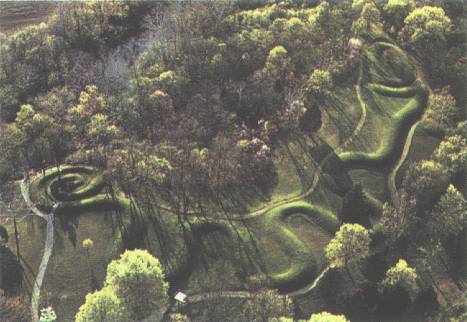
Serpent Mound, aerial photo I lived in Ohio in my high school years. On a family trip to the southern part of the state, we visited Serpent Mound, near Peebles. I was sixteen, and six feet tall already, and it seemed quite a bit taller. Of course, it is on the top of a ridge. It takes about five minutes to walk along its length; about a quarter mile. Its serpentine shape would make a walk along the spine of the Serpent quite a bit longer.

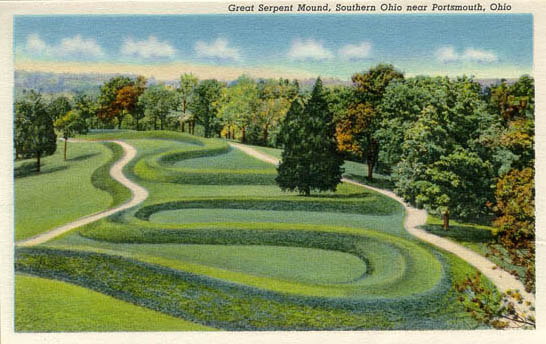
The first image here shows Serpent Mound from above. The second is a post card from about the time I visited, around 1960.

Serpent Mound, near Peebles, Ohio, on a post cardContinuing my review of 1491 by Charles C. Mann, I find it amazing that there is so much archeological richness in America, more than 99% overlooked or unrecognized. I recall visiting a relative in North Carolina, who took me digging for arrowheads. It isn't hard: Any road cut shows hundreds of yellowish flint chips along the older soil horizon a few inches below "modern" soil. We went into a field where we dug and sifted a couple cubic feet of dirt. There were hundreds of chips, a few dozen flake tools, and four arrow points. The site was a hunting camp, and has been dated to 8,000 years ago. It was used seasonally between that time and about 1200 AD. Even allowing for 7,000 years of use, there are huge numbers of artifacts. Agricultural areas nearby have few of the sought after "points", but much larger accumulations of various chips and flakes, made on the spot for various household uses, then discarded when dulled.

Aerial photo of Monks Mound at Cahokia, IllinoisMonk's Mound is shown here, with its companion mound, from above. That is a farmstead to the right!


At one time Serpent Mound was one of more than 10,000 mounds built by various peoples all over the Midwest and South. Most of them have been destroyed, plowed over or carted off for fill. While many were burial mounds, some such as Serpent Mound were "high places" or meeting centers, and some, such as Monk's Mound near Cahokia, Illinois, were for ceremonial use. The volume of Monk's Mound is substantially bigger than that of the Great Pyramid at Giza. It is often said of Giza that millions of slaves must have been employed for centuries. I wonder how many people it took to build Monk's Mound and its nearby, somewhat smaller (only by comparison!) companion mound?

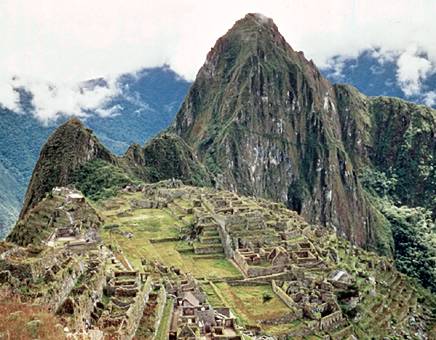
Machu PicchuLooking further south, the spread of maize after its development before 1000 BC can be followed in proxy by mapping the successive high-population cultures that followed, the Olmec followed by the Maya and Aztec in Mesoamerica, and the Wari followed by the Aztecs in and near the Peruvian Andes. They built impressive cities. Machu Picchu, shown here, is the most famous in Peru...though the hardest to get to!


Severe climate shifts after about 1250 AD seem to have greatly reduced the population the land would support. The century of famines in Europe (1304-1390) is probably a related phenomenon.

Chan Chan in Peru, photographed in 1931Yet great cities such as this one, Chan Chan in Peru, continued nearly until the Spanish conquest. Chan Chan itself was conquered by the Inca in about 1450, and declined rapidly. The Inca fell, first to smallpox, then to genocide, two generations later. Few stone cities are to be found in North America, though Tuzigoot (shown below) and the "Anasazi" cliff dwellings of the American southwest are awe-inspiring today. "Anasazi" is Navajo for "enemy ancestors"; they had a different name for themselves, now unknown.

Finally, the presence of trade goods throughout all areas testifies to numerous vibrant, sophisticated, interlocking cultures. Kentucky Flint is found throughout the Hopewell areas from Minnesota to Pennsylvania and Louisiana, Arizona pottery was traded into Utah and Idaho to the north and Mexico to the south, and copper was traded up and down the East coast of the (pre-)U.S. by Mandoag middlemen from North Carolina.

Tuzigoot Ruin, near Sedona, ArizonaAll of this speaks to a much greater cultural attainment than many care to think of. Lacking only iron tools, the Indians of North, Central and South America had all other accoutrements of a culture as complex and sophisticated as any European culture of the day.

See the following posts.

1491, Post 1 of 4: "War of the Worlds," in reverse

kw: book reviews, nonfiction, history, western hemisphere

At the climax of H. G. Wells's War of the Worlds, just as the Martians are poised to take over the earth, they are extinguished by a fatal disease against which they have no resistance. I guess we're lucky that Earthlings weren't similarly prone to catching a Martian cold.

Something like the wildfire spread of a "Martian cold" seems to have raged through the Americas in the 16th Century. Only it was worse than a cold: Prior to 1570 AD, five epidemics of smallpox roared through mid-South America, where we have the best documentation (1524, 1533, 1535, 1558, and 1565). The area was also ravaged by Typhus (or a similar disease) in 1546, influenza in 1558—which killed many that survived smallpox—, diphtheria in 1614, and measles in 1618. Nine epidemics, each killing from 20% to 50% of the population then existing...estimates of the proportion that remained range down from 20% to less than 5%, all within about two generations.

Contemporary records by Europeans show the trend. Prior to 1520, from Maine to Yucatan to Peru and Chile, described the land as well-settled, with a dense, active population of agriculturalists. Writings made after 1600 report an empty land covered with the ruins of abandoned villages, and small numbers of people subsisting by hunting and gathering in scattered, roaming bands.

Piecing together many accounts, and the best of recent scholarship, Charles C. Mann opens his new book 1491: New Revelations of the Americas Before Columbus with a study of the de-peopling of the Americas. While our children are taught an outdated view of a nearly empty continent just begging to be settled, scholars for the past generation have determined that the Americas of 1491 rivaled Europe in population, civilization, and sophistication. People are more similar than they are different.

White American culture has two opposed views of Indians, particularly the Indians prior to contact with Europeans (Mr. Mann presents his reasons for using the term "Indians," including the fact that the Indians seem to prefer it. I follow his
example. While it is not accurate, it appears to be the least inaccurate term). They are seen as "noble savages": people who made no cultural or technological progress since the glaciers melted some 12,000 years ago; people without history, mostly without agriculture, without cities or even settled homes, living by hunting and gathering on a land that was edenic and pristine. They are also seen as incurable vicious barbarians: wily, stealthy, warlike bands that kept white armies at bay for generations, only succumbing when nearly annihilated.

Thirty or forty years ago, the pre-1492 population of North America was confidently declared to be "about a million," a figure thought to be little changed for thousands of years. The forests of the East and Midwest and the grasslands of the West were considered nearly pristine. Today, the "low counters" struggle to maintain the plausibility of a pre-Columbus population estimate of around five million, while the "high counters," the majority, support figures in the ten- to fifty-million range, or higher.

Today, there are about 2.5 million Indians in the U.S., and another 1.6 million who are part Indian. I don't think of myself as part Indian, my best estimate of proportion being about 1/64th. The most inclusive tribe, the Cherokees, require 1/32d for membership, so they and I agree I am not "Indian enough to count." Most of those "counted" have one or two full-Indian grandparents.

U.S. census figures show 44,021 "American Indian, Eskimo, and Aleut" in 1860; before that year, they weren't counted. The Census of 1890 shows two figures: 58,806 "excluding Indian Territory and reservations", and 248,253 including them. So the total for 1860 was actually about 186,000. There were 31.44 million people in the U.S. in 1860, so Indians comprised 0.6% of the population. Today they total 0.9% (just the 2.5 million).

I favor a figure for North America of about twenty million in 1492, and fifty million in all of the Americas. The 17th Century estimates of a million or so Indians in North America, north of Mexico, represents a 5% survival after a century of European plagues. Then in the 19th Century we find less than a 20% survival after a century and a half of "Indian Wars," including further plagues caused by weapons such as "smallpox blankets".

Studies of immune system haplotypes indicate that the Indians derive from just four, three of which are found throughout Siberia today (along with many others). By contrast, there are dozens of European haplotypes. This is one indication that their ancestors began with a very small population and multiplied. They went through a "genetic bottleneck". However, it may be that much of the bottleneck occurred in the 1500s, as well. Two successive reductions of population by 90% would have eliminated many minor haplotypes.

The evidence for large populations in South America and Mesoamerica is much more abundant and compelling...to most. "Small counters" still argue against hemispheric populations larger than a few millions. It is hard to ignore the incredibly abundant Mesoamerican ruins. It isn't so easy to determine what happened in the Andes or Amazon areas, but archeologists now recognize very large-scale, widespread evidence for large populations.

Just in the Beni area of northeast Bolivia, the example with which Mann begins the book, there are thousands of raised areas with causeways between, raised areas composed of huge numbers of artifacts that indicate not only long-term occupation by large numbers of people, but deliberate manipulation of the soil to better support their agriculture. In areas with poor soil, broken pottery is a kind of "artifical gravel" that releases mineral nutrients into the soil much as the glacial gravels found in the northern U.S. and Canada do. Admixed charcoal, both fire leavings and charcoal deliberately produced and stirred in, further enrich the soil. Similar accumulations abound in the Amazon area.

Yet, Central and South America were ravaged by European plagues, then felled by Indian-European warfare, just as thoroughly as in the North. Introduced diseases, particularly smallpox, ran through the continents so rapidly that most Indian societies were demolished a generation or two before they saw their first white man.

Let's reconsider the stone-age, naked-savage view of early Indians. Except for a few Spaniards in ~1500, nobody saw Indians in anything like a normal condition or setting. By the early 1600s, Europeans newly arriving in America encountered indigenous peoples who were more like the survivors of a few generations in a concentration camp.

This sets the stage for further investigation of Indian society in 1491. See the successive posts.