Showing posts with label vacations. Show all posts

Wednesday, January 02, 2013

3 gets 11

kw: vacations, career

You know your vacation was long enough when you return to work and can't remember all the daily routines. This year, taking the last "week" off was a no-brainer. With both Christmas and New Year's Day on Tuesdays, and also having Monday off both weeks as company holidays, by taking Dec. 26-28th as vacation days, I got 11 days in a row of staycation (I did take a short driving trip). Most of my colleagues did the same.

I decided to retire at the end of this month. I and my managers agreed to all that a month ago. I'll be taking off a couple of days also, so today was the first of 20 days I have left to "work". Actually, I completed my work in December, and I am passing on knowledge and information to a couple of colleagues so they can continue certain projects I was involved in. Mostly, I have a lot of sorting and donating to do. I have only a few books I'll be bringing home. Most need to be passed on to colleagues who can make use of them. A lot of notebooks full of things like old viewgraphs (from the days before Framework or PowerPoint) will just be tossed out. I also have a large horizontal file (the equivalent of two filing cabinets) full of stuff:
  • Master copies of all my publications (no need to keep, they are in print, and I have those, too)
  • A 40-year collection of algorithms and analyses (maybe I'll send them to the programmers in India, where they still write technical software)
  • More than 3 years of the Sunday comics pages from a newspaper, that contain the last 3+ years of Calvin and Hobbes (though I have them in book form also)
  • Nearly a full drawer of pages photocopied from articles of (former) interest (out they go)
  • A full drawer of project files, of completed projects (out... unless someone wants the records)
That is the bulk of it. One accumulates a lot of stuff over a career, and I have had three. Time to lighten the load. The more stuff I get rid of now, the less for my heirs to throw out later.

Monday, March 19, 2012

It's in the woods

kw: vacations, sightseeing, photographs

Been in Oregon a couple days, on family business, and the bunch of us went to Camp 18, a restaurant and outdoor logging museum.

Wood carvings abound here. This image is one of their own. Camp 18 is located at milepost 18 on Highway 26, which goes northwest out of Portland to the Oregon coast. It is about an hour's drive out of Portland.

My brothers and I chose the occasion to coincide with our father's ninetieth birthday, so it was a trip for fun as well. We had Saturday free, and had lunch here. We also stopped by Sauvie Island, which someone had said was interesting. That was a bit of a dud, unless you get a kick out of ducks in a swamp.

By contrast, we spent a couple hours wandering around the equipment that is scattered around the land surrounding the restaurant at Camp 18.

What is a logging camp without a portable sawmill? This mill is belt-driven. The camp has several old tractors with take-off pulleys for hooking up a leather belt. I've seen a mill like this in operation. The belt is 20-30 feet long. Click on the image to see a larger version, where you can see that the saw blade's teeth have relief grooves cut; these reduce fouling of the blade. That's one of my brothers moving in for a closeup photo.

Inside the restaurant, one of the first things you see is this quartet of dancing bears, cut with a chainsaw out of logs. We had a great meal there, sitting at a table cut from the stump of a tree that had been nine feet in diameter. I overdid it; their "ordinary" burgers are 1/3 pound, but they had one that was double size. I had to try it. It was eight inches in diameter, on a bun so thick I had to cut the dome off so I could eat it. A couple of my brothers ate the trimmed-off dome.

Outside the restaurant's front door is this welder's whimsy. It was the only bit of artwork that wasn't chainsawn from a log.

This is another iconic bit of equipment: a tree faller (for some reason, loggers don't call it a "feller", which would be more etymologically correct; but what does a logger know of etymology?!) The business end at the left has three clamps to grab onto a trunk as thick as thirty inches. At the bottom, there is a chainsaw with a blade an inch thick, going around a 32-inch bar. Once the faller's clamps grab a tree, the blade is shoved out to saw off the tree. Then the tractor, which outweighs a typical hundred-foot tree by 5:1, simply lays the tree down and unclamps from it.

We also saw several kinds of donkey engine, winches that pulled themselves into the forest on skids; a band saw for cutting logs up to three feet, that had a 2-sided blade (16 inches across) so it could cut logs pushed through in either direction; a portable bunkhouse and camp galley on railroad cars; and a number of rigging poles for lifting and swinging big logs about. We are all mechanical machinery freaks, so it was an occasion for much exclaiming and explaining and arm-waving. A fun day.

Tuesday, August 26, 2008

Mt Rainier on our trip

kw: vacations, mountains

Mount Rainier dominates the skylines of Northwest Washington state, the more so because atmospheric refraction lifts it as much as a quarter degree above its geometrical aspect. It also rises more than 4 km (13,200 ft) above the surrounding terrain. This makes it number 21 on the list of "most prominent" mountains of the world.

When we first saw it, its peak was cloud-capped. This image is our second view; the first was just a hint. We approached from the South on Hwy 12 via Randle and Packwood. Much of the road beyond this point is amongst ridges and foothills that hide the mountain until you get inside Mt. Rainier National Park and pass the southern switchback on Stevens Canyon Road. But the whole area is so scenic, forested and dotted with lakes and reservoirs, that the drive seemed to go by quickly.

About halfway from that southernmost switchback to the turnoff to Paradise, one passes the Reflection Ponds. As my wife said, these views are postcard-perfect.

We got the chance to talk to various people as we stopped here and there for more photos. All said this was a rare day. One fellow said this was the first time he didn't have to wait for the occasional five-second opening in overcast. We feel very fortunate. It was quite a contrast to the day we first arrived in the area, when we drove all the way from Seattle to Portland in a series of rainstorms.

I am told that when Rainier has a cloud cap, that the top is being lashed by a snowstorm. It is hard to imagine such violence occurring in plain view on a seemingly peaceful day.

We had an early dinner (5:30PM) at Paradise Inn. It is pricey: we found only two entrees on the menu that were less than $20. But how many folks can claim to have dined in Paradise?

There is a small hill at the end of the parking lot from which this postcard-perfect picture was shot. Do click on the image to see a 1Mpx version...the 6Mpx original is breathtaking!

At Paradise you are right on the flank of the mountain. Mt. Rainier is cusp-shaped rather than domed, so it appears craggy even when you are right on it. I've been on a number of mountains that hide their upper reaches from their lower slopes. This is a much more viewer-friendly mountain!

After leaving the park at Longmire, we drove past Elbe, where we could see some of the cars of the Mount Rainier Scenic Railroad. Sad to say, it was closed that day, or we'd have splurged for the train ride.

Further on, just after sundown at Eatonville, we caught this last glimpse of the mountain in alpenglow. The air distance from Eatonfille to the peak is about 40 km (25 mi), yet it looks almost the same from Seattle, twice as far away. What an amazing mountain, and an amazing day!

Monday, August 25, 2008

Waterfall Fun on our trip

kw: vacations, waterfalls

The hiatus in postings between August 19 and 24 I was out of touch, staying at hotels whose much-touted wideband service didn't work. We were having too much fun to care. My family and I flew to Oregon the 20th to attend a family wedding. The pix below were from a run up the Columbia Gorge on the Waterfall route, the Historic Columbia Gorge Highway. We went with my brother and his family.

Of seven waterfalls along the route, we saw five, from Latourelle to Multnomah, the two prettiest. First we stopped at Crown Point to see the view from the Vista House, a seven-sided structure built by WPA workers during the early FDR administration. From here you can look up and down the lower Gorge.

This image is of the lower half of Latourelle Falls, with a couple to the lower right, for some idea of scale. They were attempting to go behind the falls, which is very possible, but you get drenched. The spray you can see at the base of the falls is driven sideways by a strong air blast entrained by the falling water, so anyone getting closer than a hundred feet or so soon gets a thorough soaking.

Of more interest to me are the "crystals" of columnar basalt that form the cliff. Columnar basalt is a characteristic rock of the Columbia Gorge and all the area. Huge flows of lava filled the area a few million years ago. Where the cooling lava was in contact with water, it cooled in a way that caused it to crack along the sides of hexagonal columns. The further from the lava-water contact surface, the more the columns begin to turn and even twist, as you can see right above the couple (you'll spot them better if you first click on the image to see a larger version).

Examples of columnar basalt with larger columns are the Devil's Postpile National Monument in California and the Giant's Causeway in Ireland. In the Columbia Plateau and Gorge, the scale you see in this image is more the rule.

Multnomah Falls is the tallest. The upper section, at 542 feet, is more than twice the height of Niagara Falls. There is a footpath to the bridge; the two people at the right end of the bridge are my son and his cousin. After taking the picture, I hiked that far myself, then went further about halfway to the top of the falls. Since I don't find waterfalls that interesting from the top, the halfway point was far enough!

Each waterfall we visited got us a little wetter. I am glad we were in a rental car! At least we didn't get muddy. I probably stayed the farthest from the falls, to avoid too many water spots on my camera lenses, but I still got pretty thoroughly sprayed.

Had we had more time, we'd have gone on to the other two waterfalls and seen more of the gorge. As it was, we judged the time just right, arriving back in Portland in time to dress and arrive a few minutes before the wedding began.

Sunday, March 23, 2008

Lavic is my favorite

kw: vacations, rock collecting

As mentioned in my teaser post of March 9, my brother and I spent March 8 collecting rocks at Lavic Siding. Later in the day we visited a rock store in Barstow, where the owner told us that Lavic is nearly the only classic locality which still has abundant material, easily found. Our experience was little different from visits to Lavic that I've made going back forty years.

This image taken from the "road" stop from which we began to collect, shows the Cady Mountains to the north. They are considered to be the source of the Jasper. A quarry in the Cady's was used for aggregate for the Route 66 topping, and I could see jasper in the asphalt. The Cady Mountains are reworked sediment, so when we say "source" we don't mean ultimate source; that is unknown, but occasional lava-jasper contact material indicates that the jasper is older than Pisgah crater and its lava fields, which are nearby.

We collected to the right, on the low hills, and behind the camera viewpoint. The ground is open, and the bushes are not nearly as abundant as they appear in this low-angle photo.

This is a typical view of the rocky ground that composes the alluvial hills. The visible jasper pieces here are all less than two inches (5 cm) in their largest dimension. Sometimes, you'll encounter a piece that doesn't "want" to be picked up. A little digging reveals a chunk of jasper that could be up to the size of a fist. Not many are larger than that.

The challenge is to gather solid pieces without porosity. Many pieces have abundant holes throughout. Such pieces don't polish well, unless you want to epoxy-fill a rough-ground piece and polish that. There is enough solid material to be had, that there is no need for such measures.

This high-crowned cabochon I made in 1970 has some of the nicest moss-jasper pattern I've ever seen. It is often called jasp-agate, having the texture of moss agate, but being primarily jasper "shreds" in a clear-to-milky-bluish chalcedony matrix. Some of the chalcedony forms little fortification agates, and I like such pieces the best.

We probably didn't find material that is its equal on this trip, but what we found is pretty good. A closeup of the cabochon, and three typical textures from rocks collected on this trip are shown below. They show what I like about Lavic jasper. All but the first were photographed under water, which gives a better idea what they'll look like when polished. The three are broken surfaces, so there's no desert varnish or caliche to obstruct the view.

This closeup, right near the center of the cabochon, shows the red-brown-yellow jasper shreds, the clear matrix, and the bluish spots, including one mini-agate. This is classic. Whatever the process that formed the jasper, it had to be complex.

The whole area here is just 5x9 mm, and it ought not be hard to find on the image above of the cabochon, which measures 40x30 mm. That is the "large standard" cabochon, by the way. If you go to a rock show, most of the cabochons on display by dealers are this size or smaller. It's hard to wear a stone much bigger than this, unless it is in a Western-style belt buckle. I have a big belt buckle or two, but haven't had the temerity to make a big stone for a belt!

The area of this view and those below is about 20x35 mm, so these three stones could probably produce 30x40 mm cabochon rough. Also, all three weigh a little less than a pound (about 0.4 kg, I suppose). This stone is just a little smaller than my fist.

This stone has plenty of bluish-white inclusions, including a nice mini-agate. It is the reddest piece I found. The pattern is less distinct than in the moss jasper, but is nice enough to keep the stone from being as boring as red paint. That is the trouble with a lot of red jasper: it is just red.

This piece is a breccia, a cemented-together, and now solid, agglomeration of broken chunks. The stone is smaller than the one just above, but only by a little.

The beige to yellow to brown colors seen here are more common than the red, but are less popular. However, a stone such as this has plenty of textural interest, and I find it of great beauty.

There is something about breccia that appeals on a deep level. Perhaps it is the beauty-out-of-trial aspect.

This layered piece shows a very common texture. The stone is the same size as the one just above.

Layered jasper has more color variety; the colors in this one include green, yellow, and red. I haven't seen much green jasper from Lavic. The green color usually requires either chrome or iron in a semi-reduced state. The intense reds and yellows here indicate the main colorant is fully oxidized iron. In its presence, I don't know how the green color forms.

Lavic jasper and jasp-agate are mysteries, beautiful ones.

Wednesday, March 12, 2008

The Watts Towers, a first look

kw: vacations, sightseeing

They comprise the largest work of art produced by one person working unaided. For 33 years, Simon Rodia worked alone to build these towers, using no blueprints, scaffolding, welds or bolts, using only tile-setter's tools. The tallest tower is 99½ feet (30.3 meters). When the city of Los Angeles wanted to destroy them as an "earthquake hazard", a consortium of preservationists made a good case for an engineering test. When the main tower was unaffected by a 10,000 lb test, they were deemed safer than the skyscrapers then a-building downtown, and allowed to stand.

Their innards are reinforcing rod, textured steel bars, wired together (no welds), and covered with a concrete coat a couple inches thick. Into this coating, the artist embedded shells, tiles of many sorts, pieces of rock, broken china and glass, the bottoms of colored bottles, and other found materials. He must have spent a lot of time collecting stuff! You can find out a lot more about the Watts Towers at the Watts Towers website and in this Wikipedia article.

My father, his friend, and I visited the afternoon of March 10, 2008. Dad has been there a few times, but it was the first time for me. This picture captures the tiny feeling I had looking up at them. But there is a lot more than just a few towers. At their web site, you'll find out about the Gazebo, the two decorated walls, the staircase, and other marvels built into and around them.

A closeup shows examples of the seashells, dinner plates, and tiles used for decoration. Other panels had stamped impressions in the concrete and rock and slag coatings.

The Watts Towers Arts Center has been set up nearby to teach and lead tours of Rodia's monument. We visited on a Monday, when everything is closed. Tours are scheduled only on Friday-Sunday, and the Center is closed on Monday. We did talk to a guard, who gave us a brochure with Rodia's biography and a short description of the towers' details. The web sites above are much fuller.

Conserving the structures has turned into a time-consuming job for a number of people. When an earthquake did come, the towers pretty much shrugged it off. However, the concrete cracked in a number of places, so people had to remove and restore some sections to prevent rusting of the steel inside. The towers were completely photographed in the 1970s, so whenever a piece of tile or other decoration is found on the ground, they can get it back to the spot it came from. Still, I found a number of gaps where stuff had fallen off and not yet been restored.

These details aside, the Towers are awesome.

Sunday, March 09, 2008

A day on the rocks

kw: vacations

I am on vacation in California, visiting relatives. On Saturday, March 8, my brother and I drove out into the desert to collect rocks. Once I download my pictures I'll post more. We collected 30-40 pounds of Lavic Jasper, mainly in tumbling size pieces. I always enjoy seeing the Joshua Trees, like those shown here. This is a stock photo from Joshua Tree National Monument, which is a couple hundred miles from Lavic.

Tuesday, July 05, 2005

Caving by Boat

kw: vacations, commercial caves, wildlife parks

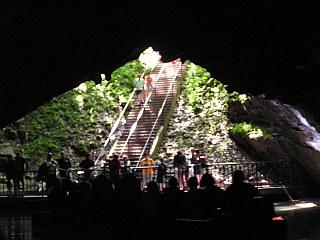
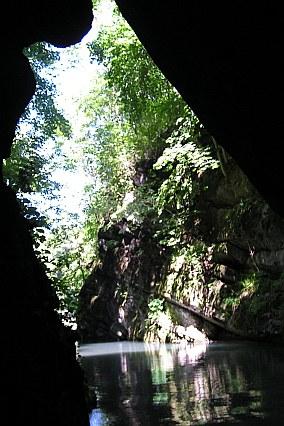
We were away for a few days...unconnected, even! We went with a church group to central PA. One place visited was Penn's Cave. This shows the entrance from within the cave, on the boat—it is a water cave. You take the boat right through the cave, and come out the other end, shown next.

If we had walked the cave, it would have been a half hour walk, probably. The boating, the lake you spin 'round out the other end, and the traverse back to the beginning entrance, make it about a 50 minute trip. We enjoyed it very much.

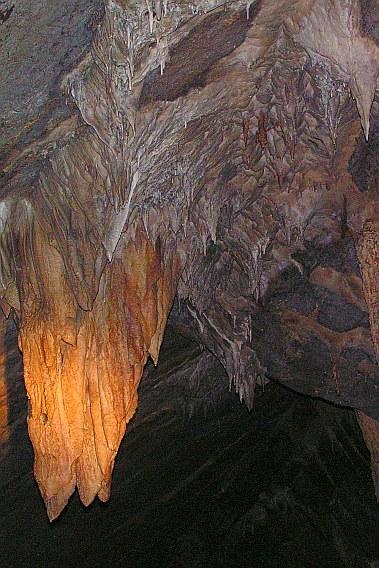
Penn's cave has a nice variety of formations, and is a fully "living" cave. The formations are growing. On many of them you can see drops of water, depositing calcite as they evaporate. Be prepared to get a few drops on you! I was taught as a kid, "Stalactites are stuck 'tite' to the ceiling, and Stalagmites (note the g) are just a 'mite' weaker, so they stand on the floor." When the two grow together, they become a cave column. Penn's cave is young enough that it has few columns.


There are few things I find more beautiful than living cave formations. Some caves, such as Carlsbad and Mammoth, are stupendous in size, with lovely formations in some areas, though most are dead in them. Growing formations have an extra vibrancy.


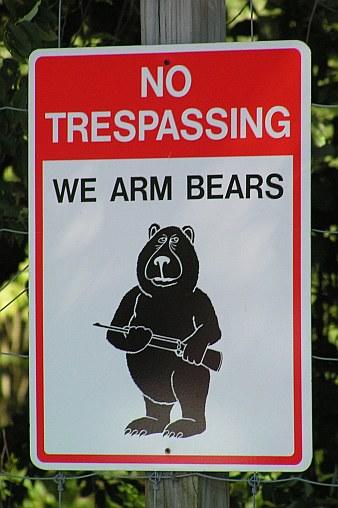
After the cave trip, we went on the Wildlife Tour. The Penn's Cave ranch has a large area with native wildlife. The ones we saw were Bison, Longhorn cattle including those shown here, Deer, Elk, Gray Wolves, a very old Timber Wolf, and some bears. We all particularly liked the sign they have near the bears.

Bears, more than other wildlife, quickly form a bond with their keepers. The ones we saw—three black bears, one the "cinnamon" color phase—are kept well fed, and also enjoy the treats the keeper gives them, including clover flowers. A few kids tried the flowers and found them a little sweet. Better'n twigs, I guess, if you're a bear.

They also have an exhibit of stuffed African animals. They emphasized that the hunting was done fully licensed, for preparing the exhibit. I still don't like the idea. There are more than sufficient exhibits of African animals. Such "scientific" hunts are really for revenue, which the countries sorely need. I prefer ecotourism, because an animal that bring $5,000 as a dead specimen, can bring much more than that as a photographic subject, over and over again.

Well, that bit of unpleasantness aside, it was an enjoyable trip. Sunday morning we met with the church in State College, just a few miles away. Lovely ending to a 2-day outing.