Showing posts with label palaeontology. Show all posts

Sunday, September 09, 2018

Dinos as you have never known them

kw: book reviews, nonfiction, science, paleontology, palaeontology, dinosaurs, mesozoic era

For at least a little while my hunger to know "everything" about dinosaurs has been satisfied! I just read The Rise and Fall of the Dinosaurs: A New History of a Lost World by Steve Brusatte. What an amazing book, and it is not enormous as you might expect: a mere 404 pages, index included.

I used to think of the earliest dinosaurs as Dimetrodons or something similar, but they were not ancestral to dinosaurs. Note the splayed legs, like a lizard or crocodile. Dinosaurs had legs under the body like a mammal or bird. These were Synapsids, and one small branch of that order that survived the great Permian extinction went on to give rise to mammals, while a different order altogether became the proto-dinosaurs.

The drawing of a Coelophysis (pronounced "seal-off-a-sis") shown here, from the opening of Chapter 2 of Rise and Fall, represents an early dinosaur, but not the earliest. These critters lived somewhat late in the Triassic, and gave rise to birds, which are the survivors of dinosaurs. That robin, cardinal or jay out in the yard? Just your everyday dinosaur!

Note how the hind legs of Coelophysis are attached to the body similarly to the legs of a chicken. Of course, the forelegs do not have the range of motion of the wings that came along much later.

A note on geologic time. Three big Eras divide up the last 541 million years:

  1. Paleozoic (Old Life) Era, from 541-252 million years ago
  2. Mesozoic (Middle Life) Era, from 252-66 million years ago
  3. Phanerozoic (Recent Life) Era, since 66 million years ago

Each era has a few Periods. The last period of the Paleozoic Era is called the Permian, and ended with a terrible ecological catastrophe, probably caused by enormous and long-lasting eruptions of lava in the middle of Asia. More than 90% of all species went extinct, and more than 99% of all living things died. Among those that survived were some synapsids (the mammal ancestors) and a few groups of "saurians" (lizardlike animals) two groups of which became the dinosaurs about 10 million years after the end-Permian extinction event.

The three periods after the Permian, that make up the Mesozoic Era, are the Triassic, the Jurassic, and the Cretaceous. Dinosaurs were present from early in the Triassic until another disaster caused by the crash of a mountain-size asteroid killed off at least 70% of all species (on land at least) and more than 90% of all land-based living things. Certain smaller dinosaurs, the birds, survived into the Phanerozoic and from them all the 10,000 or more species of bird we see around us today have evolved.

That isn't really a summary of the book, just an introduction to its landscape in time. I have read portions of the book over the past few years because they were published in briefer form as articles in Scientific American, to which I subscribe. Dr. Brusatte is one of the talented young scientists of a generation about half my age, that are discovering new dinosaurs at the rate of about one per week, describing not only the animals but the environments they lived in, and in books such as this, presenting them to the public.

As the author describes, he has been present to witness or participate in some of the scientific revolutions that produced this comprehensive view of the true "Age of Dinosaurs", which is still going on! The first ones evolved about 243 million years ago, and though they did not become dominant until the latest Triassic or very early Jurassic period, they then remained dominant until the asteroid came along to level the playing field.

So, although today we speak of the "Age of Mammals", and the largest creatures now living are indeed mammals, there are about 5,400 species of mammals now in existence, and slightly more than 10,000 species of birds. We cannot count our modern dinosaurs out; they outnumber mammals two-to-one. And, if you ever tangle with an Emu or Cassowary, you'll get a taste of what life was like for mammals when dinosaurs ruled the land. Though our son was nearly four when he met an Emu willing to be hand fed, I suspect he hasn't forgotten this "dinosaur encounter"!

The author devotes two chapters to the development and life of tyrannosaurs. They are the iconic theropods, and theropods are ancestral to birds. The ultra-famous Tyrannosaurus rex probably had feathers, although it may have had just a smattering of them, the way an elephant or rhino has a few tufts of hair. A large animal doesn't need much insulation from the cold. Interestingly, dynamic analysis of specimens of Tyrannosaurus that were of different ages shows that the younger ones were better runners, while their huge elders were not as fast, and operated more by stealth and ambush. It makes me wonder, though, how well stealth works when you're roughly twice the size of an elephant.

I cannot close without mentioning the many micro-biographies of the people—dinosaur hunters, paleo-ecologists, and others—that have over the past centuries pieced together the evidence for the amazing lives and living of the dinosaurs. The book has a larger "cast" than most novels, and introduces them to us in all their variety (and scientists come in all varieties!).

If you read only one book about dinosaurs this year, read this one.

Thursday, January 28, 2010

Ecology of the Dinos

kw: book reviews, nonfiction, palaeontology, dinosaurs, ecology

I began reading this book before the one I reviewed two days ago, but got bogged down and set it aside while finishing that one. Dinosaur Odyssey: Fossil Threads in the Web of Life by Scott D. Sampson is a big book with a lot to say. Though there are copious illustrations, there is still a ton of text.

There are also a number of good ideas. Dr. Sampson dwells on the relationships among dinosaurs and with the plants and animals about them for about half the book. Some of his writing got me thinking along the lines I explored in yesterday's post.

I happened across the online article by Mike Taylor, Sauropods Held Their Necks Erect, which included this screen shot from Walking With Dinosaurs by the BBC. While the sauropods are shown here walking "horizontally", Taylor reasons that they used a posture more like a giraffe. With trees blocking one's view, it is likely one would see at most one or two small herds of sauropods at a time.

The first part of Dinosaur Odyssey goes over earth history, the geologic time scale, and other obligatory material for a book on the Mesozoic animals. I've read so many such treatments that I wound up skipping a lot. But I don't begrudge its presence; if this book is the first dinosaur book a precocious middle-schooler reads, the discussion will be helpful and necessary.

More than any other book I've read, though, this one details the ecological relationships of dinosaurs and their place in our history…and in our present: birds are dinosaurs, taxonomically. They continue the ecological success of creatures that dominated terrestrial landscapes for 160 million years—until the K-T extinction—and bring it forward another 65 million years to the present. Bird species outnumber mammal species two-to-one, and it was only after humans got into South America some 13,000 years ago that the reign of flightless "terror birds" as dominant large vertebrates came to an end.

The author makes an interesting case in favor of dinosaurs, at least some of them, being "mesothermic", not ectotherms like modern lizards, but not quite wholly endothermic like modern birds and mammals. Indeed, many bird species can regulate their body temperature downward to save energy when they can't feed. Hummingbirds do so at night, for example. Many birds do this, but very few mammals, and not as completely. There appear to me to be two styles of endothermy, which probably evolved separately.

Now, if dinosaurs were mesothermic, particularly the predatory ones, a given landscape could support more of them. A fully endothermic tyrannosaur, weighing as much as a large bull elephant, would need between twenty and fifty times the area to feed in as an elephant needs, because its energy supply is one step removed from the herbivory the elephant employs. It takes ten to twenty pounds of good-quality feed to produce one pound of cow or elephant; herbivorous dinosaurs were probably similar.

Also, it takes five to ten pounds of the herbivore's meat to yield one pound of predator. But day-to-day energy use depends on metabolism. Comparing two modern, similar-sized beasts: a well-fed lion can go two or three days until the next kill. A well-fed Komodo dragon can last a month. Thermal strategy dictates efficiency.

Bringing us the scenarios of dinosaur ecology requires weaving together, not just biological strands, but also palaeogeography and plate tectonics, the rise and fall of oceans, and even cosmology, for it was a cosmic event that killed all the dinosaur lineages except the birds.

The author closes the book with an epilogue, musing about using dinosaurs as a vehicle to better teach biology, ecology, evolution, and scientific principles in general. He also proposes them as the "poster children" for a grand story that teaches us better stewardship of the planet. He repeats what is well known in some circles, that we are in the midst of a human-driven great extinction that could be as severe as the one that ended the "age of Dinosaurs" and ushered in this mammal-dominated one (though remember there are twice as many birds). It doesn't have to be this way, but we seem to be like someone riding in a taxicab whose driver is drunk or insane, and the door won't open. Those of us who care haven't been able to do much about it. I hope a book like this can be a positive influence.

Tuesday, May 06, 2008

Old bones by the ton

kw: book reviews, nonfiction, palaeontology

Thomas Jefferson had some; Ben Franklin handled a few; Georges Cuvier and Charles Lyell (important names in early Geology) studied and described them...the big bones from Big Bone Lick in Kentucky. In Big Bone Lick: the Cradle of American Paleontology Stanley Hedeen takes us on a rapid time-and-space tour of the late Pleistocene to early Holocene Midwest.

When I first saw the book, being ignorant of the Lick, I thought its subject might be the dinosaur wars of the desert West. But I was in for a treat. There appears to be little in the history of northern Kentucky's premier fossil locality of the hatred and rivalry that marked the Cope-versus-Marsh collecting binges of the late 1800s. The earliest visits to the area by Europeans were in the 1750s, and a great deal of collecting went on for a hundred years before Cope or Marsh ever heard the word "Dinosaur".

The "favorite fossil" of Big Bone Lick is the American Mastodon, which was at first thought to be a huge bison, or a giant human. The bones were mostly in pretty poor shape. Salt Licks get trampled, over and over again, as herbivores visit them almost as frequently as they would a watering hole in the desert. From a salt-requirement point of view, a well-vegetated field is a desert. Herbivores don't get nearly enough salt from plants, so they will travel far to a source of salt.

Where many animals congregate, many die; some of predation, more of drowning by crowding. The soft muck through which the briny waters rise facilitates rapid burial of the dead and soon-to-be-dead unwary.

Big Bone Lick was the first place the Mastodon and other species were found, and its mute evidence eventually led Jefferson and others to conclude that extinction was possible, overthrowing the Platonic (not really Christian, but widely thought to be) idea that the species of the earth are static, neither going extinct nor new species arising.

The Lick is also still the largest and most prolific deposit of fossils for the period 20,000 to 10,000 years ago. It is still a source of collections being studied. The current roster of extinct species of large mammal stands at seven. Thirteen other more recent remains, from bison to dogs, have been found there. The Big Bone Lick State Park web site has details of the modern museum and trails.

Friday, February 16, 2007

Nature's whack at the Dinosaurs' grandparents

kw: book reviews, nonfiction, geology, paleontology, palaeontology, disasters, extinction

My favorite science authors write about difficult concepts in ways that those with less training can understand, or at least appreciate. Douglas H. Erwin has written a great detective story, with the culprit still not fingered, but whose outline is beginning to emerge from the shadows. Extinction: How Live on Earth Nearly Ended 250 Million Years Ago is about an event even more significant for life on Earth than the Dinosaur-killing asteroid that whopped into the proto-Caribbean some 65 million years ago.

What is the Permian? It isn't just a high school in central Texas, nor only a series of ridges the school is named for. Those ridges are named for a geological period four times as distant in time as the demise of the dinosaurs. In Texas, the Permian reefs are a fantastic source of oil, and oil is the heart of Texas's economy. But the Permian is famous for more than that.

To a geologist, the Permian era lasted from 298 million years ago to just before 250 million years ago (abbreviated "ma" hereafter). It is one of ten major divisions of "deep time", stretching from about 2 ma to about 600 ma. It is very nearly in the middle. One of the later ones, the Cretaceous, ended with the asteriod impact that took out all the larger dinosaurs, leaving us with the little ones, that became the birds. In each of these eras, rocks worldwide contain specific kinds of fossils, and record a suite of ecological conditions that changed rather abruptly from one to the next. At least five of these abrupt changes included a mass extinction, a short interval (a million years or so? or perhaps only a few years...or less?) during which many species vanished and after which new species arose. The great extinction at the end of the Permian era is the most severe.

We know the following: about 90% of marine species, and 75% of land species became extinct. This compares to about 25% marine and 20% land species that died with the dinosaurs in the Cretaceous extinction event. The kinds of rocks being laid down everywhere changed, from massive limestone reefs to thinly layered mudstones and clays. The thin layers are particularly clean because there were no bottom-feeding critters to stir them up or burrow through them...for a few million years. Even for those species that weren't eliminated, only perhaps a percent or two of the individual animals or plants then living survived the catastrophe.

What catastrophe? Another asteroid? Lotsa volcanoes? What?? Dr. Erwin makes it clear he cannot give us a final answer, but he is able to eliminate some possibilities, and outline the most likely few that are able to explain the clues that we have.

The fact is, we have lots of clues. Problem is, they are not sufficient to define exactly what happened or in what order. Finely precise age dating of rocks has yielded an upper limit for how long the disaster took: 160,000 years. Other indications hint that it was probably much, much shorter, but the evidence for that is still being eagerly and energetically gathered. Further, the destruction of land species and marine species occurred at the same time. Thus, we can rule out suspects that operate slowly, such as mega-volcanic eruptions occurring over millions of years. We can also rule out most scenarios in which land species died out because the marine species died; we retain only those in which the marine die-off was so abrupt and so pervasive that the land die-off followed within a very short time.

However, we cannot completely rule out mega-volcanoes, if we can determine that the huge volumes of basalt that were erupted in Siberia at that time were emplaced quickly enough. It is kind of hard: The volume of a small continent was laid atop central Asia. Could that have happened in a matter of a few thousand years? Imagine hundreds of Mt Pinatubo, or thousands of Mt St Helens, going off every year for thousands of years. Actually, the style of eruption was more liquid, like tens of thousands of Kilauea eruptions, every year. It beggars belief.

The author presents all the suspects in Chapter 2, presents and explains all the evidence in several following chapters, then discusses the current understanding in the last two chapters. It is fascinating. He tends to favor what he calls Murder on the Orient Express, in which all the suspects participated in a murder. Scientists are not comfortable with scenarios that include too many players. It smacks of "throw in enough special cases until you have everything covered." But it is unlikely that such a significant event in life's history on Earth could have a single, simplistic cause.

I once favored another asteroid hit, bigger than the dino-killer. There may indeed have been one, though perhaps not any bigger. Dr. Erwin presents Jack Sepkoski's proposition, that some kind of comet or asteroid has clipped Earth about every 26 million years... but he doesn't go into it. The mega-volcanic episodes are much rarer, only every 200-300 million years, perhaps. Should an asteroid have barged in just as the Siberian eruption was well under weigh, it could have provided sufficient extra mayhem to make the effects of the eruptions much deeper and more widespread. If big space rocks are landing on a regular schedule, one is bound to arrive when something else significant is happening. So I also now favor the multi-cause scenario.

The mystery isn't yet solved. There's lots of exciting work to be done. What fun!

Saturday, December 31, 2005

Jurassic Park left out the Feathers

kw: book reviews, nonfiction, paleontology, palaeontology, dinosaurs, birds

I grew up reading Roy Chapman Andrews's books on finding dinosaur fossils in the Gobi Desert of Mongolia. Those books and similar "science adventure" books had at least as much to do as my mother's influence (she was a rockhound) with making me into a geologist.


After reading Unearthing the Dragon I find its author, Mark Morell, has assumed Andrew's mantle. Here is a lavishly illustrated (thanks to his collaborator, illustrator and photographer Mick Ellison) and well written account of the fossil find of the turn of the century: the discovery first by Chinese scientists and then in collaboration with international colleagues, that many dinosaurs were feathered, and that birds are dinosaurs.

The subtitle of the book is "The Great Feathered Dinosaur Discovery". Its second title, shown here, puts a nuance on the title, where the "Unearthing" ideogram has the connotation of revealing, and those for "Dragon" refer to a living, rather than mythological, being. The real dragon being revealed here is the land and multifaceted cultures of China.

A word as to how creatures are grouped into families. As well as I understand it, the current controversy in cladistics—grouping like things into a hierarchical classification system—is about the definition of a clade. When a clade is defined, does it include or exclude those clades that arose from its own members? For example, the Vertebrates might be a clade to one scientist, but not to another, because it is understood to include five major groups: fish, amphibians, reptiles, birds, and mammals, plus a few little critters like lanceolets that are hard to place.

I think most people have little trouble with this, or with the placing of Vertebrates and the many kinds of Invertebrates (clams, worms, insects, and many more) into the big, kingdom-size group Animals. Going smaller gets us into trouble. If the amphibians arose from one or more kinds of fish are they part of the Fish clade? More to the point, if birds arose from dinosaurs, are they dinosaurs? Dr. Norell has one heavy-duty chapter at the end, plus solid materials scattered throughout the book, that support his contention (with which I agree) that birds are dinosaurs. The main difference between a crow and some of the fossils from China are that the crow has no teeth but is better adapted to flying. Many of those fossil critters—even some that look less like birds—probably flew, also, but it is hard to prove just which ones could, and which could not.


One thing is sure, though. Nearly all the dinosaur fossils from Liaoning Province are feathered, wherever they are preserved well enough to show the feathers. This illustration, a bit enhanced compared to the book photo (p. 185), shows feathers with vanes just like modern bird feathers.

One thing has become abundantly clear. Feathers did not evolve to enable flight, but for insulation. Feathers provide better insulation than any kind of hairy pelt. Flight arose later, much later. Thus, the feathered dinosaurs must have been warm-blooded. Whether they were as stably so as modern birds and mammals is not known, but they would not need feathers if their metabolism was lizardlike.

Throughout the book, the author regales us with anecdotes of his and Mick's adventures in China, personal glimpsed of many fine Chinese scientists, and the surprising and amusing cultural differences a Westerner faces in China. The Chinese are not one people, but dozens. There is probably more ethnic and cultural diversity in China than in India, though the thousand languages of China are more closely related than the many Indian tongues.


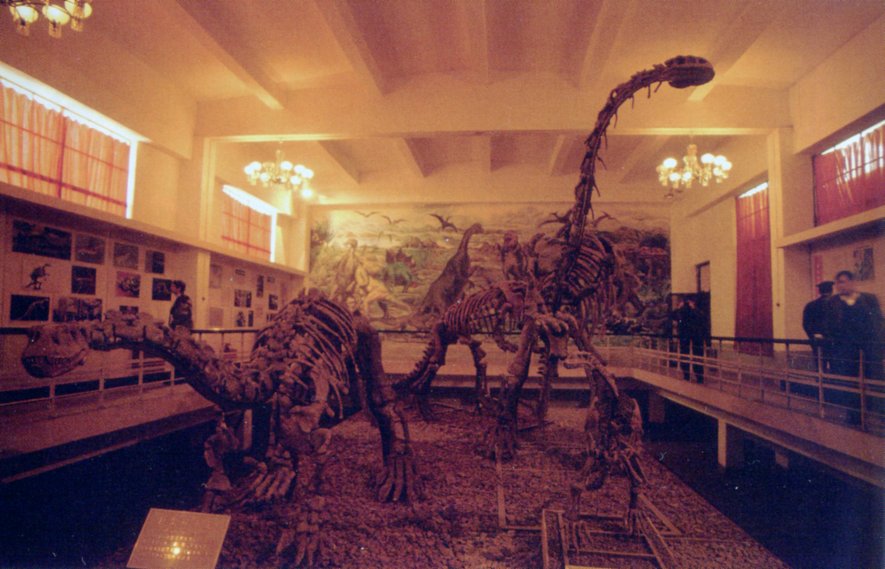
The discovery of feathered dinosaurs, dinosaurs that might have flown, very early birds, and a number of links between Archaeopteryx and both modern birds and its own ancestors, including dinosaurs that probably did fly, has catapulted Chinese fossils, Chinese scientists, and Chinese science into the international limelight. There are still very few who have visited China, but riches abound for those who do. Now, in the fossil-prone areas, small regional museums like this one (p. 147) abound, showing not just large, "traditional" dinosaurs, but many new discoveries of the smaller, much more abundant (though less often fossilized), feathered dinosaurs that we lived through the Cretaceous extinction event to become today's birds.

The last chapter of the book is polemic. As with any new discovery, there are those who see it differently. The vocal crew that rallies around the moniker BAND (Birds Are Not Dinosaurs) prefer the view that birds evolved from something ancestral to both the feathered dinosaurs and the bird clade. Dr. Morell spends the whole chapter refuting their views. Time will provide its own refuation, should one be needed.

Thursday, August 04, 2005

Synthesis of Human Origins

kw: anthropology, paleontology, palaeontology, book reviews

Prior to about 1958, there was occasional talk about various "missing links," particularly once the "Piltdown Man" hoax was uncovered (1953). At the time, as a youngster, I was what I call a "general believer" in my faith, someone who accepted what I'd been taught, including a rather sketchy account of the creation, without much thought.

I do recall at an age before ten (we were attending a Congregational church) the pastor telling us that Genesis begins with two verses that skip over a vast period of time. Later, once I began taking my faith seriously, my studies led me to conclusions similar to those of G.H. Pember in Earth's Earliest Ages, that there is room for geologic ages of time in that "gap" (yes, I subscribe to the "gap theory"), and that specific wording in Isaiah, Job, and the Psalms requires assigning the "creation" in Genesis 1 and 2 to a relatively recent restoration after a destructive spiritual war in an older creation. I do not think I have it all exactly right, but I am certain that today's Intelligent Design Creationists have nearly everything wrong.

Pember disdained Darwin's hypotheses, but I do not. I greatly enjoy reading of progress in any science, including the study of human origins. I am a fan of Darwin, S.J. Gould, and others in between who promote evolutionary processes as the best explanation we have of the origin of the physical biosphere. The science says nothing of spiritual things—nor should it, and no text in the Hebrew-Christian Bible purports to be a geological or biological textbook—nor should it. Scripture is about divine-human relationships.

Thus I very much enjoyed reading The Complete World of Human Evolution by Chris Stringer and Peter Andrews. The title to me is tongue in cheek: today's complete is tomorrow's woefully inadequate. From the ad Thames & Hudson put in the back cover, they have a line of "The Complete..." books. Such hubris.

Back to missing links. Much more is heard of this matter today, even though quite a number of links have been found. Of course, no modern creationist will ever admit that any of the fossil species assigned to the genus Homo or the probable ancestor genus Australopithecus is a human ancestor anyway. But no matter what "link" may be found, they demand another between, saying the evidence is still too incomplete...and so on. Be that as it may, let those of us who give a bit of credence to the evidence of our senses continue the discussion.

Drs. Stringer and Andrews have compiled a tour de force, and they present it in a very readable fashion. I initially expected a rather long read, but there are few pages with more than 40% devoted to text. There are just too many things that need illustrating, and the authors have gathered the cream of the illustrators' crop.

The key concept in understanding paleontological discoveries is that there is no "great chain of being," leading inevitably to a supreme species. A joke I like shows a shrew, a monkey, an ape, a cave man, and a suited "salaryman" on successive steps. A lot of empty steps lead beyond, and the cave man says, "I wondered when you'd notice that there are a lot more steps." The better metaphor is a bush, a very bushy bush, with comparatively few living twigs, and the fossil record represented by the occasional bit of twig or branch; the great majority of the mass being beyond reach.

Thus, though a diagram early in the book shows about forty fossil species (and one living species, us!), the authors make clear that if the fossil record were truly comprehensive, there would likely be thousands of species. Considering that primate species seem to change into one or more daughter species as many as five times per million years, and that pre-ape-to-apes-plus-man history covers about twenty million years, the lineal ancestry of each living species (there are five, humans and four other apes) includes perhaps fifty species. In addition, there are a number of side branches that died out entirely, some after persisting for several million years, and most species in a genus had several sibling species.

Well, I could go on and on, but I'll briefly state that the book's contents are organized around introductory concepts & examples, discussions of the fossils, and interpretation. The illustrations, photos of fossils, maps, paintings of possible scenes, charts, and all are copious and well captioned. I particularly noted that the authors show species that lived later than about a million years ago as relatively hairless, as we are; and earlier species having perhaps less body hair than a gorilla, but a definite pelt nonetheless. I have long thought that the species that discovered fire was the first nearly hairless species. A combustible pelt is simply incompatible with the use of fire.

A lovely book, from which we can learn much.