Showing posts with label dinosaurs. Show all posts

Thursday, October 16, 2025

Finding Rex

 kw: book reviews, nonfiction, science, paleontology, biographies, dinosaurs, t rex, tyrannosaurus rex

The last summer that I was a geology student I spent six weeks in an area above Lee Vining in the Sierras. Midway through, in the early afternoon I was resting near a pond when several backpackers came by, hiking toward a wilderness area another mile along the trail. I asked them how long they would be there. One said, "A week. How long have you been here?" I answered, "Three weeks." "Wow! That's neat," another one answered. I grinned ruefully and said, "Not really." I was already getting tired of tenting. Of course, since part of my daily routine was gathering rocks and hauling 10-20 pounds of them back to base camp for identification, I suppose I wasn't having quite as much fun as the average tourist. By the end of the summer I was pretty clear that I wasn't cut out for a job that required lots of field work.

Reading The Monster's Bones: The Discovery of T. Rex and How it Shook Our World by David K. Randall, I could only admire the grit of Barnum Brown. To this day, roughly half of the dinosaurs and early mammals on display at the American Museum of Natural History in New York City are specimens he collected. In addition to an iron constitution, he had a quick mind and had learned to recognize the kinds of geological deposits most likely to contain great fossils. He had also learned enough anatomy to make a good guess as to what animal a new bone belonged to.

While Barnum Brown collected on most of the continents, his main stomping ground was the great fossil beds of north-central United States. This was the area made famous by the "bone wars" of Professors Marsh and Cope, from 1877 to 1982. These rivals went broke trying to outdo each other as they collected, and described, species after species of large vertebrate fossils. In the end, the biggest and baddest dinosaur of all escaped their grasp. Brown found the first specimen of Tyrannosaurus rex in 1902, and for some years, during which he found a few more, he was the only collector to find any.

The book is largely a biography of Barnum Brown, who was named for P.T. Barnum almost on a whim, because the circus was in town. The author details his "life and hard times" and the resulting drive that motivated him to seek solace in the wilderness. Yet he wasn't antisocial, as so many "mountain men" are. In addition to great strength and persistence and lively intelligence, he could be intensely social, the kind of guy who is the life of the party, whatever party he happens across. This enabled him to befriend ranchers and farmers in the field and to maintain a, if not good, at least useful working relationship with the notoriously prickly director of the American Museum, Henry Fairfield Osborne. It greased many a relationship necessary to get access and tips to the best bone deposits. Brown lived just days short of ninety years.

Rather than focus on Barnum Brown, I find most interesting the social changes in attitudes toward dinosaurs that resulted from the discovery of T. rex. All the large dinosaurs found previously were herbivores such as the familiar Brontosaurus and Diplodocus and duckbills such as Hadrosaurus. They were portrayed as overgrown cows, brainless, plodding beasts that had to move about half submerged in swamps to buoy up their enormous bulk. When the first Triceratops was described in 1889 by Charles O. Marsh, not many wondered what the great horns were needed for. Then when the first tyrannosaur was discovered by Brown in 1902, it soon became clear that those horns were sorely needed! Public interest was piqued, and as "tyrant king" specimens or replicas were displayed in a growing number of museums, museum attendance boomed.

T. rex is still the most popular dinosaur. The proliferation of celebrity knockoffs such as Barney and the popularity of tyrannosaur suits, used for all sorts of pranks, has made this terrifying beast almost a cuddly member of the household. But I'm sure I wouldn't want to stumble across this picnic in a nearby forest! (Image generated with the Flux1.Kontext engine in Leonardo AI.)

I'm a six footer. Were I in this picture, the top of my head would barely reach the larger animal's knee. Even the "babies" shown here would outweigh me by a big factor. The teeth of an adult T. rex are the size of bananas. Big bananas. Perhaps Plantains.

I have great admiration for men like Brown who can go into the field and bring back cool stuff. My style of collecting is day trips…no more weeks in a tent for me!

Monday, February 03, 2025

Dinosaurs triumphant!

 kw: book reviews, nonfiction, history, fossils, geologists, victorian era, dinosaurs, evolution

As a fun retirement job I work at a natural history museum. A few years ago the exhibit hall was being redesigned. Several of us were discussing the plans, and the kinds of exhibits to be included. One experienced scientist—like me, retired, and a volunteer in the research division—said primarily one thing, persistently and steadily, every couple of minutes: "Dinosaurs." It was true when I was a child and it remains true that having several dinosaur skeletons on display will bring the crowds.

As told by Edward Dolnick in Dinosaurs at the Dinner Party: How an Eccentric Group of Victorians Discovered Prehistoric Creatures and Accidentally Upended the World, people had found big fossilized bones for millennia, and fitted them into whatever worldview they had, usually as prehistoric, or sometimes contemporary, giants. For example a fossil elephant skull, with its large central hole for the trunk, is behind the myths of Cyclops with a single, giant eye. As the Industrial Revolution cranked up in the late 1700's, with all the digging of canals, tunnels, and deep foundations, many more large bones were unearthed. A few chapters are devoted to Mary Anning, the most productive fossil finder of her generation. Comparative anatomy became a thing, and by the early-middle 1800's a great number of the animals to which these bones had belonged were being likened to reptiles with certain mammalian characteristics, such as upright legs rather than the sprawling legs of a crocodile.

The word "dinosaur" was coined by Richard Owen in 1842. Not long after, marine reptiles such as plesiosaurs and ichthyosaurs, and aerial reptiles such as pterosaurs, were recognized as parallel to dinosaurs, but not included. By this time it was also becoming more and more clear that the Earth was a great deal older than the comfortable assumption of "around 6,000 years", or the more specific "created in 4004 BC", based on Biblical interpretation of the time. Also, the geological principle of superposition—rock layers and their fossils found below more shallow layers and their fossils are older, and a succession of layers represents a succession in time—showed that most creatures from long, long ago had gone extinct, even that there had been entire assemblages of living things that vanished from the scene, to be succeeded by other assemblages that then became extinct, several times.

This upset the simple theology of the time. Then when Darwin published On the Origin of Species in 1859 the faith of many was shaken. Time was impossibly long (about 750,000 times as long as they had thought), the vanishing of 90+% of all living species (more than once!), and the sudden insignificance of humans and human history seemed to relegate God to the status of a minor, and indifferent, demigod.

Side note: How is it that so many people retain Biblical faith to this day? I was taught from a very early age about The Gap: that verse 1 of Genesis 1 describes an original creation, which was damaged and became chaotic, such that verse 2 and onward describe a restorative creation. Hebrew has certain complications in its grammar. One is this: the past tense of the verb "created" in Genesis 1:1 is different from the past tense used for the verbs in the rest of the chapter that describe God's actions on the Six Days. Therefore, whatever one may think of the six days (such as whether they were 24-hour days or eons or something in between), the time of the first verse is not in any way constrained. In the Scofield Reference Bible (1909), the second note on Genesis 1:1 (using "but" to mean "only") is, "But three creative acts of God are recorded in this chapter: (1) the heavens and the earth, v. 1; (2) animal life, v. 21; and (3) human life, v. 26, 27. The first creative act refers to the dateless past, and gives scope for all the geologic ages." This last sentence is the key to understanding that God's focus is on His relationship with humans, and that is the emphasis of the entire Bible. It is not a text of natural history.

In this very entertaining book we learn how the people of the Victorian era (~1837-1901) were practically dragged out of their comfortable, small and short-lived world into a dramatic, vast and eons-long spectacle. Once dinosaurs had been discovered, many thought they and their flying and swimming kin might be found in the unexplored parts of the Earth. Eventually they understood, this was not to be.

In the next-to-last chapter, "Dinner in a Dinosaur" we learn of a fantastical dinner party held New Year's Eve 1853 inside a life-size model of an iguanodon. By the late 1800's dinosaurs had thunderously earned a seat at the table.

The last sentence of the Epilogue ends, "…with no warning, no foreboding, they vanished." I would add the proviso that today's birds are dinosaurs. If you are ever in the presence of a Cassowary or Ostrich in the wild—and you'd be in mortal danger in either case—you'll understand.

Wednesday, February 08, 2023

Dinosaurs: the known unknowns

 kw: book reviews, nonfiction, paleontology, dinosaurs

This is the femur of a Titanosaur (Patagotitan mayorum) found not too long ago in Patagonia, the "largest dinosaur ever found" (so far!). The discoverers note that this animal was not yet full grown…

A picture similar to this (but with poorer lighting) graces the color plates section of How Fast Did T. rex Run: Unsolved Questions from the Frontiers of Dinosaur Science by David Hone.

How big was the whole animal? In elephants, the tibia is about 2/3 the length of the femur, and this femur is about 8 feet long, so the tibia might be about 5 to 5.5 feet long. Put that on top of a foot the size of a love seat, perhaps 1.5 feet high, and we have a hip socket roughly 15 feet up there. David Hone's book notes that the weight of this animal was between 50 and 100 tons, putting it in the same league as blue whales.

Guess what question never gets answered? How fast Tyrannosaurus rex could run, or whether it could run at all. Of course, the length of its legs and the general physics of inverted pendulums indicates that its walking speed was 3 miles per hour when "moseying along", and in the range of 15-25 mph when walking briskly. I tend to favor a maximum of 15 mph, just from proportion. Humans mosey in the 1-1.5 mph range, with a steady pace of 3 mph when going somewhere, and "power walking" in the 4-5 mph range. It is not (yet) known whether T. rex could run at all, and if so, how fast. However, it is pretty certain that they could not jump. Elephants cannot, and probably neither can rhinos (one website I found claims that some rhinos can jump). Moving a 6-8 ton mass upward fast enough to stay aloft long enough to raise one's legs off the ground? No way.

How Fast is not about what we know, but about what we don't, with suggestions for finding out more. We'll never learn it all, but that is what science is for: expanding knowledge into an infinite realm. The 16 chapters discuss numerous kinds of knowledge we know only in part, or hardly at all. For example, what color or colors were dinosaurs? We could look at big lizards and crocodilians (especially caimans like this one).

For decades, illustrations of Mesozoic landscapes have depicted the animals as mostly "elephant colored". But in Chapter 11, "Appearance", we learn of rare finds that include melanosomes (color packets) that can still be characterized. They show that some dinosaurs were spotted or striped, and give us a hint as to colors. Many seem to have been countershaded (darker on top, lighter beneath), which makes an animal harder to spot.

The chapter following, "Reproduction", points out that we know nothing so far, except the fact that it had to have happened, or there would be no eggs, no young, no dinosaurs, period. There are some apparent mega-nests that have been found, where for several yards all around you are walking on dinosaur eggs. It's hard to imagine tyrannosaurs or brontosaurs coupling, but fertilization of eggs has to take place inside the female's reproductive tract (no milt-spraying on already-laid eggs such as we see for many fish).

I was also quite taken with this illustration of representatives of the three major clades of dinosaurs: theropods, sauropodomorphs, and ornithischians. I added the gray bars for clarity. This drawing is on p. 58 in Chapter 4, "Diversity".

A close look will reveal that the ornithischians have the greatest in-clade diversity. While theropods are mostly variations on the tyrannosaur scheme—though they include the birds—and sauropodomorphs are mostly variations on the Brontosaurus/Brachiosaurus body plan, the ornithischians include ceratopsians, ankylosaurs, stegosaurs and hadrosaurs. The ornithischians are united in having hips that resemble bird hips, while the other two clades have hips more like those of lizards. It's a quirk of evolution that certain lizard-hipped theropods evolved into birds, re-developing the bird pelvis. As usual, scientists await fossils that will show how this process came about.

We find that the number of species of Mesozoic dinosaurs is less than 2,000, while about 10,000 modern species of bird (today's dinosaurs) have been described so far. No doubt there are thousands of dinosaur species yet to be discovered. 

Reading How Did was great fun. Dr. Hone's knowledge is comprehensive, and he has been to many of the key exposures at which dinosaur fossils are found, including those in China that have yielded numerous extremely-well-preserved feathered dinosaur fossils. A full size T. rex may not have sported many feathers, but the young ones, and smaller species, certainly did. Thirty years ago we had no unambiguous fossils with clearly-preserved feathers. New finds lead to new science. That is a key message of this book.


Friday, March 04, 2022

Dinosaurs, Dinosaurs!

 kw: book reviews, nonfiction, paleontology, dinosaurs, science

Searching for "dinosaur hunter", I had this in mind:

This image is from the Anyone4Science website, which caters to educators and children.

It is way cool to go out in the field, do a bit of digging, and find a big skeleton like this. I have been to Dinosaur National Monument in Colorado, where you really can see scenes similar to this, and a preserved cliff has bones sticking out everywhere.

Typically, fossil hunting is rather humdrum. When an animal dies, usually by predation, it doesn't take long for its killer and scavengers to thoroughly dismantle it and scatter the bones while picking them clean. In most environments the bones also are soon dissolved or digested, and nothing will remain. A fossil skeleton such as the one shown is the result of an unlikely series of events, such as sudden burial by a landslide, in either a dry climate or one with a handy bog with reducing conditions. There are also "water traps" such as the La Brea pits in Los Angeles, California or the Mammoth Site near Hot Springs, South Dakota (but there are no dinosaurs in either of those places). So you more typically find scattered bones, or bits of bones, and they have to be sorted and fitted together to assemble a skeleton, or some part of a skeleton.

The recent book The Science of Jurassic World: The Dinosaur Facts Behind the Films, by Mark Brake and Jon Chase, touches on this matter, but focuses more on the science behind the question, "Can dinosaurs really be cloned from ancient mosquito guts?" Spoiler alert: In a word, NO. But it made for a fun premise, as handled by author Michael Crichton for his book Jurassic Park and the series of films still being made in the Jurassic World franchise.

Also, to keep the book from being no more than a pamphlet, the authors dug into quite a variety of matters, such as, "Was Dr. Alan Grant's job a walk in the park?" (Sure, after 3+ decades of study and research), "How Did Dinosaurs Get So Big?" (Call it an arms race, between herbivores that needed to be too big to kill, and predators "growing" to meet the challenge), and "Tyrannosaur family life" (some tyrannosaurs may have hunted in family group packs, but we don't know if T. rex did).

I don't know whether it is a lack of education, or a new habit among writers of the X Generation (and since): Every few pages I encountered a partial sentence. It's like they never discovered the semicolon. Two examples:

"For more than 150 years, people have been mounting dinosaur skeletons for display. Skeletons that were discovered, dug up, and diligently prepared for subsequent analysis and potential mounting." (p 61. The period before "Skeletons" should be replaced by a comma. The second "sentence" doesn't stand on its own.)

"So, dinosaurs evolved relatively rapidly. No doubt driven by shifts in our planet's oceans, climate, and continents." (p 68. While a comma can replace the period before "No", a semicolon is better because of the comma-delimited list later on.)

In either case, the second "sentence", if viewed in isolation, is meaningless. They should actually be dependent clauses. Such instances appear at a rate of one or two per chapter, primarily in the first half of the book. Doesn't anyone employ copy editors any more? Or are copy editors equally at fault?

Out of more than 25 chapters taking up such questions, they could have dispensed entirely with one that was crafted to slander President Trump. There is no science in that chapter; it is a quintessentially ugly bit of polemical politics. As Solomon wrote, 3,000 years ago, "As dead flies give perfume a bad smell, so a little folly outweighs wisdom and honor." The authors lost all the regard I had had for them from reading the earlier chapters.

To close the loop: When I searched for "dinosaur hunter", this is typical of what I found:

The image is from an advertisement at ArtStation. 

That hunter looks rather passive in the face of a charging T. rex. Also, he has no hope of surviving unless he is carrying an RPG.

Sunday, September 09, 2018

Dinos as you have never known them

kw: book reviews, nonfiction, science, paleontology, palaeontology, dinosaurs, mesozoic era

For at least a little while my hunger to know "everything" about dinosaurs has been satisfied! I just read The Rise and Fall of the Dinosaurs: A New History of a Lost World by Steve Brusatte. What an amazing book, and it is not enormous as you might expect: a mere 404 pages, index included.

I used to think of the earliest dinosaurs as Dimetrodons or something similar, but they were not ancestral to dinosaurs. Note the splayed legs, like a lizard or crocodile. Dinosaurs had legs under the body like a mammal or bird. These were Synapsids, and one small branch of that order that survived the great Permian extinction went on to give rise to mammals, while a different order altogether became the proto-dinosaurs.

The drawing of a Coelophysis (pronounced "seal-off-a-sis") shown here, from the opening of Chapter 2 of Rise and Fall, represents an early dinosaur, but not the earliest. These critters lived somewhat late in the Triassic, and gave rise to birds, which are the survivors of dinosaurs. That robin, cardinal or jay out in the yard? Just your everyday dinosaur!

Note how the hind legs of Coelophysis are attached to the body similarly to the legs of a chicken. Of course, the forelegs do not have the range of motion of the wings that came along much later.

A note on geologic time. Three big Eras divide up the last 541 million years:

  1. Paleozoic (Old Life) Era, from 541-252 million years ago
  2. Mesozoic (Middle Life) Era, from 252-66 million years ago
  3. Phanerozoic (Recent Life) Era, since 66 million years ago

Each era has a few Periods. The last period of the Paleozoic Era is called the Permian, and ended with a terrible ecological catastrophe, probably caused by enormous and long-lasting eruptions of lava in the middle of Asia. More than 90% of all species went extinct, and more than 99% of all living things died. Among those that survived were some synapsids (the mammal ancestors) and a few groups of "saurians" (lizardlike animals) two groups of which became the dinosaurs about 10 million years after the end-Permian extinction event.

The three periods after the Permian, that make up the Mesozoic Era, are the Triassic, the Jurassic, and the Cretaceous. Dinosaurs were present from early in the Triassic until another disaster caused by the crash of a mountain-size asteroid killed off at least 70% of all species (on land at least) and more than 90% of all land-based living things. Certain smaller dinosaurs, the birds, survived into the Phanerozoic and from them all the 10,000 or more species of bird we see around us today have evolved.

That isn't really a summary of the book, just an introduction to its landscape in time. I have read portions of the book over the past few years because they were published in briefer form as articles in Scientific American, to which I subscribe. Dr. Brusatte is one of the talented young scientists of a generation about half my age, that are discovering new dinosaurs at the rate of about one per week, describing not only the animals but the environments they lived in, and in books such as this, presenting them to the public.

As the author describes, he has been present to witness or participate in some of the scientific revolutions that produced this comprehensive view of the true "Age of Dinosaurs", which is still going on! The first ones evolved about 243 million years ago, and though they did not become dominant until the latest Triassic or very early Jurassic period, they then remained dominant until the asteroid came along to level the playing field.

So, although today we speak of the "Age of Mammals", and the largest creatures now living are indeed mammals, there are about 5,400 species of mammals now in existence, and slightly more than 10,000 species of birds. We cannot count our modern dinosaurs out; they outnumber mammals two-to-one. And, if you ever tangle with an Emu or Cassowary, you'll get a taste of what life was like for mammals when dinosaurs ruled the land. Though our son was nearly four when he met an Emu willing to be hand fed, I suspect he hasn't forgotten this "dinosaur encounter"!

The author devotes two chapters to the development and life of tyrannosaurs. They are the iconic theropods, and theropods are ancestral to birds. The ultra-famous Tyrannosaurus rex probably had feathers, although it may have had just a smattering of them, the way an elephant or rhino has a few tufts of hair. A large animal doesn't need much insulation from the cold. Interestingly, dynamic analysis of specimens of Tyrannosaurus that were of different ages shows that the younger ones were better runners, while their huge elders were not as fast, and operated more by stealth and ambush. It makes me wonder, though, how well stealth works when you're roughly twice the size of an elephant.

I cannot close without mentioning the many micro-biographies of the people—dinosaur hunters, paleo-ecologists, and others—that have over the past centuries pieced together the evidence for the amazing lives and living of the dinosaurs. The book has a larger "cast" than most novels, and introduces them to us in all their variety (and scientists come in all varieties!).

If you read only one book about dinosaurs this year, read this one.

Thursday, January 28, 2010

Ecology of the Dinos

kw: book reviews, nonfiction, palaeontology, dinosaurs, ecology

I began reading this book before the one I reviewed two days ago, but got bogged down and set it aside while finishing that one. Dinosaur Odyssey: Fossil Threads in the Web of Life by Scott D. Sampson is a big book with a lot to say. Though there are copious illustrations, there is still a ton of text.

There are also a number of good ideas. Dr. Sampson dwells on the relationships among dinosaurs and with the plants and animals about them for about half the book. Some of his writing got me thinking along the lines I explored in yesterday's post.

I happened across the online article by Mike Taylor, Sauropods Held Their Necks Erect, which included this screen shot from Walking With Dinosaurs by the BBC. While the sauropods are shown here walking "horizontally", Taylor reasons that they used a posture more like a giraffe. With trees blocking one's view, it is likely one would see at most one or two small herds of sauropods at a time.

The first part of Dinosaur Odyssey goes over earth history, the geologic time scale, and other obligatory material for a book on the Mesozoic animals. I've read so many such treatments that I wound up skipping a lot. But I don't begrudge its presence; if this book is the first dinosaur book a precocious middle-schooler reads, the discussion will be helpful and necessary.

More than any other book I've read, though, this one details the ecological relationships of dinosaurs and their place in our history…and in our present: birds are dinosaurs, taxonomically. They continue the ecological success of creatures that dominated terrestrial landscapes for 160 million years—until the K-T extinction—and bring it forward another 65 million years to the present. Bird species outnumber mammal species two-to-one, and it was only after humans got into South America some 13,000 years ago that the reign of flightless "terror birds" as dominant large vertebrates came to an end.

The author makes an interesting case in favor of dinosaurs, at least some of them, being "mesothermic", not ectotherms like modern lizards, but not quite wholly endothermic like modern birds and mammals. Indeed, many bird species can regulate their body temperature downward to save energy when they can't feed. Hummingbirds do so at night, for example. Many birds do this, but very few mammals, and not as completely. There appear to me to be two styles of endothermy, which probably evolved separately.

Now, if dinosaurs were mesothermic, particularly the predatory ones, a given landscape could support more of them. A fully endothermic tyrannosaur, weighing as much as a large bull elephant, would need between twenty and fifty times the area to feed in as an elephant needs, because its energy supply is one step removed from the herbivory the elephant employs. It takes ten to twenty pounds of good-quality feed to produce one pound of cow or elephant; herbivorous dinosaurs were probably similar.

Also, it takes five to ten pounds of the herbivore's meat to yield one pound of predator. But day-to-day energy use depends on metabolism. Comparing two modern, similar-sized beasts: a well-fed lion can go two or three days until the next kill. A well-fed Komodo dragon can last a month. Thermal strategy dictates efficiency.

Bringing us the scenarios of dinosaur ecology requires weaving together, not just biological strands, but also palaeogeography and plate tectonics, the rise and fall of oceans, and even cosmology, for it was a cosmic event that killed all the dinosaur lineages except the birds.

The author closes the book with an epilogue, musing about using dinosaurs as a vehicle to better teach biology, ecology, evolution, and scientific principles in general. He also proposes them as the "poster children" for a grand story that teaches us better stewardship of the planet. He repeats what is well known in some circles, that we are in the midst of a human-driven great extinction that could be as severe as the one that ended the "age of Dinosaurs" and ushered in this mammal-dominated one (though remember there are twice as many birds). It doesn't have to be this way, but we seem to be like someone riding in a taxicab whose driver is drunk or insane, and the door won't open. Those of us who care haven't been able to do much about it. I hope a book like this can be a positive influence.

Wednesday, January 27, 2010

Mesozoic herds

kw: musings, dinosaurs, ecology

I am reading a book, not done yet, about dinosaurs and how they fit into the ecologies of their times. I'll make a couple observations while I am thinking of them.

When Charles Darwin visited Patagonia while voyaging on The Beagle, he observed a modern bone bed where two streams came together, and compared its seeming richness with a landscape containing scattered herbivores. He remarked about the concentrating effect of the rains washing corpses or skeletons of the animals together. We need only recall that, while a cow or llama may be able to live for ten, twenty, even thirty years, most live three or four years before disease or predation does them in. On a particular square mile of the prairie, it only takes one or two of the few dozen animals that die every year to wash into the stream bed, to produce a mighty bone pile in just a thousand years.

I have visited two semi-recent fossil bone beds, La Brea Tar Pit in Los Angeles, California, and the Mammoth Site near Hot Springs, South Dakota. Both of these were active as animal traps for thousands of years. I don't find it surprising that each has a few hundred mammoth skeletons; I find it surprising that there are not more of them. Most of the mammoths that died in the environs of these "traps" did not wind up in them. Yet they are considered marvels of fossil richness.

Consider an area such as Dinosaur National Monument (or, indeed, the entire Four Corners region), where animal remains were protected and fossilized over a span of a few million years. We need to remember that the animals found in them did not die all at once, but over the whole time span. There are really very, very few places of "mass killings". Where they do occur, we still find evidence that there was after-death concentration of remains, such as by fluvial gathering into stream beds or pools.

The really giant animals of the Mesozoic needed large ranges to support their feeding. In the grass-rich Badlands of South Dakota and Nebraska today, it takes fifty acres to support one 300 kg (650 lb) cow. If 50-ton sauropods were warm blooded, how many acres did each require? Several thousand? Even in richer grasslands such as in Iowa (pre-Corn), one would need ten acres per cow, and perhaps 1,500 per adult sauropod (that's over two square miles, or about ten square km).

But did sauropods have a similar energy requirement per pound of weight as a cow, even assuming they were endotherms? Probably less, so let us posit a food need of the growth of one square mile of Iowa prairie per animal.

Of course, sauropods didn't eat grass. Grasses hadn't evolved yet. Perhaps their fare was richer than modern grasses. I think it may have been, because with grasses came a big change in the atmosphere: ultra-low carbon dioxide.

Prior to the evolution of grasses and other plants that use C4 photosynthesis, the amount of CO2 was never less than 1000ppm. C3 (and CAM) photosystems can't draw down CO2 below that point. But an atmosphere like that would facilitate heavier cover by shrubs and other small plants.

Today's CO2 level of 380ppm, while well above the 260ppm of the 1820s, is much less than the optimal level for the growth of leafy plants. Experiments with boosting CO2 to 580ppm have shown that most plants grow faster and more succulent; they'd be better eating!

I conclude that, while Mesozoic environments may have been more productive than modern ones, due to increased CO2, they were probably no more than twice as productive. Of course, that is comparing any area to itself under the different conditions, and with a different array of herbivore food.

So if it took a few hundred acres to feed each large sauropod, how big could their herds have been? It all depends on how far such a super-elephant can walk in a day. A dozen cattle on a square mile of Nebraska prairie need to keep on the move. After cropping the grass in one area, they can't return for a couple of weeks (let's ignore the winter situation for this exercise). So if they form a single herd, and I have observed that a herd of a dozen is quite common, they need to cover the whole square mile in two weeks, walking 6-10 miles daily (While we might model a cow's motions as a plowman's row-turn-row, they operate more randomly and thus cover even more ground).

Now if each sauropod needs a square mile or more, a herd of a dozen might need 15-20 square miles. Their long necks are a benefit here, as they reduce the walking needed to browse the trees and shrubs (remember there's no grass). It is possible that they need walk no further than a cow does, each day. It also means, however, that the herd spends most of its time spaced two neck-lengths apart, for more efficient "mowing". I consider that reasonable. Let us also remember that their mode of feeding was more like an elephant's, stripping the trees to neck-height in addition to slurping up all the shrubbery.

With all this in mind, I imagine this kind of scene, as a Mesozoic rancher on horseback. I can see a sauropod from ten miles away, so I can survey all the herds in an area of 300 square miles (1,200 sq km). That land area supports a few hundred of them, but in loose clumps here and there, perhaps in 20-30 "small" herds. They'd need to take turns going over to the river for a drink. Taking large herds of cattle to a river creates an awful, muddy mess. When left to themselves, they go at more scattered times. Dinosaurs ought to have developed/evolved similar habits.

If I am instead on foot, so I cannot see more than three miles (though I might see a sauropod's up-stretched neck from six or eight or ten miles away), I can still see as many as 30 animals, though the nearest is probably half a mile away, and for safety's sake, I hope so! The more immediate risk would be falling into a dino-sized "pie", which could weigh several times as much as me…but monster feces is better left to another riff.

Thursday, September 24, 2009

A hole in time, or in the head?

kw: book reviews, science fiction, time travel, dinosaurs

In Russian folklore, Baba Yaga is a baby-eating witch who lives in a cabin that runs around on huge chicken legs. In Primeval: Extinction Event by Dan Abnett, which largely takes place in Siberia, tyrannosaurs get loose in the 21st century, and the Russians who encounter them—and survive—call them Baba Yaga.

The book is based on the Primeval TV series (ITV, Britain), in which "anomalies" that link older times with the present allow all sorts of ancient animals to get loose in places like London. The series takes advantage of the continuing public fascination with "people versus dinosaurs", a phenomenon that dates back to the discovery of dinosaur fossils in the early 1800s. One of my first books was of the "All About Dinosaurs" genre, and our family had a coffee-table book with historical artwork including swamps filled with brontosaurs and a couple dozen other dinosaur species, with a few kinds of pterosaurs in the sky.

As I've grown older I've sometimes wondered at this public fascination. Do we really need bigger and meaner things that could eat us, to populate our nightmares? Is getting stepped on by a Diplodocus any more final than having an elephant crunch you flat?

Anyway, in this novel the scientist Cutter and two of his assistants, the team that is at the forefront of Anomaly research, get kidnapped and taken to Siberia, where a much larger and longer-lasting anomaly has turned a large area into a misplaced section of the Cretaceous age, complete with tyrannosaurs, large sauropods and hadrosaurs, ceratopsians, and even packs of wolf-size Troodons.

Here is my own fascination with the vagaries of time and survival. Had there been no Chicxulub asteroid to bring the Age of Reptiles to an end, mammals today would probably still be Spaniel-size and smaller, and some descendant of Troodon would be a (formerly, perhaps) scaly primate with space travel and atom bombs.

In Cretaceous Siberia, both tyrannosaurs and troodons are equally deadly, the scientists are surrounded with FSB (former KGB) agents who have no humor whatever, and it takes a highly unlikely sort of hacking session for Connor to use a Russian military satellite's EMP beam to close the big anomaly. Just there, the biggest cop-out of the book occurs. The author has shown plenty of imagination up to this point, but the critical button push ends a chapter, while the next one begins with an "after it is all over" sort of wrapping up. It is kind of like a half-hour speech being concluded with a single bland sentence. C'mon, Dan, give us one more chapter of our heroes, and a villain or two, barely surviving the attack of the killer satellite!

Oh, well, there was plenty of willing suspension of disbelief needed already. I suppose I can imagine my own dramatic "blow out all the radios and cell phones and laptops" scenario. I just hope the aging general in charge doesn't have a pacemaker!

Wednesday, September 23, 2009

The popularity of big reptiles

kw: observations, popular culture, dinosaurs, lists

I'm reading yet another book based on a spin-off of Jurassic Park, which I'll be reviewing in a day or two. It got me thinking about the staying power of the human-dinosaur connection.

I did a little searching on the web, and herewith, some of the most popular J.P. spin-offs:
  1. Veloci-Mates on YouTube
  2. Jurassic Park: Operation Genesis for Xbox
  3. Warpath: Jurassic Park
  4. Primeval TV series (which has spin-offs of its own)
  5. Primeval film, which is about a crocodile, not a dinosaur
  6. King Kong (2005), with its extended sequences of dinosaur stampedes and fights
  7. Dinotopia books and films

Saturday, December 31, 2005

Jurassic Park left out the Feathers

kw: book reviews, nonfiction, paleontology, palaeontology, dinosaurs, birds

I grew up reading Roy Chapman Andrews's books on finding dinosaur fossils in the Gobi Desert of Mongolia. Those books and similar "science adventure" books had at least as much to do as my mother's influence (she was a rockhound) with making me into a geologist.


After reading Unearthing the Dragon I find its author, Mark Morell, has assumed Andrew's mantle. Here is a lavishly illustrated (thanks to his collaborator, illustrator and photographer Mick Ellison) and well written account of the fossil find of the turn of the century: the discovery first by Chinese scientists and then in collaboration with international colleagues, that many dinosaurs were feathered, and that birds are dinosaurs.

The subtitle of the book is "The Great Feathered Dinosaur Discovery". Its second title, shown here, puts a nuance on the title, where the "Unearthing" ideogram has the connotation of revealing, and those for "Dragon" refer to a living, rather than mythological, being. The real dragon being revealed here is the land and multifaceted cultures of China.

A word as to how creatures are grouped into families. As well as I understand it, the current controversy in cladistics—grouping like things into a hierarchical classification system—is about the definition of a clade. When a clade is defined, does it include or exclude those clades that arose from its own members? For example, the Vertebrates might be a clade to one scientist, but not to another, because it is understood to include five major groups: fish, amphibians, reptiles, birds, and mammals, plus a few little critters like lanceolets that are hard to place.

I think most people have little trouble with this, or with the placing of Vertebrates and the many kinds of Invertebrates (clams, worms, insects, and many more) into the big, kingdom-size group Animals. Going smaller gets us into trouble. If the amphibians arose from one or more kinds of fish are they part of the Fish clade? More to the point, if birds arose from dinosaurs, are they dinosaurs? Dr. Norell has one heavy-duty chapter at the end, plus solid materials scattered throughout the book, that support his contention (with which I agree) that birds are dinosaurs. The main difference between a crow and some of the fossils from China are that the crow has no teeth but is better adapted to flying. Many of those fossil critters—even some that look less like birds—probably flew, also, but it is hard to prove just which ones could, and which could not.


One thing is sure, though. Nearly all the dinosaur fossils from Liaoning Province are feathered, wherever they are preserved well enough to show the feathers. This illustration, a bit enhanced compared to the book photo (p. 185), shows feathers with vanes just like modern bird feathers.

One thing has become abundantly clear. Feathers did not evolve to enable flight, but for insulation. Feathers provide better insulation than any kind of hairy pelt. Flight arose later, much later. Thus, the feathered dinosaurs must have been warm-blooded. Whether they were as stably so as modern birds and mammals is not known, but they would not need feathers if their metabolism was lizardlike.

Throughout the book, the author regales us with anecdotes of his and Mick's adventures in China, personal glimpsed of many fine Chinese scientists, and the surprising and amusing cultural differences a Westerner faces in China. The Chinese are not one people, but dozens. There is probably more ethnic and cultural diversity in China than in India, though the thousand languages of China are more closely related than the many Indian tongues.


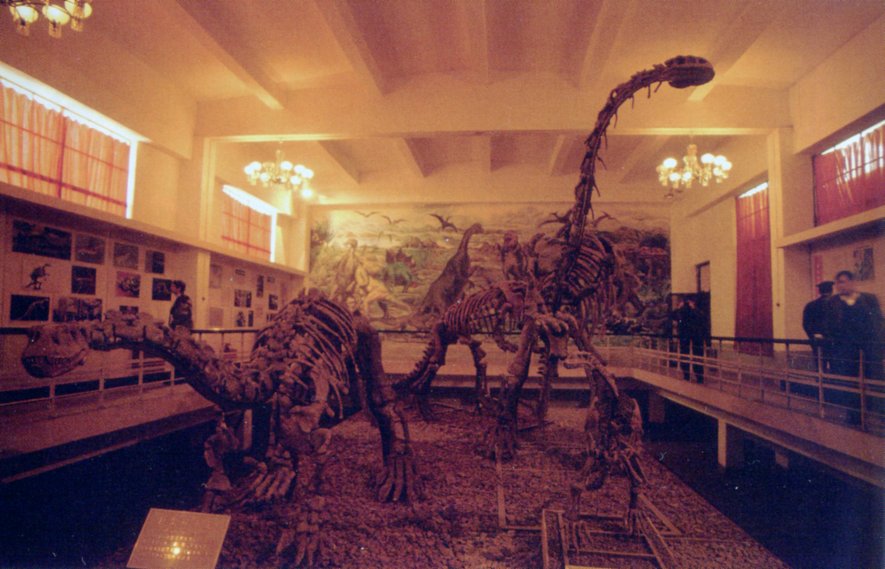
The discovery of feathered dinosaurs, dinosaurs that might have flown, very early birds, and a number of links between Archaeopteryx and both modern birds and its own ancestors, including dinosaurs that probably did fly, has catapulted Chinese fossils, Chinese scientists, and Chinese science into the international limelight. There are still very few who have visited China, but riches abound for those who do. Now, in the fossil-prone areas, small regional museums like this one (p. 147) abound, showing not just large, "traditional" dinosaurs, but many new discoveries of the smaller, much more abundant (though less often fossilized), feathered dinosaurs that we lived through the Cretaceous extinction event to become today's birds.

The last chapter of the book is polemic. As with any new discovery, there are those who see it differently. The vocal crew that rallies around the moniker BAND (Birds Are Not Dinosaurs) prefer the view that birds evolved from something ancestral to both the feathered dinosaurs and the bird clade. Dr. Morell spends the whole chapter refuting their views. Time will provide its own refuation, should one be needed.

Saturday, November 19, 2005

Dinosaur Construction 101

kw: book reviews, nonfiction, dinosaurs, DNA, genetic engineering

About twelve years ago, shortly after Jurassic Park hit the big screen, a colleague told me he was briefly famous for the first recovery of proteins from a fossil. In the '70s, when he got his PhD, he discovered a relationship between the normal body temperature of a mammal and the ratios of certain "structural" amino acids in their proteins.

Brief aside: The structure of a protein shifts with temperature. It won't work outside a certain range. About half the 20 amino acids (AAs) are mainly structural, forming the helices and sheets that form the shape of a protein. Biochemistry is mainly geometry. For a protein to work best at a different temperature, a shift in the proportions of certain AAs is required.

When my colleague published his results, a friend asked him if his method would work on the proteins from an extinct animal. He said, "Why not. But how would you get some?" The friend brought him some bones of Smilodon, the best-known sabre-tooth cat, from the Rancho La Brea tar pits in Los Angeles. When the animals died there, they were quickly dried by the tar, and the proteins in bone cavities were often preserved.

They were able to extract sufficient protein to work the method, and published a letter stating their findings. My colleague was at a conference in England when the letter was published. Suddenly, he got many calls from reporters, and a British paper published a cartoon of him, sneaking up on a huge Smilodon, and carrying a spear-sized rectal thermometer!

Now, the tar pits contain bones aged between 40,000 and 10,000 years. Hardly dinosaur-age stuff, which is between 65 million and 200 million years old. But impressive for 1970 or thereabouts.

It is a long way from body temperature to a dinosaur clone. A small measure of the difficulty is presented in Jurassic Park, both the movie and the book by Michael Crichton. A recent book makes it clear how much harder it actually is. Rob DeSalle and David Lindley, a working scientist and a highly expert science writer, in 1997 published The Science of Jurassic Park and the Lost World, subtitled, Or, How to Build a Dinosaur.

Dr. DeSalle isolated the first dinosaur-age bit of DNA in 1992, from an insect in amber. It was insect DNA, though, not dinosaur DNA. Older bits have been found since, as old as 135 million years. So when he outlines how one might (just barely, maybe) retrieve dinosaur DNA and eventually produce a living dinosaur, he has it right.

He agrees that amber is a good place to begin looking, but he prefers amber from New Jersey, which is the right age, to Dominican amber, which is only 30 million years old. But what guarantee do we have, if we find a biting critter with a belly full of blood, that it was a dinosaur's blood?

I have recently read of the recovery of soft tissue from deep inside a Tyrannosaur hip bone. Perhaps we ought to be looking there, instead. Otherwise, you're more likely to find the blood of a proto-possum than a dinosaur, which is quite a bit harder to bite...we do have samples of dinosaur skin, so we know.

The authors go through, step by step, what is needed to do the task. They make clear the uncertainties at every step. For example, the DNA sequencing method called "shotgun sequencing" is probably most amenable to this, but it cannot tell you how many chromosomes there were. We only learn this when we sequence, say, a chicken, because we can look at living chicken cells and sequence them one chromosome at a time. If you have a DNA soup with the entire genome in little bits (say from 200 to 1000 bases per chunk, each broken out of a 2- to 3-billion base sequence), you can't really tell where the chromosomes ended. Telomeres (repeated sequences at the ends) are too variable from one animal to the next to prove anything; one critter's telomere might be another's internal repeat sequence.

Suffice it to say, the undertaking is too expensive for an ordinary billionaire. Given the rate that DNA work's price is dropping, however, I expect it might be possible in another decade or two, making initially one assumption: that we can actually recover large enough bits of 80-million-year-old DNA, in sufficient quantity, in the first place. That may be the biggest hurdle of all.