Showing posts with label exoplanets. Show all posts

Wednesday, November 13, 2024

Is life everywhere or nearly nowhere?

 kw: book reviews, nonfiction, exobiology, astrobiology, seti, exoplanets, origins of life

The title of a recent book by Nathalie A. Cabrol is astonishing: The Secret Life of the Universe: An Astrobiologist's Search for the Origins and Frontiers of Life. Why astonishing? First, let us consider the limits of what is known.

  • In our solar system, until recently, only three planets have been considered habitable at least part of the time since the solar system was formed about 4.6 billion years ago (hereafter Ga): Venus, Earth, and Mars. Both Venus and Mars are considered "almost certainly dead", but hints of continued habitability are discovered from time to time.
  • Many "ice moons", such as three of the Galilean moons of Jupiter, Europa, Ganymede and Callisto; Enceladus, a moon of Saturn; and Oberon, a moon of Uranus—all appear to have large subsurface oceans of liquid water, or actually brine, which could sustain life.
  • Beyond the solar system, thousands of exoplanets have now been detected. A few hundred of these are at an appropriate distance from their host stars to be habitable, at least at present, if not for the long term.
  • Most of the exoplanets so far detected and confirmed are less than 5,000 light years from Earth. A handful (so far) are at distances ranging up to 33,000 light years.

Further interesting information is found in the List of Exoplanet Extremes. 

What do these facts imply? As much as we might like to speculate about life (almost certainly bacterial or some analog thereof) on various solar system bodies, the confirmed occurrence of life in the solar system is found only on Earth. N=1.

Outside the solar system, we have partially probed a volume of space totaling about 80 billion cubic light years (considering the thickness of the galactic disk to be 1,000 light years). That's not bad; it is 1% of the volume of the Milky Way galaxy. However our galaxy is one of at least 200 billion, and probably more than a trillion, galaxies in the visible universe. We don't know how much universe lies beyond our visible horizon. Again, in all that space, known life: N=1.

From a numerical standpoint, the data we have relate to between a quintillionth and a quadrillionth of the known universe. That makes the book's title an astonishingly extreme overstatement.

On the other hand: The author, the director of the Carl Sagan center at the SETI institute, presents the principles by which life is likely to have arisen, and the evidence from all around the universe that the right chemistry to kick-start life exist nearly everywhere. This makes the book's title almost banally obvious! Isn't that great?

Rather than survey all of the author's points, I'll focus on a few of interest, that may be little known. Firstly, note that word "Origins" in the book's subtitle. Life may have started on Earth more than once. It may have arisen, been snuffed out, and arisen again, perhaps several times. Earlier incidences of life may not have been totally snuffed out, and still exist alongside "us".

Firstly, consider that the "standard DNA coding table" doesn't apply everywhere. For example, there are variations in the encoding of certain DNA codons (3-base groups) to amino acids (or to Stop) that are found in mitochondria. Various classes of eukaryotic organisms have different mitochondria, as revealed by their coding tables. Other microscopic critters, not all of them bacteria, have alternate coding tables. So far, 30 alternative coding tables are known, with the "standard table" bringing the total to 31. See List of Genetic Codes for more details.

Let's step back and consider the situation. There are 64 possible DNA codons. All known life on Earth uses 20 amino acids (one bacterial genus may use a 21st amino acid; I can't find out much information about it). There are dozens, perhaps hundreds, more possible amino acids. The 64-to-20 conversion involves numerous duplicate codes, which makes for a robust system. Many single-codon variations (micromutations, which are common), make no change in the protein being produced. How many possible coding tables are there? I am good at many kinds of math, but not the details of "permutations and combinations". The best I can figure, the number is at least 48x1033 (a 35-digit number), but it could actually be an 84-digit number. Either way, it is a lot!

Is it safe to assume that life elsewhere in the universe also uses DNA and RNA and ribosome decoding to produce proteins from some 20 amino acids? Not really. It is not even safe to assume faraway life requires water. Dr. Cabrol mentions "life as we don't know it" from time to time. She considers places like the Saturnian moon Titan, where water ice is a rock and the primary liquid is methane. What kind of life could arise there? Water (our solvent!) is polar, but methane is nonpolar; perhaps the abundance of ammonia, which is polar, could make methane plus ammonia an appropriate solvent for generating life-as-we-don't-know-it.

I am reminded of the Lensman series of space opera novels by E.E. "Doc" Smith from 1948 to 1954. It concerns intergalactic warfare between water/oxygen-based life and methane/chlorine-based life. I am also reminded of what the character Ian Malcolm said in Jurassic Park, "Life will find a way." I am further reminded of Vital Dust by Christian deDuve, who calls life "inevitable" and "a cosmic imperative." There could be a lot of different kinds of life in the universe, and it's unlikely that we could eat any of it, nor that it could eat us!

Dr. Cabrol points out that planets seem to outnumber stars. Perhaps many stars have no planets, but many more stars have at least one planet, and usually more than one. What proportion of these are rocky (not gaseous like Jupiter, which may have no solid surface) and in the habitable zone of their host stars? Is it a percent or so? Exoplanet data so far indicates between two and three percent. A further constraint is that, as a Main Sequence star heats up during its existence, the shift of the habitable zone shouldn't move beyond the planet in less than 5 billion years or so. This is just based on the fact that life on Earth required about 4.5 billion years to produce us. We are still left with several billion possible planets in our galaxy alone that have the potential to produce life that can become "civilized" and sufficiently technological to send signals via radio or laser or something that we could possibly detect if we are close enough. "Close enough" keeps getting farther away as our own technology improves.

Let's consider that 5 billion year figure. Our Sun is a star of type G2, a little larger than average. Something like 75%-80% of all stars are smaller and lighter. The lighter a star is, the longer it burns hydrogen on the Main Sequence. During that period, it gradually gets hotter and brighter as helium accumulates in the core. I am interested in the larger half of the K series of stars. Their mass is between 0.75 and 0.9 solar masses, and they burn hydrogen for between 17 and 35 billion years, compared to the Sun's expected hydrogen burning life of about 10 billion years. Stars lighter than 0.75 solar mass have even longer "lifetimes," but they are more likely to produce large flares, which can damage or extinguish life from the surfaces of any planets in their habitable zones. So I favor focusing efforts such as SETI (Search for ExtraTerrestrial Intelligence) on stars in the range K5 to G2. Even a G3 star probably would have begun to burn us off its surface by now, as our Sun is expected to do starting about a billion years from now.

The author also considers the Drake Equation, which is a thought experiment that helps us consider the likelihood or prevalence of life in our galaxy (or the universe). It consists of a bunch of factors that are multiplied together to produce N, a possible quantity of detectable civilizations "out there". An important factor is, "How long does civilization Z emit a signal that we could detect, if we are close enough and have sufficient technological sensitivity?" Consider Earth. The first radio transmission that reached beyond "local" was in December 1901. Just about 124 years ago. 

At present, there are a few dozen "clear channel" AM radio stations that emit 50,000 watt signals 24/7, a larger number of FM radio stations of similar or even greater power, and many TV stations, mostly below 10,000 watts. However, more and more of our TV watching is moving to cable (including fiber optics), and digital signals are more efficient, so stations that do broadcast are using lower power. I have an in-attic antenna that presently receives more than 60 digital TV stations, so I don't use (expensive!) cable. Radio is beginning to go digital also. I predict that Earth will be largely "radio silent" before the 200th anniversary of Marconi's transatlantic radio transmission.

If an exo-civilization is typically detectable for only 100-200 years, even without extincting themselves, that cuts a big hole in all our speculations using the Drake equation. I'll have to think more about this…

The last chapter deals at length with our own danger of extincting ourselves. The author considers pollution, particularly CO2 buildup plus methane buildup, an existential threat; she states clearly that our window of opportunity for ensuring long-term survival is small, a matter of decades at most. I agree in part, but my expectation is not so dire. I won't encroach on her thesis, though.

I will close this part with a hearty recommendation of the book. It is full of great ideas and great information, and very well written. A pleasure!

------------------------------------

If you aren't interested in errata, you can stop here. I ran across a few items, equally the fault of the author and the copy editor, that need to be corrected.

Tidal Locking is mentioned just a few times. It is not clearly explained, and I found this on page 97: "Callisto is tidally locked to Jupiter, orbiting around it in the same amount of time it takes Jupiter to rotate." Not so. Callisto takes 17 days to revolve about Jupiter, while Jupiter takes 10 hours to rotate on its axis. Callisto's rotation period is 17 days, so it always presents the same hemisphere to Jupiter. This is the same in principle as our Moon, which both rotates and revolves in 27.5 days (sidereal periods), so we always see the same hemisphere. In the quoted sentence, the second instance of "Jupiter" should be "Callisto". A second instance where the numbers are correct is on page 141: Pluto and its moon Charon are mutually tidal locked, always facing each other the same way, both rotating and revolving in 153 days.

An egregious typo, minor misspelling of a homonym on page 142: "pour" rather than "pore". To study a document is to pore over it, not "pour."

Information Mastery, a la Carl Sagan, is a proposed scale of technological advancement. It is mentioned on page 215, where it is stated that Level A represents 106 "unique bits of information" and Level Z represents 1,031 bits. This is a formatting error, compounded by the insertion of the comma. The two numbers ought to be 106, or one million, and 1031, or ten million trillion trillion (a 32-digit number). I suspect a dumb copy-paste removed the exponent formatting. Anyway, the concept is fascinating.

Let us consider where we are as a civilization on Sagan's scale. The venerable Encyclopedia Britannica contains about half a million topics in 40 million words. I suspect that Sagan would consider a "unique bit of information" to represent about a paragraph. These half million topics then are each stated in an average of 80 words, which comes to a smallish paragraph. Worldwide, there are several printed encyclopedias, but they overlap. Thousands, nay, millions of articles and books and journals are published yearly. Then there's Wikipedia, which has (today) 62 million pages, and about 1/8 of that is in 6.9 million formal articles. All told, that puts us in the realm of a Level C or Level D civilization.

There are a couple other typos, but they have less import. I'll leave it at that.

Tuesday, November 14, 2023

Exoplanets survey

 kw: book reviews, nonfiction, astronomy, astrophysics, exoplanets, surveys

Imagine what planetary astronomy would be like if there were frequently two or even three planets visible in the sky that appeared similar in size to the Moon as seen from Earth. And I do mean "frequently." The planet currently known as Trappist-1e, the fourth planet around the small star Trappist-1, has a six-day year. From a dark-sky location, on the side away from its sun, the next planet outward (-1f) would reach superior conjunction about every dozen days, having a visible size of 34 arc-minutes; we see the Moon as about 33 arc-minutes across. The apparent size of -1g, another step outward, ranges up to 19.5 arc-minutes, nearly 2/3 of a "moon unit". From locations near the terminator (the star-rise or star-set line), the next planet inward, -1d, approaches 32 arc-minutes at inferior conjunction, as a crescent, just as Venus at its brightest is seen as a crescent because it is nearly between the Sun and the Earth. Even when the other six planets are at opposition (on the other side of the star), they always appear larger than any of the planets in our solar system ever do: even Venus at near-conjunction is too small to show a visible disk, except to a few folks with test pilot vision. All the Trappist-1 planets are always seen as disks.

From planet -1e, however (and any of the others, from -1b through -1h) there probably is no star-rise or star-set. So far as we can tell, they are all in tidal lock with Trappist-1, the way the Moon is with the Earth. It is also unlikely that three big neighboring planets can be seen in the sky at the same time because the orbital periods are all in resonance, which keeps them from lining up in the sky simultaneously.

If you were on the brighter side of the planet, the star would appear much larger than the Sun, about seven times its size. But its surface brightness is lower, by far, than the Sun's. It would still be risky to look right at it. Imagine looking at a ball of near-molten tungsten at a temperature of about 2,560K (~2,290°C or ~4,150°F), just slightly cooler than the filament in an incandescent light bulb. Although astronomers call this star a "red dwarf", one of the reddest known, visibly it appears orange-white. It would be dazzling, even though our Sun is 1,800 times as bright.

All of these facts are consequences of the small size of the Trappist-1 stellar system. The outermost known planet, Trappist-1h, revolves at a distance of only 8.8 million km from the star (from Earth to the Sun is 149 million km). The star's faintness, however, means that the habitable zone is between 3 million and 5 million km. Both Trappist-1d and -1e are within this zone, and maybe -1f and -1g, while -1h is "out in the cold" and always frozen (like Mars) and -1b is rather like Mercury and subject to searing heat (from 125°C to 230°C, or 255°F to 505°F).

All of this has been learned from viewing the Trappist-1 stellar system using several telescopes (at least 3 of them in space) and spectroscopes. The procedures and the kinds of data needed to discover and characterize exoplanets are described in a very understandable way by Joshua Winn in The Little Book of Exoplanets. Considering that there are more than 5,500 known exoplanets presently known, Dr. Winn makes a good point that we need to set aside the term "exoplanet" and just call them "planets." Our stellar system, which includes eight planets, is just one of more than 4,100. More planets, and more systems having two or more confirmed planets, are being discovered daily.

All of the earliest discoveries were made using the Doppler method, which measures how much the star is moved back-and-forth by a planet. Naturally, the easiest sort of planet to discover, by nearly any means, is one that is large (that is, massive) and close to its star. Big Doppler shifts are easier to discern, and shorter orbits take less time to confirm (days or months rather than years or decades). For one method, though, direct observation using a coronagraph, big planets that are far from the star are easiest to see. Finding smaller, less massive planets, in years-to-decades-long orbits is between difficult and (so far) impossible. None of our current methods could reliably discover Mercury, Venus, Earth, or Mars, and also Uranus and Neptune. Saturn and Jupiter are on the "possible edge". So it is no surprise that systems similar to our own have not yet been observed. Proclamations that our system represents something very rare are premature. We don't yet have a way to know!

The most prolific method so far is the transit method. When the system is lined up just right, one or more of its planets will periodically cross in front of the star, which dims its light a tiny bit. This illustration compares observations of a transiting planet made from Earth's surface with observations made using the Kepler Space Telescope. The atmosphere, even using adaptive optics, is a big handicap to precise observation.

During the useful lifetime of the Kepler telescope I used Zooniverse to make some of the measurements in a Citizen Science project called Planet Hunters. I don't think I made any new discoveries, but I think my work helped others confirm at least a few of them; the stats show that I made 6,866 classifications. Most of them were "no planet".

This image, Plate 16 in the book, shows the Starshade concept: A space telescope will have a co-orbiting daisy-shaped shade that blocks the light of one particular star with sufficient efficiency that direct observations of planets near the star can be made. The shape of the bladed disk is optimized to "spread around" diffraction effects so that a star's light can be reduced by a factor of several million or even a billion, while the nearby space, within a fraction of an arc-second, is unimpaired.

Such a system could see Earth, probably Venus, and maybe Mercury. "Co-orbiting" in this case means the telescope and the shade are about 30,000 km apart in a very high orbit! They would need to be supplied with large amounts of fuel to allow for frequent re-positioning and re-aiming. Perhaps by the time these are commissioned, paid for, built and orbited, we'll finally have a successor to the Space Shuttle that can reach high orbits so they can be refueled. Running out of fuel is the bugaboo of space observatories.

This is more than just curiosity. Every space observatory since Hubble has had as part of its ambit, "Help find habitable planets and planets with life, even intelligent, communicating life". Whether or not Earth is utterly unique in the Galaxy (if not the whole universe) is the biggest question science can address. (My note: It's curious that the budget of NASA is in the range of 1/200th of the Federal budget. The yearly spend of SpaceX and all the other private rocket companies that have sprung up in the past decade or so totals between 1/10 and 1/5 of NASA's budget. To get a "supershuttle" into operation and to genuinely support "big space astronomy", these numbers have to increase by a factor of ten or more.)

I am quite enamored of exoplanetary science. This "little book" is packed with great info and stories about its current condition.

Sunday, June 04, 2023

Planets outnumber stars

 kw: book reviews, nonfiction, astronomy, astrometry, exoplanets

We have so far detected about 5,000 exoplanets (planets of other stars). Since the first confirmed detection in January 1992, astronomers have developed five methods to detect exoplanets, over most of the range of plausible sizes, and quite a range of orbital periods. That's enough to learn a few things.

In Worlds Without End: Exoplanets, Habitability, and the Future of Humanity, author Chris Impey describes the most common type of planet: Diameter larger than Earth but smaller then Neptune, in an orbit on the warm side of the habitability zone, or inside of it. These are called "super-Earths" and "mini-Neptunes", with the dividing line about twice the diameter of Earth. Neptune weighs just over 17 times as much as Earth, so variations in density increase the range of masses from about 17:1 to perhaps 25:1 (or 20:0.8).

The technology of exoplanet discovery makes up the first of four sections of the book. The other three sections consider habitability, how we might search for life on exoplanets, and the possibilities for us or our machines to visit them.

I hadn't known that there are five ways to detect an exoplanet. In particular, I didn't know that astrometry can be used for that. Astrometry means "star measurement", and in this application, it refers to precise measurements of a star's location or position. While quite a number of exoplanets have been detected by the doppler shift in stellar spectra, using telescopes on Earth's surface, the use of a star's position is many times more delicate, and can only be done from telescopes in space. A bit of figuration will illustrate the difference.

Considering the mass of Earth as a basis, and calling it 1, the mass of Jupiter is 317.8 and that of the Sun is 332,946. The Sun's diameter is 1,392,000 km, the average distance of Earth from the Sun is 149.6 million km, and the average distance between Jupiter and the Sun is 778.3 million km. The orbital velocity of Earth is 29.78 km/sec = 107,200 km/hr and that of Jupiter is 13.1 km/sec = 47,160 km/hr.

The doppler shift caused by the Sun's reaction to the planetary motions is calculated by mass and distance ratios. Thus, for Jupiter, the mass ratio is 317.8/332,946 = 0.000 954 5; so the Sun's velocity is that times 13.1 km/sec = 0.0125 km/sec = 12.5 m/s. It takes a very precise spectroscope to measure the doppler shift caused by this motion, but it has now been done many times. 

The closer Jupiter is to the Sun, the faster it goes, and therefore the faster the Sun goes. Let's put Jupiter in Earth's orbit and check the consequences: 0.000 954 5 x 29.78 = 0.0284 or 28.4 m/s. This is more than twice the earlier figure. This is much easier to detect, and explains why the first exoplanets to be detected were "hot Jupiters" that orbited very close to their host stars. Also, doppler shift is the same from any distance, as long as you can gather enough light to get a good and precise spectrum.

Now we consider hyper-precision astrometry. The diffraction limit of the Hubble Space Telescope in visible wavelengths is around 0.02 milli-arc-seconds (5.5 billionths of a degree). It would be the same for any space telescope of equal size. However, even though star images are enlarged by diffraction to that degree, the position of a star can be measured with greater precision than this. One must magnify star images to cover many pixels of the detector, and the centroid of the star image can be calculated with great precision, in the range of millionths of an arc second (trillionths of a degree). The longer the exposure (the more photons captured), the more precisely this can be done, as the statistics of the "shot noise" of photon detection reduce the errors that would cause.

Specialized orbiting telescopes are being planned that can do this for a number of stars in a field of view. The positions of many stars would be measured again and again over long periods, looking for tiny shifts. How tiny?

For Jupiter again, when the planet moves from one side of its orbit to the other, it moves 1.56 billion km. The Sun moves 1.56 billion × 317.8 / 332,946 = 1.49 million km, or 1.07 times the Sun's diameter! However, this motion requires six years...starting at the right place.

How far away can we detect the shift? One millionth of an arc second has a tangent of 0.000 000 0159; dividing this into 1.49 million km yields 93.6 trillion km. That's almost ten light years (9.9). To reach a reasonable number of stars with this technique requires astrometric measurements with a relative precision from star to star of a ten millionth of an arc second, or smaller if possible. This takes big telescopes and long exposure times. But it has been done!

OK, that's a long discussion of two methods: Doppler Shift (the first method to work) and High Precision Astrometry (the most recent). To round out the methods, the third is the most prolific to date: the Transit method, which measures the little dip in brightness that occurs when a planet passes in front of a star. The fourth is Microlensing, for which stars are watched for brightening that occurs during the period (measured in days) that one passes in front of another and its gravity magnifies the star behind; a small extra glimmer signals that the star in front has a planet. The fifth is Direct Imaging, which works best for large planets farther from their host stars. Each method has a useful range of planetary size and orbital distance, which means we are getting a more and more complete overview of what is out there.

I will give rather short shrift to the latter three sections of the book. They are very interesting, but secondary to my interest in the subject. Only a small percentage of exoplanets so far detected are at a suitable distance from their host stars to have a chance of having liquid water at or near the surface. Thus, the discussion of habitability and life are more speculative. The author does bring up an interesting subject: Could the Earth be detected by any of these methods, from suitably placed stars in "nearby" space, the nearest few hundred light years? Very possibly!

The statistics of what we now know indicate something even more interesting: Nearly every star seems to have at least one planet, and wherever the viewpoint and associated method(s) are favorable we find a few planets, usually 3, 4 or 5. Precision timing of Transits is beginning to reap a harvest of added planets in many of the systems initially found using that method, for example. That means that there are more planets than stars, overall.

Furthermore, the Solar System has, so far discovered, 200 moons, most of them around Jupiter and Saturn. BUT! Although the surface temperature of satellites that distant from the Sun is far too cold to allow liquid water, the interiors of several larger satellites could hold a large liquid ocean, which could then host life. It may be that the greatest number of objects in the Universe that host living beings (microbes, at least) will prove to be satellites of large planets!

That in itself made the book worth reading.

Thursday, September 09, 2021

An astrophysicist comes in from the dark

 kw: book reviews, nonfiction, memoirs, science, astrophysics, widowhood, exoplanets

Dr. Sara Seager, an astrophysicist, designed something called Starshade, which NASA may build to allow a spaceborne telescope see a planet next to a star. This illustration by NASA shows the shape of the shade, which would actually be a great distance from the orbiting telescope, tens of thousands of kilometers away.

She fell in love with the night sky as a young child, as many of us do. She never fell out. During graduate school she became obsessed with exoplanets, planets around other stars. She was into them before they were cool. Her fervent desire is to discover the first planet that is enough like Earth that "someone" could be living there.

Her journey to become an astronomer, and her journey through life, are told in The Smallest Lights in the Universe, a memoir and scientific discovery journal all in one. She didn't have it easy, getting into her chosen field, but the trials were minor compared to what life handed her. Nearing age forty, with two very young sons, she was widowed. I surmise that the title of the book has a secondary meaning, of the way she thought of herself, being ground to powder by an uncaring universe.

Dr. Seager is incredibly talented, but was overwhelmed, and at a time of desperate need she had the great good fortune to meet a set of friends, all young widows like herself, whom she calls the Widows. From her telling, they sound like the best support group ever. Their help didn't make her transit through grief easy, they just made it possible. She also gathered others who could help care for the boys, backstop her slender housekeeping skills, and help her navigate the million little terrors of "the real world". I won't mention any names, because in the introduction she states that names were changed to protect them. Those she has to name, such as her (very supportive) advisors and mentors, of course, are named. I wish I'd had a few of those in grad school!

Her husband died of cancer, a cancer related to one that I survived 21 years ago. I was lucky to survive. I remember going into surgery, wondering how my wife, in her 50s, and our teenage son, would do, because I gave myself a slim chance of survival. Had I lost that battle, I like to think my widow might have found help at the level this book describes. It's no sure thing.

Finding happiness amidst enormous grief is harder than finding a planet "out there." When the author began studying the first exoplanets, only a handful had been found, and most astronomers were very skeptical of the work. It took a few years, and several more discoveries, for the majority of them to be convinced that exoplanets were indeed being located. In a few more years, as technology advanced and better tools were created, finding these tiny orbs got easier, and now a few thousand have been located.

A key element of their discovery was the Kepler telescope. I spent many a pleasant hour perusing light curves via the Zooniverse Project, along with thousands of other "citizen scientists", looking for that subtle dip that indicates a planet has crossed in front of its star, from our perspective. A not-so-subtle dip usually indicates a companion star (AKA an eclipsing binary), or sometimes, a "hot Jupiter", a big planet, not enough like Earth to be of interest except for statistical purposes. The Kepler instrument was intended to find planets not too much bigger than Earth, far enough from their stars to be possible sites of life. Among the discovered planets, there is at least one with my handle attached, along with at least a dozen other citizen scientists who also flagged it as a possible planet.

Dr. Seager works at a level that enables people like me to get in on the fun. She is a kind of mother hen to hundreds of planets. She also led the work to get a satellite built called ASTERIA. It was a proof-of-concept for a family of small satellites that just might locate a sister Earth, or a few of them. Planets, not just the right size and the right temperature, but with the right atmospheric chemistry to make them good candidates for having a biosphere.

Starshade hasn't been built yet, though models up to half size have been. The final shade would have to unfurl in space, "growing" into shape with an accuracy in the thousandth-of-an-inch range. In the 1970s I worked on a team that was building a radio telescope that had to have similar accuracy, but was much smaller; its diameter is 10 meters (34 feet, and it is still in use). Starshade's full diameter will be 34 meters (111 feet), and the central disk is 20 meters across.

I haven't done the math yet, so I'll do some on the fly to see what the parameters need to be for Starshade to work.

  • The shade's radius is 17 meters. It needs to block the glaring light of a star so that a nearby planet becomes visible. 
  • The sunflower-petal design is needed to cancel out the diffraction rings that would form if a simple circle were used.
  • A parsec is 3.26 light-years. The term is from "parallax-arc-second", and represents the distance to a star which has a parallax of one arc second as viewed from Earth. That is 31 trillion km.
  • The distance to the nearest star, Proxima Centauri, is 4.25 light years, or 1.3 parsecs.
  • From Proxima Centauri, the maximum elongation of Earth from the Sun is 1/1.3 or 0.77 arc seconds.
  • The tangent of one arc second is about 1/206,000. The tangent of 0.77 arc seconds is about 1/270,000.
  • 270,000 x 17m = 4,590 km.

That's the absolute minimum distance between Starshade and the telescope it serves. The system would barely be able to detect a planet at that distance that was the same distance from its star as we are from ours (a unit called one Astronomical Unit, or 1 AU), and only for a couple of days in the year. There are more than 100 stars within about eight parsecs from Earth. Most of them are smaller than the Sun, and thus dimmer, and thus their "Goldilocks zone" of earthlike temperature is smaller. A factor of 16 makes sense to me, to look for planets at least 0.5 AU from their stars, up to 8 parsecs away.

  • 16 x 4,590 ≈ 73,400 km.

That's almost one-fifth of the way to the Moon! It is just a little less than the diameter of the synchronous orbit.

Hmm. Perhaps the two craft, the one carrying the Starshade (and able to move it about and orient it properly) and the one carrying the telescope (ditto), should be in synchronous orbit, maybe at a 120° spacing so the Earth doesn't intrude. That would limit their bailiwick to a narrow band of sky near the celestial equator. But it would make communications with them easier. I sure hope it gets built! In the current political climate, NASA gets no respect, and the chances are pretty slim…for the time being.

I'll leave it to you to read the book to learn of the other quite literally one-in-a-billion chance that life handed Sara Seager, to bring her out of the night of the soul.

Wednesday, August 08, 2018

Climate change or climate forcing?

kw: book reviews, nonfiction, astronomy, astrobiology, exoplanets, climatology, climate change, global warming

Do we need to save the planet? It doesn't need it. Do we need to save the biosphere? We don't yet have the power to end it. Do we need to save civilization? Probably. This last is the question taken up by Adam Frank in Light of the Stars: Alien Worlds and the Fate of the Earth. He takes a new approach, you could say a Galactic approach, even a Universal approach, to setting parameters around the future of human civilization.

Dr. Frank uses a quieter tone than the noisy polemicists in the toils of public debate. He is nonetheless speaking as a prophet, warning us all of the consequences of the greatest of human endeavors, "the project of civilization." I found it notable that he never mentions the IPCC Reports. This is not to say that he doesn't give them any credence, but he is preaching to the unconverted: I learned long ago, in Christian evangelism, it does no good to quote Bible verses to someone who doesn't believe the Bible. Similarly, the content and methods behind the IPCC's work are challenged at every point by "climate deniers", so it is no use appealing to those reports.

In this book the author begins with Carl Sagan's metaphor of Western civilization as a teenager, grown up in body but not in judgement. Here in the US at least, we give 15- or 16-year-olds licenses, and the keys, to drive automobiles, knowing full well that their minds won't mature, and they will have very poor impulse control, for at least ten more years. So, at the very least, we in the First World are like a teenager with the keys to the energy sources of Planet Earth, and we have shown an utterly insatiable appetite for more and more energy use. This chart is instructive:


This shows energy use per person (credit: Our Finite World). The technology to mine and use coal jump-started the nascent Industrial Revolution in about 1850. Petroleum and Natural Gas triggered a further jump beginning right after World War I, which was stalled by the Depression, and then re-invigorated by World War II. The "flat spot" from about 1970-2000 is the effect of the Arab Oil Embargo. I suspect the development of Fracking to rejuvenate oil production in non-Arab nations is responsible for the jump after 2000.

So now we use four times as much energy per person as someone in 1820. That is a global average. Per-person use in the First World is in the 250-300 GJ/yr range, or 3-4 times the global average. So that is our "car". It has a lot of horsepower.

The question Sagan asked, based on figures from the 1960's, is, "Can the Earth provide the needs of human civilization, forever?" To abolish poverty worldwide, we'd need to roughly triple global resource use, particularly energy use. But we are seeing "cracks in the wall" already. Someone once said, to raise the entire population to the American level would require four more Earths.

What is Adam Frank's line of analysis? He continues with the Drake Equation, formulated in 1961,
that uses several factors to estimate the number of alien civilizations we might find using efforts such as SETI, the Search for Extra-Terrestrial Intelligence, which uses radio frequency reception, in hopes of overhearing the alien version of "I Love Lucy". He dissects this for us and then presents the uses of a method developed by Svante Arrhenius, 122 years ago, to determine how much the earth will warm based on how much extra carbon dioxide gets into the atmosphere. "Climate science" is not new stuff, folks!

The Arrhenius method doesn't just work on Earth. It was used to understand what happened to Venus, to raise its temperature to 600°F, and why Mars is a bit warmer than it would be without any atmosphere, though daytime highs in its "Tropics" range around -10°F. Mars and Venus both have an atmosphere containing 95% carbon dioxide. Venus has a very, very heavy atmosphere while the air on Mars is very thin, about 1% of Earth-normal. But our air contains, at present, 400 ppm CO2, or 0.04%. Martian air with enough nitrogen added to have the density of Earthly air would still have 0.95% CO2, nearly 24 times as much! So the temperature range on, for example, airless Phobos, compared to that on Mars, validates the Arrhenius analysis for a CO2-induced greenhouse effect (yes, Phobos is colder).

After presenting the history of exoplanet discoveries—a few thousand are now known—the author turns the Drake Equation on its head, to determine the "Pessimism Line". That is his term for how pessimistic you need to be to say we are surely alone in the Universe: Knowing that the stars in all the galaxies range in age up to 10+ billion years, and that there are about 100 billion stars in each of 100 billion galaxies (or perhaps even more) in the visible Universe, how pessimistic do you have to be to strongly aver that our Human civilization is the first and (so far) only civilization to have arisen in the Universe?

In 1961 the only factor of 7 in the Drake Equation that was known was the rate of star formation in the Milky Way Galaxy, about one per year. All the other terms were speculative, and all possible values of, for example, the chance that a planet will be at a "just right" distance from its star (in the habitable zone), were strongly supported by various people. You could find someone who'd argue that the probability was close to zero; someone else who'd argue that any star that had planets probably had at least one in the habitable zone. Now, with a few thousand known exoplanets, we know that nearly every star has multiple planets, and about 40% of those have at least one planet in the habitable zone. So the unknown terms are:
  • Can life form easily, or not?
  • Once formed, can life develop "intelligent" species easily, or is it very hard?
  • Is the likelihood that an intelligent species will form a global civilization large, or small? and 
  • Once formed, how long will such a civilization continue?
By turning all this around backwards, the combination of these "biological" and "sociological" terms needed to make it very unlikely that more than one civilization has ever been formed, was found to be 10-22. That is one in ten billion trillion. This is a quantitative estimate of how hostile the Universe must be to civilization, for us to be alone in all space and time (to date). Effectively, this analysis presents you with a pile of sand, a trillion tons of it, containing ten billion trillion grains, and asks, "Knowing that at least one sand grain represents a civilization in the Universe, how likely is it that no other grain of sand represents a planet with a civilization? Not one single one?"

For most of us, the thought that civilization arose only once in ten billion trillion attempts is rather ludicrous. Even Peter Ward with his Rare Earth analysis, is probably not that pessimistic!

Dr. Frank then goes further, asking, "What does it take for a civilization to be sustainable, very long-term?" Numerous isolated and semi-isolated civilizations on Earth have risen and fallen. It seems even Earth, so hospitable to life of many kinds, can he hostile to civilizations…or, at least, unforgiving of egregious errors. Further, civilizations that fell, did so quickly. The environmental disasters, caused by the Easter Islanders and the Mayans all doing what people do to have a thriving society, reduced populations to about one tenth of what had once been in just one or two generations. Even today, there are fewer Mayans than there were in 1200 AD. These are two examples of civilizations that fell not because of conquest by someone else, but at their own hand. Two cases of a teenager driving right off a cliff.

The book closes with an appeal to wake up and grow up. It would be well to heed it. To my understanding, no civilization yet produced on Earth has figured out the trick to sustaining itself without perpetual growth. In the US, a growing GDP is required for a "robust" economy. The US government recently announced a 4.1% annual growth rate (that really means 0.335% growth for that particular month). It is good in a way. But if it keeps up, we can project it into the future: In just 17 years, GDP would double, and it would keep doubling again every 17 years. By 2100 AD the US GDB would be 27 times what it is today. What chance is there of that happening? Hmmm??

Suppose we finally get the analysis right, and find out that, for human civilization on Earth to be sustainable for 100, or 1,000, or 10,000 years, we would have to reduce our population to at most two billion, and the general lifestyle and level of energy expenditure (both personal and corporate) would need to match that of Peru (about ¼ of what us Americans are used to)? Then what? I'll tell you what: whatever the actual level of lifestyle really is, in time the biosphere will enforce it.

We are not divorced from Earth. We cannot act as though we were not part of nature. Nature can get along without us. We cannot get along without nature. Civilization is an experiment. It may be one that eventually fails. The Pessimism Line only tells us how unlikely it is that we are on the only planet to develop civilizations. It doesn't tell us how long they last. That part of the Drake Equation is still entirely unknown.

I would put it this way: If there is any chance for a global civilization to develop and thrive, and properly care for all its members, without constant growth in both population and standard of living, we need to figure that out right away. Or we, too, will crash, just a bigger version of the Mayans or Easter Island.

Saturday, April 21, 2012

Kepler keeps amazing

kw: astronomy, exoplanets, spacecraft

I suppose this article is the best place to go first to track the Kepler mission to find exoplanets. It is being kept up to date, and was last edited just a couple of weeks ago. Before the Kepler mission began, we knew of perhaps one or two planets that were Earth size (out of a few hundred), and one or two that might be in their star's habitable zone. So far the Kepler team has identified more than 2,300 probable planets, and about a tenth of them are similar in size to Earth. The number of planets found in their host star's habitable zone is nearly fifty, so far.

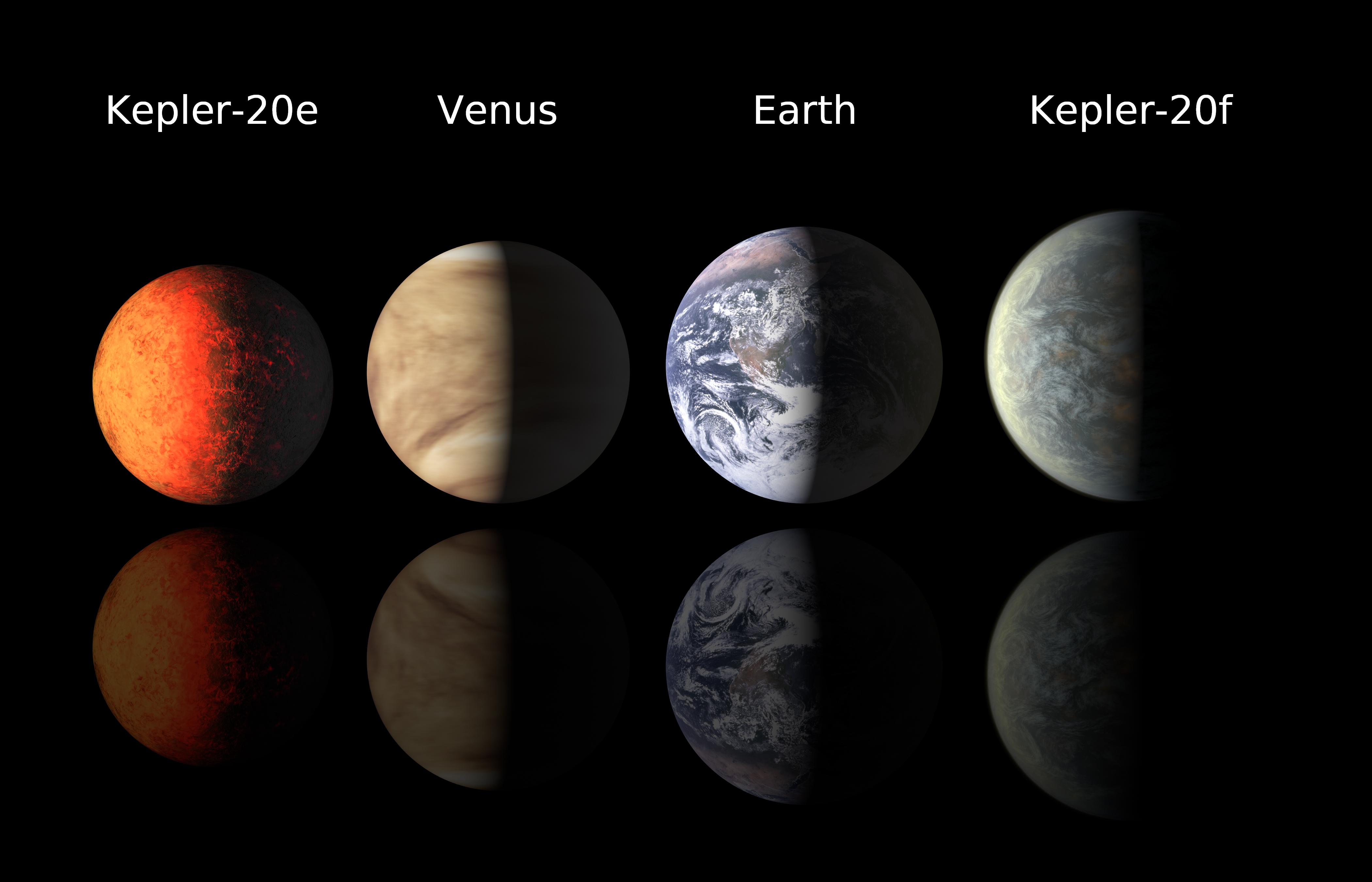
 A most exciting recent discovery is two planets around a star dubbed Kepler-20, with sizes estimated as shown, both within the star's habitable zone. The smaller one may be hot like Venus. It will depend on the atmosphere. The larger one, a bit farther out, may be a little cooler than Earth, or very similar to Earth.

It is much too early to tell what kind of atmosphere they have. Whether either of them could have life depends entirely on that.

The Kepler mission is going on four years old already. It has revolutionized our understanding of planetary systems. Considering all that we have learned from observing just 1/400 of the sky, and only stars brighter than visual magnitude 16, there are many, many planets waiting to be found, and a great deal we can learn about planetary system evolution and composition.

The Kepler spacecraft observes more than 100,000 stars twice per hour, recording their brightness with great accuracy. The "light curve" for each star is examined, both by software and by volunteer "citizen scientists" (yours truly included), to find small dips in the stars' brightness that will herald the transit of a planet across the face of the star, as seen from Earth. Close-in planets that zip around their star in a few days will transit in a couple of hours. Transits of planets in orbits close to the size of Earth's orbit about the Sun will take half a day more or less. In the list of stars for which I have reported suspected planet transits, three have been listed as planet "candidates"; the team is very cautious. To get involved, set up an account at www.planethunters.org.

Tuesday, November 08, 2011

Double sunsets

kw: astronomy, exoplanets, discoveries

Well! I let this one slip by me. Almost two months ago, September 15, 2011, the Kepler Mission folks announced the discovery of a planet similar in size to Saturn, that is orbiting a double star. In this frame from the NASA animation of the system, the larger yellow star is a K-class dwarf half the size of the Sun, and the smaller orange star is an M-class dwarf. They orbit their common center of mass at a distance of 0.22 AU from one another, while the planet's orbital radius is 0.7 AU, about the distance of Venus from the Sun. If you project from the small star through the large star to the brightest dot about 4x their distance, that's the planet. Of course it is much easier to see in the video, where it is moving rapidly.

There has been much debate among scientists (and science fiction aficionados) whether stable planetary orbits around double stars are possible. This demonstrates that such cases are indeed possible. It remains to be seen whether a planet can orbit stably in a double star system when its orbital radius is similar to the distance between the stars. Speculations about looping orbits have abounded for decades.

Given that, from Earth's perspective, the stars are an eclipsing binary, and that the planet also transits both stars, the planet is treated to frequent eclipses and transits of the two stars, and double sunrises or double sunsets must be common. A dense, Saturn-size object is unlikely to have a surface from which the sky can be seen, so anyone visiting the system will have to watch the sky from the surface of a satellite. Both our Jupiter and Saturn have many satellites, so this planet will likely have several to choose from.