Showing posts with label SETI. Show all posts

Wednesday, November 13, 2024

Is life everywhere or nearly nowhere?

 kw: book reviews, nonfiction, exobiology, astrobiology, seti, exoplanets, origins of life

The title of a recent book by Nathalie A. Cabrol is astonishing: The Secret Life of the Universe: An Astrobiologist's Search for the Origins and Frontiers of Life. Why astonishing? First, let us consider the limits of what is known.

  • In our solar system, until recently, only three planets have been considered habitable at least part of the time since the solar system was formed about 4.6 billion years ago (hereafter Ga): Venus, Earth, and Mars. Both Venus and Mars are considered "almost certainly dead", but hints of continued habitability are discovered from time to time.
  • Many "ice moons", such as three of the Galilean moons of Jupiter, Europa, Ganymede and Callisto; Enceladus, a moon of Saturn; and Oberon, a moon of Uranus—all appear to have large subsurface oceans of liquid water, or actually brine, which could sustain life.
  • Beyond the solar system, thousands of exoplanets have now been detected. A few hundred of these are at an appropriate distance from their host stars to be habitable, at least at present, if not for the long term.
  • Most of the exoplanets so far detected and confirmed are less than 5,000 light years from Earth. A handful (so far) are at distances ranging up to 33,000 light years.

Further interesting information is found in the List of Exoplanet Extremes. 

What do these facts imply? As much as we might like to speculate about life (almost certainly bacterial or some analog thereof) on various solar system bodies, the confirmed occurrence of life in the solar system is found only on Earth. N=1.

Outside the solar system, we have partially probed a volume of space totaling about 80 billion cubic light years (considering the thickness of the galactic disk to be 1,000 light years). That's not bad; it is 1% of the volume of the Milky Way galaxy. However our galaxy is one of at least 200 billion, and probably more than a trillion, galaxies in the visible universe. We don't know how much universe lies beyond our visible horizon. Again, in all that space, known life: N=1.

From a numerical standpoint, the data we have relate to between a quintillionth and a quadrillionth of the known universe. That makes the book's title an astonishingly extreme overstatement.

On the other hand: The author, the director of the Carl Sagan center at the SETI institute, presents the principles by which life is likely to have arisen, and the evidence from all around the universe that the right chemistry to kick-start life exist nearly everywhere. This makes the book's title almost banally obvious! Isn't that great?

Rather than survey all of the author's points, I'll focus on a few of interest, that may be little known. Firstly, note that word "Origins" in the book's subtitle. Life may have started on Earth more than once. It may have arisen, been snuffed out, and arisen again, perhaps several times. Earlier incidences of life may not have been totally snuffed out, and still exist alongside "us".

Firstly, consider that the "standard DNA coding table" doesn't apply everywhere. For example, there are variations in the encoding of certain DNA codons (3-base groups) to amino acids (or to Stop) that are found in mitochondria. Various classes of eukaryotic organisms have different mitochondria, as revealed by their coding tables. Other microscopic critters, not all of them bacteria, have alternate coding tables. So far, 30 alternative coding tables are known, with the "standard table" bringing the total to 31. See List of Genetic Codes for more details.

Let's step back and consider the situation. There are 64 possible DNA codons. All known life on Earth uses 20 amino acids (one bacterial genus may use a 21st amino acid; I can't find out much information about it). There are dozens, perhaps hundreds, more possible amino acids. The 64-to-20 conversion involves numerous duplicate codes, which makes for a robust system. Many single-codon variations (micromutations, which are common), make no change in the protein being produced. How many possible coding tables are there? I am good at many kinds of math, but not the details of "permutations and combinations". The best I can figure, the number is at least 48x1033 (a 35-digit number), but it could actually be an 84-digit number. Either way, it is a lot!

Is it safe to assume that life elsewhere in the universe also uses DNA and RNA and ribosome decoding to produce proteins from some 20 amino acids? Not really. It is not even safe to assume faraway life requires water. Dr. Cabrol mentions "life as we don't know it" from time to time. She considers places like the Saturnian moon Titan, where water ice is a rock and the primary liquid is methane. What kind of life could arise there? Water (our solvent!) is polar, but methane is nonpolar; perhaps the abundance of ammonia, which is polar, could make methane plus ammonia an appropriate solvent for generating life-as-we-don't-know-it.

I am reminded of the Lensman series of space opera novels by E.E. "Doc" Smith from 1948 to 1954. It concerns intergalactic warfare between water/oxygen-based life and methane/chlorine-based life. I am also reminded of what the character Ian Malcolm said in Jurassic Park, "Life will find a way." I am further reminded of Vital Dust by Christian deDuve, who calls life "inevitable" and "a cosmic imperative." There could be a lot of different kinds of life in the universe, and it's unlikely that we could eat any of it, nor that it could eat us!

Dr. Cabrol points out that planets seem to outnumber stars. Perhaps many stars have no planets, but many more stars have at least one planet, and usually more than one. What proportion of these are rocky (not gaseous like Jupiter, which may have no solid surface) and in the habitable zone of their host stars? Is it a percent or so? Exoplanet data so far indicates between two and three percent. A further constraint is that, as a Main Sequence star heats up during its existence, the shift of the habitable zone shouldn't move beyond the planet in less than 5 billion years or so. This is just based on the fact that life on Earth required about 4.5 billion years to produce us. We are still left with several billion possible planets in our galaxy alone that have the potential to produce life that can become "civilized" and sufficiently technological to send signals via radio or laser or something that we could possibly detect if we are close enough. "Close enough" keeps getting farther away as our own technology improves.

Let's consider that 5 billion year figure. Our Sun is a star of type G2, a little larger than average. Something like 75%-80% of all stars are smaller and lighter. The lighter a star is, the longer it burns hydrogen on the Main Sequence. During that period, it gradually gets hotter and brighter as helium accumulates in the core. I am interested in the larger half of the K series of stars. Their mass is between 0.75 and 0.9 solar masses, and they burn hydrogen for between 17 and 35 billion years, compared to the Sun's expected hydrogen burning life of about 10 billion years. Stars lighter than 0.75 solar mass have even longer "lifetimes," but they are more likely to produce large flares, which can damage or extinguish life from the surfaces of any planets in their habitable zones. So I favor focusing efforts such as SETI (Search for ExtraTerrestrial Intelligence) on stars in the range K5 to G2. Even a G3 star probably would have begun to burn us off its surface by now, as our Sun is expected to do starting about a billion years from now.

The author also considers the Drake Equation, which is a thought experiment that helps us consider the likelihood or prevalence of life in our galaxy (or the universe). It consists of a bunch of factors that are multiplied together to produce N, a possible quantity of detectable civilizations "out there". An important factor is, "How long does civilization Z emit a signal that we could detect, if we are close enough and have sufficient technological sensitivity?" Consider Earth. The first radio transmission that reached beyond "local" was in December 1901. Just about 124 years ago. 

At present, there are a few dozen "clear channel" AM radio stations that emit 50,000 watt signals 24/7, a larger number of FM radio stations of similar or even greater power, and many TV stations, mostly below 10,000 watts. However, more and more of our TV watching is moving to cable (including fiber optics), and digital signals are more efficient, so stations that do broadcast are using lower power. I have an in-attic antenna that presently receives more than 60 digital TV stations, so I don't use (expensive!) cable. Radio is beginning to go digital also. I predict that Earth will be largely "radio silent" before the 200th anniversary of Marconi's transatlantic radio transmission.

If an exo-civilization is typically detectable for only 100-200 years, even without extincting themselves, that cuts a big hole in all our speculations using the Drake equation. I'll have to think more about this…

The last chapter deals at length with our own danger of extincting ourselves. The author considers pollution, particularly CO2 buildup plus methane buildup, an existential threat; she states clearly that our window of opportunity for ensuring long-term survival is small, a matter of decades at most. I agree in part, but my expectation is not so dire. I won't encroach on her thesis, though.

I will close this part with a hearty recommendation of the book. It is full of great ideas and great information, and very well written. A pleasure!

------------------------------------

If you aren't interested in errata, you can stop here. I ran across a few items, equally the fault of the author and the copy editor, that need to be corrected.

Tidal Locking is mentioned just a few times. It is not clearly explained, and I found this on page 97: "Callisto is tidally locked to Jupiter, orbiting around it in the same amount of time it takes Jupiter to rotate." Not so. Callisto takes 17 days to revolve about Jupiter, while Jupiter takes 10 hours to rotate on its axis. Callisto's rotation period is 17 days, so it always presents the same hemisphere to Jupiter. This is the same in principle as our Moon, which both rotates and revolves in 27.5 days (sidereal periods), so we always see the same hemisphere. In the quoted sentence, the second instance of "Jupiter" should be "Callisto". A second instance where the numbers are correct is on page 141: Pluto and its moon Charon are mutually tidal locked, always facing each other the same way, both rotating and revolving in 153 days.

An egregious typo, minor misspelling of a homonym on page 142: "pour" rather than "pore". To study a document is to pore over it, not "pour."

Information Mastery, a la Carl Sagan, is a proposed scale of technological advancement. It is mentioned on page 215, where it is stated that Level A represents 106 "unique bits of information" and Level Z represents 1,031 bits. This is a formatting error, compounded by the insertion of the comma. The two numbers ought to be 106, or one million, and 1031, or ten million trillion trillion (a 32-digit number). I suspect a dumb copy-paste removed the exponent formatting. Anyway, the concept is fascinating.

Let us consider where we are as a civilization on Sagan's scale. The venerable Encyclopedia Britannica contains about half a million topics in 40 million words. I suspect that Sagan would consider a "unique bit of information" to represent about a paragraph. These half million topics then are each stated in an average of 80 words, which comes to a smallish paragraph. Worldwide, there are several printed encyclopedias, but they overlap. Thousands, nay, millions of articles and books and journals are published yearly. Then there's Wikipedia, which has (today) 62 million pages, and about 1/8 of that is in 6.9 million formal articles. All told, that puts us in the realm of a Level C or Level D civilization.

There are a couple other typos, but they have less import. I'll leave it at that.

Wednesday, March 20, 2024

...and just who might be listening back?

 kw: book reviews, nonfiction, SETI, extraterrestrial life, philosophy

Seth Shostak is an idiot…or to be more charitable, he is dramatically misled by his own idealism. He is a very prominent proponent of sending messages toward possible alien intelligences, and he is the senior astronomer for the SETI Institute. He minimizes the possible risks we face from becoming known to "the Universe". If someone is out there listening, how will they react to learning that we exist?

In The Contact Paradox: Challenging Our Assumptions in the Search for Extraterrestrial Intelligence, author Keith Cooper lays it out plainly. He sums it up nicely in a paragraph on page 295:

We search the Universe for evidence of extraterrestrial life to make contact with others, for humanity to be able to share the Universe with others. Yet we find ourselves in a position of not being confident about whether we should try and make contact.

We dream of learning wonderful, life-changing things from superintelligent, hyper-advanced space aliens, or ET's (ExtraTerrestrials). All too often, the idealists in particular ignore the fact that every human being is both good and evil. Under some circumstances, we are altruistic, even heroic. Under others, every single one of us is capable of murder and larceny. There are no exceptions. Can we expect anything better of the denizens of another solar system? What are the chances of any intelligent species that arises due to evolutionary processes becoming unfailingly altruistic not only among themselves, but toward others to whom they are not remotely related?

The author makes a deeper point: by searching for "others" we search for ourselves. We project our hopes and dreams on them. It reminds me of a Chinese parable:

A man prayed daily for the Dragon to come. He dreamt about meeting the celestial being, imagining the wonderful things he might learn. One day there was a knock at the door; really, more of a crashing sound. The man opened the door and he saw him: scaly, fiery orange and red, forty feet long, with eyes the size of saucers and teeth like daggers. He screamed in fright, "Who are you?" The voice hissed and roared through him, "I am the Dragon. Am I not what you wanted?"

More succinctly: Be careful what you pray for; you just might get it.

A rather unbalanced segment of American society (few people elsewhere are as enamored of ET's as Americans) lives in combined fascination and fear of "flying saucers" and the "space aliens" that might "abduct" them to do "genetic experiments". Such sexual anxiety says a lot more about these people than it does about ET's. Is it really possible that Earthly genetics can have anything to do with ET's?

Sidebar: People with biological education (whether schooled or self-taught) usually know the Central Dogma of Genetics: DNA→RNA→Proteins. More recently, it has become clear that more than half of the DNA for which we know a function does not follow this dogma directly, but is regulatory, and modifies what happens when a "coding gene" is expressed to RNA and then to a protein. The key to how this works is the coding table, or The Code, which translates 64 codons into 20 amino acids plus a "stop" signal.

A little known fact about The Code: There is one Standard Code for the nuclear DNA of nearly all eukaryotic organisms, and it is also used for the DNA of most prokaryotic organisms (bacteria and archaea, which are bacteria-sized). But on Earth there are 25 other codes! See the details at this NCBI site. A few of these alternate codes are used by simple protozoan creatures, while many are for the mitochondria in various eukaryotes, and the rest are for various families of prokaryotes. This is just for Earth life. How many alternate codes are possible? Will any aliens out there have DNA like ours, and if so, will it be based on "our" Code?

The calculation P[64:20] yields 2.1x1036 permutations. In common terms it is 2.1 trillion trillion trillion. That is one estimate of the number of possible DNA-to-Protein Codes. However, while there are as many as six codons per amino acid, the codons are grouped, so the number of efficient DNA codes may be smaller by a factor of a billion or so. Even then, we are left with a 28-digit number. It is extremely unlikely that an alien species from any other star system will have any genetic similarity to Earth life. Further, there is no guarantee that the same 20 amino acids will be used everywhere. It is actually more likely that, of the hundreds of possible amino acids, there would mostly be species with hardly any proteins that are "compatible" with any of ours. The aliens may not even be able to eat Earth foodstuffs (ourselves included!).

The book has an illuminating and comprehensive history of SETI and a detailed discussion of "things to look for" besides radio signals: flickering laser or maser light, "biosignatures" (such as the presence of both oxygen and methane together), and technosignatures other than radio (such as anomalies in a star's light caused by immense clusters of solar arrays). There is no need for me to get into detail; it's hard to beat the author's writing!

The book is a great joy to read. We have a lot to think about as we consider Who Is Out There.

Friday, September 29, 2023

Will our cosmic angst ever be relieved?

 kw: book reviews, nonfiction, science, life, extraterrestrial life, SETI

About eleven years ago I posted a review of David Brin's novel Existence. In it I mentioned two books that form the "bookends" to my thinking about exo-life: Rare Earth by Peter Ward and Donald Brownlee (2000), and Vital Dust (1995) by Christian de Duve. I read both those books before I began this blog. It may be that The Possibility of Life: Science, Imagination, and our Quest for Kinship in the Cosmos, by Jaime Green, is a fourth worthy player in this space.

Now that we know at least the existence of more than 5,500 exoplanets, plus more than 8,000 "candidates" that are being vetted, it is clear that planets outnumber stars.  A few hundred planets are in the "earthlike" range of size and mass and surface gravity; as of late July 2023 this Wikipedia page lists 63 "potentially habitable" objects in the "Earth to Super-Earth" size range, small enough to be "probably rocky". That is well over 1% of the known exoplanets, which implies that such planets number between 10 billion and 20 billion in our galaxy (accepting the extrapolations of scientists who publish about this). It is well to note that a rocky planet with 2.5 Earth's size would have 15.6 times Earth's volume and, if of the same density, 15.6 times its mass. The greater radius would mean, by the cube-square law, that the surface gravity would be 2.5 times that of Earth. It is unlikely that the density would be the same, so that's just a very rough starting point.

As the author points out in a late chapter, somewhat channeling Peter Ward, bacterial life (or something very like it) appeared on Earth within half a billion years after it was formed, but since there was a period of "molten crust" for 300-400 million years, it could have come into existence rather rapidly, on cosmic timescales. But then, it took another billion years for photosynthesis to emerge, and another billion or 1.5 billion years for the first eukaryotic (complex, nucleus-bearing) cells to be produced. So even with our whole planet for a chemical-evolutionary playground, it was apparently rather hard for the basics of complex life to arise. Once it did arise, the next period, called the "boring billion", was required for the evolution of multicellular creatures bigger than a poppy seed. So, is de Duve right, that these developments are inevitable, or are Ward and Brownlee right, that the several big steps in this progression are so hard and rare that we cannot logically claim that a sequence like this happened more than once?

To my statistical mind, it seems we need some way to determine the variance in those numbers, applied to billions of planets. For example, let us first suppose that the production of eukaryotic cells takes, on average, five billion years after photosynthesizing bacterial cells originate, with a standard deviation of half a billion years. In such a case, for it to take only 1.5 billion years is a 7-sigma outlier; it can only happen on one planet out of 390 billion. Thus, if there are, to be generous, about 20 billion "habitable" planets per large galaxy, there would only be eukaryotes that arose this "quickly" on one planet per 20 galaxies. Our chances of having a near neighbor are slim indeed! On the other hand, if 1.5 billion is closer to the average, and the standard deviation is half a billion years, then about half the "habitable" planets on which life originates can be expected to develop complex life in 2-4 billion years from the inception of life. The Milky Way is big, with a volume of about 30 billion cubic parsecs. Divide 30 billion by 10 billion: three cubic parsecs per planet, or about 100 cubic light-years. The radius of a sphere of this size is about 3 light years; double this to get 6 light-years from planet to planet. That points to a galaxy littered with inhabited planets. This is no improvement over the Drake equation, which is easy to manipulate to find any result. We still suffer from a dramatic lack of knowledge.

The book has six (longish) chapters, and the tone is wistful and lyrical rather than coldly analytical; more like Vital Dust than Rare Earth. I enjoyed it very much. The big questions, to which Ms Green returns again and again, are how we would recognize life on another planet, from a distance, and then if/when we meet "aliens", how we might communicate. At one point she muses on the problem we are facing to communicate with our descendants, across a gap of 10,000 years—about 350 generations—regarding the danger of radioactive wastes stored at Yucca Mountain or other repositories. Consider how English has changed in just 1,000 years. Old English, also called Anglo-Saxon, cannot be read nor heard intelligibly by anyone without learning it as a foreign language. Although it was a Germanic language, modern German speakers are equally befuddled. That was just 1,000 years ago. Middle English, or Chaucerian, of 500-600 years ago, is barely intelligible; many words we can recognize in print are pronounced differently now than they were then (for example, the "e" that ends so many words such as "made" or "file" was explicitly pronounced). Even the "English" of the King James Bible takes some getting used to, even though the latest edition of the KJB was produced in 1769; the "original" text of 1611 is very difficult for most of us to read. If we have such trouble with human language (and there are hundreds of "extinct" languages that still cannot be read by anyone), how will we ever learn a truly alien language, "spoken" by a creature that is not even as well related to us as an octopus?

Most science fiction stories about contact with ET's sidestep the problem by having the aliens figure out some of our languages before arriving, or by having telepathy, or they have a "universal translator" such as those on Star Trek. I've read one story that took a serious swipe at the problem: human astronauts find an abandoned spaceship, and one of them finds a chemistry handbook and locates the Periodic Table of the Elements. Right away that yields, not just the alien words for about 100 elements, but the symbols for the alien number system. A big leg up. How to go beyond that? It still won't be easy. Maybe an alien version of the CRC Handbook would help…

Nonetheless, I think the occurrence of life is somewhere in the middle, such that at least a few planets within 100 light years (31 parsecs) will be found to have complex life. Whether any of those planets will host technological species is more iffy, but I am hopeful. Life that gets any kind of start is going to diversify. The diversity of plants and animals is astonishing, and in the Bacterial/Archaean realm there may be 100 times as many species. I think that, as the Ian Malcolm character said in Jurassic Park, "Life finds a way." (Picture from Mongabay)

Wednesday, March 29, 2023

Confront the alien within to be ready for the alien without

 kw: book reviews, nonfiction, SETI, speculative musings

Did you ever play the Birthday Game? If you have a gathering of 23 or more people, ask them, "What are the chances that at least two people here have the same birthday?" You'll get all kinds of responses, and perhaps someone who knows this already will say, "Better than half." If you're comfortable with analytical math, this website shows how the probability with 23 people is just over 50.7%. This article from Scientific American is a bit more accessible.

More generally, if you have a large number of possibilities (N) and a much larger population to sample from—for example, millions of balls numbered 1 to 10,000—, how many items must you select (S) from the large population to have a 50% or greater chance of having two of them that are the same? If you select 90 balls from the example, is there a better-than-half chance that two of them have the same number? It turns out that the crucial factor is the square root of the number of possibilities divided by about 1.2. That is:

S > (√N)/1.2

For the example, where N = 10,000, S is at least 83, and is probably 84. I said above "about 1.2" because the divisor ranges up to 1.25 as N increases into the millions or more.

This is pertinent to the question of DNA compatibility between Earth life and any life that may be found on a faraway planet, assuming that the alien life is also DNA-based. 

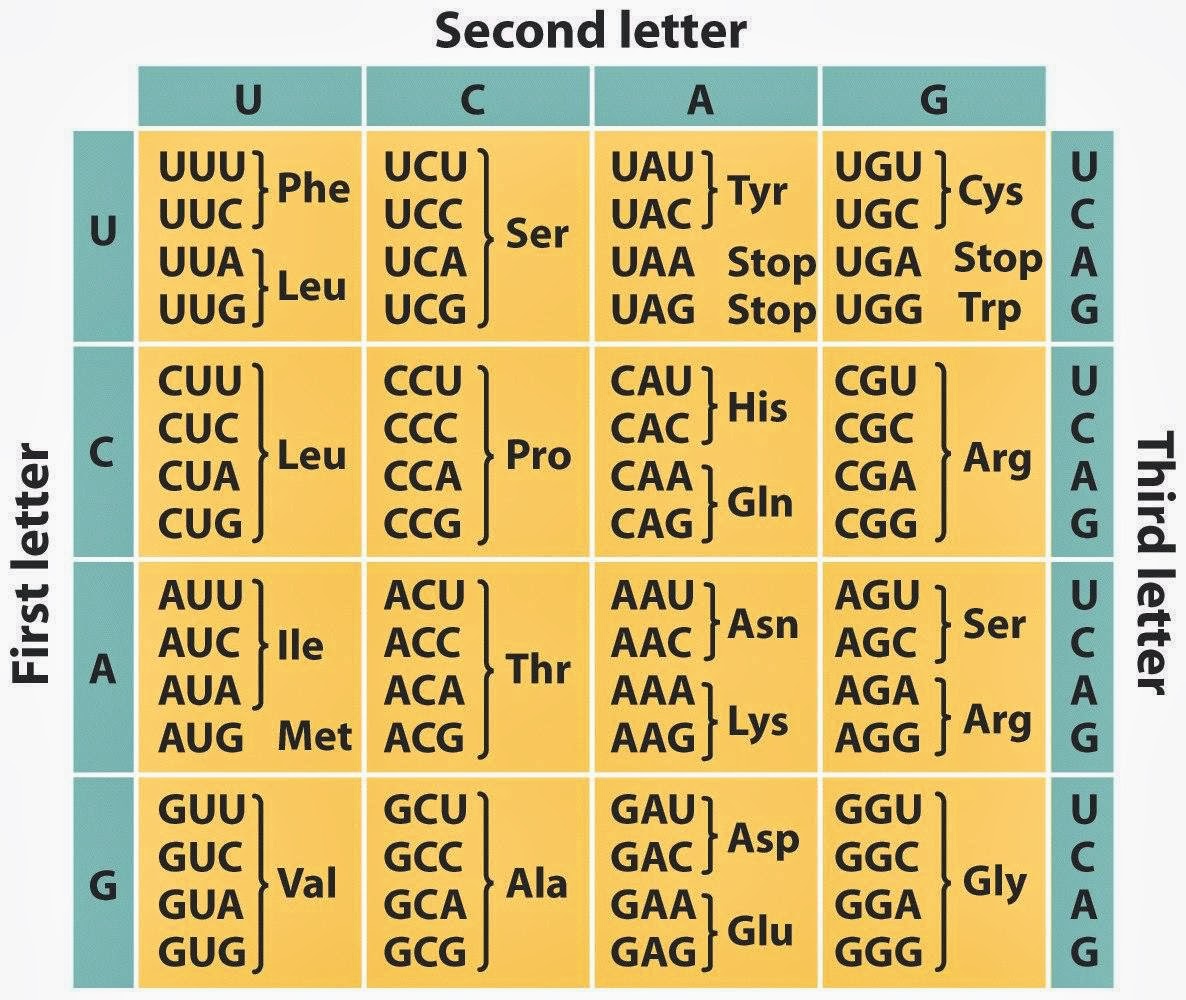
We can analyze it thus. The DNA codon-to-amino acid coding table has 64 DNA 3-letter codons that select among 20 amino acids, with three of the codons used for a Stop signal to the ribosome. Clearly, many or most of the amino acids are selected by at least two codons. The number ranges up to 6 for Leucine, an amino acid with a specific shape that is apparently "most dissimilar" to the others. Seven other amino acids are selected by 4 codons each.

Here is how the table looks, for most Earth life: 

What might it happen if it were rearranged? We must assume that the translations were arrived at by random processes via natural selection (or by careful design by God).

As it happens, this table is used by all eukaryotic life and nearly all prokaryotes…but not all. An article I read listed 16 minor variations used by certain rare bacterial species. This is evidence that various minor changes to the table don't automatically produce "incompatible" organisms; the 17 known DNA variations all exist on the same Earth. What of larger changes?

Some time ago I calculated that the number of possible rearrangements of this table, keeping the DNA codons in the order shown, but moving the amino acids about freely, is about 1070, a number with 70 or 71 digits. If we keep the codons in groups of the same size as those shown, effectively rearranging just 20 grouped items, the number of possibilities is closer to 20!, or 2.43x10¹⁸. That's 2.43 billion billion. A lot.

Now let's play the birthday game with 2.43 billion billion. Its square root is 1.56 billion; divide by 1.25 to get 1.25 billion. Simply put, we would need to collect DNA from DNA-bearing species on more than a billion planets in order to have a 50% chance that some pair of them would have compatible DNA coding tables, and we'd need to sample about 1035 species to have a 50% chance at an exact match. I wonder how many aliens (if there are any) use reproductive machinery that doesn't depend on DNA?

For those who think space aliens in UFO's (UAP's) are kidnapping people for genetic experiments, I suggest it'll be a long time before the aliens find a compatible species to ANY of those that might be "out there." Human-alien hybrids are out of the question.

The above represents my own musings, based partly on prior research, as I read The Alien Perspective: A New View of Humanity and the Cosmos, by David Whitehouse. Mr. Whitehouse doesn't get into any of the stuff above; that's all "me". What he does get into is a longish history of the precursors of SETI, of SETI itself, and of its successors that are ongoing. SETI, the Search for ExtraTerrestrial Intelligence, is (was?) a radio telescope-based search for radio signals emitted by intelligent beings in stellar systems close enough to our Solar system that we can receive the signals and recognize them. More recent programs look for laser signals and possibly gamma-ray signals.

The historical portion of the book is followed by increasingly speculative discussion of what might occur upon First Contact; it's nothing like what Carl Sagan had in mind, almost certainly. To my mind, a gigantic cover-up is most likely, and the author leans in that direction to a lesser extent. Unless, of course, First Contact is more like the early part of Independence Day, globally obvious. In that case we're toast anyway; no teen hacker would be penetrating the security protocols of an alien computer that is running an alien version of Windows 9,127 or (more likely!) Linux 7,704, with help files in an alien language. Let's remember, there are a few dozen human writing systems we have not yet deciphered. What kind of script could encode Dolphin or Elephant or Squid language? Alien will be far less "obvious".

The author seems to waver between the views that aliens will be benevolent or malignant. However, he then considers that we tend to project our own fears and hopes and dreams (and nightmares) upon our anticipation of First Contact and continuing contact. This portion of the book is of real value. It clearly indicates to me that we need to get our own mental house in order, or we'll be so unprepared for First Contact, whenever it may occur, that we'll destroy ourselves before any malignant aliens could do so, and with more finality than any benevolent aliens could restore. You got it, folks: In my view, First Contact will be a portent of Doom, no matter what "they" are like.

That said, I found it hard to read the book. Not philosophically, but because the poor writing kept distracting me. Run-on sentences abound, as do partial sentences. It's almost like the placement of punctuation was frequently chosen at random. Don't authors employ copy editors any more? Maybe that's considered too expensive, but it's a false economy. I know I'd charge a helluva lot to edit text I find so disconcerting. Call me a glutton for punishment; I read the whole book through anyway.

Sunday, May 13, 2007

Letting ourselves be found, revisited

kw: book reviews, science fiction, first contact, spacecraft, SETI

I reviewed James Gunn's The Listeners just a month back (enter Gunn in the search box above). He takes another whack at the subject in Gift from the Stars.

The prior novel concerned exchange of radio messages, which occurred over a ninety-year span. I wondered at the time how anyone could predict "answer day" with any accuracy, given the several-light-year uncertainty in the distance to the star. The message received was hidden within a replay of very old radio transmissions, so I supposed that the time lag could be calculated.

This novel has the message arriving by gravity waves, bearing plans for a working starcraft and antimatter energy conversion. An engineer has decoded the message from the first gravity wave detector, written a book containing the plans, hidden within an apparently crackpot UFO scenario, then gone insane with worry...he was unstable to begin with (a stereotype of the highly creative). Another engineer, someone who knows rocket science, finds the book.

The long and short of it is, the improbable happens; the engineer and a few friends republish the plans via the Internet, and later manage to wangle agreement to build a starship from the new planetary authority (the old was swept away by an economic revolution based on antimatter energy).

This story is more satisfying than the former, though a few things are infinitely more fantastic. However, I know the Corollary to Finagle's Law: everything is going to cost ten times as much and take twice as long as you thought. Constructing a ship to carry 200+ people for a few years, regardless of propulsion method, would bankrupt the entire planet. A pity.

Friday, April 13, 2007

How would having neighbors change us?

kw: book reviews, science fiction, first contact, SETI

I read only a portion or two of James Gunn's The Listeners in the 1970s, when it appeared piecemeal. It was refreshing to find the whole volume and devour this 35-year-old classic.

If a civilization on another planet were to send a signal we could receive, what would be its content? Some years ago, some folks devised a message in several parts, and put it, part by part, weeks between them, on a web site for all to decipher. It was clever, and many clever people deciphered it at least in part. As it turned out, not some parts of it were amenable to more than one interpretation. Making a completely unambiguous communication of any complexity is hard, and perhaps impossible (remember the old story "To Serve Man", which turned out to be about a cook book).

Jim Gunn has come up with perhaps the best compromise. The message, once the signal is detected, is composed primarily of a hash of early radio transmissions. The content of those transmissions yields a good estimate of the distance to the alien star: 45 light years. But there is more. Each short segment of the hash is followed by a staticky blip. Each blip contains simply several pulses. Once the project workers realize they can be considered an on-off raster pattern, it doesn't take long to produce an image that gives a few clues to the aliens' appearance and number system, plus a few words.

Much of the dramatic tension in the book surrounds first, the apparent futility of the Project before a signal is detected, and the meaning of the message it conveys. Of course, for the novel to go anywhere after this point, the message must be answered with one of our own; and it is, a similar image. Ninety years later, one would expect an answer, and the denouement follows from that answer.

I found myself wondering, would the world really develop such an extended peaceful period after receiving the first alien message? War and chaos are equally likely, particularly once people realize knowledge coming from an alien source will be a valuable resource like any other: something worth fighting for. We are unlikely to unite in the face of The Other until we physically face The Other.

I think the religious response in the novel is too pat. That a religion could be formed around the "Solitarian" perspective seems incredible. More likely, a "Christian" sect would arise who found the idea of aliens to be some kind of attack on the uniqueness of God.

These are minor flaws. As a classic in the field, The Listeners sets the standard others must still meet.