Showing posts with label commentary. Show all posts

Wednesday, September 06, 2023

Hell is where you find it

 kw: book reviews, humor, memoirs, commentary

Zach Zimmerman is a comedian, a stand-up comic. He expects one day to be slayin' 'em in Hell. Maybe.

His memoir Is it Hot in Here? Or am I Suffering for All Eternity for the Sins I Committed on Earth? is my wildcard selection this time. As depicted in this little book, his father is the kind of preacher that makes the Devil smile. More on that later.

Zach was brought up in an ostensibly Evangelical household; his father was an associate pastor, and he was subjected to fire-and-brimstone preaching not just in church but at the dinner table almost daily. Zach writes that he prayed a "sinner's prayer" daily, or more than daily, with no discernible result. He is gay, and became an atheist, having concluded that Hell is much less fearful if you stop believing in it. It makes sense. The only Jesus he ever heard about is one who is just itching to plunge sinners, especially gays, into hellfire.

His essays are humorous, and also informative to someone like me, as straight as they come. Oh, I understand the mechanics of gay sex. Such details are glossed over; rather, these essays reveal the complex emotions of a chronically insecure homosexual, who finds coming out to other gays almost as painful as coming out to his parents. Near the end of the book, it seems he found a partial rapprochement with his mother. His father? Not mentioned, so probably not.

OK, some commentary. Unhappy Christians are an Atheist's best argument for atheism. The several thousand denominations, and Denominationalism itself, are Satan's masterpiece. The overweening focus on homosexuality in American Christianity is just one of the many distractions provided in the Devil's Department Store. Another Department is religion itself. I am enormously grateful to God for letting me see, very early in my Christian life, that He desires not religion, but a relationship. About half the things taught in the Bible are instructions in how to relate to The Almighty. The "sinner's prayer" isn't found there, although it isn't bad in itself, and many people do come to Christ after praying in that way. It is the belief in Christ, not belief in the prayer, that saves.

Fire-and-brimstone preaching easily leads to the belief that Jesus is the Devil's disciple. The real focus of the preaching by Jesus and His apostles was redemption from Hell, by becoming a child of God. As Paul wrote to Timothy, God "desires all men to be saved and to come to the full knowledge of the truth." (1Tim 2:4) The first word Jesus spoke in His preaching was, "Repent." It is easier to come to Christ if you know who He really is. Far too many false evangelists preach a non-Biblical Christ. Zach is one of their victims.

In Leviticus 18, verses 6-23 outline numerous sexual sins, most of them incestuous. Homosexual sex is found in verse 22. Child sacrifice and bestiality are also condemned in nearby verses. Gay sex is just one of a dozen or more varieties of adultery. The Seventh Commandment, "You shall not commit adultery," covers them all.

Who knows whether, on at least one of the many occasions that Zach prayed the "sinner's prayer", God accepted it? He had no subjective feeling about it, but it may have laid a foundation for later work by the Holy Spirit to bring Zach into a genuine relationship with God. My own experience of receiving Christ encompassed several events over at least five years. "Where there is life there is hope." (Eccl 9:4)

Saturday, August 27, 2016

Dancing to the beat of a different accordion

kw: book reviews, nonfiction, essays, humor, autobiographies, commentary

My father said, "Don't put yourself down. The world is full of people who will do that for you." To make this proverb universally applicable, one must add, "…unless you can make a living from it." Think of Rodney Dangerfield ("I get no respect"). Then think of Alexandra Petri as a younger, brasher Rodney Dangerfield, with a greater range.

How great is that range? One could make a useful estimate from the chapter titles of A Field Guide to Awkward Silences. After chapter 1, "How Not to be Awkward", states, in its entirety,

  1. I have no idea.
  2. Well, how about this? Don't do any of the following.

there follow 23 chapters ranging from "Flopper" (2) to "Tuesdays with Hitler" (6) to "How to Join a Cult, by Mistake, on a Tuesday, in Fifty-Seven Easy Steps" (8) and "Under the Dome" (20 - her father was a Congressman) to "Self-Defense Tips for Fairy-Tale Girls" (21). Don't consider these the extrema, as though they were the points on a starfish. NOr is it even a starfish with 23 points; it is more of a 23-dimensional space. And it implies there are a whole lot more dimensions out there!

In today's paper, the Crossword Puzzle's first and last "across" clues were (1) "Parent of 63 across" and (63) "Child of 1 across". They turned out to be "Baby Boomer" and "Millennial". That is not generally true. My wife and I happen to be Boomers, and parents of a Millennial, only because we were in our mid-40's when he was born. My wife went right out of labor into hot flashes. Most children of Boomers are members of the "X Generation", and most Millennials are their children. Ms Petri, being no more than a few months older than our son, is definitely a Millennial, and between us and her there is a double Generation Gap.

Anyone out there remember the Generation Gap? It was the one between the Boomers and our parents, who were the "Great Depression Generation" and also the "Greatest Generation". They had lived through the two most significant eras of the Twentieth Century, but to us it was all "history", as in our classic dismissal, "Oh, that's history, man!" They said, "Waste not, want not," and we said, "But I want it NOW". They said, "An apple doesn't fall far from the tree," but we were apples with legs, and ran half across the planet. They built "The Good Life" and first we trashed it, then turned anti-trashing sentiment into the Enviro-Nazi movement that drives half of Liberal politics; we soft-heartedly (and soft-headedly) tried to "Save the World" (usually from them!), and Liberal politics (the other half) turned this into the Universal Nanny State (look up "Cowboy after OSHA" to see what I mean).

So it's understandable that it took me a while to warm to Ms Petri's style of humor, and to learn to parse when she was actually being serious. I have observed among Millennials, including our son, that "to think is to do." They lack a filter. In the chapter "Internet Bitch", about the time Rush Limbaugh called her a Bitch, she muses on two collections of words: those that cause a gut reaction, such as the F-bomb and the S-bomb, and those that used to, but don't any more, such as "Zounds!", a contraction of "God's Wounds!"—it could get you burned at the stake in the 1500's. There is a coda. to listen to nearly anyone under 35 speak, the "bombs" and a half-dozen other "four letter words" don't seem to give any of them a kick in the gut, the way they seem to affect Boomers. Fortunately, while not averse to the occasional bombing run, Ms Petri is much cleaner of mouth (of pen? of keyboard?) than most of her generation.

As a journalist (the profession she wraps around all her escapades), she gets backstage for events most of us never hear of. She went to the National Pun contest, entered it on a lark, and did so well that the next year she returned, and won! She applied, and appeared, on Jeopardy; was ahead for a while but then lost. She can't return while Alex Trebek is alive, so she awaits his demise: only then can she return to her "tribe", the trivia-obsessed She did pretty well in a whistling contest. These and other adventures hark back to Chapter 2, "Flopper", in which she shows that, if you can become immune to the shame of being a flop, there are a lot of fun things waiting out there for you to try. You might actually be sorta good at a few of them.

Her humor style is varied, but much relies on the sly exaggeration. She could have almost learned that kind of humor from many of the great humorists of the generation before mine, from Red Skelton to Jack Benny. It would be interesting to see her do a stand-up routine à la Jack Benny. He could draw out more laughs with a slow, turning gaze than a whole monologue by Jay Leno; I bet she could come close.

But her book is about awkwardness, after all. The 23 chapters aren't really about the awkward silences themselves, but about what led up to them…a great many of them. And growing up seems to be the most awkward of all. She sums up the notion that she has become, greatly to her surprise, an adult, this way:
"Everyone sees this competent-looking thing walking around, but that is just the tip of the iceberg, while for the purposes of this metaphor under the iceberg is not more ice but instead a crowd of really nervous penguins frantically trying to hold the ice in place and feeling that they aren't quite up to the task."
So really, why else would she have shown up at the airport to pick up a friend, playing a Polka on her accordion?

Saturday, December 17, 2011

Complete lack of discrimination

kw: commentary, current events

When I saw this in the mail, I almost threw it away unopened. What do the Time editors think they are doing?

The cover blurb mentions four "protest" movements. I have yet to open the issue, so I don't know if others are discussed, but these four pretty are much cover the gamut:
  • "Arab Spring" – This is a mixed bag. Starting in Tunisia, several brutal, falsely Muslim dictators were overthrown. In a few cases, however, Egypt in particular, this has led to a great strengthening of radical Islamic factions. This would be a bad thing for the world even if America didn't exist. (It would probably be even worse…)
  • Athens – I suppose the people have a right to protest, but they have badly mis-aimed. They ought to be directing their anger at several prior administrations, plus the current one, that got them into this economic morass, and because they did so. But without the proposed austerity measures—and more to come, you can be sure—the country will go belly-up and descend into overt civil war.
  • Occupy Wall Street (or wherever) – This began as a marginally good thing, to "defend" the "other 99%", which is anybody but the super-rich. It soon descended to an extended Woodstock, without the good music, but with rampant immorality (not just sexual), defecation everywhere, and a filthy, smelly mass of ingrates who represent quite a different 1%, the irresponsible 1% who don't want to work but want government to support their every whim. The Mayors were right to drive them out.
  • Moscow – Loosely based on Arab Spring, this doomed movement is up against a very different foe. Let us recall that Mr. Putin once directed the KGB, and there is enough of the old apparatus in place to cause huge mischief. This will mainly just set back Russian progress by another generation.
I came of age in the 1965-1975 "sixties", when protest movements were typically more focused, better led and eventually more effective than any of the "Occupy" hooligan groups. Full disclosure: many of the protests were very left-wing, and I am conservative. I was a heckler, sufficiently effective that I survived a couple of murder attempts.

While the impact of this year's protest movements has indeed been significant, they certainly don't deserve to be lumped indiscriminately together as Time's "person of the year".

Wednesday, June 29, 2011

Crowds, shmouds

kw: commentary, sociology

I've had a couple of instances lately when people said something like, "Well, we can trust the wisdom of the crowd." I didn't know how to reply. For example, there is a controversy that has been going on for decades about the need for professional indexing, versus free text searching, lately known as "Googling". In actuality, the PageRank method used by Google is a kind of popularity contest, with the greatest weight given to the most popular "linkers". It is a kind of human indexing method, using the free labor of those who build web sites, and who have an interest in having the best links. It resembles the "hidden hand" of Adam Smith, that regulates economic well-being due to the selfishness of those who know better than to mistreat their customers (too badly). But this is not really a "wisdom of the crowd" arena.

As described in books like The Wisdom of Crowds by James Surowiecki, the crowd being consulted is a special sort of gathering. For example, if you ask ten or twenty people at a "guess the number of beans in the jar" contest, what their guess is, the average of their guesses is usually closer to the real answer than anyone's individual guess, except for perhaps one or two lucky ones. But the "crowd" has to be consulted on a question of fact, that can be verified by something like counting the beans. On matters of belief, things can get weird quickly.

Of course, we know the difficulties that follow trying to have any kind of rational discussion of either religion or politics when those present have differing views. Mayhem is likely! But just try talking to a few people when some of them have a fixed idea about someone else's intentions. A neighbor once shared with us the cost of installing a cobbled waterway between our properties, the better to carry runoff during rainstorms. But a couple of times, some of the cobbles were moved by the neighbor, and one of us became convinced that there was a malicious intention, such as trying to make more of the water run over our property, rather than out the end of the cobbled way. Asking others' advice yielded quite a range of opinion, and nobody but me suggested the wisest choice, which is to walk over and ask. Though I plan to do just that, I'll have to do it in secret, or risk a real blowup with my loved ones!

Sociology isn't subject to factual, scientific parsing. Being emotionally inept myself, I'll have to play this one carefully. No help from this crowd.

Wednesday, October 17, 2007

And you thought his Fiction was horrifying

kw: book reviews, nonfiction, commentary

I find a certain resemblance between Stephen King and Michael Crichton. Much of their writing is of technology gone horribly wrong. The emphasis for Crichton is on the technology and the escape therefrom; for King it is the horror and the lack of escape. Secondarily, King relies in various amounts on the supernatural, something Crichton avoids.

You could put King's genre in a 20-80 range. The terror in some of his books is 80% technological and only 20% supernatural, in others it's the other way 'round. This alone makes it tough to write about his "science", but Lois H. Gresh and Robert Weinberg have done just that, in The Science of Stephen King: from 'Carrie' to 'Cell', the Terrifying Truth Behind the Horror Master's Fiction.

I confess I have read not one word of King. After a youthful brush with Lovecraft and his early 20th Century imitators, I foreswore supernatural horror. The reviews of Carrie in the 1970s made it clear that the title character was (or hosted) a malicious poltergeist. However, I was sufficiently intrigued by this book's title and cover to read through it.

In its nine chapters the authors discuss King's reliance on ESP, AI, Aliens, Plague, Higher Dimensions, Time Travel, Parallel Worlds, and Longevity, and finally discuss the philosophy of Evil, Obsession, and Fear, particularly as King uses them.

In particular, it became clear as I read that the vague, ending-without-really-ending nature of many of King's books simply multiplies their impact. Horror is, after all, a way of getting a reader to ask, "If I had the power to do that, would I do it better?" The evil and obsession are a part of all of us, and the fear is a fear of ourselves, if we have any trace of conscience.

The authors rely primarily on science fiction and its tropes to "explain" the science (loosely so-called) used by King. Stephen King was, after all, an English major. Science has provided him useful material for versimilitude (among scientifically illiterate readers, at least). The SciFi writers mentioned by Gresh and Weinberg frequently had less grounding in science than either King or themselves.

The authors were both Science majors, and they do a good job of outlining the science, as it is known—or not—about each chapter's topic. I reckon that King is less than impressed; he is a story teller, and clearly a superb one. You can't let facts get in the way of a good story.

The rule propounded by John Campbell, king of the Golden Age of SciFi Editors, was "Pose a thorny problem, then solve it." King is a master of its opposite: "Show why this problem will not be solved."

Monday, September 17, 2007

The Professor Pope

kw: book reviews, nonfiction, lectures, commentary, religion, faith, violence, tolerance

The images flanking the first word of the book's title indicate the controversy it will provoke:


Having served on the faculty of Catholic Theology at Regensburg University in the 1970s, when Joseph Ratzinger visited the University in 2006 as Pope Benedict XVI, he nonetheless spoke as a lecturer, not ex cathedra as a reigning pontiff.

Taking the ground of a University as the unique forum for discourse (an ideal seldom approached), he introduced to discussion the question, "Whether violence is permitted to further religion." He bases his analysis on the discussion between Emperor Manuel II and a (Muslim) Persian in about 1391, on the eve of a Muslim attack near Ankara, Turkey. This pithy lecture is included as an appendix in The Regensburg Lecture by James V. Schall.

As I read the lecture—several times—then the book, I took many notes, intending a thorough analysis. However, the Lecture has received a mega-overkill of analysis in the past year, and Dr. Schall's book has added kerosene to the fire. The basic reaction is this: Catholics and many ecumenical-leaning Protestants applaud, while Muslims, almost to a man (nearly no Muslim women are allowed a voice) reject it with extreme obloquy. Is anyone surprised?

Muslims take the stance that "Nobody is allowed to discuss such a question who is not Muslim," making the premise that nobody can possibly think rightly who is not submissive to Allah. The flurry has demonstrated that the majority of Muslims do think religious violence is justified.

I wonder at the result, had the question been placed by an early Frank to a Fifth Century Pope, on the eve of one of the Catholic battles of European conquest. The warlike followers of the "Prince of peace" had but two or three centuries in which to spread Catholicism by the sword, before they were given a taste of their own medicine by Seventh-Century and later Jihadism.

Equally, I wonder if any of the Canaanites so questioned the Hebrew invaders in the 15th Century BCE? The only way I can accept the "Old Testament" is by taking the stated reason (some call it an excuse) that the Canaanites had become Nephilim, as had the people destroyed by the flood of Noah a millennium (or more) earlier. I'll defer discussion of Nephilim for another occasion. Meantime, you can look it up.

This points up the vast, enormously huge difference between faith and religion. It has been fairly said that religion's primary function is to justify governmental power. Every major religion has been spread, at some point (a centuries-long "point", typically) by coercive violence. All too frequently, the peoples' faith in any personal god or God has been seen as the primary enemy of the religion. Faith needs no priests or powers; religions require both to survive.

When Jesus came, he came for individuals. He typically hid from crowds, and spoke to them seldom, on a few well-reported occasions. When he set up his church, as the post-resurrection Spirit of Life, it was to gather individuals into a Body, whose mission was to express the "testimony of Jesus". Ambrose in the Fourth Century wrote, "It has not pleased God to win men through arguments." The apostles continually exhorted the disciples to gain peoples' trust by their conduct, so their witness would be received.

We are faced with a modern continuation of the Jihads of the Seventh through Twelfth Centuries. Islam has not changed. But the modern world is much different from Medieval Europe...to the effect that modern leaders are almost wholly disarmed in its presence. We're in for a rough time of it.

Wednesday, July 04, 2007

Nightmares packaged to order

kw: book reviews, nonfiction, commentary, syntheses, surveys

I just had to show you the cover of this one (from Amazon's sales page). This has to be one of the best "bug-eyed monster" paintings from Sci-Fi's golden age. I don't know the original provenance of this cover art, but the copyright is now held by the Wood River Gallery (the 2006 date makes me think the rights cover the entire layout, and that the BEM artwork is old enough to be public).

OK, so what scares you? I grew up being taught how to grab my knees under my school desk so I could kiss my ass goodbye for a nuclear attack. What formula did all the pulp SF mags use? It was mainly Campbell's Dictum: "Pose a problem, then fix it. Do it in 5,000 words or less." For a novel, the author was allowed no more than two sub-problems and 40,000 words.

There were problems aplenty for the writers of 1950s SF to mine: nuclear, germ, and chemical warfare; the grandson of Eniac that would run your life; the Red and Yellow perils—indeed, rampant xenophobia of all sorts—; "big Brother"; renegade robots. Prior to the 1940s, there was plenty of writing about "ultimate weapons", but few guessed such a weapon would be atomic or thermonuclear. A few who did were investigated, as far back as 1935. The nuclear warhead became the enfant terrible of Sci-Fi once the first nuclear attack actually happened. The Cold War was fueled by MAD fears, and our fiction followed right along.

Along the way, we also scared ourselves with alien abduction, giant insects and lizards, mutant superheros and supervillains, and various vague plagues. Today we have a host of new things to fear: AIDS, SARS, West Nile, and Ebola among the plagues; a rapidly-growing list of smaller nations that are developing or have developed "the bomb", or that plan to; Frankenfoods and other genetic experiments that we expect to go awry...and it is certain that some of our experiments will go awry.

All this and more Heather Urbanski covers in this, her expanded PhD thesis, Plagues, Apocalypses, and Bug-Eyed Monsters: How Speculative Fiction Shows Us Our Nightmares. She proposes the Nightmare Model to provide structure to her work. While much speculative fiction, from "hard" science fiction to the SF-Fantasy mixes that are most popular today (e.g. Star Wars), to sword-and-sorcery that seems to fill a good third of the "science fiction" shelves at my local library...while much of it is escapist and oriented positively, well more than half deals with a threat that must be averted.

The biggest threats in Jules Verne's work were either technological challenges that were risky in themselves, or overwhelming natural forces, or a few disgruntled villains. By contrast, today's threats tend to be unforeseen results of our good intentions. The Nightmare Model covers these in particular, under three heads and seven major areas:
  • Science and Technology: Nuclear War; Information Technology; and Biology
  • Power: Power of the Individual and Power of the State
  • The Unknown: Monsters, Aliens, and "Other Beings"; and Progress
Cautionary tales regarding each of these have saturated print, film, and small screen media. Consider these seven terms:
  • Dr. Strangelove
  • Colossus
  • Andromeda Strain
  • Darth Vader
  • Big Brother
  • Alien
  • Modern Times
Each is the title of a book, film, or TV episode (or all 3) that relates to the seven nightmares, in order. Consider just one, Colossus. I don't remember the name of the movie made from the book, but the title character is a computer system that really does take over the US, while its Russian counterpart takes over Europe (the Far East is ignored). I've worked with computers since 1968. In 1986 my uncle asked me, "Do you think computers could take over the world?" I replied, "They already have. Most people can't do simple addition now, without their calculator. Soon we will all wear small computers that do so much for us, we'll die if the battery runs out." Today this statement is nearly true.

Colossus is dated and obsolete. We have new fears, and are justifiably concerned that the next gadget after the iPhone will have more brains than most of us do.

It is sad but true that writing about our favorite stories is less compelling than the stories themselves. Nonetheless, Ms Urbanski's thesis bears consideration and if we might say, "So what?" about the Nightmare Model, it is simply because the model is right, particularly in its added provision: being entertained into thinking about our fears goes a long way toward dispelling them.

Wednesday, September 06, 2006

Why identical twins aren't

kw: commentary, genetics, randomness

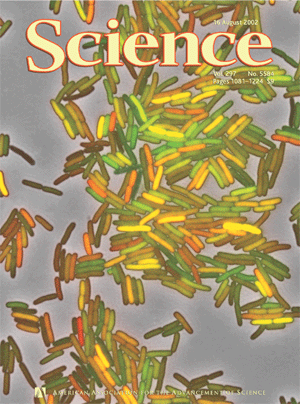
Take a look at this picture, from the cover of Science (Aug 16, 2002). The caption states, "Bacterial cells simultaneously expressing two different fluorescent proteins (red and green) from identical promoters. Because of stochasticity ('noise') in the process of gene expression, even two nearly identical genes often produce unequal amounts of protein. The resulting color variation shows how noise fundamentally limits the accuracy of gene regulation."

The article on page 1183 of that issue, "Stochastic Gene Expression in a Single Cell" by Michael B. Elowitz, Arnold J. Levine, Eric D. Siggia, and Peter S. Swain, reports on their experiments that show how random noise in and around the cellular machinery for gene expression causes variations in expression even when the genome is identical, or nearly so. The cover photo and links to the article are found at http://www.sciencemag.org/content/vol297/issue5584/cover.dtl.

I was looking for this picture when I posted More Variety Than a Field of Snowflakes, about "No Two Alike" by Judy Rich Harris. It is known that, although identical twins share nearly identical genomes (differences are due to tiny amounts of random mutations during embryo development), they can be remarkably different; and that variations in most characteristics that can be measured are about 50% genetic, and 50% unknown. Ms Harris focuses on environmental factors. Based on the above article, I also considered inherent randomness. There are three principal sources of stochastic difference in the genetics and gene expression between two cells that result from a single cell dividing by mitosis:

  1. Mutations that occur during DNA duplication (there are several varieties)
  2. Random variations in the molecular buffeting that the gene expression machinery undergoes (Brownian motion)
  3. Random variations in everything else going on in the cell at the time

All varieties of reaction to one's environment involve changes of gene expression. Also, any organism's behavior, determined by gene expression, will affect that environment; the environment reacts. Thus, any difference in expression will modify the environment, and its changes cause further reaction by the organism. This feedback may be positive (spiraling out of control) or negative (tending to a stable result little changed by the variation).

So why are twins different? Some randomness in reaction leads to positive feedback, increasing the difference between the twins.

Monday, September 04, 2006

Tell a joke, hold a door, open a service business, and...go to jail?

kw: book reviews, nonfiction, commentary

When I was in my teens and early twenties, Polish jokes were popular. This was when Ghoulardi spent half his show on WJW-TV in Cleveland (then on KFWB in Los Angelesjust after I moved there) joking about white socks and "Polacks". Early on, I had a Russian girlfriend, who had Russian and Polish relatives living near Cleveland, and they were proud of being Polacks, and had better jokes than anything you'd hear on the air. Later, a minister I knew, whenever someone told a Polack joke, would say, "You know, I'm Polish." By 1970, you couldn't get away with nearly any kind of ethnic joke. Someone would cast blame.

One story—sometimes presented as a joke—that I read several times in the 1980s concerns an older fellow who holds a door for a woman. She stops and angrily states, "You don't have to hold the door for me just because I am a lady." The man replies, "I'm not holding it because you're a lady, but because I am a gentleman."

Just a couple years ago, an enterprising student at Harvard began a dorm room cleaning service. He wanted to call it DorMaid. The administration refused to allow him to bring it on campus, and eventually threatened expulsion, unless he changed the name to remove the word "Maid". Somehow, he got them to accept DormAid. Turns out, that was good, because it opened up opportunities to offer plenty of services beyond room cleaning. But it's silly of the campus admin, don't you think?

So does Michael Smerconish. He has collected the details of the DorMaid/DormAid story and more than 25 others, to illustrate how "political correctness", or PC, is shredding American culture, and actually threatening our safety. The book is MUZZLED: From T-Ball to Terrorism—True Stories that Should be Fiction, and Chapter 27, "Still Flying Blind", shows how the continued failure of the FAA and NTSB to allow airline security personnel to make intelligent decisions simply hastens the next airline terrorist incident.

What do you call a taxi driver who sees his brother beating up a cop, jumps out of his taxi, and kills the policeman? If you called him Mumia Abu-Jamal, you are right. Currently, he has more press and celebrity support than our President and all his political opponents in the 2004 election. This is more than just political correctness; this is an insanity that infects the press and the celebrities who primarily are produced by a fawning press out of whole cloth.

And what do you call an 18th-Century merchant who briefly had a business interest in a ship that the British occasionally used to import slaves, who led the effort to abolish slavery in the Northeast prior to the American revolution (which he helped finance, and for which he smuggled materials), whose signature appears on three of the founding documents of the United States (the Declaration of Independence, the Articles of Confederation, and the U.S. Constitution)? If you called him Robert Morris, you've uncovered the "slave connection" that was used to force Wachovia Bank to "apoligize" for its early connection with the slave trade...a connection that was tenuous at best.

This reminds me; on occasion I've run into a "kill Whitey" sort of black dude, who begins to rail on me about being a slaver. When I get the chance, I explain that on one side of my family I am descended from Quakers who operated safe houses along the Underground Railway in North Carolina; and that on the other side I am descended from Methodists who purchased slaves in Missouri and took them North or Northeast to freedom. I say, "Don't blame every white man for your problems. Without my family, you wouldn't have been born free. You take responsibility for your own life, like I have taken for mine."

I have a different word for PC: Institutionalized Irresponsibility. All these jerks out there blame everyone else for everything, but never take responsibility for their own actions; indeed they change laws and codes to make their own chosen lifestyles easier at the expense of others'. Jesus said about people like this, "And they bind burdens, heavy and hard to bear, and lay them on men's shoulders; but they themselves will not move them with their finger" (Matt. 23:4). If you haven't done so in a while (or ever) read the first seven verses of Matt. 23; we have more Pharisees among us than ever!

The one thing I wish Mr. Smerconish had included is a chapter with ideas to push back on today's Pharisees. You can't give them a witty rejoinder, for they have no sense of humor. In another book (I'll be reporting on it before long) I did read half a suggestion: Judge Roy "Ten Commandments" Moore wanted a 2-ton monument to the Decalogue bad enough to risk jail over it. The result of a court case was that it now sits in a closet. A more appropriate place for Roy's Rock would be his front yard. A case like this, where the Pharisee takes action rather than preventing others' action, offers a bit more room for rebuttal!

In our own lives, what to do? It takes forethought: speak out. Gather your own stories, and talk about them, speak in public if you're able. Write about them: Letters to Editors. When someone blames, hit right back. If someone objects to a How Many Does it Take or a Blonde joke, I (a bald man) say, "Oh, and when was the last time you told a Bald joke, or laughed at one?"

Keep your travel plans flexible: when you get on an airplane or train, look at every passenger; if someone gives you the creeps, get right back off and demand that "they go or I go!" Freedom requires the committed action of many citizens. Historically, a few percent is enough. Boycott the products of public figures who do and say stupid things...they only care about their pocketbook, so hit 'em there. And in that line, investigate very carefully every "charity" that you're inclined to support. If they promote PC causes, turn them down. Further in that line, buy Michael's book! Use its examples to shed light where it is desperately needed.