kw: public service, morality
A friend from Georgia told me of a politician there who, it was found, had hundreds of thousands of dollars stashed inside a mattress in his home. There was shortly a recall election, and he was run out of office. My friend explained, "We sort of expect public officials to be corrupt, but we won't tolerate rank stupidity."
I have refrained from commenting on the idiocy of New York Representative Anthony Weiner, but a few things must be said. I sort of expect congresspersons to be philanderers; it is well known that many of them are. Probably most are. But Weiner's behavior is rank stupidity, even dumber than filling a mattress with cash. There have to be dozens of ways of communicating with targets of one's seductive wiles that are more secure! If this fool can't keep personal secrets—mainly because he can't pick discreet partners—just how safe are the nation's secrets with him?
Showing posts with label public service. Show all posts
Showing posts with label public service. Show all posts
Tuesday, June 14, 2011


Sunday, December 19, 2010
Hunting planets
kw: science, astronomy, public service
In the recent post Usefully Consuming Time I wrote about classifying galaxies in the Galaxy Zoo Hubble project. This is one project found at Zooniverse, where anyone with the desire and a bit of time on their hands can participate in any of eight astronomical projects.
The latest of these to be started is Planet Hunters. The Kepler satellite has been gathering data on about 100,000 stars for a couple of years now, a brightness measurement for each of them each thirty minutes. While software is being used to scan the light curves of each star for evidence of transits by planets, the Planet Hunters projects is pitting people against computer software, considering that people are better at matching patterns. I had to give it a try, so I logged in and learned to classify starlight curves.
 The usual pattern is a fuzz of dots running across the screen, representing the twice-hourly brightness measured over a thirty-day period. If it looks like white noise, it signals "Nothing of interest here, folks. Let's move along." Many of them are wavy fuzzes, signaling a variable star. The tutorial explains the basic kinds of starlight patterns.
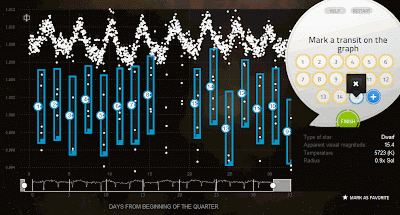
One of the patterns I was presented is this one, in which seventeen transit events are visible in the starlight curve of a variable star. At the time I took this screen shot, I had marked fifteen of the seventeen. This image shows several things. Firstly, ignoring the transits, the wavy fuzz at the top shows that the star brightens and dims by a small amount about every four days. Secondly, the fuzziness of the wavy line represents the small variation in instrument response that is characteristic of any repeated measurement. There is a scale up the left side of the chart that shows this variation is a small fraction of a percent. Thirdly, there are the transit signals, the dips that occur about every two days, which I am marking with blue rectangles.
These are very deep, very obvious dips in the brightness of the star. They indicate something in a close orbit about this star that obscures about one percent of its light every two days, taking about three hours to cross the face of the star. This star is indicated, in the table at lower right, to be a dwarf star with a diameter 0.9x that of our Sun. That is about 1.25 million km, so the object is moving at 420,000 km/hr. That is about four times as fast as Earth moves about the Sun. The two-day period yields a circumference of its orbit as 20 million km, or a radius of 3.2 million km. These figures assume the transit is close to central. The 1% obscuration indicates the object is 1/10 the diameter of the star, or 125,000 km, which makes it comparable to Jupiter (143,000 km).
By comparison, an alien Kepler mission that happened to observe Earth would see the following: Obscuration by 0.01% that lasted thirteen hours, once each 365 days. Such a signal is quite subtle in the fuzz of a starlight pattern like that shown above. But it ought to be visible. It would only be seen, however, in one thirty-day run out of twelve. Also, only one star in more than 600 is placed so as to observe any transit of Sol by Earth in the first place. So, there will be a number of "easy hits" like the one above for every one that might indicate a planet similar to Earth. But the discovery will be worth the search.
This is quite a bit different from classifying galaxies. I've decided, when I am one one computer that I use, I'll classify galaxies, and when on the other, I'll hunt planets. Any taker out there for some of the six other Zooniverse projects?
In the recent post Usefully Consuming Time I wrote about classifying galaxies in the Galaxy Zoo Hubble project. This is one project found at Zooniverse, where anyone with the desire and a bit of time on their hands can participate in any of eight astronomical projects.
The latest of these to be started is Planet Hunters. The Kepler satellite has been gathering data on about 100,000 stars for a couple of years now, a brightness measurement for each of them each thirty minutes. While software is being used to scan the light curves of each star for evidence of transits by planets, the Planet Hunters projects is pitting people against computer software, considering that people are better at matching patterns. I had to give it a try, so I logged in and learned to classify starlight curves.
 The usual pattern is a fuzz of dots running across the screen, representing the twice-hourly brightness measured over a thirty-day period. If it looks like white noise, it signals "Nothing of interest here, folks. Let's move along." Many of them are wavy fuzzes, signaling a variable star. The tutorial explains the basic kinds of starlight patterns.
One of the patterns I was presented is this one, in which seventeen transit events are visible in the starlight curve of a variable star. At the time I took this screen shot, I had marked fifteen of the seventeen. This image shows several things. Firstly, ignoring the transits, the wavy fuzz at the top shows that the star brightens and dims by a small amount about every four days. Secondly, the fuzziness of the wavy line represents the small variation in instrument response that is characteristic of any repeated measurement. There is a scale up the left side of the chart that shows this variation is a small fraction of a percent. Thirdly, there are the transit signals, the dips that occur about every two days, which I am marking with blue rectangles.
These are very deep, very obvious dips in the brightness of the star. They indicate something in a close orbit about this star that obscures about one percent of its light every two days, taking about three hours to cross the face of the star. This star is indicated, in the table at lower right, to be a dwarf star with a diameter 0.9x that of our Sun. That is about 1.25 million km, so the object is moving at 420,000 km/hr. That is about four times as fast as Earth moves about the Sun. The two-day period yields a circumference of its orbit as 20 million km, or a radius of 3.2 million km. These figures assume the transit is close to central. The 1% obscuration indicates the object is 1/10 the diameter of the star, or 125,000 km, which makes it comparable to Jupiter (143,000 km).
By comparison, an alien Kepler mission that happened to observe Earth would see the following: Obscuration by 0.01% that lasted thirteen hours, once each 365 days. Such a signal is quite subtle in the fuzz of a starlight pattern like that shown above. But it ought to be visible. It would only be seen, however, in one thirty-day run out of twelve. Also, only one star in more than 600 is placed so as to observe any transit of Sol by Earth in the first place. So, there will be a number of "easy hits" like the one above for every one that might indicate a planet similar to Earth. But the discovery will be worth the search.
This is quite a bit different from classifying galaxies. I've decided, when I am one one computer that I use, I'll classify galaxies, and when on the other, I'll hunt planets. Any taker out there for some of the six other Zooniverse projects?
Tuesday, December 07, 2010
Usefully consuming time
kw: science, astronomy, public service
Want to do some real astronomy, something helpful? You have something no computer program can duplicate, a finely tuned recognition ability. Assuming you aren't blind (and thus using some kind of assistance program to "read" this text), your vision system can quickly discriminate objects from background clutter and distinguish their shapes.
One harvest of the various telescopic surveys, including the Sloan Digital Sky Survey (SDSS) and the Hubble Space Telescope (HST) program, is a huge archive of deep space images of millions of objects. Learning how the Universe works requires classifying large numbers of these objects. While a computer program can scan a digital image and locate objects, and even discern a star from a galaxy with quite good accuracy, it usually cannot determine whether a particular galaxy is elliptical, spiral, irregular or something else. Guess what? With a minimum of preparation, you can!
Three years ago a team of astronomers launched a project called Galaxy Zoo, a web-based classification program for the galaxies identified in SDSS images. They hoped to have a million galaxies classified by several persons each over a span of a few years. They got a huge public response, and received tens of millions of classifications, an average of fifty "votes" each for a million galaxies, in about five months.
As the astronomers learned more about galaxies in the early universe, they learned better questions to ask. The project has been expanded to the deeper images found in the HST archives, and is currently the Galaxy Zoo Hubble, one of several Zooniverse projects. I encourage everyone who can, bookmark the link, register, and learn to classify galaxies. The one-web-page tutorial is a great introduction to the subject. What follows introduces some of the concepts, because I've been having great fun, having classified my first 400 galaxies.
 Click on this image to see it full size. It shows the control panel for classifying HST galaxies. You answer the Zoo's questions by clicking on the buttons on the right. As this screen shot shows, the first question is to determine, is this a smooth (that is, elliptical) galaxy, or something else? In the "recent" Universe, that within about a billion light years, most galaxies are elliptical. However, the public perception of galaxies is shaped more by the beautiful spiral galaxies.
A word of caution. There are few "pretty pictures" in the GZH archive. The focus of cosmologists' interest is the early Universe, so the galaxies of interest are very far away, and therefore appear rather small in HST images.
 This is one of the better images of a spiral galaxy. Two spiral arms are visible, and there is a small central bulge, the orange spot near the center. Questions asked by GZH lead you to describe each feature. For this one, I selected "Features or Disk", "Not clumpy", "Not an edge-on spiral" (Yes to this one leads one through different questions), "No Bar", "Spiral", "Medium tightness", "2 Arms", "Just noticeable bulge".
There is also a question, "Anything odd?", which is where you'd designate whether the galaxy is irregular, or a merger of two or more, or has a prominent dust lane (usually seen only in spirals that are nearly edge-on), and a few other features.
During classification, you can also see the image as a negative, with dark features on a white background. This is often useful for counting the spiral arms when a galaxy has a more ambiguous appearance.
 Here is one of the better images of an elliptical galaxy. This one is part of a cluster (you can see one of equal size to the upper left), and this cluster is in front of an enormous cluster of more distant galaxies. However, you are asked to classify only the object at the center of the image.
Ellipticals are simple; for this image I answered "Smooth", "Medium oval", and "Nothing odd". A computer program would need to be very smart to figure out that the five colored dots "inside" the large elliptical galaxy's image are actually galaxies situated much farther away, seen through it.
With one exception, everything you see in this image is a galaxy. That exception is the overexposed image of a star at the lower left. If GZH presents such an image to you, you'd click "Star or Artifact". I've also seen various artifacts such as a "dotted line" caused by something in motion crossing the field of view during the exposure: HST discovered lots of asteroids that way.
This elliptical galaxy happens to have a distinct central condensation. Many do, but not all. One way to distinguish an elliptical galaxy with a central condensation from a face-on disk galaxy is that the disk and central bulge are different colors, while all of an elliptical galaxy will be the same color.
 Many images of the farthest objects show galaxies that are still forming from smaller objects. They have a clumpy appearance like this. For this image I answered "Features...", "Clumpy", "More than 4 clumps", "Clustered", "No distinctly brightest clump", "Not symmetrical", "Not embedded in something larger", and "Nothing odd".
The proctors of the GZH web site are clever. One of the answers to how the clumps are arranged is "Spiral pattern". Early spiral galaxies have bright star-forming regions strung along the spiral arms, and if we cannot see the whole galaxy, all we see are those bright spots. But they outline the spiral shape, so such an image winds up being provisionally classified as a spiral galaxy.
It is remarkable how consistent the classification of most objects is. Each one is presented to a number of people, so the professional astronomers only have to take a second look at the ones that get a scattering of widely divergent classifications. This last image might be such a one.
If you are feeling helpful and have a little time on your hands, give the GZH project a try.
Subscribe to:
Posts (Atom)

 Posts

