kw: local events, flowers, springtime
Yellow and orange crocuses began blooming the first week of February around here, almost a month early. The first purple crocuses showed up a couple days ago, and some early flowering trees are putting out their first blooms: One kind of flowering cherry, and quince. My pink dogwood looks like its buds are ready to pop, and the white one will surely bloom right after that. Tulip and daffodil leaves are up, but no flowers yet. Curiously, I don't see much sign of Forsythia blooms yet, though I have seen them bloom in February once or twice.
The first time we visited this area seventeen years ago was also an early Spring. We came in late March, and all the flowering trees were in full bloom, a spectacle usually reserved for the second or third week of April. That first day my wife turned to me and said, "I could live here." Of course, the following January we were under almost three feet of snow, and wondering if we'd been so lucky to move here after all.
This makes me wonder what this Summer will be like, and the Winter to follow. The Farmer's Almanac (4 month predictions free to registered folks) is predicting a rather mild March-July 1 season, with only one 90°+ heat wave in June. Lots milder than the past Summer. I guess I rather like La Niña, compared to El Niño. It also means I'd better save up for the extra heating bills of the opposite season, due in 1½ years, and an extra-hot cooling season to follow. Meanwhile, I'll enjoy the flowering season while I can!
Showing posts with label flowers. Show all posts
Showing posts with label flowers. Show all posts
Thursday, March 08, 2012


Friday, November 26, 2010
The first cold evening
kw: photographs, flowers, weather
 It snowed in the Philadelphia area on Thanksgiving day, but the cloudy night stayed above freezing. We've just had one dip to 30 degrees (-1C) so far this Fall.
Tonight it is clear, with a forecast in the mid 20s (~-5C) in the suburbs, so we decided to bring the African violets from the sunroom into the kitchen for the night. This is an exercise we perform through the winter, as the sunroom warms up pretty well during even the coldest days. We take them out mornings, and bring them inside at nightfall.
This is our current violet collection. There are four varieties here; one is pink and the rest are variations on the traditional indigo color. It is nice that they usually bloom this time of year.
Monday, April 27, 2009
Had to miss it, didn't I
kw: observations, flowers
 Not far south of here, the Mount Cuba Center in northern Delaware has a wildflower celebration each year. Twice in the past five years (since we heard of it) we've been able to go. This year we couldn't, and I'm told it was a stunner. Their most famous type of flower is the Trillium. There are numerous varieties, which are much sought after because they are rather scarce in the wild. Fortunately many varieties are available commercially-grown, even though it takes six to seven years to raise a plant to flowering age.
This specimen is from our yard. The former owner of this house must have planted it many years ago, for now the plant is robust, flowers every year, and has new plants nearby that have begun to flower. We have lived here fourteen years, and I don't recall seeing this plant in flower the first few years, but at that time we had never heard of trilliums.
Most varieties are white or off-white, of differing sizes and narrowness of petal. Some do come in other colors, like the next specimen.
 This is someone else's photo. I wish I'd taken one as nice, when I was at Mt. Cuba last year. We typically learn about the date of each year's celebration a week in advance or less, so we too often have plans already.
Let's see; last Sunday in April this year, and a Saturday the last time we went, but also late in April. Guess it'll take blocking out a 2-week window around next year's likely date and hoping for the best.
Monday, August 07, 2006
Invertebrate geometer - Mystery Solved
kw: puzzles, geometry, flowers, solutions
 In a post on August 2, 2006, I showed a picture of a Phlox flower that looked like a propellor, each petal was chewed on one side only. This image is the clue to solving why a critter (probably a caterpillar) would favor only the left side of each petal.
The opened flower is chewed in the same propellor pattern. The bud next to it, about a quarter opened, lets us see what happened. When a bud gets partway open, and it is still mostly dark, the caterpillar eats the exposed part of each petal quickly, then flees as the sun rises.
The geometric "knowledge" thus resides in the flower bud's DNA, not in the eater.
Thursday, August 03, 2006
Invertebrate geometer?
kw: puzzles, curiosity, geometry, flowers
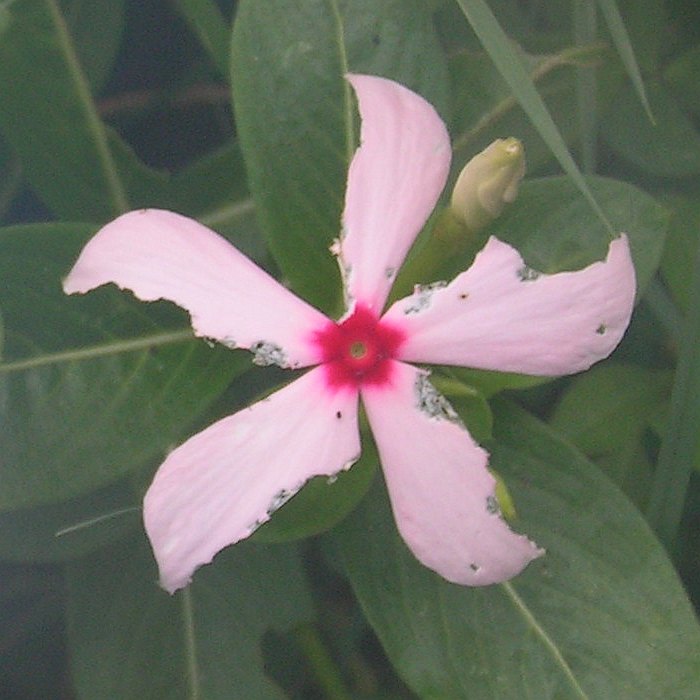 I took this picture the morning of August 1, 2006. Our little Fall Phlox plant produces a flower or two daily; a bud is visible behind this chewed flower. Each afternoon, I see the new flower(s) in pristine beauty. The next morning, they are variously chewed.
This particular morning some fastidious creature—probably some kind of caterpillar—has eaten only the left half of each petal. The other flower, on the other side of the plant, was chewed in a similar pattern.
In the past, I've seen the ends of the petals removed, or two of the five completely eaten. A curious circumstance, this one!
Subscribe to:
Posts (Atom)

 Posts

