Tuesday, June 27, 2006

This preacher comes at you from another angle

kw: book reviews, nonfiction, celebrities, religion, values

The kind of spiritual leaders I like best didn't go to any seminary, and usually haven't been ordained by any organization. God's way as seen in the Bible is for a prophet to appear from the wilderness, make a huge impression on his generation, and pass on. Though a "school of the prophets" will often rise up, none of its graduates exhibits the gift or power of its namesake. Moses is the prototype: well educated, though in the Egyptian way, at the age of forty, he suffered a terrible failure, and spend the following forty years watching sheep eat "in the back side of the wilderness," somewhere in Midian. Once God decided he'd learned his lesson, and was ready to be a more effective shepherd, he called Moses from the burning bush.

Often the best preachers are the secret ones, those who can put God's lessons into you without seeming to touch on religion at all. St. Francis strove to be one of these; he said, "Preach the Gospel at all times. When absolutely necessary, use words." Fred Rogers, TV's Mister Rogers, is my favorite of this genre.

Marcia Z. Nelson, who writes about religion in a number of venues, has found such a "secret preacher" in Oprah Winfrey. She has influenced people worldwide for twenty years through her TV talk show and the publishing empire that has grown up around it...and I mean publishing of all kinds, for it is her Web site, www.oprah.com, that has the greatest impact.

Though Oprah Winfrey was raised a Christian, she has been accused of being "New Age" because of her nonjudgmental approach and emphasis on self esteem. While I prefer to emphasize self respect over self esteem, I understand her approach, and appreciate it. I am a Christian teacher, and I find nothing to offend me in her method.

Ms Nelson's new book, The Gospel according to Oprah, shows a double handful of ways that Oprah gets her message across without being preachy. Two are of interest to me, the 5th and 10th of ten chapters: "Oprah teaches gratitude" and "Oprah is a reminder service."

We are frequently exhorted in the Bible to exercise thanksgiving. The Psalms are primarily expressions of praise and thanksgiving to God, and the rest of the Bible contains many "secret psalms" such as Isaiah chapter 12. Gratitude in our attitude makes everything go better, as Oprah reminds her audience frequently.

Also in the book of Isaiah, God's people are called "God's remembrancers," even called to remind God (and themselves in the process) what His plans are. Jesus said that the Holy Spirit's major task would be to "bring to remembrance" the things He had said, and what His disciples had read. This is why we need to read the Bible; it gives the Spirit something to work with. For those who have never read the Bible, and perhaps wouldn't be caught dead with one in hand, Oprah reminds us what values and virtues really are, and why we're happiest when we're best.

Dale Evans once said, "The way we behave may be the only Gospel some people ever see." I don't know if Oprah knows that aphorism, but it is clear she is living it, and asking us also so to do.

Monday, June 26, 2006

Isn't Weather part of Nature, too?

kw: opinion, environmentalism, ecology

The other day, on a PBS broadcast, I heard the phrase, "...a fragile ecology at the mercy of the world's weather..." I immediately thought, "What balderdash! The weather is part of the ecology."

When I was a graduate student of Geological Engineering in Rapid City, SD, I often went with fellow students to see their project areas, as many of them came to mine. One area was an alluvial fan below a steep canyon south of Sturgis, SD (an alluvial fan is a sloping plain formed of the debris of a river's erosion of young mountains. The Black Hills are part of the Rocky Mountains, a relatively young mountain chain).

The fan had a great scattering of large boulders, some as large as a minivan. My friend had mapped the locations of all the boulders, from three feet in diameter up, and measured the size of the lichen spots on them. From the known growth rates of lichens, he was able to determine that there had been more than ten flooding events in the past 5,000 years, or about one per 500 years, with sufficient force to move stones weighing many tons as far as two miles from the canyon mouth. Some older stones showed signs of having been uprooted and moved by later floods, from where an earlier flood had left them.

The current climate that we call an Ice Age Interglacial period has been relatively stable for about 11,500 years. But by "relatively stable," we must include times much colder than today, even colder than the "little ice age" of the 1400s-1800s, and periods of warming quite a bit beyond our expectations of the next hundred years of "global warming." Yes, I do believe the current warming is in large part caused by our burning of fossil fuels, but it is certainly not unusual compared to the excursions of the past ten millenia or so.

The various ecological zones of each continent contain assemblages of plants and animals that have existed over that span of time. When things were cooler, those that could, moved south or downhill, and when warmer, north or uphill. The rest adapted without migration, or went extinct. Those today existing are those that adapted, with or without migration.

The idea that a 100-year flood, a 100-year drought, or a 100-year "disaster" of any kind is unprecedented is a truly blind viewpoint. My friend noted that he couldn't tell yet which of the floods whose debris he had mapped had been the worst. Whichever it was, it was the 10,000-year flood, and didn't make great numbers of things go extinct.

We still have a lot to learn about the resilience of ecological systems. Our lifetime is too short to provide a useful baseline. Even all of written history encompasses only half the current Interglacial. Until environmentalists become astute students of history, we'll go from panic to panic, for no good reason. A pity...

Sunday, June 25, 2006

The Clueless Professor

kw: book reviews, fiction, humor

A favorite character of my childhood, first in stories, then in film, was the absent-minded professor. The inventor of Flubber is but one of a number of these archetypical bumblers.

In At the Villa of Reduced Circumstances, Alexander McCall Smith has gone the genre one better with Professor Dr. von Igelfeld, a truly blinkered, clueless academic, famous among a handful of philologists for his 1,200-page tome, Portuguese Irregular Verbs (the title of the first von Igelfeld "entertainment" by Smith).

Author Smith wrote in the voice of his native Botswana to bring us Precious Ramotswe and the No. 1 Ladies' Detective Agency series. With the good German Professor, the voice is a combination of erudite wit among mutually suspicious academics, and an exaggerated ivory-tower species of tunnel vision.

Dr. von Igelfeld, suffering the intrigues of his fellows, finds the intrigue even deeper at Cambridge on a visit there. Intrigue hardly begins to describe the thunderously funny convolutions of the plot in Bogotá, Colombia, where he is tricked into becoming President, and needs all his cleverness to abdicate before being shot by the next Government, due "any week now."

Ya want escape? None better than right here!

Saturday, June 24, 2006

The Rich and Famous get Nowhere

kw: book reviews, fiction, short stories, high society

In The Young Apollo and Other Stories Louis Auchincloss recalls New York "high society" of a century ago, evoking that unreality for a generation that thrives on "virtual anything." From the mistakenly noble motives of rich young men who find that bleeding blue blood kills you as quick as any other kind, to their wives or widows exercising their thwarted intelligence in rounds of house parties; from the robber barons to the noveau riche; all are presented in their own pretentious late-Victorian language.

Perhaps an older, more credulous generation finds such stories gratifying; I find them sad. Is that what the author intended? Perhaps. I cannot presume to read the heart of one who began publishing about the time I was born. Suffice it that I read of person after person who may have accomplished much...or may not have: All are at best grimly satisfied, but most are simply lost within a formerly familiar environment. How credible are the images thus presented? I don't have an easy way to determine.

Two stories in particular open a door rather than close any: Pandora's Box and Her Better Half. In the former, a man learns how he must play the game, and determines to play it much better than his fellow suppose. In the latter, a woman learns the same lesson. With a modicum of thought, both stories have a post-text: Watch Out World, Here I COME! I am a junkie for stories of transformation.

Thursday, June 22, 2006

A religion struggling to grow up

kw: book reviews, nonfiction, politics, religion, terrorism, islamic extremists

Of the world's great faiths, only two are territorial:

  • Biblical Israel is required to worship in Jerusalem and to live under a theocracy in “the good land.”
  • The Koran requires an Islamic theocracy, which is to be actively spread to all the world.

Point 2 is the source of World War Three, which has been going on for twelve years, at least. Islam is the youngest of the global faiths, 1,400 years, with a following of 1.3 billion. Considering that religions last millennia, Islam is in its adolescence! Until it grows up, it will be a source of global instability. Religions become more tolerant with age.

The largest faith (2.1 billion) is presently Christianity, and though it is not inherently territorial ("My kingdom is not of this world"), medieval Romanist Christianity certainly was (e.g. the Crusades), and the Protestant Reformation period (14th-17th Centuries) was marked by warfare that led to the current division of the world into three regions dominated by Roman Catholic, Orthodox, and Protestant practice.

Although Hinduism, the world's oldest active faith (4,000 years or older), is mainly esoteric, and Buddhism (aged 2,500 years) even more so, both experienced sustained periods of conflict during their "spiritual adolescence", the teen centuries (~1,500 y of age). Together, 1.3 billion follow one or both of these esoteric faiths.

Judaism, though not a great faith in numbers, only 15 million, has had a great, continuing effect on the world. It is the third-oldest faith, at 3,400 years. It underwent several upheavals, but its most warlike period was very early in its history, as the "children of Israel" wrested Canaan from its inhabitants. The spiritual teens for Judaism and a long struggle for national survival began in the Maccabean period, lasting from two centuries prior to the birth of Jesus, until 70AD. From then until 1948, Judaism was a territorial faith without territory, but matured as the jingoistic language of the old Hebrew prophets was reinterpreted in a more spiritual way.

If these faiths are any guide, religions tend to be very unstable as they pass through an adolescent stage after the first millennium or so. They are bad citizens of the world for a while, like self-centered, spiteful "young adults".

Thus it seems almost inevitable for Islam to be in a period of sustained upheaval. 'Tis a pity it occurred in a generation that has access to nuclear weapons! But few of us in the West have observed that Islam's internal struggle is more intense, and its outcome more crucial, than the external struggle we call Islamic Terrorism. As a point of plain fact, the struggle within Islam will determine whether "the war on terror" lasts one generation or ten.

Mary Habeck, formerly a popular lecturer at Yale, now an Associate Professor at Johns Hopkins, teaches and studies military history. She asks a wonderful question, "What do the Islamic extremists say about why they are at war with the West?" She brings us the answer in her new book, Knowing the Enemy: Jihadist Ideology and the War on Terror. To me, this book is required reading for every human on the planet. The outcome of Islam's internal conflicts will have some impact on the lives of us all, every one of us.

Hitler didn't invent the Big Lie, he is just the first to embrace it publicly. Today the jihadists are its most ardent practitioners. They know if they say it often, say it loud, and stifle all other voices (make them feel guilty for their virtues), they will win hearts. Professor Habeck outlines their motives and their reasoning, from their own writings. In a world where perception is everything, it doesn't matter that they are twisting the Qur'an (Koran) and their other semi-sacred writings. The studies of millions of Islamic scholars don't matter; such scholars are vilified as false Muslims. To some extent, the hope of the world rests in the laziness of the majority of Muslims.

Ms Habeck has a brilliant suggestion. We must rename the "war on terror" as the "war on the khawarij." To quote her, "They khawarij were heterodox Muslims who appeared soon after the death of Muhammad to claim that they alone were true believers...", precisely the position the jihadis take today.

As I have written elsewhere, should the majority of Muslims embrace the Jihadist view, a generations-long conflict will result in extermination, either of jihadism, or of the rest of us.

Forget what the Western commentators are saying, forget both liberal and conservative viewpoints. The jihadists themselves make it clear that their purpose is entirely religious. They really, really believe that God requires them to bring the entire planet and every person on it into subjection to Allah, or to the grave.

Think on this: Does the Devil know he is Evil?

Think on it some more.

I think, No. He thinks he is Good, even the Best. The Devil thinks he got a raw deal from God, that he is the victim of bad press, that he ought to be running things. The Devil thinks the problem of sin in people is because they are too free; he'd love set up really strong law with superior—even supernatural—enforcement, to take away all causes of straying, until nobody has the opportunity to disobey. That's how he'd run things: nobody can steal from his neighbor, because neither party has anything worth stealing; nobody can commit mayhem, murder, or adultery, because everyone works too hard and is too tired; nobody can lie because the demons can read minds and they'd be everywhere (they outnumber us...); and coveting? a level of mind control that would make Mao blush would take care of that. Then, he thinks, everyone would love him.

Absent mind-reading minions, the above is a fair description of Shari'a, at least as defined by the Jihadists. The religious heart is the power of the movement.

Get Knowing the Enemy. Read it, learn its lessons, keep it handy and read it again. And again. Until jihadism is eliminated.

Friday, June 16, 2006

Phobos Galaxy 1 anthology

kw: book reviews, science fiction, anthologies

From an introductory note: "Phobos Books has stakes its reputation on new, rather than established, voices in science fiction, because, as Orson Scott Card wrote in his introduction to our very first anthology, Empire of Dreams and Miracles, 'Science Fiction, of all genres of storytelling, is the one that hungers most for new writers.'"

This sentence makes it clear why Sandra Shulberg is a publisher, not a writer. It is also an example of the sloganeering that seems to characterize American culture since the 1970s. From time to time it is well to remember, like those late night bull sessions, the guys who have the most to say about their 'conquests' are the insecure ones. Those who talk don't do, and those who do, aren't talking.

D'ya wanna make a difference in the world? Don't say it, do it.

As it happens, the 2004 Phobos offering, Absolutely Brilliant in Chrome (edited by Keith Olexa), contains some gems among its "new voices." My idea and comment list for this volume, ten stories by six writers and a collaboration (Gordon Gross is a couple's pseudonym):

"Letters to a Sister by Rebecca Carmi. A truly touching series of letters from an Earthbound woman to her sister, who is on an 800-year starflight in suspended animation. Collapse of the global economy and Chinese takeover.

"Guess Who's Coming to Dinner" by Daniel Conover. A sickly hilarious sendup of the G.W. Bush administration. One of the aliens recovered in Roswell, NM in 1947 has been living underneath the White House ever since. More aliens show up, philistine interstellar tourists, and fireworks ensue.

"The Ants of Imhotep" by Carl Frederick. An Egyptian fantasy. The son of a pharaoh, "amberized" rather than embalmed, has a strange affinity for the young son of an archaeologist. Ants crawling on a stone slab reveal a map to a hidden chamber hiding his remains.

"Absolutely Brilliant in Chrome" by James Maxey. A cheap treatment of an interesting idea: What will we do when synthetic skin, initially created for burn victims, becomes better than the original ... Kevlar(R) plus Teflon(R) ...!

"Ascension" by Matthew S. Rotundo. A new redaction of the 'mountain makes the man' archtype. This mountain is the hardest climb on the known worlds (of course).

"A Meeting of Minds" by Gordon Gross. People have been getting frozen at death for some decades now (background fact), in hopes of being thawed and healed later. When the technology is perfected to create a digital version of one's personality, to take care of the assets of the 'frozen asset,' how do you know you are you, and not a better digital version?

"Promise" by James Maxey. I guess the editor really liked the Title story, because he gave the author another whack. I wasn't surprised that a sexual coming-of-aged figured strongly. The writer takes a whack at religious extremism, but his straw man is a pitiful caricature.

"A Debt Unpaid" by Justin Stanchfield. The planets are up for grabs, in an Oklahoma-style land run (ten days to stake your claim). Can a former Government agent become a trusted homesteader? The ending is a cop-out.

"Perfect" for Each Other by Daniel Conover. Hometown hicks make good, courtesy of a government that needs a better "Charly" to fight terror, and which is willing to "enhance" his wife to match. Ends on a note of hope, but rather weakly.

"Deep Flows the River of Time" by Carl Frederick. Fun premise: Physics post-doc lets his mentor maneuver him into testing a new time machine by going back 20 years in time; he rescues his mother and young self from his own miserable youth, and gets rescued in turn by the mentor.

Wednesday, June 14, 2006

Is Autism an Evolved Adaptation?

kw: speculation, autism, asperger, ASD

I recently read an article in one of the May 2006 issues of Time about autism. Seems the current term is "autistic spectrum disorders" or ASD. I wonder if these are really disorders? I also recently read that some number of folks (10% or so?) are sensitive to very low frequencies, such as those used by elephants, rhinos, and big cats for long-distance communication. These ideas milled around in my head...

I have three friends who are autistic. One is a 4th grader, one of my music students. He is intense, focused, disciplined, very frank, and more sociable than I'd expect of an autistic person. He does tend to live in his head, and not listen well unless you can get him to look at you. He is diagnosed with a mild form of Asperger.

Another, a 10th grader, is a family friend. His particular interest—obsession, really—is weather. He and I have spent some happy times talking about weather and climate. He knows he has Asperger. I have noticed his hands are always chapped, so he probably has a washing obsession also.

The third, in his 20s, is right on the edge of full-blown autism. He is hard to talk to, and usually unwilling to interact. Whatever he is interested in, he does 100%. Whenever he gets bored, he's gone.

I have seen other people who are, I supposed, placed variously along the autistic spectrum. I am told an autistic person who has a job of interest to him (80%+ are male) is a very devoted, often overly loyal, worker.

The various "bad habits" usually reported for autistic persons, such as screaming and head-banging, seem to be exaggerations of responses we all feel to overwhelming stimuli. To me they manifest less-than-ordinary impulse control.

As far as I can tell, autistic characteristics and behaviors are exaggerations of "normal" stuff. If a person mainfests the intense focus of an autistic savant, but is otherwise ordinary, we don't call it a disorder. I am myself sometimes very averse to human contact, and I've been known to indulge in "autistic rocking" when overwhelmed. Some, perhaps many, autistic persons have keener or more sensitive hearing or light sensitivity than usual.

If a person has four or five of these "fringe" characteristics, being "3-sigma" or more from the norm in them, we label it, but what is really going on? In quiet times, people with keener senses, who overreact to sounds or bright light, or who are extra-focused, are considered a nuisance. But what of more chaotic times? Keen senses detect enemies or impending catastrophes sooner. Great focus is needed for rapid problem-solving in the face of emergency.

I think the human species keeps a certain number of these people around, because there are times when we need them. They deserve our appreciation.

The double burden of the obese

kw: book reviews, nonfiction, autobiographies, overweight, obesity

Michael S. Berman is a bit of a big shot. He's a lobbyist and political activist who has worked on campaigns since 1964, including Bill Clinton's, and was V.P. Walter Mondale's Deputy Chief of Staff. He is also a big man. How big? It varies, from 220 to 330 pounds. With the help of Laurence Shames, he chronicles the divided life and many burdens of being fat in Living Large: A Big Man's Ideas on Weight, Success, and Acceptance.

Mike Berman repeatedly states that fatness is a disease, one with compelling power, that has no cure, but can be managed. In a way, it is similar to the AA view of alcoholism, except that 12-step programs for the fat are scarce, and there is as yet very little professional support. As I see it, American society views obesity the way it viewed alcoholism in the 1950s or earlier, as a problem of self-control and depravity. As a borderline fatso myself (currently 220 pounds, but it is a struggle to stay there), I know from the inside the power of addictive compulsion.

A story. In early 2001, undergoing chemotherapy, I was warned by my doctor to keep my weight up, because of the chemo's effect on appetite. I did weigh about 180 at the time, because before my operation, I hadn't eaten for two months due to a blocked colon. I replied, "Doc, I long ago learned to dissociate enjoyment of food from hunger. That's why I was fat."

You can be addicted to alcohol, sex, cocaine, cough medicine, amphetamines, and sometimes even heroin, and manage to hide your addiction nearly all the time. How do you hide a silhouette the width of a piano? How do you hide getting stuck in armchairs? You can hide Bipolar disorder, as I do, with judicious planning; our son's band director hides his Obsessive streak most of the time, but always carries a bottle of Purell®. How do you hide the ability to eat three racks of ribs at a sitting, or to spend two or three hours at a buffet, eating nonstop?

Berman unflinchingly relates his lifelong struggle to be thinner, and his tortuous, and torturous, path to acceptance of himself. Behind the successful lawyer and lobbyist, he has been an insecure supplicant of every weight loss scheme that didn't involve surgery or overly-"instant" claims. With maturity, and nine years of therapy, he attained a balance of insight and self-control, so he can manage his life, including his health. He can't be a 170-pound athlete, but he can be as healthy as a 230-pound man can be.

His life is not over by any means. He's only 66 (maybe 67 by now). He still yo-yos some of the time. He's been very successful, and found that his family, wife, and friends don't look on him as being quite as morbidly fat as he often views himself. By his own report, he's happy more than not, now. I hope he writes a sequel, perhaps in another ten years or so. I think he, and we, will be gratified at the equilibrium even a lifelong fat man can achieve.

Monday, June 12, 2006

Looking for God in all the wrong places

kw: book reviews, nonfiction, afterlife

I really like Mary Roach. I have read her columns in a couple of venues, most recently in the Reader's Digest. She has her own, refreshing take on almost anything. It is no surprise to me that she would straightforwardly dive right in where angels (or at least, most of the rest of us) fear to tread: is there any overlap between science and faith? In particular, she asks, can science have anything to say about "what happens after we die?" Her book Spook: Science Tackles the Afterlife is the fruit of her year-long trek through the back roads of a "search for the soul".

Scientists and Religionists are today about a deeply polarized as ever, and proponents from both sides tend to say that religious things are a priori untenable subjects for science. I was taught at one time that things of faith offered "subjective proof" only to the faithful; we could know within ourselves, but no spectrograph or microscope would detect anything. Ms Roach is not the first to say, "Is that really true?", but she is probably the most thorough.

She investigated reincarnation in India, focusing on the work of a few who collect reports by children about past lives they remember. She dug out the records of those who tried to weigh the soul, by putting moribund persons on sensitive scales, and recording sudden changes in weight that might occur at the time of death. She brings out fascinating material—quite literally—presented by Spiritualists of the 19th Century who were quite compulsive in their attempts to objectively prove that the souls of the "dearly departed" were available and eager to communicate. She attended a school for Mediums, tinkered with various gadgets that have been used to record or measure spirit voices or influences.

She came close to hitting pay dirt when she encountered some folks who record and study infrasound. No ghosts, but a possible explanation for the ghostly feelings people get in "haunted" locales. Among land animals, elephants and rhinos have recently been reported to communicate over long distance using frequencies below 20Hz (20 cycles per second), sounds humans can't hear, but which we can feel if they are strong enough, like the bass beat at a rock concert. It is less well known that lions and tigers also use infrasound, and that the after-rumble of a tiger roar is quite strong. Some people, but not all, get fearful or tearful when they hear tigers roaring, or similar strong sounds. This makes sense; it is useful to know tigers are in the vicinity!

Finally, the author reports on medical people who are doing their best to follow up on Ray Moody's 1975 book, Life After Life, about near-death experiences, or NDEs. They keep a computer screen, pointed upward, near the ceiling of their operating room, with a timed sequence of images shown. When someone reports they "floated to the ceiling," the researchers can ask what was on the screen, and learn if out-of-body consciousness has genuine senses.

Death is our biggest question, and Faith our most coherent response. Is any faith true? Can any claims made by any body of Scripture be subject to experiment? My own faith has this to say, based on the Christian Bible:

  • A person has a body, a soul, and a spirit.
  • The body deals with physical (somatic) things, the soul with psychological things (feelings, decisions, thoughts), and the spirit with spiritual things (fellowship, conscience, prophetic knowledge).
  • The Holy Spirit deals only with the human spirit, except in rare instances we call miracles.

From this we draw certain conclusions:

  • The things of the spirit are interpreted by the soul.
  • The soul controls the body, in part.
  • The only known "instrument" of spiritual things is the human soul, acting through the human body.

I suppose some kind of EEG might detect the soul's activity in changing brain waves. But it isn't certain, to a Christian at least, whether there is more to the soul than brain activity. In fact, the Body-Mind theories of some psychologists claim that the mind's activity includes endocrine and other glands throughout the body, so that the soul requires all the body. There is so much we still don't know!

But the Bible also has this to say:

  • We die but once, then await judgment.
  • After death, the spirit+soul, the disembodied person, is held in Sheol (Hebrew) or Hades (Greek) awaiting resurrection.
  • The saved and the lost are held separately, but have not yet received final judgment; that will occur after resurrection.
  • The saved can enter heaven after resurrection, when they receive a "spiritual body."

There is a lot more, but the scope of Mary Roach's study was a lot closer in than any promise of resurrection or judgment, it was just, what's happening now. I tend to think that God, being as Isaiah said of Him, "a God who hides himself," does not submit the Spirit to instrumentation.

Friday, June 09, 2006

Cultures don't clash, people do

kw: book reviews, science fiction, posthumanism, terrorism

It would not surprise me to find out that James Patrick Kelly began life among the Amish or a similar "simple life" people. Then again, maybe he took all his inspiration from Thoreau, whose quotes adorn each chapter of Burn.

An aside about Thoreau. Two of the quotes Kelly uses are, "I have lived some thirty-odd years on this planet, and I have het to hear the first syllable of valuable or even earnest advice from my seniors" (Journal, 1852), and "I find it wholesome to be alone the greater part of the time. To be in company, even with the best, is soon wearisome and dissipating" (Walden). I have read Walden and these quotes reinforce the impression I had, even thirty years ago, that Thoreau was a morose 15-year-old who never grew up. Remember the joke: "When I was 15, I thought my Dad was the dumbest guy ever born. Within five years, it's amazing how much he'd learned." Henry David, you just never listened; too self-absorbed to realize your own depression was fed by your solitary habits, you inflicted sorry lifetimes of low self-image on generations of young Americans.

Oh, my, I feel better already! Kelly is a better writer than Thoreau. I hope he outgrows his impressionable youth soon. Burn has a very telling counterplay among three cultures, two of which are at war, though a bit unconventionally.

On one planet among a thousand, named Walden, colonists are striving to retain their original soil-bound humanness, in the face of a hugely dominant humanity, called "upsiders." The upsiders use technology that allows them to transmit themselves across light-years in some quantum way. They have, to a degree, transcended death, for their psyche can be "saved," retained in a form that can live on in (unexplained) machinery. The upsiders have contracted not to mess with Walden.

The planet was bought on the cheap from some folks that expoited it to ecological ruin. They are called pukpuks (if there's a reason for the term, I didn't find it). With all the ores mined out, it is good only for farming...but that's all Walden's residents want to do. For some reason, some of the former residents have stayed on, in remote parts of the planet, and now they object to the re-forestation going on. They fight back using a mid-60s method, self-immolation to start forest fires.

At the cultural triple point between Waldenites, pukpuks, and upsiders, the story plays out. This book is more hopeful than many recent SF offerings.

Thursday, June 08, 2006

Literature as Labyrinth

kw: book reviews, fiction, rejections

Two books I didn't finish: Babylon Babies by Maurice G. Dantec (translated by Noura Wedell) and Titan by Ben Bova.

I am intrigued by some of the ideas in Babylon Babies, but was put off by the ugliness of the narrative. There is a way to handle war, even war and its atrocities, that doesn't drag the reader into a state of degradation. Most writers of the 1970s and earlier knew it, and few writers since have bothered to learn how. Dantec seems to revel in degradation for its own sake.

As I have written before, I take the Proverb seriously, "Guard your heart above all that you guard, for from it are the fountains of life." I guard my heart from trash as seriously as any wise person guards the stomach from damaging foods.

Thus, I hopped here and there, checking out the story line and the ideas; there is one of interest to me: that schizophrenics (at least some of them) are a stage in human evolution to a more comprehensive consciousness. However, the idea that a major, major evolutionary advance can take place in one or two generations simply exposes one's ignorance of natural selection, even of facilitated selection. The "punctuations" in Punctuated Equilibrium as proposed by Gould and Eldredge (see Punctuated Equilibrium Comes of Age ) encompass hundreds of generations, rather than the thousands to tens of thousands of generations of more traditional evolutionary theory.

Now, Titan, quite simply, I found very frustrating. Ben Bova has been one of my favorite writers since I got my first library card and discovered the Science Fiction section at the library. Titan is the latest of his Grand Tour series, and I suppose he plans to write an adventure about every planet and moon large enough to hold you down against a hard jump.

Bova has followed many of his fellow writers into the heads of his characters, particularly the villains and the merely venal. Mr. Bova, listen up: I don't care a rip about the though patterns of your creations. Leave that crap out!

Further, it seems no story can get published that isn't full of political machination. Titan is a middlin-big book, but in its timeline of half a year, compresses all the political and social twists of the French Revolution and the Terror.

I read the first third, then skipped to the end to see how it all wraps up. Getting the main villain a post-political job in the media was an interesting touch, and probably more like reality than the usual dénoument! But the final line turns this book into a clone of Sentinel (Clarke's story that was reworked into the movie 2001).

Having read—or declined to read—so many overly-plotted books these past few years, I got to thinking: I bet the writers are taking greater pains to hide their formula, either by cluttering them up with side branches or by making the formula much more complex. I realized these are the Maze and Labyrinth strategies.

Did you ever consider, what is the difference between a Maze and a Labyrinth? Take a look at these two items:

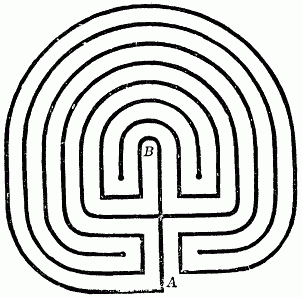

Forget that one is rounded, the other square. Some folks call both of these Mazes, some call them both Labyrinths. But there is a significant difference. Whatever the shape, a Labyrinth has a single path, sometimes from end to end, but usually from a "mouth" to the center. Whatever the shape, a Maze has branches off the main path, dead ends, whether the goal is the center or an exit. Ergo, you cannot get lost in a Labyrinth!

Suffice it to say, the long-standing principle that all narrative must serve the purpose of pressing toward the goal, a well-written tale is a Labyrinth. Look again at the rounded Labyrinth above. To go from A to B, you'd go halfway there, wind around a bit, find yourself right next to A (if you could see it), then make much more rapid progress. You'd be certain to get there. A good story has twists and turns, and seeming setbacks, but gets to a goal in the end.

In the little maze, on the other hand, if you enter at the botton, taking the right branch takes you on a long, fruitless journey, while the left branch leads you past five shorter side branches, some of which you can discern with a peek around the corner. Now let's look at the smallest possible labyrinth.
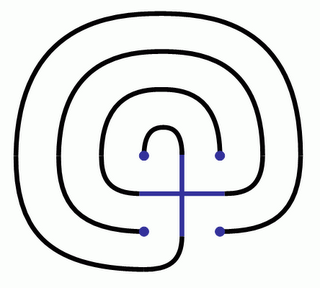
This is a 3-circuit labyrinth. Although you must make four turns on the way to the center, there is no backtracking. This and the 7-circuit labyrinth above are of ancient design, and are easily drawn, if you care to try. I put the "starting cross" in dark blue. You draw the cross and four dots, then connect them with loops. The following diagram from The Labyrinth Society shows how to draw a 7-circuit labyrinth.

By the way, the choice of making a left- or right-sided labyrinth is up to you. Mystics who make big hedge or path labyrinths in which to walk and meditate make much of the difference, but you'll find them both ways in all sorts of historical documents.

From a literary point of view, the 3-circuit labyrinth is a fine structure for a straightforward short story; each turn makes further progress with no setbacks. (A typical story by O. Henry is even simpler: a long, straight shot with a quick, neck-wrenching turn at the end)

Many, many novels have a 7-circuit structure. The first path takes you halfway to the goal, then you circle back and forth, getting farther away, to find yourself near "square 1". Another path to the halfway point, loop around, almost make it, take three more loops that lead you farther away, until you are again at the halfway point, a third time, then it's a straight shot to the goal.

The next step in the sequence of "classical" labyrinths is 15-circuit. In Medieval times, other designs arose, and the 11-circuit variety shown here was popular.

These are quite a bit harder to draw. You can find advice galore with a little searching. The Labyrinth Society is a good starting point. While this labyrinth has eleven circuits, they are not complete circuits, but combinations of half-and quarter-circuits that make the path quite complex. There are, as with the 7-circuit labyrinth, four major thrusts toward the goal, but there are many more minor advances and setbacks (31 turns in all). I didn't read enough of Titan to determine its structure, but I suspect it is of this order of complexity.

And this labyrinth, in quadrants, is actually four 9-circuit labyrinths based on a Greek Key. I found it on Joe Edkin's Maze Page. If you take out one quadrant, and "circularize" the rest, you'd have the structure of a large trilogy.

Is life really like this? Can "labyrinthine" formula really match reality? Truly, it is a simplification. Real life is often more like a maze. I daren't consider how many blind alleys I've gone down, and had to backtrack.

What is "real life" anyway? To a person of faith, life has a goal, but we seldom know what it is...of course, heaven is considered a goal, but what is the goal of the life before we pass on? If we learn that at all, we learn it only in retrospect.

Monday, June 05, 2006

Poison Ivy's Past

kw: speculation, global warming, plant growth

The recent reports of the effect of higher levels of CO2 on the growth or poison ivy got me thinking. In short, the present CO2 level in the atmosphere is 370 ppm or so. In 2050 it is expected to be about 570 ppm. At an experimental forest in North Carolina, researchers found that poison ivy grew 150% faster, produced urushiol (the toxic oil) at a 150% greater concentration, and that the urushiol was a more toxic variety.

When I was a child, I frequently got small poison ivy rashes. This was the 1950s. There was no cortisone treatment. We could only use calomel or potassium permanganate poultices. The rash typically could be cleared up in about two weeks. At that time, CO2 in the atmosphere was about 300 or 310 ppm.

So, let's figure. 570/370 = 1.55. (100%+150%)/(100%) = 2.5. There are two likely mathematical models. One is exponential: log(2.5)/log(1.55) = 2.1. This is the model exponent. For simplity's sake, we'll say this model predicts foliage growth and urushiol concentration both increase as the square of the CO2 level.

The other is a linear relationship with a threshold. Plot points at (570, 2.5) and (370, 1), and you find that the slope is 1.5/200 = .0075. Then, 1/.0075 = 133.33, the level of CO2 at which growth and urushiol production cease. The proportionality constant is 0.0075 per ppm.

What do these two models predict for a CO2 level of 310 (when I was a pre-teen)?

First model: The square of 310/370 = 0.70, which is 30% less than 1.

Second model: Decrement of 0.0075*60 = 0.45, or 45% less.

My conclusion: It seems likely that the growth rate of poison ivy was 30% to 45% less than today, during the 1950s and 1960s, and that the concentration of urushiol was also lower by a similar amount. It is also likely that the urushiol then produced was less toxic.

I do know that my reaction to poison ivy has gotten much more severe over the past fifty years. Every case I've had since the mid-1980s required a three-to-four-week regimen with prednisone to clear up. And poison ivy looks bigger than it did then. Since I am much bigger now than when I was 12, it must be really bigger! Bigger and badder...

Thursday, June 01, 2006

Math, around every corner, beneath every façade

kw: book reviews, nonfiction, mathematics

I remember realizing that Geometry and Algebra are the same thing, just using different (very different!) notations. The feeling was one of deep beauty. My lifelong interest in languages, which turned mainly toward formal languages as I matured, was kicked into high gear. Geometry and Algebra are formal languages that happen to have a great overlap of vocabulary; you just need to learn the translations.

But this isn't like English vs French; it is more like written Chinese vs written Spanish. One is entirely pictorial, with nearly no phonetics, and the other is the most phonetic of Western languages...and we won't get into their very different grammatical rules!

As in any pair of languages, Geometry and Algebra have their unique strengths. For example, the geometric proof that one cannot (truly, impossibly can not) trisect an angle using only a compass and unmarked straight edge is rather involved. Recasting it in Algebraic notation, we find that all the operations that are possible with those tools are solutions to linear or quadratic equations...that all means every single one! So geometrically, taking a square root is easy, nearly trivial. But no higher roots can be extracted using an unmarked straight edge. Algebraically, we find that trisecting an angle requires the extraction of a cube root. QED: no geometric trisection is possible.

Later, much later, once I'd (mostly) mastered "college calculus" and (finally) passed the required course in Differential Equations, I realized that I was conversant in four notations for Differential Calculus. These are very consonant, like dialects rather than distinct languages. But each has its strengths also. I prefer "prime" notation to perform implicit differentiation, for example, although I know how to do so in all four.

Fortunately, along the way, I got fully decompressed from high school and college freshman levels of calculus, and realized that the real power of calculus, and of all mathematics, is in learning how to pose a question. A properly posed question literally drags you towards its appropriate solution.

In Letters to a Young Mathematician, Ian Stewart, FRS and a professor of mathematics, drops all of the above bombshells and a great many more, in a most engaging way. His stated intention is "to give an inside view of the mathematical enterprise, and to explain what it is really like to be a mathematician." The work I do requires me to be a working mathematician, sort of a mathematical journeyman. Author Stewart hits every nail square on the head. I kept saying as I read, "Exactly!"

The scope of the book is really remarkable. The author doesn't go over the mathematical landscape in the ordered way we learned as kids: numbers, fractions, ...algebra ... calculus ... and on to things whose name we can never remember. He likens it instead to an inverted pyramid, a 3-dimensional structure, then pops all over the place, including several of those disciplines whose name I forget before the end of the sentence.

Fortunately, he doesn't mentions such things just to impress or awe, but to show connectedness; and he always has a bit of explanation so we at least find out what it's about.

This isn't just a book for mathematicians. I think it especially useful for young people of the "I HATE Math!" variety, to open for them a window onto the breadth and beauty of mathematics. Math (Maths if you're from the UK) is (are) all about patterns, and the fundamental mathematical activity is to operate on some entity to transform it into an item that is more useful or easier to understand. In other words, mathematical operators are Verbs, and the Nouns they consume and produce are numbers, functions and formulas. Thus, learning and performing music are mathematical activities, as is learning the grammar of a new language or following a cooking recipe.

Mathematics takes place in the background, but it underlies everything. Math is how the universe works. Just as we aren't all auto mechanics, but most of us drive cars, so few of us use math in an explicit way, but we do mathematical things all the time without realizing it. Professor Stewart, great mentor that he is, shows us just how much that really is.

Wednesday, May 31, 2006

That old Climate may be pretty nimble...

kw: book reviews, climatology, history, anthropology

One of my brothers, a Mayan archaeologist, was interviewed for the Discovery Channel a couple years ago. He told of the destruction of the forest around Palenque because the Mayans used huge quantities of charcoal to make stucco. All their buildings are plastered with several inches of stucco, perhaps as insulation.

Among more than a hundred theories about the destruction of the Mayan civilization some 1100 years ago, regional drying and crop failures are a prominent part of many. Regional or global climate shifts have been proposed only recently.

Among the many factors one may list, we must take account of a major dry period in all of Mesoamerica from about 750 AD to about 950 AD. Civilizations are defined by their mass effort to mitigate the effects of bad periods. They stave off droughts and other disasters, even ones that may last a few years, as the U.S. survived—though with much suffering—the dust bowl years of the 1930s, and as Joseph's Egypt was able to survive a 7-year famine around 1900 BC (with divine forewarning).

No civilization has survived a 200-year drought, though the Mayans came close: the Mayan collapse occurred in three phases beginning in 760 (about ten years into the drought) and ending about 910. Had they hung in there for another generation or two, they'd be a major civilization today.

The details needed to pin down such stories are found in abundance in The Winds of Change: Climate, Weather, and the Destruction of Civilizations by Eugene Linden. Note carefully, the word "Civilizations". This book does not forecast "the destruction of civilization", but reports on the destruction of a number of civilizations in the past, and points out the environmental and climatological influences that coincide with them. While one coincidence does not imply causality, many coincidences of the same type make a strong case.

Author Linden presents his material as a case, with opening arguments, presentation of evidence, cross-examination and rebuttal, and closing arguments. This format leads to some rather dry reading. Fortunately, much of the book is well and stirringly written, and he makes a good case.

It is a puzzle that, as an increasing majority of scientists agree that climate can change rapidly and violently, has done so in the past, and appears to be on the verge of doing so in our lifetimes, public and media complacency—even denial—are at an all-time high. To most people, "long term planning" means at most five years. Most retirement advisers work with a horizon of thirty to forty years. Futurists, even my favorite, Bruce Sterling, write about the next fifty years with great frequency, scarcely about longer periods. Few folks can think in terms of something global in scope and multi-generation in effect. We need stories with more immediacy.

So, I really like these articles about poison ivy: Global warming may aid poison ivy and CBC News: Poison ivy itchier when carbon dioxide levels increase. Even if we freeze CO2 production at current levels, the atmospheric content will rise from the current level of about 370 ppm (0.037%) to 570 ppm (0.057%) by 2050. At that level, poison ivy in an experimental forest with extra CO2 gas in the air was found to grow 150% faster each year, compared to plants grown without the extra CO2, and they contained 150% more urushiol, of a more toxic variety.

Let's work this out: 150% faster means for each pound of poison ivy in Forest A, Forest B produces 2.5 pounds; 150% more urushiol means each pound of leaves contains 2.5 times as much of the stuff. Put it together, and Forest B has 2.5x2.5 = 6.25 times as much urushiol production per acre! And the icing on the cake? Urushiol is a mix of oils of varying toxicity. Forest B urushiol has a larger proportion of the worst oils.

In Japan, this might be considered a good thing, because they use urushiol to make the lacquer for lacquerware (the lacquer isn't toxic), and to paint all those lovely temples and palaces. For the rest of us, forest burning anywhere will create six times as much toxic smoke. My wife has caught bad rashes from dried leaf bits blowing around. More CO2 means an itchier future. That hits home with me more than an extra meter of ocean water.

"The Winds of Change" sounds an alert. The author is not being alarmist. He is frustrated at our case of galloping apathy. Perhaps, to paraphrase Ronald Reagan, to keep a car that is getting bogged down off one side of the road from falling further, it is necessary to plant oneself firmly on the other side with a tow truck, and pull HARD.

It is now known to everyone who cares to look, that past climate changes have been abrupt and violent. The "Little Ice Age" of the 14th-18th Centuries was less violent than most, yet it caused widespread misery, appalling death rates, indirectly fostered staggering epidemics, and changed Western society permanently...another century and the Renaissance would have died aborning. Dare we neglect signs that the climate is about to make a major switch?

Tuesday, May 30, 2006

Kneeling a Mortal Sin?

kw: opinion, faith, spiritual practices

I heard this morning that the Pope recently left it to Bishops whether to continue the practice of kneeling during mass. This is apparently a result of questioning the practice as being due to feudal influences in the medieval church.

It is a bit older than that... In Isaiah, God says, "every knee shall bow to me...", which Paul quotes in Romans. Paul also wrote to the Ephesians, "...I bow my knees unto the Father...".

If kneeling to pray is a mortal sin, it has always been so, and if it was not a mortal sin in the past, it is not one now, nor ever shall be. The real influence is some folks being influenced by The DaVinci Code, which we must remember is a work of fiction (and pretty poorly researched fiction, at that).

Saturday, May 27, 2006

Big Brother in your pocket, your shoes, your car's tires, your shirt's designer label...

kw: book reviews, nonfiction, technology, surveillance, smart tags

In the keywords, I almost wrote "nonfiction...sadly". There is no fiction in the book. There is a bit of extrapolation, very close-in, sure-thing extrapolation: car going 100, already missed a turn, ten feet from impact with a fire hydrant...conclusion, we're going to get wet and somebody's headed for a major ER visit.

Catherine Albrecht, founder of CASPIAN, and Liz McIntyre, CASPIAN's communications director, sound alarmist in their new book SPYCHIPS. Full title of the book: SPYCHIPS: How major corporations and government plan to track your every move with RFID, and CASPIAN stands for "Consumers Against Supermarket Privacy Invasion and Numbering". Only, it ain't just supermarkets, folks.

They only sound alarmist. Compared with the magnitude—and current reality—of the threat, they are mild-mannered, harmless kittens. Fortunately, they aren't that harmless, and have forced major corporations to back down from plans to implement spy-chipping endeavors...for the present.

What is the threat? Let's take it a step at a time.

What is a spychip? There are two kinds. The cheap variety are little passive transponders: when a radio signal of the right frequency, and strong enough, is present, they take power from it and broadcast on a very close frequency their ID code, and perhaps other information...perhaps lots of other information. The more expensive variety are active transponders. They contain a battery. The most familiar are highway toll transponders, such as EZ-Pass in the Northeast US. They can respond to a weaker signal; they broadcast a stronger signal with their ID code, and probably other information as well.

Passive chips, depending on frequency and efficiency, can be "read" at distances from a few inches to two or three feet. Active chips can be read much farther, from ten feet or so to a mile or more.

Such chips can be little. The chips themselves are the size of a sand grain or smaller. Their antenna makes them larger. The low-frequency ones, like my company badge that opens the door to my office building, are the size of a credit card. The ones that work in the UHF band (off the end of the TV channels) can me half an inch long, and no wider than the wire to your IPod earphone.

Scenario one: Are you a Texan? Got a TranStar toll transponder? Like those discounts? Houston gets a lot for the discount it offers you. Ever notice, on the highways around Houston, there is a sign bridge every four or five miles...even where you'd think none is needed? Every car passing under those signs is recorded, using its TranStar. That explains why the TranStar needs replacement every year or two; the battery is getting a lot more use than you bargained for! This isn't fiction; it is happening now.

Scenario two: Since mid-2005, did you buy any Levi's in Mexico? So far, it is just one store, but you just might find a chip inside one of the labels...drop this search string into Google for more details: +frontline +levi +mexico +rfid .
Chips that can hide behind the alligator label on your designer shirt can be read from a foot away or so, just far enough that every store in the mall _could_ have a reader in the doorway, and thus be alerted to the presence of that shirt. Point-of-sale information, which the stores can all buy cheaply, will attach your name (or the name of whoever gave you the shirt for your birthday!).

I have "loyalty" cards for several local grocery stores. At the moment, they are all bar-coded, and contain no chips (I've checked). But whenever I use one during a purchase, the receipt is very diligent to print how much I've saved in the current year by using the card. It's dollars and cents, folks! My stores know everything my family has eaten, for years already. All they have to do is collate their datebases. As an expert in that field, I know how easy this is.

Within a couple years I expect these grocers to issue replacement cards, that offer "added benefits." They won't mention that the benefits are all on their own side! They'll have chips. At that point, my family and I will be faced with a decision: How badly do we value the privacy of our eating habits? Are we ready to return to paying cash for everything? Are we willing to go to the trouble to create a false identity with which to set up the "loyalty" account? (child's play, by the way)

How long will it be before we come under pressure to have chips implanted in our bodies? The story will be about public safety, but the real reason will be surveillance. Big Brother in your armpit, or up your butt, or somewhere...

Most of us are descended from patriots who threw a few thousand dollars' worth of tea into Boston harbor over a tax raise. How many of us are willing to revolt over a technology that will with total certainty lead to 24/7, minute-by-minute recording of our lives? Oh, it will be gradual, but it will be relentless.

You know, I've only touched on a few points from the book, and I'm already boiling again. I have a story from history we would all do well to heed.

John Bunyan, author of Pilgrim's Progress, wrote of a dream in which he conversed with the Devil. Satan said, "I'll get you, you know." John stalwartly replied, "You can't. I'll fight you at every turn." The Devil said, "Oh, I don't need to fight. I'll be very gentle, and gain you very gradually, like a mother lulling her infant to sleep."

Let us remember that governments and corporations live longer than we do. They can afford enormous patience. Freedom can't be retained on autopilot. The battles must be fought again and again.

See these web sites for more information, and some ideas you can put into practice: http://www.nocards.org/ (CASPIAN) and http://www.spychips.com/ .

Wednesday, May 24, 2006

Is the universe big enough for more than one god?

kw: book reviews, science fiction, deification, super powers

In the Mormon doctrine of deification (theosis or exaltation), as commonly understood, some of the really, really good folks become gods in their own right, and are given (or make for themselves) private universes in which to rule. I don't know whether Robert Reed is a Mormon, but deification is the premise of Sister Alice. Though such divinity is achieved by technology—a technology a few million years more advanced than our own—it results in beings that can, and do, destroy stars and galaxies.

Something I have yet to see in an SF novel is a clear indication of the huge energies involved in relativistic travel. Say you are satisfied to poke along at half the speed of light. To accelerate a ton of material to 0.5c requires at least the total annihilation of about a quarter-ton of mass. If you can't do total annihilation, by using antimatter for example, then, considering that hydrogen fusion uses up 4% of the mass, you need the output of a fusion generator burning five tons of hydrogen to helium...as long as you don't carry the generator with you! Want speedier? Going 0.99c requires 7 tons of total annihilation, or the conversion of 140 tons of hydrogen. You can get pretty close to light speed if you can manage to gather the total output of the Sun for a year or two, with perfect efficiency of propulsion.

OK, you endow a bunch of people (a thousand families, in Reed's novel) with technologies that allow them to manipulate power on such a scale. Now what? You get a bunch of demigods, and a handful of genuine gods. What do they do? They realize the universe isn't big enough; any one of them can boil the galaxy away on a whim. Thus far, they've exercized sufficient self control (for the past several million years, anyway) and the galaxy is intact. So, they set about making another universe. They become creators. Some of them, at least, will be able to have a private universe to play around with.

Reed's writing is called "high concept" by some reviewers, and I guess they mean it for praise. As I understand it, high concept means you can summarize the story in a sentence, and the execution relies on dressing it up with sufficient twists of plot to make the result less than obvious. High concept stories usually sacrifice character development for literate agility. Fortunately, Reed is better than that, and the five novellas that string the story together have sufficient scope for his characters to breathe a little.

The novel is galactic in scope, even intergalactic (there is no good adjective for a scope that includes a couple of galaxies of the Local Group). The term I prefer for the genre is Universal Saga, and its best early purveyor was Olaf Stapleton.

I plan to read more of Robert Reed's books (he has ten to date).

Monday, May 22, 2006

People as they oughta be...perhaps

kw: book reviews, fantasy, paranormal powers, otherness

Few are the tales I re-read. Fewer still the ones I re-enjoy time and time again. Zenna Henderson's "People" stories are among those elite few. Many think them too sentimental, even mawkish. They suit me perfectly, perhaps because I'm a very sentimental bloke myself. Others decry the open piety of the People, which is often contrasted to narrow, bitter fundamentalism...but not always: where the People encounter "earthlings" of genuine piety, they are welcomed as people of faith.

Considering that most "christian" religion consists of wholly unbiblical sentimentality (who hasn't heard, "Oh, a loving God would never do that!"?), and that fundamentalism is typically insecurity in disguise, it is no surprise that publishers prefer writers who never mention religion. It is almost true that "rational Christian" is an oxymoron...almost.

Zenna Henderson's People seem to me like Mormons without the polygamy, but with super powers, which they wisely keep in check. They are unfailingly reserved, unwilling to inflict their difference on an unknowing populace, and even less willing to become subject to curious (tending to hostile) scrutiny. As she came from a Mormon background (see the Wikipedia biography), this makes sense.

The 2005 printing of Ingathering: The Complete People Stories returns these classic tales to print after a generation. Paranormal powers—telepathy, clairvoyance, telekinesis, levitation—are the most common fantasy element of otherwise "science fiction" stories.

The growing field of universal saga SF, which deals in epic, mythic-scale story lines and ultra-technological (though largely undescribed) toolkits, commonly "explains" superpowers via the high-tech kit. Ms Henderson's People have powers that aren't explained at any level, they just are.

To use an analogy, most fish sense sound and vibration, and a very few create sounds they use for echolocation, like bats; only toothed whales also use sound as a powerful weapon. To a fish, the sonic stun beam of a dolphin must seem like a super power. To the dolphin, it's a useful hunting weapon, normal as can be.

The root of all of Henderson's stories, of the People and otherwise, is coping with being different, whether as an individual or as a social minority. Her last People story, "Katie-Mary's Trip," faces People differences with the Hippie counterculture (which she consistently misspells "hippy"); two "different" groups are thus contrasted. To me, the effort fails in this case. She couldn't get inside the hippie mind, as she could both the People mind and that of their persecutors (These last bear a singular resemblance to those who persecuted the Mormons in the 1840s).

The rest of her stories succeed, often wildly. They take the "aliens among us" theme from the angle of the alien, trying to live unnoticed in a very different world. There are more ways to tackle this notion than you might at first imagine. Setting aside "bridging material," there are seventeen stories in this collection. Sixteen at least are gems.

Thursday, May 18, 2006

De-Disneyfying the "King of the Wild Frontier"

kw: book reviews, nonfiction, biographies, history

How many legends circle around to meet their model in his lifetime? He never figured out how to spend within his means, partly because he so seldom had any; he had way too many kids (9) on little or no income; he was elected three times to Congress, but wholly ineffectual as a legislator. Yet he was an enormously popular public speaker; a spectacular marksman and hunter (nearly no 21st Century person will ever see in their lifetimes as many deer, bears, and wild turkeys as he killed in a single year); he published three books, two of embarrassingly poor quality and one that is still a classic; and it is accurately said that David Crockett was the first genuine American Celebrity, the most popular man of his generation. It is also pertinent to observe that, had he lived through the Alamo slaughter, he'd likely be mostly forgotten today. Like Samson, he became greater in death than in life.

To me and my schoolmates and siblings, Fess Parker was "Davy Crockett, King of the Wild Frontier." We all had "coonskin" (dyed rabbit skin) hats. We sang the song. We went to Disney's Frontierland in Anaheim.

Buddy Levy has slogged through a huge mass of material, in particular cross-checking and corroborating the things Crocket wrote about himself, and has produced a powerful biography, American Legend: The Real-Life Adventures of David Crockett. Crockett was not only a champion woodsman, hunter, and orator, he was a champion spinner of tall tales. More than a few are found in his "autobiography."

How to encompass a character whose fame barely fits the continent?
Historians have tried! Tens of thousands of pages in hundreds of books and thousands of learned articles...with the total growing daily. Fortunately, Author Levy has boiled it down for us. The portrait that emerges is a man of nearly incurable optimism, who suffered frequent reverses of fortune, a series of spectacular rises followed by equally stupendous descents.

He was a sore loser, but not the kind to hold long grudges; given to pushing ahead even harder than before. He embodied his motto: "Always be sure you are right, then Go Ahead!" Trouble is, he seldom had a good take on what was right, or perhaps among the various "rights" he had to choose from, he typically chose the most contrary.

I've read some pretty hefty chunks of Crockett's prose (and of course I know it was edited by his friend Thos. Chilton), and no historian can match the style. I nonetheless find Levy's writing quite readable anyway, quite a bit better than most histories. Good research, well presented.

Monday, May 15, 2006

Just how many people really need "high-def" music?

kw: opinion, music, digital music

In the recent CNET News.com article
Syncing high-def music with digital generation, Staff writer Greg Sandoval reports on efforts to distribute lossless music, challenging the "terrible sound" of mp3 files at 128 Kbps.

My experience with mp3 files isn't that clear. Yes, there's a lot of junk out there, whether purchased, ripped, or pirated. But I know few people who can hear the difference between an mp3 at 128K and the CD from which it came. I am a musician, and only in the most exacting situation, in a room with superior acoustics and using exceptional equipment, can I hear the "details" that certain audiophiles make so much of.

The difference in enjoyment is too small to warrant the trouble, for me. I suspect this is so for all but a few people that I consider overly picky.

I grew up with vinyl, and a CD track played on almost any player is superior to vinyl on equipment costing a BMW or two. An mp3 file played with my computer or an iPod is still better than the best vinyl.