Saturday, February 12, 2022

The sorta-all-in-one guide

 kw: book reviews, nonfiction, compendiums

Who wants to know everything? Pick me! Not many folks have four college majors (yes, it cost more than usual). Just peruse the contents of this blog's roughly 2,000 book reviews on all subjects. So I couldn't pass up the chance to read The Complete Guide to Absolutely Everything*: Adventures in Math and Science [*Abridged] by Adam Rutherford and Hannah Fry.

Since the book is admittedly extracts of a potentially universal encyclopedia (perhaps one for which Wikipedia is a rehearsal), the authors felt free to choose items of interest to them. The nine chapters are riffs on nine subjects. I'll touch on three of them:

Chapter 3, "The Perfect Circle" starts with an insult attributed to Fritz Zwicky, "spherical bastard." Since a sphere has perfect symmetry and looks the same from every direction, this hypothetical jerk is always and everywhere the same. But can there be a perfect sphere, or even a perfect circle? I suppose there could be if matter were continuous rather than quantized into atoms and other "elementary" particles. Just to keep things interesting, the authors get into what a 4-D sphere would look like. To us 3-D creatures, it would look like a sphere, because its intersection with our 3-D spacetime would be a spherical "cut" from its hyperspherical reality. As a hypersphere "moved through" 3-D spacetime, it would first look like a tiny sphere that grew, stabilized briefly, then shrank again to a tiny sphere that then winked out.

Fun enough. Can anything material be truly spherical or circular? Soap bubbles look like spheres, but are subtly distorted by gravity, and by even the tiniest, shifting breeze. The orb of the Earth isn't a sphere (ignoring mountains for a moment), but an oblate spheroid, the stable compromise between self-gravity and the centripetal force of its rotation. Even if it had no rotation, there are mountains and trenches, of course, but shrunk to the size of a cue ball, it would be smoother than the cue ball. The four metal spheres in a super-gyroscope in one of the satellites are considered the smoothest, most perfect spheres ever made, but a strong microscope would enable us to see ultra-tiny defects in their surfaces. If we could get rid of every defect, however, the atoms or molecules of the ball force a limit below which the smoothness cannot be reduced. Consider this printed circle:
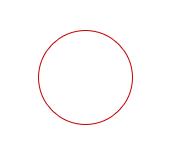
It looks pretty good, even though I deliberately made it rather small. I instructed Blogger to display it "original size", so it matches the pixels on your computer screen. But that screen does have pixels. The "pixels" of a piece of paper are smaller, of course. Here is a 16x blowup of part of the red circle:

Somewhere in this jaggedy band of red and pink pixels would run a line that represents the ideal circle I had PowerPoint draw for me. Is it possible to make a circle that is actually perfect? Clearly not. Is it possible to place some atoms such that they are on the exact locations a circular arc would pass through? To my figuration, at most 12 atoms, plus a 13th to mark the circle's center, could be so placed, using equipment such as an atomic force microscope (AFM) to push around atoms on the surface of a perfect atomic lattice such as a surface of pure silicon, oriented in a direction such that the Si atoms are in a square array:

  • Place atom #1 where you want the center to be, nestled in a pocket between four Si atoms.
  • Place #2 in such a pocket, located 5 spaces to the right.
  • Place #3 in a pocket 4 to the right and 3 upwards of the center; the 3-4-5 triangle has a hypotenuse 5 units long.
  • Place #4 in a pocket 3 to the right and 4 upwards.
  • Place #5 in a pocket 5 spaces upwards.
  • Continue around the circle.

At the end, the twelve peripheral atoms are all exactly 5 units from the center atom. The first person to do this will be the first person to create a "dotted line" that traces a perfect circle (within the limits of quantum vibration of the Si atoms!). To avoid insanity, I won't think about what is entailed in creating something with atoms at some exact distance from a known center, to form such a tracery on a perfect sphere.

Chapter 5, "A Brief History of Time" centers initially on high-speed investment algorithms that take advantage of the time lags in communication between different stock exchanges. Such algorithms have caused half a dozen "flash crashes", which came and went in milliseconds, and briefly (and fortunately, reversibly) destroyed around a trillion dollars of equity in world markets. A couple pages in, the authors ask "what is a second?", and lose their way. Here is a pair of sentences to which I take strong exception:

"If you want to measure how long a second it, it should simply be a matter of pointing a telescope straight up at a star in the sky and waiting until the same star comes back around to the same spot the next night—that is, an exact day later. If you divide the time elapsed by 86,400 (the number of seconds in the day), then you should end up with precisely the length of one second."

Nope!! This will only work if the star you focus upon is the Sun; especially, some unchanging feature of the Sun such as its east or west edge. This is a confusion between solar time and sidereal time. During the day in which the Earth rotates once, to point at the same feature on the Sun's surface (or edge), one solar day passes (which is unlikely to be exactly 86,400 seconds long, as the rest of the chapter describes). During that day, the Earth moves just under one degree along its orbit, so that it has to rotate that extra most-of-a-degree to point to the same feature again. If you begin with any other star, the time that passes will be one sidereal day, which has a length of 86,164.0905 seconds.

In this chapter we find a version of this diagram, which describes the Equation of Time. This shows the cumulative effect of variations in the length of an apparent solar day, and is the expected error of a sundial at various times during the year.

Two factors create this effect. Firstly, the Earth's orbit is not a perfect circle, but an ellipse. Using slightly rounded figures, our distance from the Sun varies from 91,407,000 miles in early January to 94,510,000 miles in early July. That means that in early April and early October, the Sun is offset from the center of the ellipse, as seen from Earth, by about 1.5 million miles. Thus, the solar day varies from 86,379 seconds to 86,429 seconds. Note that the difference from 86,400 is not symmetrical. This is because of the Earth's axial tilt. 

The contribution of axial tilt to the length of the day is more complex, so I won't try to explain. Instead, we can see from this diagram that it has two cycles per year (the purple dashed line), while the variation caused by the elliptical orbit has one cycle (the blue dot-dash line). These add to the total equation of time (the red solid line). This graph is from the German language Wikipedia.

Another expression of this mess is the Analemma, the infinity-shaped symbol printed on globes. Hardly anyone pays attention to it.

This is an example. The analemma represents the subsolar point at Noon, mean solar time, at a particular longitude for every day of the year. Some globes, as this one, have some explanation about it. Others just show the figure without much explanation. Probably only one person in 1,000 knows what the odd "8" on their globe means…of those who even have one.

This is just part of what makes the definition of "one second" far from obvious!

Chapter 6, "Live Free" asks "What is free will?", proceeds to tell why some scientists think there is no such things, then describes some conditions in which the thinking and attitude of an animal or person is affected by a chemical or a parasite. And then we find the possibility that we are still, somehow, capable of making decisions that seem to be free, and perhaps they are. 

From the other side, that of predicting the fate of the universe (or any part of it), the authors discuss chaos and quantum mechanics. I find this funny, both "haha" funny and "so odd" funny: Mathematical chaos isn't actually chaotic. It is repeatable if you always start from the same point.

We read of the Lorentz Butterfly, a seemingly unpredictable figure that represents near-cyclical patterns of weather. The origin of mathematical chaos came when Lorentz ran a simulation for a while, then stopped his computer program and wrote down the values of the parameters he was tracking. Then he let the program run a while more, seeing how it would to. Later he started the program with the values he had written down partway through, and was surprised that the ensuing trajectory soon went differently from what he had seen earlier! He realized that the program was calculating things to an accuracy of 15 decimals (48 bits), but he had written down the numbers with "only" seven decimals. The seemingly tiny difference from where the program started from during the second run made all the difference.

Mathematical "chaos" is better described as "sensitivity to initial conditions". This is seen in orbital mechanics. Predicting the position of a planet over many orbits is tricky. Every time the planet makes one orbit, the numbers that were added in the first half orbit all get subtracted out again. Tiny rounding errors pile up, and after a few orbits, they add up to substantial errors in the planet's position and velocity. Actually, in most systems that rely on numerical integration, the initial position error's size is doubled with every iteration. That's why it's best to use methods that permit one to take larger steps (usually called "higher order" methods). An error that is initially one-trillionth of the starting value will, in ten steps, grow to about 1,024 trillionths, or just over one-billionth. That doesn't seem so bad. However: ten more steps, and the error is more than one-millionth; ten more and it is one-thousandth; then a further ten, and the error is as big as the initial starting value, meaning that the planet is as much as half an orbit away from where you thought it should be. Going to a higher order method is part of the solution to such issues. Astrophysicists have numerous methods to stabilize and correct their calculations so they can predict the positions of planets and moons thousands or millions of orbits later.

The situation is worse in weather forecasting, which is what Edward Lorentz was working on. The weather models that are running on the world's largest supercomputers have millions of coupled differential equations, and they are getting better and better. Weather.com and Accuweather confidently predict the weather for up to 90 days. But in most parts of the world, going beyond a 3-day forecast is still pretty chancy. The truth is, long-range forecasts are adjusted "pattern" forecasts, based on similarity of history. The weather models all fall apart in 5-10 days, and sometimes less. The atmosphere is too big, and too much happens on too big a scale, and we have too few reliable weather stations taking the atmosphere's pulse. It's a wonder that even a 3-day forecast is any good at all.

Thus, in actuality, "chaos" just means "impossible to predict because there is way, way too little good data".

The quantum situation is different. Quantum uncertainty can be stated "impossible to predict because at the smallest scales, genuinely random influences occur." That means that atoms and electrons and protons and so forth can't be pinned down; they are subject to randomizing influences. The reason we can predict where a baseball is going is that, when the system of interest is composed of a trillion trillion atoms or more, those random influences mostly cancel out, to such a degree that we can neglect them. We only care if the ball is in the strike zone, while quantum effects on a baseball's path are measured in trillionths of a trillionth of a meter.

Interestingly, quantum effects on the path of ions and electrons in our neurons, which have axons with a diameter between 1 and 10 microns, can cause variations in the timing of a signal, and sometimes quench it altogether. Also, "shot noise" is the scattered arrival times of ions, which can change when or whether a certain synapse is triggered. This is one possible mechanism behind "free will."

But I like this description better, from an researcher who studies rats in mazes and such: "Given specific conditions of light, temperature, and location of food, the rat will do what the rat wants to do." A statement like that was once the motto of the Rat Runner's Digest. So if we feel like we have free will, it's like the proverbial duck: "Does it quack like a duck? Does it walk like a duck? It must be a duck."

If you want to know everything about everything, be prepared for a long process…like forever, to be precise. However, if you can settle for an 80-20 solution, this book provides a good start.

Saturday, February 05, 2022

When is a drug really a drug

 kw: book reviews, nonfiction, drugs, entheogenic chemicals, plants

About 90% of the human race uses caffeinated drinks, including coffee, tea, "energy drinks", and caffeinated soft drinks. Every culture has some kind of stimulant(s) to keep intelligent people "on task" as they slog through their daily grind. Before caffeine became ubiquitous, Asia-Pacific areas had Betel, tropical South America had cocaine, and North America had tobacco (which is still the second-most-used stimulant). All of these are still in use, with caffeine thrown in for good measure.

Caffeine is the centerpiece (literally and physically) of This is Your Mind on Plants by Michael Pollan. He makes a case that Western civilization was largely enabled by its stimulation, as it replaced alcoholic drinks. Formerly, alcohol was needed to make as beverage safe to drink. Boiling water to make tea or coffee also kills germs, and the resulting drink was energizing rather than stupefying.

Personally, I don't like hot drinks and I abhor the taste of coffee (a good way to ruin a teaspoon of cream), so if I want caffeine, I use one of the more robust soft drinks such as Mountain Dew or Jolt (where it can be found). However, since I retired, I stopped using "cold caffeine", which I'd needed to keep going at work, particularly during meetings when the lights would be turned low for PowerPoint presentations. I guess even then, I wasn't ingesting as much caffeine as coffee drinkers, because I didn't suffer any withdrawal symptoms. The author did a 3-month caffeine break, and withdrawal affected him quite a lot. When he had his first cup of Espresso after the break, it was like a first hit of cocaine to him. Thanks, I'll pass.

The first third of the book is about opium. Many cultures also have their favored pain-killers (willow comes to mind), but the opium poppy spread far and wide, long ago. Much of that section dwells on his early experiments with growing poppies (which is legal!), and the kinds of trouble he could have gotten into if, at the height of the War on Drugs, he had "crossed the line" by so simple a matter as drying a few seed heads and brewing tea with them. There's much information on the history of poppies and opium.

When I was in college, you could still buy Paregoric (4% opium in alcohol, with a couple of other ingredients). It was "Grandmother's helper" with colicky or teething infants. The author mentions Laudanum, which is stronger; I never saw it in drug stores. I couldn't relate to much of what he wrote. I wasn't willing to break the drug laws, but he had fewer qualms, though he writes of having a few qualms!

The third plant is actually a family of cacti that includes Peyote ("mescal buttons"), with the active ingredient mescaline. While peyote is soon to be an endangered species—it's getting too popular and is very slow-growing—another group of cacti called San Pedro (among numerous other names) is much more common, easier to grow (Pollan had some in his garden without knowing it), and different species have varying amounts of mescaline. It made me think, just as with marijuana, if mescaline gets much more popular, growers of San Pedro will breed more potent varieties.

Peyote is legal to use only for certain religious groups of American Indians. As the author found, they have a cultural mindset that is less analytical, which helps them use the plant more appropriately, as a medicinal rather than recreational substance. The author writes of the effects of environment and attitude, on one's experience with mescaline in particular. Indians get quite huffy if peyote is called a drug. To them it is medicine for the soul. It is being called "Entheogenic", meaning it reveals (or produces: "-genic") the god within ("En-theo"). That's an attempt to remove the stigma of the "drug" designation.

The author's experiences with mescaline sound intriguing, but I think I'll pass here also, for the same reason I gave up alcohol before the age of 21: I don't like anything messing with my mind.

Michael Pollan self-experiments. We have here his record of some of those experiments. It is also an approach to a manifesto of sorts, against the war on drugs. I agree that the Federal government badly overreacted over the past 2/3 century (basically, most of my lifetime). What are the chances they will pull back? Although most US states have "decriminalized" marijuana use and possession, the Feds have not, putting the states in a curious position. The process is slow; perhaps, drug by drug, various "substances" will be removed from their "Schedule". It could take decades.

Thursday, January 27, 2022

Animals and Law

kw: book reviews, nonfiction, animals, laws, legal system, humor

Mary Roach make serious subjects both interesting and humorous. In Fuzz: When Nature Breaks the Law, she writes of animals who cause problems to people (besides ants at picnics or in the kitchen), and the various officers who must deal with them. We're talking serious problems here, from killings to theft, and, in later chapters, "invasions" such as the imported rabbits in Australia and rats in New Zealand.

On the scale of danger:cuteness ratio, bears rank right at the top. A young cub like the one shown here is probably just curious. However, the mother is likely to be nearby, and will object to her baby being this close to a dangerous human. It seldom occurs to us that bears consider us a risk; we're big enough to do them damage, and too big to be worthwhile prey. I wonder what followed this moment. Most likely, the mother made a "Whuff!" sound, at which the cub ran to her, and they trotted off together. I hope so.

Bears are too smart to be predictable. They are also loners, and get cranky if someone gets too close without permission. A cranky bear can slap you as he or she would another bear, and it'll take your head right off. Then, surprised at the result, after some thought, the bear could opt to take advantage of the free meal. Now we have a "killer bear". What is a forest ranger to do with it? There's a chapter on that. Guess what: relocating, whether bear or squirrel, just makes room for another to move in…and so does killing the offender.

Bears are most likely to kill unintentionally. Not so carnivores such as leopards, nor elephants. Each rates a chapter, and the stories range from quirkily funny to spine-chilling. While in India learning about leopard attacks, one evening the author heard a ghastly scream that she concluded came from a leopard's prey being killed. She and those with her decided to wait, to check it out in the morning, leaving matters to resolve themselves overnight. The villagers called it a case of demon possession, which she took for a double entendre, because the villagers had also told her that any leopard that had killed at least two people was considered a demon. Well, whoever died that evening was definitely "possessed" by that leopard at that point!

I haven't been the subject of an attack by anything bigger than a jaybird. But that can be painful enough! I found a blue jay chick in the driveway once, and picked it up to put in a nearby bush. A parent bird bombed me. Had I not been wearing a hat, it would have drawn blood. I've managed to avoid sea gull attacks by eating only inside at the beach! This fellow, according to advertising copy, was trying out a gull repellent method that obviously isn't working. I did note that two species of gull are shown here. That's typical at almost any American beach.

A lot of the book deals with the futility of not just trying to eradicate unwanted species (such as invasive rats on islands), but even counting them to know how big the problem is. Cougars (AKA pumas or panthers) are so elusive that animal "control" officers' most effective method is scanning an area for feces, called "scat". Unlike domestic cats, cougars just "drop and walk off". With experience, the officers can estimate how old a scat is, so with a little knowledge of scat-dropping frequency and a bit of math, they can estimate how many cats frequent a certain parcel of land.

The next-to-last chapter gets into humane killing. It's not quite an oxymoron, but killing most animals "so they won't notice" is nearly impossible, and anything less abrupt than the killing bar on a classic mousetrap will entail a period of suffering, from seconds to minutes to hours. Thus the last chapter deals with genetic methods. The scariest is the gene drive. Scientists working on this have figured out how to "fix" the genes in a female mouse so she will have only female offspring. Ordinarily, releasing a lot of such mice is self-limiting, and won't eradicate them. But the gene drive somehow guarantees that all her daughters will have the same trait. Thus, any male mice remaining will get older and older, as few males get born, and eventually none. A generation later, the oldest females die, and Presto!, no mice. (At least, I think that is how it works. I may have something backwards. Anyway, they all eventually die out.)

Very late in the book, the author writes of a farmer who has a more phlegmatic attitude: Do your best to keep from spilling food all around, and live with a little "shrinkage", just as stores know they can't eliminate all shoplifting, but reduce it as much as they think reasonable, and adjust to it.

Animals don't know they are breaking human laws. I suspect if they could know somehow, they wouldn't care. After all, they were here first. We're the invaders, breaking "their" laws! The cynic's Golden Rule applies: Them that has the gold, makes the rules.

Tuesday, January 18, 2022

A food book to put you off your feed

 kw: book reviews, nonfiction, food, history

On occasion I eat alone. When I do, I read while eating. If you do the same, I suggest you accompany your meal with something other than The Secret History of Food: Strange but True Stories About the Origins of Everything We Eat, by Matt Siegel.

The book gets into the background of many—but by no means all—different kinds of foods, from pies, to the ubiquitous corn ("maize" across the pond), honey, and nightshades such as potatoes and tomatoes. (Fun fact, not from this book: you can cut a plug from a potato and graft a tomato plant into the hole; put the combined plant in a large container or raised bed with loose soil, and you'll have a harvest above ground all summer, and below ground in the fall.) However, the background the book gets into leans strongly toward the unpleasant bits, such as the amount of bee parts you are likely to ingest with your honey, or the relationship between "holiday season" feasting and the gluttonous "conspicuous consumption" debaucheries hosted by medieval and earlier "nobles". "Turducken" is a modern, pale shadow of the squab-pullet-goose-lamb-hog barbecues that were accompanied by inedible "desserts" garnished with gold dust.

Remember the nursery rhyme about "four-and-twenty blackbirds baked in a pie"? Today, pies are mainly desserts, with flaky crusts you actually enjoy eating. Pies used to be quickly-baked meat-and-veggie concoctions (again, the chicken pot pies I hated as a child are a pale shadow), with very heavy crusts that were either thrown away or used as makeshift plates. 

It is a bit interesting to learn how many products, including a huge number that have nothing to do with food, are made from or include corn or corn oil or corn starch. But then we read of the back-and-forth "recommendations" of various authorities about eggs, or meats, or almost anything (today it'll kill you; two years later, it's superfood); all have a germ of truth, but little useful guidance.

Our ancestors survived all kinds of noxious things. The plants we eat, of course, don't "want" to be eaten, so they produce insecticides and other chemicals to deter herbivory. We call them spices. Animals also don't want to be eaten, but they tend to fight back more directly, although, for example, the puffer fish and other sea "foods" that contain tetrodotoxin are deadly to eat. We can survive a lot, and we thrive. I remember being told the difference between an American mother and an Italian mother. The one said, "Eat this, it's good for you," and the other says, "Eat it, it's good!" Is it good? Eat it.

Aaand, that's plenty, because I frankly don't recommend this book. The author writes well enough, but I wouldn't want to invite him for dinner.

Friday, January 14, 2022

Volcanoes, more common than you might guess

 kw: book reviews, nonfiction, science, volcanology, volcanoes

My uncle, a geologist and geology professor, had a "volcano fund". He was ready, on short notice, to go wherever a volcano was erupting, to see it and study it. I have since learned that his fund was really just for "interesting volcanoes", or else he'd have seldom been at home. At any one time, at least twenty volcanoes are actively erupting, more than thirty have erupted within the prior week or month, and more than forty are considered to be "in continuous eruption status", according to the Current Eruptions site of the Smithsonian.

This map from the website shows the volcanoes in that status as of December 9, 2021

The symbol in the middle of the Pacific Ocean is for Kilauea in Hawaii, which erupted continually for 36 years, ending in 2018, and then started up again after a two year lull. The symbol near Africa is for the volcano Cumbre Vieja on La Palma in the Canary Islands, which erupted for 85 days, ending Dec. 13, 2021. It is considered in current eruption status because seismic rumblings haven't yet settled down, and it could erupt again in the near (very near) future.

At the peak of its eruption, the Cumbre Vieja volcano was amazingly active, as seen here. I think my uncle would have gone there, and perhaps stayed for most of the 85 days.

Whenever the map above is next updated, there is likely to be a new symbol for the eruption off Tonga that began just a day or two ago. It will be between the symbol at Hawaii and the next one to the southwest.

I learned much of the above from reading Super Volcanoes: What They Reveal about Earth and the Worlds Beyond by Robin George Andrews. This book surveys several kinds of volcanoes on Earth, including the largest of them all, totally hidden from view, that is the 40,000-mile-long system of mid-Ocean ridges. These are the "spreading centers" of plate tectonics, where bloops of magma are burped from the central crevasses of the ridge system to form "pillow lavas", and magma that cools against the sides of the world-circling slit below the crevasses forms sheet lava, which is brand-new oceanic crust.

At the opposite ends of the major plates, oceanic crust either dips below continental crust, such as off Japan and South America, or pushes one chunk of continental crust against another, raising mountains in between, such as north-moving India forcing up the Himalayas and the nearby mountain belts, which are still rising. The "ring of fire" around the Pacific Ocean is the volcanic expression of magma formed from the upper part of down-thrust oceanic crust and its burden of sediments, deposited during the tens of millions of years that the crust was crossing the ocean from the spreading center to the subduction trench.

The author doesn't dwell on the different kinds of volcanoes and their eruption styles to any great extent. That is a good subject for a different book. Rather, he aims to show how volcanoes are ubiquitous not only on Earth, but all over the Solar System. In many cases, such as the Moon and Mars, the heat engine inside the body has shut off, and the lava fields are old, very old. While there is a little evidence that tiny volcanic eruptions might be continuing on the Moon, the dark lava fields that form the "seas" (and the face of the Man in the Moon) are more than a billion years old.

He does spend a chapter on a curious volcano, Ol Doinyo Lengai, which is currently the only active carbonatite volcano on Earth. Carbonatite lava, a combination of lime and the silicates that form more ordinary lava, is less hot (only about 550°C or 1,000°F) than the "fast" lava at Kilauea, which is more than 1,100°C or 2,100°F. You still can't swim in it!

Out among the moons of Jupiter and Saturn, however, one finds cryovolcanoes that erupt warm (and sometimes downright freezing-cold) salt water. You might be able to swim there, as long as you can survive the surrounding vacuum! The "lava" erupting on Jupiter's moon Io is hotter stuff, or rather, several kinds of hotter stuff. Some is mostly molten sulfur, propelled by sulfur dioxide gas, with a temperature of a few hundred degrees. More "earthly" silicate lavas are also found there, with temperatures ranging up to 1,300°C (2,400°F), equal to the hottest eruptions on Earth.

What keeps Io hot? It is equal in size to the Moon, which has long been cold and dead (or very nearly so). Io zips around immense Jupiter every 42½ hours, and is in a resonant orbit with the next two moons, Europa and Ganymede, which have orbital periods of 85 and 172 hours. While all three (and the fourth major moon, Callisto) have orbits that are very nearly circular, as they swing by one another, tidal forces flex the moons. Io's crust rises ten meters or more each time, a few times weekly, causing internal friction that keeps it boiling hot and makes it the driest known body in the solar system. The smaller tides on the other moons seem to have kept them warm enough to have liquid oceans up to 50 miles deep beneath icy crusts. Europa in particular has a crazy-quilt surface that shows it is still active.

One very interesting (and reassuring) chapter describes the supervolcano known as Yellowstone. Or, according to the author, "former supervolcano". Yellowstone and Kilauea share this characteristic: both sit atop mantle plumes, which are apparently stable features of Earth's mantle, dredging up material from an area nearly as deep as the core-mantle boundary, and depositing it atop the crust. There are about twelve plumes known, and the one under Hawaii is the most active at present. As the Pacific plate moves along, the plume pops through from time to time ("time" meaning a million years or so), to produce a new Hawaiian island. The chain of islands and former islands (seamounts) stretches all the way to the Aleutian Trench off Alaska. 

As the North American plate moves along, the Yellowstone plume does something similar. There is a chain of old calderas stretching at least as far as Idaho, and possibly much farther. The author thinks the current round of Yellowstone volcanism ended more than half a million years ago, and if the plume busts through again, a couple of hundred miles to the east, it will have some pretty tough, old continental crust to punch through. It may instead just "plate" material against the bottom of that section of crust for a dozen million years, which will gradually raise the elevation of the northern plains. Just wait about 350,000 generations and we'll see what happens!

These are just tidbits from the flood of information in this book. When I saw the book's title, I thought it would have a lot more sensational stuff to say about Yellowstone. I didn't consider that the main title is two words. But they are apropos: Volcanoes are indeed super! They keep the planet interesting, and their role in releasing heat from below, and also gases such as water and carbon dioxide, moderate the atmosphere and oceans in favor of most living things, at a tragic cost to a smaller number of living things that happen to be "too close" when an eruption begins. 

Wednesday, January 05, 2022

Is Omicron the new Cowpox?

 kw: medical musings, pandemic, omicron, delta, sars-cov2, covid-19, omicold

These data from Worldometer show Covid-19 cases and deaths from about Memorial Day 2021 to today, January 5, 2022, for the US as a whole. The scale lines on the left represent 250,000 and 500,000 cases per day. Those on the right represent 2,000 and 4,000 deaths per day. The solid lines are 7-day running averages.

Wave 5, mainly from the Delta variant, peaked at about 167,600 cases on Sept. 2, and just over 2,000 deaths on and around Sept. 18, 2021, 2½ weeks later.

Wave 6, transitioning from Delta to Omicron, recently rose through 615,000 daily cases around the turn of the year, but the recent death rate is about 1,200 per day.

Clearly, the Omicron variant is quite different from Delta. The Wave 6 death rate is hard to estimate with the case rates rising so rapidly, but it appears to be in the range 0.1% to 0.25% of known cases. That is very similar to the average death rates for recent strains of influenza. 

The Wave 5 death rate was 1.2% of known cases. A complicating factor is that between 25% and 40% of the cases in Wave 6 are Delta, and it is likely that most of the deaths can be attributed to Delta. I sincerely hope so, because that would mean that Omicron is less than 1/10th as deadly as Delta, maybe less than 1/100th. It may be no deadlier than getting a cold!

It may take a few more weeks for Wave 5 to crest, if it hasn't already. Prior waves took two to three months to crest. A cautious forecast puts the crest in mid-February, with a peak rate of 1.5-2 million new cases per day. The Omicron variant could infect half the US population by the middle of March. If it infects less than that, it will most likely be because the mRNA agents being touted as vaccines provide robust cross-variant protection. About 2/3 (62%) of American adults are "fully vaccinated" (I don't count "booster" shots as adding anything useful), and another 15-20% have had at least one injection. Another thirty million (9%) have recovered from Covid-19; they were "vaccinated by God." That doesn't leave very many "unvaccinated" Americans. This implies something very hopeful!

A little history: The word "vaccine" traces back to the Latin word vaccinus, meaning "cow". The word "vaccination" was coined in 1800 by Edward Jenner to describe his method of injecting people with the virus that causes cowpox, and this protected them from the much deadlier disease smallpox.

Dr. Marty Makary of Johns Hopkins calls the current variant "Omicold," saying its effect is similar to a common cold caused by several other coronaviruses that have been circulating for many years. The Omicron variant, being similar to the Alpha and Delta variants, but much less virulent, is likely to be a "cowpox clone", philosophically speaking. I know twelve people, including my son and his wife, who have contracted Covid-19 during the past month. I presume they all caught the Omicron variant, because all have told me it is like a bad cold: a day or two or three of mostly bed rest, with lots of fluids, had them up and about again, and in another day or so their symptoms were over.

I pray that this pandemic has nearly run its course. The Omicron variant is likely to break the back of more damaging variants. Only time will tell if it will also break the back of the totalitarian impulse shown by many in government who have assumed draconian powers by taking advantage of our fears.

Monday, January 03, 2022

The billion-decade pie recipe

 kw: book reviews, nonfiction, geology, cosmology, astronomy, nucleosynthesis, cooking


This chart was mentioned in How to Make an Apple Pie From Scratch: In Search of the Recipe for Our Universe, From the Origins of Atoms to the Big Bang, by Harry Cliff. The book's title, indeed its raison d'être, is a humorous aside by Carl Sagan on an episode of Cosmos: "If you wish to make an apple pie from scratch, you must first invent the universe."

Harry Cliff is a particle physicist and researcher on the Large Hadron Collider, specifically the experiment/detector called LHCb. The "b" means "beauty", for the Beauty Quark, which most physicists now call the Bottom Quark (the "t" and "b" quarks were initially called "truth" and "beauty"). The short answer to "What is 'scratch'?" would be, "Something smaller than a quark." Quarks are what we call the (possibly) indivisible bits that make up protons and neutrons, which with electrons, form atoms.

I think of the book as a microscope that uses higher and higher powers to probe the makeup of the universe. Dr. Cliff actually began his investigation by obtaining an apple pie and pyrolizing a few grams. That gave him a rough estimate of the phases present, gas/vapor, liquid, and solid. The final product of pyrolysis is charcoal, although he found later that he didn't cook it hot enough; his charcoal still had some volatile stuff in it. It matters little: the end product was mainly carbon, the "gateway element" to producing the entire suite of elements from hydrogen and helium. The chart above shows the various "ovens" in which the elements were made.

Much of the book is history, the history of the discovery of the chemical elements during the Enlightenment, then the discovery of subatomic particles a bit more than a century ago. Although I've read the stories again and again (because writers seem compelled to cover it all every time), I find it enjoyable to rehearse the way alchemy became chemistry, and experiments with "cathode rays" and pitchblende came together to discover that atoms (from "a-tomos", "un-cuttable") are actually cuttable, and the "easy" sub-parts are further cuttable.

The book skips over the range of magnification available to a light microscope. There is nothing about the plant cells in the apples, or the microstructure of a perfectly baked crust. We go from some burnt pie right to atoms, which can only be distinguished when the magnification exceeds 10,000,000X, the magnification of this STM image. The best electron microscopes are hard pressed to deliver magnifications greater than 1,000,000X. Thus STM, or Scanning Tunneling Microscopy, has to be used. The white spheres here are atoms of lead, on a silicon surface.

The reason for this omission is soon apparent. The author's quarry is smaller compared to an atom of lead than that atom is to a sports arena.

An ordinary light microscope "maxes out" when viewing items smaller than half a micrometer (or micron, or µ). An E. coli bacterium is about 2µx6µ. The photons of green light, with a wavelength of 0.55µ, have an energy of 2.25 eV. One eV, or one electron volt, is the energy of an electron that has "fallen" across the gap between an anode and a cathode when the voltage is 1V. Photon energies in the range 1.75 eV to 3.1 eV are used by the retinas of our eyes to detect "light". Things smaller than about 0.5µ, or 500 nm (nanometers), can only be studied using "light" of a shorter wavelength. And here is the important principle: shorter wavelength means higher energy per photon (or other particle).

Why is it hard to "see" an atom? It is because they are so much smaller than the wavelength of visible light. The lead atoms in the image above are about 0.35 nm across. That's 0.00035µ. The silicon atoms in the surface below them are much smaller, with an interatomic spacing of 0.078nm. An electron microscope with beam voltage of a million volts uses electrons with energy of 1 MeV (million eV), and a wavelength of 0.0012 nm. However, such an electron beam simply blows off most of the electrons from the atoms you want to look at, while a more "modest" beam of about 16,000 volts, and a useful magnification of a million, can produce images without causing total disruption. The STM technique sidesteps this by using atomic forces to get higher-resolution information, with a limit in the range of 10 to 20 million X magnification.

When the biggest constituents of atoms were discovered, electrons, protons, and neutrons, they were soon found to be a whole lot smaller than the atoms. One analogy states that an atom of hydrogen magnified to the size of a stadium (a magnification of two trillion) would be "seen" to be an electron cloud with a speck at its center the size of a small pea, perhaps 6mm diameter: the proton.

How do you "see" a proton? Since it is about 50,000 times smaller than the atom, you would need 50,000 times the energy. At a minimum, 16,000 eV x 50,000 or 800,000,000 eV, just under a billion eV (GeV). Now, let's think a minute. A million-volt power supply needs a lot of insulation. In radio, the rule of thumb is that in dry air a spark will jump about a centimeter per 10,000V. So a million-volt potential can jump at least a meter. I remember seeing a picture of an early million-volt electron microscope. It was eight feet high. What do you do with a billion volts? Such a voltage can jump a few miles. Indeed, lightning has voltages in the billion-to-ten-billion-volt range.

Here it gets fun. Particle accelerators finesse the situation by using magnets and rhythmic pulses to take a bunch (that's the scientific term) of electrons or other charged particles from an "easy" energy of 10,000 eV to higher and higher energies. It's sort of like swatting a tetherball again and again to make it go around faster and faster, except these "tetherballs" are soon going 99% of the speed of light, or more.

When I worked at Cal Tech (as a machinist), I worked part of the time in a room with a dismantled synchrotron about 30 feet in diameter. Energetic electrons or protons lose energy when you turn them to go around in a circle, so the more energy you want, the bigger the circle has to be. The LHC, where Dr. Cliff works, is about 8.5 miles in diameter. It produces beams of protons with energies that exceed 10 trillion eV. It also runs them in both directions, and steers them into head-on collisions, so you get enormous penetration. All that to "see" the insides of particles a few thousand times smaller than protons, which is what it took to prove the existence of the Higgs Boson (but not see into its insides…if it has any).

Chapters and chapters earlier, the author discussed where the atoms came from. The chart that begins this article shows where. Things we can eat, and we ourselves, are primarily CHON, that is, Carbon, Hydrogen, Oxygen, and Nitrogen. Hydrogen makes up 75% of the weight of the matter in the universe. Or, at least, of the matter that is either visible or potentially visible because it can respond to electromagnetic energy ("light"). We need to ignore dark matter and dark energy here, because we still have no idea how to interact with them. Most carbon and nitrogen are made in "dwarf" stars, main sequence stars smaller than 1.25 times the mass of the Sun. The jury is still out on whether the white dwarf stars that result from the demise of a main sequence dwarf star have to be blasted apart to release carbon and nitrogen, or if the red giant phase releases enough to amount for what we see in the sky. Most oxygen, at least most of it that gets into the interstellar medium, is forged during supernova explosions. So at an atomic level, that's where the basic ingredients of the apple pie arise.

The reason for using big atom smashers like LHC to dig into the protons for their smaller bits (quarks and gluons, mainly), and into the quantum fields that modulate (or create) their properties such as mass, is that we aren't really back to "scratch" yet. By the end of the book, if we have understood it all (I am not quite there yet), we have the beginnings of matter traced back to the end of the first one-trillionth of a second after the Big Bang. 

Does that sound pretty good? Not to a cosmologist! The Big Bang is thought to have begun with everything we might call space and time located within a radius of about the Planck Length, which is about 1.6x10⁻³⁵ meters. The initial "Bang" got rolling in Planck Time, or about 5.4x10-44 seconds. Let's just call it 10-45 sec., and compare it to a trillionth, or 10-12 sec. There are about 1033 Planck Times in a trillionth of a second; a little matter of a billion trillion trillion of them. A lot happened that we will be hard pressed to probe. The author describes the ultimate particle accelerator, wrapped around the center of the galaxy (where it has a chance of being gravitationally stable), with a diameter of several thousand light years. The biggest we have a chance of building might wrap the Earth at the equator. The particle bunches would circle the planet seven times per second, so we have long enough lives to do experiments with it, with energies as high as perhaps 50,000 TeV. That's still a long way from the Planck Energy, but it might be close enough to be "interesting".

Future beings with very long lifetimes—because each experiment takes a million years or more—might probe the Planck Length using the Galactic Collider. But beyond a certain level of energy, the only output of the experiment will be tiny black holes. According to Hawking's principle, such a black hole would soon explode into a shower of energetic particles, but they would carry no information about what was going on inside, so the fancy machine would simply be a huge fireworks generator.

The book ends with a description for beginning from scratch, to the point where matter exists, including a middling size planet with apple trees and wheat fields and such. Then it ends with a pretty good recipe for making an apple pie. There ain't a quark anywhere that can explain the great taste of fresh apple pie.

Thursday, December 30, 2021

Give a dog a voice and she will use it

 kw: book reviews, nonfiction, language, dogs, speech therapy

Meet Stella, subject of the book by Christina Hunger, How Stella Learned to Talk: The Groundbreaking Story of the World's First Talking Dog.

Ms Hunger, a speech therapist who works with pre-verbal toddlers and autistic children, got Stella as a puppy several years ago. She noticed that Stella's gestures and sounds were similar to the things a young child or other non-verbal person will do to communicate.

She frequently uses AAC (Alternative and Augmentative Communication) devices with her clients to enable them to begin speaking when it seems that the usual abilities aren't (yet) working. She bought four recordable "speak-back" buttons and placed them where Stella would go to request to go outside, or play, or eat. It took the dog a few weeks to first try pushing one of the buttons. During those weeks, whenever Christina would take her outside, for example, Christina would say, "Outside" and push the button that also said aloud, "Outside". Similarly for the others. Once Stella figured out what the buttons were for, she began using them.

Over time, Christina and her husband added more buttons, until they decided to attach them to a single board in one place, so Stella could use them in combination if needed (such as "outside" "play") without walking from place to place. It took Stella some time to get used to the new arrangement, but then she took off. The board shown here has 25 word buttons and one with the phrase "love you". That was a year or two ago. I think the number of words Stella can now use has grown beyond 40.

Throughout the book the author makes it clear how much repetition and patience are needed. She also discusses speech therapy issues that are common to Stella and the toddlers she works with, such as the frustration a child (or dog) experiences when she wants to communicate something more clearly. Sometimes Stella has used word combinations to express a thought not on the board, such as "water bad" when the bowl was empty; "empty" hadn't been supplied (this is my illustration, I couldn't find the place in the book where this first occurred, and the book has no index). Little children do the same thing, particularly those with an AAC that they are outgrowing. We learn that children pick up words faster than we expect, so she is always ready to add many words to a child's AAC. AAC devices for children can often use thousands of words. Time will tell how many Stella learns!

Christina's blog is here, and there are dozens of videos on YouTube about Stella's accomplishments.


Wednesday, December 22, 2021

The Man Who Shaved the Universe

 kw: book reviews, nonfiction, science, astronomy, philosophy of science

I was a developer of scientific software for forty years. One bit of my "Coder's Credo" is, "A complex system that works began as a simple system that works." In practical terms, this meant that I had to first "get the science working", which was usually simple, at least conceptually. The complications that had to be added all derived from the user interface (making the software usable for humans) and the data interface (coupling it to the database or knowledge base). I built my career on a minimalist approach: Add new stuff only when there is a clear advantage.

Millennia ago, the Universe seemed simple compared to the Earth. In the night sky, stars were thought of as distant lamps stuck to a "firmament". The Sun, Moon, and five rather bright "wanderers" (in Greek, πλανόδιοι, which became "planets") were a complication that most folks ignored. But certain curious ones began to theorize; they wanted to figure out how the sky worked.

Fast-forward to a mere 21-22 centuries ago. The prevailing theory of the sky, at least in Europe and north Africa, was a nest of concentric, "crystalline" spheres. The outer sphere held the "fixed stars", and the seven wanderers were each ensconced in its own sphere. Over time, observations of the motions of these "planets" showed something odd: they didn't all march across the face of the "fixed stars" at a steady rate, and some looped back on themselves. Also, the Moon's apparent size changed a little. By about 150 AD, a system of epicycles attached to the spheres had been developed to better model the movements of the planets, including the Moon and Sun.

This illustration from an Arabic document of the 1300's shows the epicycles needed to model the motion of Mercury, shown at four times during a particular year. This image is from Alamy (a commercial site), where its epigraph says,

"Ibn al-Shatir's model for the appearances of Mercury, showing the multiplication of epicycles using the Tusi couple, thus eliminating the Ptolemaic eccentrics and equant."

This shows that Arabian astronomers went beyond Ptolemy. At its height in the first half millennium of the Christian era, about 80 epicycles were needed for a "good" model, and the notion of "crystalline" spheres was politely ignored. Here, I count six epicycles needed to produce motions for Mercury that matched astronomical observations.

We all know that Copernicus tried to simplify the Solar system by recognizing the Sun as its center. However, he also needed epicycles to model planetary motions accurately, because he thought all orbits were perfect circles centered on the Sun…or, at least, the rotational center of a cluster of circular epicycles followed a circle about the Sun.

Leaving behind circles in favor of ellipses, Kepler, using Tycho Brahe's data for positions, produced a greatly simplified model of the Solar system, such as that seen here (this one leaves out Saturn, at twice the distance as Jupiter).

This particular image also shows the orbits of several major asteroids and three comets. Comet Halley's ellipse extends to 35 AU, seven times as far as Jupiter. The orbit that just brushes past Jupiter belongs to Comet Kopff, one we never hear of because it is visible only with a telescope at least 4" in diameter.

The older tradition of natural philosophers, exemplified by Ptolemy, resulted in models of natural phenomena with steadily increasing complexity. Something happened about the time that Ibn al-Shatir began writing his astronomical manuals, that began to turn the study of nature from natural philosophy to science as we know it.

Here I turn to a better authority on science history, Johnjoe McFadden. In his book Life is Simple: How Occam's Razor Set Science Free and Shapes the Universe, Professor McFadden traces the progressive simplification of science and scientific theories, based on a 14th Century meme we call Occam's Razor. This is expressed in several ways, as it was by William of Ockham in the early 1300's. I like, "Do not multiply entities beyond necessity." This statement does not disallow complexity, it discourages unneeded complexity. Einstein's version is, "Make things as simple as needed, but no simpler," which looks at the matter from the other end.

Either way one looks at it, the principle known as Occam's Razor slices away unnecessary encrustations from scientific models. Before reading Life is Simple, that's about all I knew of the matter. I didn't even know that William, born in Ockham, lived in the early 1300's, about 700 years ago. This was just before the era of Geoffrey Chaucer (Canterbury Tales), who was born just a few years before William of Ockham died. The "English" of the day was Middle English, when the use of "thee" and "thou" and "doest" for "does", still found in the King James Bible, were at their height. But William wrote in Latin, which requires just a tad more translation than Middle English.

Neither did I know how the Razor grew and spread among the literate people of Europe and the Middle East. By the time of Kepler, 300 years later, and Newton, a generation later, simplification of theories was accepted throughout the world of the Enlightenment. The thread of the Razor through history is followed in all its excursions, leading to its dominance today.

It has become the ambition of many scientists to determine a Theory of Everything, which can be expressed on a T-shirt as a single equation that unifies not just the Weak and Strong and Electromagnetic forces, but also Gravity and Quantum Mechanics. Such a theory would not be a theory that "explains" everything, for a corollary to the Razor is, "That which explains everything explains nothing." The prolific clusters of epicycles in cosmology are an example. The more cycles you add, to account for refinements in astronomical observations, the less you actually know about them. The laws of orbital areas derived by Kepler, and the three laws of motion of Newton, as modified by Einstein, allow us to calculate exactly where each planet, moon, asteroid, comet, and artificial satellite is going, for decades or centuries into the future, and where they were at any time in the past. The calculations are tedious, but not difficult, and modern computing machinery shoulders the load of the tedious part.

Sadly, many (most?) modern theorists have gotten bogged down in String Theory. Somehow, these mathematical models require calculations in at least 10 or 11 dimensions (some versions, as many as 26 dimensions). None of the string theories so far proffered can be tested experimentally, and the number of possible string theories is a gigantic number with about 500 digits. And we thought 80 epicycles are too many! At the moment, this is a lot more "hair" than the Razor can manage to tame.

I was quite enthralled by the stories, the history, of how modern science developed once it was freed from the cosmogony of Aristotle and Ptolemy, which somehow became the foundation of Roman Catholic cosmology (for the curious: cosmogony is about "what is there", and cosmology is about "how it goes"). In effect, the Razor removed God's hand from the tiller of the Universe, at least so far as science is concerned. William of Ockham was also far ahead of his time in political understanding, which is probably a consequence of his revolutionary understanding of nature: he insisted that rulers' legitimate power came through the consent of everyone. His understanding of natural rights is an embryo of the Bill of Rights in our Constitution.

While I recommend this book for its historical perspective, I have a few quibbles about statements made by the author when he stepped outside his area of expertise, which is molecular genetics. Those who think my objections are TMI can stop here. What follows touches on three items that surprised me the most:

  • On p 271, discussing the Planck Law for the spectrum of a heated blackbody, he writes that such bodies "emit light in a narrow band that depends only on the black body's temperature." Not quite. The actual spectrum of a blackbody (note the absence of a space) covers all wavelengths, and the width-at-half-height of the spectrum is about 2.8:1. For example, for a blackbody at a temperature of 7,250K (~12,600°F), the half-height spectrum ranges from 240 nm to 680 nm. The peak of the spectrum for this temperature is at 400 nm. The location of peak radiation depends on temperature, and the relative shape of the spectrum follows. An analogy about whacking a piano and somehow getting only a single note is quite bogus. The range of "notes" so emitted is strongest over more than an octave (18 half-tones), and there is some resonance from every string on the "piano".
  • On p 293, about symmetry, "…time symmetry implies energy conservation, translational symmetry implies conservation of momentum, and Newton's third law, that every action has an equal and opposite reaction, is a consequence of rotational symmetry." About the last phrase: Where did that come from? Newton's third law is equivalent to time symmetry, and has nothing specific to do with rotation.
  • On p 327, regarding the Bayesian likelihood of a particular combination of numbers being thrown in ten tosses of a 60-sided die, he states correctly that this is the tenth power of 60, or 6010, but then he evaluates it as 600 million to one. Hardly! 6010 = 6.05 x 10¹⁷, or 600 million times about a billion, or 600 quadrillion. Really! Don't any of his editors and readers know enough math to punch this out on a calculator?

That's enough of that. I can't blame him too much. Although I strive to be a generalist, I admit I know woefully little about molecular genetics, at least compared to Prof. McFadden. So, if I ever write a book that happens to wander into that arena, I'll see if he's willing to give it a read, and after he stops laughing, make the odd correction here or there.

Tuesday, December 07, 2021

Mathematics – behind the scenes of everything

 kw: book reviews, nonfiction, mathematics, applications

After a forty-year career as a scientific programmer, AKA "coder", I can look back to see that I was primarily a working mathematician. The scientists whose methods I embodied in computer code were, of course, having the computer "do the math", but I frequently had to correct their math. They were all brilliant, but one cannot always expect someone whose life has been devoted to chemical engineering or mineralogy or seismic analysis to have kept up their math skills over the prior couple of decades. On the other hand, I greatly enjoyed calculus and other "mid level" math operations, so I was "up" on what they needed and could make sure they used the math properly. I don't claim to understand perhaps 90% of the higher level math in the current literature. But I understand enough that I could make a career of it. 

In all that time, I developed only a few new methods, and published only a single peer-reviewed article, to be found at Science Direct. The abstract is open. Sadly, the article is behind Elsevier's paywall. But the key takeaway is this: I had to develop new methods to numerically solve the very stiff differential equations used by physical chemists studying the conversion of organic grunge (they call it kerogen) into crude oil. Relevant to the current book, I used methods called "convergence acceleration", which were developed before crude oil was a thing. In particular, one method was first used to study stresses in earthen dams, and another was used by Leonard Euler in the mid-1700's, for a project I don't now recall. I borrowed a couple of related methods from a theoretical dissertation by a colleague at my graduate school.

What's the Use?: How Mathematics Shapes Everyday Life, by Ian Stewart, a retired Professor of Mathematics who has at least five times my expertise, is based on a notion first expressed by Eugene Wigner in a 1960 article titled The Unreasonable Effectiveness of Mathematics in the Natural Sciences.

Wigner was not remarking on math's broad effectiveness. That isn't hard to understand. Rather, mathematicians and others who use lots of math find that methods, perhaps derived for specific problems, or perhaps for their theoretical beauty, are found to be useful in realms so remote that it seems miraculous. As the author points out, some say, "The Universe must be made of mathematics!"

The book starts off with a brief historical survey, reaching back far beyond Leonard Euler. However, Euler is responsible for a breakthrough in complex analysis that led to a formula, called Euler's Identity, which displays the essential unity of all mathematics:

The five symbols, here related by two operators (the "+" and the "="), are combined into an astonishing expression. Let's unpack them, from right to left:

  • 0, zero: Before the year 1200AD, the zero as a placeholder had been in use for about 500 years, but was not yet accepted as a number, outside of India and China. Only in the 1700's (in Europe) were zero and the negative numbers accepted as numbers, making subtraction, for example, immensely more useful.
  • 1, one: The first of the "natural numbers" or "counting numbers" is the original number.
  • Ï€, pi (pronounced "pee" in Greek, but most of us say "pie"): This is the ancient symbol for the ratio of the circumference of a circle to its diameter. Millennia of effort to "square the circle" were based on the belief that Ï€ is a rational number (one that can be expressed as the ratio of two natural numbers; 335/113 is a useful approximation, but is not exact). Only in the 1700's was it proven that Ï€ is an irrational number, which is expressed by a string of digits that never ends and never repeats. Being related to the circle means it is the basis of trigonometry, but that is only the beginning!
  • i, the "imaginary" number: This is the square root of minus one. It has no place in any of the hierarchy of "number line" numbers: natural numbers, integers, rational numbers, and irrational numbers, which together constitute the "real" numbers. The combination of a real number and some real-number multiple of i is a complex number. Complex numbers became useful when it was realized that they represent coordinates in the plane.
  • e, Euler's number: This was originally the base of natural logarithms, which show up in the solutions to many calculus problems. It is named for Euler, but was actually assigned by John Napier a century earlier, when he developed natural logarithms. Its value is approximately 2.7182818285… e and Ï€ are the first two irrational numbers to be proven to be transcendental, which has an esoteric meaning related to polynomial derivations. Many (infinitely many) irrational numbers are the solutions to polynomial equations, but most (more infinitely many!) are not. However, they are hard to find. Natural logarithms and their inverse, exponential expressions, are found everywhere in both calculus and complex analysis.

The hard part, which seems magical to many, is to evaluate eix, where x is some real number, and then to show that when x = Ï€, the expression's value is -1. Endnote 50 in What's the Use? is a very short proof that exponentiation with i becomes a rotation, meaning a trigonometric combination: eix = Cos(x) - i*Sin(x). When x = Ï€, the Sin part equals 0 and the Cos part = -1. This is the connection to Ï€.

Why is this important? Much trigonometric algebra is much easier to carry out in this form. The operations automatically keep track of all the Sin and Cos functions that are embedded in the exponential expressions. Electrical engineering, frequency analysis, and a host of other disciplines would be either impossible or a great deal more difficult without complex analysis using exponential expressions.

What does this have to do with everyday life? Cell phone communications use digital decomposition and reconstruction of audio signals. Getting the digital signals transmitted efficiently requires some high-powered math. Turning a song into an MP3 file, so it takes up 1/10th or 1/20th the space on your hard drive (or phone memory) is a several-step mathematical exercise. Doing the same with a visual image to produce a JPG file is similar, and the five steps, drawn from five quite diverse realms of mathematics, are described—in brief!—in Chapter 10, "Smile, Please!".

Before getting to that point, however, the author discusses efforts to allot voting districts "fairly", describing several definitions of "fair", along with at least some hints of a proof that no matter what you may call "fair", it can't be done perfectly. He discusses the relationship between a problem involving seven bridges and two islands, that is actually insoluble, but is related to equitable ways to allocate kidneys for transplants, which is soluble. The way encryption works in your web browser (and email, I hope!) and your phone is based on "trap door functions" which are, of course, mathematical in nature. He also shows ways being developed to make much stronger trap doors to cope with the immense computing power that quantum computing just might deliver. Then, we have Einstein's theories of relativity (there are two, Special and General): both are needed to get GPS to function accurately, in addition to several other realms of mathematical operations.

There are 13 chapters showing that math is hidden behind a great deal of what goes on in the world. Civilization is impossible without it. In case this fills you with dread, remember that you don't have to be an automotive engineer to drive a car, but we do need some automotive engineers to have cars to drive. Thus, not all of us have to understand higher math to use our GPS, cell phone, or microwave cooker, but there need to be some pretty bright mathematicians out there to make these things work.

Don't shy away from this book because it is about mathematics. The author's writing is very readable, and he does his best to help us glimpse the way some of these things work. One book won't make much of a dent in your struggles with algebra, or calculus, or whatever. But it will yield an appreciation for the unreasonably diverse ways almost any mathematical development could be used for practical things later on.

Friday, November 26, 2021

Measuring the Non-Spherical Earth

 kw: book reviews, nonfiction, expeditions, science, geography

During the Age of Enlightenment theoretical and mathematical endeavors quickly outstripped the abilities of researchers ("natural philosophers", later called scientists) to apply them to the world around them. One such conundrum was the shape of the Earth. It was known that the Earth is "round" since the Earth's circumference was first measured in about 240 BC, and it was assumed for centuries to be a perfect sphere. One of the first to question this assumption from a scientific point of view was Isaac Newton. After discovering gravity, and considering that the Earth is rotating rapidly, he conjectured that the equatorial radius ought to be a little greater than the polar radius, based on an equilibrium between centripetal force and the self-gravity of the sphere. This describes an oblate ellipsoid.

In ensuing decades, others put forward reasons that the Earth might instead be prolate, that is, that the equatorial radius could be smaller than the polar radius. This may seem esoteric, but it has implications for navigation. Christopher Columbus, knowing along with the rest that the Earth is round, had proved himself wrong about the size of the Earth. "Everyone" knew that Earth was spherical in the 1490's, contrary to what was once taught in school, but Columbus thought the Indies would be "close", that the circumference was some 25,000 km (he didn't use km; this is using modern units) rather than 40,000 km. He thought India ought to be reachable by sailing only a few weeks west from Spain (as a famous poem relates, he was puzzled after 20 days of sailing and finding nothing, but "sailed on" for another 16 days). That 15,000 km error was enough to conceal two large continents, and his accidental discovery of the Americas helped trigger the Enlightenment. It also greatly increased the number of sailing expeditions across the open sea, and when you are at sea, it's essential to know where you are and the direction you need to sail to get where you are going.

If the Earth is not exactly spherical, the distance between latitudes will vary with latitude. The instruments in use prior to the 1900's were able to measure latitude with good accuracy, by sighting from the pole star, for example. Here is a quote from the Wikipedia article Earth's Circumference:

Measured around the Equator, it is 40,075.017 km (24,901.461 mi). Measured around the poles, the circumference is 40,007.863 km (24,859.734 mi).

The difference between the two is just over 67 km. Suppose a navigator calculates a rhumb line (a line to navigate by keeping a specific compass heading) to take his ship from Cadiz, Spain to Barbados. The uncertainties of navigating nearly 6,000 km might take the ship a few km. If the spherical-versus-spheroidal calculation adds another km or so of error, one might miss the island entirely.

As we read in Latitude: The True Story of the World's First Scientific Expedition by Nicholas Crane, the scientific societies of 18th Century Europe, particularly France, became convinced that it was necessarily to make measurements to determine with certainty whether the Earth is an oblate or prolate ellipsoid, and by how much. This illustration is a pictorial representation of the required calculation:


This exaggerated ellipse shows the difference between radii and lines normal (at right angles) to the surface. Latitude is measured by sighting the North Star. Its angle from the horizon is 0° at the equator and 90° (straight up) at the north pole. The green radius line shown is at a 15° angle, which would be 15° latitude on a sphere; the red radius is at 75°.

However, at the point where the green radius intersects the surface, the angle to the North Star is 47°, not 15°. Similarly, at the point where the red radius intersects the surface, the angle is about 85° rather than 75°. The other red line and green line show that to reach a position with the "right" latitude, as measured by the North Star, one must move away from the pole, unless one is at the pole or the equator already. And that means that a degree of latitude is longer on the surface of the Earth in the northerly regions than in the equatorial regions.

It was known that a degree of latitude had a certain length in Europe. However, any difference in the length of a degree (about 67 miles or 111 km in modern terms), measured in southern Europe compared to northern Europe, was too small for the academicians to clearly distinguish. The French Academy of Sciences decided to sponsor an expedition to the equatorial regions of South America, specifically to Ecuador, beginning at Quito, the city nearest the equator. At that time the area was part of the Viceroyalty of Peru, subject to Spain.

There, a team of academicians and technicians and two Spanish officers (and a multitude of helpers) were to accurately measure at least one degree of latitude, from the equator south. They eventually decided to measure three degrees, to obtain a more accurate result. That was to mean traversing more than 200 miles of mountainous terrain with quadrants, telescopes, and other equipment, tons of it.

A team of ten was sent, as the Geodesic Mission to the Equator. Not all returned, and those that did returned nearly ten years later, having suffered privations and disasters beyond what any of them could have imagined. I find it hard to understand how any of them survived. Just measuring a selected star as it crossed the zenith was a torturous trial, with the added complications of dramatic temperature and humidity variations changing the shape of the building to which the telescope was affixed, occasional earthquakes knocking it out of alignment or stopping the pendulum of the "official" clock, and cloudy nights so frequent that taking a single measurement could take a week, or weeks, of trying. One team member was an instrument maker, a former clock maker, who was kept very busy.

The team spend nearly a year to reach Quito, at a time of year that any roads that existed were muddy morasses, and much of the route had no roads. They had started out in May, 1735, and it was the rainy (or "somewhat rainier than usual") season in 1736 when they reached Quito, not all at the same time. The "team", about as badly led as any team in history, split up at one point, and a few took a different route, which delayed them; the opposite of their intention. Almost everything they did went contrary to expectation.

As I read I remembered my sessions of Summer Field Camp. Living in a tent, first in a mountainous area of Nevada, and later in a wilderness basin among glaciers in the Sierras, used up all my tolerance for camping out. And that was just three months. Compared to ten years! I remember that one reason I picked the graduate school I went to, several years later at age 30, was that their field camp was not too far from the city. I wanted to avoid another season of tent living. Wimp! 

The book delineates their many privations, but it also illuminates the significant science they were able to produce in spite of them all. They succeeded in laying out and measuring a baseline in a 7-mile-long valley (that now hosts the Quito airport), and then laying out a succession of triangles, south through about 100 miles of a "corridor" between Andean ranges, to Riobamba, and another 100 miles to some distance beyond Cuenca, where the layout was much more challenging, there being no "corridor".

A couple of years into their expedition, the Mission learned that a second Mission had been commissioned to measure a degree of latitude in northern Europe near the Arctic Circle. Another year later, at which time they had initially thought their task would be complete, they learned that the measurement at the Arctic Circle was a success: the degree measured 0.66% longer than a degree measured near Paris, 57,437 toises versus 57,060. This was decades before the invention of the meter. A French toise is just over 1.949 meters (I had to look this up; the author doesn't tell us), so the two measurements were 111.946 km versus 111.211 km. This in itself proved that the Earth's shape is oblate. However, the Mission pressed on, not just to confirm the finding (which they most decidedly did), but for the sake of many other observations and measurements of natural history, historiography, and geography they performed along the way, including measuring the speed of sound at various elevations (using borrowed cannons).

Near the end of January 1743, after collecting the angular measurements of a couple of hundred triangles over the 200-mile stretch, and doing days and days of pen-and-paper calculations, they obtained their result: one degree of latitude at the equator is 56,573 toises, or 110.262 km. Modern geodesy shows this result to be low by only a quarter of a percent, and the accepted figure today is 110.567 km, or 305 m greater.

Calculating from these figures the ellipsoid for the earth yields an interesting result, that the equator is farther from the center of the Earth than the poles by more than 22 km, and the radius at 28°N, the latitude of Mount Everest, is about 8 km less than the equatorial radius. That means that sea level near the equator is almost as far from the center of the Earth as is the peak of Mt. Everest, which is 8,848 m. In terms of distance from the center of our planet, all the high peaks in the equatorial Andes are "higher" than Mt. Everest, and the highest is Chimborazo, a 6,263 m peak, as measured from local sea level.

The author relates in an endpiece that he sought to tell a story rather than produce biographies, or relate the science in detail. Numerous books do so already. While I might prefer a few more scientific details, it is indeed an enthralling story, a real page-turner. Very enjoyable, if at times horrific in the sufferings of the members of the Geodesic Mission.

Monday, November 22, 2021

Genetic Toolkit reaches a whole new level

kw: book reviews, nonfiction, science, biology, crispr, cas9, cas12, cas13, biographies, nobel prize

For those who are aware of CRISPR, the usual meme is CRISPR/Cas9. "Nine!", you might say, "Are there eight more?" Yes, a whole lot more than that. Reading The Code Breaker: Jennifer Doudna, Gene Editing, and the Future of the Human Race, by Walter Isaacson, I learned of several others. First, a bit of jargon and some overly-brief explanation.

  • CRISPR refers to a bacterial anti-viral defense system, and is the acronym for "Clustered Regularly Interspaced Short Palindromic Repeats". From back to front:
    • "Palindromic Repeats" are strings of DNA that read the same both ways, such as GTCACCTAATCCACTG.
    • "Short" because they are just portions of a virus's DNA sequence, probably just long enough to reliably detect a specific virus.
    • "Regularly Interspaced" because they aren't jammed end-to-end but are separated by sequences that serve as delimiters.
    • "Clustered" because they occur all grouped together in a bacteria's DNA.
  • Cas is short for CRISPR-associated, and refers to enzymes that work with the Repeats, to cut DNA where the Repeat latches on.
    • Cas9 is the shortest of the first dozen or so Cas enzymes to be discovered. It is "easiest" (only by comparison!) to work with. It cuts DNA exactly where a specific Repeat attaches.
    • Cas12 and Cas13 not only cuts where the Repeat attaches, but goes on to cut up all the DNA in the vicinity.

I have a mental image of CRISPR/Cas9 (CC9 hereafter) at "homing scissors". If you dump a solution containing it, having the sequence in its Palindromic Repeat set to match some DNA in a specific virus, and that virus is present, in pretty short order the DNA of every virus present will be cut at the specified location. 

Gene editing is using CC9 to cut, and some associated chemicals to insert "new stuff" and seal the cut. It can be done with precision.

By contrast, my mental image of CC13, in particular, is an axe murderer with a roomful of victims. Perhaps a more prosaic image is someone splitting logs, going through a wood pile and making "small logs out of big ones". This enzyme complex and related ones such as CC12 form the basis for virus detection; we'll come to that in a moment.

The book is a biography of Jennifer Doudna, primarily a career biography, with just enough of the rest of her life included to produce a feel for her as a person. The author portrays someone most of us would love to work with and for: personable, demanding but not overbearing, not a micromanager yet fully engaged, and a superb team leader.

There are two big turning points in the book. Firstly, well into a career of study and work with RNA, Dr. Doudna and her collaborators, and others in usually-friendly competition with them, sought to take the bacterial CRISPR/CasX system and modify it to work inside non-bacterial cells (specifically, human cells and those of other animals). These parallel efforts bore fruit almost simultaneously, and were reported in professional publications about eight years ago. The series of breakthroughs turned CC9 into a premier gene editing tool. As the author learned at the lab bench, the process is "easy", at least in comparison to earlier genetic engineering tools such as TALENs.

Secondly, the "whack and chop" nature of CC13 makes it useful for virus detection, thus: Put it in solution with nucleic acid that has a fluorescent protein attached. The protein is not fluorescent until the DNA it is connected to is lopped off. If viruses are present that match the Repeat in the CC13 complex, the enzyme first cuts the virus's DNA, then begins cutting everything else it can reach. Do this with a UV light on, and the solution will begin to glow. More recent work has coupled the CC13 (or maybe CC12; I wasn't sure) with a dye so you can use it like a pregnancy "dipstick test". This is the basis for rapid Covid-19 tests.

There is much in the book on the ethics of gene editing. We read of the evolving feelings of Dr. Doudna, beginning with a visceral reaction, "No germline editing!", to a more nuanced view. The views of everyone in the field were rocked by the revelation in 2018 that a Chinese researcher, He Jiankui, had edited a gene in twin embryos to give them resistance to HIV; they were then implanted and brought to term, and the babies were born by C-section. The researcher, who expected acclaim, was instead prosecuted. Should he have been? That's a question we all must now answer, because the horse is out of the barn.

Writers of science fiction have for decades written stories about various aspects of gene editing, from the utopian to the dystopian. The reality is likely to be more prosaic. I recall the novella Mr. Boy by James P. Kelly, in which people regularly get their genes "twanked", either to boost characteristics they want, or to experiment with living in a very different body. We're not just talking temporary sex changes here: the teenage protagonist's best friend spends time as an intelligent Stegosaurus. I reckon that took a lot of twanking! Step back a pace or two, and it isn't hard to imagine parents choosing to give birth to a nascent Barbie or Mr. T, or perhaps Einstein or Venus Williams; upon growing up, if full-body "twanking" has arrived, the Mr. T may decide to become a bicycle racer instead, for example. And skin color might become as variable as that of a squid; perhaps we can get squid skin! "I'm feeling rather orange today; I'm tired of being blue," could become quite literal.

That paragraph is all my own. The author muses on the possibility that germline editing will result in decreased diversity, as though standards of attractiveness were universal. I think there could be a dip early on, followed by a blossoming of imagination. But I do hope that we first work toward eliminating scads of genetic diseases such as Huntington's and Cystic Fibrosis.

When a Nobelist gets "the call" it happens at a time convenient to King Carl Gustaf, which meant before 3:00 am in Berkeley. As usual, the media knew before Jennifer Doudna did, because her pre-Three phone call was from a reporter. She and her dear friend and collaborator Emmanuelle Charpentier were the Nobelists in Chemistry in 2020.

That's enough from me. I note that my last review was two weeks ago. This big (530 page) book rewards thoughtful reading. I'm just a tiny bit sorry to anyone who follows this blog. Read the book!

Sunday, November 07, 2021

An inadequate story of life

kw: book reviews, nonfiction, biology, history, taxonomy

You may need to look twice at this photo to see what it is. Just for the sake of suspense, I'll describe it a little further down.

The Story of Life in 10½ Species by Marianne Taylor incorporates a great idea, but its promise is marred by writing of spotty quality and dreadful graphic design. I will list some specific difficulties at the end of this review. First let's get to the concept.

It's practically a tautology that if you gave this book's title to a hundred biologists, the 100 lists of species would have very little overlap, although "Human" would probably be on nearly all the lists. With well over a million species described, and every biologist having some favorites, it's just a given. In this case, probably because Ms Taylor is a science writer rather than a working biologist, her view is broad enough to make quite a good selection. Furthermore, each chapter discusses numerous related species, families, and even orders or phyla, to put each choice in context.

I am not sure, were I given this task, that I would limit my exposure of the plant kingdom to only one, the Cinnamon Fern, Osmundastrum cinnamomeum. However, the author makes a good case that the ferns represent the beginning of plant life, and there is more than glancing mention of later developments in the history of plants, leading to the angiosperms (flowering plants). Each of the chapters is headed by a low-key white (or gray)-on-black photo of the subject: in this chapter, a closeup of the fiddlehead, a nascent fern leaf. Contrary to what is stated in the text, all fern leaves emerge as fiddleheads and then unfurl, not only those which have specialized sexual functions. Such factual errors sprinkle the text, and I will note just a few later on.

Eight chapters discuss various animals, after the subject of Chapter 2, Virus. The chapter's photo is of a norovirus (AKA Norwalk Virus), which looks like a coronavirus, but then so do numerous others, including Polio virus and Influenza virus. Other viruses look like icosahedra (Adenovirus), twisty bits of yarn (Ebola Virus), cigarettes (Tobacco Mosaic Virus), or even moon landers (Bacteriophages). This chapter discusses what it means to call something "living", because viruses are not considered "living" by many biologists: they don't have their own reproductive machinery but must co-opt it from other cells.

The eight animals discussed are, not in order, two birds (the extinct Dusky Seaside Sparrow, shown in the photo above, where you can see it's a bird after a second look; and Darwin's finches, which triggered his thinking about natural selection), a mollusk (Chambered Nautilus), an insect (Lord Howe Island Stick Insect), sponge (the least animal-like animal), a large mammal (giraffe), human (need I say more?), and a reptile (Yangtze River Soft-shelled Turtle, which is nearly extinct).

The extra half species is "artificial life", which is always "just around the corner" but never, it seems, closer than a generation or so. It may always remain so!

Each of the species discussed is from a different taxonomic family, at least, and usually a different order or phylum. The phyla (plural of phylum) represented are Pteridophyta in the Plant kingdom (fern), Vira (virus) in the unnamed semi-living kingdom, and then in the Animal kingdom Mollusca (Nautilus), Porifera (sponge), and Chordata (AKA Vertebrata: all the rest except artificial life). I was sorry not to see any representative of phylum Echinodermata (starfish, crinoid or urchin), a favorite of mine. The entire domain of the prokaryotes, which encompass two kingdoms (Bacteria and Archaea) are mentioned here and there over a few pages. Considering that they out-mass all the rest, they deserve more than that.

Except for the occasional cognitive glitch caused by an error, or by struggling to read black text on dark red or dark purple pages, the book made for interesting reading. I'd have enjoyed it more had I not felt that sometimes she was just parroting Wikipedia articles and didn't otherwise know her subject.

Throughout, the author waxes polemical about the Holocene extinction that is all around us. No surprise that; all my biologist friends would agree, as do I in part. At least she has the grace not to use the over-hyped term "Anthropocene".

I will close by taking the unusual step of listing some (by no means all) difficulties and errors:

  • Photos I categorize with "black cat in a coal bin" The photo of the sparrow shown above isn't quite the worst. Also, to the right, is a color photo of a living coelacanth (p. 71) that is nearly as bad. This scan is actually easier to decipher than the printed photo in the book. In my notes I flagged four more "very bad pix".
  • Page 13: The word "that" must be removed from the middle of the first sentence for it to make sense.
  • Page 16 begins by mentioning "94 chemical elements that occur naturally on the Earth". There are 90. Uranium is #92, but 43 (Technetium) and 61 (Promethium) have no stable isotopes and are not found in nature. Elements 93 (Neptunium) and 94 (Plutonium) happen to exist artificially, and have long enough half lives that they haven't all decayed away, but did not occur on Earth before the invention of the cyclotron.
  • Page 58 speaks of age-dating using radioactive decay, but calls radioactive elements "[those that] lose a neutron particle...". Neutron ejection is a very rare mode of radioactive decay. Loss of a helium nucleus (alpha decay) or electron (beta decay), or even a positron (beta-plus decay) are more common.
  • Page 64, on albinism, mentions the pinkish eyes of albinos, "[because] the blood supply in the retina is visible". No, it is the blood supply in the iris. Without shining a bright light into the eye, whether albino or not, you won't see the red color of the retina. Continuing, more sparsely:
  • Page 95 has illustrations of continental motions, and shows a possible configuration 250 million years in the future. While the text states correctly that the Americas will by then be pasted onto the east side of Asia, the illustration shows them against Africa and Europe.
  • There are three places that show an outline map of the Galapagos Islands. In two cases, the colors are OK, but on page 193, light blue on dark purple, against which the black text is very hard to read, is an extremely bad choice, particularly where the text crosses color lines. To give credit where it is due, page 216 has medium green-gray on dark gray with white text, which is a much better choice, and the white text is kept in the dark background.
  • The gray-on-black photo of a finch on page 209 is much worse than the pic of the sparrow on page 165.
  • Page 246: Clearly the author meant to refer to a preceding page, but the sentence ends abruptly without the reference.

That's enough to show that as a reader I suffered some kind of disruption about every ten pages. I hope someone revisits this subject de novo, has the text and illustrations reviewed by competent scientists, and employs a good copy editor and graphic designer (The "Design and Art Director", Wayne Blades, needs to find other employment!).