Showing posts with label letters. Show all posts

Monday, January 13, 2020

Delightful letters by a favorite of mine

kw: book reviews, nonfiction, letters

America's Astrophysicist, Dr. Neil deGrasse Tyson, speaks out for science literacy with more passion and authority than anyone else I know. As busy as he is, he corresponds with many who write to him. In Letters from an Astrophysicist he has collected and categorized a goodly number of these.

Be begins with a prologue, titled "Happy 60th Birthday, NASA", in which he congratulates NASA, but points out the political pressure that had to be applied, a decade or so into their existence, to induce them to hire people besides male WASPs for significant positions. He also alludes to his own struggles as a science-hungry black youngster, who has nonetheless succeeded in a career formerly closed to "folks who look like" him.

I'll keep this short. Here is the closing portion of one letter to him:
[writing about the 3 billion nucleotides in human DNA and a set of perhaps similar size in a daddy-long-legs] How could a mere 3 gigabytes do all that. It takes far more just to run my iPhone.

Those 3 gigs don't seem to be enough to just dictate how my brain's 100 billion neurons and their trillions of synapses behave.
A portion of the reply:
Simple sets of "rules"can lead to extraordinary complexity.
Then, after discussing the supply chain needed to deliver milk, based on supply and demand and enlightened greed, he goes on:
…the entire universe is composed of just 92 elements … there are only four fundamental forces of nature … there are only four classes of fundamental particles … nearly all behavior of electromagnetic waves (light) can be derived from a set of four equations that fit on a Post-it® note…
His conclusion: We need not be overwhelmed by the complexity, but ought to be awed by how simple it is.

A part of any scientist's "territory" is questions about God and belief. Dr. Tyson is an agnostic (a more scientific stance than atheism), and though he is frequently challenged (sometimes abused) by believers, answers with grace, but doesn't back down. I appreciate that about him.

If you enjoy science writing at its best, read this, and then others of his books, 9 others by my count.

Friday, March 02, 2018

Investing - what Buffett can do and you cannot

kw: book reviews, nonfiction, investing, short biographies, letters

Warren Buffett, the Sage of Omaha, is legendary for parlaying a modest fortune into billions, primarily by investing. He is considered a genius at stock picking. Warren Buffet's Ground Rules: Words of Wisdom from the Partnership Letters of the World's Greatest Investor, by Jeremy C. Miller, tells the real story, at least about the first 13 years, the BPL years.

Probably the impression most people have is that Buffett was somehow prescient, and could time the market. The reality is much more prosaic. Ground Rules is about half large extracts from the Partnership Letters that Buffett wrote to his partners (initially three family members), from 1956 to 1969; and about half Miller's analysis, a valuable asset in its own right.

Buffett's style of active investment management bore (and bears) no resemblance to that of the managers of the roughly 2,000 funds of the "Growth" variety, and even of most of the 1,500 or so "Value" funds, let alone all the other categories. He was an early Value investor, but Value has a different meaning nowadays.

After working in the investment field on his own and for Benjamin Graham, the "father of Value investing", he set up Buffett Partnership Ltd., with his own money and that of a few relatives. When Graham retired, Buffett already had savings of about $175,000 (more than $1.5 million in today's dollars). BPL was set up with about $100,000, having the stated goal to beat the performance of the Dow Jones Industrial Average by 10% yearly. In those 13 years he never had a down year, and usually beat the Dow by much more than 10%. He had parlayed the $100,000, plus other funds added as partners were added, into about $50 million (in 1970 dollars; more than $300 million in today's dollars). How?

Buffett had learned deep value investing from Ben Graham. His motto was, "You don't buy stock, you buy the business." That is, even owning one share, you should think like someone running the business. He developed his own ideas upon that foundation, so that he soon had three kinds of investments in the BPL partnerships:

  • General – Graham-style value stocks: with much research, companies were found whose total stock value was less than the raw asset value of liquidating the company. Stock of companies with management who had a reasonable chance of keeping the business from foundering could be purchased with almost total certainty that the stock value would increase, probably by a great amount. Such "low hanging fruit" are very rarely to be found today, nor at nearly any time since about 1970. Buffett liked a stock to not grow fast, at first, giving him time to buy a lot of it, a little at a time so as not to stir up market activity around it. Later he split this category into two based on size, particularly once BPL had much greater funding. Most General stocks represent small companies, and a million-dollar investment could buy the whole company, or totally skew the market for it.
  • Workouts – Arbitrage opportunities in today's lingo: companies in trouble, or with more cash and idle capital assets on hand than the value of all shares of stock. He would obtain a large amount (10-20%) of a small company's stock, giving him leverage (and often a seat on the Board), so that he could influence company operations. He would influence, or force, company management to get rid of unprofitable operations and concentrate capital where it could do more good, both in a business sense and a financial sense. Sometimes he was vilified in the press, much as T. Boone Pickens was a generation ago, and Nelson Peltz has been in recent years. With no more than a couple of exceptions, he avoided eliminating jobs in large numbers, even at the cost of a few more percentage points in a stock's value. I don't think either Pickens or Peltz ever cared one whit how many jobs they eliminated.
  • Controls – Ownership of more than 40%, and of course more than 50%, of a company's stock would give Buffett total control of operations. His last Control was Berkshire Hathaway, which he still controls. 

Does any of this sound like "timing the market"? Buffett repeatedly expressed his disdain for the very thought, and claimed he had no interest in market timing. He preferred stocks that were independent of market movements, and chose Generals in particular for this characteristic. This took a lot of research, in an era without electronic research tools.

So, whichever sort of investment one plans to make (most of us will find Workouts and Controls out of our reach!), these simple steps must be adhered to:

  • Set a goal toward which you are willing to work, hard.
  • Research, research, and research some more to locate publicly-traded companies that offer a great chance to meet that goal. This minimizes risk.
  • Follow a disciplined plan to obtain an appropriate amount of the stock (this can take months or even years).
  • When the goal is met, sell, perhaps as gradually as you bought in. The whole process is likely to take several years. Buffett didn't care for any time horizon shorter than 3-5 years.

Doing so sounds simple, but is emotionally impossible for more than about one person in a million. Buffett had an emotional detachment from the decisions he made that just might be unique. He also had the business acumen to successfully arbitrage or control a company he had bought. It is one thing to understand what he did. It is another to do any part of it. That is why there are so few investment billionaires.

This reminds me, in a sideways way, of something Art Linkletter said when he was interviewed late in his life. He was asked how he had such success interviewing children for his show "Art Linkletter's House Party" (I was in the audience once, at age 8, but wasn't called up on stage to talk with him). He said, "I can tell you my secret, but you can't do it. The kids have to know you are at the same mental level." Ground Rules tells you Buffett's secrets. Bet you can't do it.

Friday, February 04, 2011

On the up and up

kw: book reviews, memoirs, letters, devotional

Do you remember details of your life before the teen years? Yeah, me neither. I can recall an event or two per year prior to about age 14, and I think I have a better-than-average memory. How can we know what we have lost? If we have a mother like Kelly Corrigan, not all will be lost. In her book Lift, written as a longish letter to her children, she does more than remind of them of their early childhoods; she opens her heart to reveal her attitudes in those times.

At about 16,000 words, this is a book I could finish in a sitting. A half hour or so would suffice. But Evelyn Wood techniques are not appropriate here. I dwelt on this story and that, as the children and their mother and their interactions were gradually revealed. It seems that the slower I read, the better the reading. Reading a novel, I like one I can race through. In Lift, the point is not the memory of the writing, but the writing as memory. It requires imprinting.

The book is of a genre I call secular devotional. Though God is scarcely mentioned, the tone of many portions is that of sacred things. We all can understand (one half of us better than the other): regardless of her faith in God, a mother's children are sacred to her.

Wednesday, April 14, 2010

Put a stamp on it

kw: book reviews, nonfiction, letters, collections

I have a large number of old family letters, and have had mixed feelings about trying to have some of them published. After reading Yours Ever: People and Their Letters by Thomas Mallon, my feelings are even more mixed. My father is still living, and has said I can use his and my mother's letters as I wish. My grandparents, however, are passed away long since. I like to think they'd be honored by my interest. But if I go for publication, am I just one more aging Boomer with a carton of V-Mail to decipher (to use Mallon's dismissive phrasing)?

A search for "letters of" in the Amazon.com books section yields more than 210,000 hits. Even considering multiple editions and paperback duplication, that's tens of thousands of collections of letters in print. Yours Ever differs from nearly all in this: it is a book about letter books, and about the phenomenon of letter writing. Each chapter has ten or so vignettes that discuss and quote the letters of a person or pair of correspondents, or contrast one writer with another.

For example, one contrast is between John Donne, who wrote prolifically, and John Milton who wrote very few letters, and that often in Latin. A pair I found fascinating was Winston and Clementine Churchill. Statesmen spend a lot of time away from home, so Churchill and his wife wrote a lot; the collection of their letters is one of the largest.

The nine chapters are titled, Absence, Friendship, Advice, Complaint, Love, Spirit, Confession, War, and Prison. In the last chapter, the author admits the considerable overlap of categories, particularly because many letters from prison would just as well fit in any of the others due to any "awayness" reason besides incarceration. But letters such as those of Dr. M.L. King from jail are specific to the genre. Prison letters are often the best thought out. A prisoner has more time to think.

Though there are many quotes, well more than half the text of the book is Mallon's. He provides a survey of each of these, I guess I'd call them case studies. He tells us that it took many years to write this book. Reading between the lines, I reckon that most of that time was spent reading the letters which he has condensed for us into mini-biographies of the writers. At the beginning of the chapter on Complaint letters, for example, we learn of Eudora Welty's heroine, "Sister", who lived in a post office, and indirectly led to the choice of "Eudora" to name a popular e-mail management program.

Letters are used to connect, to instruct, to woo, and to take a stand. Letters can be as revealing as a diary. When I kept a diary, I thought of it as letters to myself, and I suspect that is pretty common. My own letters are few, even of the electronic variety. I'm a phone caller. Besides, my wife doesn't like to read my handwriting (I seldom type personal letters). I am afraid I will leave nearly nothing for my own descendants to collect! This blog is my primary oeuvre.

But I think some of the letters I hold would fascinate my grandparents' and parents' other descendants. It was from his letters that I learned my great-grandfather was a sprightly, enthusiastic, deeply Christian gentleman who enjoyed exchanging short stories with one of his daughters, and traded jokes with the other, my grandmother. Now, however will I get two cubic feet of letters transcribed…?

Monday, June 30, 2008

Echoes of the greatest generation

kw: musings, war, letters, poetry

I've been going through old family letters, putting them in protective sheets and binders. I hope some family historian will have the energy to transcribe them. It is a fascinating exercise. I've come to the wartime letters between my parents. The image just below is a V-MAIL letter my father wrote (I've obscured all but their first names; my mother's address no longer exists).


V-MAIL was a way of saving weight and space in the 1940s, when we didn't have that many airplanes yet; these standardized sheets were photographed onto microfilm and the undeveloped rolls were flown to the U.S. from overseas. One mail bag full of film could carry as much as 35-40 bags of "unshrunk" mail.

The film was developed and printed onto 3"x4" sheets—still readable if the soldier followed instructions and didn't write too small. The image above is probably that size on your monitor. These sheets were mailed to the recipient, who typically got a week's letters all at once. My father's letters indicate he would get 1-2 weeks' worth from his fiancée at once...but her letters were originals, not filmed.


This particular piece of V-MAIL had gotten wet, so it couldn't be filmed, as it wasn't clear enough. It was sent entire. The microfilmer's note is shown along with the standard instructions to the writer in this image. This image and the one above can be seen in a larger version by clicking on them.

A few weeks after this letter was sent, Dad(-to-be) realized he could not get home for Christmas. He was in the South Pacific, where he remained until early 1946. So he sent the following poem on Nov 18, 1943:

I'm many miles from Department Stores
There's nothing here to buy.
It makes be blue as I can be
But darling I'll not lie,
I must be frank and let you know
I'll not be sly or foxy.
I can't do my Christmas shopping
So - your gift I'll buy by proxy.

(He had asked his mother to buy a gift for her.) My son and I write occasional poetry. I guess it is one more thing we "come by naturally"...that is a family proverb. When one of my brothers, or I, would do something my Mom knew she or Dad once did, particularly the mischief, she'd say, "Well, you came by that naturally."

I wonder if any Americans today would tolerate the wartime restrictions that my parents learned to consider as routine. Some of the V-MAIL letters have a word or two blacked out by the censor (whose stamp appears upper-left in the first image above). Other mail was sometimes clipped—the offending word(s) cut out with a blade. One of the censor's clips looks like it started with a pinking wheel, then the slits were connected by razor cuts.

My dad's first half year of letters are written on one side of heavy foolscap. Whenever my Mom or his mother would send him onion skin, he could get more pages into a 6 cent Air Mail envelope...but many of the envelopes have postage due stamps on them. Later, all the foolscap letters are written on both sides, but the onion skin ones are still one-sided; the paper is so thin the ink shows through and writing on two sides is impractical. However, onion skin weighed 1/3 as much, so it was worth it.

The letters mention gas stamps and food rationing back home. There is a lot that they didn't talk about much. My parents weren't the type to berate us with how hard they'd had it. Their reason for urging restraint would not be "I had to wait THIS long for food coupons", but "It isn't right to be wasteful." They trained our consciences, for which I am thankful.

A lonely G.I. can write a lot. I am not yet through the first year, and I have four fat binders full of Dad's letters...and two-plus years to go! I get about two months per binder. Amazing.

Saturday, July 09, 2005

Mr. Think Different, in his own words

kw: book reviews, scientists, letters, correspondence

I worked at Cal Tech in 1974 and 1975—as a machinist. I made parts for a new design of microwave telescope. One day, walking across campus, I caught sight of Dick Feynman striding across my path. I had no chance to greet him, and it was the only time I saw him. I wish I'd been bold enough to give chase and at least meet him.

I've been fascinated by Dr. Feynman (hereafter RPF, as he often signed his letters) most of my adult life. While in graduate school, I had a friend who owned a set of his Lectures on Physics. I read quite a number of the articles over a year or so. I recall that first one, though, on the Uncertainty Principle of Heisenberg. When I finished it, I had a visceral understanding of the principle. I have a set I bought, many years later, and this summer, my son is required to read through at least Volume 1.

My son was born late in 1988, just eight months after RPF died. That was nearly twenty years after I learned to use Feynman Diagrams to understand subatomic interactions. Now, sixteen years after he said, "I'd hate to die twice. It's so boring," his daughter Michelle Feynman has edited a wonderful collection of his letters: Perfectly Reasonable Deviations from the Beaten Track published by Basic Books. The material is arranged roughly in chronological order, one or a few years per chapter, and topically within chapters.

RPF is seen to be a master of both the long, witty, discursive essay-in-letter genre and the short, punchy note. Here is a piece of the former (To Dr. R. B. Leighton, my boss when I worked there):

"...There is one direction of computer science that has particular personal appeal to me. (It is called by the unfortunate name of 'artificial intelligence,' unfortunate because in the past several obviously naïve ideas went under that name.) Virtually all computer programs today simply follow step by step instructions—they do exactly what you tell them...The programmer does a great deal of work to write a program of instructions for a computer to do what you wish. To what degree can we use machines to help in this programmers work—ultimately to make machines which program themselves with little more information than we now give the progammer who at present makes the program?"

In succeeding paragraphs, he discusses language learning ("We are far from learning how it is done"), time-sharing computer systems and how they might compare with a person doing several things at once, and image processing; all in the context of discussing an offer to be made to a visiting professor.

My favorite among the latter form (to Dr. George Beadle, who'd offered him an honorary doctorate):

"Dear George,

Yours is the first honorary degree that I have been offered, and I thank you for considering me for such an honor.

However, I remember the work I did to get a real degree at Princeton and the guys on the same platform receiving honorary degrees without work—and I felt an "honorary degree" was a debasement of the idea of a "degree which confirms certain work has been accomplished." It is like giving an "honorary electricians license." I swore then that if by chance I was ever offered one I would not accept it.

Now at last (twenty-five years later) you have given me a chance to carry out my vow.

So thank you, but I do not wish to accept the honorary degree you offered."

I learned something I'd been only peripherally aware of. RPF gave much effort to evaluating textbook, particularly math texts. The title of the book is from his discussion—lament, really—of the "one way to do things" approach in nearly every text. Mathematics, in particular, must be done by any and all means, and every 'problem' has at least half a dozen methods of solution. Only one or a few may be considered, "elegant", but all will work. As a matter of fact, "checking your work" is really a way of saying, "OK, do this problem a different way to see if you get the same result," or ,"Now do it backwards, to see if you get back to the beginning."

Well, I may rant more on this later. I'd like to give one example though, of something nearly all of us learned one way, but can be done different ways: Multiplication.
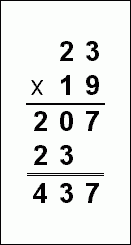
Long Multiplication: This is the way we learned it. The only variation is the way carries are handled. Some above the middle section, some below, some digits, some more cryptic marks. Other than that the method is uniform. Yet it is not the only way to carry out multiplication.

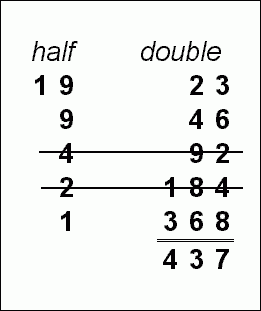
Russian Multiplication may be apocryphal, but it is a method I remember seeing once or twice as a boy. Here is how it works:

Put the smaller number on the left, and leave room for a wide column on the right with the larger number.

Divide the smaller number by two repeatedly, discarding any remainder, until you reach one.

Double the larger number to match each entry on the left.

Cross out any line that has an even number in the left-hand column.

Then add the numbers in the right hand column, that are not crossed out.

The wonderful thing about this method is that it matches very closely the way computers add numbers. The doubling and halving correspond to the way computers keep numbers: in binary, so that 19 is 10011 and 23 is 10111. To double a binary number, shift it to the left and append a zero. To divide it by two, shift it to the right and discard any bits (1 or 0 digits) that fall off the end. The computer puts both numbers into Shift Registers, and shifts one to the left, the other to the right, adding the number in the first Shift Register to a third Sum Register every time a 1 bit drops off the second Shift Register. When all the shifting and adding is done, the result is in the Add Register.
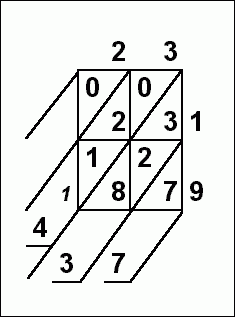
Pascal's Multiplication method is a different way of arranging the digits, to carry out Long Multiplication. This works with numbers of any size, though it gets cumbersome with larger numbers; so does Long Multiplication, but it has the virtue of taking the smallest amount of paper. To use Pascal's method, first make a box, divided as shown, with diagonals from every corner, and leave plenty of room for a carry digit.

Multiply the digit above each box's column with the digit to the far right of its row, creating a 2-digit number that you split across the diagonal line as shown (2x1 = 02; 3x9 = 27. See how they are shown in the figure).

Once all the boxes are filled, add the numbers in each diagonal section, down and to the left. Put any carry digit near the border of the main box.

The digits at the bottom left of each diagonal section make up the result.

Why do I go into this discursion? To show that even in something we think of as a very standard math method, there are several ways of getting the same result. RPF made this point again and again in his reviews—complaints, really—of math textbooks.

I love the book.