Showing posts with label ideas. Show all posts

Wednesday, August 31, 2011

In the grip of our ideas

kw: book reviews, nonfiction, sociology, speculative sociology, north american history, ideas

My all-time favorite comic is Calvin and Hobbes. As a child, like Calvin, I was interested in everything, did poorly in school, and had a stuffed tiger, though mine was named Tigger. And, the biggest factor, like Calvin, I lived inside my own head. I still am most simpatico with cartoon characters who have a rich internal life, such as Snoopy in Peanuts or the Red Rascal in Doonesbury (except my own blog happens to be factual).

Richard Dawkins coined the term meme in 1976 (not knowing of the older term mneme), and it was about then that the old term noosphere finally became widespread outside Russia. I read Dawkins' The Selfish Gene before 1980 and the "meme" idea in his last chapter clicked with me. From time to time I've thought about its implications, and wondered just how granular memes are. Now I find a book by someone who has thought it through more thoroughly, and the answer is, very granular indeed, almost atomic, in fact. On the scale gene-cell-tissue-organ-organism-colony, Dawkins wrote that the genes rule. In the noosphere, memes are not ideas, but tiny bits of ideas that come together like the components of an eukaryotic cell.

When you are looking for the origins of things it helps to study an archipelago, preferably one with a short history. The Galapagos Archipelago and its very simplified ecology were the perfect example for a young Charles Darwin. Its endowment of fourteen species of finches exemplify the "natural experiment" in species radiation from a small founding population. Their history was long enough for variants to evolve into species, but short enough that their historical development could be determined.

When Jonnie Hughes, enrapt by memes and the noosphere, was looking for a subject to test his ideas, he realized that his native England had a history much too deep for the history of any ideas to be unraveled. So he and his brother Adam paid an extended visit to the American great plains, where he settled on a collection of "idea species" that could be easily distinguished, occupied a limited geographical area, and had a comparatively short history: Indian tepees (or tipis or teepees). Starting in Minnesota, they drove a few thousand miles, visiting historical sites and museums and attending a powwow or two. Hughes boils down his findings in On the Origin of Tepees: the Evolution of Ideas (and Ourselves).

The book is no dry tome of scientific findings. It is an incredibly fun travelogue of the road trip, well spiced with his musings on a great number of subjects related to memes and the noosphere. Rather than dump all the heavy ideas into a weighty introductory chapter or two, Hughes has skilfully woven them into his narrative. In a book full of ideas and about ideas, the method he has chosen manages to pack a ton of content into a package seemingly too small for it, and make it all palatable.

For example, one of the key ideas is the "ancestral flip book". It could have been introduced very early on, but was reserved for Chapter 7. It is a fantastic way to think about our ancestors, generation by generation (one per page), all the way back to the first Eukaryote (or if you are a glutton for punishment, the first cell a couple billion generations earlier). He estimates that the human eukatyotic flip book would have 200 million pages. But, counting at 20 years per human generation (for centuries prior to the 20th), morphing to nine years per ancestral ape or australopithecine, there are about 600,000 generations starting from the split between hominids and proto-chimps.

Such a flip book emphasizes a key feature: it represents a continuous record of breeding success, even though if you were to go back a few tens of thousands of generations, you'd find a creature with which you could not breed (and probably would be unwilling to try). A chapter or two later, such thoughts lead to a discussion of "what is a species, really?". Hughes concludes that, even for large, visible animals such as ourselves, the term species is slippery and ambiguous. Just as the flip book records a gradient through time, and can be divided into a succession of "species" at certain rather arbitrary points, the famous "ring species", herring gulls, are one example of a gradient in space.

It bears discussion, briefly: there are three populations of herring gulls in North America. At their margins, each can breed with the other two, but as they are distributed west to east, the ones on opposite coasts nearly never meet to do so (but they can when brought together). Crossing the Atlantic, we find another "species" of herring gull that can breed with the easternmost American variety. These gulls coexist with, and compete with, a smaller, darker gull, the Lesser Black-backed Gull, particularly in Hughes' home town. But wait; let's return to western North America. Crossing the Pacific, we find another herring gull that can interbreed with the western American variety. A series of gull varieties/species can be traced around Asia to Europe, where they become gradually darker and smaller, until we find, particularly in Western Europe, Lesser Black-backed Gulls! They are herring gulls in disguise, and cannot breed with their competitors, but form one end of a breeding population that rings the Northern Hemisphere and includes those competitors. Do we have one species here or many? Eight or nine names species comprise the whole ring. We find that the word "species" is not sufficiently well defined to be meaningfully applied to herring gulls.

This is even more true of ideas, and that is where Hughes is going with this discussion. Once he sets eyes on a few tepees, he learns they do come in different physical forms. One big division among types is whether the initial setting up is done using three poles or four. With either starting lash-up, you then arrange the rest of the poles (twenty or so) and mount the cover. Then, at the top of the cover there are two smoke flaps, and two methods of holding them open are used, one with a sewn pocket and the other with a hole and pin arrangement. This leads to a worrying matter; are (or were) all four possible arrangements in actual use, or does one kind of smoke flap always go with a 3- or 4-pole foundation?

It turns out not to matter too much. Idea reproduction is not like physical reproduction, where you have to have just one father and just one mother. Even among physical species, there are a few methods of horizontal gene transfer, such as retroviruses, which have recently been called the third sex.

After seeing several varieties of tepee, and in Montana stumbling on the book The Indian Tipi by Reginald and Gladys Laubin, Hughes is able to boil down his thinking into this diagram. He said to his brother that it isn't the origin of all tepees, but "the origin of these tepees." There is a Siberian tent much like a small tepee that probably bears a good resemblance to a true ancestral form. The ideas that were merged to lead to the various types of larger Plains Indian tepees originated of necessity, due to the particular environmental conditions along the eastern front of the Rockies, all across the North American grasslands.

Along the way, there is a discussion of genius, and how ideas originate. Though it may seem that certain ideas spring full-blown from a single mind, Hughes sticks to his thesis, that every idea, like every natural species, has a flip book of ancestors with very small differences from "generation" to "generation". In the case of seemingly giant leaps, such as evolution or relativity, many many generations of ideas were born, competed and died inside a single brain. In Darwin's case, the process took decades (both Einstein and Newton, while each had a seeming burst of ideas in a short period, percolated those ideas for a long time beforehand).

In the long view, it appears that the human brain and human society developed sufficiently to form a noosphere some 200,000 years ago. I would argue that full development required another 130,000 years, until the development of culturally modern humans some 70,000 years ago. Either way, once memes took over, physical evolution slowed down, way down. Mental evolution is so much faster. However, this is a variable process over the world. We need a new word for "mental ecology". Just as certain isolated parts of the world have their own unique ecology, certain human cultures, which may actually encompass a majority of Homo sapiens, occupy an ecology of mind that does not include modern medicine, sanitation, or widespread use of electricity.

In countries that have some aspect of the Western technological culture, life expectancy is in the 70-80 year range for infants and closer to 80-90 for adults. In many "underdeveloped" countries these figures are around 45 years for newborns and 50-60 for adults. Just spelunk around in the CIA World Factbook a bit. These are like different worlds, different mental ecologies. The spread of ideas that originate higher in the "design space" of the noosphere can be very fast indeed, but the ideas have to compete with existing ideas that are comfortable to the people they inhabit. "It was good enough for Grandpa, and it's good enough for me" doesn't refer only to the old-time religion. However, thinking geologically, the spread and continued development of Western culture over the past 2,400 years is astonishingly fast. Whole new species of ideas can arise in a year or two, where physical species take a few thousand to a million years to speciate.

Has human physical evolution stopped? I'd like to think it hasn't. I would like to see us become smarter, wiser, stronger and kinder. There ought to be no place for venality. Solomon wrote that an increase of books was a weariness of spirit. But writing is how memes achieve immortality. Do we have ideas, or do they have us? It is a little of both.

Monday, June 27, 2011

Idea quotes

kw: quotes, ideas

A few of the quotes I dogeared while reading Where Good Ideas Come From by Steven Johnson:
  • "Good ideas are not conjured out of thin air; they are built out of a collection of existing parts, the composition of which expands (and, occasionally, contracts,) over time." -p35
  • "…some scientists have argued that natural selection has gravitated toward a small but stable error rate in DNA transcoding, that evolution has, in a sense, "tuned" the error rate to the optimal balance between too much mutation and too much stability." -p144
  • "…all decisive events in the history of scientific thought can be described in terms of mental cross-fertilization between different disciplines." -Arthur Koestler, quoted on p159
  • "There are good ideas, and then there are good ideas that make it easier to have other good ideas." -p243

The greatest power

kw: book reviews, nonfiction, ideas, creativity

I had extra time to read over the weekend, and added think time also, so I finished reading Where Good Ideas Come From:The Natural History of Innovation by Steven Johnson. The thinking part will take a considerable time yet to come. I pre-reviewed some of the crucial points earlier; Scaling in this post and the Adjacent Possible and Liquid Networks in this one. These last two items are called "idea structures" by the author.

There are five more of them, which I'll touch on briefly:
  • the Slow Hunch – The "flash of insight" that we equate with a flashbulb going off typically takes a decade or two of back-of-the-mind cogitation before it occurs. When Friedrich Kekule had his dream about the fiery snake eating its tail, that led to his discovery of the Benzene ring, he had been thinking for a long time about how C6H6 could work and be so stable (Linear C6H6 is nearly impossible to synthesize, and is expected to soon fall apart).
  • Serendipity – Ideas are often monistic, and need the support of other ideas to become a practicable reality. One of the best ideas I ever had arose from a mental collision between astronomy (orbital mechanics) and civil engineering, which I applied to physical chemistry calculations and simulations.
  • Error – Most of us know how Alexander Fleming discovered Penicillin; he was a sloppy housekeeper and let a culture plate get contaminated. Also, the cosmological microwave background was discovered only after two radio astronomers got over their conviction that their radio telescope was somehow at fault. When an experiment produces unexpected results, that isn't a problem, that is a golden opportunity!
  • Exaptation – This word was first coined for evolutionary uses, such as the conversion of feathers from thermal insulation to their use to aid flight. My example above of astronomy+geotechnology is an example of exaptation.
  • Platforms – A city, or a coral reef, or a Darwininan "tangled bank", are examples of Platforms, infrastructure that other developments can rely on. Newton and others wrote of standing on the shoulders of giants. There are actually millions of shoulders out there. I didn't have to invent the FORTRAN or COMPASS languages to have a career as a computer programmer; others had laid the groundwork. You don't have to be a road-builder to be a driver, nor must you lay rail and build locomotives in order to take a train ride.
The author closes with a chapter in which he develops a four-quadrant model of the origin and environment of the great inventions of the past 600 years, taken two centuries at a time, and focusing on the Fourth Quadrant, which refers in software development terms to the Open Source movement. That is where 90% of great innovation is currently happening, in all arenas. The Appendix to the book is a key value: 44 pages limning a couple hundred key inventions from 1400-2000 A.D.

All of this is written with a fluid, easy style that makes reading easy. Early on, I expected I'd need to take plenty of time to read the book. Its thickness and small font made me cautious. But it reads as fast as a novel. That is a danger in itself, for this book is so full of material, it requires a second read to have a chance of grasping more than a fraction. That makes it a good reference work to have on hand. And what fun!

Saturday, June 25, 2011

Idea structures one and two

kw: ideas, review reference, exploring, liquidity

This is Friday's post, as it mostly wrote itself in my head then, but circumstances intervened and I had something of a holiday from the keyboard. Fear not, it's all there.

Reading a book as packed as Where Good Ideas Come From by Steven Johnson takes time and care. He structured the book around seven structures of innovation, and the synergies that play among them to make larger assemblages—whether of people or of molecules or of creatures—more creative and innovative. A large and rich environment leads to more creativity per unit, not just more overall.

The first such structure is The Adjacent Possible. Anyone who spent the 80s and 90s reading Stephen Jay Gould's columns in Natural History, or who has read his magnificent treatise The Structure of Evolutionary Theory (2002), should have picked up this enormous thread in his work: evolution proceeds by adapting, editing and expanding upon what exists at the moment. Thus in his great essay "The Panda's Thumb" he explained how the Giant Panda species, descended from animals that lack a thumb, was over time endowed with a thumb as a wrist bone was modified into an opposable, grasping digit.

In another context, the printing press developed by Johannes Gutenberg was an adapted wine press, a device in use for more than a thousand years. Movable type by themselves were no quicker than calligraphy if one had to use them like ink stamps, one by one. But by assembling them in a frame, inking, and pressing with the great power of a screw press, sheet after sheet could be printed in a few seconds each. Modern web presses further add the idea of a roll of paper and a cylinder press, so that hundreds of pages per second can be printed.

It is very rare for a working device to spring de novo from ideation alone. I once thought the Linotype® was one such. I had read that Ottmar Mergenthaler gradually thought through the entire concept, and that the first one he built worked, and little had changed since 1884. But the great new thing about the Linotype machine was the slug matrices that sort the character slugs back into the "font" after use; the rest was gathering together all the processes that went into making a "line of type". As late as the 1960s headlines were still being composed by hand in a composer's box. My father's first job was as a headline composer in 1938. A composed line was taken to a hot lead pouring station, fitted in with shims, and the hot lead poured to a prescribed depth (by the way, the "lead" is largely antimony, a metal that is rare in swelling upon freezing the way water does; this drives the cooling type metal into every crevice of the slugs). What I didn't know until recently was that the matrices were based on the cards used for the Jacquard Loom, which was also the inspiration for the IBM card. All the other ideas in the Linotype's construction were pretty much off-the-shelf "stuff" one could assemble in the mid 1880s.

By contrast, the great mental constructions of Charles Babbage, the Difference Engine and the Analytical Engine, were really ahead of their time. Though they were possible to construct using 19th Century technology, they were simply too costly in both time and money. Babbage's patrons just could not afford the construction of either one. It was at the time lest costly, and faster, to employ legions of diligent young women as "computers" to carry out calculations using pen and paper. The ideas behind Babbage's devices required the invention of electronic circuits to become practical, so a hundred years passed before special-purpose electronic calculators and electronic computers arose in the mid 20th Century. Until then, the ideas themselves were not in the realm of the Adjacent Possible.

The following structure is titled by Johnson Liquid Networks. He uses the analogy of phases of matter: solid, liquid, and gas. The key here is that innovation requires interaction. One mind may produce an invention, but it is the aggregation of inventions that produces a civilization and a society, and most smaller items. There are dozens of inventions, by many different people, that are embodied in a digital wristwatch or laser printer, or even the hose-end sprayer I used this afternoon to fertilize my garden.

During the hundreds of thousands of years that humans lived in hunter-gatherer bands, they were like a gas, and the bands were like gas molecules. If someone or some small group produced an innovation, a new way to make a fishhook, perhaps, there was little chance for the idea to spread throughout humanity. The interactions between bands were too infrequent. At the other end of the scale, totalitarian societies such as cloistered Medieval Europe or modern-day Cuba and North Korea are noted for stagnation, not innovation. In a solid, each molecule interacts only with those it is locked to in the crystal structure. New stuff just doesn't spread. But, like the warm porridge in The Three Bears, a liquid is "just right". Interactions between molecules are frequent, and any new thing is rapidly transmitted throughout the whole.

It is this frequent interaction that underlies the power of the Adjacent Possible. One inventor may explore a few "open doors" that he or she comes upon, but it is the thousands and millions of explorations, in an environment that promotes communication, that enables rapid innovation. That is the power of the blogosphere, for example (cough, cough). The more popular blogs act as conduits for new ideas to larger audiences; the first that comes to mind is Boing Boing. Give it a try.

The synergy of these two structures underlies my career as a computer programmer, at which I spent forty years. In mid-career, I spent ten years using assembly language in large computer centers. At first, I learned the syntax of the Compass languages (there are two). Then I wrote a few callable subroutines for specialized tasks, such as a faster square root calculator for the Geologists to use in seismic prospecting. Then I took advantage of a large number of code libraries from which I could crib snippets (sometimes hundreds of lines of code) that would perform specialized tasks I didn't have to invent. These were pre-built mental "gadgets". They opened up more "doors", making more territory "adjacently possible". To this point, I was progressing as I had as a FORTRAN programmer fifteen years earlier.

Then I began to work with a team. Once I experienced the power of genuine teamwork (not groupthink!!), there was no looking back. I probably spent a quarter of my time in team interactions of many kinds, brainstorming, bouncing ideas around, "talking philosophy", or just shooting the breeze. But the group's productivity was phenomenal.

Jump fifteen years the other direction: a team of two. I was asked to learn Perl for some Web programming and other scripting tasks. After a couple days digesting a book of Perl syntax and semantics, I spent a few weeks on my first big project, in the company of an experienced Perl programmer. We alternated who sat at the keyboard and who walked about and waved arms and shouted. We also conferred with a few others at times. We knocked out a very impressive piece of work, I learned Perl, and he learned something about language processing. By then we had not just a program that worked, and is still in use, but a library of ideas too good to leave inside the product. It circulates inside the company among the community of Web programmers. Sorry, can't tell you the name just now. Companies can have their totalitarian sides…

In an example from the book, Psychologist Kevin Dunbar decided to watch scientists at work; he must be quite adept to avoid lots of awkwardness. His conclusion? "…the ground zero of innovation was not the microscope. It was the conference table." Ah, but there are conferences and conferences. My son visited the GooglePlex in Manhattan with a friend. There is no button-down mind stuff going on when the Googlers get together. Truly innovative meetings are loud! (Remember me and my friend, waving arms and shouting.)

I propose a new kind of IQ test, the NQ for "iNnovative Quotient". In a traditional IQ test, you are required to work alone. In the NQ test, you are required to get the answer from someone, and the questions are framed so that Google searches are unlikely to help (this is getting harder every day). In the spirit of "six degrees of separation", when you contact someone asking for an answer, you instruct them to ask someone else, if they don't know it, as long as they report who actually knew the answer. The test is designed to take between a week and a month to complete, and it is time to completion that counts, more than correctness of answers, though that counts also. As I think about this, NQ can also refer to "Networking Quotient". Not bad!

Thursday, June 23, 2011

How cities differ from animals

kw: ideas, scaling, review reference

I am reading Where Good Ideas Come From: The Natural History of Innovation by Steven Johnson. It is just a bit bigger than the average book at some 75,000 words, but it is packed with ideas. I simply have to explore a few of them as I read.

A major point in the book's introduction is the concept of scaling. For example, we would expect larger mammals to require more food then smaller ones, just to keep a larger body warm. But how, exactly, does the rate an animal burns food increase with increased mass? Max Kleiber studied this in the 1930s, and by the mid 1940s had derived Kleiber's Law, that metabolic heat production increases as the 3/4 power of mass for mammals. This chart is from his 1947 report, "Body Size and Metabolic Rate", published in Physiological Reviews.


The 3/4 power is the fourth root of the cube, so we can apply it thus. One dot in the middle of the chart represents the data for a woman: Mass = 50kg, Met = 1,500 kcal/day. Down and to the left, we find a mouse: Mass = 20g = 0.02kg, Met = 3 kcal/day. Ratio of masses = 2500; ratio of metabolic rate = 500. 25003 = 15.625 billion; the fourth root of this = 354. This is pretty close; using logarithms to find the exact exponent we find it is 0.79. The red line on the graph follows an exponent of 0.75. (If I had Kleiber's original data for woman and mouse, perhaps the numbers would match more closely, and perhaps not.)

It has been said, particularly in literature, that a city is like a large animal, with its own metabolism. However, when cities have been studied, many important parameters are found to scale with an exponent greater than one. The easiest to study is total cash flow, the sum total of the income of a city's residents:


This chart, from this government report, uses the natural logarithm of population and total income, which makes it harder for most people to parse. I'll pick the upper-right point (probably NYC), and the one at lower left closest to the trend line. Big city: 18.8 million people, $440 billion; small city: 57,000 people, $800 million. Dollar ratios = 550; population ratio = 330. The trend line has an exponent of 1.2, and from these two points I find an exponent of 1.09. The difference per capita is stark: $800M/57k = $14,000; $440B/18.8M = $23,400, or 67% more. No wonder so many people flock to larger cities! (Except when recession hits…)

This is not just that the rich tend to live in larger cities (I live in a suburb of a city of 80,000 and there are millionaires aplenty). Rather, Johnson's point in his book is that larger aggregations of people yield disproportionately greater amounts of innovation, invention, and entrepreneurship. For example, it takes about a thousand patients to support a physician, and at least a few hundred to support a lawyer. In the smallest towns, you might have no more than one or two local physicians or lawyers, or none.

I recently visited three small towns in Missouri. Malta Bend, where my paternal ancestors lived, has fewer than 300 residents, and not a single retail or professional establishment. Even the single Methodist church is served by a circuit rider. The residents all go to nearby Marshall, population 11,000 to shop, see the doctor, and everything else. The circuit rider also lives in Marshall. A bit farther from Marshall there is Grand Pass, population 53. They also go to Marshall for everything except neighborly socializing.

A second item larger cities provide is a greater diversity of "stuff." An inventor needs "stuff". I remember growing up in Pasadena, California. There was a military surplus store, where all the radio hams and other homebrew hobbyists got "stuff". A town much smaller than Pasadena, population 147,000, but near gigantic Los Angeles, can't support a surplus outlet. And Los Angeles is one of only three huge metro areas I know of that support a walk-in parts store for antique cars. I used to shop there for parts for a 1948 truck I had in the 1970s. They had walls of parts for Model A and T Fords! The proprietor bragged to me that you could build an entire 1955 VW bug from parts he had on hand. I wonder if that is still true. To go a step further, my brother bought two junkyard Subarus, one wrecked in front, the other wrecked in back, and put together one working car, though he had to go to the same outlet for a few parts. "Stuff". He'd have got nowhere in Malta Bend, or even Marshall.

The prime difference between a city and an animal is that a city is a colony. I wonder if metabolic rates or other parameters for colonies, such as anthills, bee hives and termite mounds, follow a super-linear scaling law, one with an exponent greater than 1.0. For whatever reason, innovation in cities is a super-linear function. As the book proceeds, the author promises to ferret out other factors of similar power. If innovation is what you need, such factors are a must-know. Stay tuned.

Saturday, December 04, 2010

How about a real Galactic survey?

kw: ideas, surveys, astronomy

OK, yesterday I reviewed a book about the Sloan Digital Sky Survey, whose primary goal was to obtain the spectra of a million galaxies scattered through redshift space. An additional harvest was the spectra of about half a million stars located in our Galaxy, which has led to a flurry of additional discoveries.

This complemented earlier surveys, particularly ESA's Hipparcos mission, which from 1989-1993 obtained highly accurate positions and parallaxes (distances) for more than 118,000 stars and slightly less accurate positions and parallaxes for another 2.5 million stars. That represents about 0.02% of the stars in the Galaxy, primarily located within a few thousand light years of the Solar System. SDSS did not pursue parallaxes specifically. ESA (the European Space Agency) plans a mission called Gaia, to be launched in 2012, which is intended to map a billion (109) stars of magnitude 20 and brighter.

Let's consider a space mission that could map all of the roughly one trillion (1012) stars, obtaining geometric parallaxes throughout the Galaxy. Firstly, it needs a larger baseline.

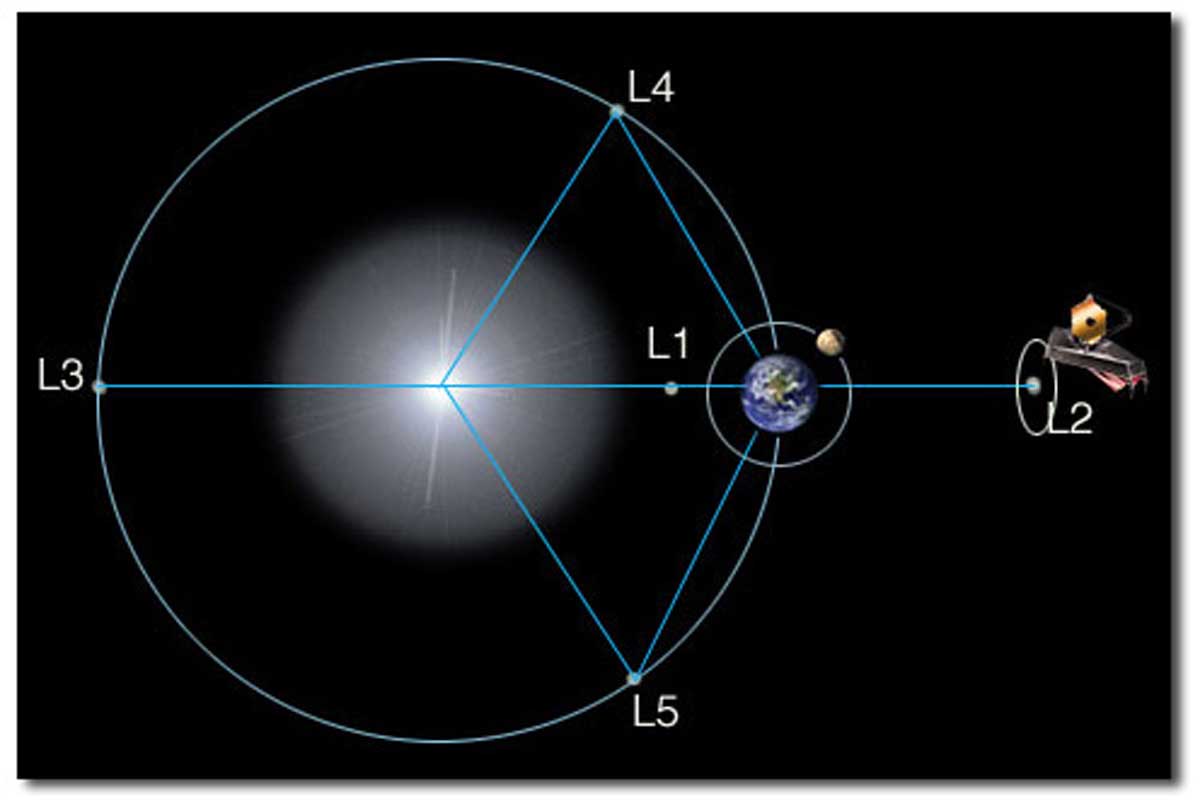
In this NASA image, the Lagrange points are shown for Earth's orbit about the Sun. NASA's WMAP probe is intended to park in the L2 point. Although it is unstable in the long term, staying near this location is easy, needing correction at rare intervals. The Gaia probe is intended to use the same region.

For getting parallaxes, the L2 location, located 1.5 million km farther from the Sun, is only slightly better than a telescope in Earth orbit. In a half year, the baseline for parallax determination is 300 million km. Getting more precise distance measurements requires ever-more-finicky angular measurements. For stars that are moving too fast, the difficulty is compounded. Having two probes a suitable distance apart allows simultaneous measurement of each star's position from two angles.

One light year is a little less than one-third of a parsec, so named because a parallax of one arc-second places a star at 3.26 light years away. A measurement with an accuracy of 1"/1000, or one milli-arc-second (mas) can provide a distance with reasonable accuracy out to about 100 parsecs, and with poor accuracy at distances approaching 1000 parsecs, or 3,260 light years. It takes accuracy in the range of a micro-arc-second (µas) to reach across the Galaxy, about 30,000 parsecs. By the way, the parsec is defined for a baseline of 1 AU, but in a half year the earth crosses a baseline of 2AU.

Suppose, instead of utilizing Lagrange points related to Earth's orbit, we use both L4 and L5 along the orbit of Uranus? The baseline is thus much longer! Uranus is 19.19 AU from the Sun (2,871 million km). The distance from L4 to L5 is 33.2 AU, providing an advantage of 16.6 over Earth-orbit-based parallax measurements. At a distance of 30,000 parsecs, the parallax is about 0.55 mas, a comfortable number using today's technology. Thus the entire Galaxy, including the globular clusters, and even the Magellanic Clouds, can be mapped with high precision.

The problem remains that the Solar System is located in the plane of the galactic spiral, about 2/3 of the way out to the edge. The central bulge and the incredible amounts of dust there and in parts of the disk will forever block our view. Much of the dust can be pierced by using farther infrared light, in the 2-3µ range. But from this location, some portions of the Galaxy will forever remain out of view.

Balancing this, there will be much less interference from dust in the inner Solar System, which can be seen from Earth as the Zodiacal Light. Light scattered from this dust is nearly all confined to inward of Jupiter. From Uranus, the Sun is 360 times dimmer, as well, so any dust remaining in "Uranus space" will likely be at least 6-8 magnitudes fainter, allowing very faint stars to be detected and measured. A white dwarf with an absolute magnitude of about 16 dims to apparent magnitude 26 at a distance of only 1,000 parsecs. At 30,000 parsecs it is dimmed, by distance alone, by another 7 magnitudes, to 33. A 33d magnitude star is barely detectable from "Earth space", but should be nice and clear when seen from Uranus orbit.

I have read of proposals to have a mission called TAU, for Thousand AU's. The idea is to place a telescope at that great distance, for measuring parallaxes in a wide band surrounding the plane that bisects the baseline. This has several drawbacks. With current technology, getting the probe into place, and then stopping its forward momentum (should we wish to) would take a couple of centuries. Getting probes to Uranus L4 and L5 would still be substantial, roughly a decade, unless rocket technology improves considerably.

Also, the data transit time to or from TAU would be about 5.8 days. Data transmission to and from Uranus orbit takes about 2.6 hours, and signal strength is much greater for a given radio power. All in all, taking advantage of the L4 and L5 "platforms" near Uranus has great advantages for stellar mapping throughout the Galaxy.

Wednesday, March 21, 2007

The glove on the gearshift

kw: experiences, ideas

One consequence of my hand operation is wearing a brace at least part of the time, during my convalescence. I find that could be months. This leads to curious circumstances.

This cold morning, the first day I got to drive myself to work in 18 days, I found the <20°F steering wheel and gearshift too cold to hold without gloves. But with the brace on, I couldn't put a glove on my right hand. I've long since got used to keeping my right hand in my lap and steering with the left, after two years of pain and therapy that led up to the surgery. But my car is stick shift, five-on-the-floor (my wife's car also). I can't do all that shifting with my left hand (ever tried?).

It didn't take me long to realize the glove for my right hand could still work, on the gearshift lever! So that's how I drove to work. It's good to know the old neurons can still think outside the box on occasion.

Monday, October 16, 2006

What's worse than wrong?

kw: ideas, opinion, theories, testability

In his most recent column in Scientific American, Michael Shermer, publisher of Skeptic, writes about ideas that are "wronger than wrong."

First, an intermediate idea. Wolfgang Pauli said of a proposed theory that made no predictions and couldn't be tested that "it isn't even wrong." He meant, there is no way to determine if it is right or wrong. You can't even call such an idea a theory, for that word is reserved for ideas that can be tested by experiment or observation.

We know, as scientists, that every theory we have is a model, and that it describes some phenomenon, and makes predictions about reproducing that phenomenon; yet that it will be found to "miss" if taken too far. That is because a model is always a simplification; something is of necessity always left out. A theory may be very, very precise (Quantum Electrodynamics makes predictions that have been tested to a numerical accuracy of something like eighteen decimal places). But at some level (maybe the twentieth decimal) its limit will be found. Taken beyond that limit, the theory is "wrong."

To a scientist, "wrong" means testable, provable, and found wanting at some level. Thus, there are degrees of wrongness.

For example, the idea that the earth is flat cannot be sustained once you determine that a vertical plumb line a few miles away isn't parallel to the one next to you (you can see the difference through a telescope). The idea that the earth is a sphere is very ancient, and a rough measurement of the earth's size was made 2,400 years ago. So, most people who know the earth is "round" (a nice, imprecise term) think of it as a sphere. With a little thought, we realize it is a bit lumpy, and so is not really a perfect sphere, but the sphere model is "less wrong" than the flat model.

I was taught when quite young that the earth was an oblate spheroid. That just means the equator is a circle, but the meridians are slightly flattened ellipses. That's a little "less wrong" yet. Later, the term "pear shaped" was used, and so forth.

Now, at some level, every model of the earth's shape is "wrong". However, Shermer makes a great point here: the notion that the "wrongness" of the sphere model is equal to that of the flat model, is "wronger than wrong." With a modicum of thought, we can realize that the sphere model, though a little inaccurate, is much closer to reality than the flat model. It is a lot "less wrong." The kind of thinking that would equate these models in terms of their relative wrongness, is just too wrong to permit discourse.

That is really the problem, here. If someone's thinking is wronger than wrong, you can't talk to them. They can't understand you, and can't even understand why you are bothered.

I remember the very old "black/white versus shades of gray" distinction, impressed on me from way, way back. To a B/W thinker of the pessimistic sort, a single non-white spot makes everything BLACK; an optimist thinks the slightest glimmer means "it's all good." Both are too wrong for reasoned discourse. One must understand, or at least admit, levels of light or dark to get anywhere.

Later, I had a Rorschach test that moved me in a better direction yet. You may know that a few of the blots are multicolored. After my test, the shrink pointed out that, on the black blots, I had lots to say, and tended to pick them apart, like looking for images in clouds; but I had very little to say about the blots with more than one color of ink. I don't know what he said from that point, becuase I began to think furiously, and realized, "There's not just black, white, and gray. There's a rainbow out there."

Let me confess, I was considered almost autistic before that point in my life. Not since. Now, no matter what the issue, I don't only see the "either/or" question, not even the axis between the poles, but I get ideas in all directions perpendicular to that axis. Life may not be "it's all good," but it's better than it once was!