kw: book reviews, nonfiction, aging gracefully, elder care
My father, now in his nineties, says from time to time, "Don't get old." Only once have I replied, "It beats the alternative." And I notice he is not interested in the alternative, though he is hardheaded enough to plan well for his demise, whenever it may come. He lives in an "Independent Living Hotel", where he has a small suite and all meals and weekly housekeeping, for a set fee. In particular, he also has a Living Will and Advance Directive. I've heard from a few sources that these documents need to be revisited every few years. At age 70, someone might say, "Oh, I'd never want to live 'that way'", referring to some adverse condition of aging, particularly at a great age. At 75 or 80, they may have a different take on it, and at 90, it is surprising what someone will live with, just to keep on living.
I am not my father's primary caretaker, though I'm willing. He lives clear across the country, and the last time I went there, total travel time, door to door, was 14 hours. Not conducive to a pop-in visit to help him balance his checkbook or roust him out for a quick lunch together. Fortunately, he is a church-goer, and has a social network there (though they aren't much for the quick lunch), and he has occasional hired help for a few things; the list is expected to grow with time. Organizations such as Visiting Angels are a good first step for finding such help.
With these things in mind, I was eager to read a recent book by a couple who specialize in elder care matters: How to Age in Place: Planning for a Happy, Independent, and Financially Secure Retirement by Mary A. Languirand and Robert F. Bornstein (both append PhD). I was not disappointed. Drs. Languirand and Bornstein are about ten years younger than I, some 5-10 years short of retirement themselves, though if they are vigorous, they could follow many who delay retirement by a decade or so. They have sufficient experience that they cover literally all the bases. The book has two sections, "Making it Work" and "Making it Count", each of five chapters, though by page count, the second section is about 25% longer.
It all begins with "Money Matters", as it ought to. While it can be said that the three requirements for retiring successfully are money, money and money, the actual key is one's attitude towards money. Actor and comic Jackie Gleason is famous for saying, "Those who say money can't buy happiness don't know where to shop." Sadly, he didn't either, and you could describe his life as a long misery punctuated by brief pleasure binges. A more normal life is one of general contentment, with both happy and unhappy times, with the resilience to recover from the bad and savor the good. But this is nearly impossible if you're broke.
Here is my secret to having enough money in retirement: Knowing that a company pension plus Social Security usually total about half of one's earnings at career's end, my wife and I lived on half our income. After paying taxes, we saved the rest, mainly in 401k and IRA. Thus, the 50% drop in income after retirement was no shock, and when inflation eats into the buying power, we'll begin needing the deferred accounts, but they are likely to last…unless we both live to 120!
I realize that many folks are living on the edge already and cutting back to half their income is not feasible. All I can say is, save what you can. Maybe you only save "for a rainy day", or to afford "something special". Just consider this: once you retire, the rainy days have arrived, and you're now "special". Save what you can. Many larger companies have eliminated pension plans but the better ones have instituted an "enhanced 401k" to ease the pain. Take full advantage of that!
Well, money matters indeed, but the second chapter introduces the authors' framework of Access, Opportunities, and Services. Access: take a look at your home. If you were confined to a wheelchair or scooter, could you get out the door and to the driveway? If not, perhaps you've heard the old term "shut-in", referring to an oldster who can't get out. Now you'd be one of them. Opportunities refer to, if you can get out, what can you do, particularly after you quit driving? Suburban life is elder-unfriendly, once you lose your drivers' license. My father gave up driving about 6 years ago, in his late 80s. He misses driving more than anything else! Whenever I visit, we're out all the time; he has a lot of pent-up "out there" to satisfy. Services really come to this: if you can afford it, you can have full assisted living or even skilled nursing care in your home. If not, it is well to live in an area where such services are most affordable or are subsidized.
Thus we come to an interesting point: to "age in place" you may need a different place. It need not be an elder facility or nursing home, and in fact this book is about avoiding those. But your "place" needs to be somewhere with available and affordable opportunities and services. My father once analyzed hotel living. An independent living facility can cost from $60-$120/day ($1,800-$3,600/month), meals included, depending on location. A hotel with a good free breakfast—one like La Quinta with a short-order cook on hand in the morning—costs about $100/day, and a canny individual can take a bagel or two along to put in the mini-fridge for lunch, leaving only dinner to be bought. Further, a long-term resident can usually negotiate a lower daily rate, getting total costs down below $3,000/month.
The other three chapters in this section deal with home safety, transportation and health needs. The second section is equally practical, but deals with the elements of happiness. This begins with health, of mind, body and spirit. My mother and her father were afflicted with Alzheimer's Dementia, as were other ancestors including a great-great grandmother whose photo has the "Alzheimer's look". My mother took it badly, and was frequently depressed. Her younger sister chose a better way, saying, "If I'm going to go crazy, I may as well enjoy it!", and she did. There is a cleverness about even deeply demented people that allows them to mess with your mind if they like, and to get joy out of life, even if they have forgotten why this or that sibling or child is special to them.
The body's aging changes are equally variable. I've learned that most people, in America at least, in this age of antibiotics and other amazing medicines, have a "health span" that falls short of their life span by as much as a decade. Setting aside those who die untimely, physical ability can be maintained at quite a high level until one begins a declining period of a few years' length. Even more, our intellectual and mental health, in the absence of dementia, can continue to improve until nearly the end. There are a number of studies of IQ versus age. They all seem to show a decline after age 40 or 50. However, if the data are refigured for years until death rather than simple age, a different picture emerges: IQ usually increases up until the physical decline of one's last 3-10 years. It is best, then, to take steps ahead of time to push the health span out and minimize the length of the decline. Another book I read many years ago, Biomarkers by Evans et al, has useful advice in this regard.
Unlike contemporary and pop psychology, these authors recognize the reality of the human spirit, and the chapter "Healthy Spirit" addresses our need for faith. It is a simple fact that people of faith tend to have longer and happier lives. Whether you think it is simply the extra social dimension, or intervention by God, it lends weight to "statistical theology". I recall reading that in the U.S. Census of 1940 (maybe 1930), there was a "bump", an unusual number of men over age 80. Someone studied the data, and reported that the "extras" were retired Protestant evangelists who'd been active during a "Great Awakening" revival period of the late 19th Century. God takes care of those who take care of His interests. But for us more ordinary folk, churchgoing adds more good years to life than the time spent in church, making it a great investment.
The last two chapters are the most social in nature. As our abilities wane, it is important to increase our social network. Also, as long as we are able, helping others will improve our well-being, and if we are financially able, it is worthwhile to consider charities or causes to support. The Apostle Paul wrote that it is better to give than to receive. I can say from experience, it is definitely better to be in a position to give, and not need to receive. It can be embarrassing to receive! But near the very end, receiving with grace is a skill it is well to learn. We'll feel better about it if we feel the balance is strongly in our favor already.
The appendices include resources, worksheets and checklists. This is a good reference to have on hand.
Showing posts with label aging gracefully. Show all posts
Showing posts with label aging gracefully. Show all posts
Friday, July 25, 2014


Monday, January 21, 2013
Boomers can't leave well enough alone
kw: aging gracefully, scams, medicine
Nobody really likes growing old. Of course, we like the occasional sign of respect, or at least a hint of deference, just because we have more experience. Senior discounts at restaurants and some stores are also nice. But the aging body? That's another matter!
Of course, people have attempted to reverse the clock since the genus Homo discovered mortality, probably 100,000 years ago. Ponce de León sought the fountain of youth in Florida 500 years ago; he needed it more than most, as he lived only 47 years. Fifteen centuries earlier, Cleopatra used a king's ransom in cosmetics and poultices in a vain attempt to retain a youthful appearance.
In my mother's generation, they thought they had "the answer" for women: estrogen or progesterone pills, a weak variety of birth control pills. They did help stave off the worst effects of menopause, but came with their own baggage, such as increased cancer risk. And there was nothing for men.
These days, youth faddists promote HGH (human growth hormone), which has to be injected, or GHR (growth hormone releaser) in pill form. I have an ad before me in the current issue of Smithsonian, that declares, "Grow Young With HGH". It actually promotes a GHR pill. How nice; if only it would work. It doesn't.
I dug around to find out more. Every reputable web site (this is too new to be in the print libraries) says the same thing. HGH injections, by prescription only, can mitigate certain symptoms suffered by people with a hormone deficiency. But tests with otherwise healthy, older adults showed only one "benefit": a small increase in muscle mass, without any measurable increase in muscle strength. The side effect list is rather daunting:
I would have expected some effect on cancer, either promotion or reduction in cancer risk, but nobody has reported on that either way. But further, nobody has demonstrated that any GHR formulation actually "releases" any HGH, whatever that may mean.
My generation's panic at getting older is certainly causing large masses of moolah to transfer to the promoters of alternative medicine ($30 billion last year). Some of the alternatives may work. HGH and GHR don't. Sorry.
Nobody really likes growing old. Of course, we like the occasional sign of respect, or at least a hint of deference, just because we have more experience. Senior discounts at restaurants and some stores are also nice. But the aging body? That's another matter!
Of course, people have attempted to reverse the clock since the genus Homo discovered mortality, probably 100,000 years ago. Ponce de León sought the fountain of youth in Florida 500 years ago; he needed it more than most, as he lived only 47 years. Fifteen centuries earlier, Cleopatra used a king's ransom in cosmetics and poultices in a vain attempt to retain a youthful appearance.
In my mother's generation, they thought they had "the answer" for women: estrogen or progesterone pills, a weak variety of birth control pills. They did help stave off the worst effects of menopause, but came with their own baggage, such as increased cancer risk. And there was nothing for men.
These days, youth faddists promote HGH (human growth hormone), which has to be injected, or GHR (growth hormone releaser) in pill form. I have an ad before me in the current issue of Smithsonian, that declares, "Grow Young With HGH". It actually promotes a GHR pill. How nice; if only it would work. It doesn't.
I dug around to find out more. Every reputable web site (this is too new to be in the print libraries) says the same thing. HGH injections, by prescription only, can mitigate certain symptoms suffered by people with a hormone deficiency. But tests with otherwise healthy, older adults showed only one "benefit": a small increase in muscle mass, without any measurable increase in muscle strength. The side effect list is rather daunting:
- Carpal tunnel syndrome
- Swelling in the arms and legs
- Joint pain
- Muscle pain
- For men, enlargement of breast tissue (gynecomastia)
I would have expected some effect on cancer, either promotion or reduction in cancer risk, but nobody has reported on that either way. But further, nobody has demonstrated that any GHR formulation actually "releases" any HGH, whatever that may mean.
My generation's panic at getting older is certainly causing large masses of moolah to transfer to the promoters of alternative medicine ($30 billion last year). Some of the alternatives may work. HGH and GHR don't. Sorry.
Tuesday, November 23, 2010
Getting rebalanced
kw: aging gracefully
I've heard about this for years: stand barefoot, close your eyes, and lift one foot. Count how long you can stand before you have to put the foot down to catch your balance. The older you are, so it is said, the less time you can stand one-footed with your eyes closed. Now this procedure has been turned into a "test" by the folks at RealAge, with a table quantifying your "balance age" with the number of seconds you last.
With closed eyes, I can stand one-footed for seven seconds. My "balance age" is thus 60. Considering my actual age is 63, it is pretty close. But is it meaningful? In particular, a few months ago, thirty pounds heavier and in worse physical shape, my duration was five seconds and "balance age" was upwards of 65. In the past month I've been standing to put on my stockings rather than doing it sitting down. A month ago, even with my eyes open, I could barely get a sock on without falling down. Now I can put on my socks with ease. There are supposedly balance exercises you can use to improve your ability to stand on one foot. Dressing without sitting down seems to be a pretty good one.
There is another factor here. I think the "close your eyes" part was just to make the test shorter. The table at RealAge indicates that people under thirty can last for nearly thirty seconds. With my eyes open I last about a minute. If the proportion holds, it becomes a test of endurance. Holding one leg in the air for five minutes, at thirty or any age, is hard just because of the weight of the leg. But people vary a lot in how much they need visual cues to stay upright. For some, standing on two feet with their eyes closed can be an iffy business.
Like all such simple tests, this one is at best a very rough indicator, for some people but not all. It'll be interesting, in another month or so, to see if my duration grows longer than seven seconds.
I've heard about this for years: stand barefoot, close your eyes, and lift one foot. Count how long you can stand before you have to put the foot down to catch your balance. The older you are, so it is said, the less time you can stand one-footed with your eyes closed. Now this procedure has been turned into a "test" by the folks at RealAge, with a table quantifying your "balance age" with the number of seconds you last.
With closed eyes, I can stand one-footed for seven seconds. My "balance age" is thus 60. Considering my actual age is 63, it is pretty close. But is it meaningful? In particular, a few months ago, thirty pounds heavier and in worse physical shape, my duration was five seconds and "balance age" was upwards of 65. In the past month I've been standing to put on my stockings rather than doing it sitting down. A month ago, even with my eyes open, I could barely get a sock on without falling down. Now I can put on my socks with ease. There are supposedly balance exercises you can use to improve your ability to stand on one foot. Dressing without sitting down seems to be a pretty good one.
There is another factor here. I think the "close your eyes" part was just to make the test shorter. The table at RealAge indicates that people under thirty can last for nearly thirty seconds. With my eyes open I last about a minute. If the proportion holds, it becomes a test of endurance. Holding one leg in the air for five minutes, at thirty or any age, is hard just because of the weight of the leg. But people vary a lot in how much they need visual cues to stay upright. For some, standing on two feet with their eyes closed can be an iffy business.
Like all such simple tests, this one is at best a very rough indicator, for some people but not all. It'll be interesting, in another month or so, to see if my duration grows longer than seven seconds.
Monday, May 04, 2009
A crisis by any other name...
kw: book reviews, nonfiction, sociology, aging, aging gracefully
When I saw The Third Chapter: Passion, Risk and Adventure in the 25 Years after 50, I snatched it up with high hopes. Having already learned by experience that people tend to experience some kind of self-reinvention about every ten years beginning at age 35, I hoped to learn more of the particular drives, risks, and opportunities that occur at ages around 55 and 65. I hoped to learn why so many are saying "Sixty is the new thirty" and why my experience doesn't square with that Pollyanna-ish assessment. I hoped to find what it is that is unique about "late middle age", for those of us who aren't quite ready to admit to "eldership" yet. Those hopes were only partly realized.
The author, Sara Lawrence-Lightfoot, already at the height of a distinguished career, in her own "third chapter" of life, having eight well-accepted books already published, interviewed forty people of ages between 50 and 75. Considering the number of quotes and references, she must have bounced a lot of this off of her friend, the cultural anthropologist Mary Catherine Bateson.
She states, both early on and in the conclusion, that her forty subjects are all privileged people, and that their experiences may not apply to those who still have to worry where grocery or rent money may come from. Being a person who would most definitely retire if he could afford to, I found that unsettling. Having only recently been able to re-invent my job to better suit my changing (growing?) personality, I'd still prefer a more definite break, a more sweeping revamping of my surroundings.
To avoid the extra-long moniker of "Ms Lawrence-Lightfoot", I'll take the cheeky presumption of using the author's first name. Sara is very thorough in her approach, as any good sociologist ought to be. It is more thorough than I could easily bear. I'd hoped for a forty-fold "Dutch uncle" talk, the words of wisdom distilled from forty lives. What I got was tiny excerpts of what they had to say, longer narratives of their mannerisms and chosen surroundings, and much, much longer disquisitions by Sara. I felt that each snippet was analyzed to death.
Granted, many of the participants found it hard to put into words, the new styles of learning that they had each developed, independently and personally. Each had been driven, often by ennui, to learn new things, accept new challenges, and enter new arenas. Perhaps their "words of wisdom" would have meant little to anyone other than themselves. I still wanted to hear them try, and I didn't.
I suppose there are many readers who will find this book more congenial than I did. It has an undertone, a combination of new-age pseudo-spirituality (or even anti-spirituality) and a fondness for progressive political activism, that I find quite abhorrent. This is coupled with a certain attitude of "Isn't this just to cool!", to which I often replied inwardly, "No, not really."
It would be an oversimplification to aver that Sara's forty subjects are reacting to imminent mortality by attempting to leave some permanent stamp on the world. Though it is certainly true in a few cases, in most there is much more of one or both of these: "I want to experience what I've ignored for the past 30-40 years," and "I may be just one person who can't make that big a difference, but I'll never forgive myself if I don't try." Therefore, the two biggest themes to emerge from their experiences are Art and Political Activism.
I have a couple of, not counter-examples, but sideshows to all this:
What she has produced is an approach to understanding the "later-than-midlife" crises that arrive at ages after fifty. I do know people who match her thesis very well. Many of them partake of various "Institutes of Lifelong Learning" at colleges in the area (particularly the ones that are tuition-free!). Others are busier with their "retirement" than they were when at work, learning by sweating, so to speak.
Being nearly twelve years into my Third Chapter, where do I fit in, if at all? I'd like to retire, and I was close to doing so when the current economic troubles began. My ideal retirement situation? First, half-time work either as a science instructor at a junior college, or gathering more music students, particularly if I can attract intermediate students who want to learn the folk genres in which I specialize. That could pay enough of the bills that I wouldn't need to "hit" my IRA and 401K. The other half of the time, I dream of seeing all of America's national parks (that includes Canada, at least). I'd probably find it rather fun to participate in a Lifelong Learning program, maybe as both a learner and a teacher, which many do. I've carried on private studies in subjects of my own quirky interest since my forties. Taking actual courses in some of them is an attractive option.
What are we to do with the third chapter of our lives? Far from dropping old passions and moldering in a rocking chair, we are most likely to trade new passions for old, to learn because it is fun to learn, and to restore those corners of ourselves that we've neglected because we were "making a living". If some want to get back out there and "change the world" some more, that is worth a try. For me, if I change myself, the change in me will change others. That's good enough.
When I saw The Third Chapter: Passion, Risk and Adventure in the 25 Years after 50, I snatched it up with high hopes. Having already learned by experience that people tend to experience some kind of self-reinvention about every ten years beginning at age 35, I hoped to learn more of the particular drives, risks, and opportunities that occur at ages around 55 and 65. I hoped to learn why so many are saying "Sixty is the new thirty" and why my experience doesn't square with that Pollyanna-ish assessment. I hoped to find what it is that is unique about "late middle age", for those of us who aren't quite ready to admit to "eldership" yet. Those hopes were only partly realized.
The author, Sara Lawrence-Lightfoot, already at the height of a distinguished career, in her own "third chapter" of life, having eight well-accepted books already published, interviewed forty people of ages between 50 and 75. Considering the number of quotes and references, she must have bounced a lot of this off of her friend, the cultural anthropologist Mary Catherine Bateson.
She states, both early on and in the conclusion, that her forty subjects are all privileged people, and that their experiences may not apply to those who still have to worry where grocery or rent money may come from. Being a person who would most definitely retire if he could afford to, I found that unsettling. Having only recently been able to re-invent my job to better suit my changing (growing?) personality, I'd still prefer a more definite break, a more sweeping revamping of my surroundings.
To avoid the extra-long moniker of "Ms Lawrence-Lightfoot", I'll take the cheeky presumption of using the author's first name. Sara is very thorough in her approach, as any good sociologist ought to be. It is more thorough than I could easily bear. I'd hoped for a forty-fold "Dutch uncle" talk, the words of wisdom distilled from forty lives. What I got was tiny excerpts of what they had to say, longer narratives of their mannerisms and chosen surroundings, and much, much longer disquisitions by Sara. I felt that each snippet was analyzed to death.
Granted, many of the participants found it hard to put into words, the new styles of learning that they had each developed, independently and personally. Each had been driven, often by ennui, to learn new things, accept new challenges, and enter new arenas. Perhaps their "words of wisdom" would have meant little to anyone other than themselves. I still wanted to hear them try, and I didn't.
I suppose there are many readers who will find this book more congenial than I did. It has an undertone, a combination of new-age pseudo-spirituality (or even anti-spirituality) and a fondness for progressive political activism, that I find quite abhorrent. This is coupled with a certain attitude of "Isn't this just to cool!", to which I often replied inwardly, "No, not really."
It would be an oversimplification to aver that Sara's forty subjects are reacting to imminent mortality by attempting to leave some permanent stamp on the world. Though it is certainly true in a few cases, in most there is much more of one or both of these: "I want to experience what I've ignored for the past 30-40 years," and "I may be just one person who can't make that big a difference, but I'll never forgive myself if I don't try." Therefore, the two biggest themes to emerge from their experiences are Art and Political Activism.
I have a couple of, not counter-examples, but sideshows to all this:
- My good friend R—, retired from blue-collar work at age 62 and now 67, is seeking to "find his place" in the Christian community as more than a "consumer". He is at his best in one-on-one situations, and he is living the frustrations of someone with a well-developed White Knight Syndrome who is learning when his help is needed and appreciated and when it is not. He is growing and learning, mostly the hard way, but that's the best way.
- My father, at age 87 firmly into the Fourth Chapter, was a business executive whose employer was bought out and shut down, so he was out of work at age 52. He spent the first half of his Third Chapter in business for himself, and succeeded quite well. He had two passionate hobbies in this forties to his early seventies: painting and the collecting and repair of antique clocks. When my mother needed full-time care, he learned nursing and took care of her until it became too demanding and he had to hire additional help. After she died, he soon found a congenial travel companion, and they married some time ago. I have some of his paintings and clocks; he has given away or sold most of the ones my brothers and I didn't take. He doesn't paint any more, though he is willing to fix a broken clock for a friend. He likes seeing new things, expecially by traveling.
- When we moved away from Oklahoma a decade ago, we lost contact with T—, who married for the first time at age sixty, and had six children by the age of 68. Though at age seventy he looked older than my father does today, he was holding two jobs and always looking for an "angle" for making money: an oilfield venture, or a business to operate. I am told he is still going strong in his early eighties.
What she has produced is an approach to understanding the "later-than-midlife" crises that arrive at ages after fifty. I do know people who match her thesis very well. Many of them partake of various "Institutes of Lifelong Learning" at colleges in the area (particularly the ones that are tuition-free!). Others are busier with their "retirement" than they were when at work, learning by sweating, so to speak.
Being nearly twelve years into my Third Chapter, where do I fit in, if at all? I'd like to retire, and I was close to doing so when the current economic troubles began. My ideal retirement situation? First, half-time work either as a science instructor at a junior college, or gathering more music students, particularly if I can attract intermediate students who want to learn the folk genres in which I specialize. That could pay enough of the bills that I wouldn't need to "hit" my IRA and 401K. The other half of the time, I dream of seeing all of America's national parks (that includes Canada, at least). I'd probably find it rather fun to participate in a Lifelong Learning program, maybe as both a learner and a teacher, which many do. I've carried on private studies in subjects of my own quirky interest since my forties. Taking actual courses in some of them is an attractive option.
What are we to do with the third chapter of our lives? Far from dropping old passions and moldering in a rocking chair, we are most likely to trade new passions for old, to learn because it is fun to learn, and to restore those corners of ourselves that we've neglected because we were "making a living". If some want to get back out there and "change the world" some more, that is worth a try. For me, if I change myself, the change in me will change others. That's good enough.
Tuesday, July 12, 2005
Old Fiddles
kw: book reviews, aging gracefully
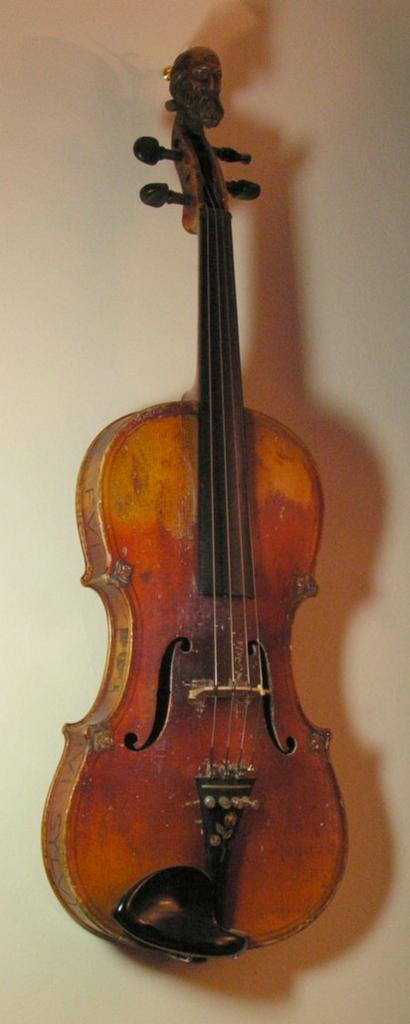 Click on this image to see a larger version.
The proverb is already old: "The older the fiddle, the better the tune." The violin pictured is an 1840 French 'court violin.' A princeling who found himself desiring a court orchestra would hire a concertmaster and order a batch of these: 20, 30, maybe even 50.
The ones made before 1880 or so have a carved head for a scroll. It is supposed to be the image of Casper Diuffelprogcar, who "standardized" the shape of the violin in about 1550. The size wasn't settled until later. The body of this one is about a half inch longer than a modern violin's. The sides and back are decorated with inlays of cities and musical instruments.
This fiddle has been in the family for six generations, beginning when a family friend gave it to my ancestor in 1850. The old gent had been to a concert in St. Louis (probably a variety show of the kind that became Vaudeville a generation later) and stopped one of the musicians to ask if he could buy the instrument. They settled on $100. Quite a princely sum for 1840 (Remeber in "Gone with the Wind," that the taxes on Tara were raised to an unheard-of $300?).
I've heard my great uncle play this violin. Its tone is very lively and sweet. It was "repaired" once by his uncle, who didn't get the neck back on quite right. It is coming loose, so until I get it restored, it isn't playable. But I am mighty gratified to have it. It has outlasted five generations of McKowns and Nyes, and with a bit of repair, could outlast five or ten more.
Would that we could be repaired and restored after decades of aging and wear. In this life at least, we can't. But we can choose to grow old either badly or well. It is up to us. "Once the cards are dealt, what matters is how we play them" (my own proverb).
Well, the original Ronald McDonald, Willard Scott, has collected notes and essays by a hundred or so friends and acquaintances, from Dr. C. Everett Koop to Pete Seeger; Mort Walker (Beetle Bailey) to Fred "Mr Rogers" to Jayne Meadows; and others well known to unknown. The title? You guessed it, The Older the Fiddle, the Better the Tune.
Don't expect anything in the way of organization, index, table of contents here. This is inspiriation, not education. Examples I like:
"...people have stopped trying to sell you life insurance." (John Updike at 70)
"...the older you get, the easier it is to shoot your age in golf." (Ralph Young at 80)
"My arteries are hard enough so that I don't have migraine headaches any more. " (C. Everett Koop at 84)
"The secret of long life is not perfection, rather the ability to adapt." (Jessie L. Dunn at 92)
"I took up painting with pastels at age seventy and thoroughly enjoyed it." (Edith H. Aschenbach at 100)
A fun read, and a bit of a leg up when you're feeling a bit over the hill.
Subscribe to:
Posts (Atom)

 Posts
Posts

