Friday, October 27, 2017

One Tree, One Year, One Book

kw: book reviews, nonfiction, natural history, trees, forests, phenology

A woman once wrote of a talk with her daughter, who was being affected by the licentious, free-love, promiscuous atmosphere of the late 1970's. The daughter had asked, "How can you be satisfied to be with just one person for a lifetime?" The woman reminded her daughter of her youthful experience living near the sea shore: "Every day that you could, you went to the little cove. You explored it over and over. You never tired of it. If we still lived there, don't you think you would still enjoy it, just that one little cove, so full of things to see, that changed a bit every day, but was always the same?"

These are wise words. They explain how a couple can, with a bit of imagination, remain fascinated with one another for 40 or 50 years or more (my parents were married 58 years; so far for me, 42 years). I thought of this story when I began to read Witness Tree: Seasons of Change with a Century-Old Oak by Lynda V. Mapes. She spent a year living in visitors' quarters at Harvard Forest near Petersham, Massachusetts, lending much of her attention to a single tree, a red oak about 100 years old and more than 80 feet tall.

The Harvard Forest is home to dozens, perhaps hundreds of experiments in forestry, botany, climatology and a number of other disciplines. Many have been going on for decades, though it is unlikely any have continued since the founding of the Forest in 1907. The map pin in this image is the approximate location of the Witness Tree.

One of the author's mentors has been walking the same route at least weekly, sometimes twice weekly, recording his observations of selected plants—trees and shrubs, mostly—and has compiled a record of more than 25 years of the phenology of those plants and that bit of the forest.

Phenology! I had to look it up (I'd seen the word before and could guess its meaning, but…):
Phenology is the study of periodic plant and animal life cycle events and how these are influenced by seasonal and interannual variations in climate, as well as habitat factors. (from Wikipedia)
A phenological record for a simple annual plant such as a sunflower might include when the seed first sprouted, the first true leaf emerged, the height and spread of the plant on various dates, when each flower appeared, when the seeds ripened, when goldfinches began to eat the seeds and when they were all finished off, the date of the first killing frost, and when the stem fell over.

Such a record for a perennial plant, particularly a shrub or tree, would include numerous events throughout the year, for year after year, not only of what the plant is doing but what significant weather and other environmental events occurred, and the plant's response to them. Disease or locust invasion or hailstorm? It all goes in the record.

The author makes clear throughout the book her interest in climate change and how this tree and those around it are responding, and have responded over the past half century or so. A core sample taken at the beginning of "her" year showed that for the past decade the tree has been doing very well, adding thicker rings than at any similar period in its past. In a sense, the changing climate has been good for this tree. Also, the tree is doing what it can to absorb carbon dioxide and make wood out of it, which mitigates the rapidity of climate change.

I want to deal with a quibble before going on: In Chapter 9 the author does her best to explain the greenhouse effect that carbon dioxide participates in, to warm the earth. A good biologist is not necessarily a good physicist, and the following statement needs amendment:
"As it enters our atmosphere, the radiant shortwave energy of the sun is transformed to long-wave radiation – heat. Molecules of carbon dioxide in the atmosphere absorb this heat and vibrate as they warm, creating even more heat." (emphasis mine)
It takes a moment to understand what she is saying here, because heat-induced warming of any gas does not create more heat. What is happening is that the molecules absorb radiation of medium wavelengths (near infrared), which induces vibration in the molecules so that they re-radiate longer wave energy, a broad spectrum of medium-to-far infrared. No "heat" is created. Infrared radiation is not specifically "heat" radiation, because all radiation heats up anything that absorbs it, in equal measure. A beam consisting of one watt of green, blue, ultraviolet, or whatever radiation, will cause just as much heating as a beam consisting of one watt of infrared radiation. So, more accurately, and specifically related to the greenhouse mechanism:
…the shortwave energy of the sun is absorbed by the earth's surface—dirt, plants, pavement, water—which warms them so that they emit long-wavelength infrared. Some gases in the atmosphere, primarily water vapor, carbon dioxide, and methane, absorb a lot of infrared, which warms them so their molecules vibrate and re-radiate infrared. Half of it is directed generally back down, and half generally outward into space. This redirection is a barrier to the infrared being radiated directly outward, so the earth's surface must get a little warmer and radiate more infrared, bringing about a balance between all the light that was originally absorbed and what is radiated back outward.
Nowhere does she mention that the primary greenhouse gas is water vapor. Though she does say that without the greenhouse effect the earth would be 33 degrees C cooler, and thus mostly frozen, nearly all of that warming to temperatures we consider "comfortable" is because of water vapor. The 280 ppm (0.028%) of carbon dioxide in the pre-industrial atmosphere added about 2°C. Now its level is about 400 ppm, and this has added another degree C.

About a century ago Svante Arrhenius determined, using calculations so simple that I have done them myself, that if atmospheric carbon dioxide were doubled from 300 ppm to 600 ppm, global average temperature would rise by about 4°C (7°F). However, the conclusion that doubling it again to 1,200 ppm (0.12%) would cause an 8°C rise is false. It is not a linear relationship. Better calculations show that carbon dioxide cannot drive warming beyond a level of about 5.5°C (10°F), even with several percent of the atmosphere being composed of carbon dioxide. At that point we would find our breathing affected! Also, The Arrhenius calculations don't take weather into account. When energy is added to the system, some of it goes into stronger winds and more frequent extreme weather events. These can reduce the extra warming by about half. This is a good-news-bad-news situation: global temperature rise is limited to about 3°C, but insurance companies are going to be paying out more claims related to floods, tornadoes and hurricanes.

Now, back to the wonderful tree in Harvard Forest. You can follow it day by day here. It is currently the last in a list of 13 "phenology cameras" (this image was captured an hour or two before I began writing this post).

Ms Mapes, with the help of several colleagues, measured the tree, studied the animals and plants that lived nearby, in, or on it, and climbed it a few times. Such a tree is no easy climb. The lowest branches begin about 40 feet above the ground. Just throwing a bean bag on a string over a branch to start hauling up a climbing rope is no easy feat. Once she learned to do that, her tree-climbing mentor pulled out a large slingshot that can rather accurately place a bean bag over a limb of choice!

Dozens of insects and other small animals depend on forest trees. A "trail camera" also showed her the various animals, from badgers and skunks to deer and coyotes, that passed by the tree, usually without paying attention to it. Trees are remarkable, having coping mechanisms of many kinds because they don't have the option of going indoors when it snows, or of packing up and moving elsewhere when threatened. They must just sit and take it. Two chapters on the way trees "talk", including the way they send signals to one another about new insect depredations, and how trees that receive such signals change their leaf chemistry to discourage the attackers, show that they are far from passive receivers of whatever nature dishes up.

We have, most of us, a certain affinity for trees. We like them in our yards: A house on a quarter-acre lot that hosts 20-30 trees sells for 20% more than one with a tree-free lawn. Eight of the ten most-visited National Parks are forested (see here). While I love the desert, even there I most enjoy areas with "large vegetation", such as at Joshua Tree in the Mojave or the Saguaro-studded areas around Tucson.

In pre-electronic days, a Witness Tree was a landmark used by surveyors, from which the survey of a neighborhood-sized area was conducted. Even in an age of GPS and ubiquitous cell phone towers (which are sometimes camouflaged as rather odd pine trees), it is no waste to give time to observe the changes of a single tree, or a small stand, as they respond to the seasons of the year, and the changes from year to year. When we slow down to not just "smell the roses" but to truly see what is going on, we are all natural-born phenologists.

Sunday, October 22, 2017

Spider, spider on the wwweb

kw: blogging, blogs, spider scanning

I checked the blog stats today. Had I waited a day or two I'd have missed another love note from Russia. All quiet since some time on October 17th, though.


Thursday, October 19, 2017

Seven edges of knowledge

kw: book reviews, nonfiction, science, theories, knowledge

Can we (collectively) know everything, or will some things remain forever beyond our ken? The answer depends on how much there is to know. If knowledge is, quite literally, infinite, then given the universe as we understand it, there is no possibility that everything can be known. But there is another way to look at the question, one taken by Professor Marcus du Sautoy in The Great Unknown: Seven Journeys to the Frontiers of Science: are some things forever unknowable by their very nature? His "Seven Journeys" are studies of the cutting edge of seven scientific and socio-scientific disciplines; they are explorations into what can be known accordingly.

The seven disciplines are simply stated: Chaos (in the mathematical sense), Matter, Quantum Physics, The Universe, Time, Consciousness, and Infinity (again, in the mathematical sense). Six of these are related to the "hard" sciences, while Consciousness is considered a "soft" problem by many, but in reality, it may be the hardest of all!

I knew beforehand of the three great theoretical limits to the hard sciences that were gradually elucidated in the past century or so: Heisenberg Uncertainty, Schrödinger Undecidability, and Gödel Incompleteness. Each can be considered from two angles:

  1. Heisenberg Uncertainty (H.U.) is the principle that the combination of momentum and position can be known to a certain level of precision, but no further. It primarily shows up in the realm of particle physics. Thus, if you know with very great accuracy where a particle is or has been (for example, by letting it pass through a very small hole), you cannot be very certain of its momentum, in a vector sense. In the realm of things on a human scale, diffraction of light expresses this. If you pass a beam of light through a very small hole, it fans out into a beam with a width that is wider the smaller the hole is. This has practical applications for astronomers: the large "hole" represented by the 94-inch (2.4 meter) aperture of the Hubble Space Telescope prevents the "Airy circle" of the image for a distant star from being smaller than about 0.04 arc seconds in visible light, and about 0.1 arc seconds in near-infrared light. The mirror for the James Webb Space Telescope will be 2.7 times larger, and the images will therefore be 2.7 times sharper. But no telescope can be big enough to produce images of "infinite" sharpness, for the aperture would need to be infinite. All that aside, the two interpretations of H.U. are 
    1. The presence of the aperture "disturbs" the path of the particle (in the case of astronomy, each photon), which can somehow "feel" it and thus gets a random sideways "kick".
    2. The Copenhagen Interpretation, that the particle is described by a wave equation devised by Schrödinger that has some value everywhere in space, but the particle's actual location is not determined until it is "observed". The definition of "observer" has never been satisfactorily stated.
  2. Schrödinger Undecidability, proposed originally as a joke about a cat that might be both dead and alive at the same moment, is the principle that the outcome of any single quantum process cannot be known until its effect has been observed. The "cat" story places a cat in a box with some poison gas in a flask which has a 50% chance of being broken open in the next hour according to some quantum event such as the radioactive decay of a radium nucleus. Near the end of the hour, you are asked, "Is the cat dead or alive?" You cannot decide. Again that pesky "observer" shows up. But nowhere have I read that the cat is also an observer! Nonetheless, the principle illustrates that, while we can know with a certain accuracy the average number of quantum events of a certain kind that might occur, we have no way to know if "that nucleus over there" will be the next to go. Two ways of interpreting this situation are given, similar to the above, firstly that the event sort of "decides itself", and the other, also part of the Copenhagen Interpretation, that only when an outcome has been observed can you know anything about the system and what it has done.
  3. Gödel Incompleteness is described in two theorems that together proved mathematically that in any given algorithmic system, questions can be asked, and even their truth can be described, but those questions' veracity cannot be proven within that algorithmic system. Most examples you'll find in the literature are self-referential things such as a card that reads on one side, "The statement on the other side of this card is true" and on the other, "The statement on the other side of this card is false." Such bogeys are models of ways of thinking about the Incompleteness theorems, without really getting to their kernel. A great many of them were discussed in gory detail by Doug Hofstadter in his book Gödel, Escher, Bach: The Eternal Golden Braid, without getting to the crux of the matter: Is our own consciousness an algorithmic system? because it seems we can always (given time) develop a larger system in which previously uncrackable conundrums are solvable. But then of course, we find there are "new and improved" conundrums that the tools of the new system cannot handle. An example given in The Great Unknown is the physics of Newton being superseded and subsumed into the two theories of Relativity developed by Einstein. Again, there are two ways this principle is thought of. Firstly, that given time and ingenuity we will always be able to develop another level of "meta system" and solve the old problems. But secondly, we get into the realm of the "hard-soft" problem of consciousness: Is consciousness algorithmic? for if it is, we will one day run out of meta systems and can go no further.
Thus the two questions that really need answering are, "What is Consciousness?" and, "Is Space Quantized?"

The only way we know to study consciousness is to study our own and that of a small number of animals that seem to be self-aware. Some would posit that we can create conscious artificial intelligence (AI), but this is questionable because all known methods in the sphere of AI studies are algorithmic, even if the algorithm is "hidden" inside a neural network. Since we do not yet know if natural intelligence (NI) is algorithmic, we cannot compare AI to NI in any meaningful sense!

One consequence of a possibly infinite universe is that everything we see around us might be duplicated an endless number of times, right down to the atomic and subatomic level. Thus there could be infinite numbers of the Polymath at Large typing this sentence, right now, in an infinite number of places, though very widely separated, to be sure (say, by a few trillions or quadrillions of light years, or perhaps much, much more). But, if I understand the proposition correctly, that is only possible if space is quantized. Quantization of space is based on the discovery of the Planck length and the Planck time about a century ago. They are the smallest meaningful units of length and time known. The Planck length is about 1.62x10⁻³⁵ m, or about 10-20 the size of a proton. If space is quantized, it is most likely quantized on this scale. The Planck time is the time it takes a photon to travel a Planck length, or about 5.4x10-44 sec.

If space is quantized with the space quantum being a Planck length, that means that positions can be represented by very large integers, and that those positions will be not just very precise, but exact. How large an integer? If we consider only the visible universe, which has a proper radius of about 75 billion light years, or 7.1x1026 m, you'd need a decimal integer of 44+26+1 = 71 digits, or a binary word (for the computer) containing 236 bits or 29.5 → 30 bytes.

The trouble comes when you want to learn positions to this kind of precision/exactitude. To learn a dimension to an accuracy of one micron you need to use light (or another sort of particle such as an electron) with a wavelength of a micron, or smaller, to see it. To see the position of a silicon atom in a crystal, you need x-ray wavelengths smaller than 0.2nm (or 200 pm), which comes to 6,200 eV per photon. X-rays of that energy are a little on the mild side. But to "see" a proton, you are getting in the sub-femtometer range, which requires gamma ray photons with several million eV each. Twenty orders of magnitude smaller yet, to be able to distinguish a Planck length, would require such energetic gamma rays (about an octillion eV each) that two of them colliding would probably trigger a new Big Bang.

By the way, photon energies of billions to trillions of eV would be needed to pin down the locations of the quarks inside nucleons, which is what would actually be needed to get a "Star Trek Transporter" to work, at both the scanning and receiving end. Each such photon has the energy of a rifle bullet. You would need several per quark of your sample to transport. Maybe that's why the transporter hasn't been invented yet, and probably never could be…even if Dilithium and Rubindium get discovered one day.

Also, just by the bye, in a quantized universe there would be no irrational numbers, not truly. I am not sure how lengths "off axis" could be calculated, but they would somehow have to be jiggered to the next quantum of space. There goes Cantor's Aleph-1 infinity!

OK, I got so wrapped up in all of this that I hardly reviewed the book. It's a great read, so get it and read it and go do your own rant about the limits of knowledge!

Monday, October 09, 2017

The die of a trillion faces

kw: analysis, radioactivity, quantum physics, chaos

I'm halfway through a book about the edges of scientific knowledge, which I'll review anon. In the meantime, two of the chapters got me thinking: one on mathematical chaos and the other on quantum randomness as it relates to radioactivity.

Mathematical chaos does not refer to utter randomness, but to mathematical process that are completely deterministic but "highly sensitive to initial conditions." Such systems are typically studied by running computer simulations, which brings out an amusing feature: many such systems are also overly prone to amplify rounding errors in the calculations. For example, numerically solving a set of stiff differential equations frequently results in the solution "blowing up" after a certain point, because the rounding errors have accumulated and overwhelm the result.

Natural systems, being analog and not digital, can be described by sets of differential equations. Digital simulations of such systems can proceed only so far before descending into nonsense. The most famous of these is forecasting the weather. Many computer scientists and meteorologists have labored for decades to produce weather models that run longer and longer, farther and farther into the future, before "losing it." So now we have modestly reliable seven-day forecasts (and Accuweather.com has the temerity to show 90-day forecasts); a decade ago or so, no forecast beyond three or four days was any good.

Quantum randomness is a beast of another color, indeed, of a different spectrum of colors! These days the classic illustration is the ultra-low-power two-slit interference pattern. You can produce a visible (and thus moderate-power) pattern with a laser pointer, a pinhole or lens, and a little piece of foil with two narrow slits a short distance apart. The pinhole or lens will spread the beam so you can see it hit both slits. On a screen a few inches behind, a pattern of parallel lines will appear, similar to this image.

The ultra-low-power version is to set this up with the lens/pinhole and the slits and the laser held in stands, and the screen replaced by sensitive photographic film. Then a strong filter is put at the laser's output, calculated to make the beam so weak that no more than one photon will be found in the space between the laser and the film at any one time. Such an arrangement requires an exposure of a few hours to get the beginnings of a record, and several days to get an image like the one above. Whereas this experiment with strong light seems to show the wave nature of light, the ultra-low-power version shows that a photon has a wave nature all by its lonely self!

A "short" exposure of an hour or less will show just a few dots where single photons were captured by the emulsion. They appear entirely random. The longer the exposure, the more a pattern seems to emerge, until a very long exposure will produce a clear pattern. The pattern shows that you can predict with great precision what the ensemble of many photons will do, but you cannot predict where the next photon to pass through the apparatus will strike the film.

Radioactivity also obeys certain quantum regularities (I hesitate to write "laws"). Half-life expresses the activity of a radioactive material in reciprocal terms. A long half life indicates low activity. In the book I was reading the author wrote of a little pot of uranium 238 (U-238) he bought, which contains just enough of the element to experience 766 alpha decays per minute. My first thought was to see how much U-238 he had bought. U-238 has a half life of 4.468 billion years. Working out the math, I determined that he had just over one milligram of uranium. The amount was very close, which made me suspicious that there was a typo: If he actually bought exactly one milligram, the activity would be 746 decays per minute…and that might be the true amount.

What is happening inside a uranium nucleus that leads a certain one to emit a helium (He-4) nucleus (and thus turn into thorium 234, Th-234)? Scattering experiments carried out decades ago showed that although the atomic nucleus is incredibly tiny, it is mostly empty space! I learned this as a physics student in the late 1960's. I had found it hard enough to wrap my mind around the view of an atom as a stadium with a few gnats buzzing around the periphery, centered on a heavy BB. So the protons and neutrons, while not being effectively "dimensionless" like electrons, are still much tinier than the space they can "run around" in. The propensity of proton-heavy elements such as U-238 to decay by emitting helium nuclei indicates that the protons and neutrons "run around" in subgroups.

The standard explanation is that at some point one of the He-4 nuclei "tunnels" through the "strong force barrier", finds itself outside the effective range of the force, and thus is accelerated away by electromagnetic repulsion to an energy of 4.267 MeV. What determines when it tunnels through?

Back in the chapter on chaos, the author spoke of dice with various numbers of faces, though he illustrated the randomness of a die's fall using a "normal" 6-sided die he got in Las Vegas. I guess they make them more accurate there, where large stakes are wagered on their "fairness". But dice with various numbers of faces are produced for board-based role playing games. This illustration, from aliexpress.com/, shows one such set of ten different kinds of die, ranging from 4 to 20 faces.

Put two thoughts together, and you can get some interesting products. Can the randomness of alpha decay be related to the randomness of a tumbling die? We can set up a model system with a box of cubical, 6-sided dice, perhaps 100. Here are the steps:
  1. Cast the dice on a table top (with raised sides so none fall off, perhaps).
  2. Remove each die that shows a 6.
  3. Return the rest to the box.
  4. Repeat from step 1.
I did this a few times, stopping each run after 16 trials. Here are two results:

100, 81, 69, 58, 49, 41, 35, 30, 24, 21, 18, 14, 11, 9, 8, 6, 5
100, 90, 78, 64, 53, 46, 37, 31, 26, 22, 18, 15, 12, 10, 9, 8, 7

The calculated half life of these dice, with "activity" of 1/6 per throw, is 4.16 throws. As seen above, small number statistics cause a certain variation, so that after four throws, 49 and 53 are left; after 8 throws, 24 and 26; and so forth. If instead you use 20-sided dice, the half life would be 13.9 throws.

This led me to think of the He-4 (alpha particle) "cores" bouncing around inside the strong-force boundary around a U-238 nucleus as being governed by a die with an immense number of faces, perhaps a trillion. Rather than numbers from one to a trillion on the faces, the only thing that matters is the "get out of here" face, which we might consider to be green (for "go"), the rest being red. On average, once per trillion "bounces" the die momentarily has its green face at the boundary, and the alpha particle flies free. Since the decay constant for U-238 is ln(2)/half life of 4.468 billion years, or one decay yearly per 6.45 billion nuclei, a trillion-sided die would imply a "bounce" time of about two days. The actual transit time for an "orbiting" He-4 is closer to 10-18 sec, which implies a die with a whole lot more than a trillion faces; say, ten trillion trillion faces.

Can it be that quantum randomness and mathematical chaos are related? Could one cause the other … in either direction?!?

That is as far as I have taken these ideas. I don't know (does anyone?) whether the internal, dynamic structure of a large nucleus is dominated by lone nucleons, by clusters such as He-4 and others, or what. The lack of decay products other than alpha particles, except in cases of spontaneous fission, for nuclei that are proton-rich, indicates that any nucleic clusters don't exceed the He-4 nucleus in size (and beta decay is a subject for another time!).

Sunday, October 01, 2017

Learn all about fat. Get depressed.

kw: book reviews, nonfiction, physiology, fat, weight loss

I have known for a long time that for many of us in affluent countries, weight management is a fierce challenge. We can see this from the very existence of Weight Watchers, Nutrisystem, Jenny Craig and literally hundreds of other clinics, systems, and plans, and the $60 to $150 billion that Americans spend on weight loss proves it. If weight management were easy it would be cheap, and we wouldn't need all those clinics and "life coaches" and the rest.

Now we can learn in great detail just what we are up against…if we really want to know. I suspect many folks don't want to! I am not sure if I am happy about knowing, either. Like it or not, I just finished reading The Secret Life of Fat: The Science Behind the Body's Least Understood Organ and What it Means For You, by Sylvia Tara, PhD.

You read right: Dr. Tara calls our fat system an organ. It is the largest and most complex endocrine organ in our body, except perhaps for a very few people who cannot deposit fat and as a consequence must eat tiny meals two to four times hourly to stay alive and comparatively pain-free. Do you think you'd like to be truly fat free? Without a system of depositing fat, which our liver and other organs produce continually, the blood gets milky with circulating lipids that just go 'round and 'round until they are used up by metabolic processes. Heart attack at a young age is the typical fate. People with this affliction who try to eat "more normally" wind up with painful lipid deposits in the skin, rather than normal layers of healthy fat, and in either case they look like walking skeletons, like it or not.

Fat does a lot more than regulate our energy stores. As an endocrine organ, it communicates with the rest of the endocrine system, regulates appetite and metabolism, determines our fertility (or its lack), and stands ready to help us stave off a famine. In babies, the "brown" and "beige" varieties of fat produce extra energy to keep the little body warm. When you have the weight-to-skin area ratio of a house cat, but no fur, you need to produce a lot more energy per pound to keep from freezing to death at "normal" temperatures in the 70's (or the low 20's in Celsius). A strange therapy that turns some "white" fat to "beige" fat is being tested to shift people's energy balance for weight loss. It promises to be even more costly than staying at a Mayo Clinic Weight Loss residence.

You may have heard of ghrelin, leptin and adiponectin. These are just three of the signaling molecules that make us hungry, or not. Leptin turns down our "appestat", the others raise it. Several other signals shift our cravings here and there. Others "tell" fat to deposit itself in our subcutaneous layer ("safe" fat) or viscerally ("dangerous" fat). Guess what can shift all of these in a healthy direction? Exercise. Lots of it. Nothing else is as effective.

Also, as we are only recently learning (partly because of a genuine conspiracy carried out 50 years ago), sugar is much more of a culprit in making us fatter and making that fat less healthy than we used to think, as compared to dietary fat. To be clear, trans fat is truly evil (and all of us who grew up eating Margarine rather than butter must shed a tear here), and also, while saturated fat is a little better and some is actually necessary, saturated fat has to be balanced with the mono- and poly-unsaturated varieties or it does cause problems. But excess sugar is the worst, and sugar substitutes, oddly enough, are almost as bad, because the insulin system kicks in when we taste sweetness, regardless of source. An insulin spike causes fat to be deposited.

During my last ten years working, I got in the habit of drinking about a liter of sugar-free cola daily (Pepsi Max had the best taste). Upon retirement I stopped drinking soda almost entirely, and lost 15 pounds. At first I thought the weight loss was because I was under much less stress; chronic stress also causes weight gain. But now I think it is probably at least half due to stopping my soda pop habit.

After nine chapters of the science of fat—and fascinating science it is—the last four chapters are the "how to" section. The author is a woman, she is descended from an ethnic group in India that endured repeated famines for millennia, and both of these work to make her metabolically fitted to gain weight and hold it, waiting for the next famine. She has also done a certain amount of yo-yo dieting. Guess what? If you have never been overweight, you have a metabolism that matches the calculations at sites such as the Basal Metabolic Rate Calculator. There I find that my basal metabolism is about 1,750 Cal/day, with a dietary intake need of between 2,400 and 3,000, depending on how active I am. Were I female, these numbers would be 1,550, 2,050 and 2,650 (Note: I rounded the numbers from the overly-exact calculations. Also, when I write Calorie, I refer to kilocalories. The calorie of physics is 1/1000 of a Calorie).

What if you have dieted, and regained your weight? Your fat system changes, permanently, so that maintaining the weight now requires fewer Calories, a lot fewer (20-30%). So, you struggled with a 1,200 Calorie per day diet and lost 25 pounds. You used to eat 2,400 Calories daily. If you go back to a 2,400 Cal/day diet, you'll gain it all back, and then some. You'll even gain it back, more slowly, at 2,000 Cal/day! If the BMR Calculator says your dietary need at the weight you want to maintain is 2,250 Calories, you'll actually now barely be able to hold the new weight at 1,700 Cal/day. That is a cruel fact of weight loss-and-regain.

Chapter 12 is titled "Fat Control II: How I Do It". Dr. Tara eats no dinner. Ever (hardly ever!). She chronicled, almost pound-by-pound, how she lost a certain amount of weight over about a year, and how she did it using a "partial fast" of no food intake for 18 of the 24 hours a day, and small high-fiber meals in that 6-hour "eating window". She also boosted her activity level, mightily. She recommends 5 workouts per week of 45 minutes' duration, sufficiently vigorous to make us sweat and have a hard time talking (none of this treadmill-walking while holding a conversation on the phone!).

I decided to check something. I used the short-form Longevity Calculator at Wharton twice, making one change between. The first time, I put "1-2 workouts per week", the second "5+ workouts per week". My life expectancy in the first instance is 91, and in the second 92. In either case, the tool reports that I have a 75% chance to live beyond age 84. Going back and changing activity to "rarely", returned a life expectancy of 90. Hmm. I am 70 now. If I hold up, and am able to do those vigorous workouts 5x/week, I'd spend an extra three hours weekly working out. That is 156 hours yearly or, in 15 years (until age 85, when I'd probably have to slow down!), 2,340 hours. My waking hours in one year are 6,570 (I sleep 6 hours on average, in spite of trying to stay abed longer).

So I can gain another year of life if I spend about a third of it working out. Would I be healthier? Certainly, as long as I don't tear up my body doing all those workouts. I'd have to get into it gradually. So it is likely that those 15 years would be pretty good ones. On the other hand, it would have to go hand-in-hand with less eating, meaning I'd be living with being chronically hungrier. That is not an easy choice, but this is the kind of cost/benefit analysis we need to do. Unless the FDA approves an economical form of Leptin treatment to help us manage appetite, it's the best hope I have of being svelte again. That's mildly depressing.

Today's spiders are Polish

kw: blogs, blogging, spider scanning

When I logged in a few minutes ago I noted a big spike in traffic had occurred about 4:00 AM my time. Focusing on the past 24 hours showed that 123 of the roughly 160 "hits" in that period are from Poland, as seen here:
It appears that the person or entity in Poland also favors the Safari browser on Linux, which leads me to believe it is a server running an automated script, that is, a spider. Hmm. Now, on to what I logged in to do…


Thursday, September 28, 2017

Not quite glowing in the dark

kw: autobiographical entries, medicine, heart disease, nuclear materials

A few weeks ago I was seeing a doctor on a follow-up about blood pressure, and mentioned I had had a brief dizzy spell with mild nausea. I was standing, felt off balance, then a bit nauseated, and sat down until it passed. In total, about a minute. A day or two later I had a milder moment of dizziness while sitting down. He said I needed to have my heart checked. I guess he thought it might be atrial fibrillation or a precursor to a heart attack.

A few days later I had an "ordinary" stress test. This is a pretty quick test, 8-9 minutes on a treadmill that definitely makes a guy sweat and breathe hard! All while hooked up to ten leads of a fancy EKG machine. Then they did a heart ultrasound and attached a Holter monitor to me, which I wore for two days. Fortunately I was allowed to unhook it for showers.

I got a phone call that the stress test was "slightly abnormal" and that they were ordering a stress test with a "tracer". I was to consult with a cardiologist the next day. He wrote the order and explained a little. He also said that, though my heart rate is slow, it is not alarming (yet). I told him of my father, whose heart slowed down a lot when he was my age, and that he has worn a pacemaker ever since. The doctor said I show no signs of "blockage" in the cardiac nerves, so my natural pacemaker is doing fine.

I studied what I could about the tracer material. The tracer is trademarked "Cardiolite®". It is a solution containing the synthetic element Technetium, the metastable isotope Tc99m. This is an amazing, mildly radioactive nuclide with a half life of 6 hours. It emits only a weak gamma ray, with an energy of 140,000 eV (conventional X-ray machines emit a spectrum of X-rays that typically range from 30,000 to 100,000 eV). After emission a Tc99m atom becomes Tc99, which is a beta emitter having a half-life of 211,000 years. It emits no gamma rays, just the beta particle (energetic electron) and converts to Ruthenium 99, which is stable. The beta particle's energy is 292,000 eV.

All this is good for several reasons. The gamma photon is low energy so it does less damage than the ones emitted by more familiar elements such as Uranium or Radium, which are 4-5 million eV. The beta particle is also in the same energy range. After a day, only about 1/16 of the Tc99m dose remains, and after two days, only a quarter of a percent. It is soon undetectable. The Tc99 that remains has very low activity. Its half life is about 300 million times as long, which means the number of particles released per second is one-300-millionth as much. I just didn't know what the dose would be.

First thing this morning I had the test. I asked the technician, a nice young man (and very skilled putting in an IV), named Mark, "how many milli- or micro-Curies?" He said, "For you, 7.4 milli-Curies." Now I had a number I could conjure with later.

Once Mark put in the IV he infused the tracer material. He said it was manufactured to order in Philadelphia, made a few percent stronger so it would be the right strength when it arrived, which takes no more than one hour. I sat for half an hour to give the stuff a chance to circulate everywhere. Then I was put in a scanner, which is a little like a MRI machine, but a special scanner swings up alongside and above the chest. It scans for eleven minutes, gathering "counts" of the gamma rays it detects. The detectors can tell the direction of each gamma particle.

Right after that I went to the next room where the EKG was hooked up and the treadmill test began. I lasted a little longer than I had a week earlier, but was still quite exhausted after 9 minutes. Partway through the test Mark put some more tracer in. My heart rate got to 144 (they needed it at 129 or above), and blood pressure rose to 180/100 during the test. My usual blood pressure is about 135/75, now that I take a medication for it. It was 20 points higher before that. When the nurses unhooked the EKG they left four electrodes in place, that Mark would use.

After five minutes of cool-down it was back in the scanner for another eleven minutes, this time hooked to a less elaborate EKG. Then I was free to go home. I guess I'll get a phone call in a few days with the analysis. I come from a family that doesn't get heart attacks, so it is a puzzle what might be happening.

Now, what can I do with the number I got, 7.4 milli-Curies (mCi)? A Curie is a large unit, a standard of radioactivity, equal to 3.7x10¹⁰ "breakdowns" per second. That is 37 billion. It is the number seen with one gram of pure Radium. The SI unit of radioactive decay is the Becquerel, which is one per second, so the Curie is 37 billion Becquerels. 7.4 mCi is just under 274 million per second. Once the tracer is injected and spreads around, that is 274 million for the whole body. I weigh about 100 kg. My heart probably weighs 1/3 kg, or 330 kg more or less. So it gets 1/300th of the dose, which would emit about 900,000 counts per second. I don't know how many of these the scanner captured. I glanced at the screen as I left the room and saw a vague heart shape composed of a few hundred white dots, and a sort of oval shape that looked similar. Probably front and side views of my heart in gamma vision!

Who knew a moment of dizziness could lead to all this?

Book history for non-historians

kw: book reviews, nonfiction, book history, history of printing

When I saw the title, Printer's Error: Irreverent Stories From Book History, I thought a moment, then opened the book to confirm an immediate surmise. You'd be tickled to do the same. Authors J.P. Romney and Rebecca Romney give us eleven very enjoyable narratives that cover the history of Western printing, from Gutenberg (practically sued out of existence a decade after printing the famous Gutenberg Bible) to the demise of the "dollar book" in the 1930's, brought about by P.R. agents on behalf of the publishers (I wonder what the authors may write later on about the "influence" of electronic publishing).

Much of the chapter on Gutenberg and incunabula (material printed before 1500 AD) dwells on an opponent of printing, named Trithemius, who in 1492 printed (!) a diatribe against the impending demise of calligraphy, In Praise of Scribes. I am sure all the wonderful people who practice calligraphy either as a hobby (Neil DeGrasse Tyson) or professionally (Mark Van Stone) would find Trithemius's book both gratifying and amusing. So would the twenty-odd calligraphers and illuminators who worked with Donald Jackson to produce the Saint John's Bible. I was privileged to see certain folios that toured the U.S. last year. This is one of my photos from that exhibit.

But Gutenberg the unknown inventor, and Trithemius the well-known opponent of his legacy, are the subjects of Chapter 2. Chapter 1 is about a famous forgery, of a proof copy of Galileo's Sidereus Nuncius from 1610. The chapter illuminates just how very difficult it is to perfect the paper, the ink, the typeface, the sewing, the binding, and a myriad of other details needed to truly fool the experts. Nobody, but nobody can do everything, and while many experts were indeed fooled from 2005 to some time in 2012, eventually a number of details (such as cotton rather than linen in the "rag" content of the paper) revealed the forgery.

This brings to mind an allied subject. I am not sure why anyone would wish to forge an "early" computer tape, say a magnetic tape from the 1950's. If they did, they would encounter a similar level of difficulty. I worked for an oil company in the 1980's and was involved in security and contingency planning. An oil company's most valuable possession is the seismic data from all the "shoots" they have carried out or commissioned over many years. Until recently (the past decade), however, they have been unable to afford to keep all that data totally online. The 9-track tapes used in the 1980's would seem "small" in capacity today, but at that time 150 Mbytes was a lot of data, and a 150 Mby disk drive cost hundreds of times as much as a tape. A seismic "shoot" could generate a dozen tapes full of data. Earlier generations of the same sort of 10-inch reel of tape held either 20 or 40 Mby. Prior to that there were 7-track tapes, and further back yet, analog recordings on various sizes of tape. But the plastic composition changed over the years, and after the early 1990's various tape cassettes (we called them "black square tapes") replaced 9-track. Each format requires a different machine to read it and write it, so "forging" a data tape, purportedly from some era of interest, would require locating, and probably repairing, a machine that hadn't been used for decades. I found it amusing that the oil company diligently stored old tapes in a dozen obsolete formats in a salt mine in Kansas, but hadn't thought to store appropriate machinery to be able to read those tapes.

Back to printed books. My favorite chapter is Chapter 6 on Ben Franklin, who created a publishing empire that became the 18th Century version of the Internet, at least for the American colonies and the new nation they became. He was also a cutthroat businessman. When he had to, he went half-and-half with another printer to publish a psalter because of a paper shortage. Thereafter he started his own paper mill, and eventually established 18 of them. Once he had sufficient paper, he produced a quality product that drove the other publisher out of business. The many details in this chapter (as in all the others) bring to life the printing business of the mid-1700's.

And then the prior chapter tells of William Shakespeare and the early editions of certain of his plays that are called "the bad quartos". Did old Bill really have Hamlet saying, "To be, or not to be, Aye there's the point, / To Die, to sleepe, is that all? Aye all."? I grew up with the proverb that Shakespeare never edited; what he wrote was what was printed. Not so? Very likely!! The chapter doesn't dwell long on the bad quartos, though, being occupied with the risky venture four men carried out to produce the "First Folio" edition. They succeeded well enough, and today a First Folio, where it can be found, is worth a pretty penny: the most recently-auctioned one went for $5 million a decade ago.

Despite the title, few "errors" are seen. The subtitle is the real title, and the "irreverent" (I'd have said, "cheeky") stories are, as Mary Poppins sang, the "spoonful of honey" that "makes the medicine go down."

Tuesday, September 26, 2017

Presenting CWWN v12 – The Spiritual Man (1)

kw: book summaries, watchman nee, christian ministry

Watchman Nee's landmark book, The Spiritual Man, was written while he was dangerously ill with tuberculosis. He considered that he might die of the disease, as had many of his countrymen, and he wanted to produce a sort of detailed handbook of the spiritual life. As he wrote in Issue #3 of The Present Testimony, "This book puts particular emphasis on spiritual reality." Years later he shared that a few times during the period of writing he visited a doctor for an X-ray of his chest. One day the doctor told him not to come back, showing him another X-ray, saying, "You are in worse shape than this man. He died last week." But after the book was finished Watchman Nee was miraculously healed, and outlived that doctor by many years.

The whole book takes up volumes 12-14 of The Collected Works of Watchman Nee, and this first volume contains three of the ten sections. The first section and its four chapters is so foundational to spiritual experience and progress that it ought to be required reading for every child of God. I cannot let God down by failing to provide a very brief summary of this section, titled "An Introduction Concerning the Spirit, the Soul, and the Body."

Before I first heard ministry based on this book, I had no idea that there is a human spirit. I knew only of evil spirits and the Holy Spirit, though we usually called Him the Holy Ghost. Practical spiritual life for me began when I learned these important facts:

  • Based on 1 Thessalonians 5:23, we have "…spirit and soul and body…".
  • The body is all our physical parts and deals with the external world, as directed by the soul.
  • The soul includes primarily mind, emotion, and will, and deals with psychological matters, using the body as its instrument or tool kit in the external world.
  • The spirit includes primarily intuition, fellowship, and conscience, and deals with divine and spiritual matters. If we permit (and how to do so is a major subject of this book), our spirit leads and directs our soul, so that we can live "in spirit".

I purposely listed the parts of the soul and spirit in parallel to emphasize that, for example, the intuition of the spirit interacts with the mind of the soul, so our mind can be renewed. Thus we read in 1 Timothy 1:7, "God has not given us a spirit of cowardice, but of power and of love and of sobermindedness": "power" because the conscience empowers our will to choose righteousness, "love" because the fellowship part of our spirit enables our emotion to love God and His people, and "sobermindedness" because the intuition supports our mind in every way so as to be fully sane, sober and sound, able to properly interpret the things of God.

For me this is key: we can only know God by using our human spirit. If we do not know the spirit, we only know soulish matters and techniques. A soulish Christian is described in 1 Corinthians 2:14, "But a soulish man does not receive the things of the Spirit of God, for they are foolishness to him and he is not able to know them because they are discerned spiritually." Numerous modern sects are founded on experiences of the soul, whether mental, emotionally ecstatic, or duty-bound (willful or "fundamentalist"). None can please God! We must learn to use our human spirit!

This book details the condition of a Christian under many circumstances, and tells how to learn spiritual reality to cope with every circumstance. Thus the rest of this first section illuminates the relationship between the spirit and the soul; explains what happened when Adam sinned, leading to partial numbness of the spirit; and shows the way of salvation from a spiritless life and living.

The second and third sections deal with "The Flesh" and "The Soul", in uncomfortable detail, perhaps, because brother Nee certainly knew how to drive a point home. These sections' goal is for us to hate our flesh, not only for its sins, but even for things that seem good but are fleshly; and that we would cross out our soul-life (see, for example, Matthew 10:39). Whether we are crude or cultured, if our soul is not subject to our spirit we cannot properly serve our dear Lord Jesus.

I had read only portions of The Spiritual Man in the past. Now, embarking upon reading it in its entirety, I find it challenging but also emancipating. Two volumes and seven sections to go.

Monday, September 25, 2017

The referential Clausiliid

kw: species summaries, natural history, natural science, museums, research, photographs

The gathering of biological species into genera (plural of genus), and of genera into families, can be a difficult matter. This is particularly true of animals that are variable in their expression, including mollusks, and gastropods (snails) in particular. The history of discovery proceeds to-and-fro: Species after species will be collected and described, and at first, many similar creatures will all be described under a certain genus. A later researcher may then distinguish a common set of features for certain of those species, and a different set of features for others, leading to setting them aside as a new genus. A similar but more arduous process is needed to discern family membership…usually.

In the case of a unique family of terrestrial snails, the Clausiliidae, one and only one distinguishing feature is needed to determine whether a newly discovered species belongs: the presence of a clausilium. This requires a little explanation.

You may know that many marine snails have a kind of "door" that they can shut behind them when they retreat into their shells. It protects them from many predators and also keeps them from drying out when they are exposed to the air for too long. These two pictures show different species of whelk; the operculum for each is visible. First we see a Lightning Whelk all pulled inside after a wave threw it up onto the beach. Its operculum is the brown oval thing in the aperture.

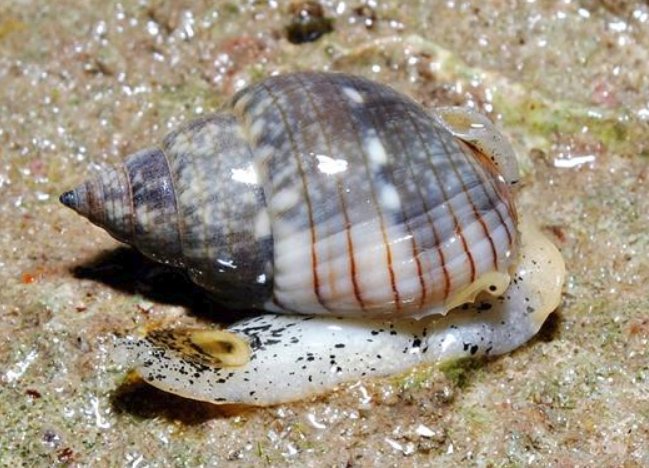
The second photo shows a different species of whelk crawling on the sand. The animal's foot, at the lower left, is white with dark spots, and the operculum is also brownish, attached atop the end of the foot. Many, many families of marine gastropods have opercula (the plural of operculum). Twenty families of freshwater gastropods also have opercula, as do a small number of non-pulmonate (that is, gilled) land snails. Only one prominent family and two very minor, though related, families of pulmonate land snails have opercula. A pulmonate snail has a lung rather than gills, or in addition to gills, and can thus spend prolonged amounts of time out of the water.

A clausilium is not an operculum. This structure is not kept external to the shell, as an operculum is, but is internal, as seen in these semi-transparent shells. Rather than being attached to the animal's foot, it is attached by a muscular structure to the columella, the central column around which the whorls of the shell are wrapped. When a Clausiliid snail retreats into its shell it pulls its body inside, then deploys the clausilium to block the aperture. So the clausilium's purpose is the same as that of the operculum, but is a distinct evolutionary development.

In addition, whereas an operculum is sometimes thin and even translucent, it is usually robust and may be a thick shell in its own right with a spiral structure. By contrast, a clausilium, although always calcareous, is thin and rather fragile. Apparently, members of the Clausiliidae, being small and having a small aperture, do not encounter the determined predators that attack many marine snails.

Today in my work on the current project at the Delaware Museum of Natural History I began to take inventory of a little more than 1,000 lots of the family Clausiliidae. The type genus of the family is Clausilia, described by Jacques P.R. Draparnaud in 1805. He based his description of the genus on the species Clausilia dubia, but a later evaluation by physician and malacologist Louis C.G. Pfeiffer led to a re-description of the genus as referred to Clausilia scalaris Pfeiffer, 1850. Ironically, this species has been renamed and then made synonymous with another species, and is now called Muticaria macrostoma (Cantraine, 1835; Cantraine originally called the species Clausilia macrostoma).

I found that DMNH has just one lot containing shells of this species, which is endemic to the island of Malta. The collector, whose material was obtained by Ralph Jackson in the 1950's and later donated to the museum, notes that this species is "very rare". Yet he somehow obtained six shells.

This photo shows the shells close to natural size. It is hard to see in this image that the shells are well-decorated with ridges or striations. Clicking on the image to see it larger is a little better, so I also took a closeup through a low power microscope.

The species name "macrostoma" means "large mouth". Clausiliids all have small apertures, and the aperture of this species is only "large" by contrast to many other species in the family, and that primarily because of the wide lip around the "mouth".

All the shells in this lot have the first one or two or three whorls broken off. That fact and the ridges indicate that these little animals live in a rather high-energy environment. I became curious about the locality so I looked it up, and found that Mistra is on a protected bay. Malta is not very large, being 17 miles long and 8 miles wide (27x13 km), but it has room for at least five places named "It-Torri", which means "red tower". The nearest to Mistra is about three miles to its northwest. This is a much windier locale than Mistra, so perhaps such environmental stresses shaped the species.

Few clausiliids are so heavily decorated, and, indeed, most are smooth or nearly smooth. So it is ironic for this to be, in effect, the "poster child of the Clausiliidae."

Monday, September 18, 2017

Fake news isn't new

kw: book reviews, nonfiction, essays, science, sociology

A headline or tweet is too small to elaborate anything useful. When Dr. Feynman received a Nobel Prize in Physics a generation ago, a reporter asked him, "Can you briefly tell me what you did?" He replied, "If I could tell that to you in one minute, it wouldn't be worth a Nobel Prize."

If everyone had to learn the basics of the sciences to graduate from high school, as it was in the past, and learn the kind of critical thinking required to "do science", maybe the American populace would be harder for quacks, charlatans, and a dishonest Media machine to manipulate. And, just maybe, the purported "national leaders" we call Senators and Representatives wouldn't make so many utterly boneheaded decisions whenever there is a scientific fact involved. The "critical thinking" taught in this generation's high schools would be laughed out of Plato's Academy.

Into the fray wades Joe Schwarcz, a Chemist who writes best-selling books, one after another, that frequently discuss how most Americans and most purveyors of the news get science wrong nearly all the time. His latest is Monkeys, Myths and Molecules: Separating Fact From Fiction, and the Science of Everyday Life.

There is no useful way to summarize 65 essays as diverse as I find between these covers. I'll just touch a point here and there:
  • "A Tale of Two Cantaloupes" in the section "Swallow the Science" discusses first an outbreak of Listeria in 2011, carried by feces-contaminated cantaloupes, that eventually killed 35 people. Cantaloupes sit on the soil at they ripen, making them particularly prone to harboring infectious bacteria if "natural" (manure-based) fertilizers are used. The second cantaloupe saved lives: during the research to turn penicillin from a laboratory curiosity into an industrial scale medicine, in 1941 a particular strain of Penicillium that makes cantaloupes rot was found to produce the antibiotic with a concentration ten times that of other strains of the mold. The principle developed here is that context matters.
  • "Capturing Carbon Dioxide" in the section "Chemistry Here and There" looks beyond the technologies of snagging the gas from smokestacks and such "emitters". The technology is well known. Its costs are inescapable, about 20% of total energy production. Than what do you do with millions of tons of this gas? The author discusses numerous things that we can do with CO2, such as making soda pop, using it to feed algae for biofuel production, and making chemical intermediates. But these don't add up to enough "uses" for the stuff to use up the supply. We burn a lot of fuel! Pumping it into the ground has its own problems. Besides the difficult matter of ensuring it won't just leak back out, the recent rash of earthquakes in places where "fracking" for oil is being carried out show that shoving anything into the earth in large quantities can have wide-spread and possibly devastating effects. Y'gotta think things through.
  • Several of the essays discuss the trouble folks sometimes cause by taking the results of tests done on mice and extrapolating them to humans. "Of Mice and Men" in the section "Stretching the Truth" is an example. A study had shown that intense sessions of treadmill running made changes to muscular and molecular structures, that were not found by longer sessions of less intense activity…at least for mice. Mice are convenient. You can work them half to death for a week or so, and then kill them and dissect their muscles to figure out what might have changed. Can't do that with people. As it happens, there appears to be a threshold in this effect, and it is probably so high that very few people ever work out with sufficient intensity. This essay takes a side trip into the possible effects of chocolate on Alzheimer's disease. This was also based on mouse work. But it was even more indirect: nobody fed cocoa to mice or to people. They dosed mouse nerve cells with various cocoa extracts. I guess there was enough of an effect that exciting headlines and review blurbs could be written. But nothing is yet known about whether the chemicals so tested will cross the blood-brain barrier when you EAT chocolate, rather than injecting it directly into the brain. Oh, well. The point here is, you need to determine what was actually found out, before concluding it is anything useful in the real world.
Dr. Shwarcz has wide-ranging interests, and his essays cover topics from acupressure to vitamin deficiencies (and how they were discerned). I hope many folks read this book, and at the very least learn a little more caution about news headlines that tout "discoveries" that soon drop out of sight.

Sunday, September 10, 2017

A must-read if you care about your internet presence

kw: book reviews, nonfiction, internet, privacy, security, self help

The subtitle of the book should catch your attention: "Are you naked online?". Are you? If so, what might you do about it? Ted Claypoole and Theresa Payton drew on broad experience in the online security arena, including Ms Payton's service in the White House, to write Protecting Your Internet Security: Are You Naked Online?. Start by reading this book.

Privacy as we once knew it is a thing of the past. The security of everything online is similarly threatened. It doesn't have to be. I took certain pieces of the authors' advice, and before noting the results, I should perhaps explain something that may be a little uncommon about me.

I decided from the time I started this weblog that I would go to certain lengths to divorce its identity from my own. There are a few clues here and there in my posts, so a persistent and diligent person could track me down. I tend to trust in "security by obscurity", as compared to more technical means. So these results might indicate how successful I have been.

Of course, the authors recommend that we all fire up a browser window in Private (or Incognito or Stealth or whatever) mode, and search our name. In my case, for historical reasons, there are six variants of my name, and two variants of this blog's name. But the search was not nearly as arduous as I expected. From the longest to the shortest ways to look up my name, always putting the entire thing on quotes (but none of those ways using a first initial rather than a first name):
  • 4 text hits, 3 of them reporting my first marriage in various newspapers.
  • 1 text hit.
  • Though Google initially said 279, there were 17 actual hits, and 12 were about me. There was also one picture of an ancestor of mine in an Image search, but none of me. More briefly for the rest...
  • 164 at first, then 19 of 21 text hits.
  • 1,330 at first, then 31 of 35 text hits, plus 3 of about 170 images are actually me.
  • 2 of 532 text hits are actually about me.
And for the blog names:
  • "polymath07": 3,930 at first, but only 33 if you look at returns pages. Hundreds of pictures in the Image search, most from this blog, in which I frequently post pictures.
  • "polymath at large": 7,590 at first, but only 26 actual hits. Many, many pix, nearly all from this blog.
All in all, the pages Google finds about me are nearly all positive, and of course the blog post returns are as I wish. I'd call that success.

Now, from an open browser page, I went to the Open Data Partnership "choices" page, which immediately ran a status check. It returned a long list of entities that either are or are not modifying ad choices based on my browsing behavior. Those who are, that I recognized, include Adobe Marketing Cloud, Amazon, Experian, Google and Microsoft. Some that are not doing so include LinkedIn and Ziff Davis (publisher of many magazines including PC Magazine, to which I once subscribed). One may easily opt out of all of their chicanery, but I have learned instead to do most searches for "stuff" in Private mode.

Private mode isn't perfect, so if you want to avoid, or at least confuse, advertisers and their tracking gimmicks, page 78 has a list of nine suggestions such as the Blur feature by Abine. You can also analyze your own online profile—the real one, not any of the ones you created yourself—using Spokeo, for example.

Why should all this be necessary? If you are old like me, it doesn't matter as much, but think of a teenager whose entire online presence is rife with teen attitude, complaints about parental restrictions, kidding and teasing (and worse) of "friends" and others, and the general sort of things you'd expect from kids who don't yet realize they are mortal. Fast-forward five years, when they are applying to a college, or ten years, when they are applying for a job. Colleges and prospective employers track down all the social media you've been using, and they are better at it than you think. Just changing your name on FaceBook or Twitter isn't enough. If your likeness appears anywhere, a single well-composed image of your face can turn up a lot through Image Search in Google, at the very least.

Or maybe you are a 35-year-old trying to build a business who has attracted the ire of a competitor. Will the competitor create an account somewhere in your name and use it to publish inflammatory and defamatory material that would drive away customers who stumble across it and think it is you? An entire industry of Reputation Management has arisen to address just such scenarios. Even if your competitor didn't do you dirt, maybe your teenage self did already, and unpleasant traces remain of someone you once were, but no longer are. The internet has a longer memory than a jilted spouse! To many folks, what you were then, perhaps you still are, under that polished veneer.

This naturally leads to a section on guiding your children through their early years as a digital native. It will be hard work to keep them from shooting their future self in the foot, but it is necessary.

Another notion occurred to me: Phase your life, and use a different online avatar and screen name for each phase. Upon entering Middle School, a preteen might post a sign-off in a soon-to-be-unused FaceBook account, saying "Goodbye, I'll go silent now. Catch everyone later, and elsewhere." Then she can use a new version of her name to start a new account, and gradually import old friends, but only after they have undergone a similar transition. Hard as it may seem, it is best to discard "friends" who don't see the value in this approach. The end of High School is a good time for a similar changeover. Other phases come to mind. Think it through.

Also, such a time is a good one to go through the abandoned account and delete posts that will cause trouble to the "new you". Of course, the Internet Archive will still have them in its "wayback machine", but you cannot cleanse everything. That's why it is best to keep your most private thoughts out of the ether entirely. When you are musing darkly, the Cloud is not your friend! The Google Docs app isn't totally secure; nothing online is.

A lot of this is like getting a better lock for the front door of your house and a better security system. It doesn't guarantee the house won't be robbed, but it makes you a harder target, so most thieves will pick someone less diligent to burgle. And that's the best advice for anyone concerned about their online privacy and security. Take a little forethought to be a harder-than-average target. It is worthwhile, and these authors are good guides to doing just that.

Monday, September 04, 2017

Toothbrush support Life Hack

kw: life hacks, toothbrush support, travel

Here is a little item I haven't seen in any of the "life hack" viral videos:


When staying in a hotel, we never see a toothbrush stand. We had been using those flimsy plastic cups to hold the toothbrushes off the sink surface, but they tip easily. Then we hit upon an easy solution: half fill the cup with water. Now the cups are stable.

By the way, we also keep the plastic bags the little soaps come in. (They are behind the left cup). If we like the soap (some brands are too sticky to wash off) we let it dry a little and put it back in the bag to bring home. If we don't like the soap I get out a small bar I carry in the suitcase. The hotel throws the soap away if you don't take it.

I'll often try out the shampoo they provide and if it is good I'll take that also. They are small enough to carry in carry-on luggage for plane flights.

We had a holiday weekend but the spiders didn't

kw: blogging, blogs, spider scanning

I didn't log in for several days because of the Labor Day weekend. Here is what the Stats look like for the past week:


I wonder what the Russians are so curious about this time? Not that it matters much…

Thursday, August 31, 2017

Student Loans Exceed Credit Card Debt

kw: book reviews, nonfiction, lending, student loans, debt

A good friend of mine was "killing himself by degrees" prior to age 30: he has four degrees, the familiar BS - MS - PhD in science, and a MS in Computer Science. He married a woman with two degrees in Fine Arts (and she is indeed a fine artist). They entered upon a new marriage and new careers with loads of student debt. However, he landed a job at the company I worked for, in a well-paying position, so in addition to making payments on their student loans, after a couple of years they were able to buy a house. It took them until their mid-forties to pay off all their student loans. I count them lucky.

Equally lucky are those who at least partly "work their way through". They finish a BS or BA degree holding debt that is no more than half a year's pay at a reasonably good job, say, $25,000 or less (The median wage in 2015 was $56,500). Over ten years at low interest, the payment would be about $220 monthly. That's only about twice what many folks pay for cable TV.

A growing number would not consider themselves lucky in any way. They borrowed $30,000 to $80,000 to fund an education that prepared them for years of unemployment or a "desperation job" (a McJob) that doesn't pay them enough to rent a tiny apartment with three roomies that is "only" a 10-minute walk from a bus stop. Car? You gotta be kidding! They live in their parents' house and borrow their car.

Let's face it. The job market for English and History and Anthropology majors, not to mention majors in Women's Studies, Social Science, Art, and almost any other "liberal art" is next-to-invisible. A few hundred college professors in "humanities" departments, at most, retire yearly. Not all are replaced (the student body is shrinking). If you have a degree in History, nearly the only jobs in History are that tiny pool of college professorships, for which you need to get a PhD anyway, at even greater expense. Or you can get a MS in Education and try for a teaching job at a high school or middle school. That job market is pretty small also, and shrinking.

OK. So you're lucky. You got a degree in a STEM discipline: Geology, Physics, Engineering, Math, even Industrial Engineering. You're marketable. Whew! The book probably isn't for you anyway.

Let's take a side tack for a moment. I am about to have a pair of roofers fix some squirrel damage to our church's roof. They'll probably work most of a day. The estimator's bid is $875. Considering that some of that money goes to the company and some to the boss, still, each worker will get around $250-$300 for the day's work. That comes to $60,000 to $72,000 for a year, as long as their company can keep them fully employed. And you know what? Nobody in India or China or Mexico or Vietnam can take that job. You can't "outsource" roofing! Nor plumbing, painting, carpentry, electrical work, landscaping, paving, and a host of other "trades". None of them require a college degree. Most of them pay better than teaching school, which these days requires two degrees (the low pay for most teachers is an injustice I'll take up on some other occasion).

For me, the hero of America's prosperity is not the college professor in the ivory tower, but the people interviewed by Mike Rowe for the Dirty Jobs series on the Discovery Channel. Mike is an actor, but the people doing the work sure aren't. To me they are heroes. And it would be a good idea if people had to work at a tough trade for several years before they were admitted to college!

This is all a riff on recently finishing the book Game of Loans: The Rhetoric and Reality of Student Debt by Beth Akers and Mattew M. Chingos. I don't really have much to say about the book itself. It saddened me, but not for the usual reason. I know enough already to be sad about abusive student debt, which is why we struggled to get our son through college debt-free. No, I am saddened by the lengths to which the authors go to minimize the reality, and they all-too-frequently "blame the victim".

I am a political conservative, though that term is losing its meaning these days. But I am also a social liberal, in the old sense of making people free, of giving them a hand up but not a handout. "Handout" politics is actually socialism, and there are darn few non-Socialists in today's Democratic party. I am not sure I would count Toni Morrison as a socialist. She is definitely a social liberal, and when I heard her speak at the commencement for our son's BA degree, she said this (not an exact quote; it has been a few years), "Will the day come that people will look back on our generation with astonishment that we required the best among us to pay for their own educations?" I agree with this, in part. Our system needs to re-gear itself toward having every student exit the "halls of academia" debt free. But I think it is healthy for a student to have some skin in the game. That means doing some work to pay for part of their education.

It is unhealthy for someone to finish college with a degree or three or four, having never worked at a job people were willing to pay them to do. It is unhealthy for massively unprepared 17-year-olds to be dropped into a super high-school environment with no parental oversight, and with no understanding of the source of the funds hidden behind the meal card they swipe at the all-you-can-eat buffet many colleges now have in place of the "food service" I "enjoyed" at Kent State in the 1960's. (P.S., There was no "freshman 15" then. Most Frosh lost weight their first year of college.) It is unhealthy for students to find themselves faced with 20 or 100 options for "student aid", most of which involve debt under terms they haven't been educated to read with any understanding, and confusing qualifications that waste their time when they apply for things they can't get anyway.

I say "unhealthy". Debt-ridden college graduates are sick. Job-unprepared graduates are sick. We need a culture shift and I am not sure how to even describe it.

The authors of Game of Loans decry the difficulty of finding information about the cost-benefit ratio of most college degrees. This is true: Congress has passed laws specifically forbidding the gathering of such information! Guess which lobbyists supported those laws? But we don't really need information in such detail. Just look at the job market. Go to any employment agency and ask for a breakdown by job type.

Oh, I forgot for a moment: If you have read this far you are not likely to be a Millennial, but if you are, you never "go to" any such place as an employment agency. You want everything online. OK, go to the Bureau of Labor Statistics website, the Occupational Outlook Handbook (OOH) (https://www.bls.gov/ooh/). Dig around and find out whether there is much future for the kind of job you "sorta want" (I know, Millennials are practically free of passions). Here are a couple of examples I found by digging around:
Fine Arts or Crafts. About 50,000 jobs held in 2014. Growth rate less than 2% (or about 1,000 new jobs per year). Half of the jobs are "self employed". Median pay is under $49,000/year. Digging elsewhere we find that about 100,000 new BA's in Fine Arts graduate yearly. Only 1% will be able to make it pay, and half of them will spend more of their time running the business than "making art".
Environmental Scientist. About 95,000 jobs held in 2014. Growth rate 11% (~10,000 new jobs yearly). Median pay $69,000/year. I didn't find stats on graduation rates. But there are about 20 times as many jobs available as there are for artists.
Carpenter. Just under 1,000,000 jobs in 2014. Growth rate 6%, or about 60,000 new openings yearly. No college is needed but it usually takes 3-7 years in an apprenticeship program to become a Journeyman and earn pay in the mid-$40's or more.
I picked the first item because I have a young friend who is quite a good artist and illustrator. He wants to work in animation, even Animé. That's a smaller field than fine arts in general. There is little hope that he will ever be anything beyond "self employed" (struggling/starving artist working nights at a McJob to pay rent and buy beans to eat).

The biggest and most important educational innovation that could be performed for America would be to teach our young people the meaning of "employable": You must be able to do something people are willing to pay for. Period. If you need college credentials to get such a job, dig around in the OOH web site above for a dose of reality. Is it worth $30,000 in student loans to get a ½% chance of paid employment as an artist? Or is that four or more years (5-6 is common now) better spent in an apprenticeship program for carpentry, or electrician (2/3 the jobs as carpenters but better pay)? Get a part time job teaching art and making art at a private school of the arts (like I did with music).

I am in favor of programs advocating trades. I read that three million jobs in the trades are just waiting for competent workers to fill them. People go to college for many reasons, but I suspect for many of them, it is that they don't want to sweat on the job. The Bible has two things to say about that:
By the sweat of your brow you will eat your food until you return to the ground, since from it you were taken; for dust you are and to dust you will return. — Genesis 3:19
For even when we were with you, we gave you this rule: “The one who is unwilling to work shall not eat.” — 2 Thess. 3:10
These two passages are the basis of social conservatism. But they also highlight a problem with the education-versus-work culture in America today. Our youngsters are told (as my generation also was told) that they need a college education to get a "good job." But what is a "good job?" One that doesn't involve bodily sweat? When a plumber's hourly pay is greater than that of the accounting clerk going blind at a "desk job", which one has the better job?

Colleges charge 'way too much because their "services" are in demand. That demand is part of the problem. I have been sorry to see the demise of most of the nation's Vo-Tech and Trade Tech institutions, while we churn out tens of millions of unemployable college graduates who think they "deserve" a better job than driving a backhoe. Backhoe operator is a pretty skilled occupation! It frequently requires problem solving skills that would surprise you.

Parents of students entering high school, and high school students: Think about what you really want to do. Find out how likely it is that someone will pay good money for that to be done. The fastest growing occupations for the next decade or so will be in personal care and health care for all of us aging Boomers! Think about that. Construction trades are big right now but they may enter a period of decline, because Millennials, today's twenties and thirties, aren't so much into buying McMansions, compared to Generation X. And do yourself a favor. Unless you have both the love and the talent for a top profession such as medicine (which Obamacare is destroying), take off a year or three from education and work in a trade before deciding on a college major, if any. Examples from my experience:

I am one of four brothers, and our life arc has been thus:

  1. Me, the eldest. Majored in Chemistry, switched to Physics, finished in Geology after 7 years. Two of those years were working full time to pay my way through the rest of college, and part time work during the rest of college. Then I worked as a Draftsman who also did computer coding. Returned to graduate school at 32, getting a MS at 38 (another 7 years), working my way through with teaching and consulting. Worked as a coder until retirement at age 66, and was never paid a nickel to do any geology. I work part time in retirement, more by choice, but the added income is nice.
  2. Majored in Physics and Art History, graduating in 4 years. Worked his way through school as an electrician's apprentice. A calligrapher and carver, worked as a "starving artist" for 20+ years, making ends meet as an occasional coder. Returned to school and got a MA in History and PhD in Archaeology by age 50, working his way through as a book illustrator. Now a college professor. Age 66, with no end in sight.
  3. Majored in Mechanical Engineering. Worked in Environmental Equipment design until company folded when he was 60. Now works as a Maintenance Tech.
  4. Didn't finish college. Tried various "management training" type jobs with friends, but best pay has always been handyman and home remodeler. He is good at it. Age 62, with plenty of work and quite good pay.

None of us had college loans. We would have floundered had we had such debt to pay off.

You may wonder why I didn't really review the book. That is because it misses the point so badly.

Tuesday, August 22, 2017

Hi, Russian spiders. I'm still watching!

kw: blogging, blogs, spider scanning

The various tools on the Stats page in Blogger just showed me that these 181 hits from Russia all occurred in the 5:00 AM hour. I presume that is Pacific Daylight Time. That would be about 3:00 PM in Moscow and 7:00 PM in Novosibirsk, a more likely source.

If I decide to pay for the more precise analytics I could pinpoint the city, but I'll leave that to others. Considering that this blog has quite low popularity, I wonder whether the same spiders are making a big impact on really popular sites like the Freakonomics guys. Is anyone else out there even checking their stats?

Sunday, August 20, 2017

Your English isn't your grandfather's English

kw: book reviews, nonfiction, language, words, linguistics, historical linguistics

I find John McWhorter fascinating: he digs out so many lovely examples of language usage, and writes about them so engagingly… In a prior book I reviewed in 2009 (Our Magnificent Bastard Tongue) he brought to our gaze the numerous chunks of other languages that were dragged together almost wholesale to produce what we today call "English". Now in Words on the Move; Why English Won't—and Can't—Sit Still (Like, Literally), he provides an antidote to the amount of energy some of us "seasoned citizens" give to decrying the trends of change in language usage (Like, you know, gag me with a spoon if I have to keep hearing that!).

That last string of phrases caused much angst in my generation when "Valley Girl" (Val Gal) talk sprawled across the nation like a lanky teen on a love seat. In particular, "like" has gone from a word meaning (as a verb) "to desire or feel affinity to" or (adjective, adverb, etc.) "similarity", into a "piece of grammar", no longer really a word, but a functional sound that has morphed from the "similarity" end of things to at least three or four uses, most particularly a kind of bullet point, such as an example on page 215:
"So we're standing there and there were like grandparents and like grandkids and aunts and uncles…"
"Like" has become more a signal than a word, and this isn't new, it started almost a century ago, some 30 years before the Beatniks began to say, "Like, wow, man!". The new "like" has gathered new uses to the extent that McWhorter touches on it in three different chapters and spends a dozen pages on it in his last chapter, "This is your brain on writing." This word is an example of several he discusses, that are grammatical markers and have become very hard to explain as words. They are "grammaticalized." Consider what "well" or "so" might mean when used to begin a sentence. Could you explain them to an inquisitive five-year-old? Thought not!

Gliding back to the first chapter, "The FACEs of English", we find a long discussion of the acronym FACE, used to describe the uses of grammaticalized words such as "well" or "so", which a linguist would call "Modal Pragmatic Markers" or MPM's. Here "pragmatic" most closely means "personal". Our author states that a multitude of such words are needed so that we don't just speak English, we can talk.

This brings us to a major theme of the book, the difference between written and spoken (or "talked") English. Firstly, of course, we use fewer grammaticalizations when writing. I tend to write at full speed as though I were having a conversation with you, so I almost began this paragraph with, "Now, …". Were you and I really talking together, that's how I would have said it. But even writing full speed at 50wpm or so, I edit as I go and make the written form a little more compact, and, I hope, readable. (Those who find me long-winded are saying, "Oh, really!")

He dwells much more on spelling. For example, written English has a pronunciation rule of "silent, terminal e", that it makes the vowel before the prior consonant into a long vowel. Thus we have "mad", meaning crazy or angry, in which the "a" is pronounced as flatly as possible and is often called "short A"; and we have "made", meaning constructed or produced, in which the "a" is pronounced almost like "eh-ee" and is called "long A". The author tells us that nobody would design such a system from scratch, and that it had to arise from some process. Indeed it did. He discusses the "Great Vowel Shift" on pages 152-159, using a map of the placement of vowels in our mouth to show how the "short A" of 5 to 9 centuries ago morphed into a longer "E" sound then to the "long A", and that a final "eh" sound at the end of many words was gradually dropped. Thus, "made" was once pronounced "mah-deh", as the spelling suggests, shifted through "meh-də' ", which a much shorter final syllable, shown by the schwa (ə), which is more of a tiny grunt than a vowel, and then into the one-syllable word of today. The Great Vowel shift moved all the vowels about, leading certain words that once rhymed to have different sounds now than then, and they no longer rhyme. "Water" and "after", in "Jack and Jill", used to rhyme perfectly. No longer.

Dictionaries began to be written for English very early in the Great Vowel Shift. While this didn't exactly entomb all the spellings in stone, they did tend to hold things back, and today, dictionaries of "modern English" have to trot to keep up, having been rendered out of date by our movable language just in the time needed to research, typeset, and publish them. By the way, usage of the words "typeset" and "typesetting" is dropping, having peaked in the 1980's; they are being overtaken by "key in" and "keying in". As computers get better at speech recognition, those will drop off also.

Here is side point that I enjoyed. Do you ever hear the expression "willy-nilly"? I figured out long ago that it came from "will I, or nill I", but I wasn't sure just what "nill" meant. Dr. McWhorter has the answer. A millennium or so ago, negating words was done by adding the prefix "ne-", so to "not will", or not desire, something was to "ne-will" it. To say you don't have something, you would say, "I ne-have it", but by Chaucer's time it would have been "I nave it", with "nave" pronounced "nah-veh" or even "nah-və". And Chaucer spelled it næbbe. It seems the consonants have shifted as well, but the author has left that for a future book, I reckon.

I'll forbear further nerdifying. It is a delightful book, and an incredibly informative one. I am thinking of giving a copy to a friend who is a linguist, but primarily of Chinese, not English, to see what similar trends might have occurred in Mandarin, which the Chinese acknowledge is not a written language at all: the "written Chinese" language is one that nobody speaks, but they all know how to interpret it into whatever dialect they grew up speaking.