kw: book reviews, nonfiction, medicine, hospitals
From the word hospital, derived from host, we get the word hospitality. Sadly, as shown in a recent Time article by Steve Brill on the Chargemaster system and hospital administration practices, there is precious little hospitality to be found at any American hospital. Put that together with a flood of anti-doctor and anti-medical-establishment books in the past ten years, and I find my attitude towards "health care" in America is pretty bleak. Thus, I was cheered to read about Laguna Honda Hospital in San Francisco, the last Almshouse operating in the U.S.…at least, I was cheered for the first third of the book God's Hotel: A Doctor, a Hospital, and a Pilgrimage to the Heart of Medicine by Dr. Victoria Sweet.
Nearly every hospital throughout Europe and America began as an Almshouse, a charitable organization usually connected to a monastery or convent. (Side note: The Roman Catholic church canonized Mother Teresa a few years ago. During the late Twentieth Century she was nearly unique, but prior to about 1930, there were thousands of Mother Teresas in Almshouses around the world and across America.) And until recently, the 2/3 of hospitals that are private, non-profit entities were low-cost facilities where doctors could provide more specialized care for major conditions. They took advantage of economies of scale, sharing the cost of operating theaters and later intensive care wards.
Then two trends collided. Technology produced "imagers"—CT (formerly CAT) scanners, MRI (formerly NMR) scanners, PET scanners, EBT scanners (e.g. HeartCam) and other multi-million-dollar imaging machines—and then "Gamma knife", daVinci robotic surgery and an increasing number of high-tech "procedure" devices. And the number of tests that can be performed on a blood or urine sample continues to multiply. All are very costly. I also count the huge pharmaceutical industry as a segment of technology. No longer an enterprise devoted to finding natural chemicals that kill bacteria or amend hormone imbalances, the drug trade is now all about designer substances intended to increase the cost of treating a growing array of symptoms (many are now just "marketing illnesses" that were once considered normal variations), primarily for the benefit of their stockholders.
Perhaps starting a little before the technology trend that began in the 1920s, the "efficiency" trend promoted by Frederick Taylor and Frank Gilbreth gained sufficient steam by the 1970s to totally transform medical "care". Today, the "health care" establishment—both hospitals and insurance companies—primarily cares for continually increasing stockholder value. Doctors' time is squeezed, so that many feel pressured to see between four and six patients (increasingly called "clients") per hour. Nurses' time is squeezed, so that paradoxically, nurses are being laid off (and new nurses can't find jobs) at a time when the Baby Boomers' need for health care is rising rapidly.
As God's Hotel shows from its middle chapters on, a third trend, of "rights" for everybody except those who are supposed to know what they are doing (doctors and nurses), has collided with the other two, demanding ever increasing "services" while ignoring their costs.
Dr. Sweet began her career with a double ambition. Of course, she was a newly-minted M.D. with her residency completed, and wanted to practice medicine, brim-full of allopathic training. She had also experienced things that seemed to go beyond Twentieth Century medicine, and at a propitious time, encountered Hildegard of Bingen's Medicine, written in the Twelfth Century. This epitome of "premodern medicine" had an entirely different view of the human person, well or ill, than "modern medicine". It also described quite a variety of treatments known to be effective, many of which are still used. Think Aspirin for minor pain: you can make it yourself by extracting willow bark with vinegar, as people did for centuries. Think "eyeblink" diagnosis (also called Augenblick, from German): when you've seen a syndrome, you will recognize it again in an instant. See many and sundry sick people, and you'll "get an eye" for this. My uncle was a master at this, as was his father. Dr. Sweet was able to pursue a PhD in premodern medicine while carrying on medical duties at LHH. Her experiences there, and a 4-year pilgrimage she undertook with a friend, form the framework of the book.
Sometimes the "eyeblink" can take a little time. Thus the value of sitting with a patient. Late in the book, Dr. Sweet (called "Dr. S" by nearly everyone at the hospital) writes of being stumped by a very sick patient who took a turn for the worse, could not endure a touch without screaming, threw off the bedclothes and her gown, and lay writhing on the bed. So the doctor sat by her bedside and watched. Soon she realized the woman looked like she was trying to drive a poison out of her system, and pondered what the poison could be. Thinking through the long list of medications, she realized that many of them increased retention of Serotonin. She diagnosed Serotonin Syndrome and cut way back on those medications. The woman recovered, fortunately, because the syndrome is frequently fatal and is hard to detect with a blood test. The diagnosis relied on application of modern knowledge together with an ancient technique of simple observation. It took less than an hour, and used no blood tests, indeed no physical contact with the sick woman at all.
What is an hour of a physician's time worth? My family doctor charges $150 for a half hour's visit (he eschews the HMO limits of 10-15 minutes, thus cutting into his income, but providing better care, genuine care). He has rent and utilities to pay, staff to pay, and probably pays himself less than half that, but suppose he is "earning" $150 per hour. That works out to $300,000 per year for an 8-hour day, but I reckon he works longer hours. When I go for blood tests, a simple "metabolic panel" has a retail cost of $300, though the insurance company discounts that to $160. Just a blood count (hematocrit) is $100 or more. The venipuncture by the needle girl is $50. I don't know what kind of blood test can detect Serotonin Syndrome, but I bet it costs more than $150, and I am sure Dr. S was paid less than $150/hr in the year 2002 or so.
The book is full of examples that show how "efficiency" is far from efficient. The paperwork to buy shoes for one patient who had none was taking weeks and weeks, until one doctor bought a pair for $60 and gave them to the patient. He could then be discharged. How many days, at a few hundred dollars a day, would he have been kept in the hospital waiting for the "efficient" service to occur?
Laguna Honda treats (or treated) the poor, the really poor, many sent over from the County Hospital after they had run the course of "acute care" available there. They ranged from very ill to nearly dead. Many were drug addicts. Some had nearly no liver left from heavy drinking. Most were too sick to return home, ever. The Almshouse provided a synergistic mix of allopathic and pre-modern medical care. But, during Dr S's twenty years there, things changed. The Twentieth Century intervened, with its "efficiency", its technological gimmicks and gadgets, and its nannyish "rights" enthusiasts. It was somehow against the "privacy rights" of the patients to have open wards with 30 beds, even though 90% of them preferred the community spirit that resulted, and LHH had a few private rooms for those who really, really didn't like sleeping in an open ward (once they recovered enough to notice). But the nanny-state decreed otherwise.
A 10-year Justice Department review resulted in a scathing report that required either shutting LHH down and paying (by California and S.F. county, of course, not by the Feds) for some level of "care" in their "homes", usually skid row hotels. Even though a number of the patients had been kicked out of such hotels for infractions such as starting fires or having fights (imagine two people too sick to stand, having a fight)…or being replaced by a new, "modern" facility up to DoJ standards. Amazingly, the voters of San Francisco voted in favor of a bond issue to the tune of a third of a billion dollars, and the architectural review began, followed by construction, and finally, moving all the patients to the new place.
The book ends in a way that led me to infer Dr. S left LHH at that point, or soon after. There is no way the former standard of caring could be carried out in the new facility; it is devoted to "modern care", which we must remember, only cares for the bottom line. There is no "hospitality" left in American hospitals. All are mis-named. The book made me laugh a time or two. More often I breathed, "Oh, wow!". Sometimes I wept. During a few months living in Switzerland, Dr. S saw medicine practiced in a way more similar to LHH than to anything else in America. To get caring care, now Americans must travel abroad. Sic transit Miraculum.
Thursday, March 14, 2013


Saturday, March 09, 2013
A Dyson hemisphere
kw: book reviews, science fiction, space fiction, space aliens, space travel
In their first collaboration, Larry Niven and Gregory Benford have come to lead that subgenre of Science Fiction that combines hard science, some blue-sky projections thereof, and believable sociology of both human and alien societies. In the case of Bowl of Heaven, the hard science keeps all speeds below that of light and accepts certain other known limitations of physics, the projections (or speculations) push engineering to the scale of a solar system and also posit a ramscoop that uses superconducting magnetic fields a few thousand times greater than any so far known, and the sociology involves a dozen or so humans confronted by not just one or a few quite alien species, but a profusion of them, in a colossal engineered ecosystem.
Most SciFi aficionados know the concept of a Dyson Sphere, the product of a society that captures all the radiation of a star as its energy source. Though Dyson first conceived of a hollow sphere, the concept was soon modified to encompass myriads of large, stellar-light-capturing orbital habitats in a thick shell about the star, sufficient to block all or nearly all of its light, and emitting waste heat primarily at wavelengths between 8 and 20µ (the human body's thermal radiation, at 310K, peaks at 10µ). So far, no deep-infrared stars suggestive of such structures have been observed. The orbital mechanics of such a system are formidable, and collisions might be so frequent as to make the scheme impracticable.
Niven's best-known foray into the partial Dyson Sphere arena has been the famous Ringworld series. Now we have an even more ambitious engineering project: Build a hemisphere centered on a flare star (a late K or early M star that tends to have a strong stellar wind), that supports many (quadrillions, I suppose) steerable mirror segments. Its radius is roughly an AU (150 million km). A wide ring at the equator supports a habitat with the area of many trillions of km², and the structure rotates to produce centrifugal "gravity" in the habitable ring. There is a hole at the center (the rotational axis of the hemisphere) with a special function. The mirrors reflect the star's light to focus on an area at the "rear" of the star (we can presume its axis of rotation), heating it and focusing its stellar wind into a jet that passes through the hole in the hemisphere. This begins to drive the star. Some sort of engines in the hemisphere counteract its orbital instability until the star begins to accelerate sufficiently to closely balance the tendency of the hemisphere to fall inwards. Then the job of the engines is quite a bit easier, or at least less energetic. Now you have a "ship" that is similar in size to the orbit of Earth or perhaps Mars, that can cross interstellar space over a span of millions of years.
This idea by itself could be fodder for a simple high-concept novel. For Niven and Benford it is mainly backdrop. Put it out there, make it a few tens of millions of years old, populate it with a cadre of large, birdlike alien species and an uncountable number of "adopted" alien species whose members they have plucked from star systems as they swung by in ages past. Then add US.
A ramscoop from Earth, bearing colonists heading for a star they've named Glory, catches up with this star-centered Bowl. Now, we all know that paying a visit to aliens who can engineer on such a scale is quite foolhardy. But it happens that the colonists, most of whom are in frozen sleep, have a problem. The small "awake" crew has discovered that the ship's top speed is a few percent low. Low enough that they can't keep a crew awake and alive long enough to get to Glory. They figure the Bowl might be able to supply them with materials they can use to replenish their stores, so they do pay the ill-advised visit, and of course the landing crew is partly taken captive and partly escapes to re-learn their Boy Scout skills as they flee hither and yon, evading capture while they learn what they can about the Bowl and the habitat.
I have wondered in the past just how big a spinning structure could be, to produce about 1g of apparent gravity. It turns out that the stress intensity for 1g of centripetal acceleration increases linearly with radius, such that the strongest known steel could not produce 1g when the radius is greater than a few hundred meters. Perhaps some kind of carbon nanotube assembly could hold together a structure of a km or so diameter. Both Ringworld and the Bowl would require materials with a tensile strength a few million times greater than any known. However, I was able to keep such considerations from marring my enjoyment of the book and its concepts, and I trust so can most SciFi readers.
A great deal goes on in this 400-page book, as we glean insights into the various cooperating "big bird" denizens and some of the Adopted species, and as one human group begins to learn to communicate with their "hosts" while the other searches for understanding and some kind of bargaining leverage. Here, the volume ends. I suppose a trilogy is planned (though the authors promise but one sequel, Shipstar).
The possibilities of quite distinct psychologies that the authors explore in the big birds are fascinating. Is our human Bicameral Mind going to be a handicap or a detriment, compared to their more unified psychology? It makes me wonder if the future volume(s) will explore the possibility that human psychology could become more unified, making our "unconscious" more consciously accessible.
There is a character, Fred, that I found myself identifying with. He is socially awkward but totally at ease with machines and computer code. In a conversation he describes his problem-solving technique, which takes advantage of sleep, and I was saying, "Yes! That's just what kept my programming career going for 4 decades!". I figure that either Niven or Benford must do this, or they know quite well someone who does and has described it. It is comparatively rare as an explicit technique, though many people have experienced waking up with a worrying problem solved.
Now I have my marching orders, to track the progress of the next volume, Shipstar, and any possible successor volumes. I can hardly wait.
Monday, March 04, 2013
Economics that is beyond me
kw: book reviews, nonfiction, economics, politics, polemics
Tranche: Transaction documentation usually defines tranches as different "classes" of notes, each identified by letter (e.g. Class A, Class B, Class C securities) with different bond credit ratings. The equity ("first-loss") tranche absorbs initial losses, followed by the mezzanine tranches which absorb some additional losses, again followed by more senior tranches. Equity is riskier than mezzanine, and so forth.
A simple statement like that above (cribbed from a Wikipedia article), early in the book, would have saved me a lot of puzzlement when I was reading Unintended Consequences: Why Everything You've Been Told About the Economy is Wrong by Edward Conard. A glossary would have been even better, because those few terms bolded above are just the tip of the iceberg of specialized jargon Conard uses. It is really too bad. The back cover has six blurbs of high praise; all are from economists, who of course would understand the book without further education. For the rest of us, the book is quite inaccessible.
Of course, I have spent two weeks with this book, gradually unscrambling the inscrutable, so I can evaluate it better. In the main, I like the author's analysis, which was a relief to me: he is a former partner in Bain Capital and colleague of Mitt Romney, and I am also a financial and political conservative. Here is a synopsis of what I did understand. Bottom Line: The cause of the 2008 Financial Crisis was a classic bubble, in real estate rather than in banking as the media have stated (repeatedly!). The collapse of the bubble led to the collapse of major banks, and we'll get into that.
In the first of three sections, "What Went Right", he outlines the parts played in a national economy—on a global stage—by Investment, the Trade Deficit, and Incentives.
Incentives in particular are misunderstood by most Americans, especially in the face of a steady drumbeat of Liberal propaganda that "the rich" are "oppressing" the poor and "taking advantage of the 99%". Let's be frank. Suppose the combined governments in the U.S. were to have a super-flat tax, meaning you can earn up to, say, $30,000 per year tax-free, and then the tax rate is 100% for every dollar above that point (divided somehow among Federal, state and local governments). Do you think Andy Grove or Bill Gates or Warren Buffet would have built their businesses, or even remained in the country? At a much, much lower level, I observed this: When one of my co-workers had been at a particular salary grade a few years, he or she would begin taking on more and harder projects, hoping to impress management and receive a promotion (with its extra 5-10% pay boost). If a promotion was not forthcoming within a year or two, the same person would get discouraged and begin slacking off, and perhaps even drop in productivity to a level lower than a few years before. It is a well known business proverb: you get what you incentivize.
Now, I get pretty bothered when a company executive attains a salary that works out to a few thousand dollars per hour. I don't think anybody is worth that kind of salary. However, when a business owner takes financial risks to grow the company, and happens to hit it big (like Bill Gates, everybody's first example), it may rankle folks that he becomes "worth" millions or billions of dollars, but he hasn't attained that by putting an inflated salary into the bank. What he is "worth" is the market value of that portion of the business that he owns.
I can use a friend of mine as an example. His family-owned business was worth a few million dollars when he took over its management in his 30s. He built the business, investing deeply but wisely, so that it grew a thousandfold. A few years ago he was said to be "worth" about $20 billion. The Financial Crisis has been worldwide. Although most of his company's assets are overseas, they were affected by the recession, and his current "worth" is about $2 billion. In all this time, though, he has been paid the same executive salary of a few hundred thousand, in terms of $US. And let's consider what would happen if Bill Gates or my friend were to attempt to cash out his holdings. There is hardly anybody who can afford to buy all of Bill Gates's stock in Microsoft, and probably no institution that is willing to do so. He'd have to sell the stock over time, and it would depress the market for that stock and possibly bankrupt the company, because the precipitous drop in its value would make capital purchases more difficult or impossible.
So as much as we may envy the rich, for the most part they are enjoying the rewards of their risk-taking luck. Incentives are a necessary part of a robust economy.
There was, of course, a fly in the ointment, long before 2007. As outlined in the second part, "What Went Wrong", regulators loosened regulations on the way banks write home mortgages, administration officials and lawmakers began to put pressure on banks to make mortgages more affordable to lower-income people, the credit rating agencies rated "tranches" of bundled mortgages (as defined above) more liberally than they should have, and banks and short-term investors soon got caught up in the speculative frenzy, driving up home prices.
Continually falling interest rates, led by the Federal Reserve, played a big rôle. If the homes in Suburb A all sell for $100,000, and mortgage interest drops from 8% to 4%, you can get a loan for just over half the payment. But the price won't stay put. Someone paying $587 monthly on a $80,000 mortgage finds he can get almost twice the money for the same payment. He figures, so can someone else with a cheaper house who wants to upgrade, so he puts his home on the market for $125,000, amplifying his $20,000 of equity into nearly $38,000 after paying his realtor. Now, since he can borrow more than $120,000, he buys a house for $160,000 (ignoring the fact that it was valued at $125,000 a few years earlier). Prices spiral upward.
There is a second effect. Banks got more confident in making "subprime" loans, which are loans with smaller or zero down payment, made to buyers who are near the bottom of the "qualified" credit-score window. In a price spiral, they knew that a $100,000 home, financed at full price, would gain in price (not necessarily value!), and be "worth" $150,000 in a few years. Once the homeowner has equity in the home (the $50,000 rise in price), the bank judges he is not likely to default, making the loan no longer subprime. But something happens the bank didn't expect. The homeowner got an equity loan for $50,000 and bought a boat, took a vacation, and paid some college tuition. Now the combined loans are subprime, equity is near zero, and the smallest dip in the market (they happen every few years), makes the homeowner "under water", owing more than the house is worth. This is a fragile situation. Anything even a little unfortunate—a medical bill, a falling tree that damages the roof—puts the homeowner in the position of skipping a mortgage payment so he can buy food or gas for the car. Skip a few payments and the bank forecloses. They don't really want to, because they are going to lose money auctioning off the home, but it is better than waiting to see if this particular homeowner gets back in the black. So they foreclose, the homeowner has to move, and if house prices are still down, is able to rent a home similar to the one he just left for less than he was paying earlier.
The housing market got overheated, and then cooled off, as they always do. Too many subprime loans collided with too many underwater loans, and foreclosures climbed. Some of the loans had balloon payments, leading to more foreclosures. On average, the housing market dropped 30% in value. Even a bank with a conservative loan portfolio (there were very few), meaning there was a 20% buffer of equity, found their entire portfolio at least 10% underwater, as evaluated by the short-term lenders they'd been relying on for capital. That includes people with their money in savings accounts. The short-term lenders bailed. There was a run on the banks. Banks became insolvent, and some went under.
Here is where it gets hard to follow. When I was watching this happen in 2008, Treasury Secretary Henry Paulson announced that we had to bail out the biggest banks to the tune of some $700 billion, because they were "too big to fail". The bailout couldn't save them all, and a few went under. The next year, with companies laying off workers due to a lack of capital—they couldn't borrow money enough to run at full capacity and cover cash flow variations—, a new administration proposed spending more than $800 billion on "shovel-ready" jobs in infrastructure repair, to stimulate the economy. They did it so badly the economy simply got worse, and it turned out nothing was shovel-ready anyway. But now such "stimulus" funds are a permanent part of federal expenditures (and just try to find out where the money is going!), making up more than half the Federal deficit every year since. It is a big reason the national debt went up by $6 trillion since 2008.
In the third section of the book, "What Comes Next", Conard outlines a great number of suggestions for improving the economy. This was hardest to follow, but the general tenor is, he is trying to get lawmakers to take a long-term view, something that is flatly impossible to do. Every one of his suggestions goes against human nature, particularly for a politician who must get elected. Now that roughly half the country's citizens obtain significant Federal support, there is a built-in majority who will never vote for a candidate who promises to make even the smallest dent in their own paycheck!
As much as I hate to say it, here is what we really need (and this is me talking, not the author): We need a Presidential Candidate who lies persistently, baldly, and totally, about "taking care" of "the people". One with sufficient charisma and inspirational power to bring a large number of lawmakers along on his coat-tails into office. He, or perhaps she, will have exactly one term, and perhaps only two years, to enact a flurry of actually intelligent legislation. The bills could be quite simple, of the order of
 This chart came late in the book, but could have done good service in Part 2. It shows that as median earnings increase, so do those of the poorest 20%. I dug into this chart. The trend line has an exponential slope of about 1.2, which is good news for the poor in a growing economy. It means that if median income goes up by factor X, the income of the poorest goes up by X1.2. For example, if median income doubles, (X=2), the income of the poorest 20% increases by a factor of 2.3; if X=10, the factor for the poorest is nearly 16! (P.S. I'd like to find out what country is represented by that dot above and to the right of the U.S.!)
Ronald Reagan was not the first to say, "A rising tide lifts all boats". This diagram illustrates that the smallest boats rise most, contrary to what you hear in the media. So to simplify Conard's point even more: The country that innovates the most will have the strongest economy. Investing for innovation is the best use of our money, even if it risks the occasional bubble.
Tranche: Transaction documentation usually defines tranches as different "classes" of notes, each identified by letter (e.g. Class A, Class B, Class C securities) with different bond credit ratings. The equity ("first-loss") tranche absorbs initial losses, followed by the mezzanine tranches which absorb some additional losses, again followed by more senior tranches. Equity is riskier than mezzanine, and so forth.
A simple statement like that above (cribbed from a Wikipedia article), early in the book, would have saved me a lot of puzzlement when I was reading Unintended Consequences: Why Everything You've Been Told About the Economy is Wrong by Edward Conard. A glossary would have been even better, because those few terms bolded above are just the tip of the iceberg of specialized jargon Conard uses. It is really too bad. The back cover has six blurbs of high praise; all are from economists, who of course would understand the book without further education. For the rest of us, the book is quite inaccessible.
Of course, I have spent two weeks with this book, gradually unscrambling the inscrutable, so I can evaluate it better. In the main, I like the author's analysis, which was a relief to me: he is a former partner in Bain Capital and colleague of Mitt Romney, and I am also a financial and political conservative. Here is a synopsis of what I did understand. Bottom Line: The cause of the 2008 Financial Crisis was a classic bubble, in real estate rather than in banking as the media have stated (repeatedly!). The collapse of the bubble led to the collapse of major banks, and we'll get into that.
In the first of three sections, "What Went Right", he outlines the parts played in a national economy—on a global stage—by Investment, the Trade Deficit, and Incentives.
- Investment: There are three things you can do with money that comes your way, consumption, savings, or investment. Here, "consumption" includes charity and any other use of money besides saving and investing, and "saving" means putting money into a bank account, money market account or CD. "Investment" means different things depending on your rôle. For most of us, it is trying to beat the bank rates by putting some money into mutual funds or stocks or bonds. It can also mean investing in more education. For a business owner, it means money spent towards innovation, to increase the competitiveness of the business, or even better to create new and lucrative products.
- The Trade Deficit is seen as a positive, a way to export labor costs. This both drives consumption and reduces its costs. It's a nice idea to "Buy American", but it doesn't make economic sense for a poor or lower-middle-class family to purchase only products manufactured by workers who earn an average $17/hr, when available products of equivalent utility were manufactured for 75¢/hr: that's a labor cost of just 4.4%, effectively zero, so you can afford a lot of transportation cost and still pay much less. This is a major reason most American jobs are in the service sector. You can't export plumbing or auto repair to China. (By the way, make sure your college student also learns a trade; more likely to pay off.)
- Incentives have two sides. A businessperson who invests is likely to compete better, and may get lucky with a blockbuster product. This will bring a great increase in income, and increased status. A businessperson who does not invest, or does so meagerly, will not do as well, and will also suffer a loss of status for failing to grow the business.
Incentives in particular are misunderstood by most Americans, especially in the face of a steady drumbeat of Liberal propaganda that "the rich" are "oppressing" the poor and "taking advantage of the 99%". Let's be frank. Suppose the combined governments in the U.S. were to have a super-flat tax, meaning you can earn up to, say, $30,000 per year tax-free, and then the tax rate is 100% for every dollar above that point (divided somehow among Federal, state and local governments). Do you think Andy Grove or Bill Gates or Warren Buffet would have built their businesses, or even remained in the country? At a much, much lower level, I observed this: When one of my co-workers had been at a particular salary grade a few years, he or she would begin taking on more and harder projects, hoping to impress management and receive a promotion (with its extra 5-10% pay boost). If a promotion was not forthcoming within a year or two, the same person would get discouraged and begin slacking off, and perhaps even drop in productivity to a level lower than a few years before. It is a well known business proverb: you get what you incentivize.
Now, I get pretty bothered when a company executive attains a salary that works out to a few thousand dollars per hour. I don't think anybody is worth that kind of salary. However, when a business owner takes financial risks to grow the company, and happens to hit it big (like Bill Gates, everybody's first example), it may rankle folks that he becomes "worth" millions or billions of dollars, but he hasn't attained that by putting an inflated salary into the bank. What he is "worth" is the market value of that portion of the business that he owns.
I can use a friend of mine as an example. His family-owned business was worth a few million dollars when he took over its management in his 30s. He built the business, investing deeply but wisely, so that it grew a thousandfold. A few years ago he was said to be "worth" about $20 billion. The Financial Crisis has been worldwide. Although most of his company's assets are overseas, they were affected by the recession, and his current "worth" is about $2 billion. In all this time, though, he has been paid the same executive salary of a few hundred thousand, in terms of $US. And let's consider what would happen if Bill Gates or my friend were to attempt to cash out his holdings. There is hardly anybody who can afford to buy all of Bill Gates's stock in Microsoft, and probably no institution that is willing to do so. He'd have to sell the stock over time, and it would depress the market for that stock and possibly bankrupt the company, because the precipitous drop in its value would make capital purchases more difficult or impossible.
So as much as we may envy the rich, for the most part they are enjoying the rewards of their risk-taking luck. Incentives are a necessary part of a robust economy.
There was, of course, a fly in the ointment, long before 2007. As outlined in the second part, "What Went Wrong", regulators loosened regulations on the way banks write home mortgages, administration officials and lawmakers began to put pressure on banks to make mortgages more affordable to lower-income people, the credit rating agencies rated "tranches" of bundled mortgages (as defined above) more liberally than they should have, and banks and short-term investors soon got caught up in the speculative frenzy, driving up home prices.
Continually falling interest rates, led by the Federal Reserve, played a big rôle. If the homes in Suburb A all sell for $100,000, and mortgage interest drops from 8% to 4%, you can get a loan for just over half the payment. But the price won't stay put. Someone paying $587 monthly on a $80,000 mortgage finds he can get almost twice the money for the same payment. He figures, so can someone else with a cheaper house who wants to upgrade, so he puts his home on the market for $125,000, amplifying his $20,000 of equity into nearly $38,000 after paying his realtor. Now, since he can borrow more than $120,000, he buys a house for $160,000 (ignoring the fact that it was valued at $125,000 a few years earlier). Prices spiral upward.
There is a second effect. Banks got more confident in making "subprime" loans, which are loans with smaller or zero down payment, made to buyers who are near the bottom of the "qualified" credit-score window. In a price spiral, they knew that a $100,000 home, financed at full price, would gain in price (not necessarily value!), and be "worth" $150,000 in a few years. Once the homeowner has equity in the home (the $50,000 rise in price), the bank judges he is not likely to default, making the loan no longer subprime. But something happens the bank didn't expect. The homeowner got an equity loan for $50,000 and bought a boat, took a vacation, and paid some college tuition. Now the combined loans are subprime, equity is near zero, and the smallest dip in the market (they happen every few years), makes the homeowner "under water", owing more than the house is worth. This is a fragile situation. Anything even a little unfortunate—a medical bill, a falling tree that damages the roof—puts the homeowner in the position of skipping a mortgage payment so he can buy food or gas for the car. Skip a few payments and the bank forecloses. They don't really want to, because they are going to lose money auctioning off the home, but it is better than waiting to see if this particular homeowner gets back in the black. So they foreclose, the homeowner has to move, and if house prices are still down, is able to rent a home similar to the one he just left for less than he was paying earlier.
The housing market got overheated, and then cooled off, as they always do. Too many subprime loans collided with too many underwater loans, and foreclosures climbed. Some of the loans had balloon payments, leading to more foreclosures. On average, the housing market dropped 30% in value. Even a bank with a conservative loan portfolio (there were very few), meaning there was a 20% buffer of equity, found their entire portfolio at least 10% underwater, as evaluated by the short-term lenders they'd been relying on for capital. That includes people with their money in savings accounts. The short-term lenders bailed. There was a run on the banks. Banks became insolvent, and some went under.
Here is where it gets hard to follow. When I was watching this happen in 2008, Treasury Secretary Henry Paulson announced that we had to bail out the biggest banks to the tune of some $700 billion, because they were "too big to fail". The bailout couldn't save them all, and a few went under. The next year, with companies laying off workers due to a lack of capital—they couldn't borrow money enough to run at full capacity and cover cash flow variations—, a new administration proposed spending more than $800 billion on "shovel-ready" jobs in infrastructure repair, to stimulate the economy. They did it so badly the economy simply got worse, and it turned out nothing was shovel-ready anyway. But now such "stimulus" funds are a permanent part of federal expenditures (and just try to find out where the money is going!), making up more than half the Federal deficit every year since. It is a big reason the national debt went up by $6 trillion since 2008.
In the third section of the book, "What Comes Next", Conard outlines a great number of suggestions for improving the economy. This was hardest to follow, but the general tenor is, he is trying to get lawmakers to take a long-term view, something that is flatly impossible to do. Every one of his suggestions goes against human nature, particularly for a politician who must get elected. Now that roughly half the country's citizens obtain significant Federal support, there is a built-in majority who will never vote for a candidate who promises to make even the smallest dent in their own paycheck!
As much as I hate to say it, here is what we really need (and this is me talking, not the author): We need a Presidential Candidate who lies persistently, baldly, and totally, about "taking care" of "the people". One with sufficient charisma and inspirational power to bring a large number of lawmakers along on his coat-tails into office. He, or perhaps she, will have exactly one term, and perhaps only two years, to enact a flurry of actually intelligent legislation. The bills could be quite simple, of the order of
HB1234 and SB321, also known as The Stupid Ugly Fleece-the-Public Act, is revoked in its entirety. All expenditures authorized under the Act are to end immediately.The trouble is, I suspect it would require jailing the entire cadre of lobbyists for lawmakers to do so. And here is another problem. Last year's $3.6 trillion federal payout supported about 15 million people plus 2 million military personnel. To cut it back to $2.2 trillion, and thus eliminate the deficit, would put about 6.6 million federal workers (probably including some military folk) out of work. So perhaps Conard's way will work better. He suggests returning to the laws and regulations of the late 1990s, in effect, with more conservative bank loan standards. He suggests limiting the "soak the rich" tenor of the country so business owners will find it worth taking investment risks to foster innovation.

Ronald Reagan was not the first to say, "A rising tide lifts all boats". This diagram illustrates that the smallest boats rise most, contrary to what you hear in the media. So to simplify Conard's point even more: The country that innovates the most will have the strongest economy. Investing for innovation is the best use of our money, even if it risks the occasional bubble.
Thursday, February 28, 2013
Constructing a folded paper skeletal Icosahedron
kw: crafts, origami, solid geometry, polyhedra, mobiles, photographs
This long post has many pictures, showing a technique I learned for making attractive shapes based on Platonic and Archimedean solids. The shape chosen here is the Icosahedron, but I call it "skeletal" for reasons you'll see once it is complete.
For this technique, we use folded paper shapes as the vertices of the chosen polyhedron's skeleton. All the shapes of interest have either 3, 4, or 5 edges radiating from a vertex. Most have vertices of the same type, as does the Icosahedron, but some shapes have more than one type of vertex. I find the Icosahedron interesting because its vertices have 5 edges. I earlier made one using cut-out, 5-pointed stars, which will be seen at the end of this post. This time I did an experiment using a "puckered star" made by adding a corner to a square. Such a "square" will not lie flat; it becomes a 5-pointed star with extra paper in it.
 Six such stars are at top center in this image. It takes twelve to make the Icosahedron.
Three squares are needed to make two stars, so the project starts by cutting 18 squares. At bottom, two squares have been folded into the Origami base fold: corner to corner both ways folded from one side and then edge to edge folded from the other side, to make a 4-pointed star. One of these stars is cut along the diagonal to make the extra material to be inserted in the other two.
At lower right, one 4-pointed star is shown next to the extra point with its "wings" which are used for gluing. At lower left, the other star is shown with its side cut open so the point can be inserted. The next image shows these in closeup.

I use a glue stick. You could use any adhesive you like, so long as it is long-lasting. I think you can see how the extra point will go in the cut-open star on the left. I put the "wings" inside the shape. That makes it easier to line things up when gluing and holding.
OK. It would be possible to simply glue these with a little corner overlap on the points, but the original technique, for another shape, used a pocket fold to fit one point inside the other. The next pair of images shows how I prefer to set up the pocket.
 On the left, one pocket was formed by folding the tip 1/3 of the way to the center. This is easier than you think, because when it is folded, the tip is halfway to the center from the fold. On the right, the first puckered 5-pointed star has had pockets folded on all 5 points. We are looking at the "bottom" of these stars, the side that will be inside the finished shape.
Let's think about this a minute. A point that has not been folded into a pocket will be inserted and glued into a point that has. Five points each on 12 stars means there are 60 points, so we need 30 to be folded and 30 to be left unfolded. We will have to take care not to fold too many or too few as we go. For starters, I made the one on the right to have all five points folded in, and five more stars with just two adjacent points folded in.
 Here are the first six stars ready to glue. The 5 pockets on the central star plus 2 on each of the others totals 15, or just half of our total need for pockets. They are arranged in a way that you can see how each one will fit into its neighbor.
 This is how one of the non-folded points on a star fits into the pocket in the central star.
 This is how I hold them; I put some adhesive on the unfolded point, hold it in line inside the pocket, and give it a squeeze.
It takes a little care to put each star on the central one in the right orientation. We want them to each fit into its neighbor.
 On the left, the five have been glued just to the central star. In the middle, they have been joined together, as seen from above; on the right as seen from below (inside). The shape is already half joined. Once this was done I did some more thinking about how to distribute the remaining 15 pockets.
 On the left, the pockets on the glued shape are pointing clockwise, and the unfolded points are pointing counter-clockwise. I realized that the five surrounding stars (all but one of those that remain) could be "pocketed" as shown, with three points each folded into pockets. The last star will have no pockets. It will fit into five pockets that will wind up pointed toward its location.
 So now the five 3-pocket stars have been added to the shape in the right orientation. They need to be joined together. You can already see that there will be five pockets pointed at the last star's location.
 Look carefully. This is ready for the last star to be added. This one is the hardest. The shape has been rather flexible, but by this point is rather stiff. As each point of the last star is glued in, the next gets just a bit harder to put into place. Fortunately, even with the last point, there is enough flexibility so it can be coaxed into position and held tight so the glue will stick.
 This is the final shape, shown looking right down on a vertex. This is a stereo pair for crossed eyes. You need to look at the left side with your right eye, and the right side with your left eye.
 This stereo pair is looking more equatorially at the shape. This is the way the Icosahedron is usually pictured.
The actual Icosahedron is formed of 20 triangles, which fill the space between the edges that go from vertex to vertex. Here, we have made a more complex figure based on the geometry of the Icosahedron.
 The reason I tried out using puckered stars was to make a shape with more "meat" inside the edges. This green one was made from flat 5-pointed stars. Even though I had a program to print the star shapes on the green paper, it was a tedious matter to cut them out. Their slender shape made a more skeletal look to the final piece.
I folded each star five times, from a point to an inside corner, then back-folded the shorter limb of each fold to get the 3D star shape that is so familiar.
I also didn't use the same method to fold the pockets. I wanted a little angle to the "edge" (which is now a dihedral), so I folded each point almost to the center of the inner fold, then turned it inside. Thus, when the unfolded point is inserted into the pocket, it doesn't line up the same way but has about a 10° angle. I think it makes the final shape prettier.
 As I said, the vertexes of other shapes can have 4 or 3 edges. The square is easiest to use to make a shape. The yellow item on the left, based on an IcosaDodecahedron, is the first shape I learned to make, and uses square pieces. It is quicker to make, though it uses 30 squares.
The blue one on the right was made using triangles, and is based on Buckyball geometry. It uses 60 triangles. There is an Archimedean solid with 90 vertexes, but I haven't mustered the ambition to try to make one!
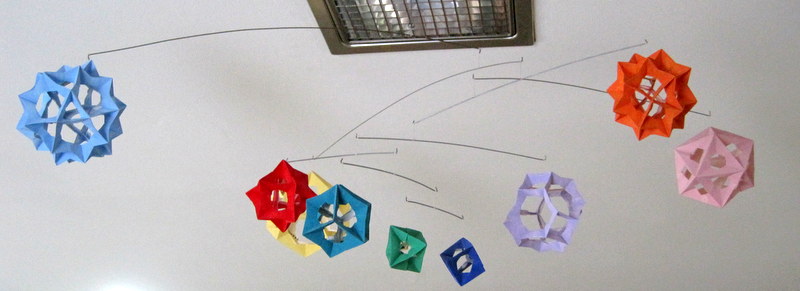
Shapes like these can be displayed by themselves, but I like to make mobiles, and these are light so they make ideal mobile danglers.
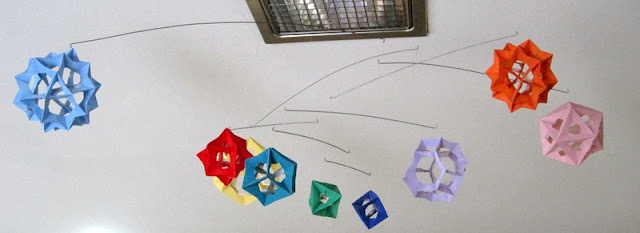 I made this mobile a couple of years ago. The pic is looking up at it. I made it so all the shapes are nearly in the same plane. Sorry, one is hiding behind. The blue one on the left is the IcosaDodecahedron. The Icosahedron on the right (pink) was made differently than either of the two I have shown above, using fatter stars, but still flat. A couple of the shapes mix vertices with 3 and 4 corners. That is a bit tricky to put together!
This long post has many pictures, showing a technique I learned for making attractive shapes based on Platonic and Archimedean solids. The shape chosen here is the Icosahedron, but I call it "skeletal" for reasons you'll see once it is complete.
For this technique, we use folded paper shapes as the vertices of the chosen polyhedron's skeleton. All the shapes of interest have either 3, 4, or 5 edges radiating from a vertex. Most have vertices of the same type, as does the Icosahedron, but some shapes have more than one type of vertex. I find the Icosahedron interesting because its vertices have 5 edges. I earlier made one using cut-out, 5-pointed stars, which will be seen at the end of this post. This time I did an experiment using a "puckered star" made by adding a corner to a square. Such a "square" will not lie flat; it becomes a 5-pointed star with extra paper in it.

Three squares are needed to make two stars, so the project starts by cutting 18 squares. At bottom, two squares have been folded into the Origami base fold: corner to corner both ways folded from one side and then edge to edge folded from the other side, to make a 4-pointed star. One of these stars is cut along the diagonal to make the extra material to be inserted in the other two.
At lower right, one 4-pointed star is shown next to the extra point with its "wings" which are used for gluing. At lower left, the other star is shown with its side cut open so the point can be inserted. The next image shows these in closeup.

I use a glue stick. You could use any adhesive you like, so long as it is long-lasting. I think you can see how the extra point will go in the cut-open star on the left. I put the "wings" inside the shape. That makes it easier to line things up when gluing and holding.
OK. It would be possible to simply glue these with a little corner overlap on the points, but the original technique, for another shape, used a pocket fold to fit one point inside the other. The next pair of images shows how I prefer to set up the pocket.

Let's think about this a minute. A point that has not been folded into a pocket will be inserted and glued into a point that has. Five points each on 12 stars means there are 60 points, so we need 30 to be folded and 30 to be left unfolded. We will have to take care not to fold too many or too few as we go. For starters, I made the one on the right to have all five points folded in, and five more stars with just two adjacent points folded in.



It takes a little care to put each star on the central one in the right orientation. We want them to each fit into its neighbor.


The actual Icosahedron is formed of 20 triangles, which fill the space between the edges that go from vertex to vertex. Here, we have made a more complex figure based on the geometry of the Icosahedron.

I folded each star five times, from a point to an inside corner, then back-folded the shorter limb of each fold to get the 3D star shape that is so familiar.
I also didn't use the same method to fold the pockets. I wanted a little angle to the "edge" (which is now a dihedral), so I folded each point almost to the center of the inner fold, then turned it inside. Thus, when the unfolded point is inserted into the pocket, it doesn't line up the same way but has about a 10° angle. I think it makes the final shape prettier.

The blue one on the right was made using triangles, and is based on Buckyball geometry. It uses 60 triangles. There is an Archimedean solid with 90 vertexes, but I haven't mustered the ambition to try to make one!
Shapes like these can be displayed by themselves, but I like to make mobiles, and these are light so they make ideal mobile danglers.
Thursday, February 21, 2013
Who owns your death?
kw: book reviews, nonfiction, politics, legislation, supreme court, death with dignity
There is a scene in the opening chapter of Shogun in which a Japanese warrior has failed to kill his opponent and is lying, injured and disarmed, in a pit below a shattered house. His commanding officer looks in, throws down a knife and walks off. The warrior expresses his thanks and kills himself with the knife, thus retaining some shred of honor after his shameful defeat. I discussed this with my wife, who is Japanese, and she understood that this was a case of "officer-assisted suicide", not murder, because the officer didn't actually hold the knife and kill the warrior. However, I had brought up this example to illustrate the difference between physician-assisted suicide, in which a doctor prescribes lethal medication that is later ingested by the patient, and what Dr. Kevorkian did, which was in at least some cases to actually kill his "patient". Even after this discussion, she did not see the latter difference. This mis-perception underlies a great difficulty confronting proponents of legislation and other measures such as referenda that would permit physicians to write such lethal prescriptions.
I had showed my wife the book At Liberty to Die: The Battle for Death with Dignity in America by Howard Ball. She said just one word, "Kevorkian". "Dr. Death" has been dead only a year and a half, so he is still fresh in the American psyche. Although he last participated in a patient's death in 1998, to some folks it is like yesterday. It seems to me that he has made things harder, not at all better, for those who would decriminalize physician-assisted death (PAD), the term author Ball prefers to physician-assisted suicide. In the present situation, a terminal patient wishing to control the time and manner of death must become a "death migrant", establish residence in Oregon or Washington, and request PAD services there.
The bulk of the book, and nearly the exclusive content of 4 of its 7 chapters, is detailed discussion of the legal cases and legislative battles that led to the present situation. An appendix lists the 53 court cases discussed; by my quick count 23 were decisions of the U.S. Supreme Court. The most significant of these were two cases adjudicated back-to back in 1997: Washington v Glucksberg and Vacco v Quill. The bottom line: the Court found that no constitutional right exists to control one's time and mode of death, nor to request or require a physician to participate. They threw the issue to the states.
Voters in the state of Oregon had already acted; the Oregon Death with Dignity Act passed in November 1994. Fourteen years later a nearly identical law was enacted by the legislature of the state of Washington. After another year, the Montana supreme court stated that nothing in state law prevented a physician from honoring a competent, terminal patient's request for a lethal prescription for the patient to use. Efforts to introduce a law in Montana similar to the Oregon or Washington measures are still ongoing.
In the other 47 U.S. states, PAD is prosecuted as either murder or manslaughter. Though nearly half the state legislatures have considered pro-PAD legislation, anti-PAD activists have blocked all other attempts, and they continue to challenge the Oregon and Washington laws. Their loudest, if not strongest, argument is the "slippery slope", that allowing PAD will inevitably lead to euthanasia, at first voluntary perhaps, but eventually even involuntary euthanasia. Today, parents may joke, "Be on good terms with the boy's girlfriend. One day she may decide our nursing home." Will tomorrow's joke be, "One day she may decide when we die."?
The real slippery slope is in the argument. The political climate in America has been getting more polarized for at least 60 years (It is probably not yet as polarized as it was in the 1860s!). Now, no matter what the issue is, both sides claim their opponents are the devil in a union suit. Here, pro-PAD folks claim the "right to lifers" (who are pretty much identical to the anti-abortion crowd) "hate" the dying in favor of their doctrinal purity, and most of them do base their sanctity of life stance on religious belief. The anti-PAD folks claim that PAD will lead to euthanasia for a rapidly growing list of reasons, until we return to a Nazi like state, and eventually anyone can be killed for the "sin" of inconvenience.
The fact is, every decision has a possible slippery slope. Many people like to drive just a bit faster than the speed limit. Not all are speed maniacs, just a little impatient. But you do see the occasional fool weaving through traffic, determined to shave another minute off his last record for getting to work. That fool has fallen down the slope, and can be voted "most likely organ donor". Many like a drink at a party. They don't go there intending to get totally snockered, but may get falling down drunk anyway. And how many "it's only lunch" occasions turn into love affairs, followed by divorces and other nastiness?
The Oregon and Washington laws contain anti-slippery-slope provisions. Will they be enough? They will likely be better than letting the occasional Kevorkian run unchecked. Dr. Ball is unabashedly pro-PAD. I am guardedly pro-PAD, while my wife is entirely anti-PAD. I am pretty sure at least we three recognize that times and laws change, if slowly. Will new laws move us, even slowly, down a slippery slope? It is possible. So is a more conservative swing that leads to overturn not only of the PAD laws currently in effect, but even of Roe v Wade. These issues are deeply divisive, and every generation has to confront them anew.
Tuesday, February 19, 2013
Was he the original ugly American?
kw: book reviews, nonfiction, biographies, commerce, politics
 A stalk or stem of bananas might weigh 100 pounds or more (50+ kg), and hold 200-300 fruits. Technically they are berries. This stem is only half there; you can see the scar at the bottom of the image where half the stem was removed a few days earlier. (Image adapted from one at the Alabama blog)
One other interesting bit of natural history I learned from reading The Fish That Ate the Whale: The Life and Times of America's Banana King by Rich Cohen: The old sight gag of slipping on a banana peel is rarely used any more because the Big Mike variety, which had a very moist and slippery peel, went extinct about 1966. Most bananas sold today are the Cavendish variety. Not quite as bit, not quite as sweet, and with a drier peel.
That means that the Mythbusters episode using a few hundred banana peels was not quite authentic. When the episode was filmed, they had to use Cavendish peels, which can be slippery, but they'd have had a much harder time standing up had Big Mike peels been available. When Adam and Jamie invent a time machine, they will have the chance to remake the episode.
The book is primarily about Sam Zemurray, "the banana man" as he was known all his adult life. His rags-to-riches story is inspiring, but would have a more salutary impact if he'd been a nicer guy. But a nice guy doesn't overthrow a government, as he did in Honduras in 1910 with a hundred or so mercenaries. A nicer guy might have spent more time with his family. Even after his son and daughter were born, he spent nearly half the year in Central America, and extended periods in New York and Boston, leaving his wife to raise the children. He could swear colorfully in four languages, a skill he frequently displayed.
The book's title refers to newspaper headlines that appeared when he came out of retirement to take over United Fruit in a proxy battle the board of directors was hardly aware was going on. He attended a board meeting and presented his case for improving the company's bottom line. It was the mid-1930s and the Depression was throttling trade everywhere. He was over 60 and still spoke with a heavy Russian accent. The Chairman said, patronizingly, "I can't understand what you are saying". Zemurray stepped out and returned with his bag of proxies, slapped them on the table and said, "You're fired. Can you understand that?"
From the 1890s to 1930 he had built a banana business, starting with the nearly-ripe fruits that nobody wanted to sell. He found a market for them. By the 1920s his company Cuyamel Fruit was bigger than all but United Fruit, but in 1930, in a reversal of antitrust policy, the government twisted his arm to sell out in a merger with UF. They—and the UF board—thought removing him would improve their image in Central America. They didn't realize that, while he was unpopular with the governments and some of the populace, his long-term residency there, mingling with the workers, made him very popular with them. He took better care of their concerns than the remote, elitist management of UF. Because of his unparalleled knowledge of banana production and distribution he was able to earn the trust of the largest UF shareholders and take control of the company.
The book chronicles the rise and fall of the "banana republics". Sam Zemurray was the most visible figure (in Central America, not in the US) and became the focus of anti-American sentiment stirred up by the Communists and other revolutionaries. Che Guevara worked briefly in the banana trade before he was a medical student, and was later a fierce opponent of UF with Zemurray at its helm.
UF is no more. Zemurray died in 1961, just before the Big Mike variety went extinct. His personal aura was the biggest factor in the company's success, and that of Cuyamel fruit before it. Without him, the management faltered and failed. The banana trade is carried on in quite a different way now.
The Cavendish variety is likely to go extinct in a decade or so. Breeders are trying to produce a more disease resistant hybrid that still tastes good. I learned elsewhere that "eating varieties" of banana are triploid hybrids, and thus are sterile. Banana planters propagate them by cutting a rhizome into chunks that each grow into the "tree", really a big stalk formed of large leaf stems. Breeding varieties are diploid and produce viable seeds.
We understand that everyone is a combination of good and bad. In some areas of his life, Sam Zemurray was good, almost great. In other areas, he was bad, nearly evil. Few indeed become rich enough to overthrow whole governments. Fewer still actually do so. The "Pac-Man" action of taking over UF made the Banana Man a legend, and he needed a unique mixture of his best and worst qualities to pull it off.
Saturday, February 16, 2013
A risky gift
kw: book reviews, nonfiction, gifted children, gifted adults, sociology
In the early 1980s Grady Towers wrote The Outsiders, which was published in the first issue of Vidya that I received when I joined the Triple Nine Society* in 1985. I photocopied it immediately, and still have it. Towers re-calculated the statistics found in Lewis Terman's studies of gifted children and the gifted adults they grew into, but using better statistical measures than Terman had used.
Dr. Terman undertook his study of giftedness hoping to dispel the common notion that highly intelligent people are more likely to be unstable or insane. According to Terman's studies and statistical calculations, he found what he was looking for. Children with high IQ's were not only smarter, they tended to be taller, stronger, and healthier than others, and became well-adjusted adults with no greater risk of insanity or emotional distress than the rest of the population. Towers used a more probing statistical technique and found, not the opposite result, but a troubling trend. Taken as a whole, the "Termites" were at worst only slightly more likely than "average folks" to suffer from depression and other emotional ills. But ranked by IQ, the number of those who suffered such distresses increased towards the top. The group with IQ's greater than 170 had a 35% or greater incidence of such mental problems, and of a small number ranging towards 200, more than half had such issues. However, the incidence of more dangerous psychoses was not significantly different from "everybody".
These conclusions were placed in apposition to the experiences of most gifted persons. Being in the top 0.1% of the IQ range means it is hard to find people to talk to. A very smart child may turn to an older sibling, or aunt or uncle or grandparent. In rare cases, even a parent, but if the child is brighter than the parents, they all too often feel threatened and shut the child down. Once the child grows up, the older relative may no longer be smarter, so the gifted adult must find peers in college or on the job or in church, or in a club or a society such as Mensa.
Small towns or small suburban neighborhoods can be especially deadly for the social life of a brilliant young adult. If your social circle is limited to a few hundred people, you may be the only one who appreciates Renaissance poetry, or can understand calculus, or who has your own microscope. Who can you talk to? You become an Outsider, keeping camouflaged when with others, living inside your mind because that's the only safe place. Think Calvin in Calvin and Hobbes.
Towers stated, "the point of this article is not that there's some special hazard to having an exceptional IQ: There's not. The point is that the danger lies in having an exceptional IQ in an environment completely lacking in intellectual peers. It's the isolation that does the damage, not the IQ itself."
Here is a synopsis of the last 65 years of a gifted life (my own):
Well, where is this going? This is quite a long introduction to a book review! I've been reading Gifted Grownups: The Mixed Blessings of Extraordinary Potential by Marylou Kelly Streznewski. The book was published in 1999, and my (also very gifted) brother gave it to me a few years later. It got buried in a pile of "stuff" before I finished it, and I just found it last week. So I read it, and found myself saying again and again, "Yes!" Marylou knows of what she writes, being gifted herself.
And now I don't know what to write about her wonderful book! She writes that giftedness is not tied to IQ. Instead it is an attitude. Sure, speed of thinking is a necessary component, but not all fast thinkers are scientists: a great football quarterback has to think as quickly as an astrophysicist. A major component is breadth of interest. I don't just mean the college freshman who can't choose a major because "I want to major in all of them!". I think of a judge who took guitar lessons from me. On his own, in a few years, he'd taught himself some rather challenging finger picking techniques, even quicker than I had learned them. It's a pity he was too busy in the courtroom to keep up with the lessons. A student like him, I'd teach for free! It is great just to have someone talented to jam with.
The gifted are creative. There's the young man who got an F on a physics test: the question was how to measure the height of a building with a barometer. His answer was to drop the barometer off the side and time its fall. He got the correct answer, but an F for "wrong method". He went to a faculty meeting, where he described three other ways to measure the building's height, without using the barometer as a barometer. His teacher was directed to give him an A. My dad used to give a mechanical test to army inductees. Simple things like how to brace a ladder so it won't fall. He loved the question, "State five uses for a brick." He said that alone could usually single out the ones worth sending for further training.
The gifted learn that the world hates them. In their case, paranoia is perfectly justified. So they develop protective coloration. This is particularly hard on smart girls. They suffer if they aren't "nice" enough, or if they do something (other than cook or clean) better than a boy. In my last year as a geology undergraduate, one young woman and I blew the curve. On most tests I got "the A" and she got "the B". She was hated more than I.
A theme of the book is that we are wasting a ton of talent. I remember the early 1970s when PhD's were flipping burgers at food wagons and us lowly "college graduates" were making boxes in warehouses or schlepping goods at the dock as stevedores (shipping containers were not yet in wide use). Now that was a waste of talent! But the point is well taken. Teachers who feel threatened by a smart student usually drive the kid back inside his or her mind, or when asked for "more" give more of the same, rather than more challenging assignments. Parents may beat a kid who mouths off, and the smarter a kid is, the more he has to say! (Girls learn this one quicker than boys) Interviewers look for applicants who are "overqualified" and will not hire them. Bosses who are threatened by a smart employee are much too prone to say, "My way or the highway." Who knows how many opportunities are lost because the person who knows the answer is bullied into keeping quiet?
In a late chapter, "Young in Mind: The Later Years", it sorta seems most gifted folks have to wait for retirement to enjoy a fuller range of their abilities. Sadly, for too many of them, it is too late. The self-protective habits of a lifetime become unbreakable.
I know what I'm going to do with this book. A woman recently hired at my (former) company has the brightest mind I've touched in a long time. She has very young children. She needs it! It can help her for herself, and help her raise kids that the world doesn't run down like so much sparkly road kill.
*Triple Nine Society, or TNS, also called "the Thousand", is apparently defunct. A web page titled "Virtual Triple Nine" hasn't been updated since 2000. It is or was a society a step above Mensa. Membership required an IQ of at least 148. One Westerner in 1,000 scores at this level; the IQ tests found in the U.S. and Europe are much less valid for people raised in Eastern, Middle Eastern, and African cultures. I was a member of TNS between 1985 and 1992. I later joined ISPE, another notch higher in selectivity. I left it some years ago. I prefer friends I can reach out and touch, and now I have that.
In the early 1980s Grady Towers wrote The Outsiders, which was published in the first issue of Vidya that I received when I joined the Triple Nine Society* in 1985. I photocopied it immediately, and still have it. Towers re-calculated the statistics found in Lewis Terman's studies of gifted children and the gifted adults they grew into, but using better statistical measures than Terman had used.
Dr. Terman undertook his study of giftedness hoping to dispel the common notion that highly intelligent people are more likely to be unstable or insane. According to Terman's studies and statistical calculations, he found what he was looking for. Children with high IQ's were not only smarter, they tended to be taller, stronger, and healthier than others, and became well-adjusted adults with no greater risk of insanity or emotional distress than the rest of the population. Towers used a more probing statistical technique and found, not the opposite result, but a troubling trend. Taken as a whole, the "Termites" were at worst only slightly more likely than "average folks" to suffer from depression and other emotional ills. But ranked by IQ, the number of those who suffered such distresses increased towards the top. The group with IQ's greater than 170 had a 35% or greater incidence of such mental problems, and of a small number ranging towards 200, more than half had such issues. However, the incidence of more dangerous psychoses was not significantly different from "everybody".
These conclusions were placed in apposition to the experiences of most gifted persons. Being in the top 0.1% of the IQ range means it is hard to find people to talk to. A very smart child may turn to an older sibling, or aunt or uncle or grandparent. In rare cases, even a parent, but if the child is brighter than the parents, they all too often feel threatened and shut the child down. Once the child grows up, the older relative may no longer be smarter, so the gifted adult must find peers in college or on the job or in church, or in a club or a society such as Mensa.
Small towns or small suburban neighborhoods can be especially deadly for the social life of a brilliant young adult. If your social circle is limited to a few hundred people, you may be the only one who appreciates Renaissance poetry, or can understand calculus, or who has your own microscope. Who can you talk to? You become an Outsider, keeping camouflaged when with others, living inside your mind because that's the only safe place. Think Calvin in Calvin and Hobbes.
Towers stated, "the point of this article is not that there's some special hazard to having an exceptional IQ: There's not. The point is that the danger lies in having an exceptional IQ in an environment completely lacking in intellectual peers. It's the isolation that does the damage, not the IQ itself."
Here is a synopsis of the last 65 years of a gifted life (my own):
- Knew the ABC's very early, and began learning to read at age 3.
- Enrolled in a private grade school at age 5, because my (fortunately intelligent) parents could see I was "ready". Public school wouldn't take someone so young.
- Tested in grade 2. Not told the result. Rumors around the school of "the kid that aced the IQ test" led to a second test. Only my parents were told the score was "somewhere above 170".
- That same year, Dad quit playing chess with me because he couldn't win. Curiously, I didn't improve in chess thereafter, and haven't played since high school.
- Enrolled in public school in grade 4. Always passed, but a B- student in most subjects. The mantra from teachers and parents: "We know you can do better. Why don't you try?"
- The above mantra was repeated, almost daily, until the middle of grade 10.
- Grade 10 was begun at Lakewood High in Ohio, a gang-controlled school. Being too honest for my own good, I was soon crossways with every gang. I was at the point of making a serious case to my parents to be moved to another school, when they said we'd be moving to Sandusky, some 60 miles away. I contrived to miss the next few days of school, and it may have saved my life.
- At SHS, which served the whole region, the English teacher basically saved my mind. I'd missed the first month, and they were just completing English 6400 (the current edition is English 3200), a book of programmed instruction in grammar and syntax. Mr. Couch gave me a copy, showed me how it worked, and suggested I try a few of the exercises to get the hang of it. I finished it over a weekend: if you do each "frame" correctly, you only need to do about 800 of the 6,400 frames. All the rest are for remediation.
- Mr. Couch was smart enough to know "more of the same" would be no challenge, so he found creative ways to give me added challenges in class, and pressed me to join the drama club, a fantastic experience! He seems to have spread the word. Mr. Schneider in Chemistry, Mr. Brown in Biology, and several other teachers did their best to stay ahead of me and keep me interested.
- An example: Mr. Brown found I had a microscope at home and liked to take pictures through it. He hired me to take pix of all his prepared slides, onto Kodachrome, so he could project the pictures instead of using the balky, frustrating projecting microscope in class. Without the extra efforts of these teachers, I would never have attempted college. But I had good grades those years, in contrast to grades up to 9.
- Let's move a little faster. I started college at 17. I could learn like a house afire, but was emotionally unready. My grades were 0.1 GPA above flunking out. Dropped out and worked in a defense industry company as an optical and vacuum technician. While there, I learned FORTRAN.
- I returned to school after 2 years, but changed majors (and I still don't know what I want to be after I grow up) a couple times, finally graduating in Geology at age 24. After the "attitude adjustment" of working, I got a GPA of 3.7.
- By the time I graduated, I was in the church life in which I remain, one that values the life of the mind, while emphasizing spiritual progress even more. Jobs were hard to find in the early 1970s, so I worked warehouse jobs, then took a great job as a machinist at the Cal Tech Physics shop. At Cal Tech, even the machinists are very bright! I didn't have to hide that I had interests besides work and wasn't interested in falling asleep in front of a TV showing sports. Of course, my boss was a genius. He was a good friend of Dick Feynman. We got along well.
- In 1974 I got an engineering job, and married the next year (we'll have our 38th anniversary this summer).
- After four years, I realized my job was a dead end without more education. I left for graduate school in 1978.
- I am not at liberty to discuss why the PhD I earned was not conferred. Still a bit naive and overly honest at age 35, I didn't realize how deeply I offended a few powerful persons by proving them wrong by my research. I left with only a MS in Geological Engineering.
- Having used FORTRAN whenever possible, during 1978 until I left the graduate school I was a professor of Computer Science, teaching the beginning programming classes. This combination with Geology got me a job at an oil company.
- Within a year or so I gravitated to a "skunk works", a group of super-programmers, the kind that outperform ordinary professional computer programmers by a factor of 10 to 100. I fit right in! Not just a friend or two, a peer or two, here or there, but a whole big office with 20 of them! I am still close friends with some of them. I wrote simulation software for exploration geologists.
- In the mid 1990s I transferred to the parent corporation. I'll just talk about the middle four years of the past 18. I had a supervisor who is a great guy but a very poor manager. In particular, he didn't know what to do with me. By that time I'd learned to hide just how much I could do, to avoid "test pilot's curse" (superhuman performance today becomes tomorrow's standard). I rejected projects that I knew would simply rot my brains. I got a series of poor yearly reviews. Yet, the projects that I was doing, nobody else could do; nobody else could even understand. He moved on, as managers do after 3-5 years; I had outlasted him!
- My final several years were much more conducive to good work and a satisfying life. I had a boss who is as nerdy as I am, made several good friends who also value the interior life, and became a sort of elder statesman to the whole group. I retired on my own terms, and I'm building a moderately busy "retirement career" on Uncle Sam's payroll.
Well, where is this going? This is quite a long introduction to a book review! I've been reading Gifted Grownups: The Mixed Blessings of Extraordinary Potential by Marylou Kelly Streznewski. The book was published in 1999, and my (also very gifted) brother gave it to me a few years later. It got buried in a pile of "stuff" before I finished it, and I just found it last week. So I read it, and found myself saying again and again, "Yes!" Marylou knows of what she writes, being gifted herself.
And now I don't know what to write about her wonderful book! She writes that giftedness is not tied to IQ. Instead it is an attitude. Sure, speed of thinking is a necessary component, but not all fast thinkers are scientists: a great football quarterback has to think as quickly as an astrophysicist. A major component is breadth of interest. I don't just mean the college freshman who can't choose a major because "I want to major in all of them!". I think of a judge who took guitar lessons from me. On his own, in a few years, he'd taught himself some rather challenging finger picking techniques, even quicker than I had learned them. It's a pity he was too busy in the courtroom to keep up with the lessons. A student like him, I'd teach for free! It is great just to have someone talented to jam with.
The gifted are creative. There's the young man who got an F on a physics test: the question was how to measure the height of a building with a barometer. His answer was to drop the barometer off the side and time its fall. He got the correct answer, but an F for "wrong method". He went to a faculty meeting, where he described three other ways to measure the building's height, without using the barometer as a barometer. His teacher was directed to give him an A. My dad used to give a mechanical test to army inductees. Simple things like how to brace a ladder so it won't fall. He loved the question, "State five uses for a brick." He said that alone could usually single out the ones worth sending for further training.
The gifted learn that the world hates them. In their case, paranoia is perfectly justified. So they develop protective coloration. This is particularly hard on smart girls. They suffer if they aren't "nice" enough, or if they do something (other than cook or clean) better than a boy. In my last year as a geology undergraduate, one young woman and I blew the curve. On most tests I got "the A" and she got "the B". She was hated more than I.
A theme of the book is that we are wasting a ton of talent. I remember the early 1970s when PhD's were flipping burgers at food wagons and us lowly "college graduates" were making boxes in warehouses or schlepping goods at the dock as stevedores (shipping containers were not yet in wide use). Now that was a waste of talent! But the point is well taken. Teachers who feel threatened by a smart student usually drive the kid back inside his or her mind, or when asked for "more" give more of the same, rather than more challenging assignments. Parents may beat a kid who mouths off, and the smarter a kid is, the more he has to say! (Girls learn this one quicker than boys) Interviewers look for applicants who are "overqualified" and will not hire them. Bosses who are threatened by a smart employee are much too prone to say, "My way or the highway." Who knows how many opportunities are lost because the person who knows the answer is bullied into keeping quiet?
In a late chapter, "Young in Mind: The Later Years", it sorta seems most gifted folks have to wait for retirement to enjoy a fuller range of their abilities. Sadly, for too many of them, it is too late. The self-protective habits of a lifetime become unbreakable.
I know what I'm going to do with this book. A woman recently hired at my (former) company has the brightest mind I've touched in a long time. She has very young children. She needs it! It can help her for herself, and help her raise kids that the world doesn't run down like so much sparkly road kill.
*Triple Nine Society, or TNS, also called "the Thousand", is apparently defunct. A web page titled "Virtual Triple Nine" hasn't been updated since 2000. It is or was a society a step above Mensa. Membership required an IQ of at least 148. One Westerner in 1,000 scores at this level; the IQ tests found in the U.S. and Europe are much less valid for people raised in Eastern, Middle Eastern, and African cultures. I was a member of TNS between 1985 and 1992. I later joined ISPE, another notch higher in selectivity. I left it some years ago. I prefer friends I can reach out and touch, and now I have that.
Friday, February 15, 2013
February may be for lovers, but June is for marriage
kw: family events, marriage
My parents married in early March, right after WW2. Fast-forward half a century. For their Golden Wedding Anniversary, we all had kids in school: my brothers and I, all of us, had our children quite late. Even if we'd had kids when we were younger, we would have had school-age grandchildren that year. So we held a celebration for our parents in June after school let out. Five years later, we did a 55th Anniversary party for them, also in June.
Planning a wedding? Plan it for a time that your grandkids, or their kids, won't be in school 50 years later!
Vanishing value
kw: stamp collecting, philately
I was at the Dutch Country Stamp Center yesterday, and I sure wish I'd had a camera with me. I had been talking with their stamp expert about some of my duplicates, and whether to auction them. On our way out, he said he had something to show me. In one room a large crate was near a sorting table with stacks and stacks of sheets of unused stamps. The crate was still half full. An elderly woman had been buying sheets for more than 50 years, in hopes they'd have more value some day. He said, "I have the sad duty to burst her bubble."
 In my collection I have a small binder with some plate blocks. This image is an example, a block of 4 (some collectors prefer 2 or 6 or 8 or 9), with the printing plate number attached. In 1941 this block cost $1. For a short time, when regular postage was 6¢, these "Postal Savings" stamps were actually sold as an investment. That didn't last long, because they are a poor investment.
This block is in excellent condition, so a collector of plate blocks might actually pay $1 for it, but probably not. Unused stamps of all the common issues typically sell for half to 3/4 of their face value! Entire sheets seldom sell for more than 50¢ on the dollar.
The stamps in that crate probably cost this dear lady thousands of dollars over the years. Their value as collectibles is only about half that, if they will sell at all. Thirty years ago, I was told that whole sheets were selling at 70-75¢ on the dollar. Stamp collecting is a less popular hobby than it used to be. The "market" is smaller, and prices are lower.
For most of the last half century, passbook savings earned 5% per year. For the first 30 years, the money she spent on stamps, if put in the bank, would have more than quadrupled in value. Even since then, it would have grown another 30-40%. Instead she has a 50% loss.
If you are a new stamp collector, don't be discouraged. Collections of any kind are not investments. They are for fun, for learning, and for the enjoyment of completing a set. In about 55 years of stamp collecting, I have had one instance of getting a couple of "valuable" stamps. In a box of German stamps (all were used, that is Canceled, stamps), there were two copies of a commemorative from the 1950s that is rather rare. I put one in my collection, and the other among my German duplicates. At a stamp club "share" event, a fellow member spotted the stamp, and said, "Hey, that stamp is worth $8. What would you sell it for?" I let him have it for $1, since it wasn't in top condition.
Heck, the acrylic sheets I use for my collection cost $1 per page! I reckon the main value of my collection is the display pages, not the stamps they contain!! That's OK. It is a fun hobby.
I was at the Dutch Country Stamp Center yesterday, and I sure wish I'd had a camera with me. I had been talking with their stamp expert about some of my duplicates, and whether to auction them. On our way out, he said he had something to show me. In one room a large crate was near a sorting table with stacks and stacks of sheets of unused stamps. The crate was still half full. An elderly woman had been buying sheets for more than 50 years, in hopes they'd have more value some day. He said, "I have the sad duty to burst her bubble."

This block is in excellent condition, so a collector of plate blocks might actually pay $1 for it, but probably not. Unused stamps of all the common issues typically sell for half to 3/4 of their face value! Entire sheets seldom sell for more than 50¢ on the dollar.
The stamps in that crate probably cost this dear lady thousands of dollars over the years. Their value as collectibles is only about half that, if they will sell at all. Thirty years ago, I was told that whole sheets were selling at 70-75¢ on the dollar. Stamp collecting is a less popular hobby than it used to be. The "market" is smaller, and prices are lower.
For most of the last half century, passbook savings earned 5% per year. For the first 30 years, the money she spent on stamps, if put in the bank, would have more than quadrupled in value. Even since then, it would have grown another 30-40%. Instead she has a 50% loss.
If you are a new stamp collector, don't be discouraged. Collections of any kind are not investments. They are for fun, for learning, and for the enjoyment of completing a set. In about 55 years of stamp collecting, I have had one instance of getting a couple of "valuable" stamps. In a box of German stamps (all were used, that is Canceled, stamps), there were two copies of a commemorative from the 1950s that is rather rare. I put one in my collection, and the other among my German duplicates. At a stamp club "share" event, a fellow member spotted the stamp, and said, "Hey, that stamp is worth $8. What would you sell it for?" I let him have it for $1, since it wasn't in top condition.
Heck, the acrylic sheets I use for my collection cost $1 per page! I reckon the main value of my collection is the display pages, not the stamps they contain!! That's OK. It is a fun hobby.
Monday, February 11, 2013
An augmented Bible story
kw: book reviews, bible, fiction
The first half of 1 Chronicles 4 lists sundry families of the tribe of Judah, from his younger three sons. In the midst, connected with nothing else, we find
In his book Jabez: A Novel, Thom Lemmons weaves a man's life story from such suppositions. From the 60 or so words (in our English translation) the Bible contains about Jabez, and a guess here or a hint there about the time in which he might have lived, he has produced a 129-page narrative. One more thing; the statement about pain in his prayer, in the King James Version, is translated "that I may not cause pain", a significant point. This is enough for Lemmons to construct the personality of a gentle, retiring man.
The name of God is not found in 1 Chronicles 4, though it is frequent in Judges. This name, either translated as "the LORD" or transliterated "Jehovah" in Christian versions, is forbidden for modern Jews to pronounce, and this has been so for generations. Given the frequency with which the phrase "O Jehovah" is found in the Psalms, it is likely that at least until the time of David the name of God was commonly found on the lips of His people in prayer and praise. The Bible, both Testaments, frequently mentions (in OT) "calling upon the name of Jehovah" or (in NT) "calling upon the name of the Lord". In the latter case, by context you can understand whether Jehovah or Jesus is being called upon. If God wants His people to call upon His name, it makes sense to use His name! What a pity that Jews today forbid the practice that God exhorts them so frequently.
Lemmons supposes that Jabez and his neighbors knew the God of Israel only as a nameless god, while worshiping sundry idols in their homes. The word Jehovah (or any alternate spelling such as Yahweh) is not found in the novel.
Such niceties aside, we have a straightforward novel of a man's life, centered on his coming of age in a hostile environment, and the psychological crisis that led him to pray such a prayer. I suppose such fiction is popular fare among many Christians; who knows, perhaps also among today's Jews. It is a touching story, and well told, though it leaves my spirit untouched. The friend who gave us the book meant well. Yet our human spirit is nourished by the words of God, rather than by appeals to emotion or intellect. But if such literature leads some to delve into Scripture, well and good.
The first half of 1 Chronicles 4 lists sundry families of the tribe of Judah, from his younger three sons. In the midst, connected with nothing else, we find
Jabez was more honorable than his brothers. His mother had named him Jabez, saying, “I gave birth to him in pain.” Jabez cried out to the God of Israel, “Oh, that you would bless me and enlarge my territory! Let your hand be with me, and keep me from harm so that I will be free from pain.” And God granted his request. – 1 Chr 4:9-10 [NIV84]There is nothing else regarding the parents or descendants of Jabez. Given the few surrounding names such as that of Othniel, the time of Jabez may have been quite early, within a generation or two after the Exodus. Othniel was the first Judge of Israel, and the second was Ehud, 58 years later. Could Jabez have lived during the occupation by Moab, which was ended when Ehud assassinated Eglon, king of Moab? Thom Lemmons thinks it possible.
In his book Jabez: A Novel, Thom Lemmons weaves a man's life story from such suppositions. From the 60 or so words (in our English translation) the Bible contains about Jabez, and a guess here or a hint there about the time in which he might have lived, he has produced a 129-page narrative. One more thing; the statement about pain in his prayer, in the King James Version, is translated "that I may not cause pain", a significant point. This is enough for Lemmons to construct the personality of a gentle, retiring man.
The name of God is not found in 1 Chronicles 4, though it is frequent in Judges. This name, either translated as "the LORD" or transliterated "Jehovah" in Christian versions, is forbidden for modern Jews to pronounce, and this has been so for generations. Given the frequency with which the phrase "O Jehovah" is found in the Psalms, it is likely that at least until the time of David the name of God was commonly found on the lips of His people in prayer and praise. The Bible, both Testaments, frequently mentions (in OT) "calling upon the name of Jehovah" or (in NT) "calling upon the name of the Lord". In the latter case, by context you can understand whether Jehovah or Jesus is being called upon. If God wants His people to call upon His name, it makes sense to use His name! What a pity that Jews today forbid the practice that God exhorts them so frequently.
Lemmons supposes that Jabez and his neighbors knew the God of Israel only as a nameless god, while worshiping sundry idols in their homes. The word Jehovah (or any alternate spelling such as Yahweh) is not found in the novel.
Such niceties aside, we have a straightforward novel of a man's life, centered on his coming of age in a hostile environment, and the psychological crisis that led him to pray such a prayer. I suppose such fiction is popular fare among many Christians; who knows, perhaps also among today's Jews. It is a touching story, and well told, though it leaves my spirit untouched. The friend who gave us the book meant well. Yet our human spirit is nourished by the words of God, rather than by appeals to emotion or intellect. But if such literature leads some to delve into Scripture, well and good.
Sunday, February 10, 2013
Skirting antisemitism
kw: book reviews, nonfiction, prejudice, science, history, philosophy
I almost gave the book a pass when I saw it. The title implies prejudice: Einstein's Jewish Science: Physics at the Intersection of Politics and Religion, by Steven Gimbel. I reasoned that the book actually was, or included, a defense of Albert Einstein, and that turned out to be right. But there is much more.
In his introduction, Gimbel complains that our visceral dismissal of all things Nazi keeps us from engaging with the ideas themselves. He does so in this volume so he can disprove the Nazis' anti-Einstein polemics on their merits, rather than guilt by association. Thus he investigates just how Jewish Einstein was, to what extent any style of thinking he used is characteristically Jewish, and whether contemporary Jews considered the theories of Relativity themselves to be Jewish. He makes it quite clear that the opposition to Einstein was not just prejudice, but was nonsense.
A major element of the argument involves the contrasting styles of argument characteristic of Descartes and Newton. He writes of the "Catholic science" of Descartes and the "Protestant science" of Newton. René Descartes was faced with the requirement to reconcile his cosmological ideas with the Church's reliance on Aristotle's cosmology. The whirling, entrained aether Descartes propounded managed to satisfy both if you didn't look too hard. This is considered (by Gimbel) Catholic science. Newton, in reaction, based his work on fixed and unalterable space and time, the heavenly bodies and Earth moving within this infinitely rigid framework. The absolutist basis then resulted in Protestant science.
In his conclusion, Gimbel calls Einstein's work Cosmopolitan science. He points out that it is based on engaging and reconciling multiple viewpoints, and that the new world emerging in the early 1900s was a world in which scientists and philosophers were faced with a new diversity of social, religious and political trends. Surprisingly to me, certain influential voices continue to denigrate Einstein and his work, particularly the Special and General theories of Relativity. Their antisemitism is evident, and the charge of "Jewish science" is still made.
Gimbel does not go quite far enough. I am reminded that Paul, rebuking the Corinthians for exclusivism, wrote, "Each of you says, I am of Paul, and I of Apollos, and I of Cephas, and I of Christ. Is Christ divided?" Even those seemingly more pure ones saying "I am of Christ", Paul declares to be in the wrong as excluding the others. While the terms Catholic science, Protestant science and Jewish science offend, so does Cosmopolitan science.
Science is just science. While we may speak or write of Earth science, Biological science, and even the oxymoronic Political science, the practice of science is just science. To speak of top-down methods, or bottom-up, and so forth, is to speak of portions of scientific activity. Scientific method requires all these practices working together. One may start with observations that include apparent anomalies. One must then think about the reason for the anomalies, and plan further observations (AKA experiments) to tease out the possible influences. As Richard Feynman wrote, once you say, "That's interesting," you start on the road to discovery. One may also start with an idea (formally, a hypothesis), a notion of how things might work. One must then do experiments or make observations to either support, modify or reject the hypothesis. There is a back-and-forth here.
In Einstein's case, many observations and experiments had been performed already and published, along with all kinds of speculation about what might be going on. His method resembled that of Sherlock Holmes (actually Joseph Bell): "when you have eliminated the impossible, whatever remains, however unlikely, must be the truth." He performed thought experiments to refine his thinking, and learned the mathematical tools he would need to distinguish the possible from the impossible. The four papers Einstein published in 1905 were hypotheses, proposals of theory, with suggestions for observations to determine or refine their predictions. One of the four papers proposed Special relativity. He continued the process to propose General relativity nearly two decades later. He did not perform experiments, but others did. Based on those experiments, the hypotheses were confirmed and refined, later reaching the status of Theory.
Let us recall that no theory is "good" or "bad". A theory is a provisional description of how certain phenomena are produced. Theory is composed of multiple hypotheses, which are ideas that can be tested by experiments or observations (Astronomy, for example, does not lend itself to experiment, but to observation). If all such work supports the hypotheses, the theory is considered confirmed. Contradicting experimental or observational results discount or refute the hypotheses and thus the theory.
The "Catholic science" of Descartes is not science at all. It is a political statement of how things might work if Aristotle's cosmology must be satisfied. Most likely, Descartes knew Aristotle was wrong. But he'd lose his head to openly say so. In this environment, science is not possible. To call what Newton did "Protestant science" is nonsense. Newton was not really a Protestant; he professed loyalty to the English church, but was a secret Unitarian. Newton was a rigid, unsociable jerk, and he'd have been just as absolutist whether in Protestant England or Catholic France or Islamic Turkey or even in Jewish Israel, had it existed at the time. In his own way, Einstein, while a bit more sociable, was more like Newton, a kind of absolutist, one who thought in terms of a broader absolutism that did not include absolute time or space. But that same absolutism led him to reject the strange conclusions of quantum theories, saying "the Old One does not play dice."
One chapter is devoted to discussing Talmudic reasoning. This is considered prototypically Jewish. Yet it strongly resembles "buddy study" as I experienced it in my college years. In my experience, it is also the best method of Bible study, whether Jewish or Christian in intent. And the interplay of multiple viewpoints that I find called "Cosmopolitan science" is simply a further expression of the same practice. Perhaps Isaac Newton came the closest to being the solitary thinker, bringing forth new discoveries by the power of thought alone. Yet even Newton did experiments, and was also embedded in a social milieu that did affect his work.
 I have had the privilege to work and worship among Christians of both Western and Eastern cultures. I find that the more explicitly corporate practices that are characteristic of the East are most conducive to learning what the Bible means. The Chinese out-Talmud the Talmudic scholars in their ability to dig into infinite detail. However, they tend not to codify every little thing in the same way. Such habits of thought also lead to a different way of "doing science". Yet this is not "Chinese science" or "Eastern science". Let us remember that the Chinese, Japanese, and even Indian and Arabic peoples are all supposed to be descended from Shem, and thus are Semites. They all tend to be less individualistic than Japhethites (mainly Europeans).
Science is just science. Nobody is all-inclusive, so of course we must specialize, but not too much. In an early job as an electronics technician, I sometimes worked with engineers from Jet Propulsion Labs. They were over-specialized; they had a resistor guy, a capacitor guy, and so forth (there were no women, this was 1967). Together, they could design wonderful circuits for spacecraft. But my supervisor was a ham radio hobbyist, who could design and build a whole circuit on his own, quicker, cheaper, and better. And while I am primarily a geologist, the publication of which I am proudest combines methods developed in astronomy and in civil engineering. Not a Jack of all trades, perhaps, but the master of two or three.
Science is carried on better and more effectively when it is in a cosmopolitan setting. But let us not call the result Cosmopolitan science. To apply any adjective to science is to make it non-science. There is no Jewish or Catholic or Aryan or Creation or any other "kind" of science. There is just Science. Einstein may have brought certain Jewish habits of thought to his scientific studies. Once the theory was crafted, however, that all fell away. You don't need to be Jewish to understand Relativity, you just need to be smart, mathematically trained, and diligent...it isn't easy! Dr. Gimbel has done valuable service to show that the charges the Nazis made were misdirected. We need to continue beyond the notion of Cosmopolitan science that he presents, to the understanding of science as science.
I almost gave the book a pass when I saw it. The title implies prejudice: Einstein's Jewish Science: Physics at the Intersection of Politics and Religion, by Steven Gimbel. I reasoned that the book actually was, or included, a defense of Albert Einstein, and that turned out to be right. But there is much more.
In his introduction, Gimbel complains that our visceral dismissal of all things Nazi keeps us from engaging with the ideas themselves. He does so in this volume so he can disprove the Nazis' anti-Einstein polemics on their merits, rather than guilt by association. Thus he investigates just how Jewish Einstein was, to what extent any style of thinking he used is characteristically Jewish, and whether contemporary Jews considered the theories of Relativity themselves to be Jewish. He makes it quite clear that the opposition to Einstein was not just prejudice, but was nonsense.
A major element of the argument involves the contrasting styles of argument characteristic of Descartes and Newton. He writes of the "Catholic science" of Descartes and the "Protestant science" of Newton. René Descartes was faced with the requirement to reconcile his cosmological ideas with the Church's reliance on Aristotle's cosmology. The whirling, entrained aether Descartes propounded managed to satisfy both if you didn't look too hard. This is considered (by Gimbel) Catholic science. Newton, in reaction, based his work on fixed and unalterable space and time, the heavenly bodies and Earth moving within this infinitely rigid framework. The absolutist basis then resulted in Protestant science.
In his conclusion, Gimbel calls Einstein's work Cosmopolitan science. He points out that it is based on engaging and reconciling multiple viewpoints, and that the new world emerging in the early 1900s was a world in which scientists and philosophers were faced with a new diversity of social, religious and political trends. Surprisingly to me, certain influential voices continue to denigrate Einstein and his work, particularly the Special and General theories of Relativity. Their antisemitism is evident, and the charge of "Jewish science" is still made.
Gimbel does not go quite far enough. I am reminded that Paul, rebuking the Corinthians for exclusivism, wrote, "Each of you says, I am of Paul, and I of Apollos, and I of Cephas, and I of Christ. Is Christ divided?" Even those seemingly more pure ones saying "I am of Christ", Paul declares to be in the wrong as excluding the others. While the terms Catholic science, Protestant science and Jewish science offend, so does Cosmopolitan science.
Science is just science. While we may speak or write of Earth science, Biological science, and even the oxymoronic Political science, the practice of science is just science. To speak of top-down methods, or bottom-up, and so forth, is to speak of portions of scientific activity. Scientific method requires all these practices working together. One may start with observations that include apparent anomalies. One must then think about the reason for the anomalies, and plan further observations (AKA experiments) to tease out the possible influences. As Richard Feynman wrote, once you say, "That's interesting," you start on the road to discovery. One may also start with an idea (formally, a hypothesis), a notion of how things might work. One must then do experiments or make observations to either support, modify or reject the hypothesis. There is a back-and-forth here.
In Einstein's case, many observations and experiments had been performed already and published, along with all kinds of speculation about what might be going on. His method resembled that of Sherlock Holmes (actually Joseph Bell): "when you have eliminated the impossible, whatever remains, however unlikely, must be the truth." He performed thought experiments to refine his thinking, and learned the mathematical tools he would need to distinguish the possible from the impossible. The four papers Einstein published in 1905 were hypotheses, proposals of theory, with suggestions for observations to determine or refine their predictions. One of the four papers proposed Special relativity. He continued the process to propose General relativity nearly two decades later. He did not perform experiments, but others did. Based on those experiments, the hypotheses were confirmed and refined, later reaching the status of Theory.
Let us recall that no theory is "good" or "bad". A theory is a provisional description of how certain phenomena are produced. Theory is composed of multiple hypotheses, which are ideas that can be tested by experiments or observations (Astronomy, for example, does not lend itself to experiment, but to observation). If all such work supports the hypotheses, the theory is considered confirmed. Contradicting experimental or observational results discount or refute the hypotheses and thus the theory.
The "Catholic science" of Descartes is not science at all. It is a political statement of how things might work if Aristotle's cosmology must be satisfied. Most likely, Descartes knew Aristotle was wrong. But he'd lose his head to openly say so. In this environment, science is not possible. To call what Newton did "Protestant science" is nonsense. Newton was not really a Protestant; he professed loyalty to the English church, but was a secret Unitarian. Newton was a rigid, unsociable jerk, and he'd have been just as absolutist whether in Protestant England or Catholic France or Islamic Turkey or even in Jewish Israel, had it existed at the time. In his own way, Einstein, while a bit more sociable, was more like Newton, a kind of absolutist, one who thought in terms of a broader absolutism that did not include absolute time or space. But that same absolutism led him to reject the strange conclusions of quantum theories, saying "the Old One does not play dice."
One chapter is devoted to discussing Talmudic reasoning. This is considered prototypically Jewish. Yet it strongly resembles "buddy study" as I experienced it in my college years. In my experience, it is also the best method of Bible study, whether Jewish or Christian in intent. And the interplay of multiple viewpoints that I find called "Cosmopolitan science" is simply a further expression of the same practice. Perhaps Isaac Newton came the closest to being the solitary thinker, bringing forth new discoveries by the power of thought alone. Yet even Newton did experiments, and was also embedded in a social milieu that did affect his work.

Science is just science. Nobody is all-inclusive, so of course we must specialize, but not too much. In an early job as an electronics technician, I sometimes worked with engineers from Jet Propulsion Labs. They were over-specialized; they had a resistor guy, a capacitor guy, and so forth (there were no women, this was 1967). Together, they could design wonderful circuits for spacecraft. But my supervisor was a ham radio hobbyist, who could design and build a whole circuit on his own, quicker, cheaper, and better. And while I am primarily a geologist, the publication of which I am proudest combines methods developed in astronomy and in civil engineering. Not a Jack of all trades, perhaps, but the master of two or three.
Science is carried on better and more effectively when it is in a cosmopolitan setting. But let us not call the result Cosmopolitan science. To apply any adjective to science is to make it non-science. There is no Jewish or Catholic or Aryan or Creation or any other "kind" of science. There is just Science. Einstein may have brought certain Jewish habits of thought to his scientific studies. Once the theory was crafted, however, that all fell away. You don't need to be Jewish to understand Relativity, you just need to be smart, mathematically trained, and diligent...it isn't easy! Dr. Gimbel has done valuable service to show that the charges the Nazis made were misdirected. We need to continue beyond the notion of Cosmopolitan science that he presents, to the understanding of science as science.
Thursday, February 07, 2013
Some songs that lasted
kw: music, popular songs, history
For a special project I gathered some songs of the period from just before the American Civil War to about 1880. I was surprised to find more than twenty that I already knew, that date back to 1860. I've no doubt if I look further back, there will be more.
Of course, I was glad to find Aura Lee, which I have loved all my life. It was published in 1861, and may actually date to some years (or decades?) earlier, because it began as a folk song. Just a bit older, published in 1860, and perhaps originating quite a bit earlier, is Wildwood Flower. This is one of my favorite pieces to play instrumentally. I find that the original words – see below – make a lot more sense than the version recorded by the Carter Family.
1.
I will twine, I will mingle my raven black hair
With the roses so red and the lilies so fair,
And the myrtle so bright with its emerald hue,
The pale Amanita and the hyssop so blue. ["Amanita" emphasized as 'a-me-NEE-ta']
2.
I will dance, I will sing and my laugh shall be gay.
I will charm every heart, in his crown I will sway.
I woke from my dreaming, my idol was clay.
All portions of loving had all flown away.
3.
But he taught me to love him and promised to love
And to cherish me over all others above.
My poor heart is wondering no misery can tell—
He left with no warning, no word of farewell.
4.
Well, you told me you love me and called me your flower,
That was blooming to cheer you through life's dreary hour…
I live to see him regret life's dark hour:
He's gone and neglected this pale wildwood flower.
I find at the Wikipedia page for this song and elsewhere that there is a lot of discussion about "Amanita", spelled "emanita" in the sheet music, and that also there is "aronatus" in its place in some published versions. The consensus some have come to, with which I agree, is that Amanita is meant, referring to the Death Angel mushroom. The line thus refers to the pallor of the furious girl's face, with her blue eyes blazing out.
A few other songs that I was surprised to find, first published in that era: Clementine, Home on the Range, Grandfather's Clock and Abdul Abulbul Ameer. I suppose the last one should have come as no surprise, for it commemorates the Russian-Muslim rivalry of the Crimean War in the mid-1850s. It was a favorite of my mother's who loved to sing a verse about the Russian hero Ivan Skivinsky Skivar, who excelled at "euchre or pool, and he played on the Spanish guitar".
Ah, history. There is so much of it!
Tuesday, February 05, 2013
Seeing in depth
kw: sensibility, marriage
My wife and I were with another couple this evening, and we saw some interesting dynamics play out. We were discussing a difficulty the man was having, and a significant decision he has to make. We all saw the effects of various points of view, and the man and I kidded about how our wives were both such worriers. Then I mentioned that without their caution, we might be over-confident, that my wife had "rescued" me a time or two. There was no arguing, but we did see the effect of seeing things differently…a helpful effect.
Of course it is not always the wife who is the worrier. Sometimes it is the other way 'round. But it is quite rare for any man and wife to have the same viewpoint about everything. Considering that later, I realized something that has been gelling in the back of my mind for a few months. I could call it the social principle of binocular vision. I said recently to someone, if any two people agree about everything, one of them is redundant. I realize that there is value in having different points of view.
Try asking someone, "Do you see the same thing with both your eyes?" Most people will quickly say, "Yes." Some may wonder out loud why you are asking, but few will say, "No." Yet, actually, it takes a special arrangement of lenses and mirrors for our two eyes to see exactly the same view. Even looking at a photograph, our two eyes see slightly different distorted versions of the rectangular paper, and what each eye sees is a trapezoid; the two perceived trapezoids "point" opposite ways. The brain meshes these two trapezoids into a mental perception of a rectangle with a certain orientation in 3D space.
In most cases, we don't realize the difference. Sometimes a small object is wholly hidden from one eye but seen by the other. We have to pay attention and move our head around, or blink one eye, to perceive the parallax that our brain uses to sense depth. So it is with the different situational viewpoints of men and women. Sure, as to worrying or caution, some men are more prone to worry than some women, but in many important ways, men and women look at social situations differently.
Sadly, this often leads to tension in a man-woman relationship, particularly a marriage. It is the main reason for the nearly 50% divorce rate for first marriages. A man and a woman are like two eyes, spaced a distance apart, such that they will never see everything the same way. (And let those who'd say I am being Politically Incorrect go jump in the lake.) This isn't bad, it is good. It is very good. It can be a source of great strength for a couple, if they are willing to use their different viewpoints to triangulate the situation and "merge" their vision into a 3D view that is more accurate than either could achieve alone.
A husband and wife who cannot communicate are at a disadvantage. They are like someone blind in one eye. It is quite dangerous for someone who has only one eye to drive. It can be risky just to walk around! You need different ways to discern distances, and they are all less effective than binocular vision.
This synergy between the viewpoints of men and women underlie my sadness about "gay marriage". I do not make an argument from tradition. As a matter of fact, there have been tribes or societies in the past that allowed a woman to have a wife, though very, very few that allowed a man to have a husband. In all cases, these tribes or societies have passed from the scene. A man-man or woman-woman "marriage" is at a disadvantage. True, there will still be different viewpoints, but a certain, wider view is simply unavailable to them. It is like a head with two left eyes or two right eyes, jammed right together. No effective binocular vision. Well-integrated couples (that's about half of them, folks!), couples that can communicate effectively, can see things that single folks and same-sex couples simply cannot see, in a social sense. It is the way the human animal works.
Monday, February 04, 2013
Fine? I call it barely legible
kw: coins, numismatics
About ten years ago someone gave an old Roman coin to my father, who passed it on to me. It is about 28mm in diameter.

 I scanned it against a black background so I'd be able to enhance the image. The actual color is very dark brown. The original inscription is DIVVS AVGVSTVS PATER or Divus Augustus Pater. The reverse is a female, possibly Livia, seated between S and C. It was struck in the reign of Tiberius about AD 15-16.
A little card it came with says "Augustus AE AS (Commemorative)". Penciled in are "fine" and "$40.-". I hope nobody paid $40 for this in 2003! But then, a couple web sites with nicer examples of this coin for sale are asking around $200 (£120 or so).
The collectibles business suffers from grade inflation. A more recent coin with this much wear would be graded "poor". The entire inscription has to be readable to merit "good", and "fine" requires at least some definition about the figures. These images show much more than the original coin.
Is a commemorative coin similar to our commemorative stamps, extra nice in the artwork department, but still subject to circulation? This one certainly looks well-circulated.
It is a nice find. I'd completely forgotten I had it. Now in about three years I can celebrate the 2000th anniversary of this coin.
Sunday, February 03, 2013
The decamillennial man
kw: book reviews, science fiction, space opera, space fantasy
The galaxy of the Culture may not be the Milky Way. The time is certainly not our own. The roughly humanoid body plan of many, probably not most, species seems the only trace of anthro-hubris. Space travel is accomplished in hyperspace, vaguely defined as a buffer space between "concentric universes" (Interestingly, the notion that there may be two hyperspaces available, one 'within' and one 'without' is not explored). Space ships of a mere kilometer or two are considered small, and the largest "ship" mentioned has 11 billion residents. Energies are casually expended that we might expect to require the annihilation of stars. Machine intelligence has taken two directions, one called AI, the other Minds; only the latter are self-reflective and self-directed.
Thus freed from constraints of physics as we know it, in The Hydrogen Sonata Iain M. Banks strings a 500-page novel across a substantial portion of a galaxy as replete with space-faring species as our poor Earth is filled with jet-setting peoples. One such species, the Gzilt (Derived from guilt? Likely), is on the verge of Subliming. This is no mere "going to Heaven" aspiration by some suicidal cult. Numerous species have Sublimed, and the readiness of the Gzilt to do so is betokened by the Presence, a dark, teardrop shape dozens of miles high hanging above their major cities.
Upon this backdrop, but presented as introductory, before all this setting up, a smallish ship zips into Gzilt space, bearing a message from a long-Sublimed culture. A Gzilt ship destroys the ship before its message can be delivered. The plot proceeds as the young Gzilt woman Vyr and a coterie of Culture ships and their Minds (no ship is entrusted to a mere human) track down an alternate source of the lost message, which is thought to challenge the veracity of a Scripture volume called the Book of Truth. Vyr's key contact is QiRia, species never stated, but humanoid, who claims to have been present at the founding of the Culture some hundred centuries earlier.
Vyr Cossont, a mere half-century or so old, is a musician who has had an extra pair of arms grafted on so she can play an enigmatic instrument called—among other things—the elevenstring, which actually has at least two dozen strings, some of them internal, making tuning rather tricky. It is played with two bows. The Hydrogen Sonata is the only major piece of music written for the elevenstring, and indeed preceded its invention; a ticklish joke by the author. Vyr is also the most recent contact of QiRia, some 20 years prior. Considering the book's title I began to wonder if the Sonata itself encoded the message; not really. Rather, an amputated portion of QiRia does, and the collecting of this relic forces the climax of the action.
QiRia interests me the most. Alone among the galaxy's trillions (or quadrillions) he persists across the centuries in full consciousness, not spending long periods in Storage as others do who wish to experience far-flung time periods. A former lover of QiRia is one such: awakened, ported into a new body, and sent to find and contact him while Vyr is half across the galaxy. QiRia has used technology to be able to store his centuries of memories throughout his body. Other authors have speculated that we might lose most of our older memories if we were to live for two or three centuries or more, and that someone who remembers events more than a century before would be exceptional. Here we find a technological alternative.
How does QiRia cope with the ennui of having seen it all before? He seeks novel experiences. He has loads of time, so early in the book he has spent a couple decades as a "leviathid", a whale-like creature, and his more recent jaunt back in human form is to dwell in a very noisy place, where cyclonic winds tease titanic organ-pipe sounds from a series of tunnels drilled through a mountain range. It makes me wonder, what sense of purpose can remain in one who has outlived a couple of hundred generations? Living for millennia would seem normal if everybody did so. When death is rare, though, would people rush to experience everything they can quite so obsessively? Yet the panic of mortality might still be as keenly felt, no matter how long delayed.
I like an author like Banks who can so casually deliver loads of engaging ideas (Of course, he just may protest that it is really hard work!). The Culture of this novel, and probably a few others, as embodied for us in a number of ship Minds, is insouciant and playful, yet deadly serious as needed. It struck me as an echo of what the US might be had The Articles of Confederation not been superseded by The Constitution. I don't recall a book that has explored that notion.
Subscribe to:
Posts (Atom)

 Posts

