kw: book reviews, nonfiction, physics, time
Just over two years ago I reviewed an earlier book by Carlo Rovelli, Seven Lessons On Physics. That was a fun and interesting read, so I was happy to find a new book of his, The Order of Time. It is equally fun and interesting.
Let's first get to the bottom line: Nobody yet knows just what time IS. So of necessity, a lot of this book is about things that time is NOT. Understanding how time works, and perhaps to approach knowing what it is, constitutes Dr. Rovelli's life's work.
Now that we can make comparatively affordable (cheaper than an automobile) instruments that "measure time" to incredible accuracy, it is possible to obtain two of them, place one on the tabletop, and the other on the floor…Then, within perhaps a half hour, the one on the tabletop will show a slight positive difference in "what time it is", to the nearest picosecond or so. You can then switch their places. After a while, the one that is now on the tabletop will have caught up with the other, that is now running slower, and then will pass it by, so to speak. Why? The force of gravity is just a tiny bit greater at floor level than at tabletop level, and gravity slows time.
You can also take one of the "clocks" for a joyride, and when you return, it will have recorded the passage of a little less time than the one that remained behind. Motion slows time.
While we are at it, the equivalence of gravity and acceleration that underpins the General Theory of Relativity by Einstein indicates that acceleration also slows time. It's a bit harder to measure, since we don't have a simple way to divorce acceleration from velocity of motion. Even driving around with a hyper-precise clock, we don't know how to distinguish the change in what it measures that is due to the acceleration from that which is due to the speed(s) traveled.
The fact that time flows differently because of one's velocity, and one's position relative to a large mass, results in the necessity for the satellites used in the GPS system to correct the time their very precise clocks record. Otherwise, in just a day, your navigation device would be misplacing your calculated location by a few kilometers. These corrections, for both the speed of the satellite and its elevation (~22,000 km) above Earth, are sufficiently accurate that your device can know its location within a 5-to-10-meter radius, and a military-grade (and much more costly) device can determine its location within a centimeter or so. The radio signals that the satellites send travel about a foot (0.3m) in a nanosecond. Centimeter-level precision implies time accuracy of ~10 picoseconds, or trillionths of a second.
Back to the book. We have a number of practical and customary definitions of time, that allow us to go about our day-to-day work. Part I of the book draws us to realize that, to a physicist, time is changeable. Physics equations that include time and rate terms work in either direction. There is no "past", "future", or "present". Even the notion of Entropy, which is a physicist's description of the direction of time, is actually based on the "blurring" of our perceptions.
We may think we have pretty sharp vision. Indeed, since our visual cortex is nearly as large as the entire brain of a chimpanzee, our general vision is better than any other animal's (the very acute vision of a hawk is in a very small part of the bird's visual field). But how sharp is sharp? Human visual acuity ranges from 1/20 to 1/60 of a degree of arc. That means, if you hold something in your hand at "reading distance" of about 16 inches (40 cm), you'll be able to distinguish features on its surface as small as 1/60 inch, or perhaps 1/200 inch apart (0.4 to 0.13 mm). But we know we need a microscope to see "small stuff" like pollen grains (10-100 times smaller) or bacteria (even smaller). Special microscopes are needed to "see" atoms, which are smaller than a millionth of a millimeter.
So, we cannot see the molecules moving in a glass of water, but their motion gives the water its temperature. What we measure as a temperature of, say 20°C or 68°F, represents a certain average velocity of the molecules in the water. We don't see that. But the basic concept of entropy can be considered this way: moving energy through a system tends to make it less ordered. Thus, ice is very ordered, because the water molecules are in fixed relationships to one another. When ice melts, the molecules come "unglued" and can move about. Even a small glass of water contains, not just millions or billions, but billions of trillions of them. So there are a lot of ways for those molecules to be arranged, but they all look the same to us. In the glass full of ice, there was only one arrangement. We can't distinguish the motion; to us the glass of water just sits there. That is the blurring of our perception.
In the second part of the book the author describes a world without time; where there are no "things", just events. Not only do you and I not understand this, neither does he. Some very smart scientists have developed mathematical formulas that describe events with no time element. That doesn't mean we have any way to experience utter timelessness.
In Part III, he claims that "Time is Ignorance" (a chapter title). We can say that "Time is nature's way of keeping everything from happening at once", or "Time is a dimension" (as Relativity states). Whatever time "really is", we have our perceptions, which include a flow and direction of time, because that's what we need to survive. We evolved to perceive successions of events as time. We are pretty far from really knowing much more than that.
Showing posts with label time. Show all posts
Showing posts with label time. Show all posts
Tuesday, January 01, 2019


Saturday, August 18, 2018
Time from some new angles
kw: book reviews, nonfiction, time, cultural history
I have thought and thought, and I just don't know how to approach Timekeepers by Simon Garfield. That is to say, I have no clever approach; no warm, fuzzy stories; no chuckle-inducing anecdotes.
The book is about the experience of time. Within, the author reacts to our steadily increasing overscheduling. He also journeys to some special places where time is perhaps a commodity, or contrariwise, something to be largely ignored.
The two chapters that most appealed to my inner geek were "Horology Part One: How to Make a Watch" and "Horology Part Two: How to Sell the Time". In the first, the author visited the one Swiss watch factory that allows you to do this: At IWC (formerly International Watch Company), for a (hefty) fee, you can remove a portion of an assembled watch, 17 parts, and then put them back in again. You are at a desk with an intimidating array of tools for handling the tiny parts such as screws about the size of a poppy seed. The portions you get to "play with" were originally assembled by a craftsman who routinely puts them in within a quarter of an hour or so. You are given about an hour. The author took longer.
In the second, back in his English home, the author ruminates on the rapturous language used to engage the interest of the sort of person who just might be in the market for a watch costing as much as a rather good auto. We are not talking about the TAG Heuer watches that are advertised in certain mens' magazines for a few thousand dollars (or pounds sterling). These are in the £20,000 and up class, topping out in the £200,000 range (in dollars, that's about $26,000 to $260,000). An example, from an email:
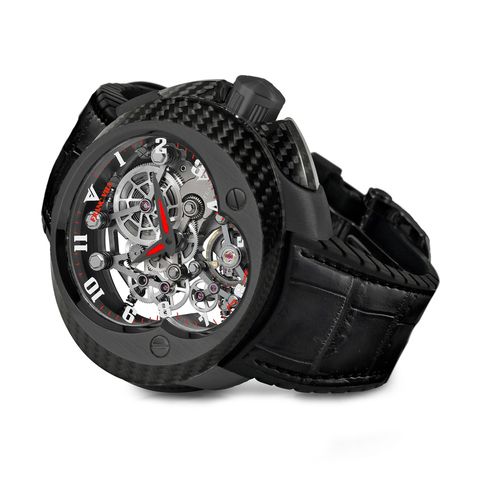
 Yeah, I didn't know what texalium is either, so I had to look it up. It is a woven carbon fiber product, perhaps similar to the stuff they use to make high-end golf club shafts. The Franc Vila website is revealing…and contains lots of zeroes. Here is a picture of the watch in question. Would you pay $20,000+ for it?
But all this is just one aspect of time. There is a chapter on tempi (tempos for the non-musical). Beethoven had his own ideas about the meanings of words such as Lento, Adagio, Allegro and so forth. So, just how long "should" it take to perform the Ninth Symphony? Recent recordings, presumably being played at the speed they were recorded, mostly range from 62:30 to just under 70 minutes, and then there is the outlier: Leonard Bernstein conducting the Ninth at the Berlin Wall in 1989, in nearly 82 minutes. Would Beethoven have been happy with any of these? Possibly, but he was famously cantankerous and, given modern recording equipment (and a miraculous hearing aid), he just might insist on re-recording it "his" way.
Well, there are 15 chapters, including a long final one on a few time-involved sections of the British Museum. These days, museums, including the one I work at, tend to focus a lot on time sequences, particularly when geology is involved. After all, rocks range in age from almost-right-now, such as a recently crystallized mineral specimen from a briny lake, to just under 4.4 billion years ancient. Even an art museum will typically have the date a work was produce on a card nearby, and certain halls are arranged chronologically, particularly if a featured artist went through "periods".
Look at your wrist. Does time have a handcuff on you? The first wristwatch was produced in 1812. The first "affordable" watch came nearly 100 years later. Are we the better for it? Simon Garfield would say a definite "Maybe, maybe not." He did manage to find one culture, the Inuit, who have a language without "time" in it, and the people live by the skies and the seasons. Not bad work if you can get it.
I have thought and thought, and I just don't know how to approach Timekeepers by Simon Garfield. That is to say, I have no clever approach; no warm, fuzzy stories; no chuckle-inducing anecdotes.
The book is about the experience of time. Within, the author reacts to our steadily increasing overscheduling. He also journeys to some special places where time is perhaps a commodity, or contrariwise, something to be largely ignored.
The two chapters that most appealed to my inner geek were "Horology Part One: How to Make a Watch" and "Horology Part Two: How to Sell the Time". In the first, the author visited the one Swiss watch factory that allows you to do this: At IWC (formerly International Watch Company), for a (hefty) fee, you can remove a portion of an assembled watch, 17 parts, and then put them back in again. You are at a desk with an intimidating array of tools for handling the tiny parts such as screws about the size of a poppy seed. The portions you get to "play with" were originally assembled by a craftsman who routinely puts them in within a quarter of an hour or so. You are given about an hour. The author took longer.
In the second, back in his English home, the author ruminates on the rapturous language used to engage the interest of the sort of person who just might be in the market for a watch costing as much as a rather good auto. We are not talking about the TAG Heuer watches that are advertised in certain mens' magazines for a few thousand dollars (or pounds sterling). These are in the £20,000 and up class, topping out in the £200,000 range (in dollars, that's about $26,000 to $260,000). An example, from an email:
Franc Vila is pleased to present you the RV EVOS 18 Cobra Suspended Skeleton in texalium...
But all this is just one aspect of time. There is a chapter on tempi (tempos for the non-musical). Beethoven had his own ideas about the meanings of words such as Lento, Adagio, Allegro and so forth. So, just how long "should" it take to perform the Ninth Symphony? Recent recordings, presumably being played at the speed they were recorded, mostly range from 62:30 to just under 70 minutes, and then there is the outlier: Leonard Bernstein conducting the Ninth at the Berlin Wall in 1989, in nearly 82 minutes. Would Beethoven have been happy with any of these? Possibly, but he was famously cantankerous and, given modern recording equipment (and a miraculous hearing aid), he just might insist on re-recording it "his" way.
Well, there are 15 chapters, including a long final one on a few time-involved sections of the British Museum. These days, museums, including the one I work at, tend to focus a lot on time sequences, particularly when geology is involved. After all, rocks range in age from almost-right-now, such as a recently crystallized mineral specimen from a briny lake, to just under 4.4 billion years ancient. Even an art museum will typically have the date a work was produce on a card nearby, and certain halls are arranged chronologically, particularly if a featured artist went through "periods".
Look at your wrist. Does time have a handcuff on you? The first wristwatch was produced in 1812. The first "affordable" watch came nearly 100 years later. Are we the better for it? Simon Garfield would say a definite "Maybe, maybe not." He did manage to find one culture, the Inuit, who have a language without "time" in it, and the people live by the skies and the seasons. Not bad work if you can get it.
Subscribe to:
Posts (Atom)

 Posts

