Showing posts with label demographics. Show all posts

Thursday, December 03, 2020

The population bomb goes PFFT

 kw: book reviews, nonfiction, population, demographics, futuristics

As Yogi Berra (probably) said, "Prediction is hard, especially about the future." That doesn't seem to stop anyone. When I was growing up, projections of future gloom and doom, particularly about population, were periodical literature. Paul Ehrlich's book The Population Bomb was a best-seller in 1968. The Club of Rome issued Limits to Growth in 1972.  As recently as 2015 we have The End of Plenty by Joel Bourne. Much further back, the "granddaddy of gloomy prophets" is probably Thomas Malthus, with An Essay on the Principle of Population as it Affects the Future Improvement of Society, in 1798.

All of these based their predictions on the fact that population grows exponentially while agricultural productivity grows linearly. Each author called on us to expect disaster within a generation. However, 8 or 9 generations have passed since Malthus wrote, and about 2 generations since Ehrlich. Not only haven't we starved to death, the population has risen from just under a billion in 1798 to almost 7.8 billion today (late 2020), yet the proportion of that population who are starving is at a historic low, and there is actually abundant food for all, but corrupt governments and failed states are responsible for every food shortage that currently exists.

What happened to all the predictions? This chart, from The World in Data, sums up one factor nicely:


The curves after 2019 are a projection. Note the peak of the pink curve, which shows the global rate of population growth. That peak was in 1968, when Dr. Ehrlich's book was published. I wonder if he takes credit for the dramatic reduction in growth rate that followed. Had a growth rate of 2.1%/year (actually 2.08%) continued for the next 52 years, world population today would be not 7.8 billion but nearly 10.4 billion.

However, it is critical to understand that 2.1%, or any other figure on this chart, is not the birth rate, but births minus deaths. In those years, birth rate was around 3.7%/year, but that is not the criterion that economists use to calculate future population. That is fertility, or the number of births per woman, a lifetime figure. Projecting the chart above further into the future, its authors would conclude that the global population growth rate would reach zero about the year 2130, and then go into negative territory, meaning that population would begin to fall below a peak that they expect to be just above 11 billion.

The fertility of the whole world expected by the chart's authors in 2130 would be 2.1 births per woman, which is called "replacement rate". If nobody died before adulthood, a fertility of 2.0 would provide full replacement, but of course some do. In a much safer world, perhaps replacement fertility could be 2.05 or less.

The second factor is, I would say, a series of "white swans" (as opposed to "black swans", which are unpleasant surprises) in agriculture. In the Parable of the Soils (Matthew 13:1-23), Jesus speaks of the "good ground" yielding fruit 30-, 60-, or 100-fold. Thirty-fold harvests were good for the time, and 60- to 100-fold harvests must have seemed incredible to the disciples. Grain harvests today exceed 300-fold. That is just one element in the agri-revolution that can feed 8 billion right now. Another is factory farming; some hate it but you can't argue with the results. Land that once couldn't be farmed, is now arable, cranking out those huge harvests.

One final point before getting to the current book. The wiggles in the growth curve above represent generational trends. The upward burst after 1910 shows the effect of public health measures that led to safer water and less cholera and malaria; a steepening in the 1940's is the "baby boom" that affected mainly the West; the near-plateau about 1950-55 shows the "birth dearth" after decolonization and the breakup of the British, French, Portuguese and other empires; the "pop-up" that peaked in 1968 and then fell just as rapidly shows the twin effects of the X Generation's births followed by "the pill"; and then the blips in the 1980's and early 2000's are late "echoes" of the Baby Boom, which produced the Millennials (Y Generation) and the Z Generation. But the continuing trend of lower growth rate remains to be explained, and that is the job of today' authors.

Authors Darrell Bricker and John Ibbitson are not economists, but they think like economists. Their book Empty Planet: The Shock of Global Population Decline analyzes the data used by the authors of the above chart, and even more the data and reports published by the United Nations, on the population trends that the U.N. expects for the rest of this Century. To be blunt, Bricker and Ibbitson claim the above chart is incorrect, that the growth rate is most likely to fall to zero and below by about 2050, and that world population will barely exceed 9 billion in that year, and perhaps not even that. They expect world population in 2100 to be close to what it is today, or a little less, and that it will continue to fall.

They base their contentions on a thorough study of trends in many regions and countries. The biggest factor in fertility is education, particularly education of women. The big trend that underlies access to education is urbanization. In 2007, for the first time, more than half the world population lived in cities on in major urban areas. By 2050, this proportion could reach 2/3 (67%) or more. The US and other Western nations hit 50% in the 1920's. Quite a number of countries, mostly smaller ones, are 100% urban, which means they import all their food.

The two biggest countries, by population, are China and India. Chinese urbanization is 61.4% as of early 2020, and India's is 34.9; both are rising fast. Urban, educated people have low fertility; in nearly all nations with large urban populations, fertility is between 1.5 and 1.9. Even in rural areas, which show higher fertility, education is spreading such that there are few places with fertility greater than 3.

The authors write of many things, but emphasize just a few: educated women learn how to control the number of children they have and more of them aspire to a career, so they put off having children, which also reduces the number of children they might bear; and while children on a farm are a benefit—grow your own farm workers!—in a city they are unproductive mouths to feed and their post-secondary education is very costly. For urban people, small families are a survival strategy. Talk to ten millennials; it will be hard to find more than two who think they will have any children, and certainly not before age 30 or 35.

What will happen in the long run? Let us suppose that the year 2100 is ushered in by just 7 billion earthlings, and with a fertility well below replacement, in the range of 1.6, population will continue do decrease. It's not a bad picture, actually. There will be less pollution, global warming will be (or will soon be) a thing of the past, and less of the Earth will be needed for farmland.

Until then, for some countries at least, immigration can ameliorate the problems of an aging population. But eventually there will be few immigrants. However, is decreasing population a disaster, as the authors claim? The biggest problem with a decreasing population is that it is an aging population, and old people need more services, and not just medical. When there aren't enough younger folk available to perform those services, then what?

I expect a "gig economy" to arise for the semi-retired. The healthy ones can do things for those who need it (or are willing to pay for things they just don't want to do). For example, we have a neighbor, a widow in failing health, aged 81. She has a caretaker to lives with her part of the time, for a few days at a time, a woman aged 83 in robust good health! If my wife and I get too frail (or too fed up) to mow our lawn any more, we might employ a lawn care company, or we might look on Craigslist or a similar place for a retiree who likes mowing lawns for a fair price. He or she may be slower at it than the young fellow with a 48-inch riding mower, but I bet more careful. In their dotage, my parents employed a gardener who was older than they, but healthier. I could go on…

Every book I've read on these subjects is based on the premise that continued growth is a requirement for economic health. Where are the economists who are planning what is needed for a future in which the "growth rate" of a country's or planet's GDP is negative? We do have a couple of points of reference. One is the Black Death that removed a third of the population of Europe. Once the survivors got everyone buried and began to pick up the pieces, they found lots of land and "stuff" left behind for the taking, and there was an economic boom. The current Covid pandemic isn't likely to have nearly as great an effect (death rate overall is less than 1%, not 35%), and we don't expect any sudden drop in population to disrupt society the way the Black Death did. With a slower, gradual decrease we can adapt, and it is likely that we are adaptable enough to adjust and thrive.

One production value I must commend: the end notes are all references, with hardly any "extended explanations." I prefer that; if an author has something worth writing about, it is worth putting in the text. When I find that a book's end notes are full of added material, I put a second book mark there, so I can refer to an end note on-the-spot to see what else was written, and read it while the referring material is fresh in my mind. I prefer not to have to do that.

Friday, April 19, 2019

The unexpected down side of better public health

kw: book reviews, nonfiction, public health, demographics

First impression: Thomas J. Bollyky should have employed a co-author. His book Plagues and the Paradox of Progress is very difficult reading, not just because of the emotional weight of the subject, but because he writes for PhD-level readers (I subjected certain paragraphs to the Gunning Fog Index algorithm, which yielded numbers of 19 and greater. That's worse than most legal contracts!). Yet the subject is very important. So much so, that I read through it anyway.

A thousand years ago, life expectancy at birth, almost anywhere on Earth, was in the range of 25-30. This was still true just 150-200 years ago, but that was beginning to change. Nonetheless, this picture of a cemetery in Missouri, where my ancestors are buried, is instructive (Payne is a family name). When I took this picture I inadvertently recorded the basic demographic fact about life prior to 1880 in America: half of these tombstones are half-size, indicating children five years of age or younger. The larger tombstones commemorate people who typically lived into their fifties to eighties. Even a millennium ago, if a child survived at least five years, remaining (average) life expectancy could exceed sixty years.

The advances in public health have been very uneven. As described in the book, the countries of today's "first world", mainly the U.S., Europe and Japan, began making changes to infrastructure and health practice that reduced infant and youth mortality, and the spread of infectious diseases in general, more than 200 years ago. Progress was slow and not always steady. But the one big effect of all this was a gradual "younging" of the adult population. More children survived childhood and grew into young workers. Because the changes occurred over decades or even a century or more, employment for this glut of young workers grew at a rate that employed most of them. Much of that employment was in the growing cities, which grew into many of the mega-cities of today.

That's oversimplified, but the major and obvious effect of better public health is a demographic shift. If a country or region has a growing employment base, which typically means growing cities and more manufacturing, the economic benefits multiply. A major problem with citification is that crowded conditions foster the spread of infectious diseases, so for a generation or two (or three), the burden of disease shifted from early childhood to the working years. Many of the major cities of the Western world grew only because in-migration exceeded the appalling death rate from cholera, tuberculosis, and other diseases of crowding. Further public health measures, such as quarantine, and later, effective medications (beginning in the early 1900's), reduced the toll of plagues and other infections. Thus the "first world" has average life expectancy at birth in the range of 80 years!

A second demographic effect has been that families got smaller. A couple didn't need to have five or more children to ensure that a few would survive to become their parents' "retirement plan". Of course, some couples just like to have a lot of kids anyway; a neighbor of ours has 18 siblings, all from the same mother and father! But few Western families have more than two or three children, a great many have only one, and among Millennials, the trend is toward having none.

The "third world" (is there a "second world"?) has had it different. And worse. Rich nations began helping poor nations with medical and financial aid around a century ago. So the life expectancy in most countries exceeds 70 years (160 out of 223). I looked up a few in the CIA World FactBook: Albania, 79y; Bangladesh, 74y; Thailand, 75y; Libya, 77. However, other places still lag: Angola, 61y; Ethiopia, 60y; Laos, 65y; Botswana, 64y. The lowest life expectancies are to be found in sub-Saharan Africa, ranging down to the mid-fifties.

The book describes what has happened. Death rates among infants and children, and generally from infectious disease, have been dropping. As a consequence, there is a glut of younger people trying to make a living. The mass migrations, for primarily economic reasons, that began in the 1700's and 1800's, are accelerating as the poor countries of the world struggle to (and usually fail to!) employ their teeming millions.

The last chapter has a "what do we do about it?" message. The answer: much more...but what? So far, there is a little hope here and a little there. Malaria and AIDS and cholera and TB get all the press. Even though there is still a ways to go, progress to date has led to a demographic crisis that is being mainly ignored by the various bodies that have been addressing the diseases. Nobody has broad-based plans to address the resulting glut of young workers.

Well, that just presents the problem. Who will solve it? We're at risk of many good trends of the past few centuries being reversed. At this point I'd usually say, "Read the book." But many won't be able to, unless they are ready to cope with prose that you need 19 years of education to read without difficulty. I hope someone takes this book and its deficiencies as a challenge to write a better one, a more accessible one.

Monday, April 14, 2014

The population un-bomb

kw: book reviews, nonfiction, demographics, sociology

Disaster sells. When Paul and Anne Ehrlich published The Population Bomb just over 45 years ago they predicted imminent disaster if population continued to increase. I read that book then, and others by either Ehrlich since, and picked up the feeling that they knew they were overstating their case, but felt they had to because otherwise nobody would listen. I don't know if many really were listening, but in fact fertility has fallen in America, and even more in most of Europe. Consider these two figures, from a report by Mark Mather:


Mr. Mather's thesis is the effect of a falling economy on fertility. The data can be interpreted a number of ways, however. For example, the 1960-80 period saw a great increase in American females entering and graduating from universities, chemical birth control (actually conception prevention) was introduced in the mid-60s, and abortion was legalized in 1973; also, the pre-1930 fertility decrease began about 1921, long prior to the great market crash. A careful look at the right third of the upper graph reveals that fertility has been below 2.1 births per woman, considered the replacement level, since 1970. The second chart shows ethnic data. As of the 2010 estimate (that's what the asterisk means) only Hispanics have remained above 2.1 bpw.

On a side note, I have yet to see a good explanation why 2.1 rather than 2.0 is "replacement rate". It is usually said that this accounts for the 5% who do not reproduce, but the figure already includes them in the calculation. I surmise, without formal proof, that the 2.1 figure is related to economic estimates that a small population increase results in the stablest economy, and this has somehow been laundered of this association and been promoted instead as "replacement", when it is actually replacement plus 5%. Spread that 5% over a typical 30-year fertility period, and you get an annual population increase of just over 0.15%. Yet American population is currently growing at 0.7% yearly. World population growth is 1.14%.

The Ehrlich's were right that unfettered population growth is a problem. They were wrong about the timing, but the key element is compounded growth. At its most basic, we need to realize that any rate of growth above zero, carried on long enough, will exceed any criterion you might set. For example, if world population were to continue growing at 1.14% yearly until 2100 (another 86 years), the total growth factor is 1.011486 or 2.65. Today's population, estimated to be 7,156,000,000, would become 18,969,000,000. Nearly 19 billion. The US might fare a little better (unless a few billions decide to relocate here): 1.007086 is "only" 1.82; in 2100 its population could become 571,400,000.

One last point before getting to the book on hand. What if we slow down population growth, say by a factor of 10? That just defers the inevitable, assuming any growth at all. A simple calculation shows that there will still be 19 billion folks on earth at some point, but in 860 years rather than 86. And go the other way. Could Earth support a trillion of us? Posit a 0.1% growth rate: the factor needed is 139.74. Working the math backwards (it requires using logarithms) yields a mere 4,942 years.

Now here is someone who must hope that the planet could support an unbounded number, perhaps trillions or more. Jonathan V. Last has issued What to Expect When No One's Expecting: America's Coming Demographic Disaster. He shows from history that every time a nation has experienced declining population it has fallen. He calls The Population Bomb "one of the most spectacularly foolish books ever published" (p. 7), primarily for historical reasons.

The book provides a fascinating survey of all the factors behind the current trend toward one-child and no-child families, though I hesitate to call a couple who marry with the expectation to remain childless a 'family'. It stretches the definition. Then again, from a Christian perspective, if they want to stay together, marriage is better than shacking up. Note that this lifestyle is only possible—barring medical reasons for infertility—since effective contraception was developed about two generations ago.

One big factor in the West is the rise of hedonism and "positive self esteem" as values in themselves. If you value your pleasure above all else and feel so good about yourself that you lack nothing, in a personal sense, then why have a child? Raising a child costs lots of money, swallows up your time, and induces you to forgo nearly all pleasures. That is, if you are not the kind of monster who refuses to change even a little bit to accommodate the new arrival(s). It may also, under most governmental systems, induce you to marry in case you hadn't already, because of the substantial benefits that accrue to married couples and parents.

However, there are certain benefits to marriage and child-raising, besides those that governments can provide. I have had occasion to counsel young married folks who are having problems. The chief problem is communication (men don't talk and women don't listen – stereotypes that are too true to be funny). I always make sure they know that by marrying they have each entered into a lifelong negotiation. It is impossible for any two people to agree or have the same opinion about absolutely everything. At least in America, if one partner is the "My way or the highway" sort of negotiator, that one will soon be single again. Learning to collaborate and do some horse-trading is a huge factor in what we call maturity.

Then, when children come along, a new set of growth opportunities arises. If you had no self control before, you'll soon learn some, or your child will be short-lived. And you learn the joys of filling a little head full of mush with your own values, hobbies and mannerisms. I remember with the fondness only time can bring, the late nights of carrying a cranky baby in the "colic hold" that soothed him, but only if carried on for long enough. The dogged experimenting with method after method of inducing a 1-year-old who could climb out of his crib to stay put; I finally settled on putting him in and just sitting there to watch.  He would watch back, and gradually his little eyes would droop closed and he'd tip over, fast asleep. This led to some talk, then to story time and later to precious times of reading to each other. I wouldn't give that up for ten centuries of "living the single high life".

But it seems the better educated a population becomes, fewer and fewer are those who are willing to have and raise children. Learning is a more effective method of birth control than a boatload of condoms and a trainload of pills or IUD's. I happen to think this is a good thing, but I'll get more into that anon.

Apparently, in all of history, only one nation has rebounded from a long-term falling population: Georgia in Eastern Europe. The secret of their success is the beloved patriarch of the Georgian Orthodox Church, Ilia II. He announced in 2007 that he would "personally baptize any child born to parents who already had two or more children" (p. 159). Births increased 20% the following year and continued to surge. America has no Patriarch. We're too fractious for that.

In the end, Jon Last tries his best not to sound like a doomsayer. He wants to remain optimistic. He has suggestions, tailored to the American situation, that he hopes would improve things—that is, raise the fertility rate.
  1. Social Security "distorts the 'market value' of children and forces fertility rates down" (p. 162). He passes along a suggestion by Phillip Longman to dramatically reduce the SSI tax the more children a family has, until the last one reaches age 18. (I suggest the subsequent increase be phased in to avoid sticker shock when the last kid leaves home!) He also briefly surveys related suggestions by others.
  2. College costs make anxious parents more anxious, and strongly deter many from childbearing. The system is out of whack. What about eliminating the need for college, for many jobs. Is it really useful for an employer to require a BA degree when what you really want is to know of someone is bright and has good work habits? Yeah, the degree sort of proves that (not always!), but so would admittance testing. IQ tests by employers were banned in 1971 on the grounds of racial discrimination, but schools use them (SAT and ACT are IQ tests). So companies foist off the job on the schools, but students then have to go into debt to the tune of $30,000-$100,000 and get "the sheepskin". A few wise companies just want to know if an 18-year-old was offered admission to a good school. The author proposes a federal degree-granting body that certifies any student who passes certain tests. I guess you could spend a year or so watching and studying using Khan Academy videos, for example, and pass a bunch of tests. You know, I like that idea, even if I loathe the notion of yet another federal agency.
  3. "The Dirt Gap" reflects the much greater cost of real estate wherever the jobs are. When people go to a workplace they either must live close by, or commute. I endured 9 years of a 40-mile commute each way. Luckily I can read in a moving vehicle, so I pooled with others and used those 1.5 to 2 hours daily (when I wasn't the driver) more productively as a result. I remember living in Los Angeles. For one job, I rode my bicycle, because I could get there quicker: 9 miles in 20 minutes versus 30 minutes by car. During rush hour in major cities, even the freeways average 10 mph (16 kph). Years ago I could trot along about that fast, on foot! One solution is a huge increase in telecommuting. Any job that primarily uses computer skills can be done anywhere on the planet with high-speed Internet service. The last several years before I retired, half my colleagues were in Gurgaon, India. We didn't need much face-to-face, but we video conferenced every couple of weeks. 7AM here was 6PM there, and those guys would work a late day for the purpose, while we stateside folks started early that day (I usually began close to 6AM anyway).
  4. Immigration…we just think the "illegals" are a problem. Though there is a lot of variation, immigrants and their children tend to be harder working and more innovative than "people who have always lived there" (that is, four or more generations). American has been lucky to assimilate most immigrants within a generation or two. And I learned long ago that moving to a new place just within my own country is a great boost to well-being. There is some kind of value to being the kind of person who can "up sticks and go". A close relative greatly hindered his career because he allowed his wife to persuade him to stay within driving distance of her parents.
  5. Church. It is falling out of favor with the liberal elite. Yet it is strange: people in America attend church at rates much higher than in any other Western country, and at the same time, our demographics and economy are healthier. The author's concluding paragraph of this section is telling:
"…there are many perfectly good reasons to have a baby (curiosity, vanity and naïveté all come to mind.) But at the end of the day, there's only one good reason to go through the trouble a second time: Because you believe, in some sense, that God wants you to."

As the author demonstrates, history shows that reducing population means trouble. But I think the reason is different than he states. Our economic system is designed for a growing population. Growing companies cannot cope with shrinking customer bases, and there is not a single executive in all the countries on Earth who has been trained to guide a company properly when the market for its widgets gradually and steadily decreases. This phenomenon needs study. I must agree in part with Paul Ehrlich that unbounded population growth cannot be sustained. At some point, population must decrease, or nature will, quite impersonally, force it to decrease in numerous unpleasant ways. I am of the opinion that 7+ billion is already too many, particularly so if we have the heart to wish them all a standard of living that is something above subsistence poverty.

Let's consider Costa Rica, a constitutional republic with a GDP per person of about $13,000. That is pretty good for South and Central America. It is about 1/4 of the figure for the U.S. About 80% of Earthlings live on less. To raise them all to this level would require more than doubling global GDP; perhaps tripling it (purchasing power parity calculations are notoriously difficult and error-prone). Either way, there isn't enough planet to do so. My estimate is that grinding poverty cannot be eliminated until the population is about half what it is at present. Thus I must disagree with Mr. Last. Growing the population might be good under the current economic system, but we won't be able to afford the current economic system very much longer.

A new economic system must be devised, one that allows persons and companies to survive and even thrive as population resettles itself to a level that Earth can sustain for the very long term. I would hope this author and others would bend their considerable skills to determining the key factors that make our economies collapse when population takes even the smallest of downturns, and to inventing a new kind of economics for an Earth in a steady state, and during the population reduction that leads to it.

Sunday, November 11, 2012

OK it is full already - now what?

kw: population, religion, demographics

From time to time I read that this or that international body "expects" human population to peak at some number, such as nine or ten or eleven billions. I wonder if those respected experts have consulted with people in sub-Saharan Africa or in the Middle East, or with the strongly religious of every culture, whether Jewish, Muslim, Hindu, Christian (and others): all are trying to out-breed the competition.

I can't speak for any of the world religions, but I do know Christianity, particularly the strongly Biblical variety such as Evangelicals. In the U.S. as a whole, the rate of population increase is just over 1%. Among Evangelicals it is much, much higher. A great many families in the churches I know have 3-5 children. Most of them think they have a divine mandate to have many children. Halfway through the first chapter of the Bible we find God's command to Adam: "Be fruitful and increase in number; fill the earth and subdue it. Rule over the fish in the sea and the birds in the sky and over every living creature that moves on the ground." (Genesis 1:28, NIV).

I have never heard a sermon on Revelation 11:18, "The nations were angry, / and your wrath has come. / The time has come for judging the dead, / and for rewarding your servants the prophets / and your people who revere your name, / both great and small— / and for destroying those who destroy the earth." (NIV, emphasis supplied). So here is a mini-sermon: Listen up, people, are you among those who destroy the earth? If so, you are NOT among His servants the prophets, nor those who revere His name. That verse about multiplying until you fill the earth? It has been more than fulfilled. It is time to stop!

The earth is groaning under seven billions of us, even though half of them are in poverty. By far most of the burden on the earth is the top two billions. The "green revolution" is pretty much over, and nearly all fisheries are decreasing. If another two or four billions are added, nearly all of them will be miserably poor. And many of the 3-4 billion who are not poor today, will become poor. That doesn't sound like what God wanted in Genesis chapter 1!

So, Evangelicals, if you truly believe in God, stop trying to outbreed the Muslims and Catholics and everyone else. Do whatever you can to improve worldwide education! The birth rate drops, the more educated the population is. There is a young Pakistani girl, recovering from being shot by the Taliban for promoting education for girls. Support her cause! The best kind of missionary is an international teacher. Do you want to serve God? Raise up a giant outcry for better education everywhere, and prepare your kids to teach everywhere!

Wednesday, May 03, 2006

The man who would be prophet dare not miss.

kw: book reviews, nonfiction, economics, demographics, forecasting

This book took a week to read, and a couple days to think over. In The Next Great Bubble Boom: How to Profit from the Greatest Boom in History: 2005-2009, written in 2002, Harry S. Dent, Jr. forecasts a boom in the last half of the decade, followed by a significant recession, or even a depression, of about 14 years' duration. He rides on his credentials as the one who forecast the economic ride we had in the 1990s.

So is he right this time? Or is it as Churchill said, "Even a fool is right sometimes." Author Dent's main thrust is the demographic changes that America and much of the world will go through as the Baby Boom generation finishes its climb to the peak of economic power, then goes into retirement, followed by the smaller, and thus less powerful, echo boom, the X generation.

I am certain there will be a significant impact. Whether the reduction in the need for goods and services will be greater or less than the reduction of workers available is another question. In other words, we know demand is going to reduce, probably from 2010 until the early 2020s. Will the job market shrink more than the working population, leading to rampant unemployment? Will the working population instead contract the more rapidly, leading to a surplus of job and business opportunity?

The demographics are pretty clear. There are many studies of the expected population trajectory for most countries, and of the economic rise and decline of typical individuals as they age into the work force, buy houses, raise families, retire, and "fade away." The use we make of such data requires a more rigorous mathematical basis than it receives at the hands of economic forecasters.

For example, the author shows that for the average American, spending is the greatest around age 42. Then he takes the birth curve of the 1940s to 1960s, projects forward 42 years, and shows it as an economic projection. However, that curve has a rather broad peak, and is skewed: rapid rise, slower fall with aging.

To properly combine a spending curve with a changing population curve, the proper mathematical tool is convolution, AKA cross-correlation. Only a convolution of spending with age, and the numbers at each age over time, will properly predict an economic trajectory.


An extremely simplified model shows the principle. This chart shows a population bubble: an otherwise steady birthrate of 10 (thousands, millions, whatever) per time period (years, decades...), rises to 25, then drops again to 10. We'll call this the Birth Function.


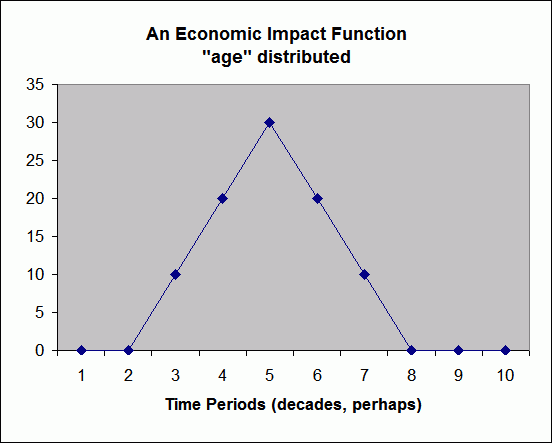
This second chart shows economic effectiveness (on whatever scale you'd prefer to measure it) as it rises then falls with age. Supposing these time periods are decades: earning "enough to care about" begins in the 20s, rises to a peak in the 50s, then falls to "too little to care about" in the 80s...on average. We can call this the Spend Function.

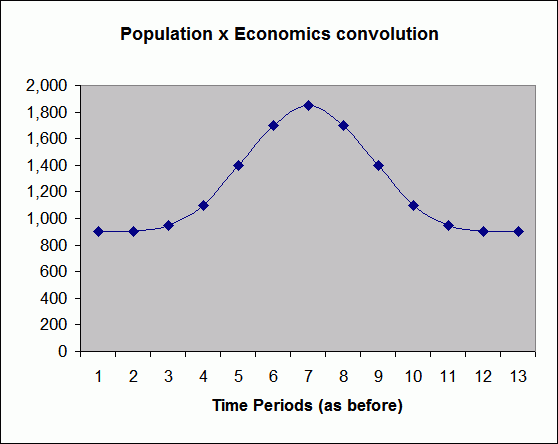
You may of course get more complicated schemes, with differing trajectories (and impact levels!) for rich, middle, and poor "classes." Regardless, the homogeneous economics-with-age Spend Function function is convolved with the Birth Function to produce our result:


This chart shows that the convolution is not as sharply peaked as the two functions that produced it. The time scale is different also; this Economic Impact Function covers about an amount of time equal to the width of the Birth Function and the width of the Spend Function.

The Birth function and Spend Function both fall from a peak to the baseline (10 in the first case, zero in the second) in three time periods. Their total width is the same, six periods.

The total width of the Economic Impact Function, the convolution, is twelve time periods. However, because it is more 'curvy', it really has a significant difference only over about eight time periods, so the fall from the peak to the effective end covers about four periods.

Now, given the many other factors that affect a national market over various periods of time, there is a lot of noise masking any signal we'd like to discern. Specifically, if the month-to-month variation in a market signal is a few percent (10% is common for the DJIA, for example, from any month to the next), it can take a long time to pick out a long-term trend.

Thus, we may expect the US economy to turn downward around the end of 2009, and it very well may. However, it may have market peaks and valleys that make it hard to determine the fall has really begun for several months. Major market slides take a couple years to work out. Only in retrospect can we say, "The downturn was such-and-such a date."

Harry Dent's book is interesting, informative, and gave me a lot to think about. I like his ideas, though I think the analyses view some noise as though it were a signal. That's where I'd put Elliott Waves, on which Dent spends a chapter. Bottom line: the Boomers and the Echo Boom can be expected to make the world economy ring like a bell for about a century to come. When you expect a downturn, how do you prepare? Best way known: start a business that caters to those you expect to have money anyway.

My grandfather, once a salesman, later a piano tuner, began renting and leasing used and repaired pianos in the 1930s. He figured almost anyone would go for having a piano if it only cost them a dollar or two a month. Everyone needs entertainment, and radios then cost a lot. He was right, and continuing piano rental receipts provided my grandparents a very comfortable retirement, including two vacation homes.

Harry Dent makes me think. I like that.