Showing posts with label biology. Show all posts

Sunday, February 08, 2026

Dominance of the spineless

 kw: book reviews, nonfiction, science, oceanography, biology, invertebrates, medicine

Behold a gallery of sponge animals. They headline The Ocean's Menagerie: How Earth's Strangest Creatures Reshape the Rules of Life by Drew Harvell.

Considering the matter for a moment, I concluded that the word "reshape" in the title ought to be "reveal." I suppose the publisher thought the title as it is makes better clickbait.

The thousands (almost 10,000 so far) species of sponge comprise the phylum Porifera. Their shapes and sizes are so variable, that pores are the only consistent feature. Brainless, apparently without nervous systems, they are remarkably successful predators. Most consume plankton (little floating things), but some grow over and consume coral animals, and some have inner chambers with other critters such as shrimp living inside. The shrimp gets a safe home, and the sponge eats the leftovers the shrimp drops. Being stationary, sponges need good defenses against predation and against diseases caused by bacteria, fungi and viruses. Dr. Harvell tells us that they have the most multifarious immune system of all animals. Her particular interest is figuring out how their various chemical defenses work, and which ones might lead to medical advances for humans. She writes, "…I call the capability to produce potent biologically active chemicals a sponge superpower." Sponge research is likely to lead to either better antibiotics, or to new alternatives to antibiotics, for example.

This image shows several corals along with a variety of sea anemones, which are related to corals. Both are members of the phylum Cnidaria, which also includes jellyfish (called "jellies" by scientists because they most definitely aren't fish). The phylum contains more than 11,000 species. Though they are  brainless, they have simple nervous systems that coordinate their movements.

The basic body plan is a radially-symmetric, columnar tube with only one opening (a combined mouth-anus) surrounded by stinging tentacles. Sea anemones are larger and solitary, while corals are colonial and build skeletons; the stony corals build mineral skeletons that form the backbones of reefs.

Stony corals are the subject of the second chapter (of 8). They are considered a "canary in the coal mine" related to ocean acidification. Later in the book we find that the pH of the ocean is presently very near 8.0; elsewhere I read values ranging to 8.05. A century ago ocean pH was about 8.15

Sidebar on pH: It is a logarithm, the negative logarithm of hydrogen ion concentration in water. Pure, distilled water has pH of 7, which means that the concentration is 10-7, or one ten-millionth, or one hydrogen ion per ten million molecules of water (pH=7 is called "Neutral"). Thus a pH of 8 means one hundred-millionth. Putting these on a linear scale, adjusted with 1 meaning one per billion (pH=9) and 10 meaning pH=8, pH=8.05 converts to 8.9 and pH=8.15 converts to 7.08. Dividing the linear values, 8.15/7.08 = 1.15, which means that "acidity" is 15% greater at pH=8.05. Both these values are slightly alkaline, one more than the other.

What does 15% extra acidity mean to a coral (or any other ocean creature that uses calcite for its skeleton or shell)? Acid dissolves calcite, which doesn't dissolve when pH is 7 or larger. Acids have lower pH. For example, the pH of orange juice is about 4, and lemon juice pH is less than 3 (sour! You can taste pH). In sum, getting calcite to precipitate out of sea water is easier, and takes less chemical energy, when the water is a little alkaline. It takes a coral more energy to form its calcite skeleton at pH=8.05, compared to 8.15. Do note that fears of "shells dissolving" in the oceans any time in the near future are groundless. However, corals and shelled animals are having a little harder time forming their skeletons and shells.

On to Chapter 3, about sea fans and other gorgonians. These are also in the phylum Cnidaria, and are often called "soft corals" because they don't form rocky skeletons, using chiton or similar biopolymers instead. The word "gorgonian" refers to the Gorgon of mythology, who had snakes instead of hair on her head. An early biologist thought that these animals looked a little like that.

Collecting part of one of these is easier than collecting a stony coral: you don't need a hammer and chisel! And collecting is what the author did, of many of these creatures. Soft corals have immune defenses nearly as potent and various as sponges do, plus stinging cells like other cnidarians. Usually, the stinging cells, or nematocysts, not only immobilize prey, they also fend off most predators. Most. That word introduces the fourth chapter.

The term "sea slug" is rather ugly, because most of us know slugs in the garden as voracious pests, with slippery grayish bodies that offend most folks. I like the term "Nudibranch" better; it means "naked gills". As this illustration shows, these oceangoing mollusks are often beautiful. Being mollusks, they are members of the second largest phylum, Mollusca, with at least 100,000 species, and perhaps a million or more—we know so little about the ocean… Mollusks have a pass-through body, with both mouth and anus, plus a brain and nervous system. 

Nudibranchs' bright colors warn of a darker side to them. Many are venomous, but not in the way a snake or spider is. Many nudibranchs eat corals and other cnidarians, and they have an astounding biochemical trick: they can capture the nematocysts of their prey without setting them off and incorporate them into their own frilly tissues. Brushing up against one is like encountering a jellyfish and can sometimes be life-threatening.

The giant clam, subject of Chapter 5, is a quite different kind of mollusk, with a different superpower. They channel light and even shift its color, to "feed" symbiotic algae that provide much of the clam's nourishment.

The bright colors of their mantles are a combination of filtered light and fluorescence. Ultraviolet and violet-blue light in particular are useless for inducing photosynthesis. Fluorescent chemicals convert some of these "blue and ultra-blue" colors to colors the algae can use. In addition, the algae are arranged in small physical structures that stack them in ways that increase their overall efficiency. We have a lot to learn from clams! On a side note, we learn that these big clams cannot close their shell all the way. Old rumors about divers being trapped by giant clams are bunk.

One more group of mollusks fills Chapter 6. The skin of an octopus is possibly the most complex organ in the animal kingdom. This image shows an octopus most of the way through a rapid transition into looking like a lumpy rock. A careful look will reveal an eye, and further down, a few of the suckers that haven't yet been tucked under.

Octopuses, cuttlefish, and squids can change color, not just wholesale, but in patterns. The first two can also raise lumps, bumps and spikes in their skin to produce all kinds of shapes. A moment before this photo was taken, the octopus had smooth orange-red skin. It changed so fast that it seemed to vanish before the diver's eyes. Single frames from the video showed that the entire transformation took about a quarter second (7 or 8 frames in a 30-fps video). Great numbers of tiny muscles surround chromatocytes (color organs the size of a poppy seed) and sections of skin (to shift from flat to bumpy or spiky), under direct nerve control. Perhaps that is why an octopus or cuttlefish has nine brains. Lots of logistics going on!

Back to Cnidaria for Chapter 7: Jellies and their light shows. I have only seen these animals at the surface. On a couple of occasions my friends and I pulled dozens of 2-foot-wide jellies out of the surf at Huntington Beach in California, to make swimming safer. If you dive at night, you are more likely to see the light show. Not only jellies, but many other soft-bodies sea critters make their own light, or have captured special bacteria that do it for them. This amazing medusa has several colors of bioluminescence. It was photographed by its own light.

How poor is our land-borne experience! We have only fireflies and glowworms (certain female fireflies) and a number of other beetles to light up an evening, and a few species of glowing mushrooms. In the ocean, 90% of species produce light. Naturally, scientists are scurrying to learn their secrets. One is very useful already: green fluorescent protein (GFP), derived from a jelly. DNA to produce it is easy to splice into various parts of other animals' genomes, producing mice that glow green, or small fish with certain organs that glow with varying brightness as metabolism waxes and wanes.

Another phylum shows up in the last chapter, Echinodermata, the "spiny skins". Sea stars (colloquially, starfish) are not quite radially symmetric, as the Cnidaria are. There is a respiratory port off-center on top, making them bilaterally symmetrical, just barely.

This gallery shows 13 species of sea star, and three related echinoderms. The phylum contains more than 7,500 species so far known, while we have fossils of 13,000 extinct species. All are predatory.

This chapter focuses first on an experiment in removing sea stars from a section of seacoast. The area became overrun by mussels, which grew to the size of footballs. Where sea stars were present, there were still lots of mussels, but also areas where many other animals could settle, which greatly increased biodiversity.

More recently, there was a "starfish pandemic", and nearly all the common ochre stars along the west coast of the US and into Canada died, plus just as many "sun stars", a deep-water species with 24 arms. Over time, natural selection did its work and the numbers of ochre stars began to recover, but not, at the date of writing, the sun stars. The author and others are doing captive breeding to develop a resistant variety of sun star, in hopes of repopulating the deep coastal plain. Why, you might ask? Sun stars prey on sea urchins. If unchecked, sea urchins eat all the kelp. Kelp forests protect many species of fish and other pelagic (midwater) animals, including commercial species. Sun stars in deeper water and ochre stars in tidal areas are keystone predators: their presence controls the biodiversity of entire areas.

Throughout the book the author complains of the effects of climatic warming and ocean acidification that are based on increasing carbon dioxide in the atmosphere. In the ocean areas she frequents, the effects are visible. She calls it a Gut Punch. Her Epilogue is a long plea for more rational approaches to management of the ocean. While I agree with her on one level, I find it sad that we, as a species, find the need to "manage" 3/4 of the planet's surface. What we really need is to manage ourselves, but the lesson of the Bible, along with most other religious texts, is that humans excel at mismanagement, and any god you may imagine has a hard time keeping us in check. 

For context: The God of the Bible spent two millennia dealing with one family, the descendants of Abraham, to finally rid them of their tendency toward idolatry. He has spent the two millennia since then dealing with the spiritual descendants of Abraham, that is, the Christians, and has yet to rid them (us) of their (our) tendency to divide (there are more than 40,000 "denominations"), primarily over opinions, which are our modern idols. Mismanagement of the human soul is the source of mismanagement of planet Earth. This is why we need a Savior.

Tuesday, October 07, 2025

Yet another take on the origin of life, here and afar

 kw: book reviews, nonfiction, science, biology, exobiology, origin of life, evolution

Seeing the book's title, Is Earth Exceptional? The Quest for Cosmic Life, by Mario Livio and Jack Szostak, I had a waking dream that this image evokes. Is someone out there, wondering if there is life elsewhere?

(It took a while to "persuade" OpenArt to make the base image, one to which I could add the other elements.)

I was surprised to find that in a book this small (just over 300 pages), the authors would deal with the two biggest questions that exist: "How did life arise?" (the question behind "Where did we come from?") and "Are we alone?" The authors survey what is currently known about the abiotic→biotic transition in six chapters, and they present the multitude of methods for finding signs of life off-Earth in six chapters. The final chapter summarizes the whole.

Concerning the chemistry and physics that might have engendered the first living cells, one must get a bit technical. So much so that they include an appendix to Chapter 3 ("From Chemistry to Biology") that one might call a pre-Primer for Biochemistry 001. In biochemistry as in geochemistry, chemistry is geometry, because the shapes of molecules matter. In fact, much of biological evolution has been taken up with creating innovative and useful molecular shapes for "doing things" (that is, proteins, particularly enzymes). This pre-Primer introduces this kind of geometrical chemistry.

Thus, Chapters 3-5 show the results of breakthroughs in recent years, that broke through a logjam that confounded the science of biotic origins for decades. They describe in particular the way certain necessary molecules could have been assembled step by step, rather than all-at-once, as earlier hypotheses required. 

There's no need for me to get into the weeds about that here. I'll just touch on this impression: Chapter after chapter filled with "could be" and "might have" sorts of statements begin to sound like a case of terminal arm-waving. What rescues this section from that fate is the salient fact that we really don't know what happened between the period, starting almost 4 billion years ago, and lasting about 0.2 or 0.3 billion years, until the time of the first unambiguous fossils of biological "something", and the time that the chemistry of Earth, its atmosphere, and its oceans, had changed enough to support whatever living beings then existed. We have a somewhat good idea of the chemistry of some 3.5 billion years ago, but only the rawest speculation about what came before. We surmise that the change came about largely because of living things, just as the later Great Oxygenation Event made an even more radical change. We still have a lot to learn!

As to, "Who might be out there?"…the only "experiments" we can perform are the various kinds of detection technologies: Telescopes of the optical, ultraviolet, infrared, and radio varieties. Contrary to the claims of the UFO (and now UAV) communities, there is no (publicly known) and concrete evidence that some kind of space aliens have visited or are visiting. A big part of the budget of NASA is devoted to ET-finding technology. It's great that a few exoplanets can now be seen, though not in any detail, and that thousands have been detected and catalogued. 

I once read a short story in which a signal is detected by SETI (the Search for Extra-Terrestrial Intelligence, conducted with radio telescopes), and is found to be encrypted. The story ends with the protagonist wondering if the source is military in nature, which would not bode well for future relations. I wrote to the author, "Perhaps if the signal gets decoded, it will be bank transactions or inventory records." 

It's sobering to consider that the signals we have sent off into space by our radio and TV signals have yet to reach beyond about 100 light years, and if "someone" at a distance of 50-100 light years is listening in our direction, with technology at our level, they probably cannot yet detect it. Maybe in another 10-20 years…

Enrico Fermi's question still resonates: "Where is everybody?" How plausible is it that we are at the forefront? That, at least in a bubble a thousand or so light years in radius, we are the first planet with life to develop a civilization? Consider that it may be necessary for the Universe to evolve for 8-9 billion years, to produce a generation of stars with enough metallicity to have rocky planets that are roughly Earth-sized. Perhaps life can arise quickly once a planet's surface cools enough for oceans and lakes to exist. But then on Earth, at least, it took almost four billion years for biology to produce an animal that can build telescopes. I like the Copernican Principle, that we are about average. Maybe somebody, somewhere, developed faster and is millions or tens of millions of years ahead of us. Is that enough for them to develop the tech needed to send expeditions all around the galaxy, and find us? Maybe not.

In coming years, perhaps we will find out. Meanwhile, we have the great task of keeping the one planet we possess in good enough shape that we can survive long enough to be the visitors to someone else.

Thursday, July 17, 2025

Beautiful Spiders

 kw: book reviews, nonfiction, biology, natural history, spiders

James O'Hanlon loves spiders, particularly jumping spiders. Seeing these beauties, it isn't hard to understand. I gathered these pictures of peacock jumping spiders from several sources. They are astonishing!

Depending on your display, these pictures are about two to three times life size. They show a female's eye view of the male spiders' mating dances. To attract a female, a male peacock spider will raise his flattened abdomen and two legs, and wave and bob about and dance for her.

In O'Hanlon's book Eight-Legged Wonders: The Surprising Lives of Spiders, we find that a chance photo of such a spider taken by Stuart Harris completely changed his life. Before, he had a rather good life, but unfocused. When he saw a colorful little spider, photographed it, and posted the photo, he was soon hailed as the discoverer of a new species. To confirm it, a spider expert (arachnologist) asked Harris to find and capture a specimen. It took him three years! Now, the new species has been described and given the designation Maratus harrisi. And Harris has become something of an arachnologist himself.

For perspective, I must note that more than 53,000 species of spider are known so far. About 6,000 are jumping spiders, but only about 100 species are peacock jumping spiders. That narrows the field, since Stuart has added 1% to the list of known peacock spiders (In proportion, finding a new species of monkey would add only 0.3% to the known 334 species of monkeys). Nearly all of these pretties are found in Australia.

With this book, O'Hanlon hopes to reduce spider phobia. Many people find spiders both horrifying and disgusting. Popular culture, which usually depicts spiders as venomous monsters, hasn't helped. While it is true that nearly all spider species are venomous, most of them are too small to bite through human skin. Of those that can bite, a spider bite is usually milder than a bee sting. A big spider, like this tarantula I caught in my garage in Oklahoma about 40 years ago, can inflict a more painful bite, but it is not dangerous (In Oklahoma, male tarantulas are on the move, looking for mates, in late summer). Only a very few spiders have a bite that is dangerous to humans, and the only really deadly one, the Sydney funnel-web spider, is native to Australia, though international shipping has begun to spread them around.

Some people keep tarantulas as pets. A formative experience for me was when I was in kindergarten; one kid's dad visited, bringing the family tarantula. The father lifted the spider out of its cage and let it walk on his hand and arm. I was fascinated, as were most of the kids, but some hung back in great fear. Fortunately, nobody screamed.

I understand that some people's spider-phobia is so great that they will be distressed just seeing the photos in this post. I hope such folks can look, first from a distance, then gradually closer, and desensitize themselves at least a little. Along with the author of Wonders, I would like for people to appreciate what spiders do for us. They live in every environment on earth except the extreme polar regions, including in our houses. The ones that come indoors specialize in eating insects. When you find a cobweb with a multitude of insect bits in it, ponder for a moment how many insects the spider has eliminated from your home, so you didn't need to use a fly swatter nearly so much.

Spiders may do more for us in the future. You may know that silk, from certain moth caterpillars, can be woven into a bullet-proof fabric. Kevlar was inspired by such silk. So was nylon, but for a different reason: silk is not only very strong, it is soft and beautiful. Chemists wanted to duplicate these characteristics in a cheaper material. For many purposes, nylons (there are several varieties) have proven "good enough".

Dragline silk, one of the silks most spiders produce, is much stronger than silkworm silk, and apparently more luxurious. A few people have been industrious enough to gather thousands of spiders and "milk" them for their dragline silk, and a few garments have been made. Such textiles are exceedingly costly, and it is hard to "farm" spiders. Put a number of spiders in any enclosure smaller than a back yard, and it will soon contain only one spider. They are indiscriminate cannibals. But a spider silk fabric is very glossy, soft, and yet strong, although you don't dare get it wet. Sweat a bit, and an undergarment would become a sticky mess! Research continues. Perhaps one day…

The book is filled with great facts and information. Spiders live among us, they very rarely do any harm. I suspect more people are hurt because they jump when they see one, than directly hurt by spiders. Let's get rid of the jumping reaction and save ourselves some pain and distress. Few people will come to love spiders, but I think most of us can learn to appreciate them and react more calmly when we encounter them.

Sunday, June 22, 2025

Another naturalist, more yards

 kw: book reviews, nonfiction, science, biology, naturalists, natural history, citizen science, cities

When you think of Picnic Guests, what do you imagine? This image probably doesn't come to mind. Ants are the more likely thought. The third chapter of Secret Life of the City: How Nature Thrives in the Urban Wild, by Hanna Bjørgaas (or the fourth if you count a long "Introduction") considers ants. Ants that invade the author's city apartment, ants that drive her to consider chemical warfare. Discussions with a couple of scientists dissuade her, and she simply pays more attention to keeping things clean and outwaits them.

In the meantime, she uses a magnifier to get a closer look at one. At 20X, it looks quite fearsome. Ants are well fitted for living in a great many environments. They may be the primary ubiquitous animals. They live on six of the seven continents; none are native to Antarctica (the only insects that live there, in a few coastal areas, are a couple of species of midges that can survive being frozen for half the year). They abound everywhere else, and probably outweigh the sum of all mammals, humans included.

Ms Bjørgaas lives in Oslo, Norway. Her book was translated from Norwegian by Matt Bagguley. The nine titled chapters touch on living things she paid attention to during nine months of the year. She begins the year with crows, the most intelligent birds most of us are likely to encounter. Crows in the city, like many types of city birds, are less skittish around humans than their more rural cousins. They may not be as human-adapted as pigeons—sometimes you almost have to step on a pigeon before it flutters away—but they seem to have a keen sense of how far you can reach, should you be so inclined.

In the Introduction, though, which takes place in Antarctica where she worked briefly as a tour guide, her focus is not so much on penguins as on a particular species of lichen that caught her eye. Both crows and lichens appear later in the book also. The November chapter focuses on lichens, and is titled, "The Written Language of the City." This is because, among the great variety of lichen species, some are more sensitive, and others more tolerant of the polluted air of cities, particular when it includes sulfurous (stinky) gases. 

This picture shows at least three species of lichen on an old branch, in an area with rather clean air. Using citizen scientists to help collect observations, researchers have developed a "lichen scale" to measure the level of air pollution in and around cities. One may then map concentric rings that surround sources of more egregious stenches such as paper plants (Sixty years ago I remember the smell of paper plants near Newark NJ, which my cousin called "the armpit of New Jersey". It's been cleaned up a bit since then).

The author did an experiment in soil fertility. She bought nine pieces of cotton underwear and selected three locations, one in a desiccated city lot, one in a park, and one well outside the city in the forest. In each, she dug three holes and buried a garment a spade-length deep in each hole. Months later, there was nearly nothing left of her "offerings" in the forest, and the parkland holes yielded semi-composted cloth bits. The third location had been paved over since, which demolished that part of the experiment. I expect that the cloth may have been darkened a bit, but would have been otherwise almost unchanged, and I suspect she would agree. That's what others have found.

If you find the spectacle of a woman digging holes in a city park amusing, consider coming across her prone upon the ground, examining the contents of a shallow scrape with a strong magnifier. She did a little of this, as she tells in "August: Stories from Underground". With a bit more discretion, she visited a soil scientist, who showed her the life beneath our feet with a video microscope. A tiny springtail (the size of a comma) was a hideous monster compared to protozoa and other small denizens of the soil. And, of course, it must be said that the number of bacteria in a teaspoonful of soil will typically exceed the entire human population of the earth, perhaps ten times over. Even the dry, sandy soil of a trampled path in a city may contain a billion bacteria per gram.

This book is a delightful contrast to nature books that tend to concentrate on, for example, birds, or beetles, or some other focus. There is room in the concept of "naturalist" for anything living. I wish the book had an index. Still, it is fascinating and it opens one up to some of the variety to be found in any environment, if we will simply slow down and look, and listen, and observe.

Monday, June 16, 2025

The naturalist in the yard

 kw: book reviews, nonfiction, science, biology, naturalists, natural history, citizen science

I took this picture in 2010, the first year I participated in the Great Sunflower Project. It is a sweat bee of a species common in the mid-Atlantic area, gathering pollen from a Lemon Queen Sunflower, the flower designated in the Project for attracting pollinators, primarily native bees. For those who like to be involved with natural history in their own surroundings, GSP is one program that Thor Hanson recommends in Close to Home: The Wonders of Nature Just Outside Your Door.

According to directions, I planted sunflower seeds in early spring, and once the flowers began to bloom, I stood nearby for 15-30 minutes a few times weekly to record what I saw. The project organizers don't expect us backyard naturalists to identify the species of every bee. They supply a simple field guide to several broad types of common bees, and participants report how many of each type appears during each session of watching.

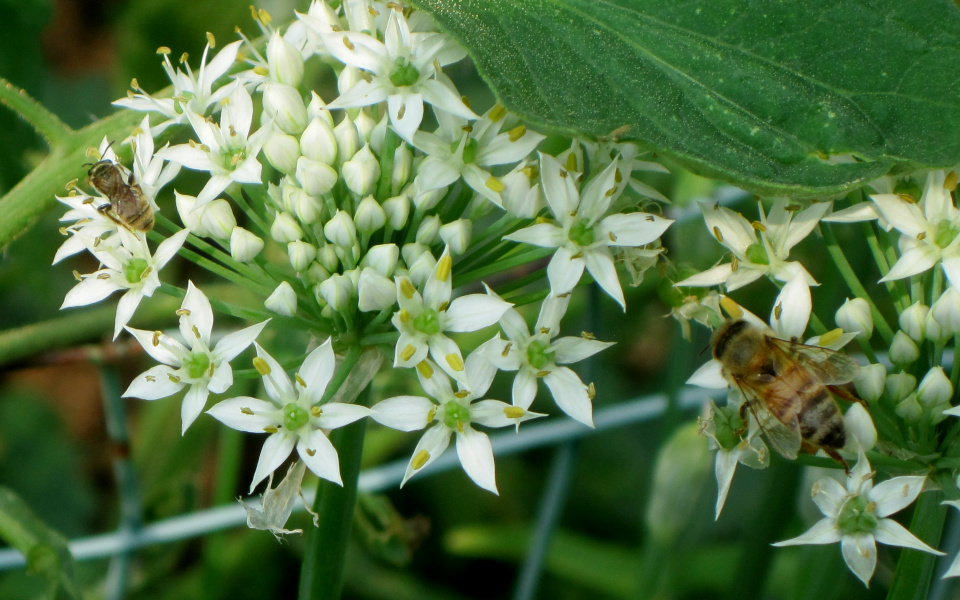
That year I saw very few honeybees, at least in the late summer when the sunflowers were blooming. But as summer cooled toward autumn, I saw a few more, not just on the sunflowers, including this one on a flower of garlic chive, near a smaller bee that I don't recognize (it is near upper left).

I participated in the project for several years, then stopped. Standing around on a hot August day is rather hard on me. But we have plenty of fare for pollinators in all seasons, as seen in the pair of pictures below:


On the left, three tiny bees (about 8mm) are picking over Sedum flowers that bloom in the spring next to our front walk. Oh the right is a flower bed with flowers for all seasons. A Hellebore is almost hidden beneath late-spring-blooming evening primroses. The Hellebore blooms from February until June. We have a few in other parts of the yard, to keep pollinators supplied while they await other kinds of flowers. In mid-June the Echinacea begin to bloom, and carry on for a month. Lavender and heather flower later, and several other flowering plants push the season almost to first snow. This garden is next to a crabapple tree, that flowers in mid-spring, and across the yard, an apple tree flowers in early spring.

One more creature we recently began to try to attract is the Monarch butterfly, with these milkweed plants. There is a schoolyard nearby that has a big patch of milkweed, but this is just the third year for us. We started with a single plant we grew from seeds we collected in the schoolyard. So far we haven't seen any butterflies, but these plants attract many more honeybees than I've seen in ten years or more. They also become infested with milkweed bugs. When they are very small, the little red nymphs must have honeydew like aphids do, because ants tend them.

Early in the book, Thor Hanson uses the term "backyard biology." Later he says it might be better to speak of "yard biology," though it is less euphonious, because nature doesn't just hide out behind our houses. It is all around us. The ten chapters (plus an Introduction and Conclusion) reveal the manifold riches of his own yard. Of course, he does live on an island in Washington state, with a yard that's bigger than average…multiple yards, from the sound of it. However, any of us, if we're willing to slow down and observe, can see a lot.

Thinking it over, we can gather quite a list of the variables that lead to quite a variety of creatures making themselves at home in any yard: variations of light and shade; warmth on cooler days and shelter on hotter days; foods that appeal to this or that sort of creature; shelter for the shy ones (such as little songbirds) and open spaces for the bold (rabbits, squirrels, and foxes; even deer when apples are falling).

I tend to favor insects because many of them ignore humans if we move gently and don't breathe on them. They're easier to photograph than birds. One acquaintance of the author uses a lighted sheet at night to attract moths, which he photographs obsessively. He has catalogued hundreds of species in his yard. One can do the same for beetles; many will also come to a lighted sheet. The beauty of a light trap is you don't have to catch and kill to identify most species (sometimes it's necessary, though).

Dr. Hanson speaks much of birds, and advises getting not just "a birdhouse" but a dozen or more, of various sizes, because there are many varieties of bird that prefer to nest in cavities. There just aren't enough abandoned woodpecker holes to go around. During my last few years at my company I was on a team that monitored birdhouses scattered around the property. All were sized for bluebirds, which also made them ideal for swallows (2 species), wrens (3 species) and chickadees. On occasion we would find a birdhouse in a more sheltered location that had been taken over by a pair of starlings, which are rather large; they had pecked the hole a lot bigger. At the end of the season we would take that birdhouse to the company shop to be fitted with a new door, this time with a metal collar in the hole! On another part of the property there were much larger boxes designed for wood ducks. My wife and I have talked it over a little. We may get (or make) a few birdhouses.

Another project recommended in the book is iNaturalist. It is a phone app, with an accompanying website, where I find it helpful when I want to edit an entry. TIP: The GPS on my phone is not as accurate as I'd like, so I go into the website later and edit the location if it is too far off. The minimum "native" accuracy of an iNaturalist geolocation is four meters. That's usually sufficient; for us Yanks, that comes to a radius of 13 feet. On the website, if you remember accurately where you were (it shows you a detailed aerial photo), you can enter a value as small as one meter.

Here I have focused on the "what we can do" suggestions. The book is also chock full of stories about various animals of all sizes found in the author's yard, or discussed by his friends and colleagues. Getting closer to what goes on outdoors is good for us. We need to slow down and, typically, just look and listen. It is good to recognize that we are part of nature.

Thursday, June 05, 2025

Artificial aliens?

 kw: book reviews, nonfiction, science, biology, physics, cosmology, genetics, first contact

To put Sara Imari Walker's last question first, will first contact with a true alien occur in a laboratory? Dr. Walker's book Life as No One Knows It: The Physics of Life's Emergence is a heady brew of ideas. She has a wonderful kind of mind that looks at things from angles others would never imagine existed, and she has managed to find a number of kindred souls with a similar talent.

Dr. Walker and her colleagues propose Assembly Theory, a new view of evolution in which technology has become an agent of evolutionary change, and "selection" takes on a meaning that would mightily bemuse Darwin. Her explanations make sense. I don't yet understand enough about assembly theory to attempt an explanation. I must content myself with a few bullet points gleaned from the third chapter ("Life is what?"; intended to be pronounced with a distinct upward lilt, as, "Life is WHAT??"). These items do not describe life, but rather objects. Objects as the new theory envisions them:

  • Objects are finite and distinguishable
  • Objects are breakable (I would have said, "can be disassembled")
  • Objects exist more than once
  • Objects are lineages
  • Objects form via selection

Some objects are living things. Some are not. A wooden table of the kind I built long ago to hold my mouse pad next to my desk is an example. I constructed it using nine pieces of wood, eight large wood screws, 24 small nails, and some glue. The top is plywood, which itself was fabricated by someone else before I bought it from a lumberyard and cut it to size. We can inventory the statements. 

  • My little mouse-pad table is finite (less than a meter tall) and is distinct from other items of furniture in this room, some purchased (and thus built by someone else) and others built here, by me.
  • It can be taken apart, by removing the fasteners and breaking the glue joints (no doubt tearing wood in the process). I don't plan to do so.
  • I have made other similar tables, which I suppose qualifies at "exists more than once." Worldwide, there are many tables of many designs, but all related in general shape and function.
  • Is it a lineage? The idea of "table", generalized from "supporting platform" is certainly a lineage, going back to the first table or table-like platform built by a human or prehuman creature.
  • "Selection" in such a case means that the I selected to make a table rather than a cantilevered shelf hung off my desk, or other possible means of supporting my mouse pad.

Consider a screwdriver. The author writes, "An evolutionary chain of objects is necessary to assemble screwdrivers into existence." In other words, the forebears of screwdrivers include machine shops, mining and metals productions facilities, and creatures like us to think them up. In the case of living things, the "lineage" of everything alive today goes back about 3.9 billion years. All known life comes from life. What came before?

This is the crux of the matter for assembly theory. The theorists use these concepts to imagine life as we don't know it, life as no one knows it.

Side question: Can objects be produced by other objects that are not living? They can, which is apparently where all nonliving and never-previously-living things arose. For example, a planet such as Earth was assembled from dust, rocks, etc., under the influence of gravity and electromagnetism and sundry other possible forces. Also, natural, nonliving actions produce raindrops and snowflakes in clouds, sand and gravel from rocks, and so forth. 

However, the production of objects by nonliving processes yields objects with very few unique parts. Living objects tend to be much more complex, as do many of their products. Thus this conjecture, stated at least a couple of times in the book, "Life is the only thing in the universe that can make objects with many unique parts." The author notes that many kinds of minerals don't form in the absence of life. I recall taking a class in minerology, in which the professor stated, "There are about 1,000 mineral species known in the earliest rocks, before there was much life on Earth. There are now more than 4,000 minerals, and most of them can only form because there is life on Earth." Today the number of catalogued minerals is almost 7,000, and that may grow to more than 10,000 as busy geologists keep finding new stuff.

This principle yields the basis of the author's "assembly index", a measure of the minimum number of steps needed to produce an object. This gets us away from looking for life that is too chemically similar to "Earthlings" (from microbes and viruses to whales and forests, with us in the mid-range). If the assembly index of numerous objects collected on an exoplanet is large enough, we could conclude that life most likely produced them. The critical number is, according to the author, fifteen.

Frankly, I don't know how assembly index is calculated. I read that the assembly index of the molecule ATP is fifteen. This molecule has 47 atoms. Perhaps the calculation allows the synthesis to begin with smaller molecules that natural processes have already produced: water, carbon dioxide, ammonia, phosphorus oxide, and perhaps even small hydrocarbons such as ethane (ethane can result from abiotic, or nonliving, processes, but in the presence of a living biosphere we never observe it).

Therefore, the number 15 seems to be a good "filter" to discern objects produced by life.

A second prong in the approach by proponents of assembly theory is the development of a "chemputer", a semi-automated way to sort of "3d print" molecules, designed to have certain properties, in an attempt to produce a chemical system that takes on the attributes of life: reproduction, ingestion of supplies, elimination of wastes, relationships (very broadly construed), for example. Were such an effort to succeed, using large numbers of chemputers to explore the "assembly space" of small-to-medium sized molecules, there might indeed be alien life produced in the laboratory. It would be as alien as anything we might find on a planet far away, perhaps even more so. 

The key to grasping assembly theory is the claim that all things life can build are historically contingent. We can see this in the visible relatedness between the wide range of animals known as "tetrapods". They all have four limbs. The mythical flying horse Pegasus cannot evolve from a horse, because to do so would require adding two new limbs (to become wings) to a body that already works well with four limbs. The intermediate steps required don't make sense (and let's ignore the physics of wings long enough to support a half-ton animal). In fact, mammalian hexapods in general aren't likely to arise, because the competition from extremely well-adapted tetrapods has already pretty much filled all available ecological niches for critters bigger than a cockroach…on land, at least.

Historical contingency is a key concept. Finger-and-toenails didn't evolve all at once. They descended from claws. Claws came from something else. All living things trace back to a single-celled creature called LUCA, the Last Universal Common Ancestor. LUCA may not be the first cell. At one time other living things could have existed alongside LUCA that may have had quite different chemistry and cellular mechanisms. But only LUCA has descendants: us, and every living thing in the biosphere of Earth.

Our chain of imagined forebears stops with LUCA. Our knowledge is further constrained, because it is extremely unlikely that any creature now living is descended without change from LUCA. When I say "extremely unlikely", that middle E needs to be drawn out, "Extreeeeeeeeeeeemely!" Meaning, utterly impossible unless the universe is truly infinite, with an infinite number, not just of planets, but of biospheres. Even if we somehow track back the chain of biochemical contingency to "show" us a robust model of LUCA, the chain stops there.

I like the idea of the chemputer. But I don't hold out much hope. The assembly space of "small molecules" is too big. For example, if we "restrict" ourselves to the twenty most common elements, all of which are found in known life, and all of which are likely to be in any possible kind of life, and further, we call a molecule "small" if it has fifty or fewer atoms (just a tad bigger than ATP), the number of possible chemical species (most of them quite chemically unstable) is close to ten-to-the-power-of-65. A 66-digit integer. How large is that number? The number of stars in the visible universe is thought to be a 22- or 23-digit number. Could the average number of planets be as great as ten? Even if that were so, the number of planets in all the galaxies in the visible universe is no larger than the largest 24-digit number. It is hard to think about 66-digit numbers in any useful way. 

Dr. Walker dreams of being the researcher in the cartoon above, "meeting" the first true alien in the laboratory. I hope her dream comes true. But I think it more likely that we'll come across something, somewhere, soon, that proves life as we don't yet know it does in fact exist.

Friday, May 09, 2025

The bear facts

 kw: book reviews, nonfiction, biology, natural history, bears

This is a very unfortunate bear. It is an Asiatic Black Bear, also called a Moon Bear. It has been in this "crush cage" its entire life, and will probably die here. A couple of times per week a long, very thick needle is thrust into its side to extract bile from its gall bladder. The bare patch on the bear's belly isn't just from gall extraction; its hair is generally falling out because of malnourishment, in spite of the fact that it is obese: "empty calories" in their grimmest manifestation.

As we learn in Eight Bears: Mythic Past and Imperiled Future by Gloria Dickie, 12,000 of these bears are "farmed" in China and much of Southeast Asia, including a few countries such as Vietnam, where the practice has been legally banned (but that's very poorly enforced). Twelve thousand is about one quarter of the entire population of these bears. The bile sells for about $1 for 1cc, which comes to 25,000 Vietnamese Dong or 4,000 Cambodian Riels. The bile is claimed to have great medicinal benefits. It actually does have certain medical uses, but there are other medicines that work better, though they may cost more.

A telling anecdote from Chapter 4, "Liquid Gold": In a hospital the author encountered a bear farmer she had met. He told her he had joint pains. She asked, "You have lots of bile!" He said, "I want something that works."

On to other bears. The smallest is the Sun Bear; adults average about 130 pounds, half the size of a Moon Bear. The largest is the Kodiak population of the Brown Bear, up to 1,000 pounds and more. The most dangerous is the Sloth Bear of India, which kills more people than all other bears combined (This is a dreadful combination of very dense population of humans and an extremely territorial bear). Next largest is a tie between the Brown Bears of the "Lower 48 states", also called the Grizzly Bear, and the Polar Bear. These two bears are also considered man-killers, but only the Polar Bear thinks of humans as prey. We are about the size of a seal, their favorite snack. The most popular bear is the Panda Bear, which tops out at around 300 pounds. These are also the rarest in the wild. The most populous bear is the American Black Bear (the only one I've seen in the wild), in the 600-pound range, but a few old males have topped 900 pounds. The number in the U.S. is nearly half a million, with half that many in Canada. Finally, the South American Spectacled Bear is rather rare (less than 18,000 remaining), and is the most cautious and shy. In her worldwide travels, with experts to guide her, she never saw one of these in the wild.

There are a few illustrations in the book, primarily chapter headings such as this one for Chapter 1. The artist, Arjun Parikh, has a unique style.

The book is a feast of information and impressions of not just the bears, but of human interactions with them in the various places they inhabit. None of them is as cuddly as our imagination dictates, though the tiny Sun Bear comes close (just watch out for 3-inch claws). 

Please consider finding, and signing, a petition to Asian governments to ban farming bears for bile.

P.S. Although I typically add Metric conversions when I use English units, there are so many this time that it would be cumbersome. I expect an educated reader to be able to divide pounds by 2.2 to get kg, and to multiply inches by 2.54 (or just 2.5) to get cm.

Monday, March 03, 2025

Grin and bear down

 kw: book reviews, nonfiction, science, teeth, odontology, paleontology, biology

It is easier to get the bite force of an alligator than a human. With a large alligator, it may be more dangerous, but the process is simple: restrain the beast, tap the tip of its nose so it will open its mouth, and stick the measuring tool in between the teeth at the back of the mouth. The measuring tool is typically a steel rod fitted with one or two force plates that can survive a few tons of force. When the gator feels the intruding rod it will bite as hard as it can, even though one or more teeth might be knocked out or broken.

Humans are more cooperative than alligators. However, a human will never bite with full force, particularly when his or her teeth meet the instrument. We have a protective reflex that snaps our jaw back open when we bite on something harder than the average bit of gristle. Very few people can bite hard enough to crack open a hazelnut, for example. We are all strong enough to do so, but the reflex prevents it. Why can an alligator (or a shark) bite hard enough to break teeth, but we cannot?

It isn't for lack of strength. As adults, if we break a tooth, it stays broken. Without the help of a dentist to fit a denture or insert an implant (both quite costly), we have lost that tooth forever. But an alligator's teeth are replaced when any break. Even more so the teeth of sharks. So it makes sense that humans have a reflex that protects our teeth, but sharks and alligator's don't need that reflex.

This is just one subject covered in a very entertaining way in Bite: An Incisive History of Teeth, from Hagfish to Humans by Bill Schutt. The first section of the book consists of eight chapters that deal with various specialized kinds of teeth. The subject of bite force is found in chapter eight, where we find that a 17-foot crocodile can exert 3,700 pounds (~1,700 kg), and that regardless which of the four kinds of crocodilians were studied, bite force was based almost totally on size (the four "crocs" are alligators, crocodiles, caimans, and gharials). For example, even though the mouth of an alligator is twice as wide as the mouth of a crocodile of equal length, the length of their jaws is very nearly the same, and the bite force is the same.

Compared to the peg-shaped teeth of these reptiles, a human molar is rather complex, as this dentist's sign shows. The strong, curved roots of the molar hold it firmly in the jaw. This is why, whenever someone needs to have a molar removed, the dentist schedules a double-length appointment, and these days takes great care to inject enough Novocain or Lidocaine, because the tooth will probably need to be broken in half to get it out, and removing each section requires a great deal of force. I've noticed that dentists tend to be built like weightlifters, and it makes sense!

Human teeth are not particularly sharp. Our pet cat's teeth are much sharper than mine. But perhaps the sharpest teeth belong to vampire bats, the subject of the first chapter. The incisors of a vampire bat are so sharp that the bat can slice off a bit of skin, really a shallow scrape, without disturbing the sleep of the victim. The typical location of the bite is a toe or ear or other easy-to-reach extremity—certainly not the neck! The shallow wound will ooze blood, which the bat laps up. Along with this understanding, we learn how the mythology of vampires and of bats had to be gradually swept aside so scientists could learn how these tiny mammals really live.

A side note on the subject of Chapter 2, the candiru fish of Brazil. Contrary to rumors, these slender catfish don't swim into you while you are peeing in the river. They are about half an inch in diameter, and won't fit. The author was able to track down just one apparently verified account of a man who had this happen, but "apparently verified" turned out to be not really verifiable.

Other kinds of specialized teeth include fangs, both the large canines of baboons and the venom-bearing fangs of certain snakes and lizards such as the Gila monster. They include tusks, which are teeth that project out of the mouth or skull. And we learn why the teeth of horses continue to grow with age: Grass is so abrasive it wears down the crowns of the teeth, so new material has to be grown continually, or no horse would live more than a few years.

Does every animal have teeth? Or at least, all the animals big enough for us to notice? Apparently the earliest vertebrates had no teeth, and no jaws. Hagfish have a weird Y-shaped sort-of-tongue with two patches of toothlike scrapers. They eat from a fallen fish or whale by gripping a bit of flesh with the Y, then tying themselves into a knot that they slip forward until they can pry against the flesh and tear out the piece, which they just swallow. Some frogs and toads are toothless, and turtles have a beak of keratin rather than teeth. Of course birds have a beak also, and the proverb "scarce as hens' teeth" is apt. Certain experiments show that the genes for making teeth are present in birds, but are inactive. The dinosaur ancestors of birds probably all, or nearly all, had teeth.

While the toothed whales—porpoises, orcas, and sperm whales—have many teeth, the other major group of whales instead have baleen or "whalebone", a filtering organ, and no teeth. The echidna, or spiny anteater, and other anteaters, have no teeth, swallowing their prey whole; their main "utensil" is the tongue.

Cephalopod mollusks (octopus, squid, cuttlefish, etc.) have beaks similar to a parrot's beak, made also of keratin. Contrary to this fanciful image of Jack Sparrow about to enter the gullet of a Kraken, or mythical giant squid, squids don't have any teeth. The beak of a giant squid is about the size of a fist; the exposed portion that actually bites is just 2-3 inches across (5-7 cm).

The last section of the book is all about human teeth, and the things people do and have done with them. You may have heard that George Washington had wooden teeth. He lost most of his teeth rather early, probably because of mercury poisoning due to medical practices of the time. His dentures contained teeth of porcelain and of human origin. When dentists of the era extracted teeth, they kept them to be fitted into dentures. Certain cultures drilled holes into the front of incisors to put jewels or other ornaments in. That's a rather painful way to show status! 

As someone who has a bunch of fillings, and now a few crowns, I know the rigors and discomfort, and sometimes the pain, of dental work. The author tells of research that may one day allow us to re-grow lost teeth. It would be a slow process, but a few months of careful chewing while the new tooth grows into place would be no worse than a few months of careful chewing while the titanium root of an implant becomes firmly incorporated into the jaw, until the titanium-and-ceramic crown can be attached. And it may cost a lot less.

Appreciate the teeth you have. Take care of them. Perhaps some folks alive today will live to see the re-growth of lost teeth. Until then, love your dentists; they really try to cause minimal pain while doing maximum good!

Friday, October 06, 2023

Babies outnumber all

 kw: book reviews, nonfiction, biology, zoology, population, embryology

I couldn't think of a better illustration of the book's theme than the cover art. It shows the larval or infant form of several dozen animals, from tadpoles to veligers to baby monkeys and birds. 

"Veligers?", you ask? A veliger (soft "g": "vell-uh-jer") is the larval form of most kinds of mollusk, like this tiny snail shown at 50x.

The book is Nursery Earth: The Wondrous Lives of Baby Animals and the Extraordinary Ways They Shape Our World, by Danna Staaf. The author's enthusiasm for these small-to-tiny-to-invisible animals will soon become your own as you read.

We seldom pay much attention to baby animals of any kinds besides kittens and puppies, because they are small and mostly unseen. However, in numbers they dominate the biosphere! Think about it: we usually relate everything to our human milieu and to the most familiar animals, which are mostly domestic. These familiar animals live a long time as adults (if not slaughtered for food), compared to their lives as infants and juveniles. 

When we think "animal", what comes to mind is mainly mammals and possibly birds…and maybe lizards and fish. Mammals and birds, in particular, care for their offspring, and we were all told in a beginning science class that "other animals" such as fish and turtles and "everything else" simply leave newborns to fend for themselves. Maybe we've seen documentaries of newly-hatched, nickel-sized sea turtles struggling down the beach to reach the water. Now, step back a moment: How many of those little sea turtles will survive to adulthood and produce more baby turtles? A few out of hundreds, or of thousands? It is easy to conclude that, by numbers, the vast majority of sea turtles alive at any one time are the babies, even as they are being gobbled up by predatory fish or dying of diseases. This is true for nearly every living animals species. Most animals alive now are babies, but most are hidden.

Even for backyard birds, the nestlings may number four or five or six, like these little robins (there are four, but one had just closed its beak) in a nest outside our kitchen window. But on average, only two grow up and have their own families, from a lifetime of nesting, not just from one nest. A pair of robins may produce five or six clutches of eggs in their lifetime; only two nestlings will survive to reproduce. Birds care for their young with great diligence, but they still need to lay many eggs to ensure a stable population. It's a similar case with most mammals. Infant and juvenile mortality is very high, so they must have many cubs or kits or joeys or puggles so that the next generation will not be less numerous than the present one. 

Now, what of fishes? There are a few notable species of fish that care for their young, but only a few. Salmon may represent the opposite end of the spectrum: they struggle upstream to their birthplace and lay millions of eggs, and then die. The fry (newborns) have been bequeathed a yolk sac, which nourishes them until they learn to catch their food. They look like fish, but not much like they will appear when grown. This is because of a theme of the book, that the environment of a newborn animal is quite different from the adults' environment, so they need a different kind of body to thrive in it. This is more evident among animals that develop through stages, with partial or full metamorphosis. The conversion of a caterpillar into a moth or butterfly, or of a grub or mealworm into a beetle, are familiar examples. Even baby grasshoppers, that have "partial metamorphosis", and thus look a lot like adults, don't grow wings until they reach full size.

Most people have seen caterpillars, or inchworms, or lawn grubs. Particularly for insects, the larval stage (or stages) of life can last much longer than the adult period. A mayfly nymph grows underwater for several months, then surfaces and metamorphoses into the adult, flying form, which lives just a few days, mates, and dies. Periodical cicada larvae live underground for 13 or 17 years. When they emerge, the adults "serenade" us (really, each other) for a month or so, and die before winter arrives. Therefore, at any one time, there are trillions of cicada babies hidden away underground, and then for a short time, this year's crop emerges to amuse and irritate us while they hurry to reproduce. Crops of other years remain hidden until their time comes.

Many details about many of these baby animals fill this very enjoyable book. The author, who has children of her own, circles back to the human condition. We don't think of mammals, or humans in particular, as experiencing metamorphosis. While a human baby doesn't pupate and melt away, to be radically reorganized to a new form, we do change a lot between birth as a seemingly helpless wiggle-wormy, squirmy baby, and the competent (we hope!!) grownup we become after 15-25 years. Baby humans are actually very well adapted to the environment into which they are born. And at birth they have already undergone the greatest period of growth of their lives: from a single cell to around 3 kg, complete with all major organs, the motivation to find a nipple and suckle at it, and a brain about 1/3 adult size; everything is primed to go through the decades-long metamorphosis we call "growing up." As adults, we may not remember that much of going through puberty. It is a huge metamorphic change in both body and mind. (For neurotics, many of the outdated defense mechanisms that plague us were formed during adolescence.)

Here's the takeaway: The vast majority, in number, of animals alive at any time are babies.

Friday, September 15, 2023

Innovation can take its sweet time

 kw: book reviews, nonfiction, biology, culture, sociology, evolution, innovation

The cover of the book really catches the eye, being decorated with lovely shells of the Cuban land snail Polymita picta. Interestingly, these snails are never mentioned in the text. These golf-ball-sized snails are considered by many to be the most beautiful snails in the world.

For your delectation, here are some more, from one lot in Berlin's Museum für Naturkunde. 

I happen to consider a different species the "most beautiful", and I'll show some examples below.

The term Sleeping Beauties is used by practitioners of scientometrics (measuring the effectiveness of scientific ideas), to describe articles or monographs that receive few or no citations by other scientists, for years or decades, until they suddenly become "popular", possibly receiving hundreds or thousands of citations in literature. A real "blockbuster" idea might then be cited, and even enter the popular press, for many years. One learns this rather late in the book Sleeping Beauties: The Mystery of Dormant Innovations in Nature and Culture by Andreas Wagner.

The thesis of the book is that innovations crop up all the time but are seldom "on time". They may need to arise a few times before factors in the environment permit them to spread. The first example in the book is grass. Grass evolved about 70 million years ago, but widespread grasslands did not appear until about 25 million years ago in South America and Asia, and 10-15 million years ago in North America. From that time, grasses radiated into thousands of species, from cm-high Alpine grasses to 20-meter-high timber bamboo. Although grasses had several innovations that made them more efficient—growth from the base rather than the tip; drought and heat resistance; SiO2 granules in the tissues—these did not favor them when Earth was mostly moist and tropical. Only in certain isolated areas did the environment favor grasses over other plants. Then the environment changed, and so did the kind of plant cover found on the major continents. The evolution of C4 photosynthesis, which makes plants that use it well adapted to CO2 levels below 1000 ppm, and a change of climate to warmer and drier across large swathes of continents, favored grasses even more over shrubs and trees. Today, even though many decry the rising CO2 level—it is more than 400 ppm now—trees and shrubs are struggling and grow more slowly than they did while dinosaurs were around, while grasses do quite well.

Similar cases are found throughout the natural world. About one-third of the book explains what has happened in evolutionary, cellular, and molecular terms. Basically, every biological entity undergoes many small DNA mutations in various cells yearly. Some are damaging and cause the cell to die. Some affect how a cell grows and it becomes cancerous, which can cause the entire animal to die a few weeks or months later. Most seem to be neutral, in that they don't change the protein a gene makes or the way a regulatory sequence works. Finally, some improve the lot of that cell; as it divides, whatever it is doing (making digestive enzymes, making muscle move, releasing a hormone) might be done a bit better so that daughter cells attain that advantage. In a multicellular animal or plant (a metazoan) a mutation must arise in a germ cell, one that will become an egg or sperm, for the trait to enter the next generation. 

The author argues that small mutations such as SNPs (Single Nucleotide Polymorphisms) occur with great frequency. Some mutations can affect larger things. A SNP in just the right place can disable a regulatory sequence, so that a key protein is no longer made. Sometimes an error in DNA copying causes a whole gene to be duplicated. Then if you have copy A and copy B of that gene, and copy B is the next one to incur a SNP or other mutation that changes its function (usually decreasing it), the organism can get along fine as long as copy A works well. Then further changes to copy B might occur until it is sufficiently modified that it might take on another function. However, let us be clear that this doesn't happen all in one organism, but over several generations. In prokaryotes (bacteria and archaea), where the entire organism is a single cell, it is easier to see how this can lead to rapid evolution. In eukaryotes (protozoa and all metazoa, including almost everything big enough to see), a mutation, beneficial or not, must pass through the bottleneck of reproduction, occurring in a germ cell, or it will not affect the next generation. I think this is not made clear enough in the text. The author deals almost exclusively with single-celled organisms.

I'll step aside from the book's content for a moment. The statistics of metazoan reproduction are such a steep hill for new mutations to climb that it would seem that their evolution must almost come to a complete halt. But there is a "third sex" that transmits genetic information horizontally between organisms, including across species boundaries: viruses, retroviruses in particular. Although some retroviruses (such as HIV) cause disease, others do not. Let's call one of these apparently harmless viruses Friendly Human Virus, or FHV. You'd never notice an infection by FHV, it is so low-level. For a period of time the infected cells would produce FHV particles, and in the process they would incorporate the FHV genome into the cell's DNA. Not all infected cells die. About 8% of human DNA consists of hundreds of "endogenous retroviruses", stored more-or-less intact in our "noncoding DNA" (it used to be called "junk DNA"). Some of the FHV particles your body sheds will include copies of some of your own DNA that the new virus particles picked up during their manufacture, which is a rather sloppy process. When someone is infected with FHV that came from you, cells in that person's body get some of your DNA incorporated into their genomes. The "Viral 8%" is part of a "library" of potentially useful genes that may get activated by other mutations later on. Contrast this 8% with the amount of your own DNA that is actually used to make proteins (2%) and regulatory sequences including ribozymes (another 2%).

There is a lot of terminology in the chapters that form the "meat" of the author's argument. It's OK, it's all well described and defined. By the middle of the book a reader can understand how certain kinds of innovation in evolutionary traits occur over and over, until other factors in the environment one change or another something favorable, something that will spread in a population.

The second half of the book discusses similar concepts as they relate to culture. Culture is not only a human thing, although until a generation or two ago, everyone thought only humans had culture. Consider certain small British birds with bills that can puncture the heavy foil lid of a milk bottle. For many years the milkman left milk bottles on people's porches once or twice weekly. At some point, a bird managed to cut its way into a milk bottle to get a beak-full of milk. Birds observe one another, and when another bird saw the feat, it tried it. Soon, the practice spread throughout the British Isles. Milk is now dispensed in a different way, which thwarts the birds. This is an example that seems to have spread rapidly, but the details are interesting. A little records-gathering has shown that the practice was confined to a small area for a few years, and then spread rapidly after that delay. I haven't learned if it happened more than once, but the author of Beauties posits that every time an innovation is researched in detail, it is found to have occurred several or many times, but only the most recent is usually remembered. He discusses the use of citrus fruits to combat scurvy: it was discovered several times during a period of two centuries before finally "taking hold" in the British Navy, to the point that British sailors are still called Limeys.

In general (but see below), the book is a great pleasure to read. There is a lot to think about, a lot to learn. Evolution has more going on than I'd have thought.

As promised, here is an example of what I consider the most beautiful species of snail, the Splendid Jewel Snail, Liguus fasciatus splendidus. The next picture has a few examples of other subspecies of jewel snails.

These are found primarily in Florida, on the trees and shrubs of "hammocks" (the local pronunciation of "hummocks", elevated, shrubby places in the Everglades).


I have a quibble. On page 181 the author discusses writing systems that were studied in detail by Mark Changizi and colleagues, including Latin, Arabic, Hebrew, Greek, Cyrillic, Chinese and Cherokee. They sorted the characters in a script according to the number of strokes. For example, "O" and "I" have one stroke (when written without serifs), while "M" and "W" have four. Analyzed this way, there are great similarities among writing systems, and he states, "Most characters can be written with three strokes, some with one or two, but none has more than four, regardless of the writing system." I think Dr. Wagner missed something. This is ridiculous if one includes the logographic scripts, primarily Chinese, Japanese and Hangul (Korean). The image at right is scanned from the spine of my Japanese wife's "big dictionary". It reads "Complete Kanji Dictionary Ocean", where "ocean" is an emphatic modifier of "complete"; the corpus deals with more than 80,000 logographs. From top down, the number of strokes are 17, 13, 13, and 10. If one wishes to separately treat the portions that don't touch, dividing a single logogram into its root and "the rest", many of those still have more than four strokes each. Hangul characters usually have fewer strokes than Chinese, but seldom fewer than 5 or 6. I dug around among other languages of Asia. A "swirly" script like Tamil may have letters with few strokes in the formal sense, but some single strokes swirl around so much they may as well be three or four, to which another stroke or two are added. I don't know how one even counts strokes in Sanskrit! And then there's classical Mayan. The characters are very complex, and quite variable depending on the writer. Dozens of strokes are typical. A key concept when looking at a Mayan stela: the carved glyphs are intended to appear a though they were written with a brush in a paper codex (of which few survive).  Probably 95% of the world's scripts follow the "4-or-less" tendency, but it is not universal.

Secondly, as to the structure of the book. The endnotes occupy 38 pages, and more than half the space is devoted to long notes that could have been incorporated into the main body of text, which is 240 pages. Such asides take off from the main text in a way that it's often necessary to go back to the original page and re-read what came before the superscript, to get the thread of the discussion. Bad practice. Dear authors, don't put "asides" in endnotes, just keep them in the main text or leave them out. If something is worth saying, that's where to say it. Reserve endnotes for citations or very (very!) brief elucidations.

Tuesday, June 27, 2023

Star stuff 'R' us

 kw: book reviews, nonfiction, science, chemistry, cosmology, biology, philosophy

Let's take powers of ten, in time, looking back to the beginning:

  • 13.8 billion years ago, everything began. Starting with the "Big Bang", or whatever it was, in some tiny fraction of a second all energy and matter appeared and sorted themselves out, becoming something like 1080 "elementary" particles; either protons, neutrons, and electrons, or electrons plus quarks. Initially something like a thousand times that many particles of both "matter" and "antimatter" formed, and some tiny imbalance resulted in all the matter presently in existence. At least the visible or potentially visible stuff. This is accompanied by a much greater number of bosons such as photons.
  • 1.38 billion years ago, we find that our Galaxy has appeared (10 billion years earlier) and then our solar system (just over 3 billion years earlier), and then once Earth settled down, life that either began as bacteria or soon became bacterial and archaean (AKA prokaryotes); and finally eukaryotic cells (larger cells with a nucleus) had arisen, such that almost anything big enough for us to see was composed of them (though they were, as we are, vastly outnumbered by the tinier prokaryotes).
  • 138 million years ago it's already getting late in the Age of Dinosaurs: the familiar Tyrannosaurs plus Triceratops, Iguanodon, and sauropods such as Argentinosaurus stalked the land, pterosaurs flew hither and yon, and the seas were filled with ammonites (like an octopus with a big, coiled shell), mosasaurs and plesiosaurs. Flowering plants had recently evolved and were spreading everywhere.
  • 13.8 million years ago it's the middle of the Miocene; mountain building is going on, and the continents have formed something similar to their modern configuration. A minor branch of mammals, the primates, has produced a few species larger than a rat, up to the size of a squirrel monkey.
  • 1.38 million years ago, it's the middle Pleistocene. The ice ages began a million years earlier, and the Gorilla-Chimp-Hominin divide occurred in the range of 6-9 million years earlier. Homo erectus appeared 2 million years ago and by 1.38 million, was speciating into a few hominid species, although Neanderthals had yet to appear.
  • 138,000 years ago, Neanderthals are all over Europe and Asia, while all archaic Homo sapiens are still in Africa.
  • 13,800 years ago: It's been about 20,000 years since Neanderthals became extinct (or assimilated with H. sapiens). It's the middle of the Late Glacial Interstadial, a warm period that lasted about 1,800 years, followed by the colder Younger Dryas era. Humans are already on every continent except Antarctica (and maybe there also at times!). 
  • 1,380 years ago: As I write this, that would be 643 AD (or CE), almost 160 years before Charlemagne unified the Holy Roman Empire. Anything resembling "science" is a millennium in the future.
  • 138 years ago, in 1843, Queen Victoria had recently begun her 63-year reign; Louis Pasteur began to teach; the first Opium War had just ended in China; the first immigrant from Japan arrived in the United States. The germ theory of disease is still 50 years in the future.

That's a good place to stop the timeline, because 13.8 years ago almost anyone who can read this was alive and can remember numerous world events. It's also a useful backdrop to the much different history developed in What's Gotten Into You: The Story of Your Body's Atoms, from the Big Bang Through Last Night's Dinner, by Dan Levitt. 

Note that there is no question mark in the title; it is not a question but a statement, an affirmation. Wind back to 13.8 billion years ago, and the first atoms were produced soon after, very soon. They are nearly all still with us. If we pull back to look at the Universe as a whole, nearly 75% by mass is hydrogen and 25% is helium. About 1% is everything else, all the other 90-odd elements that have been formed since stars began to shine. Subtract that 1%, and you have the composition of the Universe 13.7 (or maybe 13.6) billion years ago.

The core of an atom is its nucleus. For hydrogen, it's almost always a single proton. Two other forms (isotopes) of hydrogen have one and two added neutrons, respectively. Helium almost always has two protons and two neutrons; a rare isotope of helium has one neutron. Nearly all the atoms of hydrogen and helium that were produced in the extremely early universe are still in existence. About 1% of them have been compounded (fused) into other atoms, of almost 100 elements and several hundred isotopes. The book tells about the step-by-step discovery of how the stars "cooked" the other elements. Without that cooking, there would be no carbon, oxygen, nitrogen, and other elements that it takes to make Earth and the other planets, and also all living things including us. Note that the atoms in the stars, in planets, in us, probably don't have their "original" electrons. Those can move from atom to atom, and chemistry is what we call the movements of electrons.

So, what has gotten into you, and into me? Primarily water (60+% of our bodies are water), composed of hydrogen from the early universe and oxygen cooked up in a large star that later blew up as a supernova. In whatever way elements were produced in stars, the way they got back into the universe to become planets and people was by supernova explosions…well, some amount of lighter elements got out of stars in a more gentle way as they shed their outer layers in the late stages of being a red giant. But anything heavier than iron had to come from a supernova, created during the eruption, and most elements heavier than oxygen also were expelled during supernova eruptions.

Chapters in the book detail the discoveries of organic chemicals, and RNA and DNA, and other molecules of life, a story that is still unfolding. The story of all the parts that have to work together for a cell to function is one of the most complex tales there is. Every cell in your body is as complex as Chicago, but operates millions of times faster. Even bacterial cells are only "simpler" by comparison: one cell of the "simple" bacterium E. coli contains 20,000 "factories" called ribosomes, that produce proteins under the direction of bits of RNA copied from the DNA "library". And the same cell contains thousands of other active bits called organelles with sundry functions. A typical cell in our body is 15,000 times as large (in volume; 25x the diameter) as an E. coli cell, and contains dozens of organelles that the bacterium doesn't have (or need). All are made from either primordial hydrogen or from the forty or so other elements, ejected by supernovae, which were brought together on this planet to become living things. THAT is what has gotten into us.

Reading this book was joyful. I hope you read it and will agree.