Wednesday, March 29, 2023

Confront the alien within to be ready for the alien without

 kw: book reviews, nonfiction, SETI, speculative musings

Did you ever play the Birthday Game? If you have a gathering of 23 or more people, ask them, "What are the chances that at least two people here have the same birthday?" You'll get all kinds of responses, and perhaps someone who knows this already will say, "Better than half." If you're comfortable with analytical math, this website shows how the probability with 23 people is just over 50.7%. This article from Scientific American is a bit more accessible.

More generally, if you have a large number of possibilities (N) and a much larger population to sample from—for example, millions of balls numbered 1 to 10,000—, how many items must you select (S) from the large population to have a 50% or greater chance of having two of them that are the same? If you select 90 balls from the example, is there a better-than-half chance that two of them have the same number? It turns out that the crucial factor is the square root of the number of possibilities divided by about 1.2. That is:

S > (√N)/1.2

For the example, where N = 10,000, S is at least 83, and is probably 84. I said above "about 1.2" because the divisor ranges up to 1.25 as N increases into the millions or more.

This is pertinent to the question of DNA compatibility between Earth life and any life that may be found on a faraway planet, assuming that the alien life is also DNA-based. 

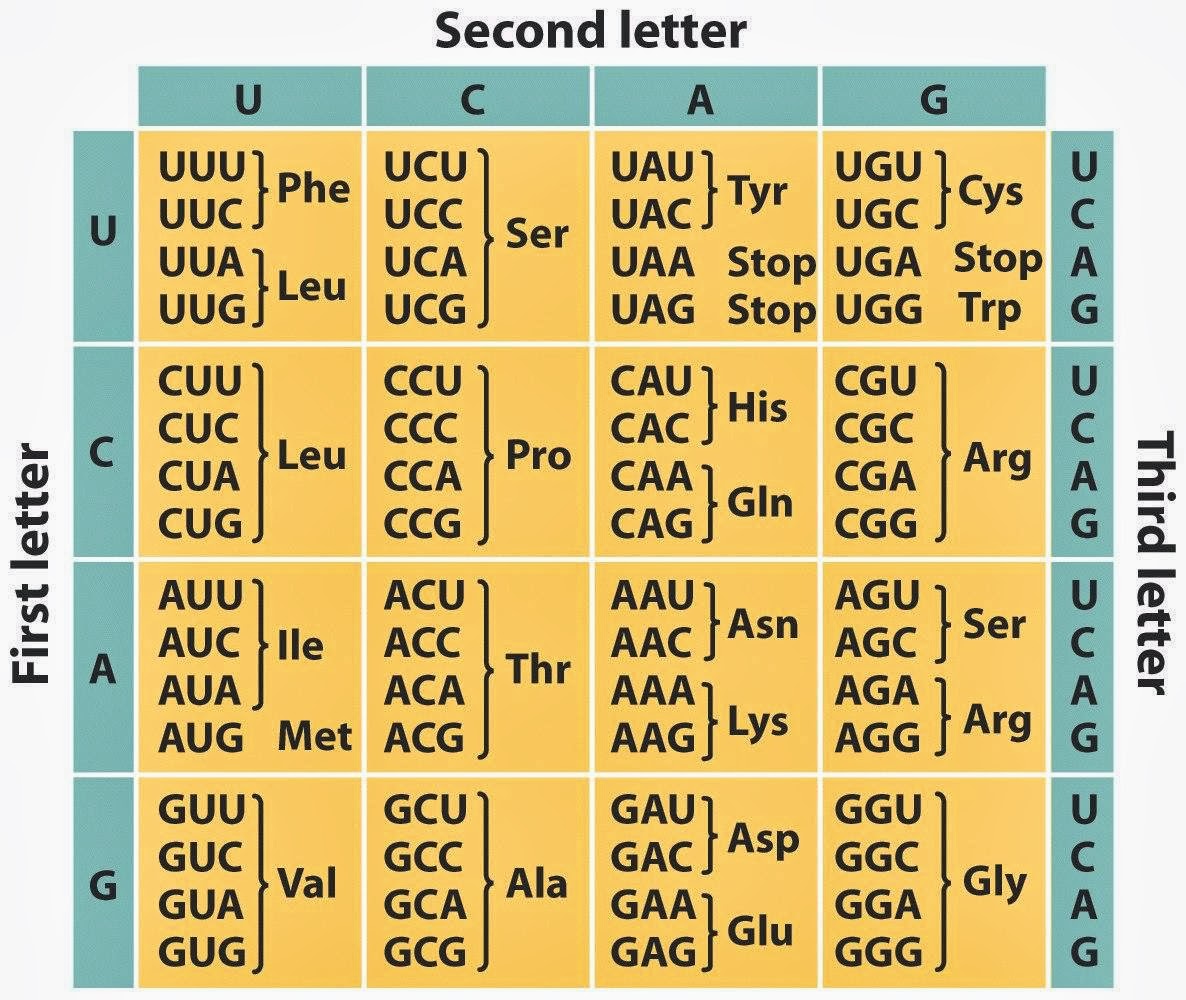
We can analyze it thus. The DNA codon-to-amino acid coding table has 64 DNA 3-letter codons that select among 20 amino acids, with three of the codons used for a Stop signal to the ribosome. Clearly, many or most of the amino acids are selected by at least two codons. The number ranges up to 6 for Leucine, an amino acid with a specific shape that is apparently "most dissimilar" to the others. Seven other amino acids are selected by 4 codons each.

Here is how the table looks, for most Earth life: 

What might it happen if it were rearranged? We must assume that the translations were arrived at by random processes via natural selection (or by careful design by God).

As it happens, this table is used by all eukaryotic life and nearly all prokaryotes…but not all. An article I read listed 16 minor variations used by certain rare bacterial species. This is evidence that various minor changes to the table don't automatically produce "incompatible" organisms; the 17 known DNA variations all exist on the same Earth. What of larger changes?

Some time ago I calculated that the number of possible rearrangements of this table, keeping the DNA codons in the order shown, but moving the amino acids about freely, is about 1070, a number with 70 or 71 digits. If we keep the codons in groups of the same size as those shown, effectively rearranging just 20 grouped items, the number of possibilities is closer to 20!, or 2.43x10¹⁸. That's 2.43 billion billion. A lot.

Now let's play the birthday game with 2.43 billion billion. Its square root is 1.56 billion; divide by 1.25 to get 1.25 billion. Simply put, we would need to collect DNA from DNA-bearing species on more than a billion planets in order to have a 50% chance that some pair of them would have compatible DNA coding tables, and we'd need to sample about 1035 species to have a 50% chance at an exact match. I wonder how many aliens (if there are any) use reproductive machinery that doesn't depend on DNA?

For those who think space aliens in UFO's (UAP's) are kidnapping people for genetic experiments, I suggest it'll be a long time before the aliens find a compatible species to ANY of those that might be "out there." Human-alien hybrids are out of the question.

The above represents my own musings, based partly on prior research, as I read The Alien Perspective: A New View of Humanity and the Cosmos, by David Whitehouse. Mr. Whitehouse doesn't get into any of the stuff above; that's all "me". What he does get into is a longish history of the precursors of SETI, of SETI itself, and of its successors that are ongoing. SETI, the Search for ExtraTerrestrial Intelligence, is (was?) a radio telescope-based search for radio signals emitted by intelligent beings in stellar systems close enough to our Solar system that we can receive the signals and recognize them. More recent programs look for laser signals and possibly gamma-ray signals.

The historical portion of the book is followed by increasingly speculative discussion of what might occur upon First Contact; it's nothing like what Carl Sagan had in mind, almost certainly. To my mind, a gigantic cover-up is most likely, and the author leans in that direction to a lesser extent. Unless, of course, First Contact is more like the early part of Independence Day, globally obvious. In that case we're toast anyway; no teen hacker would be penetrating the security protocols of an alien computer that is running an alien version of Windows 9,127 or (more likely!) Linux 7,704, with help files in an alien language. Let's remember, there are a few dozen human writing systems we have not yet deciphered. What kind of script could encode Dolphin or Elephant or Squid language? Alien will be far less "obvious".

The author seems to waver between the views that aliens will be benevolent or malignant. However, he then considers that we tend to project our own fears and hopes and dreams (and nightmares) upon our anticipation of First Contact and continuing contact. This portion of the book is of real value. It clearly indicates to me that we need to get our own mental house in order, or we'll be so unprepared for First Contact, whenever it may occur, that we'll destroy ourselves before any malignant aliens could do so, and with more finality than any benevolent aliens could restore. You got it, folks: In my view, First Contact will be a portent of Doom, no matter what "they" are like.

That said, I found it hard to read the book. Not philosophically, but because the poor writing kept distracting me. Run-on sentences abound, as do partial sentences. It's almost like the placement of punctuation was frequently chosen at random. Don't authors employ copy editors any more? Maybe that's considered too expensive, but it's a false economy. I know I'd charge a helluva lot to edit text I find so disconcerting. Call me a glutton for punishment; I read the whole book through anyway.

Thursday, March 16, 2023

How long is the Universal Keyboard?

 kw: book reviews, nonfiction, frequency, vibration

Once in a while I encounter a book with a wholly fresh idea, an unexpected view of a subject. Such a book is What the Ear Hears (and Doesn't): Inside the Extraordinary Everyday World of Frequency, by composer and musician Richard Mainwaring.

Frequency is related to everything physical. In the 1970's I worked on the campus of the California Institute of Technology (CalTech), and sometimes I would arrive early and read in the campus library. I was on the top floor, the tenth, one day, when the building began to shake. The elevator shafts began a regular Click-Click, a little longer than a second apart. Alarmed, I found a phone and called campus security. They said, "Oh, Dr. Richter is on the roof shaking the building with his earthquake machine." The machine was a strong variable-speed motor turning an off-center weight. I learned that the building is full of strain and motion sensors, and Dr. Richter (of the Richter Scale) did such experiments from time to time, to learn the resonant frequencies of the structure and how it responded to various frequencies.

Something less planned but no less alarming happened in South Korea when a tall building began to shake, rather badly. This building is much taller than the CalTech library. The "culprit" was not an earthquake, but a Tae Bo class of 23 people, stomping and taking lunges in unison, on the twelfth floor. Their workout was on the resonant frequency of the building. Mainwaring tells us that building engineers installed equipment to dampen and counter resonance in the future, making the building safe for fitness classes in the future.

For the frequency of anything to persist, it must stimulate a resonant system. For example, a tuning fork, when struck on something like the edge of your hand, oscillates at a characteristic frequency, such as the "standard A" at 440 Hz that is used to tune up an orchestra or any modern musical instrument. If you consider a tuning fork's reaction in detail, it is stimulated by the strike with a wide range of frequencies, but those that it cannot resonate with vanish quickly, leaving the frequency it is calibrated to.

In order to make all the frequencies he writes about relevant to readers of the book, the author attaches them to popular musical compositions, saying things like, "…the Techno Mart tower of Seoul gets vertically excited whenever it hears the opening G of Beethoven's Fifth Symphony (eleven octaves lower though…)". To unpack this: That "G" is 196 Hz (Hz, or Hertz, designates cycles per second, using lots fewer letters). Eleven octaves is the 11th power of two, or 2,048; 196/1,024 = 0.19 Hz, or a period of 5.2 seconds.

Early in the book the Infinite Keyboard is introduced, starting with the standard piano keyboard. A piano can play 88 notes, and at 12 notes per chromatic octave, that comes to seven-and-a-third octaves. The highest note on a piano is C8, with a frequency of 4,186 Hz, and the lowest C on the keyboard is C1, with a frequency of 32.7 Hz. These have a ratio of 128:1 because each octave, from C to C, encompasses a doubling of frequency, or a halving if counting downwards. The lower 1/3 of an octave ends on a low A (A0), with a frequency of 27.5 Hz. This is just a little above the lowest tone that most people are able to hear, 20 Hz, a "note" midway between F#0 (19.44 Hz) and G0 (20.6 Hz).

However, people in their teens and younger can hear many sounds higher than C8; the limit is about 20,000 Hz (AKA 20 kHz), which is a D# more than four octaves above C8. How long would a keyboard need to be to play that note? Each octave has a width of 165 mm (6.5 inches). That D# would then be 2.25x165 = 371 mm or about 14.6 inches further. At that point, it gets hard to reach both ends! This ignores the different widths of the white and black keys on the keyboard. The author does the math in the background so the reader doesn't have to.

Once that is set up, a survey of (almost) the entire realm of frequency begins with the author's pick for the lowest note in the universe, a slow oscillation of a galaxy-sized plasma jet with a period of 18.5 million years. He reports the frequency as 0.000000000000002 Hz. I dickered around with the figures and refined that a little: 0.0000000000000017 Hz. This is a B, 57 octaves, plus one note, below middle C. How far is that on the Infinite Keyboard? 9.4 meters, or almost 31 feet to the left. This shows the power of the logarithmic transformation between frequency and music notation.

At this point, let us touch on scientific notation. Very large and very near-zero quantities are cumbersome when written out. Thus, that low tone is better represented as 1.7E-15 Hz. "E-15" means "ten to the minus 15th power", which puts 14 zeroes in front of the "1", locating it in the 15th decimal place. More familiar numbers such as a million, or 1.0E+6 or one-billionth, or 1.0E-9, ought to make this comprehensible.

So this keyboard is getting long. It won't fit in your living room any more. Fast-forward to near the end of the book. The very low note was discovered by a space telescope called Chandra using gamma rays. These are some of the highest frequencies in the universe. X-rays and gamma rays are not usually reported in terms of frequency, but energy per photon. Photons of light have enough energy to stimulate the dyes in our cone cells, but not enough to do damage. Visible light photon energies range from 1.77 eV to 3.1 eV, while UVC, the ultraviolet rays that cause skin damage, have energies in the 4-5 eV range. The unit eV is "electron-volt"; 1 eV is the energy of an electron accelerated by a one-volt difference between two electrodes.

The X-rays that are used by your dentist or bone doctor have energies in the range 10,000 to 100,000 eV. They are called "penetrating radiation" because they'll easily go through flesh but not through bones or teeth. Gamma rays are much more energetic, in the millions to billions of eV. The most energetic gamma ray detected had an energy of 1.4 peta-eV, or 1.4 quadrillion eV. That's 1.4E+15 eV…about a million billion times as energetic as visible light. What frequency might that be? There is a proportionality constant that cranks out the frequency as 3.4E+29 Hz. On the Infinite Keyboard, that's a C# just over 90 octaves above middle C, at a distance of nearly 14.9 meters, or 48'-9". Put this together with the distance below middle C of the low-low note, and we find we need a total keyboard length of 24¼ meters, or just over 79½ feet. Hm! Eighty feet. That's all we need of an "infinite" keyboard to encompass all the frequencies ever detected.

That got me thinking: How long would the keyboard need to be to encompass all possible frequencies that "fit" in our universe? I would call it a Universal Keyboard!

  • The lowest possible note is one that began at the Big Bang and has just completed one cycle, with a period of 13.8 billion years, or 4.35E+17 seconds. It is a "note" between E and F, 66.6 octaves to the left of middle C.
  • The highest possible note is one with a period equal to the Planck time, or a frequency of 2.95E+42 Hz. It lies between C and C#, just over 133 octaves to the right of middle C.

The sum of these octave ranges is 199.7, and thus the full length of the Universal Keyboard is 32.95 meters or 108 feet. Building lots in my neighborhood are 100 feet wide. This keyboard would have to be placed on a diagonal to fit in the lot, and you'd need a big, big house with a basement rumpus room at least 75 x 80 feet in size, or more to have room to play the highest and lowest notes.

But beware: as you approach the highest notes, there is danger. Actually playing the top note would force a new Big Bang, and create a new universe. Your basement room would not survive, nor would the rest of known creation.

I've gone far beyond the author's scope. There's plenty to do with "only" 80 feet of keyboard: all of known science. I haven't touched on most things he gets into. I'll leave that up to you. I didn't recognize nearly any of the musical pieces the author uses to anchor our understanding of this note or that note, but that's OK. You might…read this book! Great fun.

Saturday, March 11, 2023

Can American Christians be aroused?

 kw: book reviews, nonfiction, persecution, christian testimony, history

Will it come to this? A law proposed in California two years go would require the persecution of Christians who own businesses if they do not promote the "rainbow agenda" of wokeness. Fortunately, it was not enacted. Don't think that Invertors* will not try again.

You, reading this, may be someone who considers "Woke" to be some cool trend, the "thing to be". The leaders and promoters of Wokeness have a very different idea: Control of the masses, for whom they have enormous contempt. Wokeness is extortion, it is evil, and it is the latest weapon of totalitarians in the United States and throughout the West, to subjugate everyone to their control.

Persecution of Christians and Jews simmered along at a low level for about a hundred years in America. It is now exploding. The arson of church buildings is one glaring symptom of this disease.

Christian writer Eric Metaxas recently published Letter to the American Church, in which he likens the modern trends to those existing in Germany in 1932, and the lassitude of American Christians and Christian leaders with the inaction of the German pastors 90 years ago. Mr. Metaxas wrote a biography of Dietrich Bonhoeffer, the prophet to German Christians, who was martyred by the Nazis. His exposition is based on what he learned while researching that book.

The author wastes no time getting to his point: "The German Church of the 1930s was silent in the face of evil; but can there be any question whether the American Church of our own time is guilty of the same silence?" I will proceed mainly by annotating certain quotes from the book.

The author writes to the "American Church." I understand what is behind the terminology, but the theology of most varieties of Christianity is flawed, so I prefer the term American Christians. Biblically speaking, there is no "American Church", nor "German Church", etc. With that in mind…

The tragedy of American Christianity is that nearly all have bought into the pernicious notion that we must not be "political." Indeed, many states have laws that deny the right of preachers to speak on political subjects or to publicly take any political stance. Many Christians piously (sniffingly) pronounce, "We just pray, we don't…" speak out, vote, or whatever. The proper term is Cowards.

We are called by God to stand for His righteousness and against evil. Evil is afoot today. Do we dare? In the Introduction, p10, we read

If anyone would feel that believing God has chosen the American Church for such a vital role somehow smacks of an egotistical nationalism, they have already bought into the Marxist and globalist lie that America is nothing special…

One may think a prophet is proud, and even say, "How do you know what God wants?" A proper prophet is humble, not arrogant, but knows for sure what God has said. Again and again in the books of prophecy in the Bible God tells a prophet, "I will make your forehead flint," to enable the prophet to withstand criticism and opposition. No proud person can withstand determined opposition, only a prophet, one submissive to God's sending, can do so. In Chapter 1, "What is the church", pp14, 18:

Where did we get the idea that we shouldn’t be at the forefront in criticizing the great evil of Communist countries like China that brutally persecute religious minorities in ways that bring to mind the Nazis themselves?

…it is an inescapable and painful fact: if the churches in America are not free to speak on any topic and in any way that they choose—and if they voluntarily go along with this view—then no one in America is truly free, and America herself has effectively ceased to exist.

Not only should we be speaking out against Chinese persecution of Christians and other religious minorities, and not only should we denounce such persecution elsewhere, such as in Burma, we must even the more denounce it in America, or we, or our children, will indeed one day be thrown to the lions. The Woke in particular are enemies of the right to speak freely. Their attitude is that only the Woke have the right to speak at all. This is the most anti-American, and Antichristian, sentiment there is.

God judges evil, and He judges those who are complicit in evil by their silence, as we read in Chapter 6, "The spiral of silence", p60:

God is no respecter of persons, and if we believe we are exempt from His judgments, we will learn the hard way that we are mistaken.

Bonhoeffer wrote, "Silence in the face of evil is itself evil. Not to speak is to speak. Not to act is to act. God will not hold us guiltless." (quoted on p58) Do you prefer to "not get involved"? To serve God is to be involved. To be uninvolved is to be not Christian. That doesn't mean we all have to volunteer at homeless shelters or preach on street corners (but doing those things more than they are now done would be a very good thing). It means that, when you encounter evil, speak up. If you see a group beating another, perhaps you are afraid to kick a few butts and break it up: Then call 911. Several times if necessary. Always mention that weapons are involved; the police will come faster. Is that a lie? A lie to save a life is no sin. The few good Germans who hid Jews in their homes in the 1930s lied to the SS. God will reward them.

Of course we know (most of us) that our good works do not earn us a place in God's kingdom. But "if we have faith that will bring us to Heaven, we will inevitably do good works." This is from Chapter 8, "The church paralyzed", p77. Jesus called His disciples to be "the light of the world." The world was very dark when I was in the Jesus Movement in the 1960's, and darker when I began to meet with a proper local church in 1972. It is much darker now.

We call our God a God of love, and He is. But there is such a thing as tough love, as we read in Chapter 10, "Speaking the truth in love", p92. Some Christians overdo things, pushing others away with their "truth", but

The opposite of this is an equal problem: to show so much "love" that you are misrepresenting the real love of God, and are forsaking God’s truth in the process.

God warned certain prophets that if they neglected to warn the wicked, who then died in their sins, the blood of the wicked ones would be counted against the prophets. Dear silent Christian, does this describe you? Whose blood is on your hands because of your silence? Do you fear to "offend" someone? The teaching of the Cross is offensive, even called a Scandal (1 Corinthians 1:23). Without it, all perish forever.

Later on p77 the author writes of two off-balance attitudes, that of the "fundamentalists" for whom "truth" is everything (even though most "fundamentalist" "truths" are incomplete or misleading!) and of "progressive" Christians who take the facts of the faith so lightly it seems they have no faith. I would add those who speak so much that "God is love" that they forget there is a Hell for those who persist to their grave in denying God.

In Leviticus 11 we read of the clean and unclean animals. Ignoring bugs and even birds for the moment, we see two characteristics of a clean mammal such as a sheep, goat or deer: It has a cloven hoof (also called a "straight foot") and it chews the cud. It must have both characteristics to be clean. The swine is pointed out as being unclean because, though it has a cloven hoof, it does not chew the cud. Camels and rabbits are pointed out for the opposite defect: they chew the cud but have paws rather than cloven hooves.

Proper Bible expositors apply these things in typology to two opposite kinds of Christian practice. We may call one Rule-Followers, and the other Experiencers. A large number of denominations are so much into rule following that they deny any value to experience. They explain away entire chapters that include the word "gift", even distorting scripture to say that such things are no longer with us. An equally large number of denominations are so into gifts and experiences that they mostly ignore righteousness and truth in any area that might require self control. God wants His people to have both a righteous walk according to the truths found in the Bible, and experiences in our human spirit that frequently refresh us with personal contact with God. Such experiences may include ecstatic prayer and "tongue speaking". That's Biblical. The sad fact is that the rule-followers are unhappy (except for a certain self-righteous glee when they see sinful others), while the experiencers are seldom righteous, falling into besetting sins that make the rule-followers gleeful with unholy Schadenfreude.

Let us go on. There is a telling simile near the end of the book, which I will pull forward for this point. The appearance of a genuine prophet among us will often cause many to "clutch their pearls and lift their skirts and express their horror at it." (p135). Prophets are rather "wild". Guess what, so was Jesus. Do you sort of skip past the portions in the Gospels that describe Jesus twisting reeds into a whip, lashing the money-changers in the Temple, and overturning their tables? Is this Jesus too wild for you? John the baptist was wild. He wore a camel-hide cloak and ate locusts and wild honey. Elijah was described as "a hairy man", and probably not only for having a big beard. Real prophets are scary. They are supposed to be. In Chapter 14, "Justifying ourselves", p121:

But the goodness of God is a wild and unpredictable goodness, infinitely far from the pious and “religious” tameness so many of us have mistaken for the real thing.

Very near the beginning of my Christian life I realized something and I began to tell others, "God doesn't want a religion, He wants a relationship." Few accepted such a word. Those that did, I later encountered among the genuine local churches I encountered in 1972. On p.124 the author quotes Bonhoeffer, that perhaps we need a "religionless Christianity". Yes, we do. This was considered heresy in the 1930s, and is still considered heresy today by many. The fact is, there is only one true religion: Judaism. The Christian church was never supposed to become a religion. The Christian faith is not a religion. Religion is practices and rules, a checklist that you can hang on your wall, but you cannot do it. A robot could do it, but you cannot. Faith is a relationship with a divine Person, Jesus Christ. Having this faith has several characteristics:

  • You get great fulfillment from reading the Bible, particularly reading aloud.
  • You love other believers.
  • You find yourself helping others you might have ignored before you knew Christ.
  • Whether prayer on any particular day is easy or difficult (it will be both!), you touch the joy of the Spirit when you pray.

There are others, but that is a good beginning. But what do we see on the "Christian landscape" that is American Christianity? Almost 10,000 denominations and other named groups; there are only about 8,000 verses in the entire New Testament! Peter preached of Jesus, "There is salvation in no other, for neither is there another name under heaven given among men in which we must be saved." (Acts 4:12) And Paul wrote, "Are you so foolish? Having begun by the Spirit, are you now being perfected by the flesh?" (Galatians 3:3). Names glorify the flesh.

Some Christians ask, "Which denomination is the right one?" The answer is, "None of them." A genuine local church is not a denomination. Terms in the New Testament such as "the church in Ephesus" are not names, but descriptions, naming the locality in which the believers live, and nothing more. 

In 1932 Bonhoeffer appealed to the 12,000 pastors of German congregations. The term "pastor" is a misnomer. The Greek word just means "shepherd" or even "caretaker", and doesn't refer to a church leader, but to any believer who is caring for another believer, leading that one to know God better. In a proper church with 100 members, there is not a "pastor" but 100 shepherds. A church does have elders (always multiple, always), and elders teach, but the commission of any teacher, according to Ephesians 4:11-12 is to perfect others, that is to teach them to teach. A younger brother asked once, "How could I become an apostle? I'd like to travel to care for the churches." I answered, "Pick out an apostle and follow him around, such as brother so-and-so," naming a very useful brother we both knew. The genuine apostles I have known were always eager to train and perfect younger ones in apostolic functions.

To whom would a modern Bonhoeffer appeal? He would appeal to all serious believers, "Drop your differences. Denominationalism is the Devil's masterpiece. Get together to denounce evil in your midst. Teach your fellow believers to recognize the totalitarian impulse in every ambitious person, and rebuke it. Drive out of your congregation anyone who insists that Woke ideology be accepted or, worse, practiced." He would further say, "Tear down the signboard that has a blasphemous name upon it. Dis-corporate the denominational corporation and re-incorporate if you must, with no distinctive, religious name. Find like-minded believers and groups of believers and fellowship with them. Ignore different practices that are not heretical or idolatrous. God hates division." Let us raise up real churches, not social groups that may or may not teach the Bible. Such churches just might have the spiritual power to drive away Wokeness. At least for a time.

In Revelation 12 we read of a universal woman who bears a male child "who is to rule the nations with a rod of iron." The great dragon waits to devour the child (so it isn't Christ, who was born in a stable). The woman is helped by God to avoid the dragon and flee "to the wilderness" on "great wings as an eagle". Many good Bible teachers in America consider that this "wilderness" is the U.S.A., or North America, which is defended by a great ocean (the wings) on either side. But there is a warning in this passage. The term "wilderness" just might be literal. Will America survive as a thriving, prosperous, free nation all the way until the Lord's return? Will it become a literal wilderness, so wild and unruly that it affords the fleeing "woman" (persecuted Christians) a place to hide?

Let us strive to fulfill in our lives what we find in Psalm 69:6,

Do not let those who wait on You be put to shame because of me,
O Lord Jehovah of hosts;
Do not let those who seek You be humiliated because of me,
O God of Israel.

On one hand, the Woke must be resisted, and in particular, poked fun at. As in Psalm 2, "He who sits in the heavens laughs." On the other, Wokeness is only the latest salvo in Satan's war on Christian faith and expression. Don't expect it to wither away so easily. When the end times are truly here, Wokeness or something like it will seem to prosper and overcome everything. Even then, let us remember what God said to Elijah when he thought he was the only righteous man left in Israel, "I have left Myself 7,000 in Israel, all the knees that have not bowed unto Baal and every mouth that has not kissed him." 

My words are few, and may have little effect. Please get this book and read it, prayerfully.

_________________________________________________

*Invertors: those who invert the truth, based on Isaiah 5:20,

Woe to those who call evil good,
And good evil;
Who put darkness for light,
And light for darkness;
Who put bitter for sweet,
And sweet for bitter!

These days, such Inversions include saying that men can give birth; or that "gender" is "assigned" at birth, when in reality, the sex of a child is OBSERVED at birth, based on physical characteristics that are determined by biology.

Tuesday, March 07, 2023

Our emotion-conveying technology

 kw: book reviews, nonfiction, writing systems, scripts, philology

The study of writing is not really the study of language; so says Silvia Ferrara in The Great Invention: A History of the World in Nine Mysterious Scripts. The book was translated from Italian by Todd Portnowitz. The author leads a collaboration, INSCRIBE, for Invention of SCRIpts and their BEginnings. They use a synergistic stockpile of methods, including deep learning, to tackle the remaining undeciphered scripts of the world.

My next-in-age brother and I, when very young, were enamored by a Table of Alphabets in the family encyclopedia. We have both retained interest in the subject, though he took it much farther than I, becoming a professional calligrapher in several script traditions including Japanese and Egyptian. As a job, that doesn't pay well, so he became a professor of art history. I went the IT direction, and retained the interest as an occasional hobby. I have always been fascinated by the multitude of non-Latin scripts. The endpapers of Gideon Bibles have John 3:16 translated into many languages, primarily in non-Latin scripts such as Sinhalese. Here is a smattering of lovely aperiodic crystals that I extracted from Google Translate:

The source statement is a bit hyped, but it refers to something in the last chapter of Greatest Invention: while lists of "great inventions" based on surveys with many people have "writing" some 30 places down the list (making the book's title rather ironic), several great inventions further up the list would not have been possible without writing. Yet the author has shown that writing really wasn't a necessity for carrying on a civil society, and several cultures came and went without having a writing system. Although it occurs to me that perhaps the lack of record-keeping doomed those that vanished. And not all "writing" can be committed to paper or papyrus (or clay tablets): the Peruvian quipu, or knotted string, recording system seems to be a full-featured "script". It's like a 3-dimensional alphabet.

In the translated texts above, only the latter 3 are alphabetic. Mandarin is not purely ideographic as is commonly thought, but is a combination of ideographs and phonic elements. Japanese and Korean are similar, but Japanese has two other writing systems that work together with the "square" Chinese-style characters called kanji ("Chinese writing"). These are hiragana and katakana, which are pure syllabaries. In a syllabary a consonant (or two) combines with a vowel, all represented by a single character (glyph). Hiragana characters are used to add inflections (Chinese has no inflections, but Japanese has plenty) and numerous words that have no kanji; katakana characters are used to phonetically spell out non-Japanese words. That makes Japanese the most complex writing system I know about.

Amharic and Gujarati are syllabaries of a style called abugida; this is explained briefly in the book. Hebrew, while it is called an alphabetic script, is semi-syllabic because although a few vowels are included as glyphs, most vowels are either understood in context or are explicitly indicated by dots and other small diacritics attached to consonants. Note that this Hebrew sample includes no diacritics.

The author's particular obsession is the undeciphered scripts. Some were clearly scripts conveying real languages. Others are more mysterious, such as the Voynich Manuscript; a part of one page is shown here. Philologists are still very divided over whether there is a language behind its unique set of characters, or if it is a hoax. The latter view is supported by the many illustrations that portray plants and animals that are not and never were.

I never figured out what the "nine mysterious scripts" are. The author discusses numerous writing systems, including many scripts that have yet to be deciphered; also many that are known, even though they are now defunct. It will be interesting to learn if the INSCRIBE project cracks any of them. Perhaps "deep learning" will help.

By the way, "deep learning" is actually "shallow but very wide learning". If the human mind is like the Mississippi River, deep and powerful, the best "deep learning" AI systems are like the Wind River of Wyoming: half a mile wide, half an inch deep, and prone to flowing uphill when the wind is right.

"Latin is a dead language,
it's plain enough to see.
First it killed the Romans,
and now it's killing me!"

Speaking of dead languages, my brother and I, ages 11 and 8, tried our hand at Babylonian cuneiform. We carved styluses from chopsticks. We used red clay from a stream and let our scribed-on tablets dry in the sun for a couple of days. Then we tried to fire them by putting them in the oven, set to broil. Apparently they weren't dry enough, because they exploded! Curious boys do curious things. Luckily, the oven wasn't damaged.

Whatever the nine scripts really are, this is definitely a book worth reading.

Wednesday, March 01, 2023

Some stories actually go somewhere

 kw: story reviews, collections, short stories, poems, sketches

The latter 3/5 of 2023 Pushcart Prize XLVII: Best of the Small Presses, edited by Bill Henderson and a ton of others, did only a little to improve my opinion of the volume. I didn't read past the first page of about a third of the 38 remaining pieces. Of those I read, there were only a few more pointless stream-of-consciousness pieces, a smattering of tolerable items, and then there was actually a poem that I liked, in spite of its being "free verse" (which means "not verse"), and three more items that made me react, "I'm glad I read that".

The first of these is "If Your Dreams Don't Scare You" by Joni Tevis, published in the Georgia Review. The theme is hazing in the context of a marching band. I was in a high school marching band for 3 years, and I'm glad there wasn't a hazing tradition at my school. The skills we had to learn, and the sarcastic comments from one of the band directors, were bad enough. About a third of the story reviews hazing mishaps around the country that made national news (or should have)…like deaths.

The second is "Half Spent" by Alice McDermott, from Sewanee Review. The story gradually reveals hidden depths in a widow who'd been thought a "silly goose" (my term, not the author's). Her passing showed she had a much greater connection to her community than her late, somewhat-lamented husband.

The third, which made me weep, is "Too Attached" by Whitney Lee, from The Threepenny Review. A doctor attends a woman with a dying pre-born baby, which finally miscarries. Later the woman tries again, and delivers safely, attended by the same doctor. The doctor muses over being too attached to this couple, that such attachments might cause her to leave the profession. This is a real risk. During her last year my mother was attended by a lovely nurse; she became so attached that, as Mom failed, the nurse had a nervous breakdown and had to turn over the caring duties to another nurse. But she managed to be there when Mom died.

The poem I liked is "Screensaver" by Robert Cording, from The Common. An elegy to a youngster who died, it proves that stream-of-consciousness has a proper use. Very touching.


That's a poor harvest of goodness from 66 pieces. The volume as a whole gets this from me:

Wednesday, February 22, 2023

Is literature becoming irrelevant?

 kw: book reviews, collections, short stories, poems, sketches

I am a little less than halfway through reading Pushcart Prize XLVII: Best of the Small Presses (2023), edited by Bill Henderson and others.

The series used a few logos in early years, and then settled on this one, presented in various background hues ranging from yellow through earth tones to red.

When I encountered the 2014 edition I liked it rather well and posted a positive review. I was still positive a couple of years later. This time, not so much (so far). Of the 28 pieces I have read (or passed over) so far, only one made me react, "I'm glad I read this": "Dear Friends" by Mary Rueful, originally published in Sewanee Review. I call it an annotated list of friends, a series of vignettes that explore numerous dimensions of friendship.

I almost rejected the entire volume based on the first half-dozen lines of text in the first piece, which I decline to name. Sadly, I read too fast to have stopped earlier, because it almost immediately takes the reader into a realm no person of conscience willingly visits, with an image that is hard to forget. It is a sad fact of the human condition that a vicious, corrupted mind such as the author's can even exist.

A goodly number of the pieces are "poems". So far, what I have seen (and skimmed through) have neither rhyme nor rhythm. They consist of slightly evocative prose broken into lines. If the language were more poetic I might call such a piece a poem, but they are junk.

Many of the pieces are aimless stream-of-consciousness bits of one or a few pages, that start and end nowhere, with nothing learned along the way.

One imaginative piece, "Mantis" by Gina Chung, tells of love almost found and then lost, in the character were a praying mantis, who is accustomed to devouring suitors during copulation. The "one that got away" is her only regret. It's a useful allegory of a certain kind of relationship…

A number of pieces portray gay men or women, closeted or out. "The Kiss" by Kate Osana Simonian treats of a relationship between two lesbians who attend a religious school; one is fully out, the other so closeted that her orientation is unknown, even to her best friend. A drama production enwraps their drama. The writing is overdone, with attempts to build tension in a Hitchcockian way that is more annoying than useful.

"Back" by Banzelman Guret is moderately dystopian science fiction, exploring an extreme development of gig work while the protagonist is dealing with his father's OCD and institutionalization.

These few out of 28? If these are "the best", literature is coming on hard times. Maybe in the next few days I'll find another story or two that make me glad I found them.

Friday, February 17, 2023

Let's learn from nature while we still have it

 kw: book reviews, nonfiction, science, technology, nature, innovation

This is a Crystal Jellyfish. Crystal jellies the original source of green fluorescent protein (GFP), which has become an important diagnostic tool.

Curiously, when Osamu Shimomura, a survivor of the atomic attack on Nagasaki, first isolated the luminescent compound in these jellyfish, it glowed a deep blue. Further work led to another compound, a protein, that fluoresced a brilliant green, stimulated by the light from the blue compound. That protein can now be synthesized (no more need to blenderize jellyfish). GFP has so many uses I can only mention a few: tagging genes to elucidate their expression or localization profiles, acting as a biosensor or cell marker, studying protein-protein interactions, and visualizing promoter activity. Dr. Shimomura received a Nobel Prize in 2008.

For microscopic viewing, versions of the protein have been developed that fluoresce in different colors. I remember the old dyes I learned to use to stain biological samples, such as eosin or carmine. Now a simpler process can be used to attach different fluorescent dyes to different tissues or organelles: when illuminated with UV, they glow in surreal colors on a black background. The WOW factor is enormous! Witness:


The eosin-stained cells are from scraping a spoon inside someone's cheek. They are the easiest animal cells to harvest without pain or bloodshed. Those on the right are somewhat smaller cells at higher magnification, from elsewhere in the body. I don't know the source (literally millions of such photos appear online, many without attribution). In the image on the right it is worth noting the targeting: GFP was attached to a molecule that homes in on the microtubules that enable cell movement; the blue version was targeted to the DNA in the nuclei; and the red version has been attached to mitochondria. In the image at left, the mitochondria are barely visible as a kind of "grit" in the cells, surrounding the nuclei, which are darkly stained.

This is just one application of a natural material to perform numerous technical tasks. Dozens of others are described in Nature's Wild Ideas: How the Natural World is Inspiring Scientific Innovation by Kristy Hamilton. The chapters number a baker's dozen, but with multiple ideas per chapter, we see an amazing plethora of nature-inspired materials and mechanisms. In her Acknowledgement the author notes that another book (or a few) could be written from other material she gathered. She had to be quite selective to produce "only" one book!

How do we organize three or four robots (perhaps a search-and-rescue team)? Central management can probably do the trick. What if the "team" numbers a thousand, or 10,000? Robot swarms. "Go to the ant, thou sluggard; consider her ways, and be wise," wrote Solomon in Proverbs 6:6. So some scientists did just that, to learn how tiny, apparently mindless creatures can self-organize in ways that would defeat a supercomputer (this from Chapter 4). What they learned is being used throughout robotics.

You can't put a band-aid on a wet finger. But mussels can glue their little byssus threads to shells and stones while under water, and corals can cement themselves to the substrate with a different underwater glue (Chapters 6&7). Their chemical tricks are being used to develop glues to hold together the edges of wounds in spite of the blood.

We can't see UV light, unless it's bright enough to do damage. Many birds can see it, at least a little. Scientists are still disputing over whether they see the UV reflected from spider webs, and so avoid flying through them. But a UV-reflective pattern on glass seems to deter most birds from flying into window panes (Chapter 12). At the natural history museum where I work part time, most of the dead birds brought in by people in the area are from window strikes.

In one evocative portion the author tells of the pervasive destruction wrought by humanity on the rest of nature. When a species becomes extinct, all the genes and traits that characterize it, the product of 4 billion years of evolution, vanish forever. No creature, it seems, is without something to give us or to teach us. Nature is an immense library of "what worked to keep us going for billennia." She quotes one medical researcher, "We are burning down the library faster than we can read it."

Read this bit of the global library, a volume that has been gleaned from a thousand thousand stories.

Wednesday, February 15, 2023

Wisdom of Deuteronomy by an heir of its promises

 kw: book reviews, commentaries, bible, deuteronomy

The third volume in the Rational Bible series by Dennis Prager is The Rational Bible: Deuteronomy: God, Blessing and Curses. This is no ordinary book, and I did not read it in an ordinary way. I took it slowly, thoughtfully, and made a number of highlighted bookmarks. I will base my (sparse) comments primarily on the highlighted texts.

Dr. Prager affirms that the Bible, in particular the Torah (the 5 books of Moses), is composed by God. In the first two volumes he delineates a number of reasons for his belief, which I summarized in my reviews posted in 2020 (in April and May). One further statement of note appears on the first page:

If Jews believed the Torah was man-made, there would be no Jews today.

For that matter, there would be no Torah either. Hebrews would not have persisted upon Earth long enough to become a kingdom under Saul or David, or to produce the Scriptures.

Deuteronomy is a series of long speeches by Moses to the new generation, mostly born in the wilderness of Sinai, on the eve of their entrance into Canaan. They had defeated the eastern Amorites, primarily the kingdoms of Sihon and Og. Except for some older ones who were born in Egypt but were taken into the wilderness during the Exodus as children, the children of Israel did not know Egypt and had not witnessed the miracles of their deliverance. Everyone under the age of forty had eaten only manna (and on one occasion, quails), and had experienced the daily miracles of maintenance, as Moses told them: "Your clothing did not wear out from upon you, nor did your sandal wear out from upon your foot." (Deut. 29:5). Now Moses, knowing that he was soon to die at the Lord's command, repeats the key elements of God's words to them.

Moses frequently exhorted them to remember, in such a way as if they had personally experienced the Exodus and the mighty acts of the Lord God. As noted on p. 87, 

WHEN NATIONS FORGET THEIR PAST, THEY CEASE TO EXIST (capitals by the author)

In his speeches, recorded Fireside Chats, and other works, Dr. Prager repeats this maxim, pointing out that during the past few decades in America certain political leaders have been laboring to erase our nation's past, and thus destroy the one country on Earth where "the experiment of Freedom" has had its greatest success.

The same political leaders wish to make Christians and Jews forget the true past of their faiths, claiming that the Jews practiced genocide and that the Crusaders followed suit. In an essay on Deuteronomy 4:19-20, Dr. Prager wrote on p. 92,

These verses are further proof that the Torah never even hints that Israelites, or the Jewish people later, have any right, let alone obligation, to make war on pagans or “infidels.”

The command to "exterminate" certain people is rare, and focused. While the Canaanite tribes were indeed to be "dispossessed", there was no command of their genocide as there had been for the Amorites. Further, 

The justification for war against the Canaanites was their evil actions, most especially their practice of child sacrifice—not their worship of false gods.

This also relates to another common theme, that in the Torah, actions are judged, not theology or thoughts or feelings.

In chapter 5 we find a repetition of the Ten Commandments. Dr. Prager has said frequently that Commandments 1 through 4 are founded on #5, "Honor your mother and father", for the Commandments related to our relationship to God is based on honoring hierarchy as set up by God; and that Commandments 6 through 9 are founded on #10, "Do not covet…", because coveting (desiring others' things or reputation so strongly as to be willing to do something about it) is the root of the evils that damage our relationships with one another. In particular, on p. 146 commenting on Commandment 10:

No advanced civilization developed that did not honor private property.

Indeed, we see before our eyes a truly incredible violation of private property, from the goods and the lands of citizens to their very right to claim citizenship as a distinction, in the "open borders" policy of those same politicians who are struggling to erase America's past and distinctiveness. 

After Moses presented the Commandments and urged the Israelites to keep them, God said (5:26), "May they always be of such mind, to revere Me and follow My commandments, that it may go well with them and their children forever." This is a surprising statement, not a "command" but a wish ("may they"), and as the author writes on p. 148,

God has dominion over the world, but He does not control whether human beings act in accordance with His will. In the words of the Talmud, "All is in the hands of Heaven except whether one fears Heaven."

This brings to mind the proverb I use in reply to fools who try to pose a paradox: "If God is all-powerful, is he able to create a rock so heavy he can't lift it?" I reply, "He has already done so, when He created humans with a free will." (Some Calvinists will cringe at this statement, but it is more true than the soulless view John Calvin espoused.)

Although Dr. Prager strongly affirms an afterlife (for example, because not all wrongs are righted in this life, and further because the righteous were taken "to their people" upon death), he also points out that the thrust of Chapter 7 is that God does reward the good, adding "and that's a good thing!". Further, he writes, on p. 181,

Doesn’t reward for good and punishment for bad mean there is justice in the world? And who doesn’t want to live in a just world? Only the unjust.

As we go on, we see a view of God higher than the common attitude that He is a "divine butler" or "sugar daddy". God has warned the rich in particular not to think their own expertise is solely responsible for success. And we read on p. 198,

…it is destructive of faith to see God primarily as a provider of things.

 But I have observed in life that many, certainly not most, extremely wealthy individuals are geniuses in one area (acquiring wealth) and foolish in others.

It is a tragedy that so many accomplished people come to believe that they are equally accomplished in many areas in which they are actually quite inexperienced, even naïve. In a prior essay (p. 197) we find a statement that seems to me better as a successor to the above,

What God does provide is moral order, ultimate meaning, wisdom, an afterlife, and an enduring source of love. And the richest person in the world needs those things as much as the poorest person does.

Chapter 11 is full of rewards promised to Israel if they will follow God and His Word. In an essay titled, "Are these rewards that God promises believable?," the author concludes,

God considers the behavior of those living in Canaan of such great importance that He may be prepared to interfere with the natural order there.

The order of the world in general is "feast/famine". Our technology may have lessened the impact of the variability of climate and seasons, but the events of the past few years have showed how incapable we are to "subdue the Earth". If, as many "climate scientists" (a designation that hardly existed before 1980 and didn't have its current meaning until early this Century) claim, we are pushing the atmosphere of Earth into an overheated regime, that hardly qualifies as "subduing the Earth". It is more like abusing it until it strikes back. If we could truly "subdue the Earth", as God commanded Adam—and it could only be carried out by co-laboring with God—the climate would be quite controllable. In Deuteronomy 11, however, we find the promise of a more equable climate, and greater general health of livestock, than the Israelites or any other people would naturally expect…at least locally.

As noted above, I have space only to touch on matters that struck me with sufficient force that I made a highlight and bookmark. So I skip over numerous matters (please get the book to read Dr. Prager's take on it all!), and we come to Chapter 17, about righteous judges. This chapter was much dwelt upon by America's founding fathers, and John Adams wrote, as quoted on p. 323,

"Without Religion this World would be Something not fit to be mentioned in polite Company, I mean Hell." and also, "Our Constitution was made only for a moral and religious People. It is wholly inadequate to the government of any other."

Look around you. Those who subscribe to what is called "Woke" fall in the category of "other", in John Adams' words, and thus shall the American people become ungovernable if we permit it to continue.

Chapter 18 introduces that Prophet, who would be the Messiah. Moses declared that this One would be "like me", that is, dealing with God face to face. No other prophet, from Samuel to John the Baptist, rose to this level. But we must not suppose that the work of a prophet is primarily to predict the future. First, a word from Dr. Prager, on p. 334,

If we could divine the future from Tarot cards, or the entrails of animals, or from consulting ghosts, it would mean the future is fixed, and humans therefore do not have free will.

A prophet does not somehow peer into the future as a deterministic calculating machine. Firstly, a prophet tells us God's opinion about what is going on, and warns us of the consequences of what we are doing or planning. The prophet's predictions are about what God will do, not about the machinery of nature. Even the great prophecy by Daniel of the 70 weeks (in the book The Coming Prince by Sir Robert Anderson, written in 1894, the 69-week period from the emperor's order to Nehemiah to rebuild the city, until Jesus was publicly proclaimed Messiah on Palm Sunday, is shown to be a fulfillment of that 483-year period, to the day) does not depend on natural events for its working out, but depends on the sovereignty of God to so order specific events to bring it about.

Then in Chapter 20 we find a rehearsal of the order to expel the Canaanites. People have a problem with this. Yet in history, expulsions of one group by another were practically routine. In recent times, the tragic irony of the Lakota Sioux calling the Black Hills of South Dakota their "Vatican" and "Historic homeland" hides the true history, that at the time Custer arrived in South Dakota in 1873, the Lakota had just finished driving other tribes, including the Crows, out of the Black Hills to Montana. So why do we think the Biblical stories are somehow different? Here is why:

The most intellectually honest way to look at our having a moral problem with orders to kill and/or expel the Canaanites is this: the reason these directives disturb us is because the Bible itself rendered them disturbing.

Without the Bible, we would have no problem with genocide.

So if God is so good, why aren't we more happy? Numerous times, God even commands us to be happy, sort of indirectly, with phrases such as "You will rejoice in the land the Lord God gives to you." This longer comment says it better than any summary I could write (we're in Chapter 26 now):

I once asked a deeply religious man if he considered himself a truly pious person. He responded that while he aspired to be one, he fell short in two areas. One of those areas, he said, was his not being a happy enough person to be considered truly pious. His point was that unhappy religious people reflect poorly on their religion and on their Creator. He was right: In fact, unhappy religious people pose a real challenge to faith. If their faith is so impressive, why aren’t these devoted adherents happy? There are only two possible reasons: Either they are not practicing their faith correctly, or they are practicing their faith correctly and the religion itself is not conducive to happiness. Most outsiders assume the latter reason. Unhappy religious people should therefore think about how important being happy is—if not for themselves, then for the sake of their religion. Unhappy, let alone angry, religious people provide more persuasive arguments for atheism and secularism than do the arguments of atheists.

I am reminded of a New Testament story, in Acts 8, of Philip and the Ethiopian officer. After their conversation, the officer's conversion, and his baptism, the officer "went his way rejoicing." Faith ought to result in rejoicing.

I had a few other bookmarks but these are sufficient for now. I cannot do justice to the wisdom of Dr. Prager's work anyway. Reading it slowly as I did, over a period of months, I learned a lot. I recommend The Rational Bible to anyone, believer or nonbeliever, and regardless of what kind of believer one may be. It is not intended to convert anyone to Judaism, but to provide reasoned understanding of the Biblical text, and hopefully trigger reasoned discourse among those who take the Bible seriously, and perhaps add to their number.

Wednesday, February 08, 2023

Dinosaurs: the known unknowns

 kw: book reviews, nonfiction, paleontology, dinosaurs

This is the femur of a Titanosaur (Patagotitan mayorum) found not too long ago in Patagonia, the "largest dinosaur ever found" (so far!). The discoverers note that this animal was not yet full grown…

A picture similar to this (but with poorer lighting) graces the color plates section of How Fast Did T. rex Run: Unsolved Questions from the Frontiers of Dinosaur Science by David Hone.

How big was the whole animal? In elephants, the tibia is about 2/3 the length of the femur, and this femur is about 8 feet long, so the tibia might be about 5 to 5.5 feet long. Put that on top of a foot the size of a love seat, perhaps 1.5 feet high, and we have a hip socket roughly 15 feet up there. David Hone's book notes that the weight of this animal was between 50 and 100 tons, putting it in the same league as blue whales.

Guess what question never gets answered? How fast Tyrannosaurus rex could run, or whether it could run at all. Of course, the length of its legs and the general physics of inverted pendulums indicates that its walking speed was 3 miles per hour when "moseying along", and in the range of 15-25 mph when walking briskly. I tend to favor a maximum of 15 mph, just from proportion. Humans mosey in the 1-1.5 mph range, with a steady pace of 3 mph when going somewhere, and "power walking" in the 4-5 mph range. It is not (yet) known whether T. rex could run at all, and if so, how fast. However, it is pretty certain that they could not jump. Elephants cannot, and probably neither can rhinos (one website I found claims that some rhinos can jump). Moving a 6-8 ton mass upward fast enough to stay aloft long enough to raise one's legs off the ground? No way.

How Fast is not about what we know, but about what we don't, with suggestions for finding out more. We'll never learn it all, but that is what science is for: expanding knowledge into an infinite realm. The 16 chapters discuss numerous kinds of knowledge we know only in part, or hardly at all. For example, what color or colors were dinosaurs? We could look at big lizards and crocodilians (especially caimans like this one).

For decades, illustrations of Mesozoic landscapes have depicted the animals as mostly "elephant colored". But in Chapter 11, "Appearance", we learn of rare finds that include melanosomes (color packets) that can still be characterized. They show that some dinosaurs were spotted or striped, and give us a hint as to colors. Many seem to have been countershaded (darker on top, lighter beneath), which makes an animal harder to spot.

The chapter following, "Reproduction", points out that we know nothing so far, except the fact that it had to have happened, or there would be no eggs, no young, no dinosaurs, period. There are some apparent mega-nests that have been found, where for several yards all around you are walking on dinosaur eggs. It's hard to imagine tyrannosaurs or brontosaurs coupling, but fertilization of eggs has to take place inside the female's reproductive tract (no milt-spraying on already-laid eggs such as we see for many fish).

I was also quite taken with this illustration of representatives of the three major clades of dinosaurs: theropods, sauropodomorphs, and ornithischians. I added the gray bars for clarity. This drawing is on p. 58 in Chapter 4, "Diversity".

A close look will reveal that the ornithischians have the greatest in-clade diversity. While theropods are mostly variations on the tyrannosaur scheme—though they include the birds—and sauropodomorphs are mostly variations on the Brontosaurus/Brachiosaurus body plan, the ornithischians include ceratopsians, ankylosaurs, stegosaurs and hadrosaurs. The ornithischians are united in having hips that resemble bird hips, while the other two clades have hips more like those of lizards. It's a quirk of evolution that certain lizard-hipped theropods evolved into birds, re-developing the bird pelvis. As usual, scientists await fossils that will show how this process came about.

We find that the number of species of Mesozoic dinosaurs is less than 2,000, while about 10,000 modern species of bird (today's dinosaurs) have been described so far. No doubt there are thousands of dinosaur species yet to be discovered. 

Reading How Did was great fun. Dr. Hone's knowledge is comprehensive, and he has been to many of the key exposures at which dinosaur fossils are found, including those in China that have yielded numerous extremely-well-preserved feathered dinosaur fossils. A full size T. rex may not have sported many feathers, but the young ones, and smaller species, certainly did. Thirty years ago we had no unambiguous fossils with clearly-preserved feathers. New finds lead to new science. That is a key message of this book.


Wednesday, January 25, 2023

Neighborhood birds – not so ordinary

 kw: book reviews, nonfiction, ornithology, birds, bird watching, photographs

This is how baby robins look the day they hatch. On most monitors this image will be just a little smaller than actual size.

We had the good fortune that a pair of robins built a nest on the kitchen window ledge. They anchored it to the thermometer support. Four blue eggs were followed by four pink nestlings, covered with sparse white fuzz. We kept the window shade down, except when taking pictures, to keep from spooking the parent birds, and later, the fledglings.

I am not much of a bird watcher, but I pay attention to them, particularly the ones in my yard and neighborhood. In Jack Gedney's book The Private Lives of Public Birds: Learning to Listen to the Birds Where We Live, the author wants, most of all, that we all pay attention. Birds are all around us.

When we step outside in the morning (or if we have an open window at sunrise), do we notice the birdsong? When we turn a corner at the end of the house and hear a flutter from a nearby bush, do we bother to look for the rapidly-exiting bird we just spooked? When a catbird is crying nearby, do we crane about, hoping to see it? Do we thrill to see a cardinal in the birdbath?

The book has the stories of 15 common birds of California, where the author lives. A few, the towhee and two species of native sparrow, were new to me. The rest were familiar. Hmm: Chapter 10, on the White-crowned sparrow and golden-crowned sparrow, is two-for-one, so that's 16 bird species.

Although I've lived in California three times, for a total of eleven years, I never learned of the California towhee. Gedney calls it "the brown bird", which reflects its principal characteristic. However, the average songbird is a "little brown thing"—think of common (English) sparrow and wrens—which makes sense. For prey birds, being inconspicuous is a life strategy. So I was probably in the presence of towhees daily and never noticed.

I love the way he writes: lyrically, without being maudlin. In Chapter 6, about the House Finch, he invites us to "reenchant our lives": "You can choose to peel away the concealing layer of quotidian gray and rediscover the brilliant core that's been present all along." From any distance farther than halfway across your yard, it's hard to tell this is a red bird. Particularly in fall and winter, its winter coat is more of a stately pink than this blazing red.

Writing of owls, he remarks on the way they add their own sounds to the night (the stereotypical "Hoo-hoo Hoooo!" is generally a great horned owl; hard to spot in spite of its size). Yet with the spread of artificial light, the monthly cycle of the moon's phases is lost on us, and the changes in owl song that were once so familiar: "[We] lose the evening, erase the quiet time between activity and sleep. Moonlit groves grow lonely in an age of off-and-on." He turns to a poet, Pablo Neruda, to limn the Anna's hummingbird: "You are / a seed in the sun / a fire / dressed in feathers." Although mourning doves have the fastest level flight of any bird, Anna's hummingbirds fly faster relative to their size than any other bird. Put another way, the hummingbird is a bit slower than the dove, but is 1/3rd the length and 1/30th the weight.

I suspect if almost anyone put their mind to it, they could recall at least a dozen birds with which they are at least a little familiar.

I live some 10 km west of the Delaware River, near the PA-DE state line. This is the northern end of the Mid-Atlantic region. The ranges of many populations of northeastern and mid-southern birds overlap, so folks that keep life lists have a rich harvest without going far.

The larger birds we see are typically turkey vultures, such as these two (photographed by my wife), after chopping up some small carcass in our yard, peering in the neighbor's window. I've seen bald eagles in nearby areas, but never from our neighborhood. Even from far away, it's easy to distinguish eagle from vulture. The eagle's wings are held flat and its flight is very steady. The vulture's wings are held in a shallow "V", and it tends to teeter in flight, catching every tiny shift in the updrafts that keep it aloft. The turkey vulture, if close enough, sports long, white triangles on the rear of its wings. Half the tail is also white.

We also have black vultures, with black skin on the head rather than red. Turkey vultures have the best sense of smell of any bird, and black vultures keep an eye on them because they can smell what no vulture can see.

Slightly smaller raptors in the area include this Cooper's hawk, that was sitting our our fence, and both red-tailed hawks and red-shouldered hawks. Cooper's hawks are bird hawks, but one day a friend and I were in the driveway talking, and heard a thump. We turned just in time to see the Cooper's hawk flying off with a squirrel. That's a lot of load for this hawk, for they are smaller than red-tailed hawks.

Middle sized birds are dominated by robins. In certain seasons, it's interesting to see a nearby schoolyard hosting 20 or more feeding robins, which keep 10-20 feet apart, while not far away, a flock of 100 blackbirds, with much closer spacing, could fit in the area of a garage. We also have cardinals—this picture is of two cardinal eggs in a nest in our privet hedge. There are also catbirds, starlings, mourning doves, tree swallows, blue jays, and occasional goldfinches.

Smaller birds include several "little brown things": English sparrows, Carolina wrens, and another wren species I haven't identified. We also have chickadees. Neighbors have reported seeing bluebirds, but I haven't.

That's nineteen. Not much of a life list compared to many folks I know. But for me, it's enough. I can't identify them all by sound, but with observation that ought to improve. I hope Mr. Gedney would approve.

Monday, January 16, 2023

The irresistible impulse to predict

 kw: book reviews, nonfiction, speculation, prediction, futurism

The second chapter of The Skeptics' Guide to the Future: What Yesterday's Science and Science Fiction Tell Us About the World of Tomorrow, by Dr. Steven Novella and his brothers Bob Novella and Jay Novella, begins with a quote by the sage of the ball park, Yogi Berra: "The future ain't what it used to be."

I can think of three facts about the 1969 landing on the Moon by astronauts of Apollo 11, that were not anticipated by science fiction writers, nor by futurists in general:

  1. Between 10% and 30% of Americans believe it was all a hoax.
  2. The sponsor was not a corporation nor a "rich industrialist" but the Federal government.
  3. The world watched Neil Armstrong climb down the ladder on color TV.

It took only 50 years for a few "rich industrialists" to gather both the financial muscle and the personal will to start spaceship companies, and at present there are three! In the golden age of space fiction, mainly pre-1960, nobody dreamed the combined Mercury-Gemini-Apollo programs would cost about a trillion dollars (in current dollars).

What did science fiction get right? Arthur Clarke foretold telecommunications via synchronous satellites in 1945, 12 years before Sputnik 1 surprised the world. On the dystopian side, George Orwell wrote in 1948 of a pervasive surveillance state (he was mixing Stalin with his expectation of immense progress in video technology); now it is upon us. More prosaically, in 1911 Hugo Gernsback wrote of video chatting; of course the inimitable Hugo made dozens of predictions in everything he wrote, so getting it right once in a while is simple statistics in this case.

What approach do the Novella brothers take? I'd call Skeptics' Guide a catalog of futurist ideas sorted by plausibility. I am amused by the title of Chapter 3, "The Science of Futurism." To me, that's an oxymoron. Science is about what we know, or think we know. Stuff that hasn't happened cannot be a scientific subject. To me, futurist speculation is fun, and when folks in a position to know more than most of us about technological and sociological trends speculate that one or another trend "has legs" and is likely to affect all of us, it's worth taking note. Some decent fraction of the time, the speculation turns into fact.

The authors sagely note that it's hard to distinguish robust trends from fads. I look back at a number of things I once thought were "neaty-keen!", that have vanished from the scene, with decidedly mixed feelings. I tried out a Segway at a science park once. I like them. The business model was fatally flawed, though, and my insurance company would probably have charged me more than the cost of the machine...per year. So as much as I hope for the rapid development and spread of self-driving autos, I suspect I won't live to see them "take over" (but I'll get one of they do!).

Or maybe I'll live long enough for many more trends to play out. The next-to-last chapter deals with indefinite life extension. Scale that back to "let's make it possible for most people to live 100-120 years in good health", and I have a decent chance to use or own (if we still own cars in 2040) a self-driving car, and to have not a robot butler but instead several (affordable!) robotic appliances, such as one that can make a decent omelet. Maybe I'll live to see actual, true, artificial general intelligence (AGI). My goal post for AGI is that a mechanism, entirely without "handlers and minders", does research, produces something new, and obtains a patent. A secondary goal post: one that can carry on a discussion on numerous subjects, and hold its own at a meeting of an intelligent, well-read Book of the Month Club.

Of course, artificial narrow intelligence (ANI) is beginning to do some very interesting things. One is the language understanding behind "art generators" such as Dall-E and "text generators" such as ChatGPT, and the object recognition behind image sharpeners such as Sharpen AI. Would life in a settlement on Mars such as the one shown here appeal to you? I prompted Dall-E to create this image. It's a portion of a larger image I "created" with "outpainting". ANI is beginning to push our culture in new directions.

After the introductory part of the book, each of the four sections deals with matters that are less and less likely. The last section discusses the impossible, at least until new laws of physics are discovered: time travel, transporters, and faster-than-light travel for example. My, how prone we are to wrestle against the constraints of the universe!

The point is often made that fiction writers and futurist writers cannot escape putting today's people into their future scenarios. A small number of people are fanatical about "living forever", but do they have a way to predict the social disruption that would result, if even 0.1% of humans became effectively immortal? The authors discuss both positive and negative views of this, and are careful not to draw conclusions. It would be a Black Swan moment for the human race. While I'd like to "not die", I am not willing for evil people to live long enough to get really, really evil. Imagine if Stalin or Mao Zedong were still alive...

As good as the writing is, the book is rather insipid. The authors didn't want to be sensationalists. They succeeded at that.

Yogi Berra also said, "It's tough to make predictions, especially about the future."

Friday, January 13, 2023

Backyard gravitational energy storage

 kw: analytical projects, energy, energy storage, batteries, gravitational energy storage

The Federal subsidy for installing solar panels on houses' roofs continues. I can't take advantage of it because the huge trees in my back yard shade too much of the roof too much of the time. I was told there is an extra subsidy to pay for removing big trees. Hmm, I wonder what the carbon "pollution" balance is between removing several 150-foot trees and using solar power…produced with panels that were manufactured using large amounts of fossil fuel-powered equipment. Is anybody producing solar panels using only solar power?

Anyway, at my latitude, I must use air conditioning about one-third of the year. On the warmest days, the A/C runs periodically all night long, particularly when the overnight low temperature is in the 80's (°F of course; that's about 30°C). It's no longer possible in most states to have the solar panels "run the meter backward" during the day, to build up an energy credit with the utility. Thus, I would have to purchase electricity to run my A/C, and the rest of the house, at night.

I'd like to store energy during the day to use at night. The Tesla Powerwall is one expensive option, and it is probably insufficient. Let's do some figuration.

My electricity bill shows monthly usage between 500 and 1,100 kwh/month. The smaller amount is characteristic of spring and autumn. My A/C unit is a heat pump, so my highest usage is actually in slightly warmer winters, when the heat pump usually runs rather than the backup oil furnace. Let's take 600 kwh/month as the top end of A/C-heat pump usage. That's about 20 kwh/day on the "worst" days, from an energy consumption perspective. Not every day is the same, so there are probably peak days with usage in the 30-40 kwh range. In the summer, more cooling is needed during the day; in winter, more heating is needed at night. Considering that these are very approximate figures, I can begin with the likelihood that an energy storage solution in the range of 20 kwh is appropriate.

First possible option: Tesla Powerwall 2. At a web page for This Old House, I find that the Powerwall 2 has a current (early 2023) price of $11,500 for one battery with a capacity of 13.5 kwh, and $18,500 for a unit with two batteries (27 kwh total). The warranty life is 10 years, with a guarantee of 70% remaining capacity at the end of 10 years. That brings the effective storage of an older unit as low as 9.45 kwh or 18.9 kwh. My benchmark figure of 20 kwh thus requires a two-battery system, with replacement needed 9-10 years down the road. Also, such a unit weighs about 500 pounds (230 kg).

If you're enough of a maker (we used to say "handyman"), what about buying a bunch of car batteries and wiring them together with a charger and a large inverter for converting the DC output to AC at 110 volts (or 220V, for your A/C)? Lead-acid batteries have an energy density of about 40 watt-hours per pound (wh/lb) or 88 (or 90) wh/kg. To achieve 20 kwh we need 500 pounds of car batteries. Hmm, that's about the same as the Tesla unit. Of course, adding the charger and inverter will probably add 100 lbs, and the supporting structure would be another hundred or so. A typical car battery costs $200 or more and weighs 45 pounds; we need 11 of these, perhaps 12 for good measure (even numbers are better for balancing charging and discharge circuits). Not knowing what large, fast chargers cost, nor large inverters, this is still looking pretty good at a battery cost of about $2,400.

That sets some sidebars on direct electricity storage. But I've been wondering about gravitational energy storage. This picture shows one company's proposal for using concrete cylinders and a six-arm crane that uses wind turbine-generated electricity to raise the cylinders, and generates electricity when they are lowered during periods of less wind. They claim overall efficiency of 90%.

The concept is by Energy Vault. The tower is 33 storeys tall (about 100 meters). However, I couldn't make much sense of the numbers in the report, which describes 5,000 concrete blocks with a total weight of 35 tons. That doesn't add up; it works out to 14 pounds per block. I suspect the actual weight of each block is 1,400 lb (640 kg). Such a cylinder would have a volume of a little less than a third of a cubic meter (or about 1/3 of a cubic yard), which is almost twice the volume of an oil drum. From the picture, that looks about right.

What kind of weight would I need to make a backyard gravitational power "tower"? In most neighborhoods, one cannot construct anything taller than a 2-story house; perhaps 30 feet (9 m) at the very most. More figuration is needed, to convert weight and distance to watt-hours.

  • One horsepower is 33,000 ft-lbs per minute, or 550 ft-lbs per second
  • One kilowatt = 1.36 HP = 738 ft-lbs/s
  • 1 kwh = 738×3,600 = 2,692,800 ft-lbs = 372,400 kg-m
  • 20 kwh comes to 7,448 Tonne-m (nearly 7½ million kg-m)
  • Divide by 9: About 830 Tonnes (910 tons) raised to a 9 m height

Ok, just to run my overnight energy storage, I need to be able to raise and lower upwards of 900 one-ton blocks, using motors that can function as generators with a 4000-watt capacity. Standard concrete weighs 2,400 kg (2.4 Tonnes) per cubic meter, or 4,000 lbs (2 tons) per cubic yard. 830/2.4 = 346 cubic meters of concrete, a mass 18 by 19 meters, one meter thick (English units: 455 cubic yards, about 64 by 64 feet, and 3 feet thick).

My back yard is rather small, only 30 feet deep, though it's 90 feet wide. I do have a side yard that's plenty large enough. I wonder what my neighbors would think if I built a structure as tall as my house, with a footprint of more than 4,000 sq ft. And the big electric motors/generators would most likely whine when in use. I'd probably have to remove some soil and seat it 2-3 feet below grade (with drainage infrastructure for rainy weather) to keep the total height below 30 feet.

Maybe I can use iron (I can't afford 900 tons of lead!). Iron's density is 7,874 kg/cubic meter, or 3.28 times that of concrete. This would shrink the volume needed to 105.5 cubic meters or 138 cubic yards. Reducing the vertical depth to 2 feet means the footprint would be no longer 4,000 sq ft but 1,860 sq ft, or about 43 feet square. My 2,000 square-foot house is two storeys, so it's size is only 25 by 40 feet.

The picture is a bit ridiculous. The primary virtue of such a system is that its energy capacity doesn't reduce over time the way the Powerwall will. But it illustrates the amazing energy density of batteries, even lead-acid car batteries, compared to big blocks of iron or concrete and big motors to lift and lower them.

This is a fun mental exercise. It convinces me to wait for better batteries to be developed. Systems based on something besides lithium, for sure! Sodium-sulfur can have 2-4 times the energy density of lithium-ion, and sodium-ion is in the two-times range. Recent research has produced prototypes that don't have to be kept at 300°C (570°F) to operate efficiently. I can wait.